
Overview of Histoplasmosis
B. Keith English, M.D.
Chair, Department of Pediatrics
and Human Development
Nothing to Disclose
Thank You!
 Many thanks to my long-time colleague Dr.
Sandy Arnold, Chief of Pediatric Infectious
Diseases at Le Bonheur Children’s Hospital and
the University of Tennessee Health Science
Center in Memphis for sharing her slides with me
(I have modified them for this presentation)
Diagnosing Pulmonary
Histoplasmosis in Children
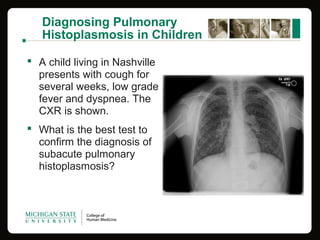
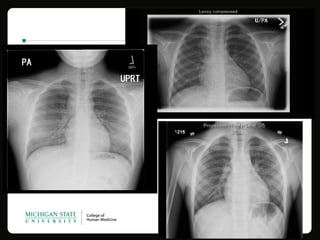
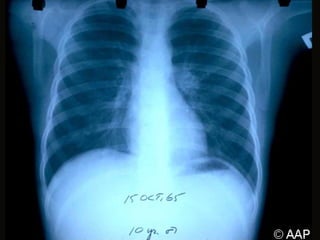
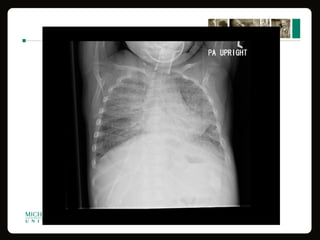
 A child living in Nashville
presents with cough for
several weeks, low grade
fever and dyspnea. The
CXR is shown.
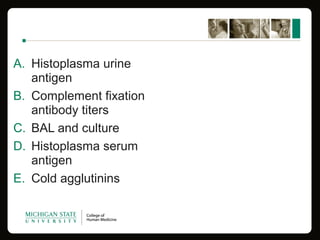
 What is the best test to
confirm the diagnosis of
subacute pulmonary
histoplasmosis?
A. Histoplasma urine
antigen
B. Complement fixation
antibody titers
C. BAL and culture
D. Histoplasma serum
antigen
E. Cold agglutinins
Treating Mediastinal
Histoplasmosis?
 A 6 year old boy in Memphis is discovered
to have a large right paratracheal mass
deviating the trachea on a CXR done during
influenza A infection. He became
asymptomatic after the flu resolved.
 What is the best treatment for this patient?
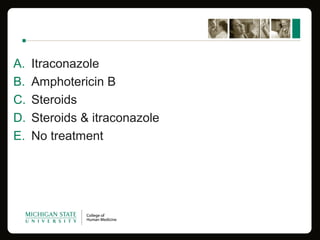
A. Itraconazole
B. Amphotericin B
C. Steroids
D. Steroids & itraconazole
E. No treatment
Dimorphic Fungi 101
 Thermally dimorphic fungi
 Yeast form at body temperature i.e. isolated from tissues
 Mold at lower temps – found in the environment
– Endemic mycoses – geographically distinct and thermally
dimorphic
 Histoplasmosis
 Blastomycosis
 Coccidioidomycosis
 Exist in nature as spore forming molds
 Inhaled spores are infectious
 Not contagious from person to person
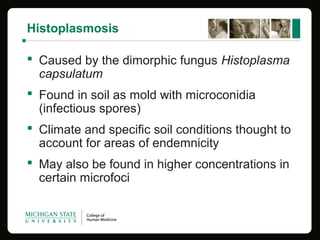
Histoplasmosis
 Caused by the dimorphic fungus Histoplasma
capsulatum
 Found in soil as mold with microconidia
(infectious spores)
 Climate and specific soil conditions thought to
account for areas of endemnicity
 May also be found in higher concentrations in
certain microfoci
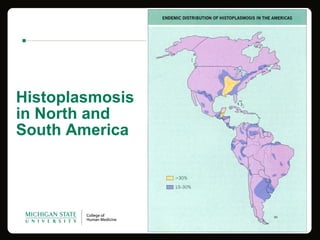
Histoplasmosis
in North and
South America
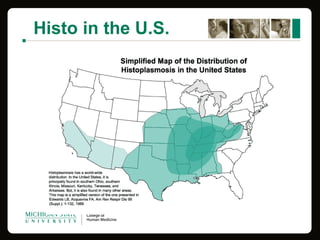
Histo in the U.S.
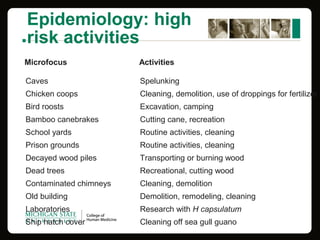
Epidemiology: high
risk activities
          Caves           Spelunking
          Chicken coops           Cleaning, demolition, use of droppings for fertilizer
          Bird roosts           Excavation, camping
          Bamboo canebrakes           Cutting cane, recreation
          School yards           Routine activities, cleaning
          Prison grounds           Routine activities, cleaning
          Decayed wood piles           Transporting or burning wood
          Dead trees           Recreational, cutting wood
          Contaminated chimneys           Cleaning, demolition
          Old building           Demolition, remodeling, cleaning
          Laboratories           Research with H capsulatum
          Ship hatch cover           Cleaning off sea gull guano
Microfocus Activities
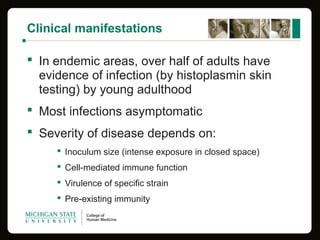
Clinical manifestations
 In endemic areas, over half of adults have 
evidence of infection (by histoplasmin skin 
testing) by young adulthood
 Most infections asymptomatic
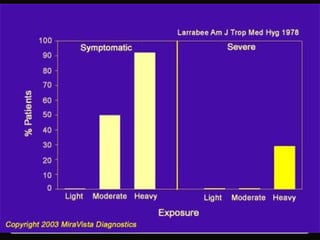
 Severity of disease depends on:
 Inoculum size (intense exposure in closed space)
 Cell-mediated immune function
 Virulence of specific strain
 Pre-existing immunity 
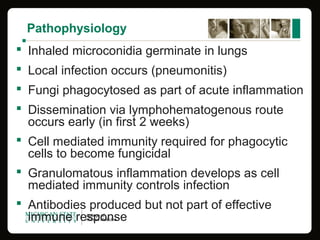
Pathophysiology
 Inhaled microconidia germinate in lungs
 Local infection occurs (pneumonitis)
 Fungi phagocytosed as part of acute inflammation
 Dissemination via lymphohematogenous route 
occurs early (in first 2 weeks)
 Cell mediated immunity required for phagocytic 
cells to become fungicidal
 Granulomatous inflammation develops as cell 
mediated immunity controls infection
 Antibodies produced but not part of effective 
immune response
Pathophysiology
 Re-infection can occur but usually mild due to 
pre-existing cell-mediated immunity
 Most likely to occur in setting of high inoculum 
exposure
 Reactivation/reinfection may also occur in the 
setting of immunosuppression (HIV, organ 
transplant)
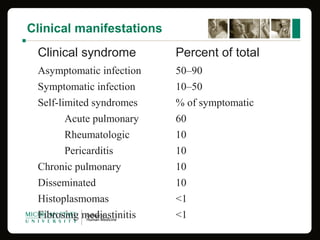
Clinical manifestations
Clinical syndrome Percent of total
Asymptomatic infection 50–90
Symptomatic infection 10–50
Self-limited syndromes % of symptomatic
Acute pulmonary 60
Rheumatologic 10
Pericarditis 10
Chronic pulmonary 10
Disseminated 10
Histoplasmomas <1
Fibrosing mediastinitis <1
Case
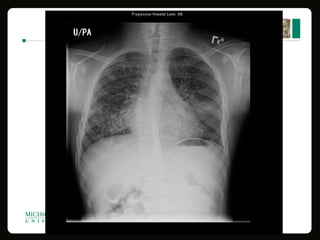
 A 15 year old boy presents with diffuse 
pneumonitis (CXR on next slide). In the ER he is 
profoundly hypoxic and is intubated for 
respiratory failure. His father is at the adult ER 
for similar symptoms. You suspect 
histoplasmosis because the mother tells you 
they were hiking and exploring caves a few 
weeks ago. 
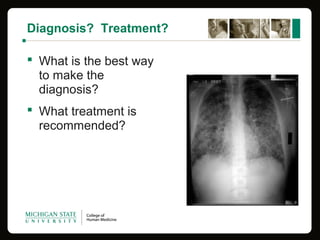
Diagnosis? Treatment?
 What is the best way 
to make the 
diagnosis?
 What treatment is 
recommended?
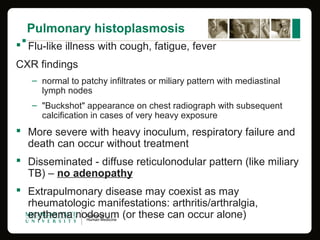
Pulmonary histoplasmosis
 Flu-like illness with cough, fatigue, fever
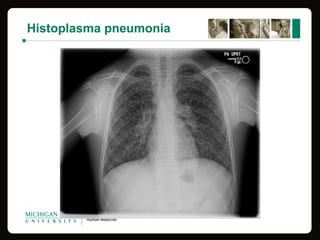
CXR findings
– normal to patchy infiltrates or miliary pattern with mediastinal 
lymph nodes
– "Buckshot" appearance on chest radiograph with subsequent 
calcification in cases of very heavy exposure
 More severe with heavy inoculum, respiratory failure and 
death can occur without treatment
 Disseminated - diffuse reticulonodular pattern (like miliary 
TB) – no adenopathy
 Extrapulmonary disease may coexist as may 
rheumatologic manifestations: arthritis/arthralgia, 
erythema nodosum (or these can occur alone)
Histoplasma pneumonia
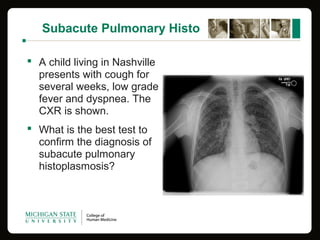
Subacute Pulmonary Histo
 A child living in Nashville
presents with cough for
several weeks, low grade
fever and dyspnea. The
CXR is shown.
 What is the best test to
confirm the diagnosis of
subacute pulmonary
histoplasmosis?
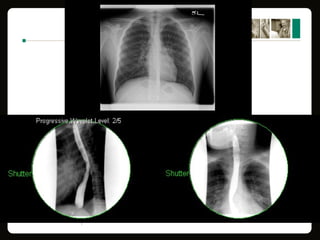
Mediastinal granuloma
 A 6 year old boy in Memphis is discovered
to have a large right paratracheal mass
deviating the trachea on a CXR done during
influenza A infection. He became
asymptomatic after the flu resolved.
 What is the best treatment for this patient?
Mediastinal histoplasmosis
 Exuberant granulomatous response may result in
compression of mediastinal structures by lymph
nodes
 Tracheobronchi, esophagus, pulmonary
vessels, SVC
 May have associated granulomatous* lesions in
lungs, liver, spleen
*Acute histoplasmosis may heal with calcification of granulomata
Mediastinal histoplasmosis
 Masses may persist for years but do
eventually resolve; may wax and wane over
time
 Symptoms may develop months or years after
infection
 Generally treatment for the histoplasmosis is
not needed unless there are prolonged
symptoms (and even then if of uncertain
value)
Post-obstructive pneumonia
 Masses have very few organisms so response
to antifungal therapy unlikely
 Steroids may help – data are limited
 For post-obstructive pneumonia, treat for
community-acquired pneumonia, not
Histoplasma pneumonia
Treatment of mediastinal granuloma?
A. Itraconazole
B. Amphotericin B
C. Steroids
D. Steroids & itraconazole
E.No treatment
histo
Clinical Infectious Diseases
Disseminated histoplasmosis
 Occurs in patients with depressed CMI
 Risk correlates with CD4 count in HIV in
endemic areas (was once leading “AIDS-
defining illness” in certain parts of U.S.)
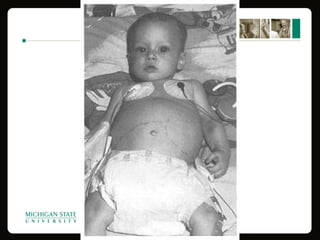
 Also occurs in infants under one year of age
with diffuse reticuloendothelial involvement -
may cause pneumonitis, hepatosplenomegaly,
bone marrow suppression; may be fulminant,
fatal
Clinical Infectious Diseases
Laboratory diagnosis
Culture/Histopathology
 Lung biopsy or BAL specimen will be positive
in acute pulmonary with high inoculum or
disseminated, not mild acute pulmonary
 Use lysis centrifugation (Isolator) for blood
culture in disseminated disease
 May take 4 to 6 weeks to grow
 Tissue specimens can be stained for fungus
with silver stain or GMS, peripheral blood with
Wright’s stain
Laboratory diagnosis
Antigen detection
 Detected in urine, serum, CSF, BAL fluid
 Most likely to be positive in disseminated
disease (90% positive) or severe acute
pulmonary (75% positive)
 Urine > sensitive than serum
 May cross react with blastomyces,
paracoccidiodes
Laboratory diagnosis
Serologic testing
 For yeast and mycelial antigens
 Complement Fixation more sensitive [>1:8 in 90%
of acute pulmonary cases; immunodiffusion more
specific [76% M band +, 23% H band +]
 Develop 2 to 6 weeks after infection
 May be elevated from past or asymptomatic
infection
 Low titer or false negative if immunocompromised
Clinical Infectious Diseases
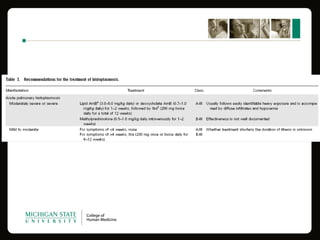
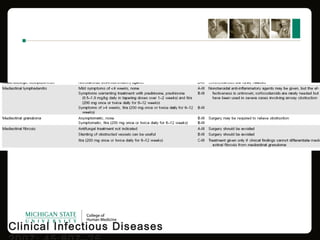
Treatment of Histoplasmosis
in Children
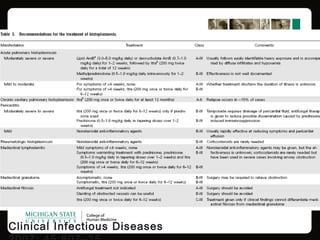
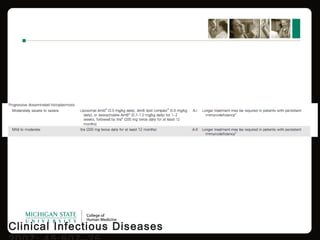
 Antifungal therapy (itraconazole, Ampho B)
strongly recommended for severe pulmonary
disease, disseminated disease, CNS disease
 IDSA guidelines recommend antifungal therapy
(with steroids) for severe pericarditis, prolonged
or severe symptoms associated with mediastinal
granuloma, etc – but evidence supporting this
recommendation weak to non-existent
 Anecdotal evidence of dramatic response to
steroids in patients with bronchial/tracheal
obstruction, etc, but weak overall evidence
Overview of Histoplasmosis

Overview of Histoplasmosis

Editor's Notes

  • #15 Outrbreak of histoplasmosis in Panama in 47 men exposed to Histo in an old bunker inhabited by bats; likelihood and severity of Sx correlated with degree of exposrue (incubation 4-30 days)