Fetal Presentation 
The term "fetal presentation" refers to the 
part of your baby's body that is closest to 
the birth canal. 
By: Sharmaine Fuentes,RN
Methods for Assessing Fetal Position 
vaginal exams, 
Ultrasound, 
feeling the abdomen, 
and listening to the baby's heartbeat with a Doppler device.
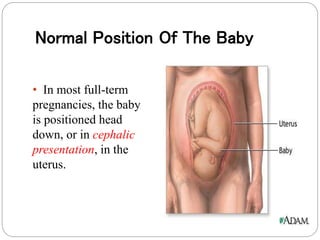
Normal Position Of The Baby 
• In most full-term 
pregnancies, the baby 
is positioned head 
down, or in cephalic 
presentation, in the 
uterus.
Types of 
Cephalic Presentation
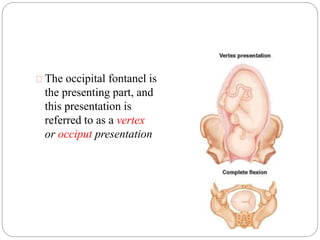
The occipital fontanel is 
the presenting part, and 
this presentation is 
referred to as a vertex 
or occiput presentation
Types of Vertex Presentation 
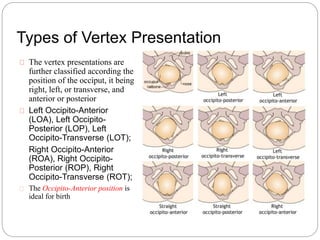
The vertex presentations are 
further classified according the 
position of the occiput, it being 
right, left, or transverse, and 
anterior or posterior 
Left Occipito-Anterior 
(LOA), Left Occipito- 
Posterior (LOP), Left 
Occipito-Transverse (LOT); 
Right Occipito-Anterior 
(ROA), Right Occipito- 
Posterior (ROP), Right 
Occipito-Transverse (ROT); 
The Occipito-Anterior position is 
ideal for birth
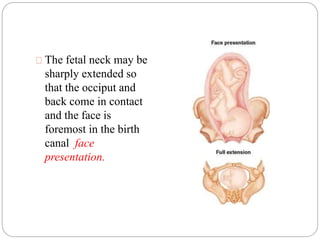
The fetal neck may be 
sharply extended so 
that the occiput and 
back come in contact 
and the face is 
foremost in the birth 
canal face 
presentation.
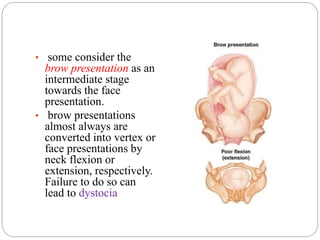
• some consider the 
brow presentation as an 
intermediate stage 
towards the face 
presentation. 
• brow presentations 
almost always are 
converted into vertex or 
face presentations by 
neck flexion or 
extension, respectively. 
Failure to do so can 
lead to dystocia
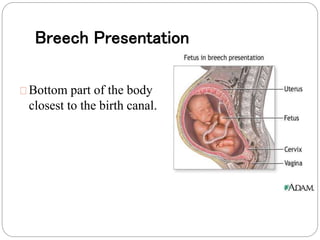
Breech Presentation 
Bottom part of the body 
closest to the birth canal.
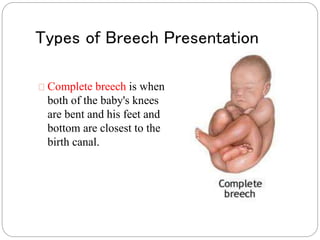
Types of Breech Presentation 
Complete breech is when 
both of the baby's knees 
are bent and his feet and 
bottom are closest to the 
birth canal.
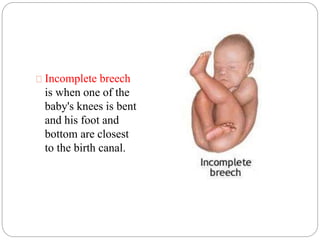
Incomplete breech 
is when one of the 
baby's knees is bent 
and his foot and 
bottom are closest 
to the birth canal.
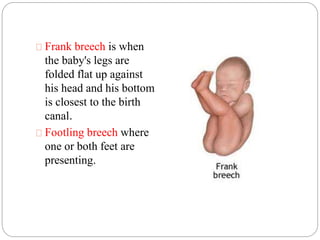
Frank breech is when 
the baby's legs are 
folded flat up against 
his head and his bottom 
is closest to the birth 
canal. 
Footling breech where 
one or both feet are 
presenting.
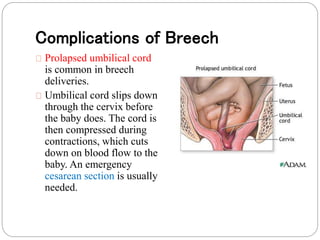
Complications of Breech 
Prolapsed umbilical cord 
is common in breech 
deliveries. 
Umbilical cord slips down 
through the cervix before 
the baby does. The cord is 
then compressed during 
contractions, which cuts 
down on blood flow to the 
baby. An emergency 
cesarean section is usually 
needed.
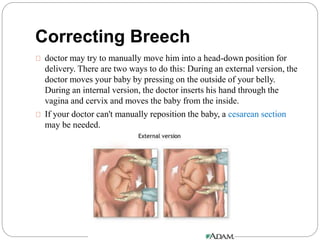
Correcting Breech 
doctor may try to manually move him into a head-down position for 
delivery. There are two ways to do this: During an external version, the 
doctor moves your baby by pressing on the outside of your belly. 
During an internal version, the doctor inserts his hand through the 
vagina and cervix and moves the baby from the inside. 
If your doctor can't manually reposition the baby, a cesarean section 
may be needed.
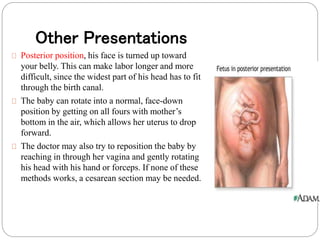
Other Presentations 
Posterior position, his face is turned up toward 
your belly. This can make labor longer and more 
difficult, since the widest part of his head has to fit 
through the birth canal. 
The baby can rotate into a normal, face-down 
position by getting on all fours with mother’s 
bottom in the air, which allows her uterus to drop 
forward. 
The doctor may also try to reposition the baby by 
reaching in through her vagina and gently rotating 
his head with his hand or forceps. If none of these 
methods works, a cesarean section may be needed.
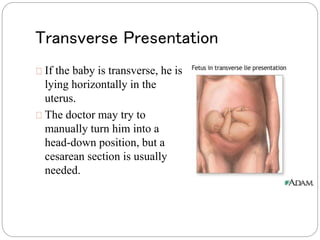
Transverse Presentation 
If the baby is transverse, he is 
lying horizontally in the 
uterus. 
The doctor may try to 
manually turn him into a 
head-down position, but a 
cesarean section is usually 
needed.
Prepared by: 
Sharmaine Fuentes, RN 
Davao City , Philippines, 8002 
fuentesharm888@gmail.com

Fetal Presentation

  • 1.
    Fetal Presentation Theterm "fetal presentation" refers to the part of your baby's body that is closest to the birth canal. By: Sharmaine Fuentes,RN
  • 2.
    Methods for AssessingFetal Position vaginal exams, Ultrasound, feeling the abdomen, and listening to the baby's heartbeat with a Doppler device.
  • 3.
    Normal Position OfThe Baby • In most full-term pregnancies, the baby is positioned head down, or in cephalic presentation, in the uterus.
  • 4.
    Types of CephalicPresentation
  • 5.
    The occipital fontanelis the presenting part, and this presentation is referred to as a vertex or occiput presentation
  • 6.
    Types of VertexPresentation The vertex presentations are further classified according the position of the occiput, it being right, left, or transverse, and anterior or posterior Left Occipito-Anterior (LOA), Left Occipito- Posterior (LOP), Left Occipito-Transverse (LOT); Right Occipito-Anterior (ROA), Right Occipito- Posterior (ROP), Right Occipito-Transverse (ROT); The Occipito-Anterior position is ideal for birth
  • 7.
    The fetal neckmay be sharply extended so that the occiput and back come in contact and the face is foremost in the birth canal face presentation.
  • 8.
    • some considerthe brow presentation as an intermediate stage towards the face presentation. • brow presentations almost always are converted into vertex or face presentations by neck flexion or extension, respectively. Failure to do so can lead to dystocia
  • 9.
    Breech Presentation Bottompart of the body closest to the birth canal.
  • 10.
    Types of BreechPresentation Complete breech is when both of the baby's knees are bent and his feet and bottom are closest to the birth canal.
  • 11.
    Incomplete breech iswhen one of the baby's knees is bent and his foot and bottom are closest to the birth canal.
  • 12.
    Frank breech iswhen the baby's legs are folded flat up against his head and his bottom is closest to the birth canal. Footling breech where one or both feet are presenting.
  • 13.
    Complications of Breech Prolapsed umbilical cord is common in breech deliveries. Umbilical cord slips down through the cervix before the baby does. The cord is then compressed during contractions, which cuts down on blood flow to the baby. An emergency cesarean section is usually needed.
  • 14.
    Correcting Breech doctormay try to manually move him into a head-down position for delivery. There are two ways to do this: During an external version, the doctor moves your baby by pressing on the outside of your belly. During an internal version, the doctor inserts his hand through the vagina and cervix and moves the baby from the inside. If your doctor can't manually reposition the baby, a cesarean section may be needed.
  • 15.
    Other Presentations Posteriorposition, his face is turned up toward your belly. This can make labor longer and more difficult, since the widest part of his head has to fit through the birth canal. The baby can rotate into a normal, face-down position by getting on all fours with mother’s bottom in the air, which allows her uterus to drop forward. The doctor may also try to reposition the baby by reaching in through her vagina and gently rotating his head with his hand or forceps. If none of these methods works, a cesarean section may be needed.
  • 16.
    Transverse Presentation Ifthe baby is transverse, he is lying horizontally in the uterus. The doctor may try to manually turn him into a head-down position, but a cesarean section is usually needed.
  • 17.
    Prepared by: SharmaineFuentes, RN Davao City , Philippines, 8002 fuentesharm888@gmail.com