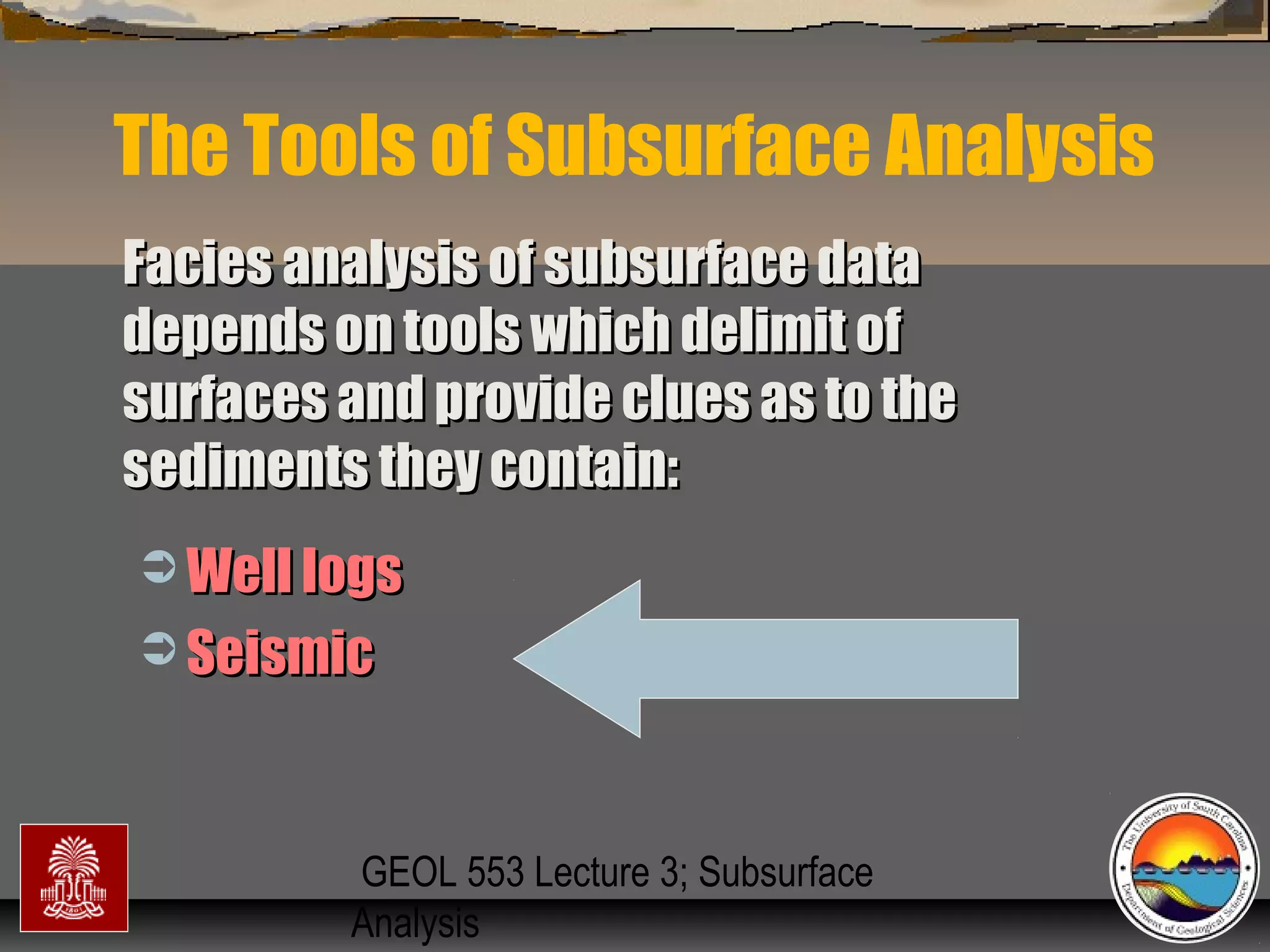
GEOL 553 Lecture 3; Subsurface
Analysis
GEOL 553:GEOL 553: Marine SedimentsMarine Sediments
University of South CarolinaUniversity of South Carolina
Fall 2005Fall 2005
Professor Chris KendallProfessor Chris Kendall
EWS 304EWS 304
kendall@sc.edukendall@sc.edu
777.2410777.2410
The Tools of Subsurface AnalysiThe Tools of Subsurface Analysi
GEOL 553 Lecture 3; Subsurface
Analysis
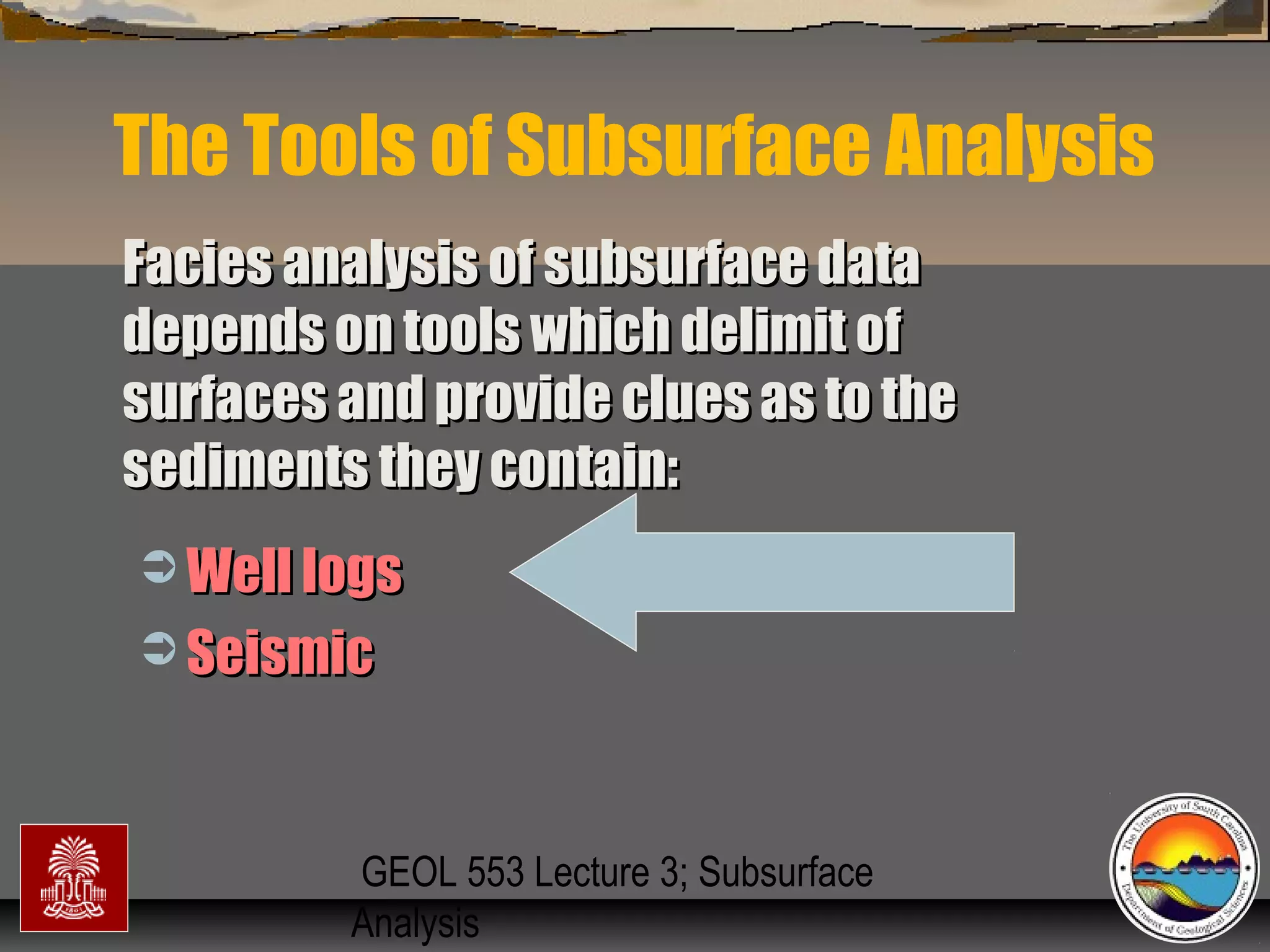
The Tools of Subsurface AnalysisThe Tools of Subsurface Analysis
 Well logsWell logs
 CoresCores
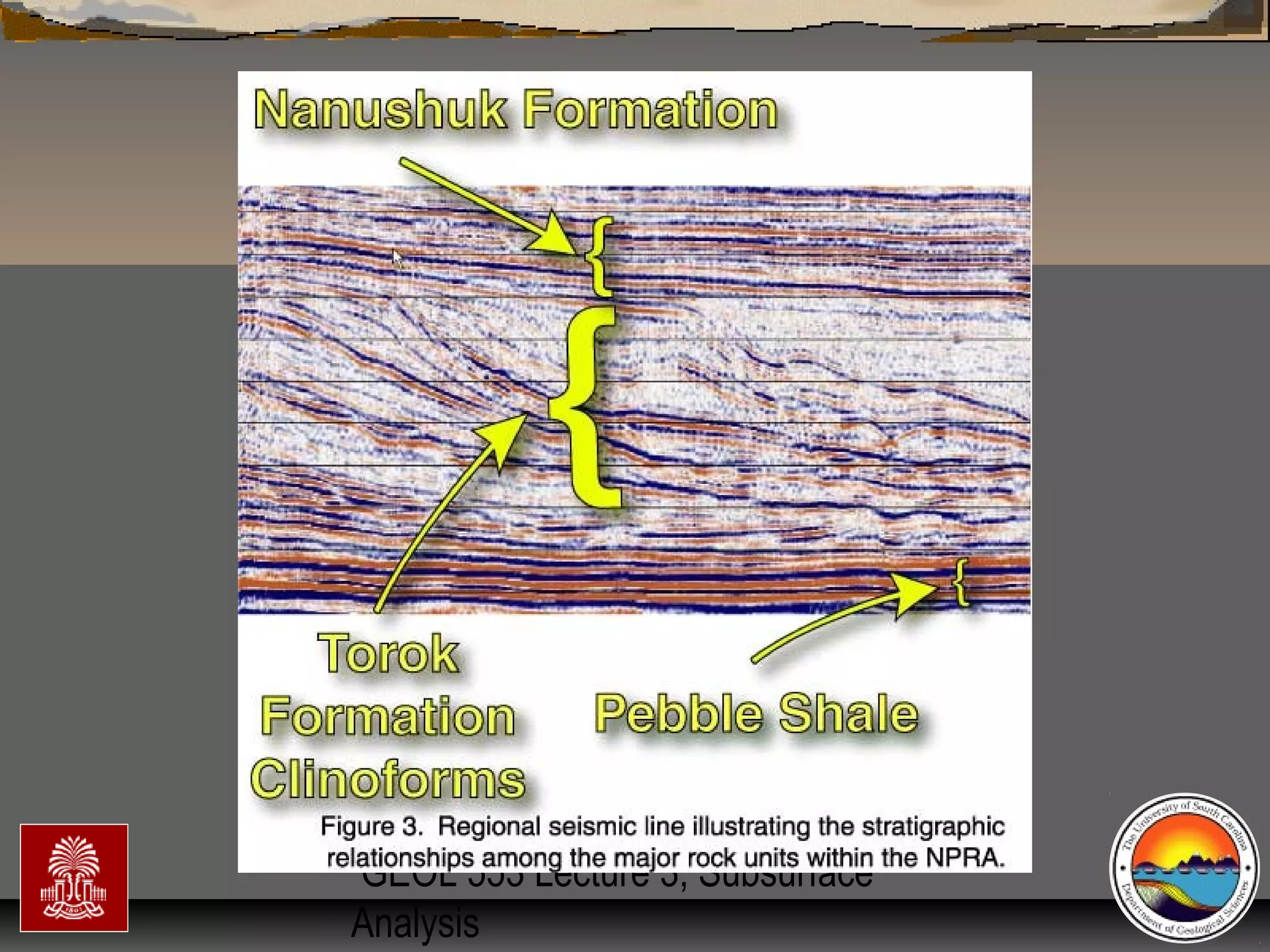
 SeismicSeismic
 Gravity & magneticsGravity & magnetics
Facies analysis of subsurface dataFacies analysis of subsurface data
depends on tools which delimit ofdepends on tools which delimit of
surfaces and provide clues as to thesurfaces and provide clues as to the
sediments they contain:sediments they contain:
GEOL 553 Lecture 3; Subsurface
Analysis
Well Logs Versus SeismicWell Logs Versus Seismic
 Well logsWell logs
Great vertical resolutionGreat vertical resolution
Delimit bounding surfacesDelimit bounding surfaces
Establish lithology of sediments penetratedEstablish lithology of sediments penetrated
 SeismicSeismic
Great lateral continuity and resolutionGreat lateral continuity and resolution
Define gross sediment geometryDefine gross sediment geometry
GEOL 553 Lecture 3; Subsurface
Analysis
Tools are Keys to Allostratigraphy
& Sequence Stratigraphy
 AllostratigraphyAllostratigraphy : bounding: bounding
discontinuities including erosiondiscontinuities including erosion
surfaces, marine flooding surfaces,surfaces, marine flooding surfaces,
tuffs, tempestite, and/or turbiditetuffs, tempestite, and/or turbidite
boundaries etc. as time markersboundaries etc. as time markers
 Sequence StratigraphySequence Stratigraphy : higher level: higher level
allostratigraphic model which interpretsallostratigraphic model which interprets
depositional origin of sedimentarydepositional origin of sedimentary
strata as products of "relative sea levelstrata as products of "relative sea level
changechange""
GEOL 553 Lecture 3; Subsurface
Analysis
The Tools of Subsurface Analysis
 Well logsWell logs
 SeismicSeismic
Facies analysis of subsurface dataFacies analysis of subsurface data
depends on tools which delimit ofdepends on tools which delimit of
surfaces and provide clues as to thesurfaces and provide clues as to the
sediments they contain:sediments they contain:
GEOL 553 Lecture 3; Subsurface
Analysis
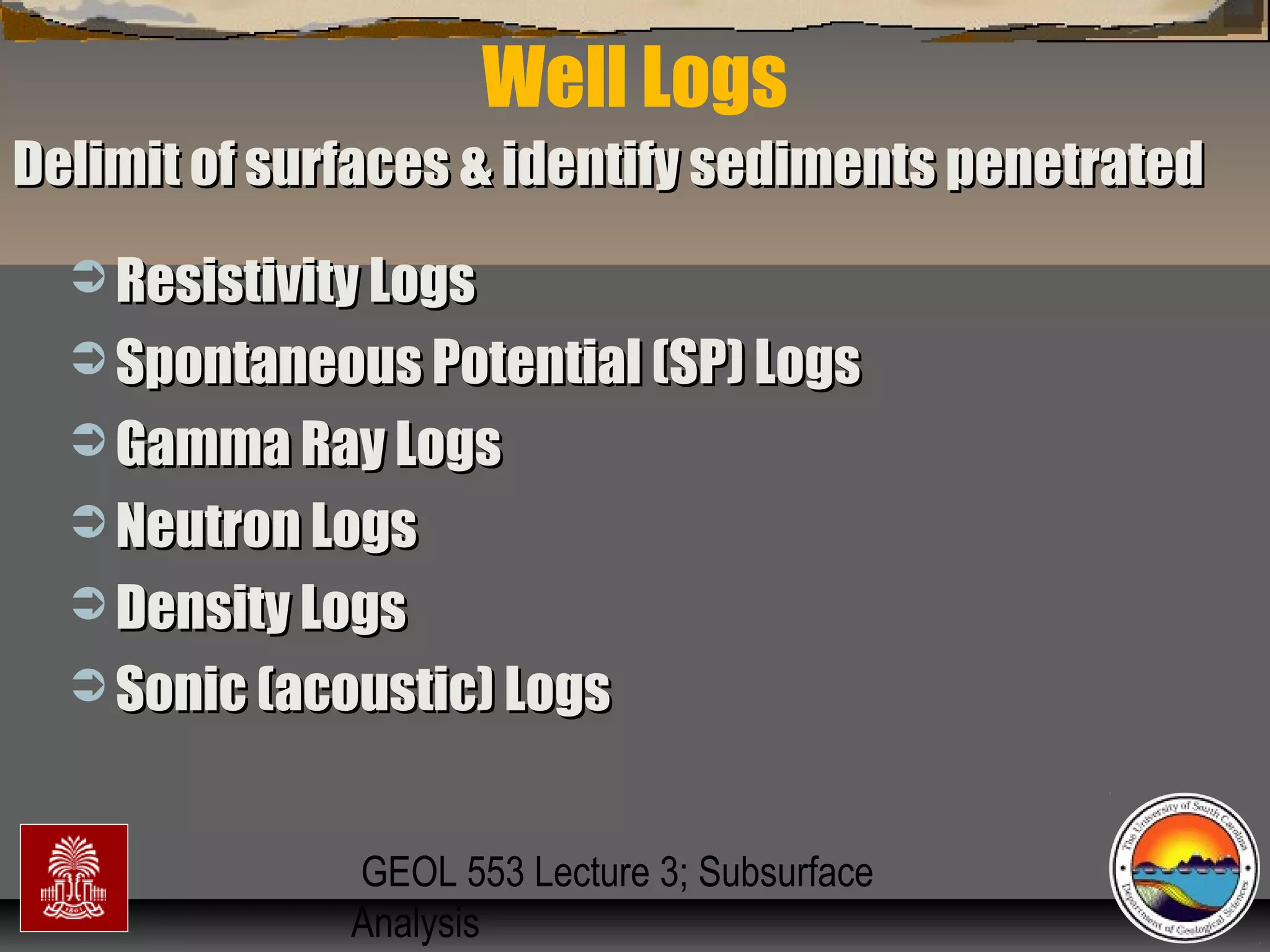
Well Logs
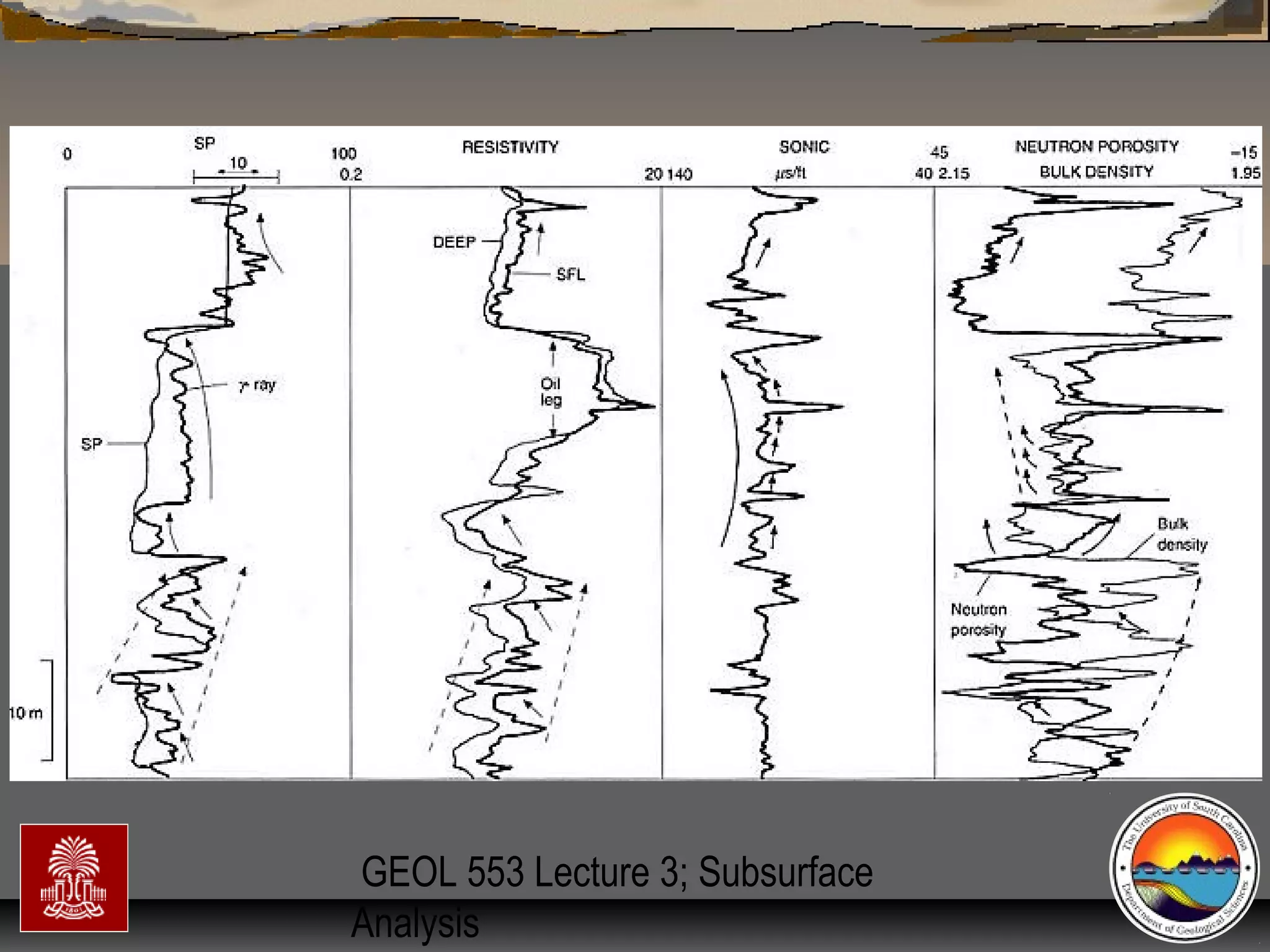
 Resistivity LogsResistivity Logs
 Spontaneous Potential (SP) LogsSpontaneous Potential (SP) Logs
 Gamma Ray LogsGamma Ray Logs
 Neutron LogsNeutron Logs
 Density LogsDensity Logs
 Sonic (acoustic) LogsSonic (acoustic) Logs
Delimit of surfaces & identify sediments penetratedDelimit of surfaces & identify sediments penetrated
GEOL 553 Lecture 3; Subsurface
Analysis
GEOL 553 Lecture 3; Subsurface
Analysis
GEOL 553 Lecture 3; Subsurface
Analysis
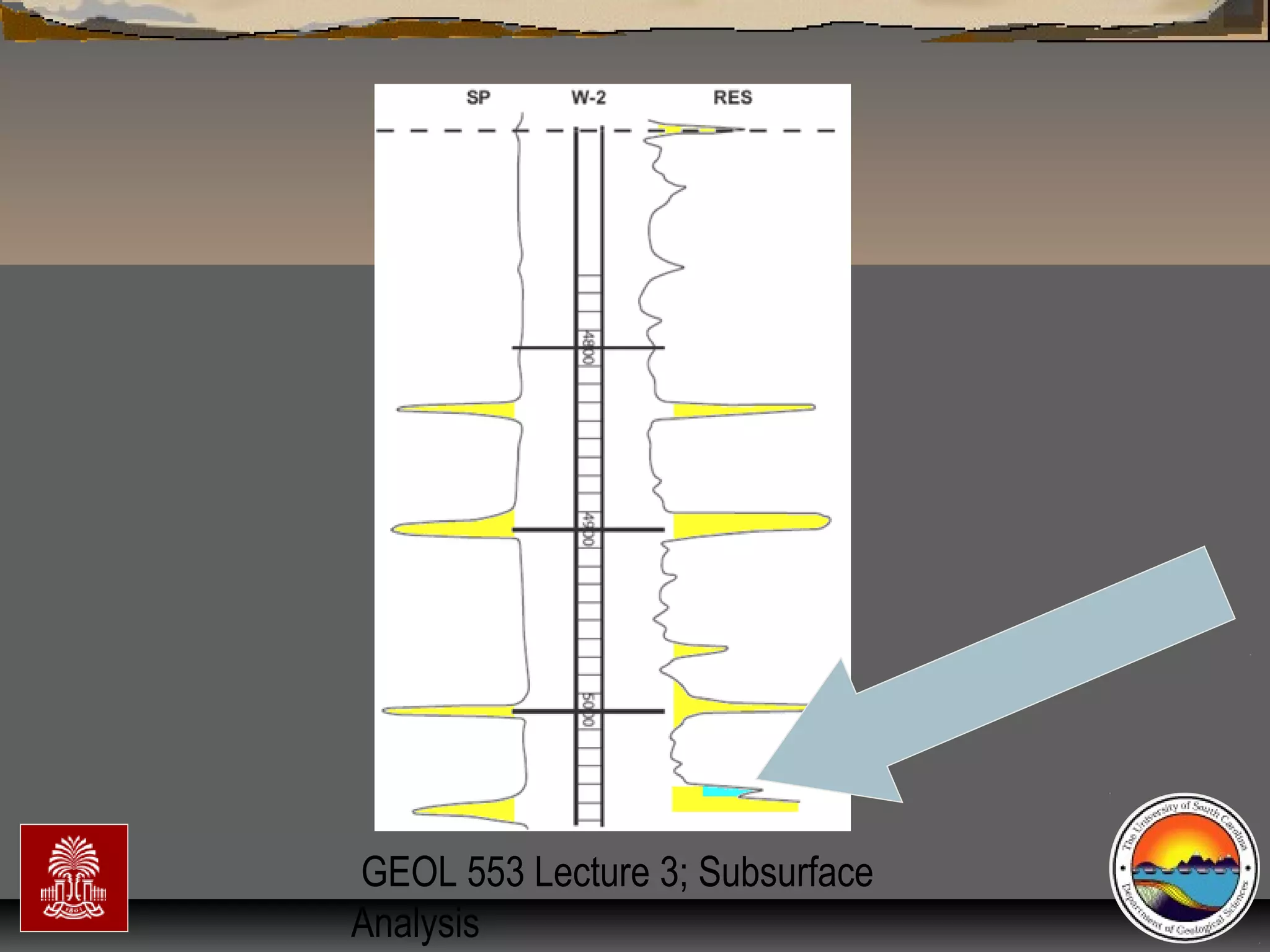
Resistivity Logs
 Measures resistance of flow of electricMeasures resistance of flow of electric
currentcurrent
 Is function of porosity & pore fluid in rockIs function of porosity & pore fluid in rock
 Frequently used to identify lithologyFrequently used to identify lithology
The most commonly used logs:The most commonly used logs:
GEOL 553 Lecture 3; Subsurface
Analysis
GEOL 553 Lecture 3; Subsurface
Analysis
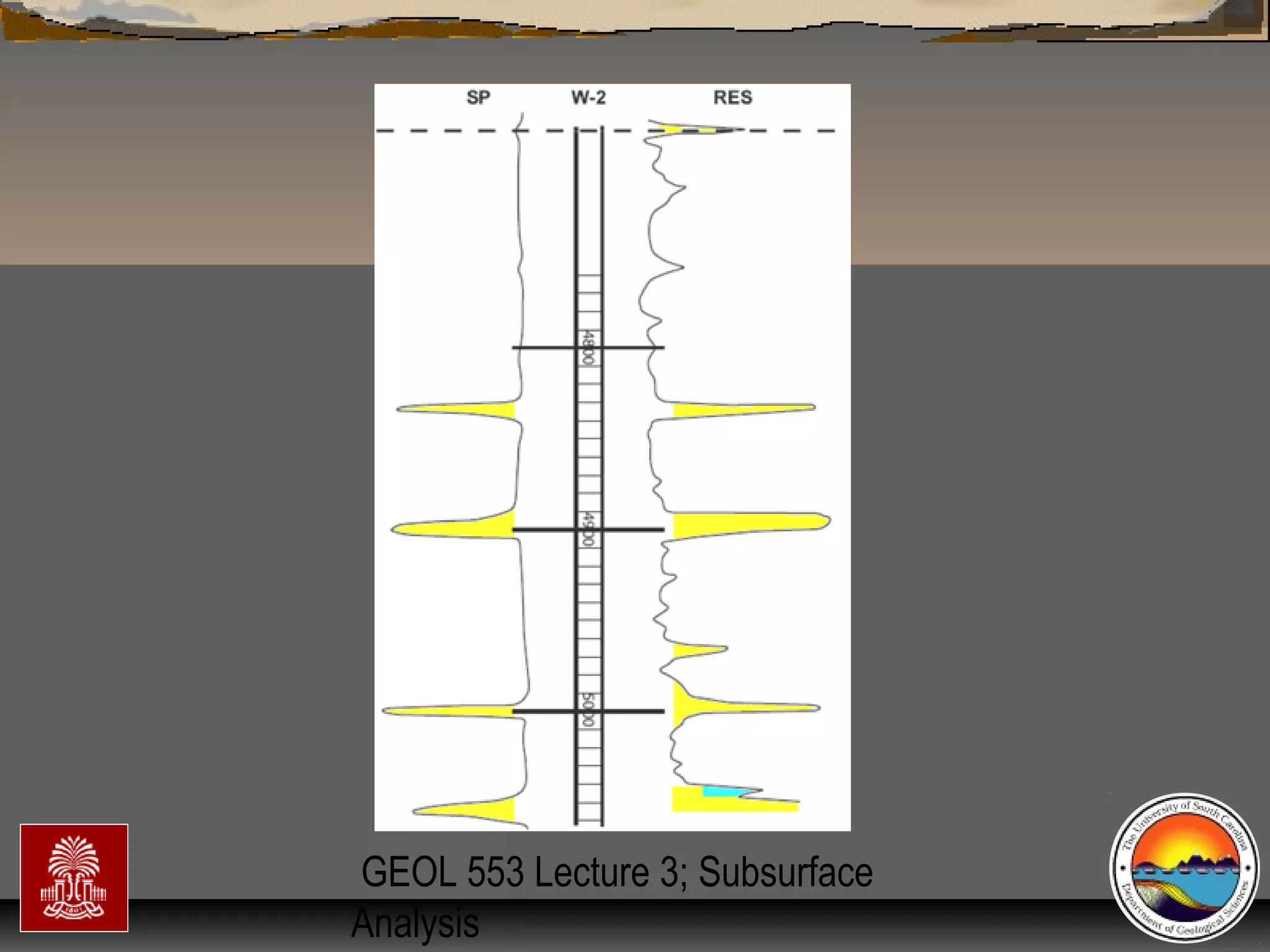
Spontaneous Potential (SP) Logs
 Measures electrical current in wellMeasures electrical current in well
 Result of salinity differences betweenResult of salinity differences between
formation water and the borehole mudformation water and the borehole mud
 Separates bed boundaries of permeableSeparates bed boundaries of permeable
sands & impermeable shales.sands & impermeable shales.
Next most common logNext most common log
GEOL 553 Lecture 3; Subsurface
Analysis
GEOL 553 Lecture 3; Subsurface
Analysis
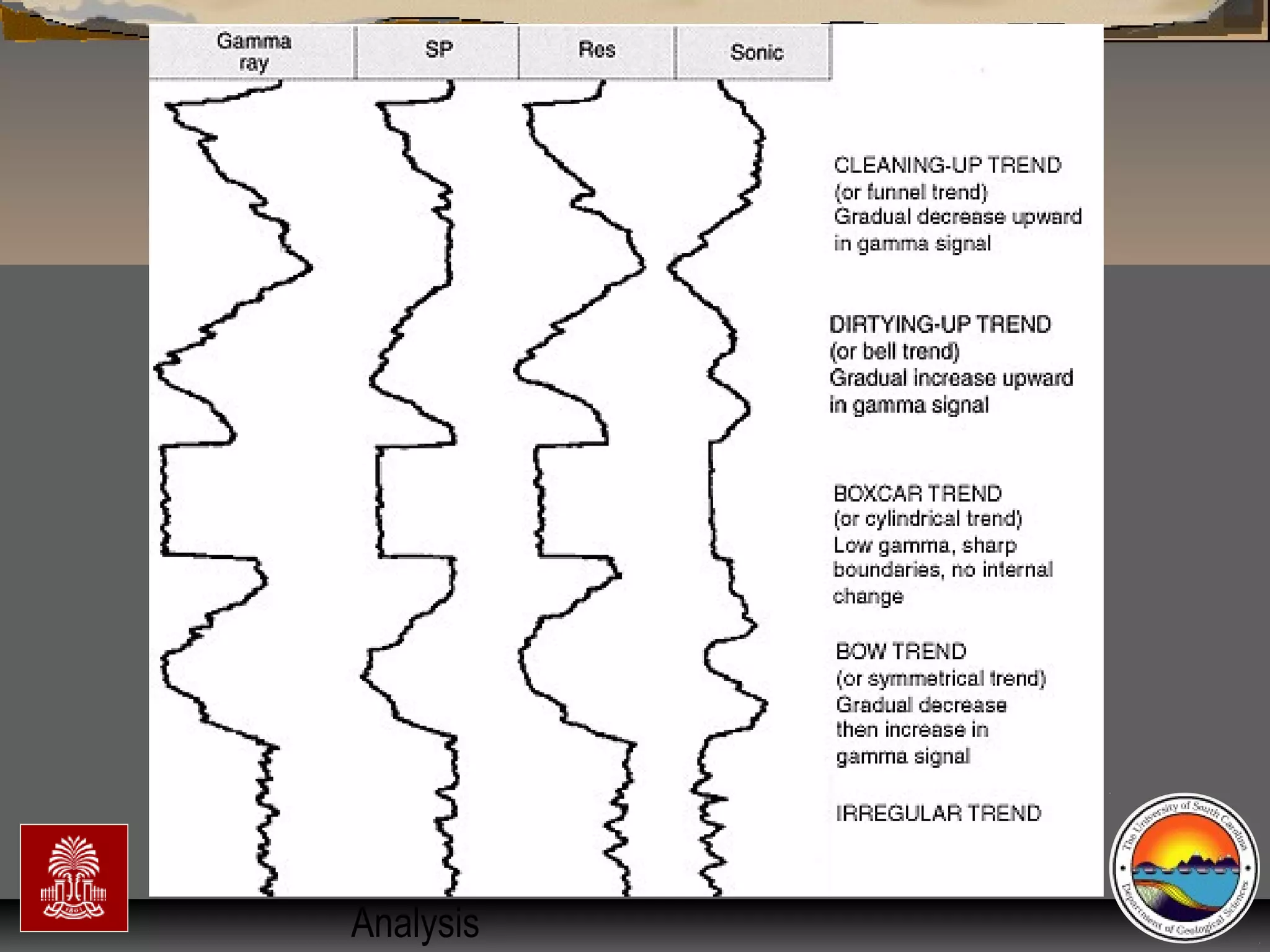
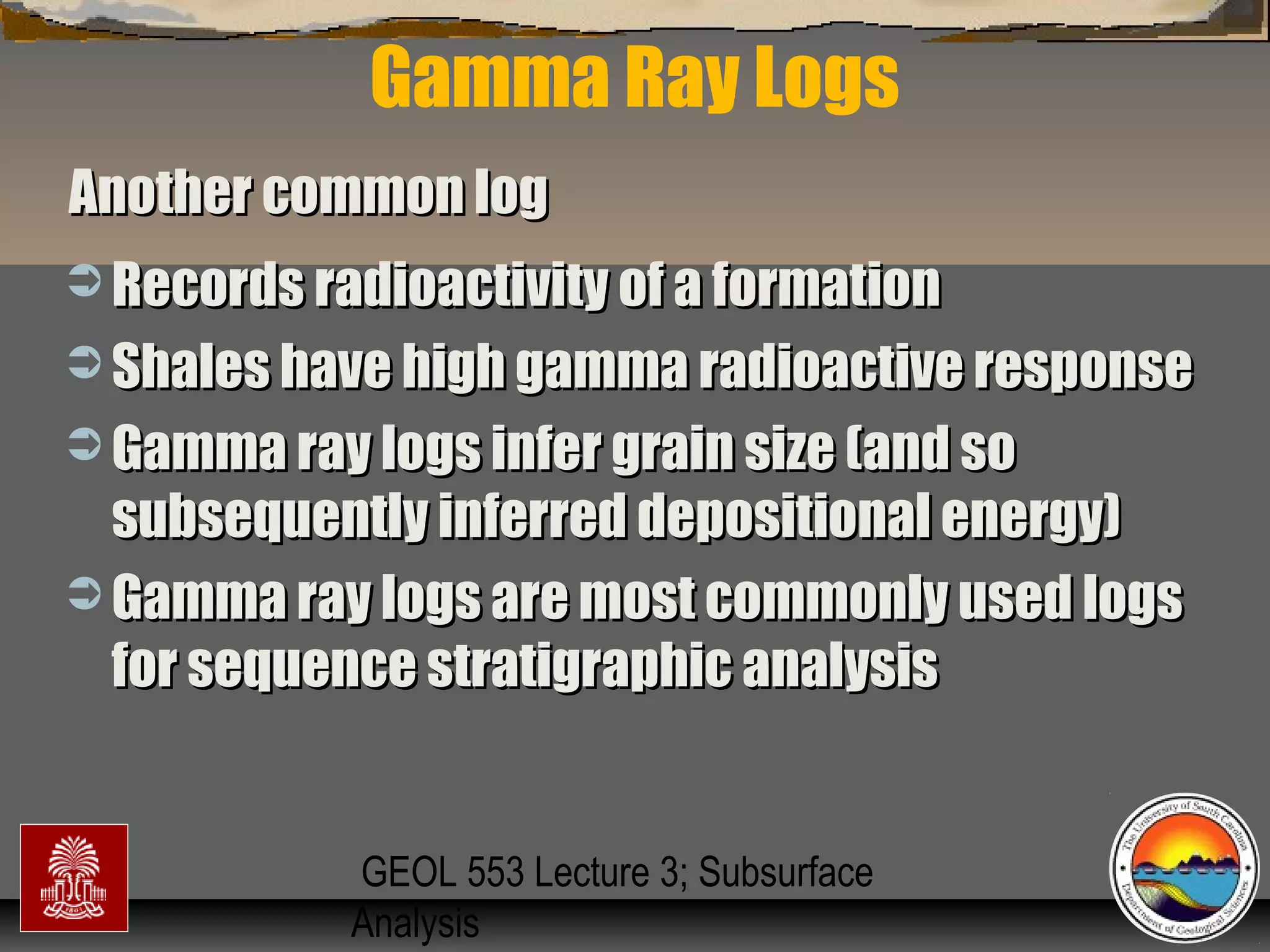
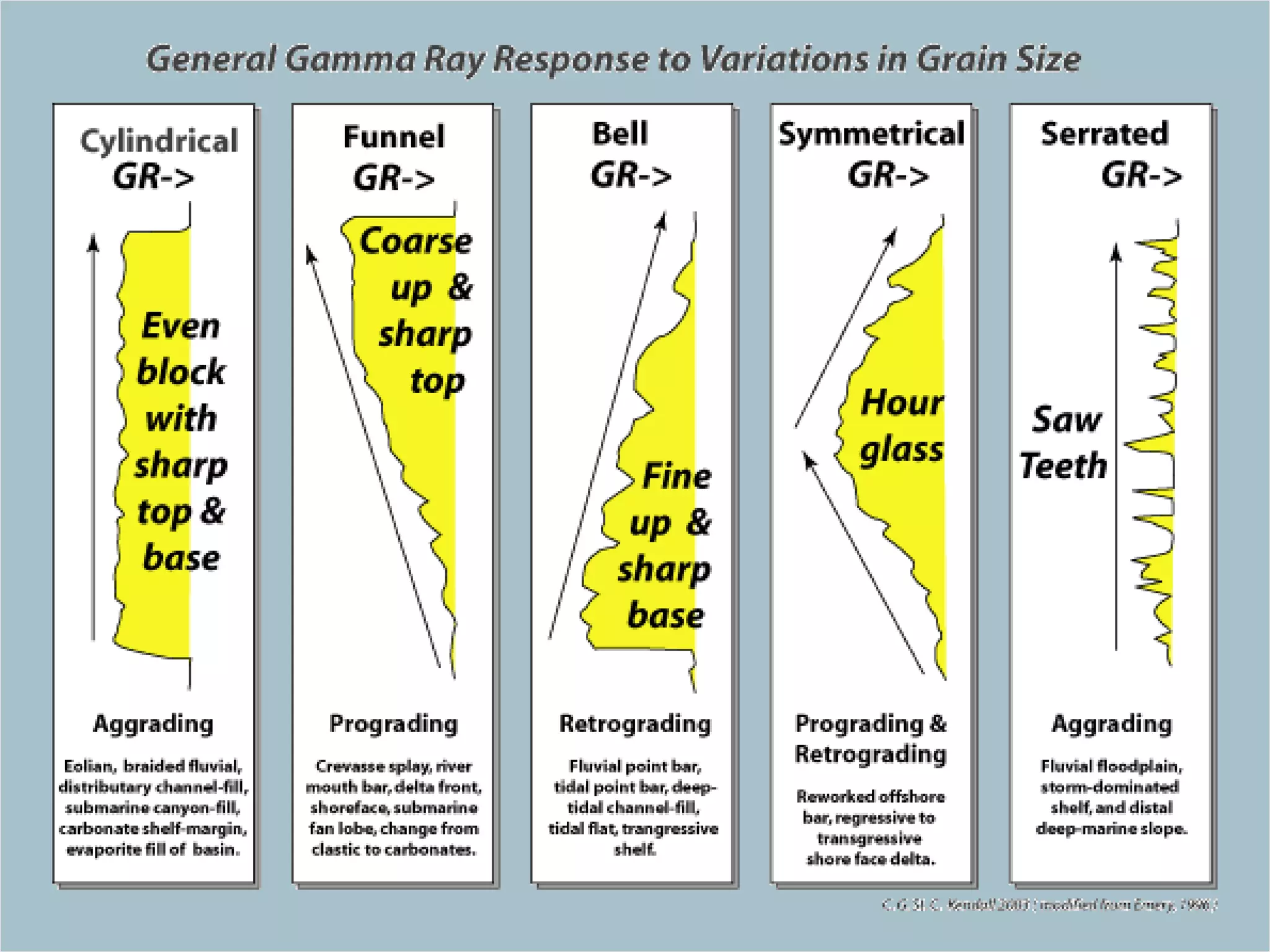
Gamma Ray Logs
 Records radioactivity of a formationRecords radioactivity of a formation
 Shales have high gamma radioactive responseShales have high gamma radioactive response
 Gamma ray logs infer grain size (and soGamma ray logs infer grain size (and so
subsequently inferred depositional energy)subsequently inferred depositional energy)
 Gamma ray logs are most commonly used logsGamma ray logs are most commonly used logs
for sequence stratigraphic analysisfor sequence stratigraphic analysis
Another common logAnother common log
GEOL 553 Lecture 3; Subsurface
Analysis
GEOL 553 Lecture 3; Subsurface
Analysis
GEOL 553 Lecture 3; Subsurface
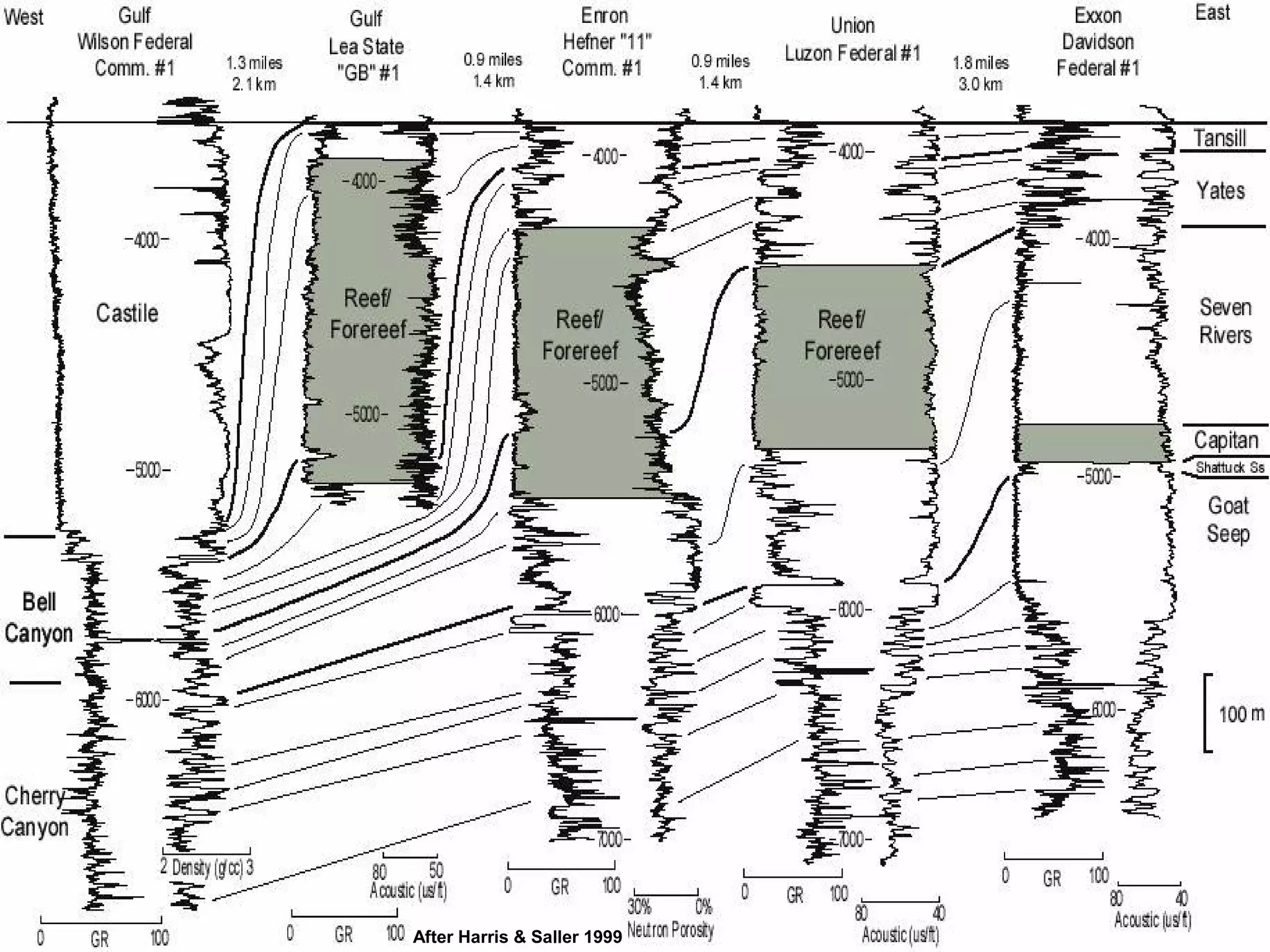
AnalysisAfter Harris & Saller 1999
GEOL 553 Lecture 3; Subsurface
Analysis
Neutron Logs
 Measures porosity of formationMeasures porosity of formation
 Uses quantity of hydrogen presentUses quantity of hydrogen present
 Measures lithology when used with DensityMeasures lithology when used with Density
LogLog
Another common logAnother common log
GEOL 553 Lecture 3; Subsurface
Analysis
Density Logs
 Measures formation’s bulk densityMeasures formation’s bulk density
 Used as a porosity measureUsed as a porosity measure
 Differentiates lithologies with Neutron LogDifferentiates lithologies with Neutron Log
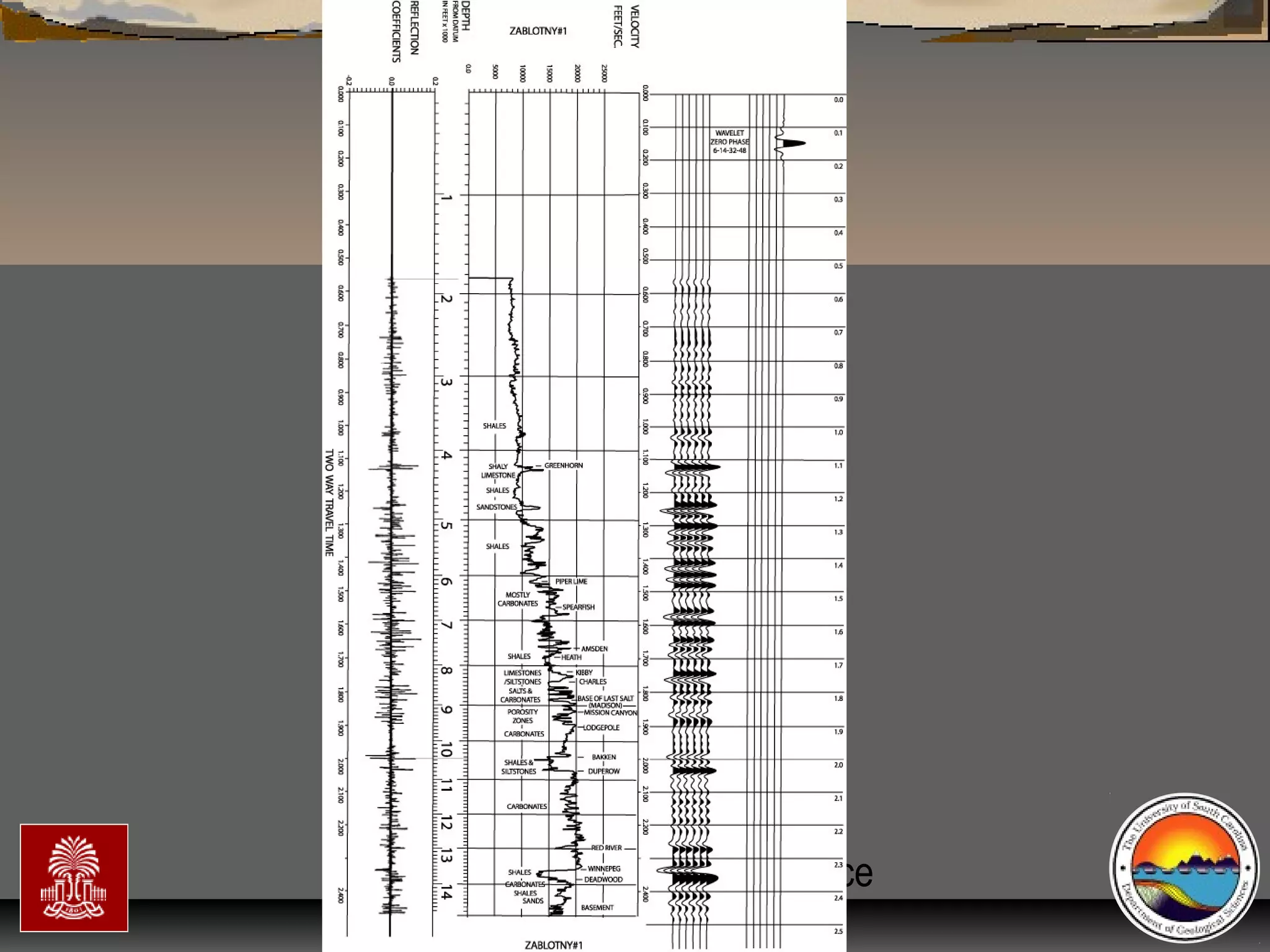
 Used with Sonic Logs to generate syntheticUsed with Sonic Logs to generate synthetic
seismic traces to match to seismic linesseismic traces to match to seismic lines
A common logA common log
GEOL 553 Lecture 3; Subsurface
Analysis
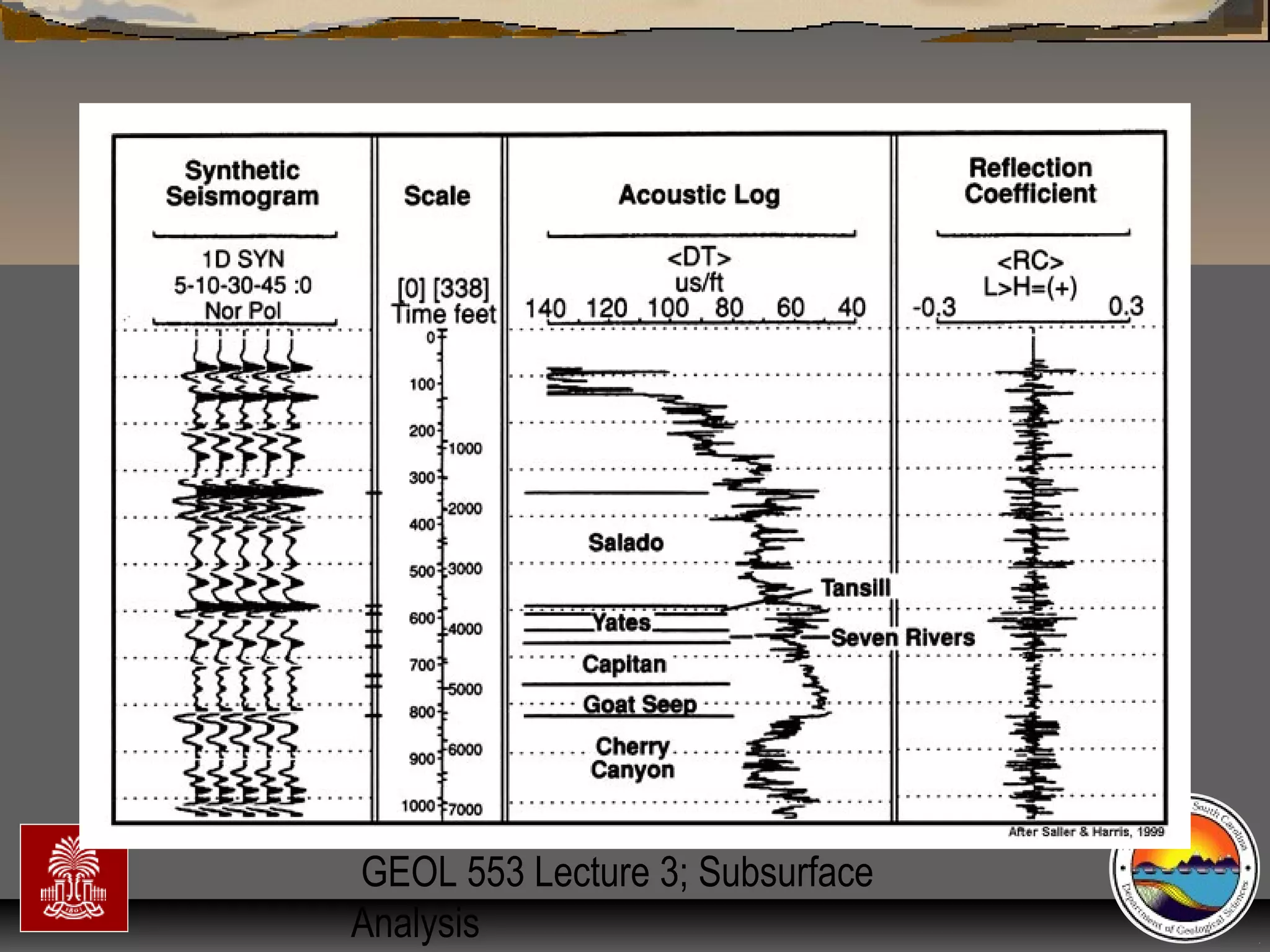
Sonic (Acoustic) Logs
 Measures of speed of sound in formationMeasures of speed of sound in formation
 Tied to porosity and lithologyTied to porosity and lithology
 Used with Density Logs to generateUsed with Density Logs to generate
Synthetic Seismic traces to match toSynthetic Seismic traces to match to
Seismic linesSeismic lines
Another common logAnother common log
GEOL 553 Lecture 3; Subsurface
Analysis
GEOL 553 Lecture 3; Subsurface
Analysis
GEOL 553 Lecture 3; Subsurface
Analysis
The Tools of Subsurface Analysis
 Well logsWell logs
 SeismicSeismic
Facies analysis of subsurface dataFacies analysis of subsurface data
depends on tools which delimit ofdepends on tools which delimit of
surfaces and provide clues as to thesurfaces and provide clues as to the
sediments they contain:sediments they contain:
GEOL 553 Lecture 3; Subsurface
Analysis
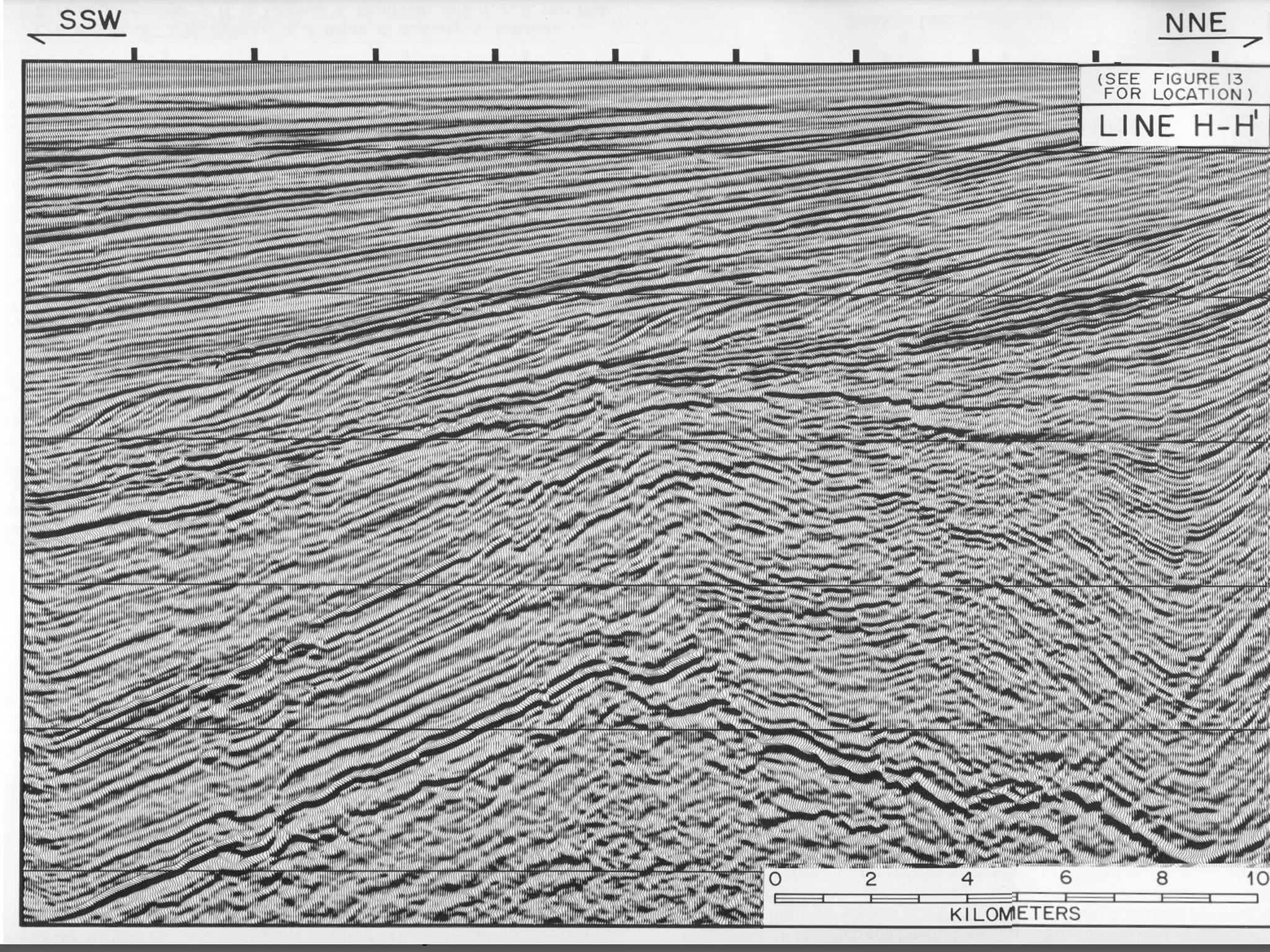
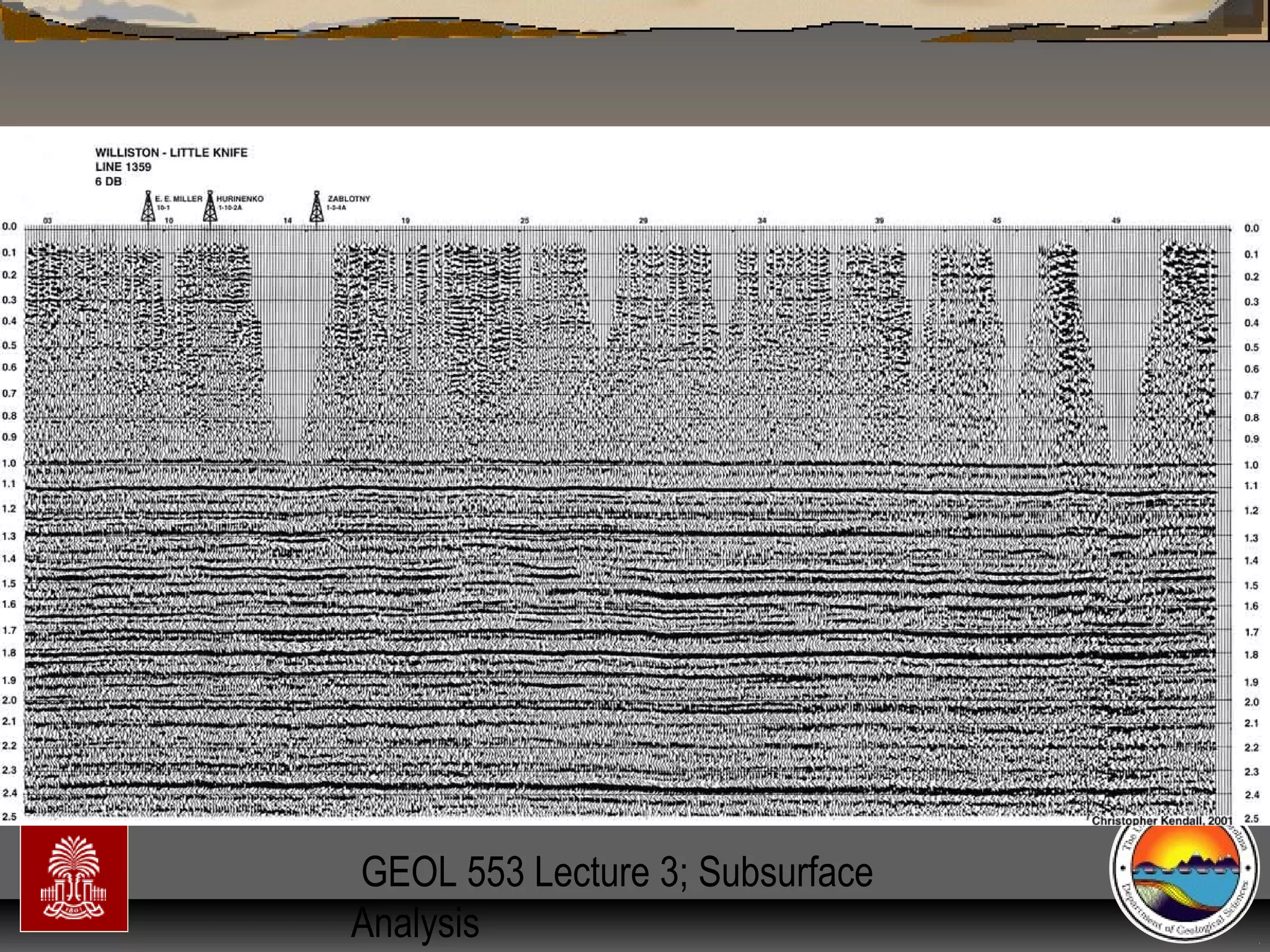
Seismic
 Define geometries of genetic reflectionDefine geometries of genetic reflection
packages that envelope seismic sequencespackages that envelope seismic sequences
and systems tractsand systems tracts
 Identify bounding discontinuities on basisIdentify bounding discontinuities on basis
of reflection termination patterns andof reflection termination patterns and
continuitycontinuity
Seismic stratigraphic interpretationSeismic stratigraphic interpretation
used to:used to:
GEOL 553 Lecture 3; Subsurface
Analysis
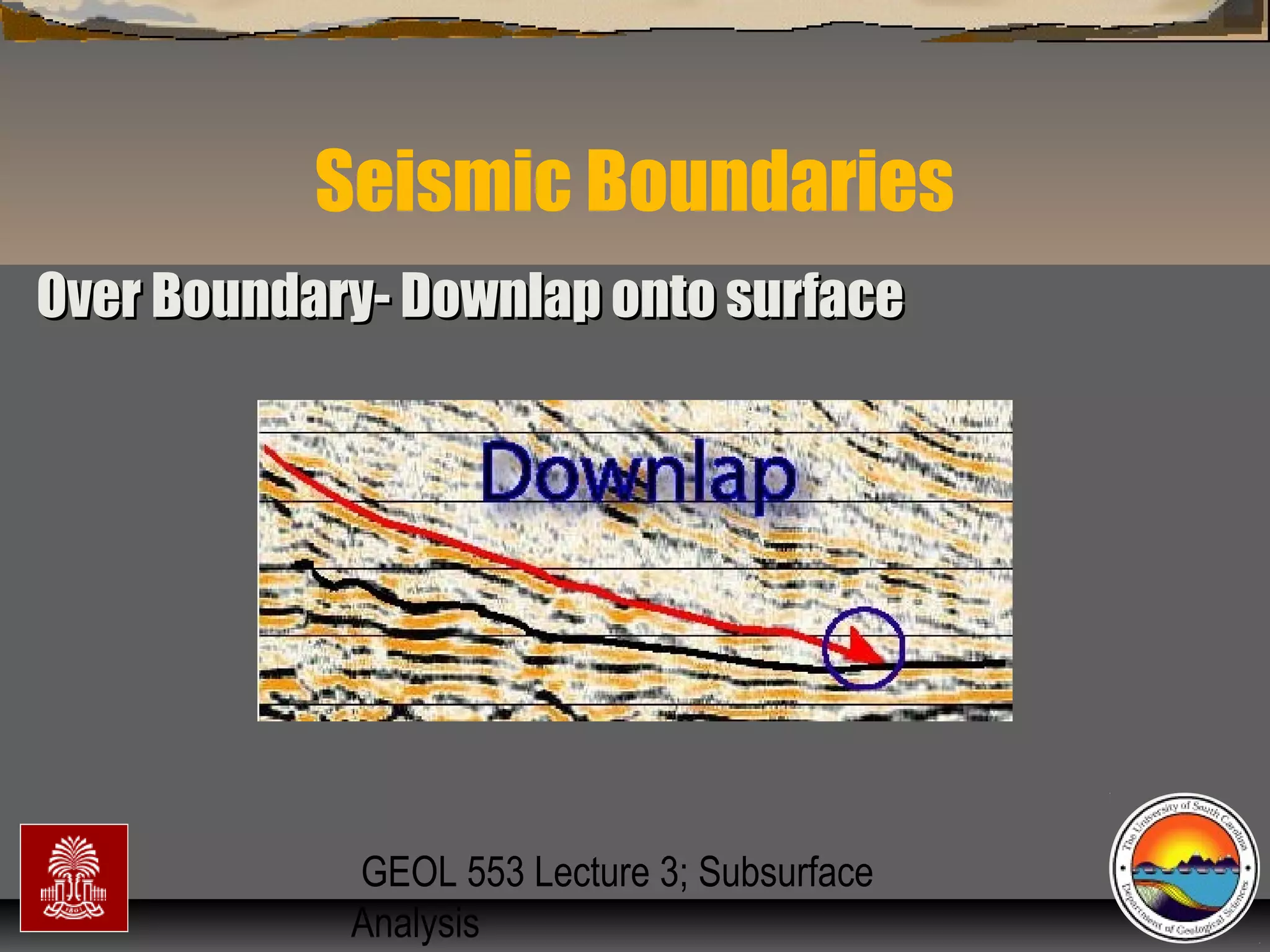
Seismic Boundaries
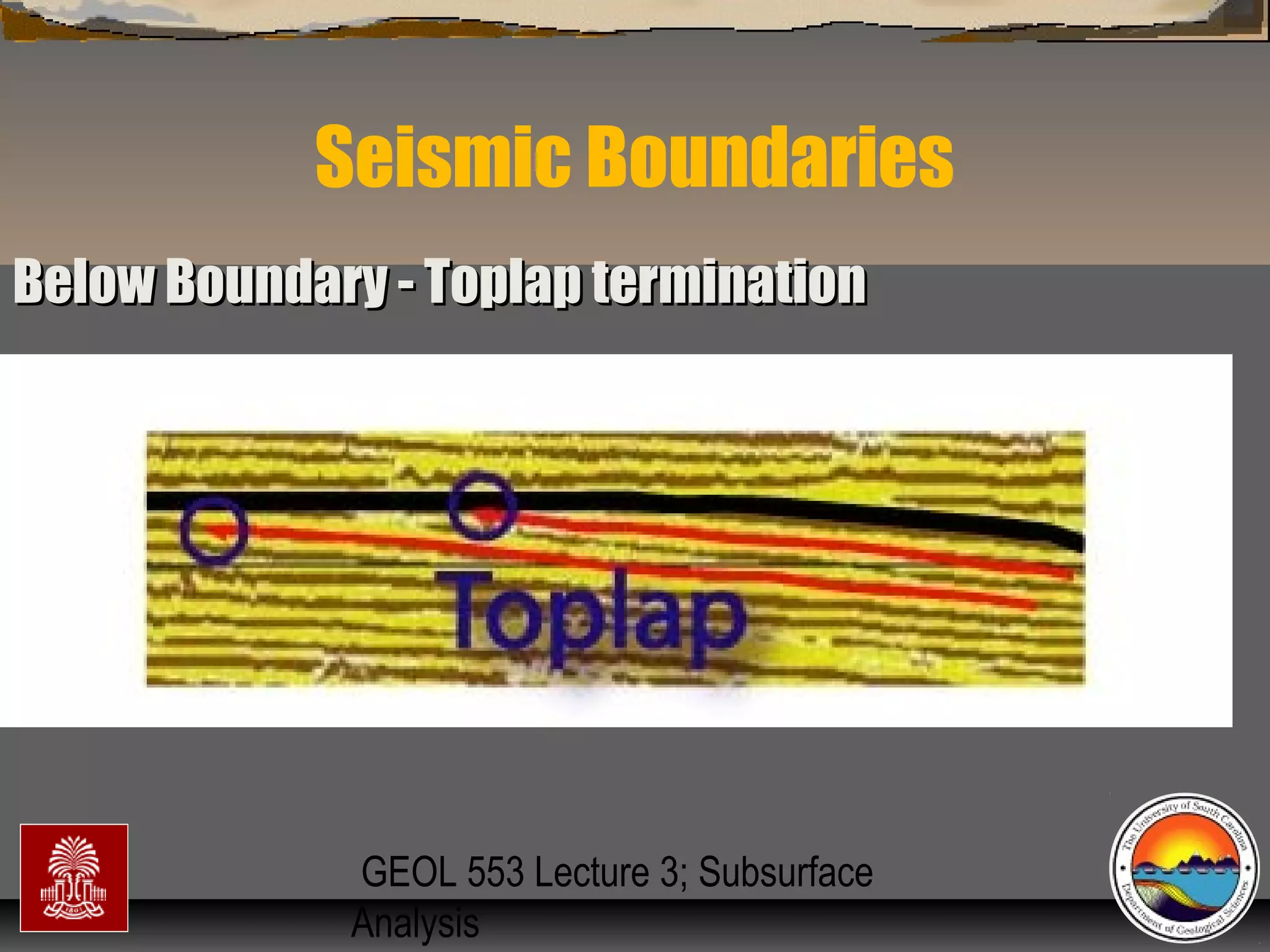
 Toplap terminationToplap termination
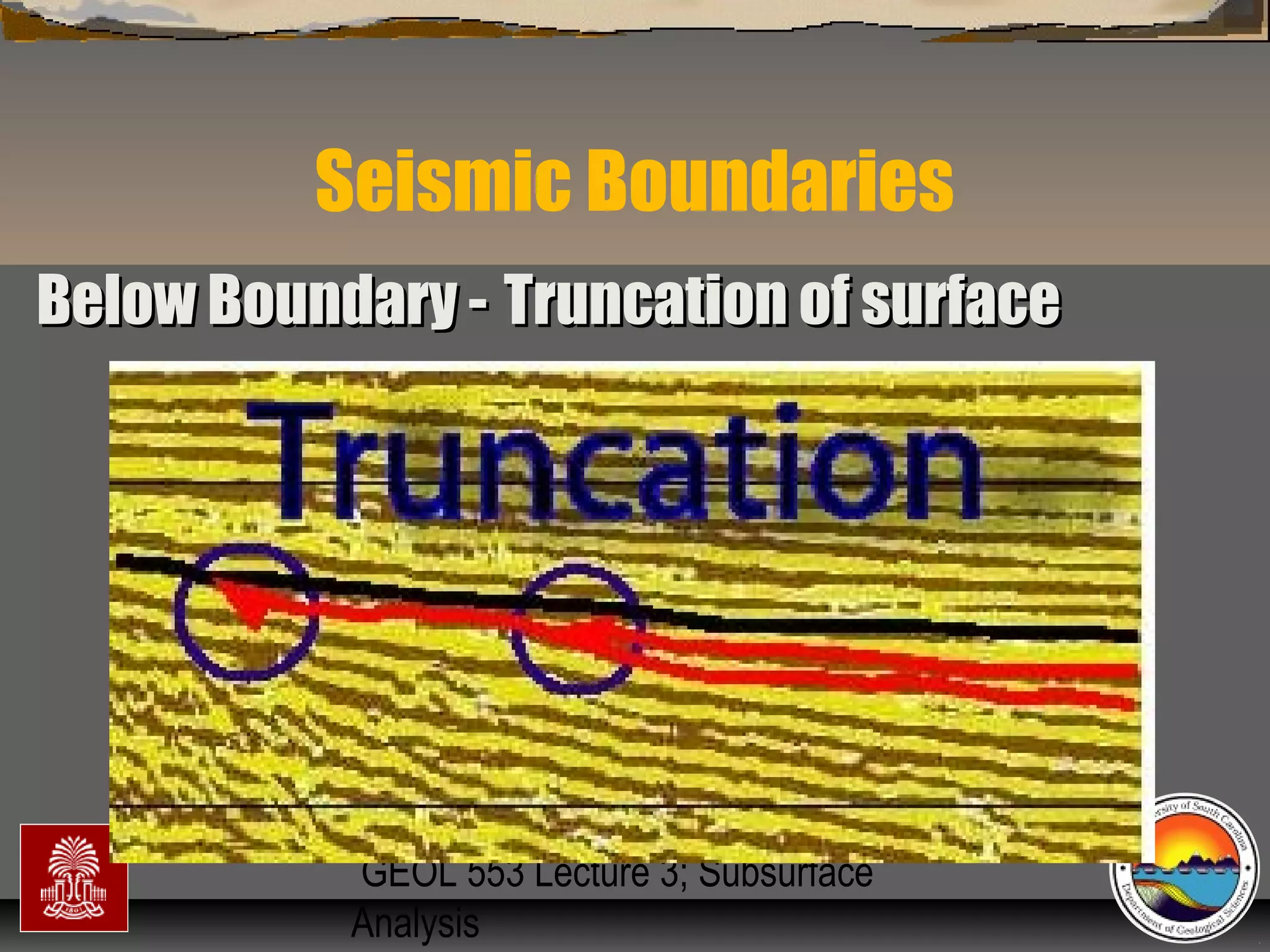
 Truncation of sediment surfaceTruncation of sediment surface
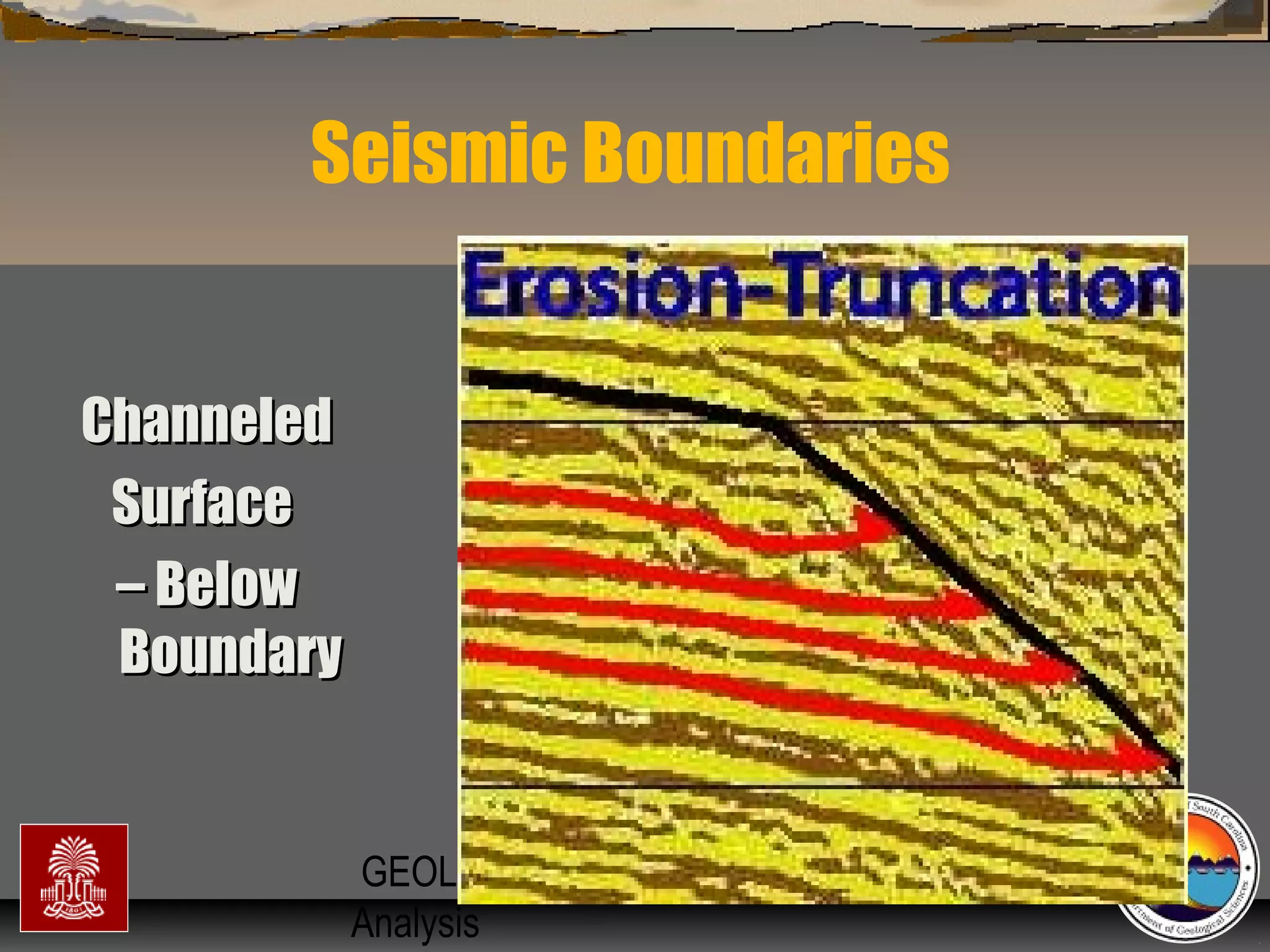
 Often channel bottomOften channel bottom
Termination below discontinuity, orTermination below discontinuity, or
upper sequence boundaryupper sequence boundary ::
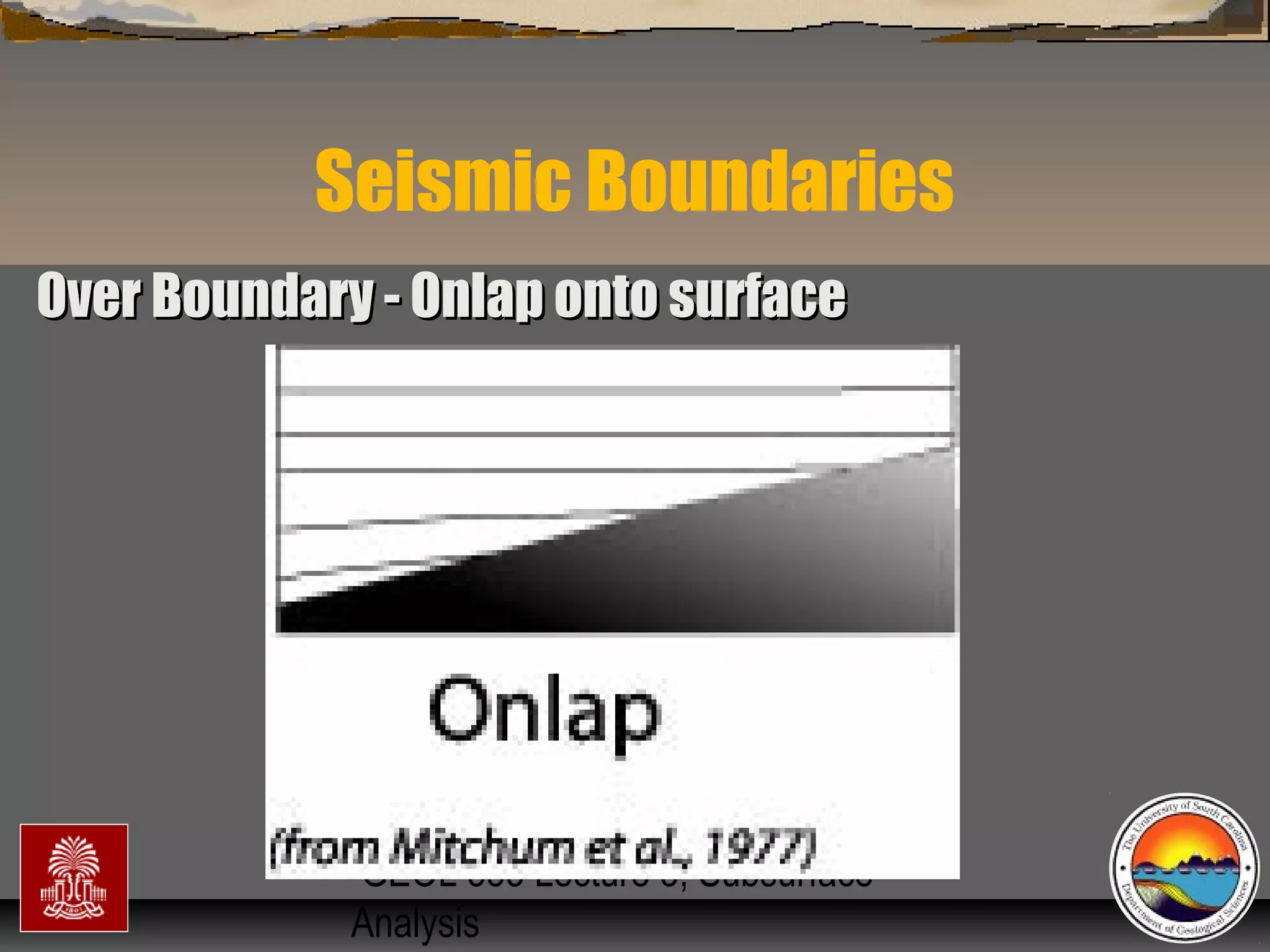
 Onlap over surfaceOnlap over surface
 Downlap surfaceDownlap surface
Above a discontinuity defining lowerAbove a discontinuity defining lower
sequence boundary:sequence boundary:
GEOL 553 Lecture 3; Subsurface
Analysis
Seismic Boundaries
Below Boundary - Toplap terminationBelow Boundary - Toplap termination
GEOL 553 Lecture 3; Subsurface
Analysis
Seismic Boundaries
Below Boundary -Below Boundary - Truncation of surfaceTruncation of surface
GEOL 553 Lecture 3; Subsurface
Analysis
Seismic Boundaries
ChanneledChanneled
SurfaceSurface
–– BelowBelow
BoundaryBoundary
GEOL 553 Lecture 3; Subsurface
Analysis
Seismic Boundaries
Over Boundary - Onlap onto surfaceOver Boundary - Onlap onto surface
GEOL 553 Lecture 3; Subsurface
Analysis
Seismic Boundaries
Over Boundary- Downlap onto surfaceOver Boundary- Downlap onto surface
GEOL 553 Lecture 3; Subsurface
Analysis
GEOL 553 Lecture 3; Subsurface
Analysis
GEOL 553 Lecture 3; Subsurface
Analysis
GEOL 553 Lecture 3; Subsurface
Analysis
GEOL 553 Lecture 3; Subsurface
Analysis
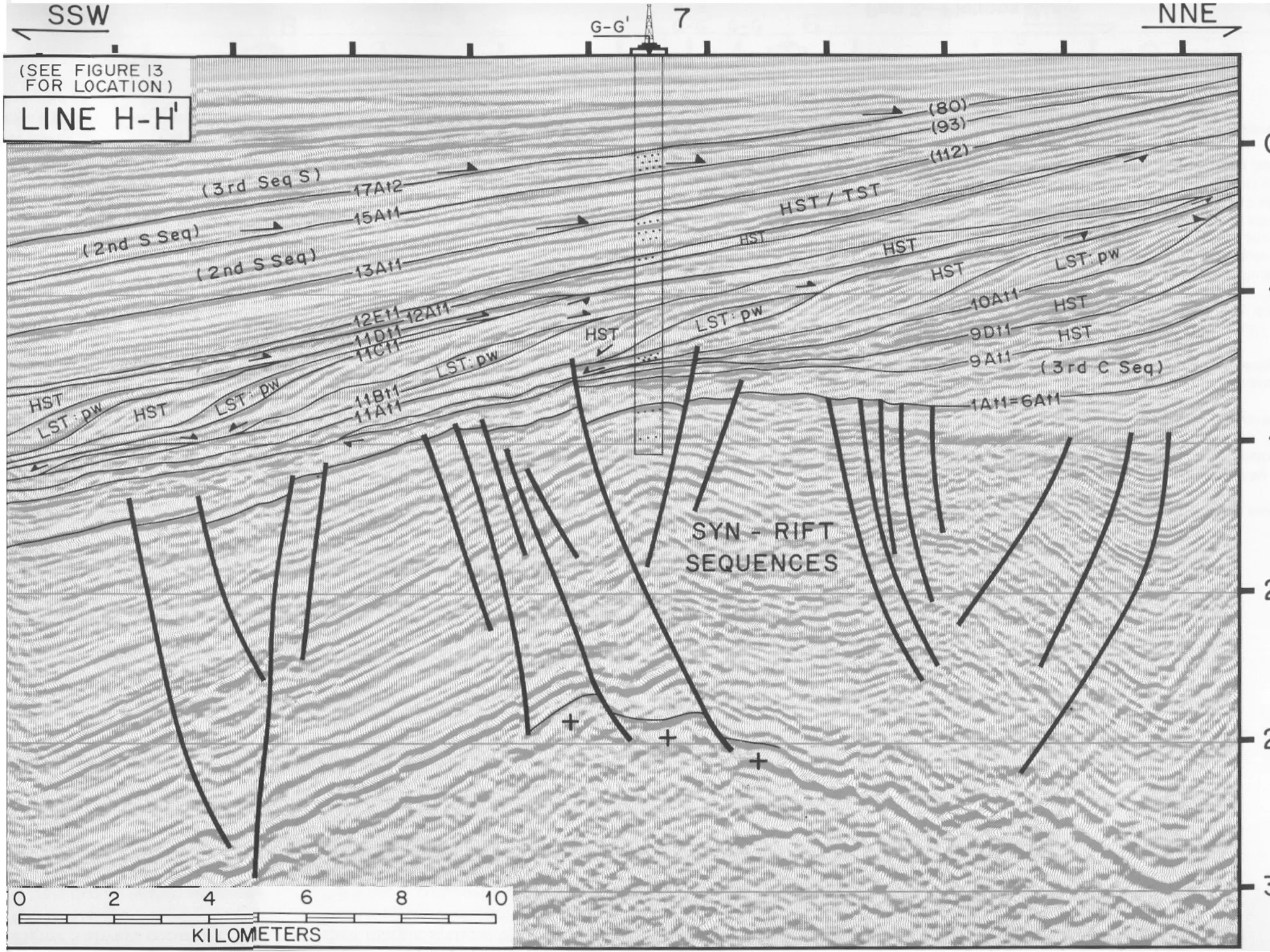
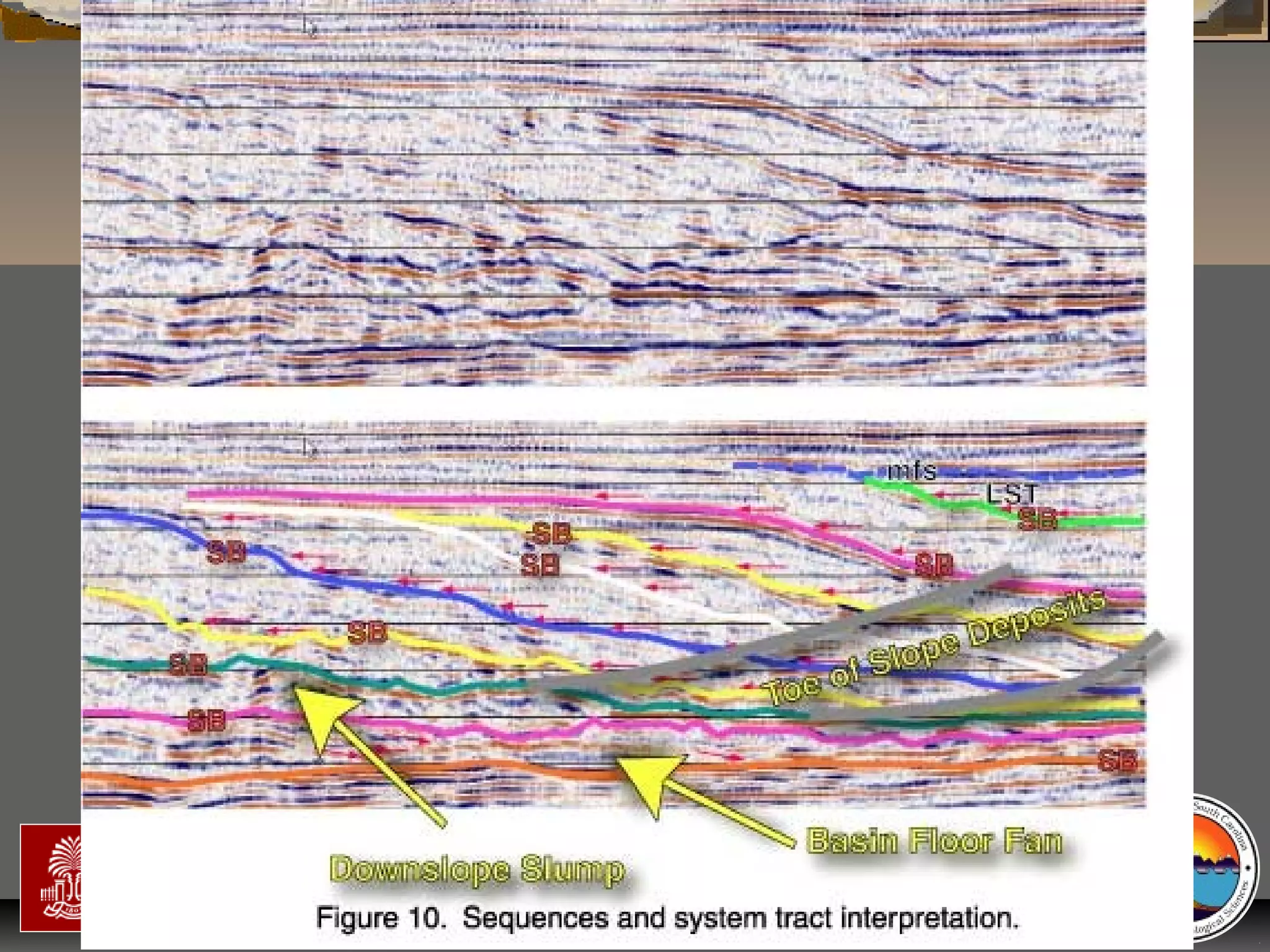
Sequence Stratigraphy
 Surfaces of erosion & non-deposition (sequenceSurfaces of erosion & non-deposition (sequence
boundaries)boundaries)
 Flooding (trangressive surfaces [TS] &/orFlooding (trangressive surfaces [TS] &/or
maximum flooding surfaces [mfs]) & high standmaximum flooding surfaces [mfs]) & high stand
condensed surfacescondensed surfaces
Subdivision & interpretation of sedimentarySubdivision & interpretation of sedimentary
record using a framework surfaces seen inrecord using a framework surfaces seen in
outcrops,outcrops, well logs, & 2-D and 3-D seismicwell logs, & 2-D and 3-D seismic..
Include:Include:
This framework used to predict the extentThis framework used to predict the extent
of sedimentary facies geometry, lithologicof sedimentary facies geometry, lithologic
character, grain size, sorting & reservoircharacter, grain size, sorting & reservoir
qualityquality
GEOL 553 Lecture 3; Subsurface
Analysis
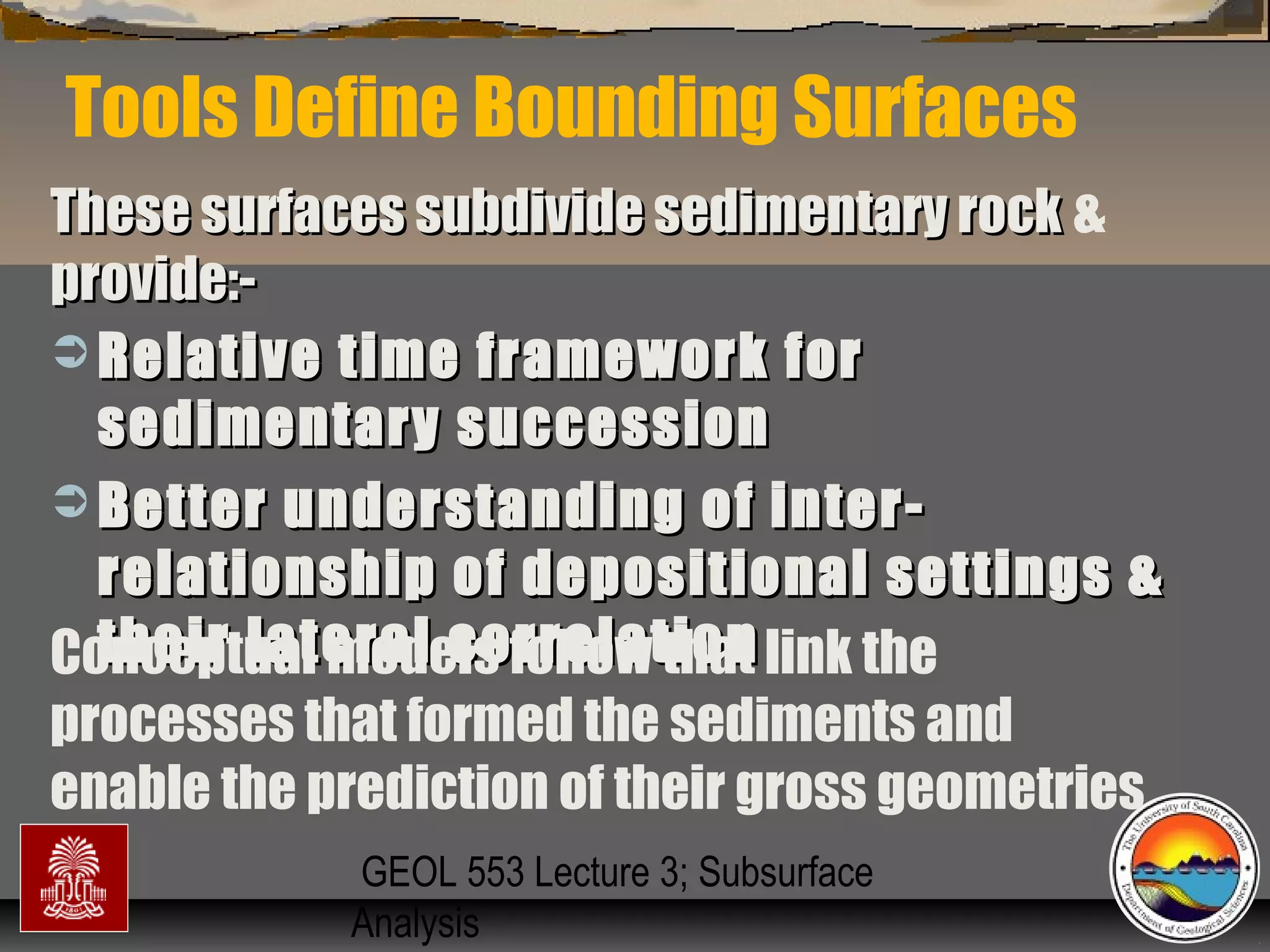
Tools Define Bounding Surfaces
 Relative time framework forRelative time framework for
sedimentary successionsedimentary succession
 Better understanding of inter-Better understanding of inter-
relationship of depositional settings &relationship of depositional settings &
their lateral correlationtheir lateral correlation
These surfaces subdivide sedimentary rockThese surfaces subdivide sedimentary rock &
provide:-provide:-
Conceptual models follow that link the
processes that formed the sediments and
enable the prediction of their gross geometries
GEOL 553 Lecture 3; Subsurface
Analysis
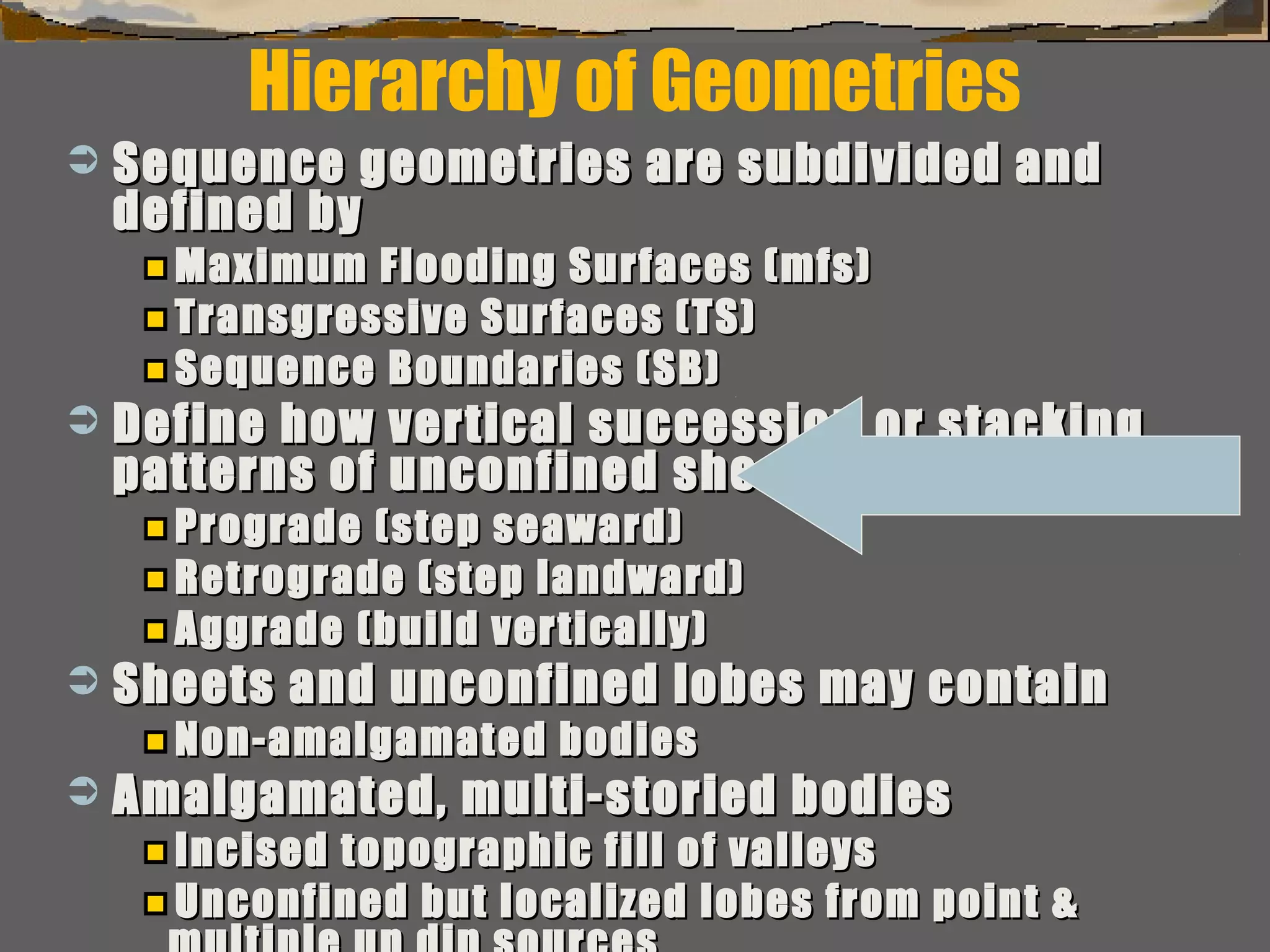
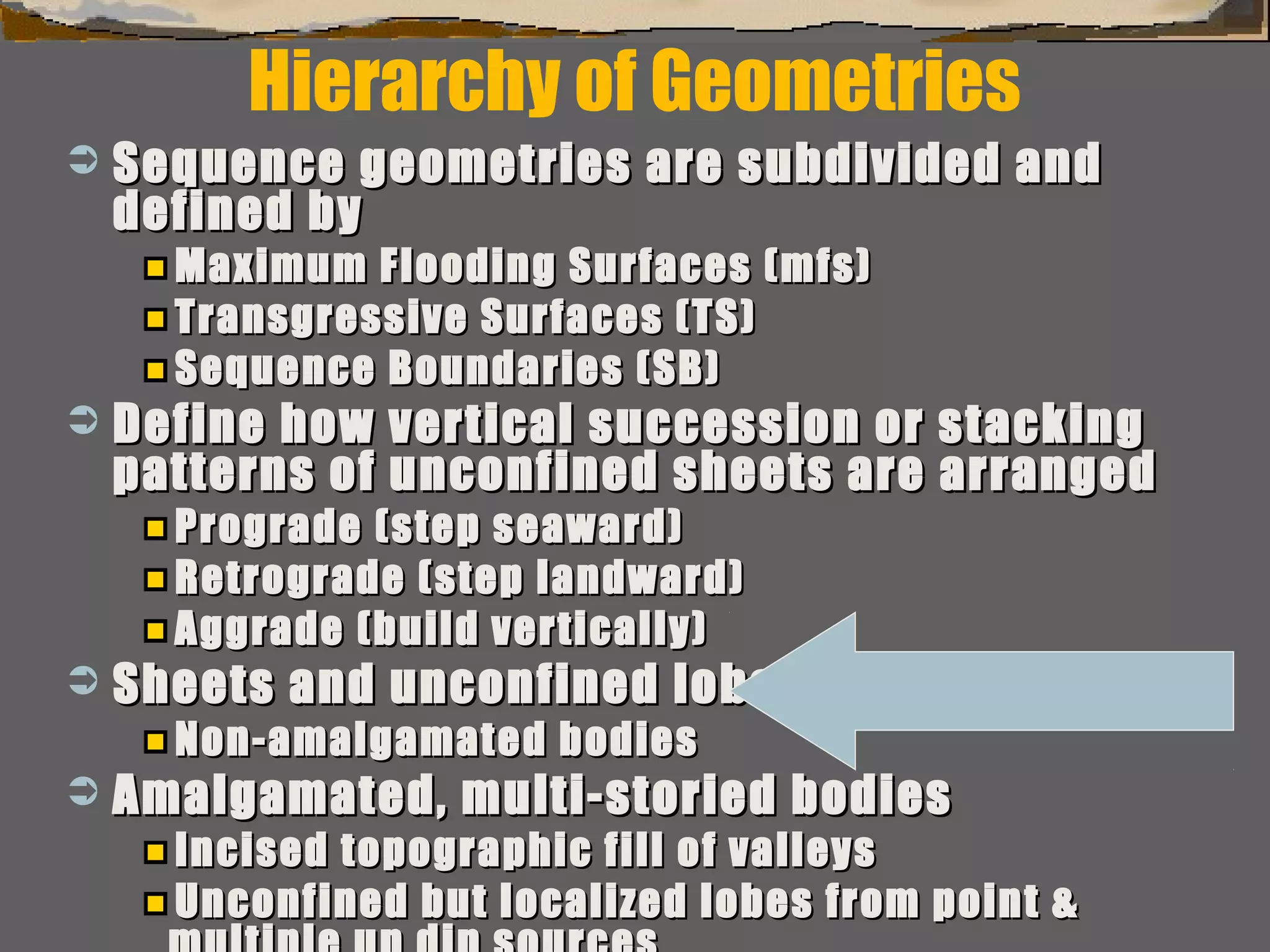
 Sequence geometries are subdivided andSequence geometries are subdivided and
defined bydefined by
Maximum Flooding Surfaces (mfs)Maximum Flooding Surfaces (mfs)
Transgressive Surfaces (TS)Transgressive Surfaces (TS)
Sequence Boundaries (SB)Sequence Boundaries (SB)
 Define how vertical succession or stackingDefine how vertical succession or stacking
patterns of unconfined sheets are arrangedpatterns of unconfined sheets are arranged
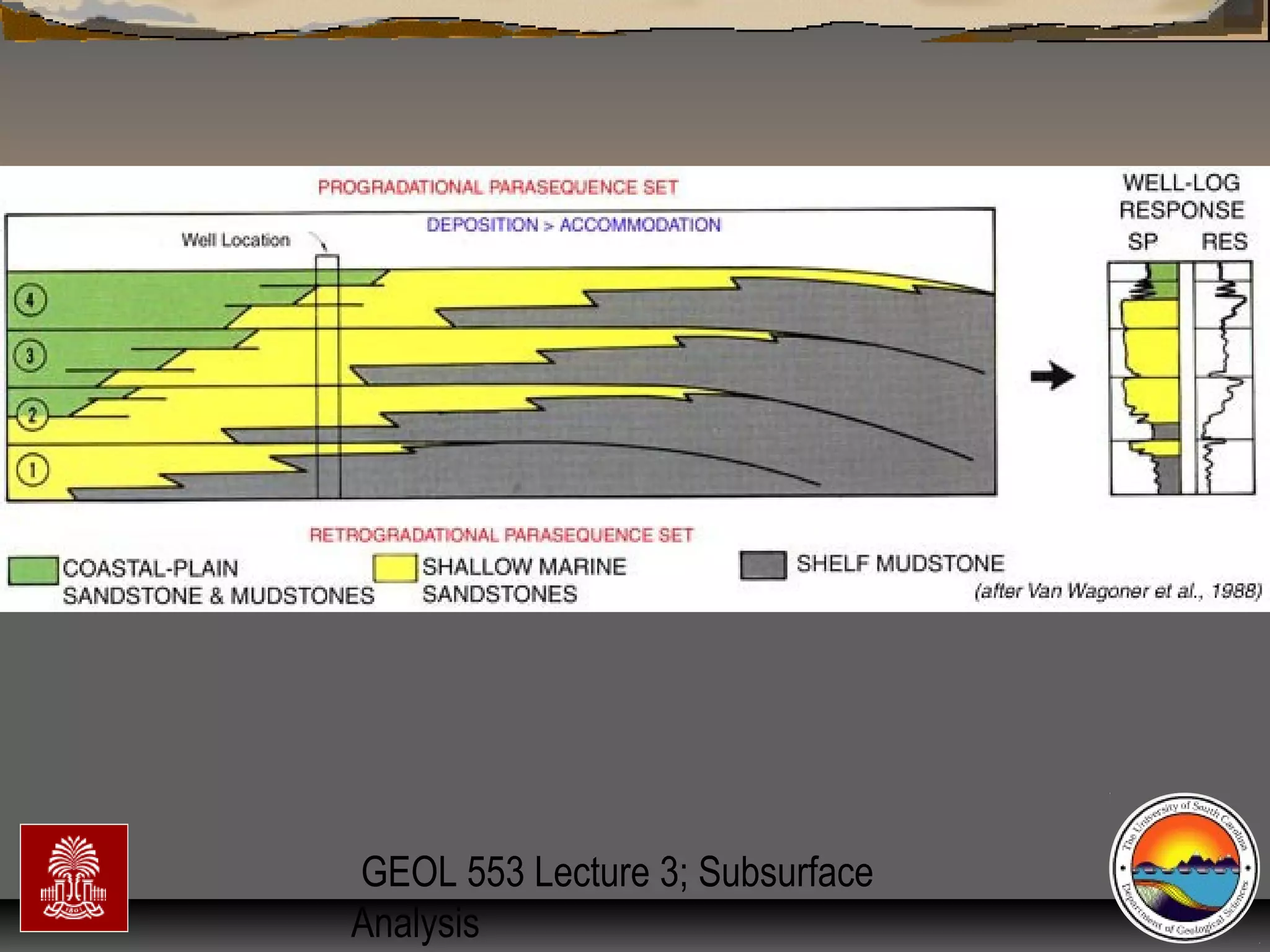
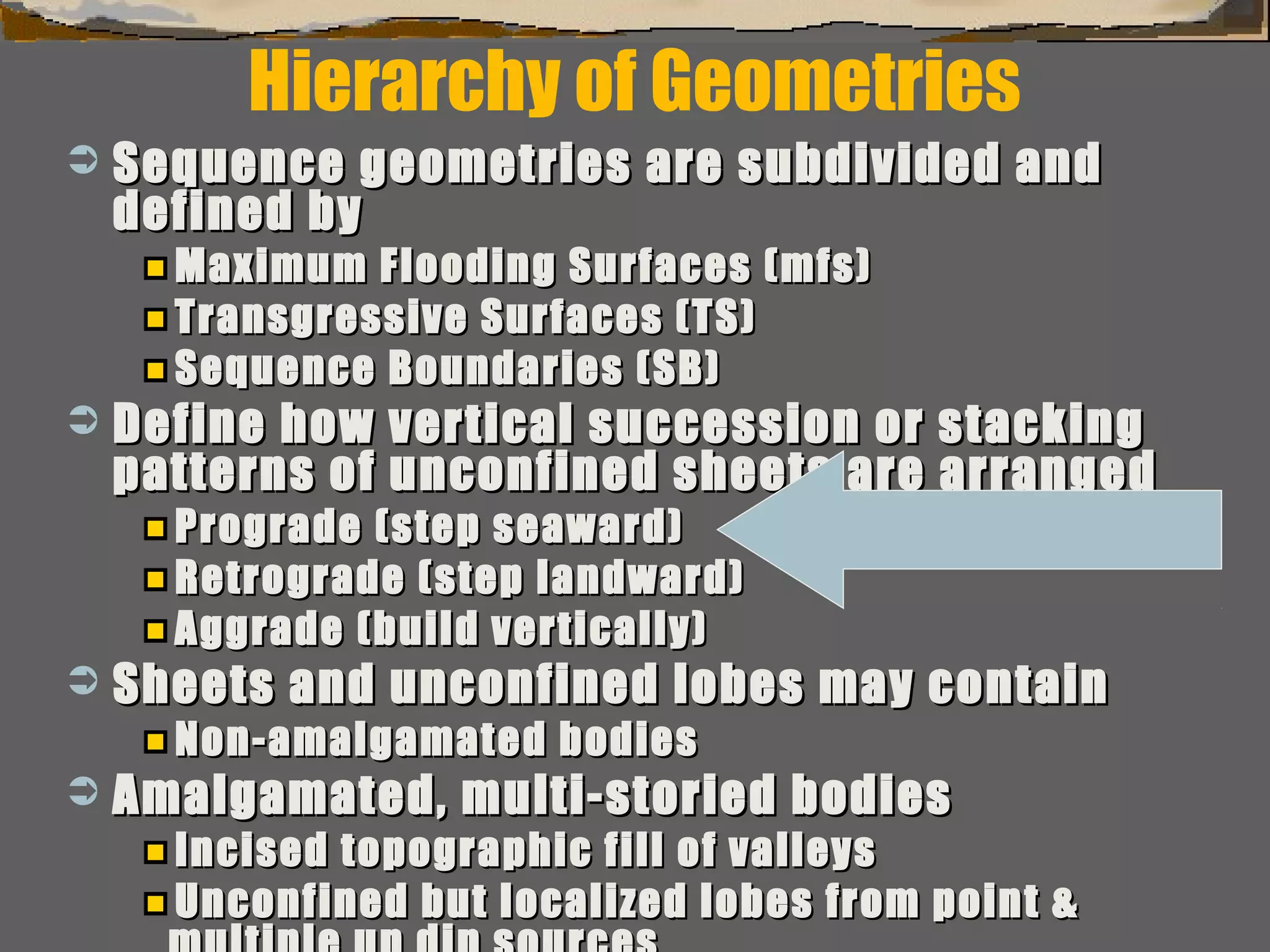
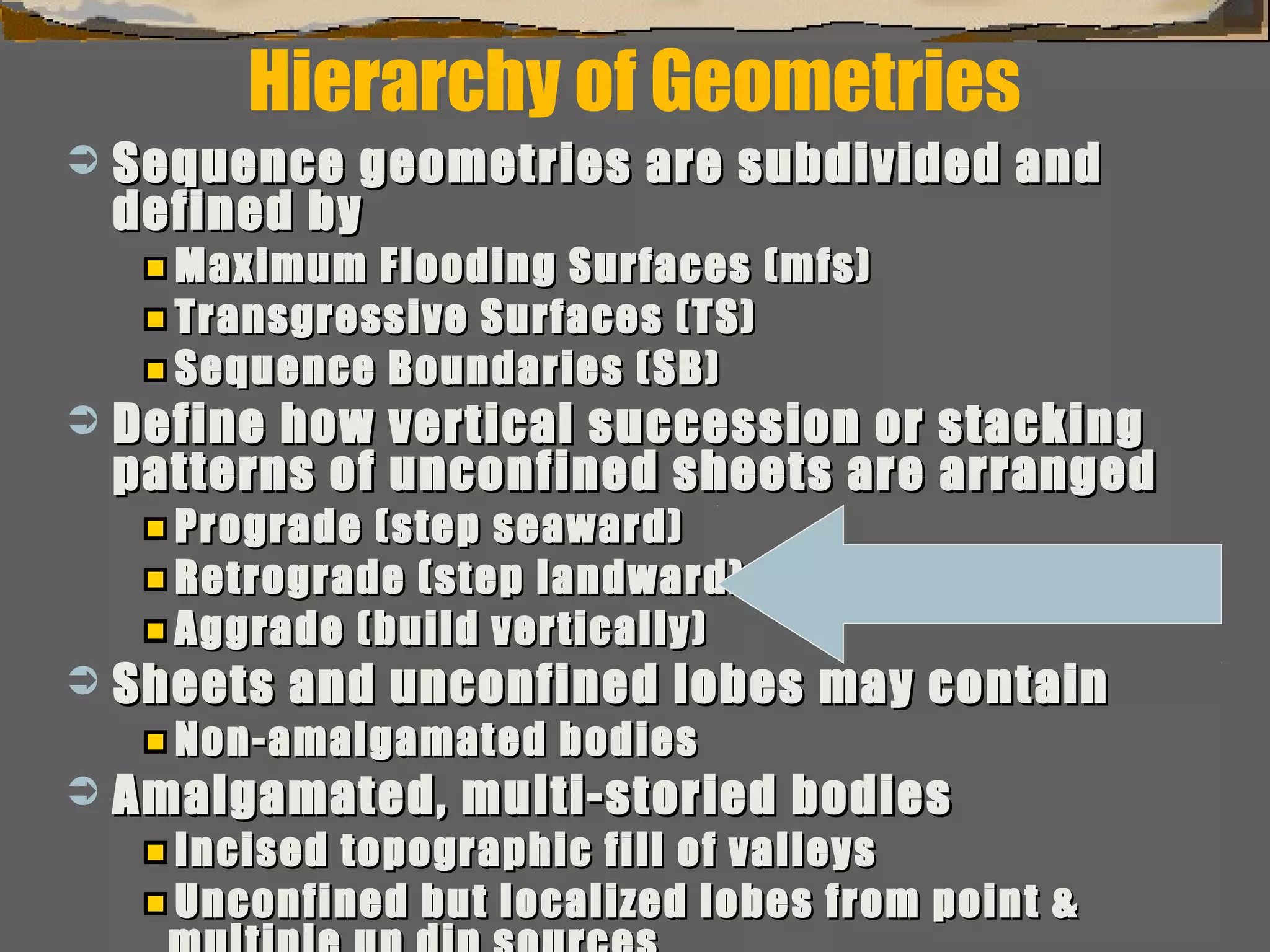
Prograde (step seaward)Prograde (step seaward)
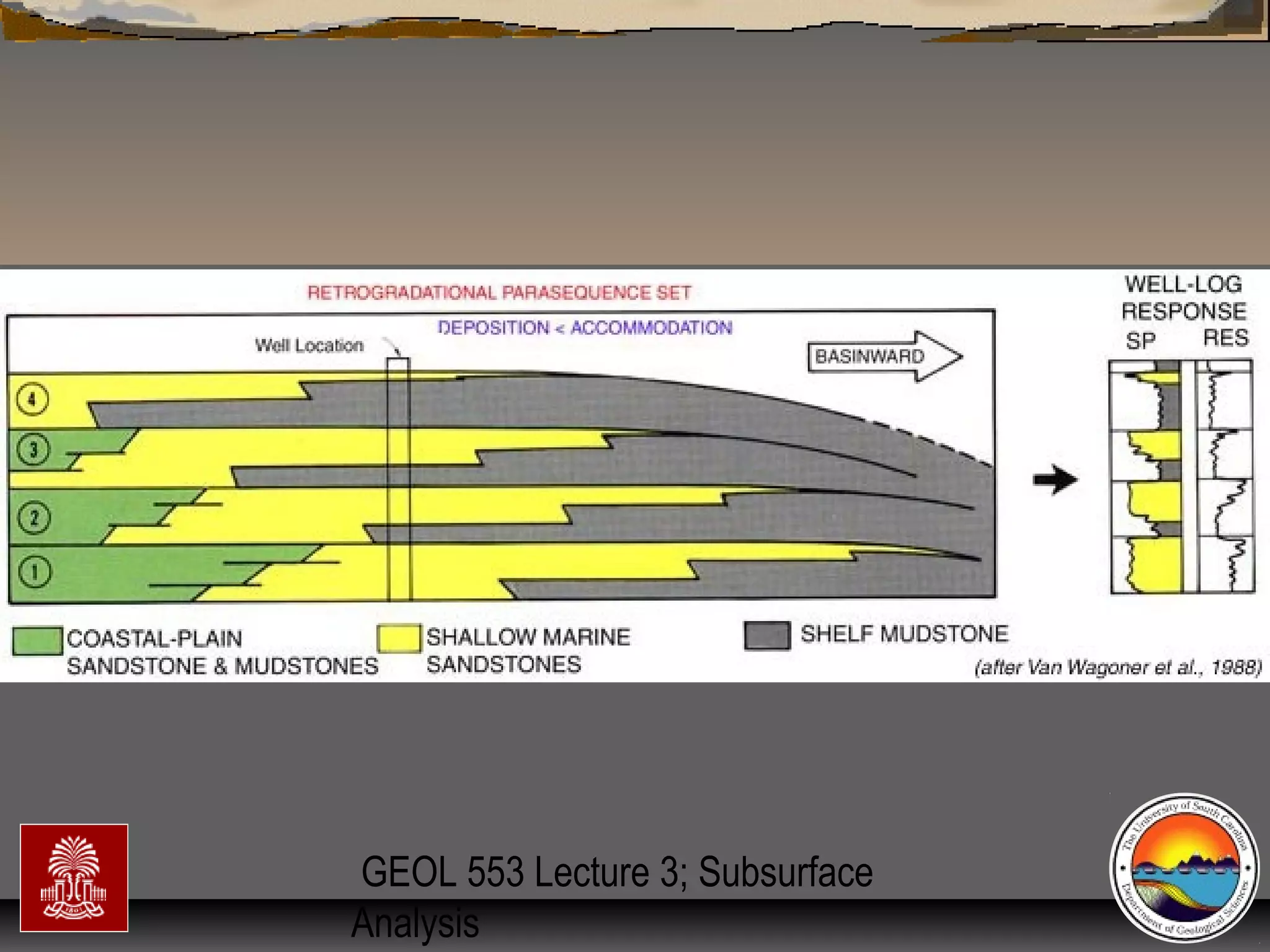
Retrograde (step landward)Retrograde (step landward)
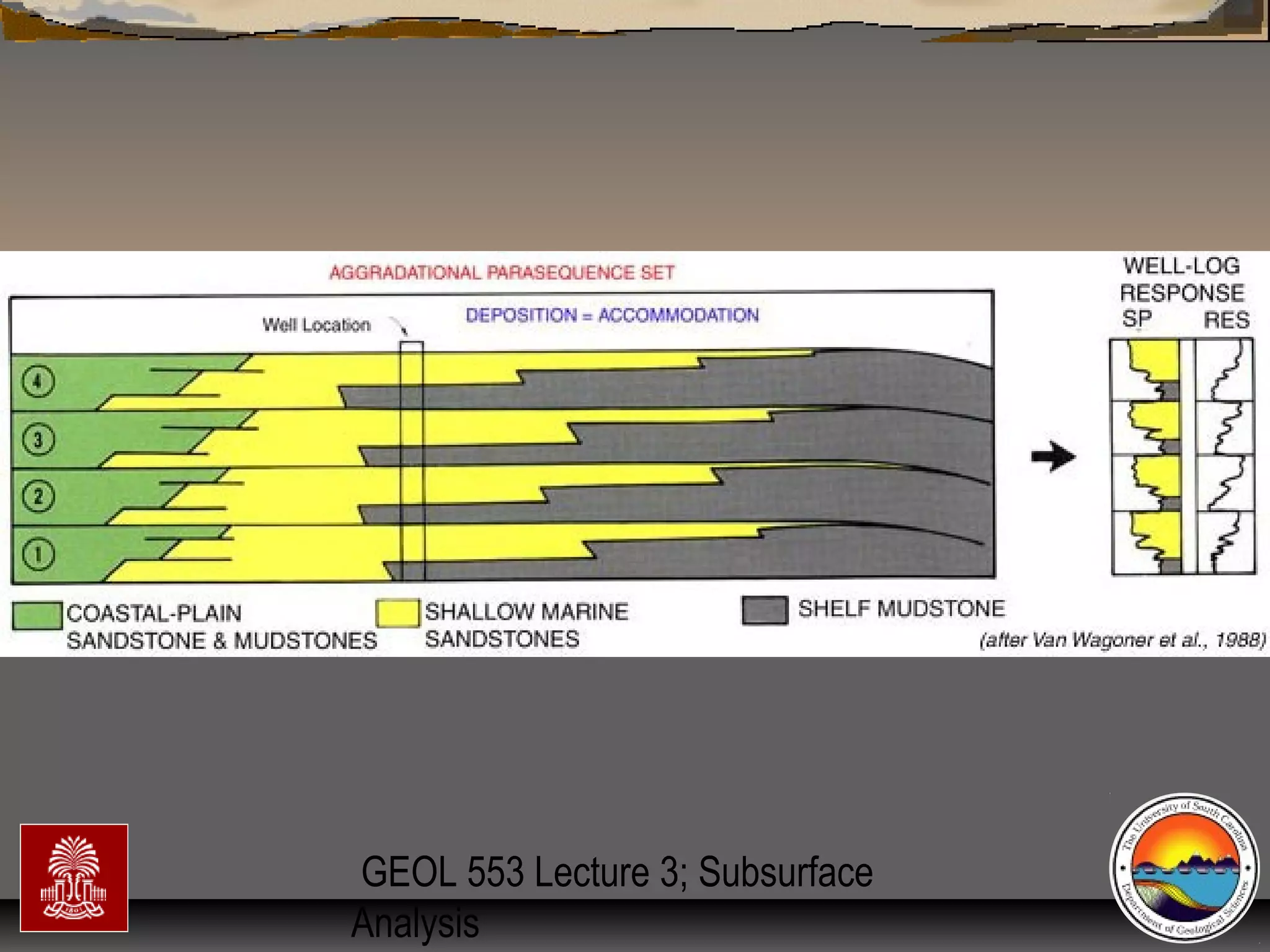
Aggrade (build vertically)Aggrade (build vertically)
 Sheets and unconfined lobes may containSheets and unconfined lobes may contain
Non-amalgamated bodiesNon-amalgamated bodies
 Amalgamated, multi-storied bodiesAmalgamated, multi-storied bodies
Incised topographic fill of valleysIncised topographic fill of valleys
Unconfined but localized lobes from point &Unconfined but localized lobes from point &
Hierarchy of Geometries
GEOL 553 Lecture 3; Subsurface
Analysis
GEOL 553 Lecture 3; Subsurface
Analysis
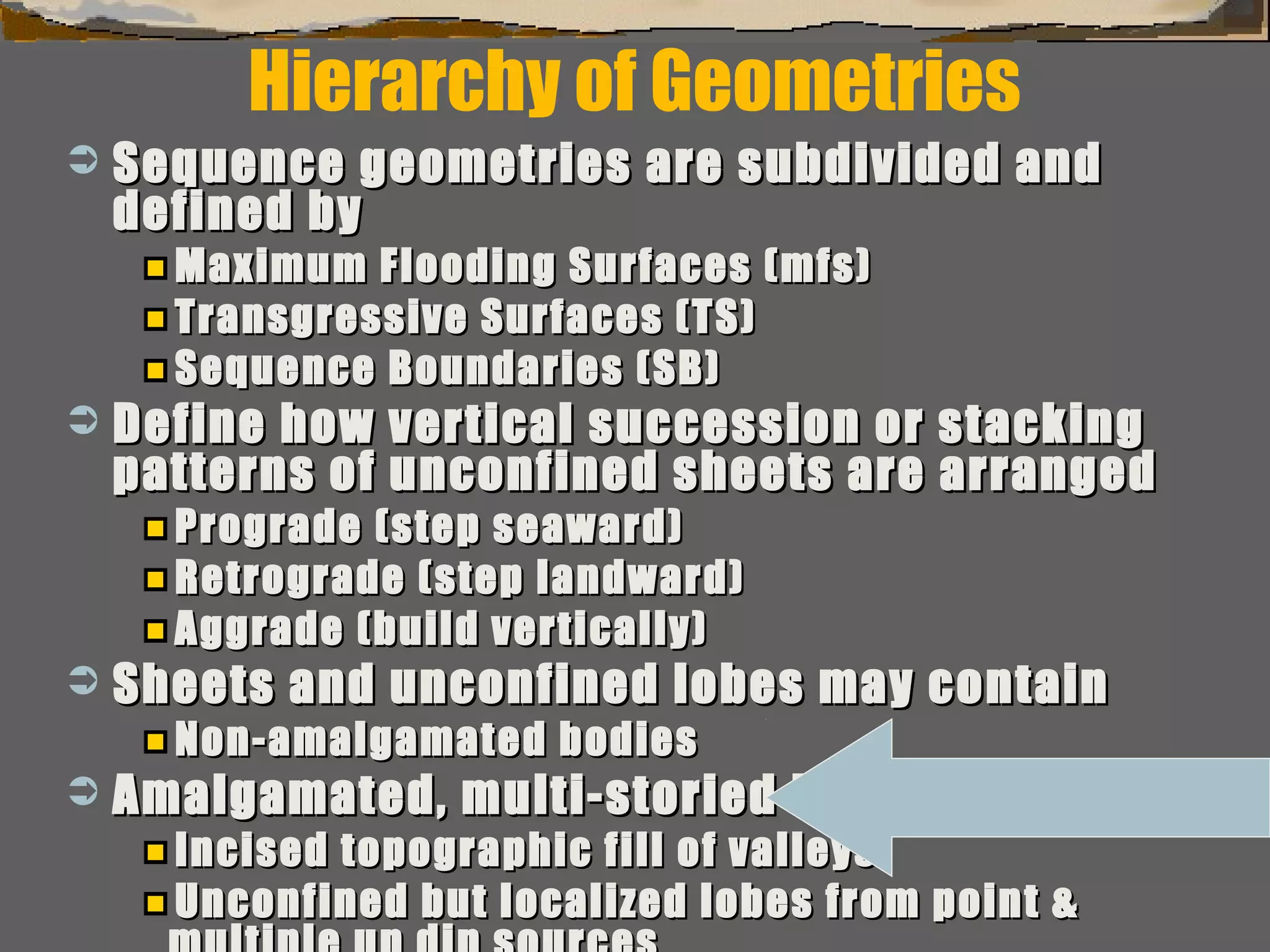
 Sequence geometries are subdivided andSequence geometries are subdivided and
defined bydefined by
Maximum Flooding Surfaces (mfs)Maximum Flooding Surfaces (mfs)
Transgressive Surfaces (TS)Transgressive Surfaces (TS)
Sequence Boundaries (SB)Sequence Boundaries (SB)
 Define how vertical succession or stackingDefine how vertical succession or stacking
patterns of unconfined sheets are arrangedpatterns of unconfined sheets are arranged
Prograde (step seaward)Prograde (step seaward)
Retrograde (step landward)Retrograde (step landward)
Aggrade (build vertically)Aggrade (build vertically)
 Sheets and unconfined lobes may containSheets and unconfined lobes may contain
Non-amalgamated bodiesNon-amalgamated bodies
 Amalgamated, multi-storied bodiesAmalgamated, multi-storied bodies
Incised topographic fill of valleysIncised topographic fill of valleys
Unconfined but localized lobes from point &Unconfined but localized lobes from point &
Hierarchy of Geometries
GEOL 553 Lecture 3; Subsurface
Analysis
GEOL 553 Lecture 3; Subsurface
Analysis
 Sequence geometries are subdivided andSequence geometries are subdivided and
defined bydefined by
Maximum Flooding Surfaces (mfs)Maximum Flooding Surfaces (mfs)
Transgressive Surfaces (TS)Transgressive Surfaces (TS)
Sequence Boundaries (SB)Sequence Boundaries (SB)
 Define how vertical succession or stackingDefine how vertical succession or stacking
patterns of unconfined sheets are arrangedpatterns of unconfined sheets are arranged
Prograde (step seaward)Prograde (step seaward)
Retrograde (step landward)Retrograde (step landward)
Aggrade (build vertically)Aggrade (build vertically)
 Sheets and unconfined lobes may containSheets and unconfined lobes may contain
Non-amalgamated bodiesNon-amalgamated bodies
 Amalgamated, multi-storied bodiesAmalgamated, multi-storied bodies
Incised topographic fill of valleysIncised topographic fill of valleys
Unconfined but localized lobes from point &Unconfined but localized lobes from point &
Hierarchy of Geometries
GEOL 553 Lecture 3; Subsurface
Analysis
GEOL 553 Lecture 3; Subsurface
Analysis
 Sequence geometries are subdivided andSequence geometries are subdivided and
defined bydefined by
Maximum Flooding Surfaces (mfs)Maximum Flooding Surfaces (mfs)
Transgressive Surfaces (TS)Transgressive Surfaces (TS)
Sequence Boundaries (SB)Sequence Boundaries (SB)
 Define how vertical succession or stackingDefine how vertical succession or stacking
patterns of unconfined sheets are arrangedpatterns of unconfined sheets are arranged
Prograde (step seaward)Prograde (step seaward)
Retrograde (step landward)Retrograde (step landward)
Aggrade (build vertically)Aggrade (build vertically)
 Sheets and unconfined lobes may containSheets and unconfined lobes may contain
Non-amalgamated bodiesNon-amalgamated bodies
 Amalgamated, multi-storied bodiesAmalgamated, multi-storied bodies
Incised topographic fill of valleysIncised topographic fill of valleys
Unconfined but localized lobes from point &Unconfined but localized lobes from point &
Hierarchy of Geometries
GEOL 553 Lecture 3; Subsurface
Analysis
GEOL 553 Lecture 3; Subsurface
Analysis
 Sequence geometries are subdivided andSequence geometries are subdivided and
defined bydefined by
Maximum Flooding Surfaces (mfs)Maximum Flooding Surfaces (mfs)
Transgressive Surfaces (TS)Transgressive Surfaces (TS)
Sequence Boundaries (SB)Sequence Boundaries (SB)
 Define how vertical succession or stackingDefine how vertical succession or stacking
patterns of unconfined sheets are arrangedpatterns of unconfined sheets are arranged
Prograde (step seaward)Prograde (step seaward)
Retrograde (step landward)Retrograde (step landward)
Aggrade (build vertically)Aggrade (build vertically)
 Sheets and unconfined lobes may containSheets and unconfined lobes may contain
Non-amalgamated bodiesNon-amalgamated bodies
 Amalgamated, multi-storied bodiesAmalgamated, multi-storied bodies
Incised topographic fill of valleysIncised topographic fill of valleys
Unconfined but localized lobes from point &Unconfined but localized lobes from point &
Hierarchy of Geometries
GEOL 553 Lecture 3; Subsurface
Analysis
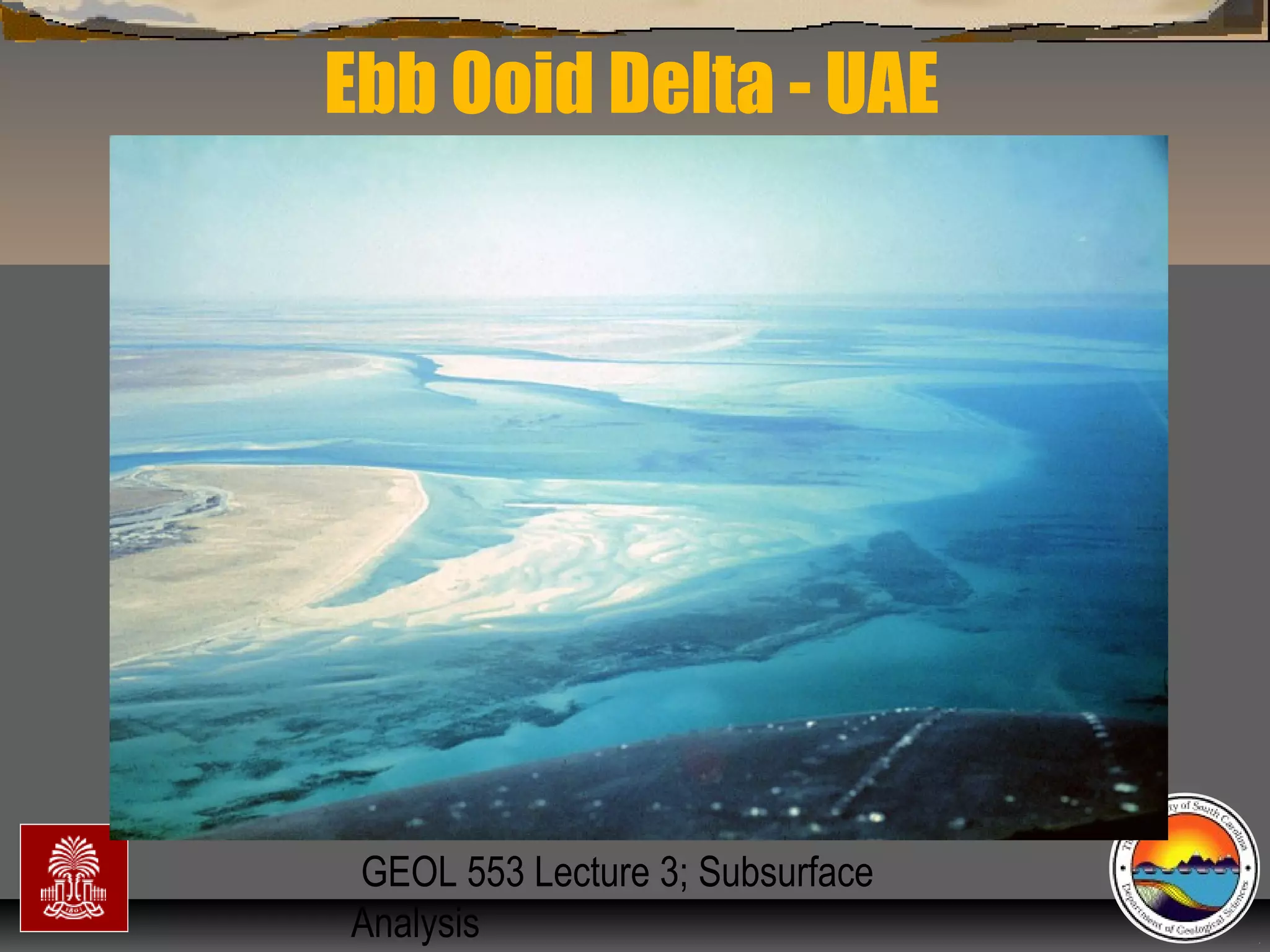
Ebb Ooid Delta - UAE
GEOL 553 Lecture 3; Subsurface
Analysis
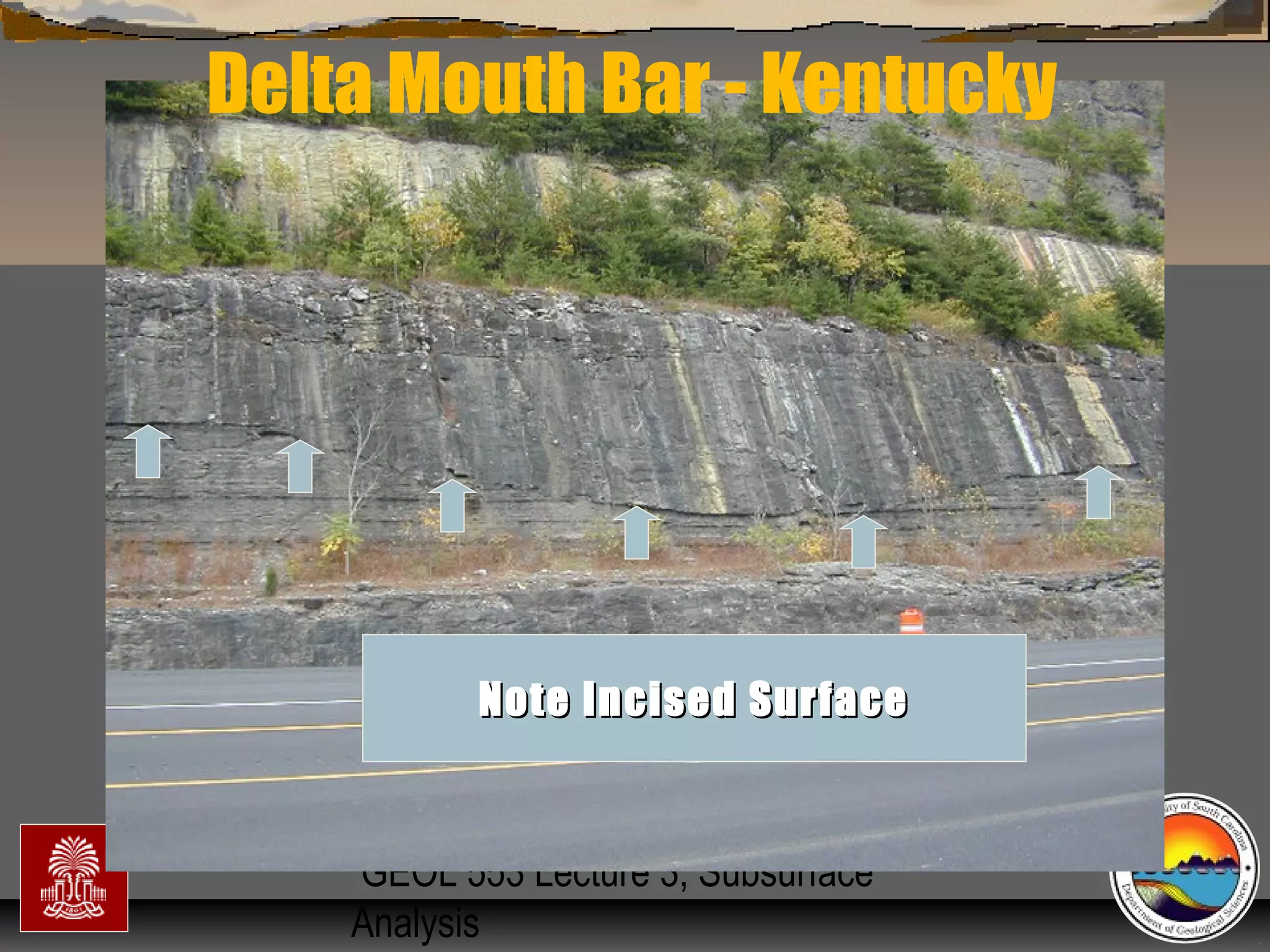
Delta Mouth Bar - Kentucky
Note Incised SurfaceNote Incised Surface
GEOL 553 Lecture 3; Subsurface
Analysis
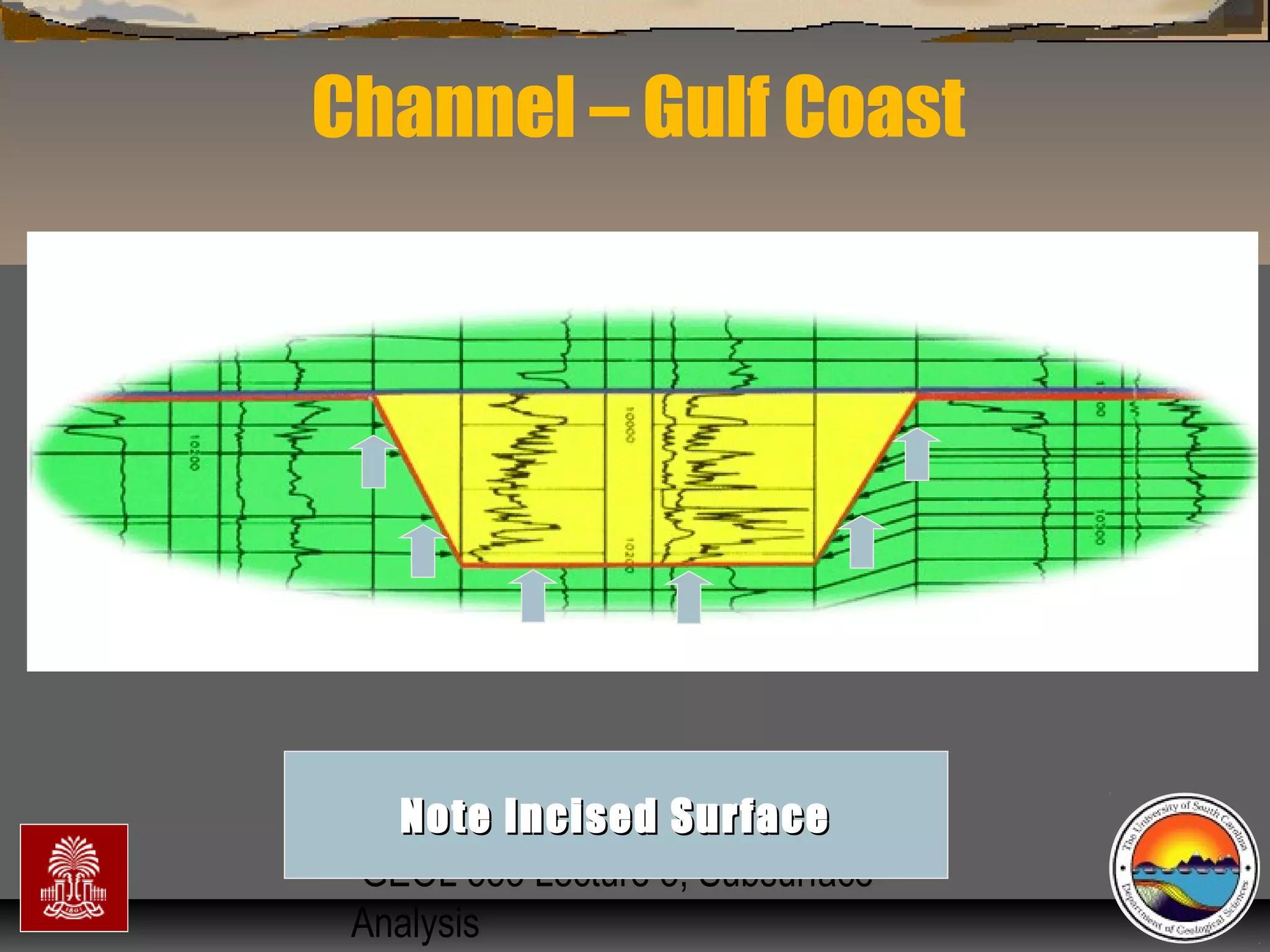
Channel – Gulf Coast
Note Incised SurfaceNote Incised Surface
GEOL 553 Lecture 3; Subsurface
Analysis
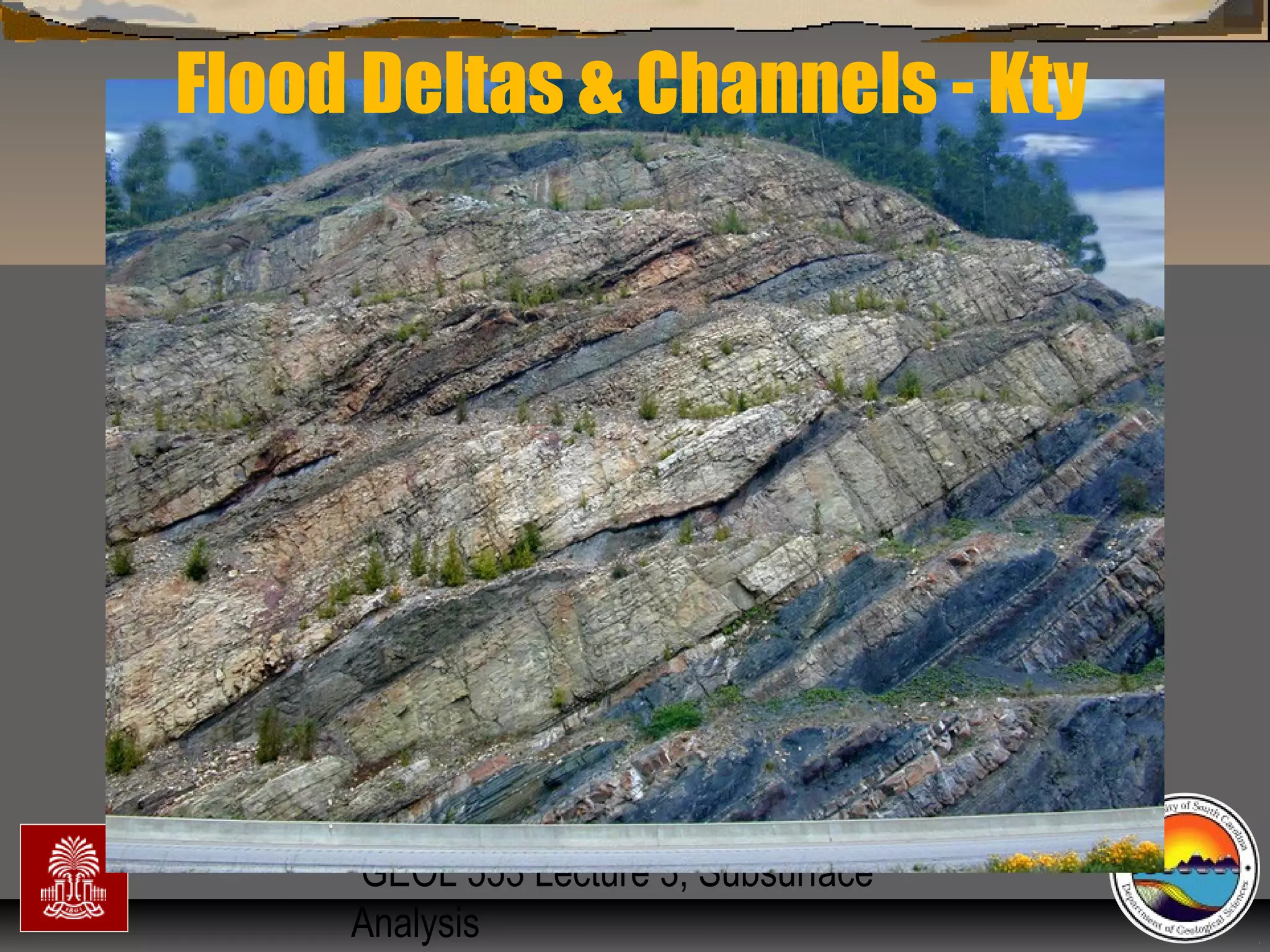
Flood Deltas & Channels - Kty
GEOL 553 Lecture 3; Subsurface
Analysis
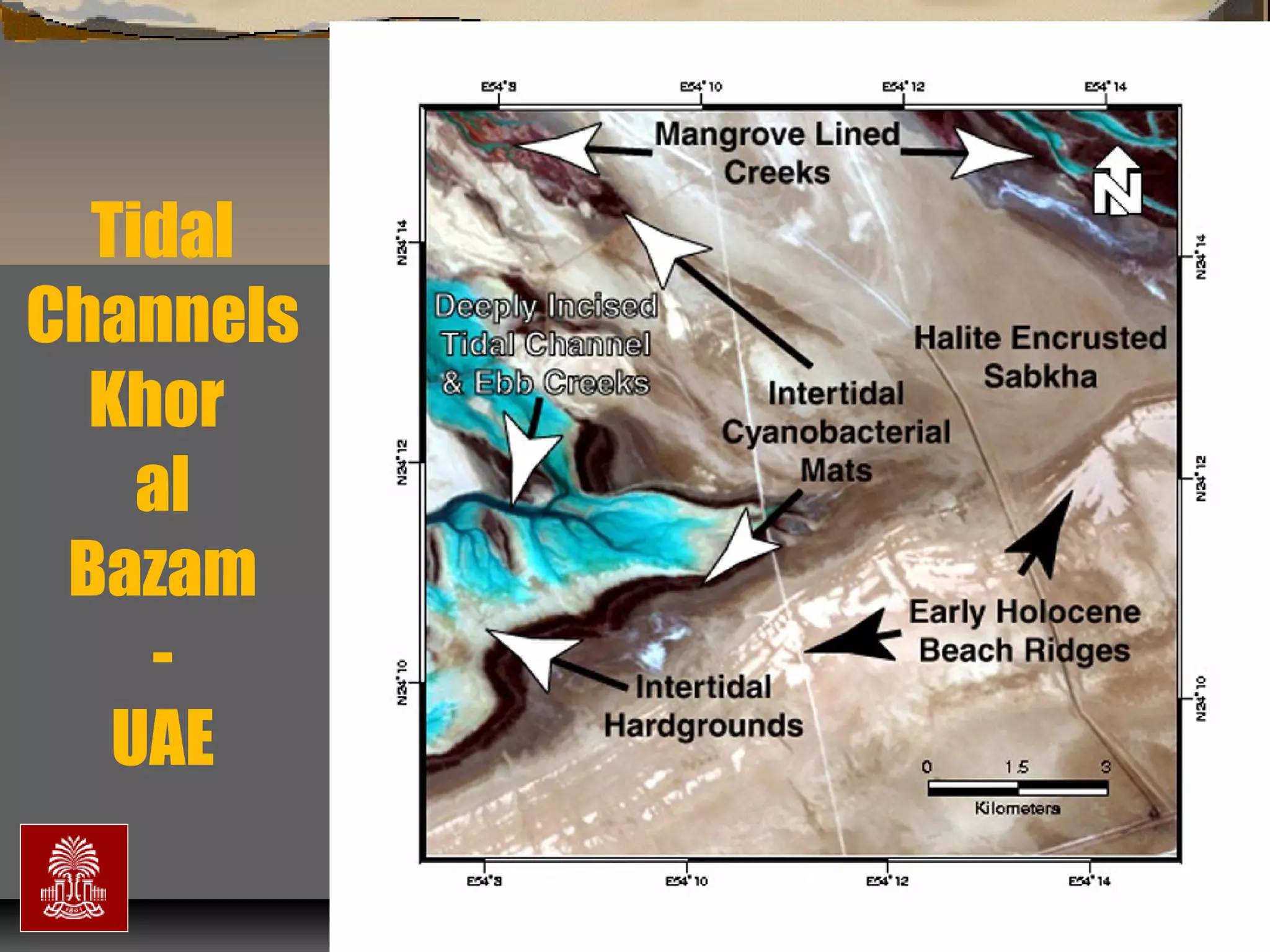
Tidal
Channels
Khor
al
Bazam
-
UAE
GEOL 553 Lecture 3; Subsurface
Analysis
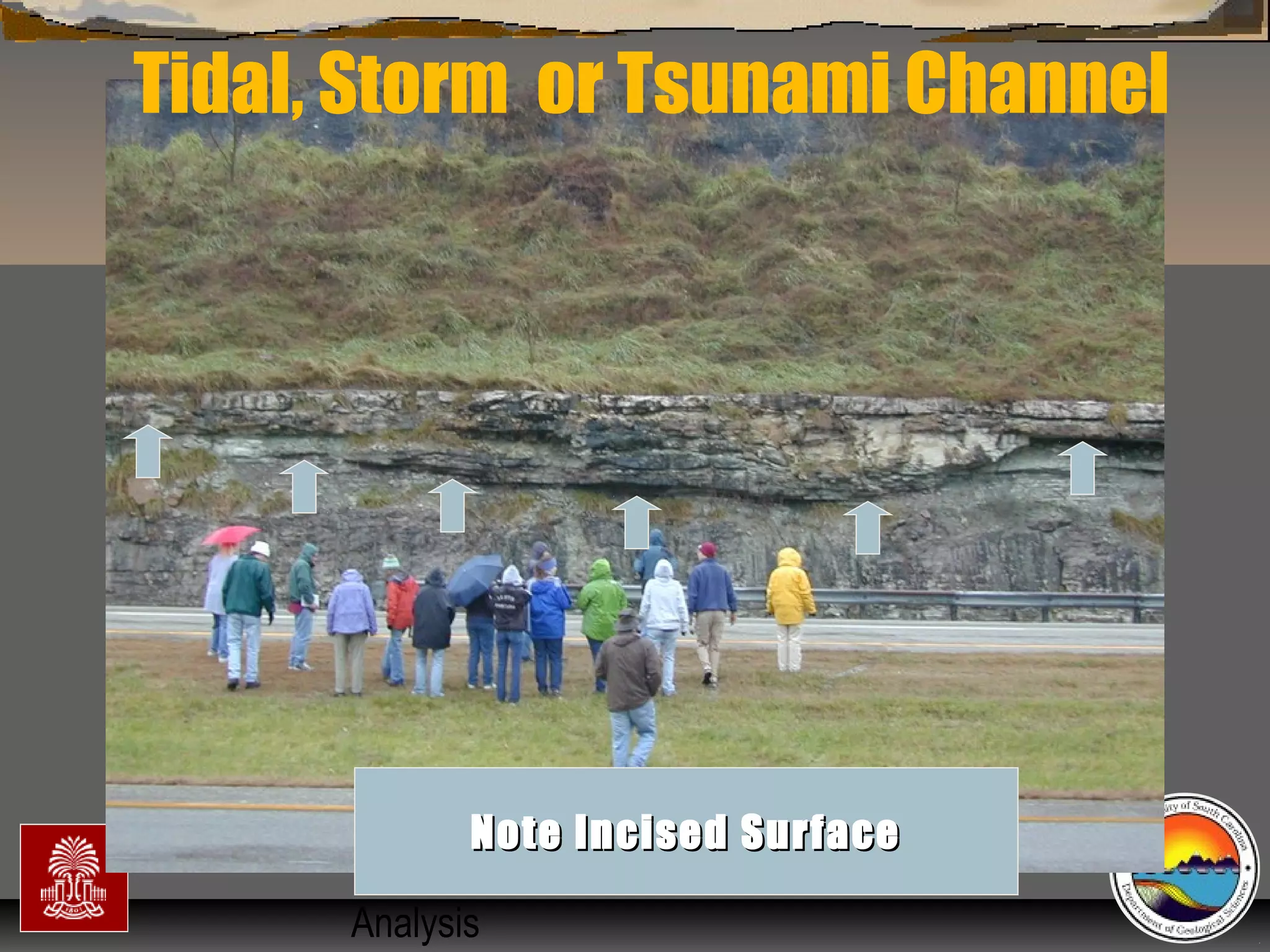
Tidal, Storm or Tsunami Channel
Note Incised SurfaceNote Incised Surface
GEOL 553 Lecture 3; Subsurface
Analysis
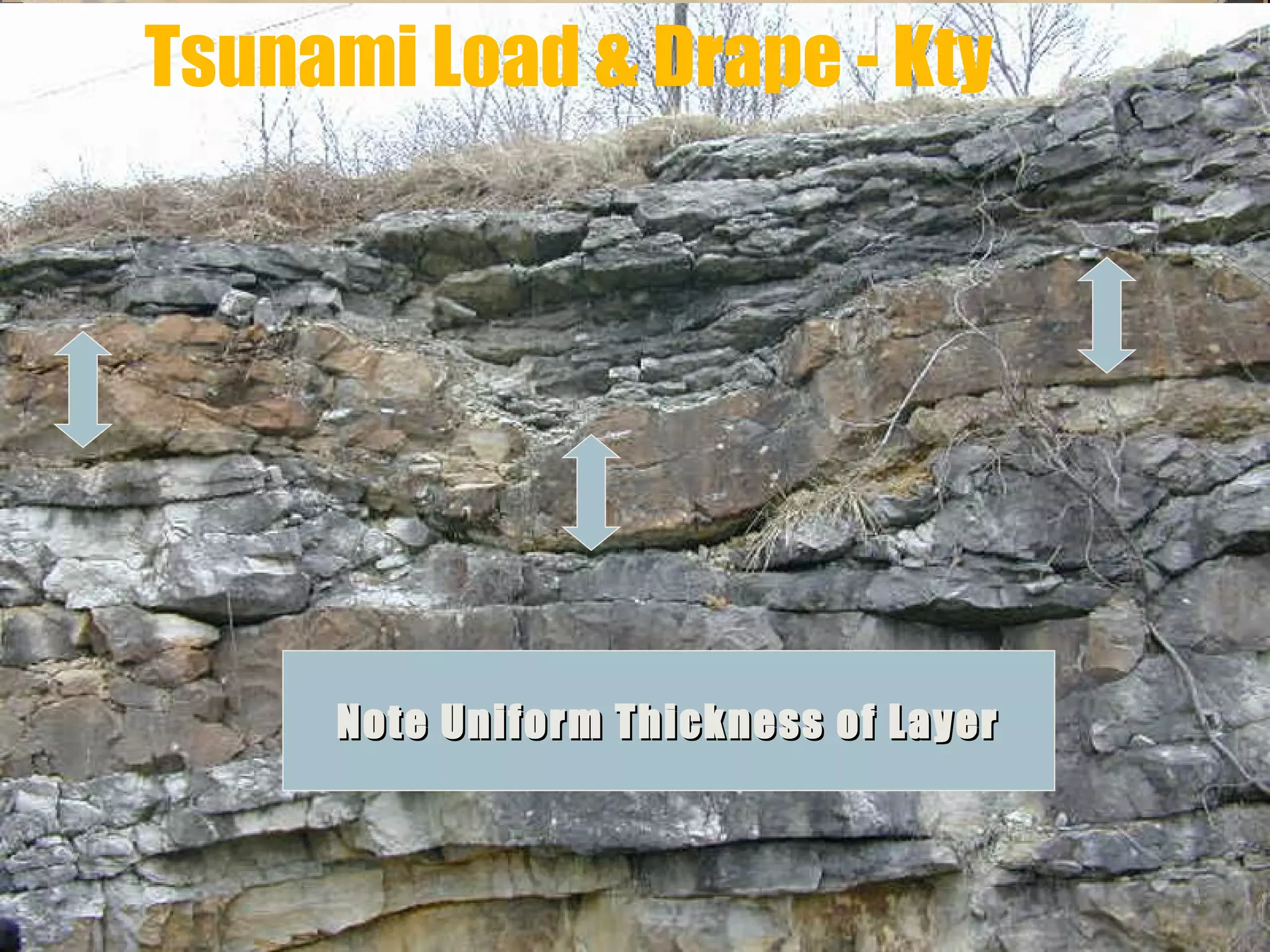
Tsunami Load & Drape - Kty
Note Uniform Thickness of LayerNote Uniform Thickness of Layer
GEOL 553 Lecture 3; Subsurface
Analysis
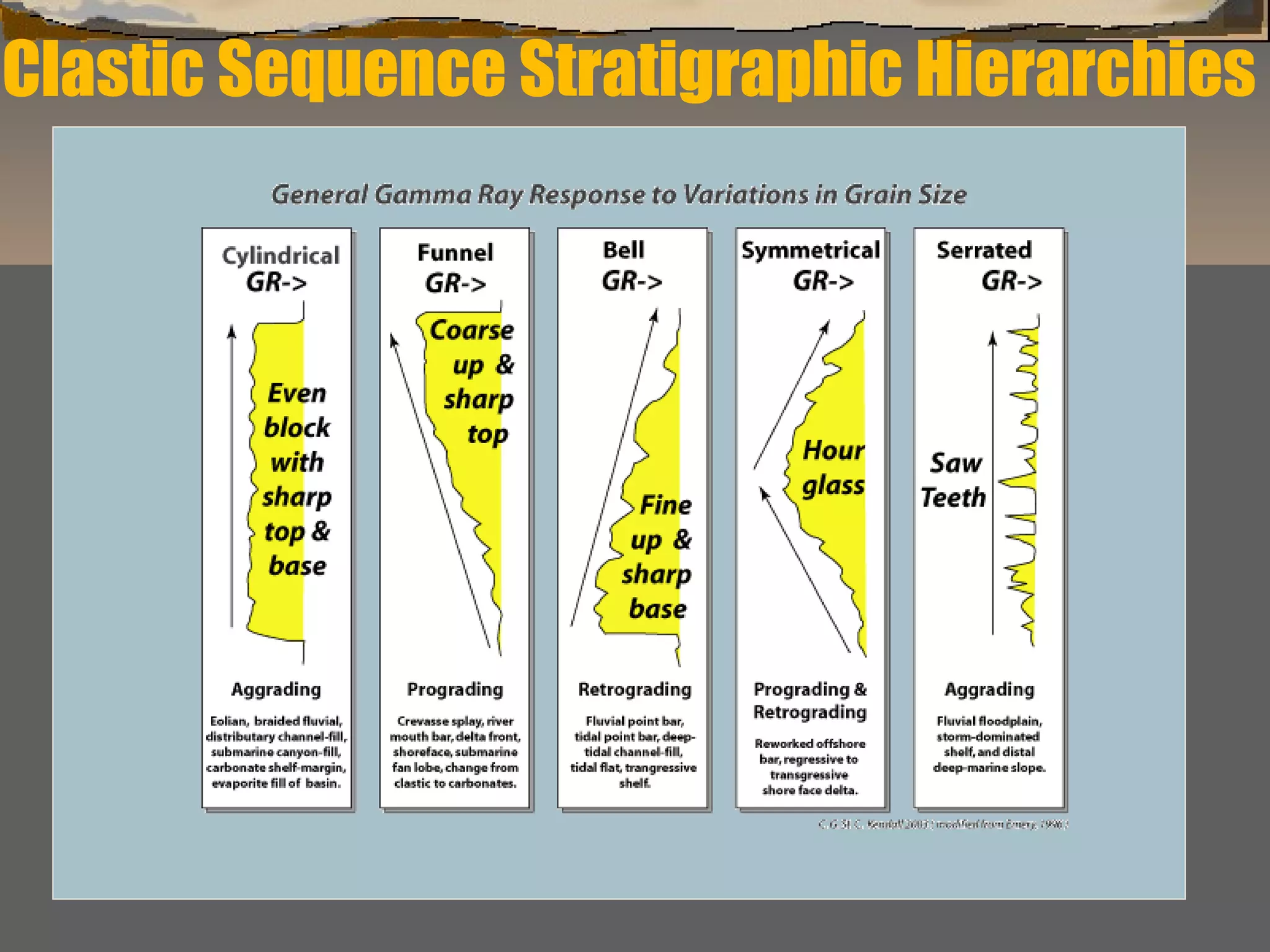
Clastic Sequence Stratigraphic Hierarchies
GEOL 553 Lecture 3; Subsurface
Analysis
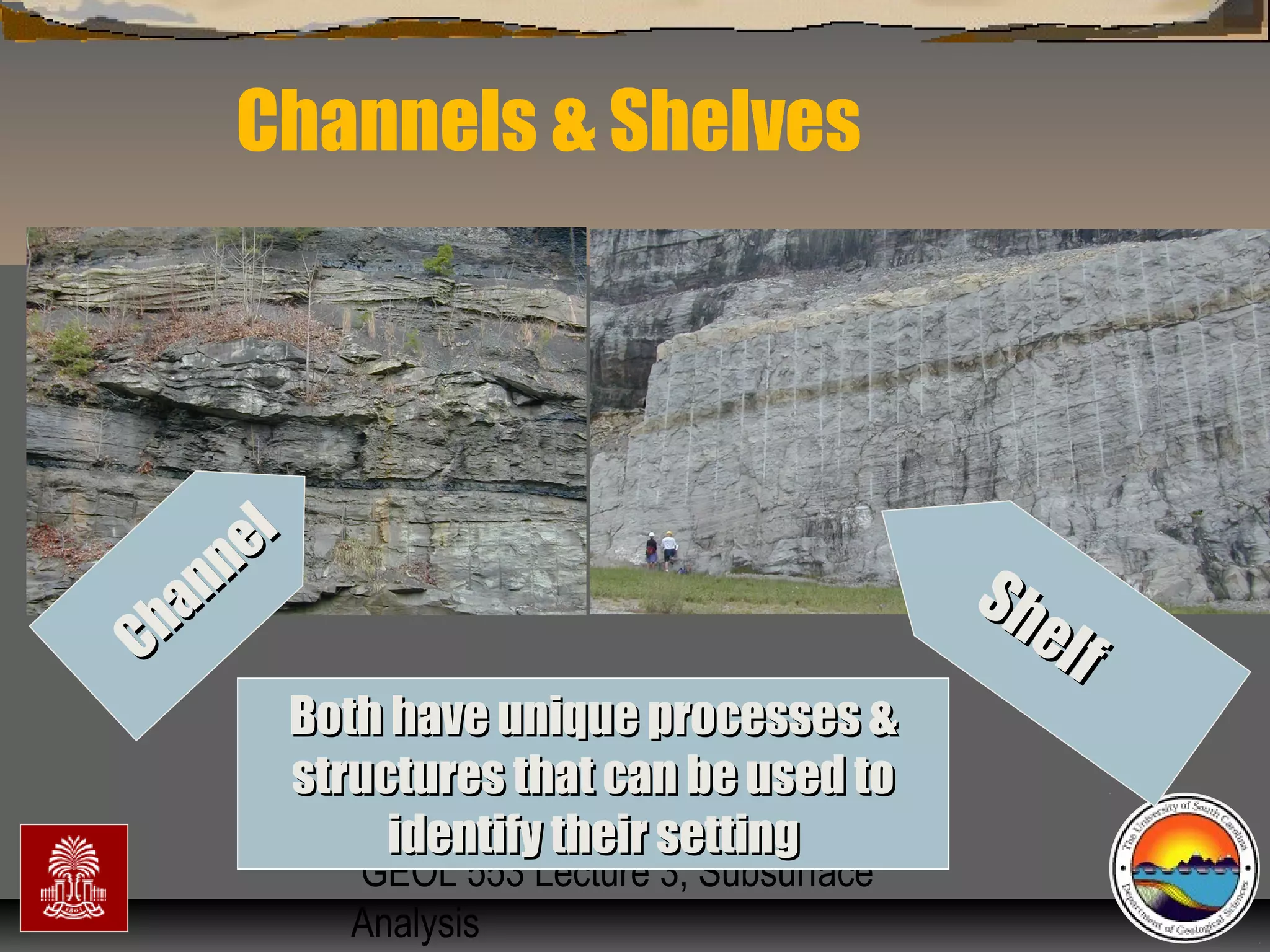
Channels & Shelves
Channel
Channel
Shelf
Shelf
Both have unique processes &Both have unique processes &
structures that can be used tostructures that can be used to
identify their settingidentify their setting
GEOL 553 Lecture 3; Subsurface
Analysis
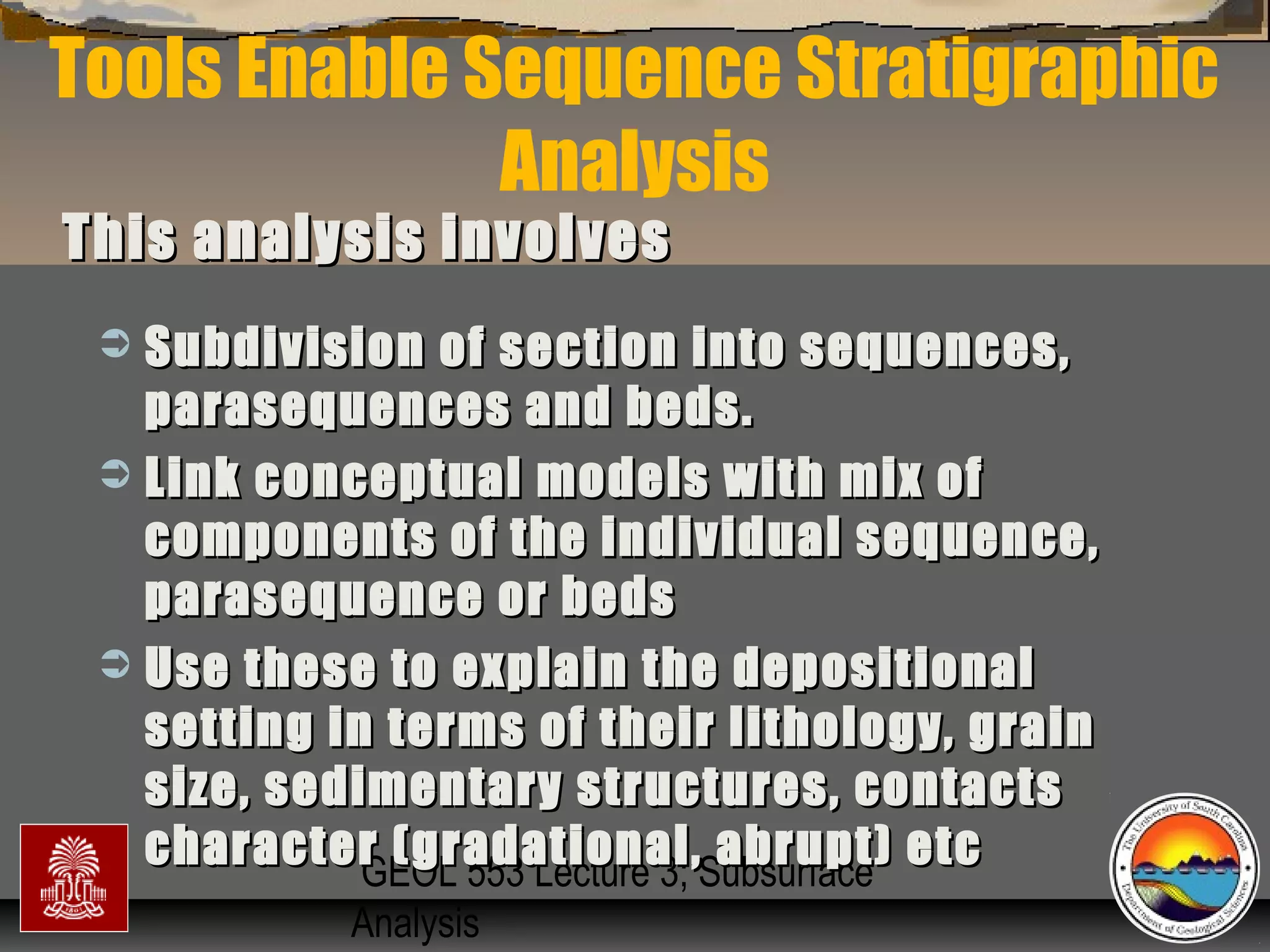
Tools Enable Sequence Stratigraphic
Analysis
 Subdivision of section into sequences,Subdivision of section into sequences,
parasequences and beds.parasequences and beds.
 Link conceptual models with mix ofLink conceptual models with mix of
components of the individual sequence,components of the individual sequence,
parasequence or bedsparasequence or beds
 Use these to explain the depositionalUse these to explain the depositional
setting in terms of their lithology, grainsetting in terms of their lithology, grain
size, sedimentary structures, contactssize, sedimentary structures, contacts
character (gradational, abrupt) etccharacter (gradational, abrupt) etc
This analysis involvesThis analysis involves
GEOL 553 Lecture 3; Subsurface
Analysis
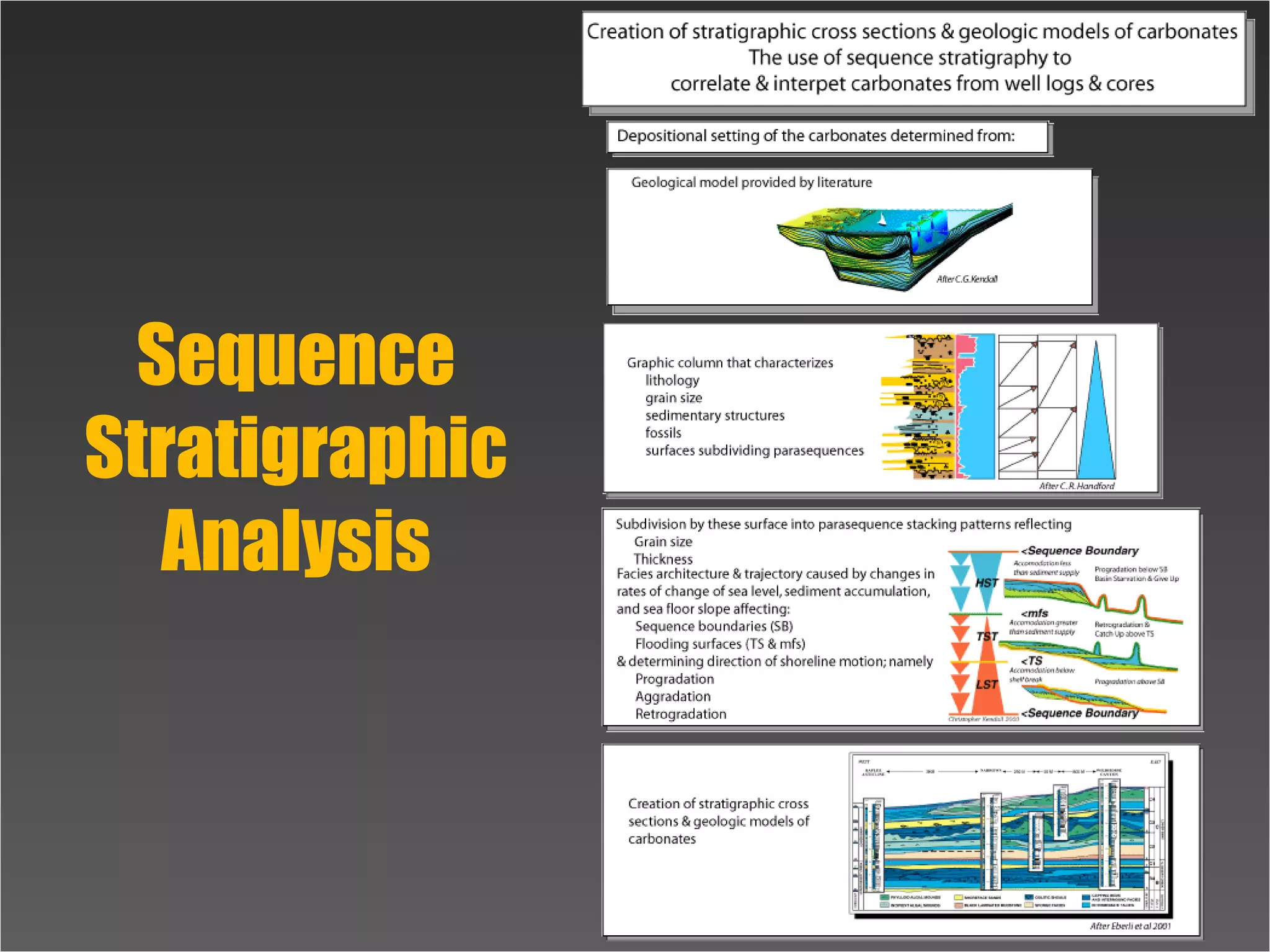
Sequence
Stratigraphic
Analysis
End of the Lecture
Can it be supperCan it be supper
time?time?
GEOL 553 Lecture 3; Subsurface
Analysis
GEOL 553 Lecture 3; Subsurface
Analysis
GEOL 553 Lecture 3; Subsurface
Analysis
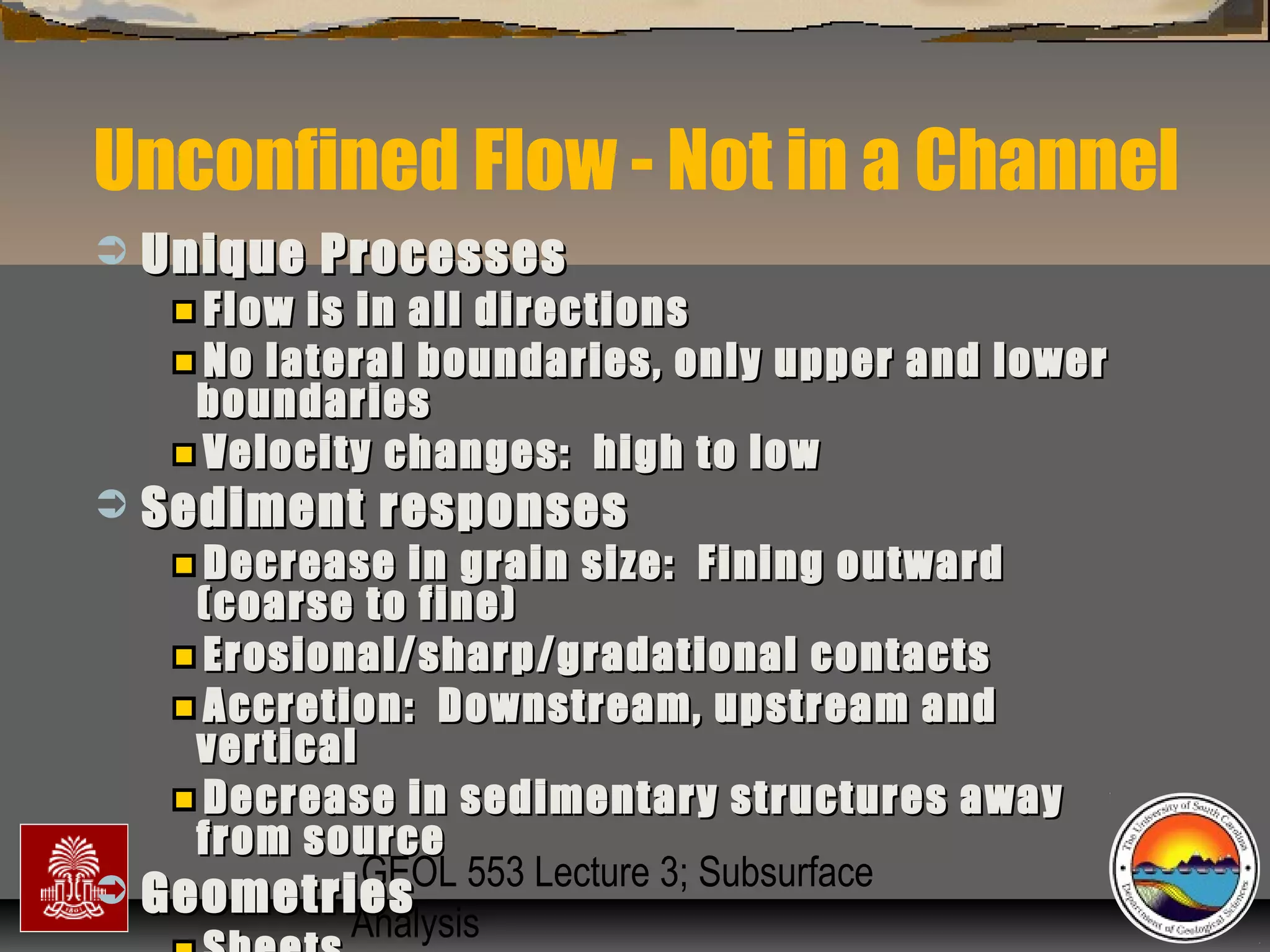
Unconfined Flow - Not in a Channel
 Unique ProcessesUnique Processes
Flow is in all directionsFlow is in all directions
No lateral boundaries, only upper and lowerNo lateral boundaries, only upper and lower
boundariesboundaries
Velocity changes: high to lowVelocity changes: high to low
 Sediment responsesSediment responses
Decrease in grain size: Fining outwardDecrease in grain size: Fining outward
(coarse to fine)(coarse to fine)
Erosional/sharp/gradational contactsErosional/sharp/gradational contacts
Accretion: Downstream, upstream andAccretion: Downstream, upstream and
verticalvertical
Decrease in sedimentary structures awayDecrease in sedimentary structures away
from sourcefrom source
 GeometriesGeometries

Tools for subsurface analysis

  • 1.
    GEOL 553 Lecture3; Subsurface Analysis GEOL 553:GEOL 553: Marine SedimentsMarine Sediments University of South CarolinaUniversity of South Carolina Fall 2005Fall 2005 Professor Chris KendallProfessor Chris Kendall EWS 304EWS 304 kendall@sc.edukendall@sc.edu 777.2410777.2410 The Tools of Subsurface AnalysiThe Tools of Subsurface Analysi
  • 2.
    GEOL 553 Lecture3; Subsurface Analysis The Tools of Subsurface AnalysisThe Tools of Subsurface Analysis  Well logsWell logs  CoresCores  SeismicSeismic  Gravity & magneticsGravity & magnetics Facies analysis of subsurface dataFacies analysis of subsurface data depends on tools which delimit ofdepends on tools which delimit of surfaces and provide clues as to thesurfaces and provide clues as to the sediments they contain:sediments they contain:
  • 3.
    GEOL 553 Lecture3; Subsurface Analysis Well Logs Versus SeismicWell Logs Versus Seismic  Well logsWell logs Great vertical resolutionGreat vertical resolution Delimit bounding surfacesDelimit bounding surfaces Establish lithology of sediments penetratedEstablish lithology of sediments penetrated  SeismicSeismic Great lateral continuity and resolutionGreat lateral continuity and resolution Define gross sediment geometryDefine gross sediment geometry
  • 4.
    GEOL 553 Lecture3; Subsurface Analysis Tools are Keys to Allostratigraphy & Sequence Stratigraphy  AllostratigraphyAllostratigraphy : bounding: bounding discontinuities including erosiondiscontinuities including erosion surfaces, marine flooding surfaces,surfaces, marine flooding surfaces, tuffs, tempestite, and/or turbiditetuffs, tempestite, and/or turbidite boundaries etc. as time markersboundaries etc. as time markers  Sequence StratigraphySequence Stratigraphy : higher level: higher level allostratigraphic model which interpretsallostratigraphic model which interprets depositional origin of sedimentarydepositional origin of sedimentary strata as products of "relative sea levelstrata as products of "relative sea level changechange""
  • 5.
    GEOL 553 Lecture3; Subsurface Analysis The Tools of Subsurface Analysis  Well logsWell logs  SeismicSeismic Facies analysis of subsurface dataFacies analysis of subsurface data depends on tools which delimit ofdepends on tools which delimit of surfaces and provide clues as to thesurfaces and provide clues as to the sediments they contain:sediments they contain:
  • 6.
    GEOL 553 Lecture3; Subsurface Analysis Well Logs  Resistivity LogsResistivity Logs  Spontaneous Potential (SP) LogsSpontaneous Potential (SP) Logs  Gamma Ray LogsGamma Ray Logs  Neutron LogsNeutron Logs  Density LogsDensity Logs  Sonic (acoustic) LogsSonic (acoustic) Logs Delimit of surfaces & identify sediments penetratedDelimit of surfaces & identify sediments penetrated
  • 7.
    GEOL 553 Lecture3; Subsurface Analysis
  • 8.
    GEOL 553 Lecture3; Subsurface Analysis
  • 9.
    GEOL 553 Lecture3; Subsurface Analysis Resistivity Logs  Measures resistance of flow of electricMeasures resistance of flow of electric currentcurrent  Is function of porosity & pore fluid in rockIs function of porosity & pore fluid in rock  Frequently used to identify lithologyFrequently used to identify lithology The most commonly used logs:The most commonly used logs:
  • 10.
    GEOL 553 Lecture3; Subsurface Analysis
  • 11.
    GEOL 553 Lecture3; Subsurface Analysis Spontaneous Potential (SP) Logs  Measures electrical current in wellMeasures electrical current in well  Result of salinity differences betweenResult of salinity differences between formation water and the borehole mudformation water and the borehole mud  Separates bed boundaries of permeableSeparates bed boundaries of permeable sands & impermeable shales.sands & impermeable shales. Next most common logNext most common log
  • 12.
    GEOL 553 Lecture3; Subsurface Analysis
  • 13.
    GEOL 553 Lecture3; Subsurface Analysis Gamma Ray Logs  Records radioactivity of a formationRecords radioactivity of a formation  Shales have high gamma radioactive responseShales have high gamma radioactive response  Gamma ray logs infer grain size (and soGamma ray logs infer grain size (and so subsequently inferred depositional energy)subsequently inferred depositional energy)  Gamma ray logs are most commonly used logsGamma ray logs are most commonly used logs for sequence stratigraphic analysisfor sequence stratigraphic analysis Another common logAnother common log
  • 14.
    GEOL 553 Lecture3; Subsurface Analysis
  • 15.
    GEOL 553 Lecture3; Subsurface Analysis
  • 16.
    GEOL 553 Lecture3; Subsurface AnalysisAfter Harris & Saller 1999
  • 17.
    GEOL 553 Lecture3; Subsurface Analysis Neutron Logs  Measures porosity of formationMeasures porosity of formation  Uses quantity of hydrogen presentUses quantity of hydrogen present  Measures lithology when used with DensityMeasures lithology when used with Density LogLog Another common logAnother common log
  • 18.
    GEOL 553 Lecture3; Subsurface Analysis Density Logs  Measures formation’s bulk densityMeasures formation’s bulk density  Used as a porosity measureUsed as a porosity measure  Differentiates lithologies with Neutron LogDifferentiates lithologies with Neutron Log  Used with Sonic Logs to generate syntheticUsed with Sonic Logs to generate synthetic seismic traces to match to seismic linesseismic traces to match to seismic lines A common logA common log
  • 19.
    GEOL 553 Lecture3; Subsurface Analysis Sonic (Acoustic) Logs  Measures of speed of sound in formationMeasures of speed of sound in formation  Tied to porosity and lithologyTied to porosity and lithology  Used with Density Logs to generateUsed with Density Logs to generate Synthetic Seismic traces to match toSynthetic Seismic traces to match to Seismic linesSeismic lines Another common logAnother common log
  • 20.
    GEOL 553 Lecture3; Subsurface Analysis
  • 21.
    GEOL 553 Lecture3; Subsurface Analysis
  • 22.
    GEOL 553 Lecture3; Subsurface Analysis The Tools of Subsurface Analysis  Well logsWell logs  SeismicSeismic Facies analysis of subsurface dataFacies analysis of subsurface data depends on tools which delimit ofdepends on tools which delimit of surfaces and provide clues as to thesurfaces and provide clues as to the sediments they contain:sediments they contain:
  • 23.
    GEOL 553 Lecture3; Subsurface Analysis Seismic  Define geometries of genetic reflectionDefine geometries of genetic reflection packages that envelope seismic sequencespackages that envelope seismic sequences and systems tractsand systems tracts  Identify bounding discontinuities on basisIdentify bounding discontinuities on basis of reflection termination patterns andof reflection termination patterns and continuitycontinuity Seismic stratigraphic interpretationSeismic stratigraphic interpretation used to:used to:
  • 24.
    GEOL 553 Lecture3; Subsurface Analysis Seismic Boundaries  Toplap terminationToplap termination  Truncation of sediment surfaceTruncation of sediment surface  Often channel bottomOften channel bottom Termination below discontinuity, orTermination below discontinuity, or upper sequence boundaryupper sequence boundary ::  Onlap over surfaceOnlap over surface  Downlap surfaceDownlap surface Above a discontinuity defining lowerAbove a discontinuity defining lower sequence boundary:sequence boundary:
  • 25.
    GEOL 553 Lecture3; Subsurface Analysis Seismic Boundaries Below Boundary - Toplap terminationBelow Boundary - Toplap termination
  • 26.
    GEOL 553 Lecture3; Subsurface Analysis Seismic Boundaries Below Boundary -Below Boundary - Truncation of surfaceTruncation of surface
  • 27.
    GEOL 553 Lecture3; Subsurface Analysis Seismic Boundaries ChanneledChanneled SurfaceSurface –– BelowBelow BoundaryBoundary
  • 28.
    GEOL 553 Lecture3; Subsurface Analysis Seismic Boundaries Over Boundary - Onlap onto surfaceOver Boundary - Onlap onto surface
  • 29.
    GEOL 553 Lecture3; Subsurface Analysis Seismic Boundaries Over Boundary- Downlap onto surfaceOver Boundary- Downlap onto surface
  • 30.
    GEOL 553 Lecture3; Subsurface Analysis
  • 31.
    GEOL 553 Lecture3; Subsurface Analysis
  • 32.
    GEOL 553 Lecture3; Subsurface Analysis
  • 33.
    GEOL 553 Lecture3; Subsurface Analysis
  • 34.
    GEOL 553 Lecture3; Subsurface Analysis Sequence Stratigraphy  Surfaces of erosion & non-deposition (sequenceSurfaces of erosion & non-deposition (sequence boundaries)boundaries)  Flooding (trangressive surfaces [TS] &/orFlooding (trangressive surfaces [TS] &/or maximum flooding surfaces [mfs]) & high standmaximum flooding surfaces [mfs]) & high stand condensed surfacescondensed surfaces Subdivision & interpretation of sedimentarySubdivision & interpretation of sedimentary record using a framework surfaces seen inrecord using a framework surfaces seen in outcrops,outcrops, well logs, & 2-D and 3-D seismicwell logs, & 2-D and 3-D seismic.. Include:Include: This framework used to predict the extentThis framework used to predict the extent of sedimentary facies geometry, lithologicof sedimentary facies geometry, lithologic character, grain size, sorting & reservoircharacter, grain size, sorting & reservoir qualityquality
  • 35.
    GEOL 553 Lecture3; Subsurface Analysis Tools Define Bounding Surfaces  Relative time framework forRelative time framework for sedimentary successionsedimentary succession  Better understanding of inter-Better understanding of inter- relationship of depositional settings &relationship of depositional settings & their lateral correlationtheir lateral correlation These surfaces subdivide sedimentary rockThese surfaces subdivide sedimentary rock & provide:-provide:- Conceptual models follow that link the processes that formed the sediments and enable the prediction of their gross geometries
  • 36.
    GEOL 553 Lecture3; Subsurface Analysis  Sequence geometries are subdivided andSequence geometries are subdivided and defined bydefined by Maximum Flooding Surfaces (mfs)Maximum Flooding Surfaces (mfs) Transgressive Surfaces (TS)Transgressive Surfaces (TS) Sequence Boundaries (SB)Sequence Boundaries (SB)  Define how vertical succession or stackingDefine how vertical succession or stacking patterns of unconfined sheets are arrangedpatterns of unconfined sheets are arranged Prograde (step seaward)Prograde (step seaward) Retrograde (step landward)Retrograde (step landward) Aggrade (build vertically)Aggrade (build vertically)  Sheets and unconfined lobes may containSheets and unconfined lobes may contain Non-amalgamated bodiesNon-amalgamated bodies  Amalgamated, multi-storied bodiesAmalgamated, multi-storied bodies Incised topographic fill of valleysIncised topographic fill of valleys Unconfined but localized lobes from point &Unconfined but localized lobes from point & Hierarchy of Geometries
  • 37.
    GEOL 553 Lecture3; Subsurface Analysis
  • 38.
    GEOL 553 Lecture3; Subsurface Analysis  Sequence geometries are subdivided andSequence geometries are subdivided and defined bydefined by Maximum Flooding Surfaces (mfs)Maximum Flooding Surfaces (mfs) Transgressive Surfaces (TS)Transgressive Surfaces (TS) Sequence Boundaries (SB)Sequence Boundaries (SB)  Define how vertical succession or stackingDefine how vertical succession or stacking patterns of unconfined sheets are arrangedpatterns of unconfined sheets are arranged Prograde (step seaward)Prograde (step seaward) Retrograde (step landward)Retrograde (step landward) Aggrade (build vertically)Aggrade (build vertically)  Sheets and unconfined lobes may containSheets and unconfined lobes may contain Non-amalgamated bodiesNon-amalgamated bodies  Amalgamated, multi-storied bodiesAmalgamated, multi-storied bodies Incised topographic fill of valleysIncised topographic fill of valleys Unconfined but localized lobes from point &Unconfined but localized lobes from point & Hierarchy of Geometries
  • 39.
    GEOL 553 Lecture3; Subsurface Analysis
  • 40.
    GEOL 553 Lecture3; Subsurface Analysis  Sequence geometries are subdivided andSequence geometries are subdivided and defined bydefined by Maximum Flooding Surfaces (mfs)Maximum Flooding Surfaces (mfs) Transgressive Surfaces (TS)Transgressive Surfaces (TS) Sequence Boundaries (SB)Sequence Boundaries (SB)  Define how vertical succession or stackingDefine how vertical succession or stacking patterns of unconfined sheets are arrangedpatterns of unconfined sheets are arranged Prograde (step seaward)Prograde (step seaward) Retrograde (step landward)Retrograde (step landward) Aggrade (build vertically)Aggrade (build vertically)  Sheets and unconfined lobes may containSheets and unconfined lobes may contain Non-amalgamated bodiesNon-amalgamated bodies  Amalgamated, multi-storied bodiesAmalgamated, multi-storied bodies Incised topographic fill of valleysIncised topographic fill of valleys Unconfined but localized lobes from point &Unconfined but localized lobes from point & Hierarchy of Geometries
  • 41.
    GEOL 553 Lecture3; Subsurface Analysis
  • 42.
    GEOL 553 Lecture3; Subsurface Analysis  Sequence geometries are subdivided andSequence geometries are subdivided and defined bydefined by Maximum Flooding Surfaces (mfs)Maximum Flooding Surfaces (mfs) Transgressive Surfaces (TS)Transgressive Surfaces (TS) Sequence Boundaries (SB)Sequence Boundaries (SB)  Define how vertical succession or stackingDefine how vertical succession or stacking patterns of unconfined sheets are arrangedpatterns of unconfined sheets are arranged Prograde (step seaward)Prograde (step seaward) Retrograde (step landward)Retrograde (step landward) Aggrade (build vertically)Aggrade (build vertically)  Sheets and unconfined lobes may containSheets and unconfined lobes may contain Non-amalgamated bodiesNon-amalgamated bodies  Amalgamated, multi-storied bodiesAmalgamated, multi-storied bodies Incised topographic fill of valleysIncised topographic fill of valleys Unconfined but localized lobes from point &Unconfined but localized lobes from point & Hierarchy of Geometries
  • 43.
    GEOL 553 Lecture3; Subsurface Analysis
  • 44.
    GEOL 553 Lecture3; Subsurface Analysis  Sequence geometries are subdivided andSequence geometries are subdivided and defined bydefined by Maximum Flooding Surfaces (mfs)Maximum Flooding Surfaces (mfs) Transgressive Surfaces (TS)Transgressive Surfaces (TS) Sequence Boundaries (SB)Sequence Boundaries (SB)  Define how vertical succession or stackingDefine how vertical succession or stacking patterns of unconfined sheets are arrangedpatterns of unconfined sheets are arranged Prograde (step seaward)Prograde (step seaward) Retrograde (step landward)Retrograde (step landward) Aggrade (build vertically)Aggrade (build vertically)  Sheets and unconfined lobes may containSheets and unconfined lobes may contain Non-amalgamated bodiesNon-amalgamated bodies  Amalgamated, multi-storied bodiesAmalgamated, multi-storied bodies Incised topographic fill of valleysIncised topographic fill of valleys Unconfined but localized lobes from point &Unconfined but localized lobes from point & Hierarchy of Geometries
  • 45.
    GEOL 553 Lecture3; Subsurface Analysis Ebb Ooid Delta - UAE
  • 46.
    GEOL 553 Lecture3; Subsurface Analysis Delta Mouth Bar - Kentucky Note Incised SurfaceNote Incised Surface
  • 47.
    GEOL 553 Lecture3; Subsurface Analysis Channel – Gulf Coast Note Incised SurfaceNote Incised Surface
  • 48.
    GEOL 553 Lecture3; Subsurface Analysis Flood Deltas & Channels - Kty
  • 49.
    GEOL 553 Lecture3; Subsurface Analysis Tidal Channels Khor al Bazam - UAE
  • 50.
    GEOL 553 Lecture3; Subsurface Analysis Tidal, Storm or Tsunami Channel Note Incised SurfaceNote Incised Surface
  • 51.
    GEOL 553 Lecture3; Subsurface Analysis Tsunami Load & Drape - Kty Note Uniform Thickness of LayerNote Uniform Thickness of Layer
  • 52.
    GEOL 553 Lecture3; Subsurface Analysis Clastic Sequence Stratigraphic Hierarchies
  • 53.
    GEOL 553 Lecture3; Subsurface Analysis Channels & Shelves Channel Channel Shelf Shelf Both have unique processes &Both have unique processes & structures that can be used tostructures that can be used to identify their settingidentify their setting
  • 54.
    GEOL 553 Lecture3; Subsurface Analysis Tools Enable Sequence Stratigraphic Analysis  Subdivision of section into sequences,Subdivision of section into sequences, parasequences and beds.parasequences and beds.  Link conceptual models with mix ofLink conceptual models with mix of components of the individual sequence,components of the individual sequence, parasequence or bedsparasequence or beds  Use these to explain the depositionalUse these to explain the depositional setting in terms of their lithology, grainsetting in terms of their lithology, grain size, sedimentary structures, contactssize, sedimentary structures, contacts character (gradational, abrupt) etccharacter (gradational, abrupt) etc This analysis involvesThis analysis involves
  • 55.
    GEOL 553 Lecture3; Subsurface Analysis Sequence Stratigraphic Analysis
  • 56.
    End of theLecture Can it be supperCan it be supper time?time?
  • 57.
    GEOL 553 Lecture3; Subsurface Analysis
  • 58.
    GEOL 553 Lecture3; Subsurface Analysis
  • 59.
    GEOL 553 Lecture3; Subsurface Analysis Unconfined Flow - Not in a Channel  Unique ProcessesUnique Processes Flow is in all directionsFlow is in all directions No lateral boundaries, only upper and lowerNo lateral boundaries, only upper and lower boundariesboundaries Velocity changes: high to lowVelocity changes: high to low  Sediment responsesSediment responses Decrease in grain size: Fining outwardDecrease in grain size: Fining outward (coarse to fine)(coarse to fine) Erosional/sharp/gradational contactsErosional/sharp/gradational contacts Accretion: Downstream, upstream andAccretion: Downstream, upstream and verticalvertical Decrease in sedimentary structures awayDecrease in sedimentary structures away from sourcefrom source  GeometriesGeometries