Presented By:
Md Shadab Alam
Assistant Professor, Department Of Special
Education
Himalayan University, Itanagar
• First Indian comprehensive Behavioral Scale developed in 1975
at Chennai by Pro. P. Jeyachandran sir and Pro. V. Vimala Ma’am.
• Used for any age, sex, and level of retardation.
• A Criterion referenced Assessment Scale.
• Used for Individualized Educational Programming and in
classroom teaching.
• 18 domains – each domain comprises of 20 items. Total no. of
items are 360.
• The items are sequentially arranged according to normal
development.
1. Gross motor activities
2. Fine Motor activities
3. Meal Time Activities
4. Dressing
5. Grooming
6. Toileting
7. Receptive Language
8. Expressive Language
9. Social Interaction
10. Reading
11. Writing
12. Numbers
13. Time
14. Money
15.Domestic Activities
16. Community Orientation
17. Recreation, Leisure Time Activities
18. Vocational
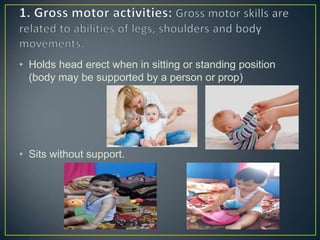
• Holds head erect when in sitting or standing position
(body may be supported by a person or prop)
• Sits without support.
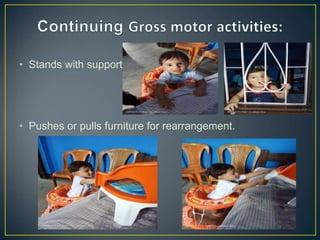
• Stands with support.
• Pushes or pulls furniture for rearrangement.
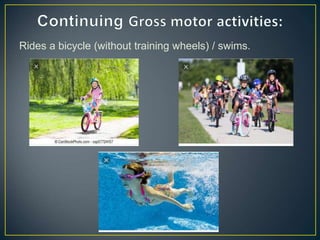
Rides a bicycle (without training wheels) / swims.
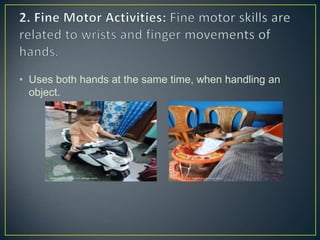
• Uses both hands at the same time, when handling an
object.
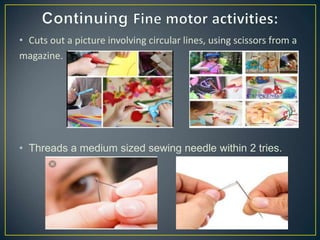
• Cuts out a picture involving circular lines, using scissors from a
magazine.
• Threads a medium sized sewing needle within 2 tries.
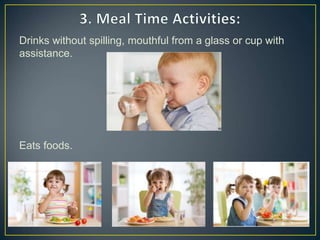
Drinks without spilling, mouthful from a glass or cup with
assistance.
Eats foods.
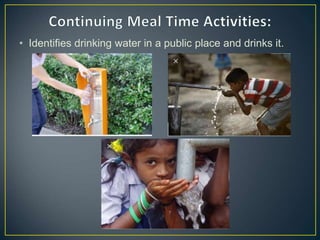
• Identifies drinking water in a public place and drinks it.
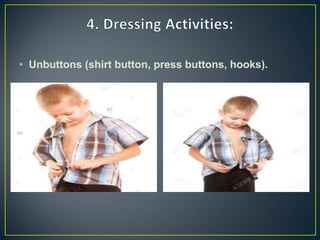
• Unbuttons (shirt button, press buttons, hooks).
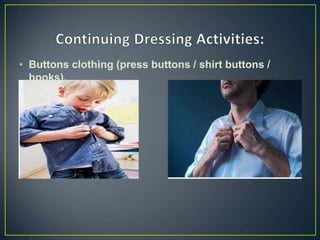
• Buttons clothing (press buttons / shirt buttons /
hooks).
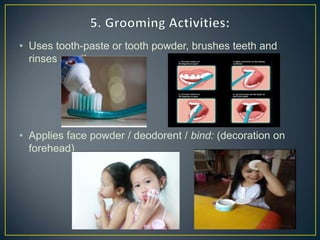
• Uses tooth-paste or tooth powder, brushes teeth and
rinses mouth.
• Applies face powder / deodorent / bind: (decoration on
forehead)
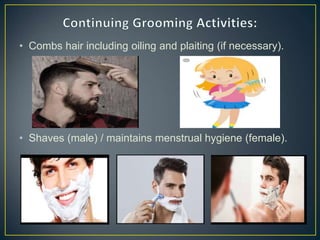
• Combs hair including oiling and plaiting (if necessary).
• Shaves (male) / maintains menstrual hygiene (female).
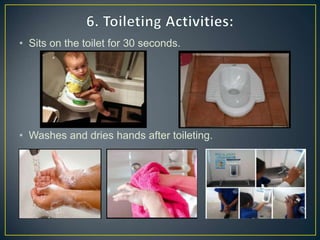
• Sits on the toilet for 30 seconds.
• Washes and dries hands after toileting.
• Communication is simply the act of transferring
information from one place/person to another person. It is
most important vehicle of human being for their feelings
through Verbally, Non Verbally, Written and Visualization.
It has two parts one is Receptive and second is
Expressive.
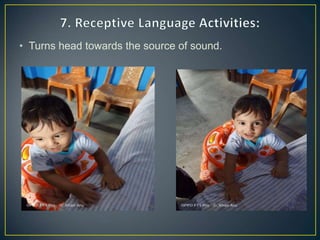
• Turns head towards the source of sound.
• Uses voice sounds to get attention.
• 3. Says or indicates, 'Yes' or 'No' in response to
questions.
• Carries on a meaningful conversation with another
person(s) for 10 minutes.
• Summarises a T.V./Radio programme in own words.
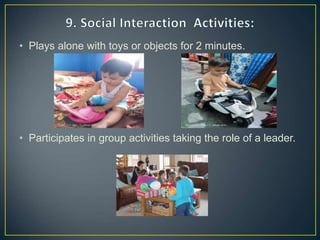
• Plays alone with toys or objects for 2 minutes.
• Participates in group activities taking the role of a leader.
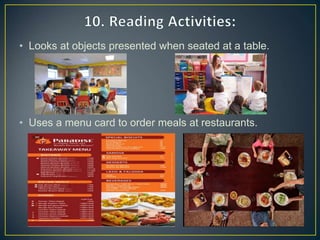
• Looks at objects presented when seated at a table.
• Uses a menu card to order meals at restaurants.
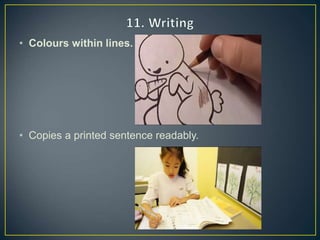
• Colours within lines.
• Copies a printed sentence readably.
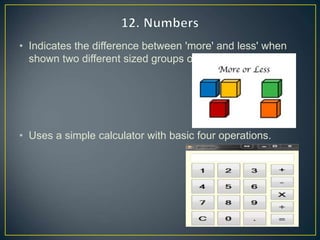
• Indicates the difference between 'more' and less' when
shown two different sized groups of objects.
• Uses a simple calculator with basic four operations.
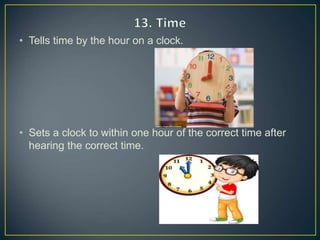
• Tells time by the hour on a clock.
• Sets a clock to within one hour of the correct time after
hearing the correct time.
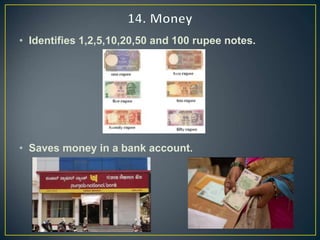
• Identifies 1,2,5,10,20,50 and 100 rupee notes.
• Saves money in a bank account.
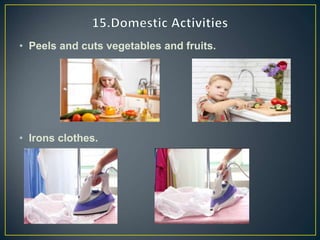
• Peels and cuts vegetables and fruits.
• Irons clothes.
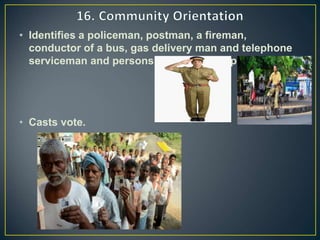
• Identifies a policeman, postman, a fireman,
conductor of a bus, gas delivery man and telephone
serviceman and persons from power supply.
• Casts vote.
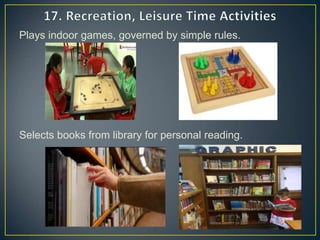
Plays indoor games, governed by simple rules.
Selects books from library for personal reading.
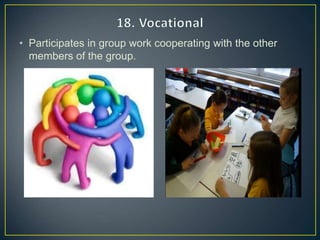
• Participates in group work cooperating with the other
members of the group.
• Contains wide area of behavioral domain.
• Details of items in each area.
• The items are sequentially arranged.
• Easy administration.
• Helps in curriculum development.
• Helps in educational Grouping of the children.
• Helps in formative evaluation and summative evaluation.
• Used for assessment, IEP formation and management in the
class room.
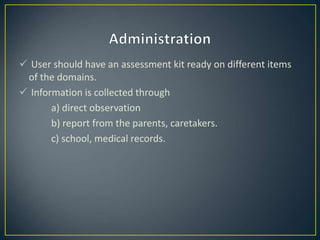
 User should have an assessment kit ready on different items
of the domains.
 Information is collected through
a) direct observation
b) report from the parents, caretakers.
c) school, medical records.
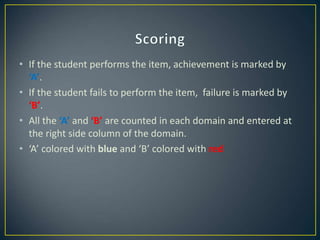
• If the student performs the item, achievement is marked by
‘A’.
• If the student fails to perform the item, failure is marked by
‘B’.
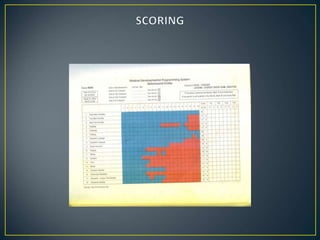
• All the ‘A’ and ‘B’ are counted in each domain and entered at
the right side column of the domain.
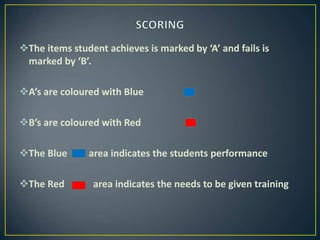
• ‘A’ colored with blue and ‘B’ colored with red
The items student achieves is marked by ‘A’ and fails is
marked by ‘B’.
A’s are coloured with Blue
B’s are coloured with Red
The Blue area indicates the students performance
The Red area indicates the needs to be given training
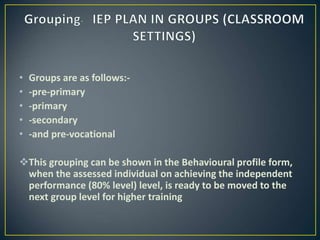
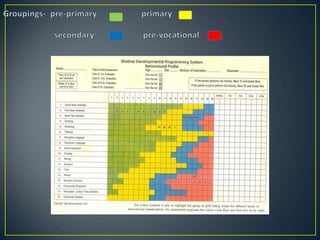
• Groups are as follows:-
• -pre-primary
• -primary
• -secondary
• -and pre-vocational
This grouping can be shown in the Behavioural profile form,
when the assessed individual on achieving the independent
performance (80% level) level, is ready to be moved to the
next group level for higher training
• jayachandran, P. & Vimala, V. (1992). Madras Developmental
Programming System. Chennai : Vijay Human Services.
Web References
• https://www.google.com/search?rlz=1C1NHXL_enIN686IN686&biw=1366&bih=667&tbm=isch&sa=1&ei=RNebXc2lO8z1vgT
JpZOQDg&q=Community+Orientation&oq=Community+Orientation&gs_l=img.3..0j0i24l5.27784.27784..28202...0.0..0.330.3
30.31......0....2j1..gwswizimg.06bCEuf4xf8&ved=0ahUKEwjN14Ms4vlAhXMuo8KHcnSBOIQ4dUDCAc&uact=5
• https://www.google.com/search?rlz=1C1NHXL_enIN686IN686&biw=1366&bih=667&tbm=isch&sa=1&ei=N9ebXbzNHYOuvg
Tq1ILIAw&q=domestic+activities+of+daily+living&oq=Domestic+Activities&gs_l=img.1.1.0i67j0j0i7i30j0i8i30l3j0i24l4.5393.57
12..8728...0.0..1.1803.3152.52j81......0....1..gwswizimg.gqVefBAM2Q4
• https://www.google.com/search?rlz=1C1NHXL_enIN686IN686&biw=1366&bih=667&tbm=isch&sa=1&ei=8dWbXaWwLoQwg
PHmLugBg&q=Dressing+skills&oq=Dressing+skills&gs_l=img.3..0l4j0i5i30l2j0i24l4.4906.8967..9877...0.0..0.373.2128.23j4...
...0....1..gwswizimg.......0i67.odK_0i9dwCs&ved=0ahUKEwjl7KDqsYvlAhUPiHAKHUfMDmQQ4dUDCAc&uact=5
• https://www.google.com/search?rlz=1C1NHXL_enIN686IN686&biw=1366&bih=667&tbm=isch&sa=1&ei=XtabXaSsNMXZvA
TS176gBg&q=Expressive+Language&oq=Expressive+Language&gs_l=img.3...30243.32506..32951...0.0..0.565.2659.41j4...
...0....1j2..gwswizimg.....0.q07k7cYP5c&ved=0ahUKEwik06OesovlAhXFLI8KHdKrD2QQ4dUDCAc&uact=5
• https://www.google.com/search?rlz=1C1NHXL_enIN686IN686&biw=1366&bih=667&tbm=isch&sa=1&ei=jNSbXb6hNculwgO07o_4Dg&
q=fine+motor+activities&oq=fine+motor+activities&gs_l=img.3..0i67l7j0l3.161848.165486..166282...0.0..0.289.2270.2-9......0....1..gws-
wiz-img.......0i7i30.P6ZbJhoYmsU&ved=0ahUKEwi-l4rAsIvlAhXLknAKHTT3A-8Q4dUDCAc&uact=5
• https://www.google.com/search?q=gross+motor+activities&rlz=1C1NHXL_enIN686IN686&source=lnms&tbm=isch&sa=X&ve
d=0ahUKEwiYvbi sIvlAhUEuY8KHaVEBRoQ_AUIEigB&biw=1366&bih=667
• https://www.google.com/search?rlz=1C1NHXL_enIN686IN686&biw=1366&bih=667&tbm=isch&sa=1&ei=_dWbXfqyB8mPwg
PW_LXQDQ&q=grooming+skills&oq=Grooming&gs_l=img.1.0.0i67j0l3j0i67j0l5.26352.26352..29550...0.0..0.681.681.5-
1......0....2j1..gws-wiz-img.mD9n86dAxfw
• https://www.google.com/search?rlz=1C1NHXL_enIN686IN686&biw=1366&bih=667&tbm=isch&sa=1&ei=NdWbXd3
GMKQwgPL75PQDw&q=Meal+Time+Activities&oq=Meal+Time+Activities&gs_l=img.3..0l2.125739.125739..12660
1...0.0..0.293.293.21......0....2j1..gwswizimg.RTLC1zLEac&ved=0ahUKEwid7biQsYvlAhVCiHAKHcv3BPoQ4dUDC
Ac&uact=5
• https://www.google.com/search?rlz=1C1NHXL_enIN686IN686&biw=1366&bih=667&tbm=isch&sa=1&ei=O9abXabtI
cfbvASY9ZmgBg&q=receptive+language+skills&oq=Receptive+Language&gs_l=img.1.0.0i67j0l7j0i67j0.28494.306
84..33626...0.0..0.542.2401.3-4j1j1......0....1j2..gws-wizimg.....0..0i24.ukHOBCO6DUE
• https://www.google.com/search?rlz=1C1NHXL_enIN686IN686&biw=1366&bih=667&tbm=isch&sa=1&ei=ptabXer6H
8zTvATy8ZeIDw&q=Reading+skills&oq=Reading+skills&gs_l=img.3..0l10.25692.33204..33921...0.0..0.1641.13024.
74j5......0....1j2..gwswizimg.....0..0i67.JX3sFGxw5Jw&ved=0ahUKEwjq5bnAsovlAhXMKY8KHfL4BfEQ4dUDCAc&u
act=5
• https://www.google.com/search?rlz=1C1NHXL_enIN686IN686&biw=1366&bih=667&tbm=isch&sa=1&ei=gdabXfjM
PMLSvATh84mQCg&q=Social+Interaction++&oq=Social+Interaction++&gs_l=img.3..0l10.33613.33613..34548...0.0
..0.372.372.31......0....2j1..gwswizimg.kBRsbYPVEWM&ved=0ahUKEwi4kYSvsovlAhVCKY8KHeF5AqIQ4dUDCAc
&uact=5
• https://www.google.com/search?rlz=1C1NHXL_enIN686IN686&biw=1366&bih=667&tbm=isch&sa=1&ei=HNabXfCy
JIzsvgSSi5jgBA&q=toileting+skills&oq=Toileting&gs_l=img.1.0.0i67j0l9.26552.26552..28875...0.0..0.400.400.4-
1......0....2j1..gws-wiz-img.PauDf1o_Grc
• https://www.google.com/search?rlz=1C1NHXL_enIN686IN686&biw=1366&bih=667&tbm=isch&sa=1&ei=ytabXe6gL
Mdps Checklist

Mdps Checklist

  • 2.
    Presented By: Md ShadabAlam Assistant Professor, Department Of Special Education Himalayan University, Itanagar
  • 3.
    • First Indiancomprehensive Behavioral Scale developed in 1975 at Chennai by Pro. P. Jeyachandran sir and Pro. V. Vimala Ma’am. • Used for any age, sex, and level of retardation. • A Criterion referenced Assessment Scale. • Used for Individualized Educational Programming and in classroom teaching.
  • 4.
    • 18 domains– each domain comprises of 20 items. Total no. of items are 360. • The items are sequentially arranged according to normal development.
  • 5.
    1. Gross motoractivities 2. Fine Motor activities 3. Meal Time Activities 4. Dressing 5. Grooming 6. Toileting 7. Receptive Language 8. Expressive Language 9. Social Interaction
  • 6.
    10. Reading 11. Writing 12.Numbers 13. Time 14. Money 15.Domestic Activities 16. Community Orientation 17. Recreation, Leisure Time Activities 18. Vocational
  • 7.
    • Holds headerect when in sitting or standing position (body may be supported by a person or prop) • Sits without support.
  • 8.
    • Stands withsupport. • Pushes or pulls furniture for rearrangement.
  • 9.
    Rides a bicycle(without training wheels) / swims.
  • 10.
    • Uses bothhands at the same time, when handling an object.
  • 11.
    • Cuts outa picture involving circular lines, using scissors from a magazine. • Threads a medium sized sewing needle within 2 tries.
  • 12.
    Drinks without spilling,mouthful from a glass or cup with assistance. Eats foods.
  • 13.
    • Identifies drinkingwater in a public place and drinks it.
  • 14.
    • Unbuttons (shirtbutton, press buttons, hooks).
  • 15.
    • Buttons clothing(press buttons / shirt buttons / hooks).
  • 16.
    • Uses tooth-pasteor tooth powder, brushes teeth and rinses mouth. • Applies face powder / deodorent / bind: (decoration on forehead)
  • 17.
    • Combs hairincluding oiling and plaiting (if necessary). • Shaves (male) / maintains menstrual hygiene (female).
  • 18.
    • Sits onthe toilet for 30 seconds. • Washes and dries hands after toileting.
  • 19.
    • Communication issimply the act of transferring information from one place/person to another person. It is most important vehicle of human being for their feelings through Verbally, Non Verbally, Written and Visualization. It has two parts one is Receptive and second is Expressive.
  • 20.
    • Turns headtowards the source of sound.
  • 21.
    • Uses voicesounds to get attention. • 3. Says or indicates, 'Yes' or 'No' in response to questions. • Carries on a meaningful conversation with another person(s) for 10 minutes. • Summarises a T.V./Radio programme in own words.
  • 22.
    • Plays alonewith toys or objects for 2 minutes. • Participates in group activities taking the role of a leader.
  • 23.
    • Looks atobjects presented when seated at a table. • Uses a menu card to order meals at restaurants.
  • 24.
    • Colours withinlines. • Copies a printed sentence readably.
  • 25.
    • Indicates thedifference between 'more' and less' when shown two different sized groups of objects. • Uses a simple calculator with basic four operations.
  • 26.
    • Tells timeby the hour on a clock. • Sets a clock to within one hour of the correct time after hearing the correct time.
  • 27.
    • Identifies 1,2,5,10,20,50and 100 rupee notes. • Saves money in a bank account.
  • 28.
    • Peels andcuts vegetables and fruits. • Irons clothes.
  • 29.
    • Identifies apoliceman, postman, a fireman, conductor of a bus, gas delivery man and telephone serviceman and persons from power supply. • Casts vote.
  • 30.
    Plays indoor games,governed by simple rules. Selects books from library for personal reading.
  • 31.
    • Participates ingroup work cooperating with the other members of the group.
  • 32.
    • Contains widearea of behavioral domain. • Details of items in each area. • The items are sequentially arranged. • Easy administration. • Helps in curriculum development. • Helps in educational Grouping of the children. • Helps in formative evaluation and summative evaluation. • Used for assessment, IEP formation and management in the class room.
  • 33.
     User shouldhave an assessment kit ready on different items of the domains.  Information is collected through a) direct observation b) report from the parents, caretakers. c) school, medical records.
  • 34.
    • If thestudent performs the item, achievement is marked by ‘A’. • If the student fails to perform the item, failure is marked by ‘B’. • All the ‘A’ and ‘B’ are counted in each domain and entered at the right side column of the domain. • ‘A’ colored with blue and ‘B’ colored with red
  • 35.
    The items studentachieves is marked by ‘A’ and fails is marked by ‘B’. A’s are coloured with Blue B’s are coloured with Red The Blue area indicates the students performance The Red area indicates the needs to be given training
  • 37.
    • Groups areas follows:- • -pre-primary • -primary • -secondary • -and pre-vocational This grouping can be shown in the Behavioural profile form, when the assessed individual on achieving the independent performance (80% level) level, is ready to be moved to the next group level for higher training
  • 39.
    • jayachandran, P.& Vimala, V. (1992). Madras Developmental Programming System. Chennai : Vijay Human Services. Web References • https://www.google.com/search?rlz=1C1NHXL_enIN686IN686&biw=1366&bih=667&tbm=isch&sa=1&ei=RNebXc2lO8z1vgT JpZOQDg&q=Community+Orientation&oq=Community+Orientation&gs_l=img.3..0j0i24l5.27784.27784..28202...0.0..0.330.3 30.31......0....2j1..gwswizimg.06bCEuf4xf8&ved=0ahUKEwjN14Ms4vlAhXMuo8KHcnSBOIQ4dUDCAc&uact=5 • https://www.google.com/search?rlz=1C1NHXL_enIN686IN686&biw=1366&bih=667&tbm=isch&sa=1&ei=N9ebXbzNHYOuvg Tq1ILIAw&q=domestic+activities+of+daily+living&oq=Domestic+Activities&gs_l=img.1.1.0i67j0j0i7i30j0i8i30l3j0i24l4.5393.57 12..8728...0.0..1.1803.3152.52j81......0....1..gwswizimg.gqVefBAM2Q4 • https://www.google.com/search?rlz=1C1NHXL_enIN686IN686&biw=1366&bih=667&tbm=isch&sa=1&ei=8dWbXaWwLoQwg PHmLugBg&q=Dressing+skills&oq=Dressing+skills&gs_l=img.3..0l4j0i5i30l2j0i24l4.4906.8967..9877...0.0..0.373.2128.23j4... ...0....1..gwswizimg.......0i67.odK_0i9dwCs&ved=0ahUKEwjl7KDqsYvlAhUPiHAKHUfMDmQQ4dUDCAc&uact=5 • https://www.google.com/search?rlz=1C1NHXL_enIN686IN686&biw=1366&bih=667&tbm=isch&sa=1&ei=XtabXaSsNMXZvA TS176gBg&q=Expressive+Language&oq=Expressive+Language&gs_l=img.3...30243.32506..32951...0.0..0.565.2659.41j4... ...0....1j2..gwswizimg.....0.q07k7cYP5c&ved=0ahUKEwik06OesovlAhXFLI8KHdKrD2QQ4dUDCAc&uact=5 • https://www.google.com/search?rlz=1C1NHXL_enIN686IN686&biw=1366&bih=667&tbm=isch&sa=1&ei=jNSbXb6hNculwgO07o_4Dg& q=fine+motor+activities&oq=fine+motor+activities&gs_l=img.3..0i67l7j0l3.161848.165486..166282...0.0..0.289.2270.2-9......0....1..gws- wiz-img.......0i7i30.P6ZbJhoYmsU&ved=0ahUKEwi-l4rAsIvlAhXLknAKHTT3A-8Q4dUDCAc&uact=5
  • 40.
    • https://www.google.com/search?q=gross+motor+activities&rlz=1C1NHXL_enIN686IN686&source=lnms&tbm=isch&sa=X&ve d=0ahUKEwiYvbi sIvlAhUEuY8KHaVEBRoQ_AUIEigB&biw=1366&bih=667 •https://www.google.com/search?rlz=1C1NHXL_enIN686IN686&biw=1366&bih=667&tbm=isch&sa=1&ei=_dWbXfqyB8mPwg PW_LXQDQ&q=grooming+skills&oq=Grooming&gs_l=img.1.0.0i67j0l3j0i67j0l5.26352.26352..29550...0.0..0.681.681.5- 1......0....2j1..gws-wiz-img.mD9n86dAxfw • https://www.google.com/search?rlz=1C1NHXL_enIN686IN686&biw=1366&bih=667&tbm=isch&sa=1&ei=NdWbXd3 GMKQwgPL75PQDw&q=Meal+Time+Activities&oq=Meal+Time+Activities&gs_l=img.3..0l2.125739.125739..12660 1...0.0..0.293.293.21......0....2j1..gwswizimg.RTLC1zLEac&ved=0ahUKEwid7biQsYvlAhVCiHAKHcv3BPoQ4dUDC Ac&uact=5 • https://www.google.com/search?rlz=1C1NHXL_enIN686IN686&biw=1366&bih=667&tbm=isch&sa=1&ei=O9abXabtI cfbvASY9ZmgBg&q=receptive+language+skills&oq=Receptive+Language&gs_l=img.1.0.0i67j0l7j0i67j0.28494.306 84..33626...0.0..0.542.2401.3-4j1j1......0....1j2..gws-wizimg.....0..0i24.ukHOBCO6DUE • https://www.google.com/search?rlz=1C1NHXL_enIN686IN686&biw=1366&bih=667&tbm=isch&sa=1&ei=ptabXer6H 8zTvATy8ZeIDw&q=Reading+skills&oq=Reading+skills&gs_l=img.3..0l10.25692.33204..33921...0.0..0.1641.13024. 74j5......0....1j2..gwswizimg.....0..0i67.JX3sFGxw5Jw&ved=0ahUKEwjq5bnAsovlAhXMKY8KHfL4BfEQ4dUDCAc&u act=5 • https://www.google.com/search?rlz=1C1NHXL_enIN686IN686&biw=1366&bih=667&tbm=isch&sa=1&ei=gdabXfjM PMLSvATh84mQCg&q=Social+Interaction++&oq=Social+Interaction++&gs_l=img.3..0l10.33613.33613..34548...0.0 ..0.372.372.31......0....2j1..gwswizimg.kBRsbYPVEWM&ved=0ahUKEwi4kYSvsovlAhVCKY8KHeF5AqIQ4dUDCAc &uact=5 • https://www.google.com/search?rlz=1C1NHXL_enIN686IN686&biw=1366&bih=667&tbm=isch&sa=1&ei=HNabXfCy JIzsvgSSi5jgBA&q=toileting+skills&oq=Toileting&gs_l=img.1.0.0i67j0l9.26552.26552..28875...0.0..0.400.400.4- 1......0....2j1..gws-wiz-img.PauDf1o_Grc • https://www.google.com/search?rlz=1C1NHXL_enIN686IN686&biw=1366&bih=667&tbm=isch&sa=1&ei=ytabXe6gL