INSTITUTIONAL
CATERING
SCHOOL
COLLEGES
OLD PEOPLE HOMES
PRISON
UNIVERSITIES
HOSPITALNSK NOTES 1KUMARS RECIPE FILE
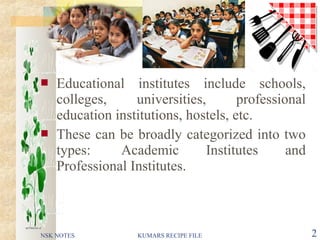
 Educational institutes include schools,
colleges, universities, professional
education institutions, hostels, etc.
 These can be broadly categorized into two
types: Academic Institutes and
Professional Institutes.
NSK NOTES KUMARS RECIPE FILE 2
INTRODUCTION
 Institutional catering is a rather old fashioned
term these days and has to a great extend been
replaced by welfare catering.
 In recent years this sector has been revitalized by
the building of brand new universities and
polytechniques with modern purpose built
catering facilities.
NSK NOTES 3KUMARS RECIPE FILE
 Initial stages of institutional catering in INDIA is
probably originated from GURUKUL system where
students used to stay at teachers ashram to seek education.
 Later in 12th
century NALANDA university was famous
throughout ASIA attracting scholars from CHINA,
JAPAN, CEYLON etc.
 In modern world institutional catering is responsible for
health and welfare of younger generation as it involves
catering to youths in schools, colleges and residential
universities.
 They are responsible for developing good food habits
among the children's of the nation and helping to develop
strong, healthy population.
NSK NOTES 4KUMARS RECIPE FILE
 Institutional catering is described as the art of feeding
people who are unable to feed themselves in the modern
world. It is responsible for the health and welfare of the
younger generation.
 It involves catering for youth in schools, colleges &
residential universities.
 These youth are generally in the age group of 5 – 25.
 It has the social responsibility of developing good food
habits among the children of the nation and helping to
build a strong and healthy population.
 Today this sector is recognized as being a significant and
influential part of the catering industry.
NSK NOTES 5KUMARS RECIPE FILE
 Like all public sector, institutional catering operates
under severe budgetary limitation.
 Public spending restraints mean that caterers must
examine all areas food cost minutely. However, their
degree of freedom to cut costs is often curtailed by the
imposition of bureaucratic measures designed to
monitor spending for instance, most caterers must deal
with designated suppliers, work within rigid budgets
and pay nationally negotiated wages.
 At times of cutbacks in spending the catering service
is one of the first to be affected. Institutional catering
differs in some aspects from those in the hotel
industry.
NSK NOTES 6KUMARS RECIPE FILE
Academic Institutions
(Schools and Colleges)
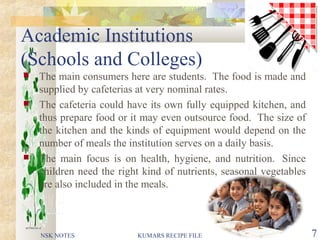
 The main consumers here are students. The food is made and
supplied by cafeterias at very nominal rates.
 The cafeteria could have its own fully equipped kitchen, and
thus prepare food or it may even outsource food. The size of
the kitchen and the kinds of equipment would depend on the
number of meals the institution serves on a daily basis.
 The main focus is on health, hygiene, and nutrition. Since
children need the right kind of nutrients, seasonal vegetables
are also included in the meals.
NSK NOTES KUMARS RECIPE FILE 7
 Some schools monitor closely when serving students in
dining halls as the focus is also on developing good eating
habits and etiquettes among children.
 Considerations should be given to the physical,
sociological and sociological atmosphere including both
functional and aesthetic value of the Dining Hall. The
location should provide plenty of light air and the place
free from disagreeable odours, noxious fumes, noise, etc.
NSK NOTES KUMARS RECIPE FILE 8
Professional Institutes
 The main consumers here are adults and hence it is
important to offer some variety to them.
 Kitchens of these institutes are referred to as 'mess', which
may be run by a committee called mess committee or it
could also be run with professional help from an outside
agency.
 Cyclic menus help to solve the issues of monotonous
food. It includes seasonable fruits and vegetables, and
nutritious food is the main criteria of the educational
catering.
NSK NOTES KUMARS RECIPE FILE 9
 The kitchen set-up can be basic to modern depending on the
type and volume of meals that the institution cooks on a daily
basis.
 The main responsibility of institutional catering is the
welfare and health of the younger generation.
 They cater for youth in schools, colleges and residential
universities. These youth are generally in the age group of 5
– 25.
 It has the social responsibility of developing good food habits
among the children of the nation and helping to build a strong
and healthy population.
 Today, this food services sector is recognized as being a
significant and influential part of
the institutional catering industry.
NSK NOTES KUMARS RECIPE FILE 10
Food service in institution differ in
some aspects from those in hotel
industry, yet both has some common
factors…
 Food of good quality, properly cooked and
prepared.
 Prompt and courteous service.
 Well balanced varied menus.
 Reasonable price consistent with service offered.
 Adequate facilities.
 High standards of cleanliness and sanitation.
NSK NOTES 11KUMARS RECIPE FILE
NEEDS/EXPECTIONS OF THE
CLIENT GROUP.
 How food is prepared and served in schools,
colleges, hospitals etc.
 Five main food groups as set out for balance of
good health.
fruit and vegetables.
starchy foods.
meat, fish and other non dairy sources of
protein.
milk and dairy products.
foods containing fats and sugar.
NSK NOTES 12KUMARS RECIPE FILE
The essential skills of a
caterer are….
 Skills of selecting, preparing and cooking
food with the size of the meals provided
should really appeal to the students.
 Institutional catering works on a no profit
no loss basis so all the costs must be within
the budget so the caterer should be well
versed in maintaining the budget.
NSK NOTES 13KUMARS RECIPE FILE
PLANNING MENU
 It is a quantity production and it is a
production of few products for each
meals. So the menu should be simple and
properly cooked and palatable.
 Cyclic menu is adopted, but there should
be some variations to keep up the appeal
of menu.
 Weightage should be given in the
nutritional aspects.
 The menu should not be too elaborate
and have strict portion control.
NSK NOTES 14KUMARS RECIPE FILE
 In addition to the fixed menu, there should be
some menus for special occasions and events
such as
festival day
parents and teachers day
valedictory function etc
 The manager of the institutional catering of
course have the similar responsibility to those of
any food service manager.
 To ensure that the preparation of the food meets
the required nutritional standards.
NSK NOTES 15KUMARS RECIPE FILE
The school continues to
operate its own catering
facilities for…..
 Tradition
 Flexibility:
the school believes it can be more flexible in its
approach to catering than the contractor.
 Cost:
school believes that it is more economic to run its
own catering especially as employing contract
catering would mean the additional cost of their
fees.
NSK NOTES 16KUMARS RECIPE FILE
 Special needs:
in addition to the every day catering the schools
catering manager is also familiar with the special
requirements of the annual event such as founders
day, feast, reunion, sports event etc.
 Staffing:
by operating school can take full advantage of
letting the facilities during vacation periods.
NSK NOTES 17KUMARS RECIPE FILE
Nutritional requirements of
different people…..
 Proteins: an average diet requires about 65 gms
protein a day. These are broken down in to amino
acids during digestion. Generally meat, fish,
cheese, eggs are higher value of foods and
vegetables are low value foods.
 Fats: they provide with energy and yield more
energy for a given weight than any other
nutrients. 30 to 35% of calorie is needed.
 Carbohydrates: they also provide energy in the
form of starch and sugars. They provide bulk in
the diet.
NSK NOTES 18KUMARS RECIPE FILE
 Minerals: three functions
bone formation
as dissolved salts in the body fluids to
maintain acidity or alkalinity.
as constituents of soft tissues to enable
them to carry out particular function.
 Vitamins: they are present in small
quantities and are needed to prevent
specific deficiency diseases.
NSK NOTES 19KUMARS RECIPE FILE
Problems associated with ...
NSK NOTES KUMARS RECIPE FILE 20
NSK NOTES KUMARS RECIPE FILE 21
NSK NOTES KUMARS RECIPE FILE 22
NSK NOTES KUMARS RECIPE FILE 23

Institutional catering

  • 1.
  • 2.
     Educational institutesinclude schools, colleges, universities, professional education institutions, hostels, etc.  These can be broadly categorized into two types: Academic Institutes and Professional Institutes. NSK NOTES KUMARS RECIPE FILE 2
  • 3.
    INTRODUCTION  Institutional cateringis a rather old fashioned term these days and has to a great extend been replaced by welfare catering.  In recent years this sector has been revitalized by the building of brand new universities and polytechniques with modern purpose built catering facilities. NSK NOTES 3KUMARS RECIPE FILE
  • 4.
     Initial stagesof institutional catering in INDIA is probably originated from GURUKUL system where students used to stay at teachers ashram to seek education.  Later in 12th century NALANDA university was famous throughout ASIA attracting scholars from CHINA, JAPAN, CEYLON etc.  In modern world institutional catering is responsible for health and welfare of younger generation as it involves catering to youths in schools, colleges and residential universities.  They are responsible for developing good food habits among the children's of the nation and helping to develop strong, healthy population. NSK NOTES 4KUMARS RECIPE FILE
  • 5.
     Institutional cateringis described as the art of feeding people who are unable to feed themselves in the modern world. It is responsible for the health and welfare of the younger generation.  It involves catering for youth in schools, colleges & residential universities.  These youth are generally in the age group of 5 – 25.  It has the social responsibility of developing good food habits among the children of the nation and helping to build a strong and healthy population.  Today this sector is recognized as being a significant and influential part of the catering industry. NSK NOTES 5KUMARS RECIPE FILE
  • 6.
     Like allpublic sector, institutional catering operates under severe budgetary limitation.  Public spending restraints mean that caterers must examine all areas food cost minutely. However, their degree of freedom to cut costs is often curtailed by the imposition of bureaucratic measures designed to monitor spending for instance, most caterers must deal with designated suppliers, work within rigid budgets and pay nationally negotiated wages.  At times of cutbacks in spending the catering service is one of the first to be affected. Institutional catering differs in some aspects from those in the hotel industry. NSK NOTES 6KUMARS RECIPE FILE
  • 7.
    Academic Institutions (Schools andColleges)  The main consumers here are students. The food is made and supplied by cafeterias at very nominal rates.  The cafeteria could have its own fully equipped kitchen, and thus prepare food or it may even outsource food. The size of the kitchen and the kinds of equipment would depend on the number of meals the institution serves on a daily basis.  The main focus is on health, hygiene, and nutrition. Since children need the right kind of nutrients, seasonal vegetables are also included in the meals. NSK NOTES KUMARS RECIPE FILE 7
  • 8.
     Some schoolsmonitor closely when serving students in dining halls as the focus is also on developing good eating habits and etiquettes among children.  Considerations should be given to the physical, sociological and sociological atmosphere including both functional and aesthetic value of the Dining Hall. The location should provide plenty of light air and the place free from disagreeable odours, noxious fumes, noise, etc. NSK NOTES KUMARS RECIPE FILE 8
  • 9.
    Professional Institutes  Themain consumers here are adults and hence it is important to offer some variety to them.  Kitchens of these institutes are referred to as 'mess', which may be run by a committee called mess committee or it could also be run with professional help from an outside agency.  Cyclic menus help to solve the issues of monotonous food. It includes seasonable fruits and vegetables, and nutritious food is the main criteria of the educational catering. NSK NOTES KUMARS RECIPE FILE 9
  • 10.
     The kitchenset-up can be basic to modern depending on the type and volume of meals that the institution cooks on a daily basis.  The main responsibility of institutional catering is the welfare and health of the younger generation.  They cater for youth in schools, colleges and residential universities. These youth are generally in the age group of 5 – 25.  It has the social responsibility of developing good food habits among the children of the nation and helping to build a strong and healthy population.  Today, this food services sector is recognized as being a significant and influential part of the institutional catering industry. NSK NOTES KUMARS RECIPE FILE 10
  • 11.
    Food service ininstitution differ in some aspects from those in hotel industry, yet both has some common factors…  Food of good quality, properly cooked and prepared.  Prompt and courteous service.  Well balanced varied menus.  Reasonable price consistent with service offered.  Adequate facilities.  High standards of cleanliness and sanitation. NSK NOTES 11KUMARS RECIPE FILE
  • 12.
    NEEDS/EXPECTIONS OF THE CLIENTGROUP.  How food is prepared and served in schools, colleges, hospitals etc.  Five main food groups as set out for balance of good health. fruit and vegetables. starchy foods. meat, fish and other non dairy sources of protein. milk and dairy products. foods containing fats and sugar. NSK NOTES 12KUMARS RECIPE FILE
  • 13.
    The essential skillsof a caterer are….  Skills of selecting, preparing and cooking food with the size of the meals provided should really appeal to the students.  Institutional catering works on a no profit no loss basis so all the costs must be within the budget so the caterer should be well versed in maintaining the budget. NSK NOTES 13KUMARS RECIPE FILE
  • 14.
    PLANNING MENU  Itis a quantity production and it is a production of few products for each meals. So the menu should be simple and properly cooked and palatable.  Cyclic menu is adopted, but there should be some variations to keep up the appeal of menu.  Weightage should be given in the nutritional aspects.  The menu should not be too elaborate and have strict portion control. NSK NOTES 14KUMARS RECIPE FILE
  • 15.
     In additionto the fixed menu, there should be some menus for special occasions and events such as festival day parents and teachers day valedictory function etc  The manager of the institutional catering of course have the similar responsibility to those of any food service manager.  To ensure that the preparation of the food meets the required nutritional standards. NSK NOTES 15KUMARS RECIPE FILE
  • 16.
    The school continuesto operate its own catering facilities for…..  Tradition  Flexibility: the school believes it can be more flexible in its approach to catering than the contractor.  Cost: school believes that it is more economic to run its own catering especially as employing contract catering would mean the additional cost of their fees. NSK NOTES 16KUMARS RECIPE FILE
  • 17.
     Special needs: inaddition to the every day catering the schools catering manager is also familiar with the special requirements of the annual event such as founders day, feast, reunion, sports event etc.  Staffing: by operating school can take full advantage of letting the facilities during vacation periods. NSK NOTES 17KUMARS RECIPE FILE
  • 18.
    Nutritional requirements of differentpeople…..  Proteins: an average diet requires about 65 gms protein a day. These are broken down in to amino acids during digestion. Generally meat, fish, cheese, eggs are higher value of foods and vegetables are low value foods.  Fats: they provide with energy and yield more energy for a given weight than any other nutrients. 30 to 35% of calorie is needed.  Carbohydrates: they also provide energy in the form of starch and sugars. They provide bulk in the diet. NSK NOTES 18KUMARS RECIPE FILE
  • 19.
     Minerals: threefunctions bone formation as dissolved salts in the body fluids to maintain acidity or alkalinity. as constituents of soft tissues to enable them to carry out particular function.  Vitamins: they are present in small quantities and are needed to prevent specific deficiency diseases. NSK NOTES 19KUMARS RECIPE FILE
  • 20.
    Problems associated with... NSK NOTES KUMARS RECIPE FILE 20
  • 21.
    NSK NOTES KUMARSRECIPE FILE 21
  • 22.
    NSK NOTES KUMARSRECIPE FILE 22
  • 23.
    NSK NOTES KUMARSRECIPE FILE 23