GROUP 1
AJERO, JOHANN JAMES A.
AMAGAN, ELRIC
BALTER, RUFINO JOSE
BANAGUA, MAXIMINO
BUENAFLOR, RICH ANNE
CALDERON, DAVID MOSES
DE ROJAS, BEA NOREEN
MEAL
MANAGEMENT
MEAL
Is an instance of eating
in a specific time and
includes specific food
preparation
MANAGEMENT
Getting people together
to accomplish desired
goals and objectives
using available resources
MEAL MANAGEMENT
series of events
concerned with menu
planning, food
purchasing, preparation
and serving meal.
IMPORTANCE OF MEAL
MANAGEMENT
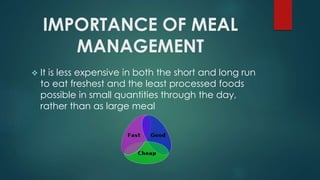
 It is less expensive in both the short and long run
to eat freshest and the least processed foods
possible in small quantities through the day,
rather than as large meal
PRELIMINARY
ESSENTIAL IN MEAL
MANAGEMENT
MENU PLANNING
MENU PLANNING
 Menu planning is the selection of a menu
for an event.
 Menu planning is the act of advanced
planning of the menu for different
situations such as for a family or a
restaurant. It is important to consider the
dietary needs of the people one is
preparing for.
IMPORTANCE OF MENU
PLANNING
Facilitate evaluation and improvements
Customer satisfaction
Facilitating costing
Facilitating pricing
Reference by customer and
management
Guide production
Facilitate ordering
Plan storage
Guides the catering staff on how to
prepare dishes
Help the catering staff to prepare in
terms of attitudes, skills ordering etc.
Some menu requires special preparation
like decorations and equipment
therefore menu will help in availing the
necessary.
MENU
Menu is a list of
dishes to be serve in
given meal
TYPES OF MENU
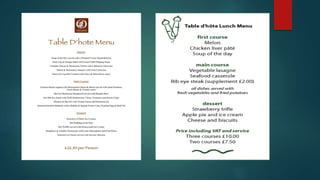
Table d’hôte
 A set menu forming a complete meal at a
set price. A choice of dishes may be
offered at all courses. Choice and number
of courses is limited to two, three or four.

A La Carte
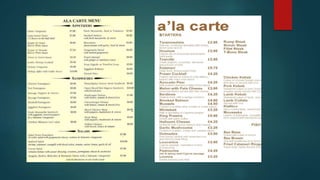
 Menu with all the dishes individually priced.
 Customers compile their own menu from the list.
 The meal is cooked to order.
 The customer should be prepared to wait for this
service
Party/function Menus
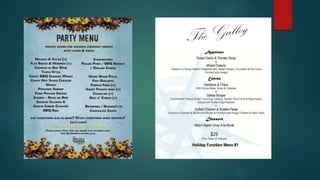
 Menu for banquets or functions of all kinds.
 All guests start the meal at the same time.
 Seasonable foods must be available if the
menus are printed well in advance to avoid
embarrassments
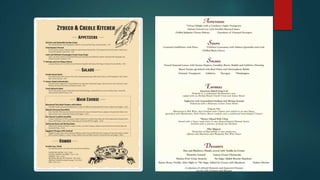
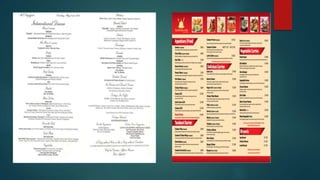
Ethnic/Specialty menus
 Can be al carte or table d’hôte specializing in
the food or religion of the country or in a
specialized food itself e.g.
 a) Ethnic: - Chinese, Indian, Kosher, Kenyan,
African etc.
 b) Specialty: - steak, fish, pasta, vegetarian etc.
 Kitchen staff must know how to obtain and use
the ingredients.
 The ambience (mood) of the restaurant must
reflect the menu.
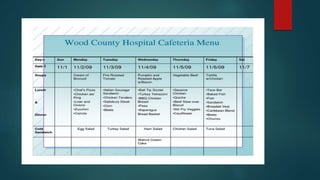
Hospital menus/Institutional menus
 It’s a form of a menu given to the patient.
The day before service the patient ticks
his/her preferences.
 A dietician is usually involved with menu
compilation to ensure nothing is given to
the patients that would be detrimental to
their health.
 The patient’s meals are usually 2-3 courses.
Menu for people at work
 Traditional recipes form a sound foundation
of knowledge for the chef/caterer.
 However fashions in food change and
customers look for new dishes, different
combinations of food, fresh ideas on menu
etc.
 Some of the most successful menus contain a
sensible balance of traditional and
contemporary dishes.
Traditional menus/Ethnic menus
 Traditional recipes form a sound foundation
of knowledge for the chef/caterer.
 However fashions in food change and
customers look for new dishes, different
combinations of food, fresh ideas on menu
etc.
 Some of the most successful menus contain a
sensible balance of traditional and
contemporary dishes.
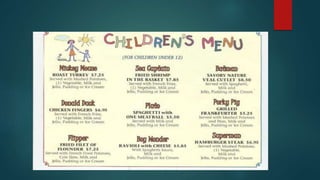
Menu for children
 They emphasize on healthy eating and a
balanced diet in schools.
 Schools with children from different cultural
and religious backgrounds should have
appropriate items available o the menu.
 Most establishments provide special
children’s menus which concentrate on
favorite foods.
FACTORS TO CONSIDER WHEN
PLANNING A MENU
1. Nutrition requirements
Proteins
Starches
Vitamins
Fats
Mineral salts
 2. Health consideration
 Sickness
 Deficiencies like scurvy, diabetes, kwashiorkor
 3. Availability of foodstuffs
 Seasonal foods like
 Fruits
 Vegetables
 4. Number of courses
 Appetizer
 Main dish
 Dessert
 5. Sequence of courses
 6. Nutritional balance
 Proteins
 Vitamins
 Minerals
 Water
 Roughage – acts as a “broom” along the digestive system.
 Fats and oils
 Occasions
 Funerals
 Wedding
 Birthday
 Graduation Ceremony
 National holiday celebration
 Festivities like
 Christmas
 Ramadhan
 Easter holiday
PURCHASING
 It is the process of getting the right
product into a facility at the right time
and place , plus the amount of goods at
the right price and right source. An act of
buying. It is the complex activity because
it involves a lot of decision making in
obtaining best quality with the least
money, time and energy.
CLASSIFICATION OF FOOD
PURCHASE
Perishable Food - are the food
items that have short, useful life
after they have been receive.
Items that are liable to spoil or
decay.
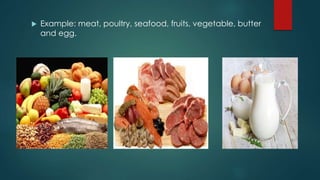
 Example: meat, poultry, seafood, fruits, vegetable, butter
and egg.
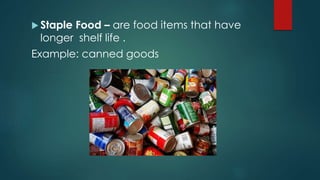
 Staple Food – are food items that have
longer shelf life .
Example: canned goods
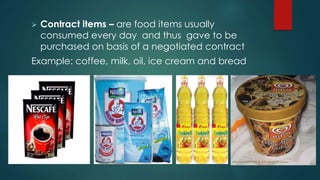
 Contract items – are food items usually
consumed every day and thus gave to be
purchased on basis of a negotiated contract
Example: coffee, milk, oil, ice cream and bread
BUYING GUIDELINES
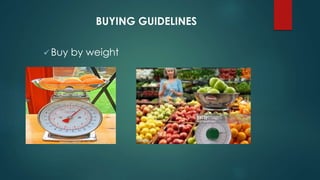
 Buy by weight
Buy by count or size
Buy by brands
 Buy foods in season
RECEIVING
Receiving is the point at which
food service operation inspects
and takes legal ownership and
physical possession of items
ordered. Its purpose is to ensure
that the food and supplies
delivered match the established
quantity and quality specifications.
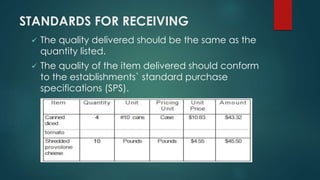
STANDARDS FOR RECEIVING
 The quality delivered should be the same as the
quantity listed.
 The quality of the item delivered should conform
to the establishments` standard purchase
specifications (SPS).
 The prices on the invoice should be the same as
those circled on the quotation list.
 All invoices for foods delivered in a given day
should be listed by the receiving clerk`s daily
report for that day.
 Meat tags should be filled out.
 Completed paperwork should be forwarded to
proper personnel.
 Food should be moved to the appropriate
storage area.
VERIFYING QUANTITY, QUALITY,
AND PRICE
A permanent copy of SPS.
Equipment for determining weight-
hanging scale or platform scale.
Certain paper forms, tags, and
rubber stamps.
METHODS OF RECEIVING
1. Blind Method – providing an invoice or purchase
order. The clerk will quantify each item by
weighing, measuring or counting, and recording
it.
2. Invoice Receiving – Is a frequently used and
more traditional method. The receiving clerk
checks the delivered items against the original
purchase order and takes note of any deviations.
This method is efficient but requires careful
evaluation to ensure the accuracy of delivery.
STORAGE
 Proper storage of food immediately after it has been
received and checked is an important factor in the
prevention and control of loss or waste.
 Perishables need to be places immediately to
refrigerated or frozen storage.
 Staples should be stored in an orderly and systematic
arrangement. Food should be protected from pests,
rodents, and insects. Storage should also have a low
humidity and proper ventilation to help prevent
spoilage.
HOW TO PROTECT FOODS FROM CROSS-
CONTAMINATION
 In a clean, dry location
 Where it is not exposed to splash, dust, or other
contamination.
 At least 6 inches (15 cm) above the floor
 Food in packages and working containers may be stored less
than 6 inches above the floor on case lot handling
equipment.
 Pressurized beverage containers, cased food in waterproof
containers such as bottles or cans, and milk containers in
plastic crates may be stored on a floor that is clean and not
exposed to floor moisture.
ISSUING
Food assets must be issued into
production in order to earn a profit
for the business
One of two methods is used
• Informal issuing
• Formal issuing
Informal Issuing
 Storeroom is open to the kitchen staff
• Free to enter when supplies are needed
• Room is subject to theft if not properly controlled
• No ability to separate costs
• If multiple retail outlets use same storeroom
Formal Issuing
 Buyer purchases goods on behalf of all outlets and issues them at
cost to each individual outlet
• Process of releasing items controlled by requisition
• Immediate information on daily food cost by revenue center is available
Direct Issues
 Products issued immediately into production from the receiving
dock
• Should be recorded in storeroom’s inventory for recordkeeping
purposes
• Expenditure must be charged to the cost center to which it is issued
 Product requisitions are forms used to identify foods needed by the
chef
 Purchase requisitions are internal documents used:
• In businesses that have formal storeroom operations
• For special equipment that is needed

Group 1

  • 1.
    GROUP 1 AJERO, JOHANNJAMES A. AMAGAN, ELRIC BALTER, RUFINO JOSE BANAGUA, MAXIMINO BUENAFLOR, RICH ANNE CALDERON, DAVID MOSES DE ROJAS, BEA NOREEN
  • 2.
  • 3.
    MEAL Is an instanceof eating in a specific time and includes specific food preparation
  • 4.
    MANAGEMENT Getting people together toaccomplish desired goals and objectives using available resources
  • 5.
    MEAL MANAGEMENT series ofevents concerned with menu planning, food purchasing, preparation and serving meal.
  • 6.
    IMPORTANCE OF MEAL MANAGEMENT It is less expensive in both the short and long run to eat freshest and the least processed foods possible in small quantities through the day, rather than as large meal
  • 7.
  • 8.
  • 9.
    MENU PLANNING  Menuplanning is the selection of a menu for an event.  Menu planning is the act of advanced planning of the menu for different situations such as for a family or a restaurant. It is important to consider the dietary needs of the people one is preparing for.
  • 10.
    IMPORTANCE OF MENU PLANNING Facilitateevaluation and improvements Customer satisfaction Facilitating costing Facilitating pricing Reference by customer and management Guide production
  • 11.
    Facilitate ordering Plan storage Guidesthe catering staff on how to prepare dishes Help the catering staff to prepare in terms of attitudes, skills ordering etc. Some menu requires special preparation like decorations and equipment therefore menu will help in availing the necessary.
  • 12.
    MENU Menu is alist of dishes to be serve in given meal
  • 13.
    TYPES OF MENU Tabled’hôte  A set menu forming a complete meal at a set price. A choice of dishes may be offered at all courses. Choice and number of courses is limited to two, three or four.
  • 15.
    A La Carte Menu with all the dishes individually priced.  Customers compile their own menu from the list.  The meal is cooked to order.  The customer should be prepared to wait for this service
  • 17.
    Party/function Menus  Menufor banquets or functions of all kinds.  All guests start the meal at the same time.  Seasonable foods must be available if the menus are printed well in advance to avoid embarrassments
  • 19.
    Ethnic/Specialty menus  Canbe al carte or table d’hôte specializing in the food or religion of the country or in a specialized food itself e.g.  a) Ethnic: - Chinese, Indian, Kosher, Kenyan, African etc.  b) Specialty: - steak, fish, pasta, vegetarian etc.  Kitchen staff must know how to obtain and use the ingredients.  The ambience (mood) of the restaurant must reflect the menu.
  • 21.
    Hospital menus/Institutional menus It’s a form of a menu given to the patient. The day before service the patient ticks his/her preferences.  A dietician is usually involved with menu compilation to ensure nothing is given to the patients that would be detrimental to their health.  The patient’s meals are usually 2-3 courses.
  • 23.
    Menu for peopleat work  Traditional recipes form a sound foundation of knowledge for the chef/caterer.  However fashions in food change and customers look for new dishes, different combinations of food, fresh ideas on menu etc.  Some of the most successful menus contain a sensible balance of traditional and contemporary dishes.
  • 24.
    Traditional menus/Ethnic menus Traditional recipes form a sound foundation of knowledge for the chef/caterer.  However fashions in food change and customers look for new dishes, different combinations of food, fresh ideas on menu etc.  Some of the most successful menus contain a sensible balance of traditional and contemporary dishes.
  • 26.
    Menu for children They emphasize on healthy eating and a balanced diet in schools.  Schools with children from different cultural and religious backgrounds should have appropriate items available o the menu.  Most establishments provide special children’s menus which concentrate on favorite foods.
  • 28.
    FACTORS TO CONSIDERWHEN PLANNING A MENU 1. Nutrition requirements Proteins Starches Vitamins Fats Mineral salts
  • 29.
     2. Healthconsideration  Sickness  Deficiencies like scurvy, diabetes, kwashiorkor  3. Availability of foodstuffs  Seasonal foods like  Fruits  Vegetables  4. Number of courses  Appetizer  Main dish  Dessert
  • 30.
     5. Sequenceof courses  6. Nutritional balance  Proteins  Vitamins  Minerals  Water  Roughage – acts as a “broom” along the digestive system.  Fats and oils
  • 31.
     Occasions  Funerals Wedding  Birthday  Graduation Ceremony  National holiday celebration  Festivities like  Christmas  Ramadhan  Easter holiday
  • 32.
    PURCHASING  It isthe process of getting the right product into a facility at the right time and place , plus the amount of goods at the right price and right source. An act of buying. It is the complex activity because it involves a lot of decision making in obtaining best quality with the least money, time and energy.
  • 33.
    CLASSIFICATION OF FOOD PURCHASE PerishableFood - are the food items that have short, useful life after they have been receive. Items that are liable to spoil or decay.
  • 34.
     Example: meat,poultry, seafood, fruits, vegetable, butter and egg.
  • 35.
     Staple Food– are food items that have longer shelf life . Example: canned goods
  • 36.
     Contract items– are food items usually consumed every day and thus gave to be purchased on basis of a negotiated contract Example: coffee, milk, oil, ice cream and bread
  • 37.
  • 38.
    Buy by countor size Buy by brands  Buy foods in season
  • 39.
    RECEIVING Receiving is thepoint at which food service operation inspects and takes legal ownership and physical possession of items ordered. Its purpose is to ensure that the food and supplies delivered match the established quantity and quality specifications.
  • 40.
    STANDARDS FOR RECEIVING The quality delivered should be the same as the quantity listed.  The quality of the item delivered should conform to the establishments` standard purchase specifications (SPS).
  • 41.
     The priceson the invoice should be the same as those circled on the quotation list.  All invoices for foods delivered in a given day should be listed by the receiving clerk`s daily report for that day.  Meat tags should be filled out.  Completed paperwork should be forwarded to proper personnel.  Food should be moved to the appropriate storage area.
  • 42.
    VERIFYING QUANTITY, QUALITY, ANDPRICE A permanent copy of SPS. Equipment for determining weight- hanging scale or platform scale. Certain paper forms, tags, and rubber stamps.
  • 43.
    METHODS OF RECEIVING 1.Blind Method – providing an invoice or purchase order. The clerk will quantify each item by weighing, measuring or counting, and recording it. 2. Invoice Receiving – Is a frequently used and more traditional method. The receiving clerk checks the delivered items against the original purchase order and takes note of any deviations. This method is efficient but requires careful evaluation to ensure the accuracy of delivery.
  • 44.
    STORAGE  Proper storageof food immediately after it has been received and checked is an important factor in the prevention and control of loss or waste.  Perishables need to be places immediately to refrigerated or frozen storage.  Staples should be stored in an orderly and systematic arrangement. Food should be protected from pests, rodents, and insects. Storage should also have a low humidity and proper ventilation to help prevent spoilage.
  • 45.
    HOW TO PROTECTFOODS FROM CROSS- CONTAMINATION  In a clean, dry location  Where it is not exposed to splash, dust, or other contamination.  At least 6 inches (15 cm) above the floor  Food in packages and working containers may be stored less than 6 inches above the floor on case lot handling equipment.  Pressurized beverage containers, cased food in waterproof containers such as bottles or cans, and milk containers in plastic crates may be stored on a floor that is clean and not exposed to floor moisture.
  • 46.
    ISSUING Food assets mustbe issued into production in order to earn a profit for the business One of two methods is used • Informal issuing • Formal issuing
  • 47.
    Informal Issuing  Storeroomis open to the kitchen staff • Free to enter when supplies are needed • Room is subject to theft if not properly controlled • No ability to separate costs • If multiple retail outlets use same storeroom Formal Issuing  Buyer purchases goods on behalf of all outlets and issues them at cost to each individual outlet • Process of releasing items controlled by requisition • Immediate information on daily food cost by revenue center is available
  • 48.
    Direct Issues  Productsissued immediately into production from the receiving dock • Should be recorded in storeroom’s inventory for recordkeeping purposes • Expenditure must be charged to the cost center to which it is issued  Product requisitions are forms used to identify foods needed by the chef  Purchase requisitions are internal documents used: • In businesses that have formal storeroom operations • For special equipment that is needed