NSK NOTES kumars recipe file 1
NSK NOTES kumars recipe file 2
HISTORY
 Bengali food has inherited a large number of influences, both
foreign and South Asian, arising from a turbulent history and
strong trade links with many parts of the world.
 Originally inhabited by Dravidians and other ethnic groups, and
later further settled by the Aryans during the Gupta era,
Bengal fell under the sway of various Muslim rulers from the
early thirteenth century onwards, and was then ruled by the
British for two centuries (1757-1947).
 It also saw a fair share of immigrants from various parts of the
world - most prominently Jews, Chinese and Afghans who
settled down in their own distinct communities in and around
Kolkata.
NSK NOTES kumars recipe file 3
 Bengal (before its partition into eastern and western parts) has been
ruled by Muslim rules since the Delhi Sultanate in early 12th century.
However, for over five hundred years the center of Muslim rule in
Bengal was centered in Dhaka.
 Trade routes going from Delhi to Dhaka travered the entire width of
today's West Bengal but seems to have little influence beyond that.
West Bengal came under Muslim influence only when Murshid Quli
Khan became the governor of Bengal and moved the capital from
Dhaka to the newly founded city of Murshidabad in the late 17th
century.
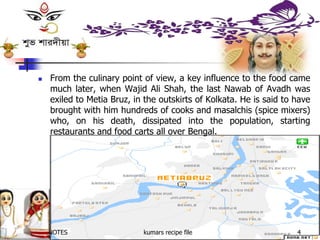
 From the culinary point of view, a key influence to the food came
much later, when Wajid Ali Shah, the last Nawab of Avadh was
exiled to Metia Bruz, in the outskirts of Kolkata. He is said to have
brought with him hundreds of cooks and masalchis (spice mixers)
who, on his death, dissipated into the population, starting
restaurants and food carts all over Bengal.
NSK NOTES kumars recipe file 4
NSK NOTES kumars recipe file 5
THE FOOD
 Bengali food today has some broad (though not so distinct)
variations - Traditional, Mughal, Anglo-Indian and Chinese.
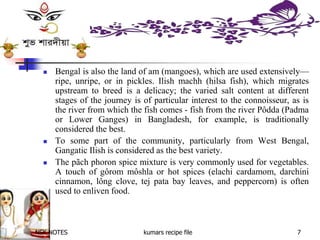
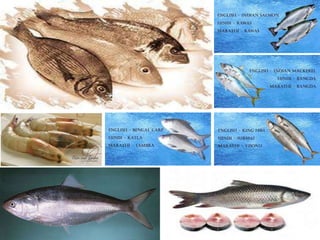
 Fish is the dominant kind of meat, cultivated in ponds and fished
with nets in the fresh-water rivers of the Ganges delta. More than
forty types of mostly freshwater fish are common, including carp
varieties like rui (rohu), katla, magur (catfish), chingŗi (prawn or
shrimp), as well as shuţki (small dried sea fish).
 Salt water fish (not sea fish though) Ilish (hilsa ilisha) is very
popular among Bengalis, can be called an icon of Bengali
cuisine. Almost every part of the fish (except fins and innards) is
eaten; the head and other parts are usually used to flavor
curries.
 Khashi (referred to as mutton in Indian English, the meat of
sterilized goats) is the most popular red meat.
 Other characteristic ingredients of traditional Bengali food
include rice, moshur đal (red lentils), mug đal (mung beans),
shorsher tel mustard oil, mustard paste, posto (poppyseed) and
narkel (ripe coconut).
NSK NOTES kumars recipe file 6
NSK NOTES kumars recipe file 7
 Bengal is also the land of am (mangoes), which are used extensively—
ripe, unripe, or in pickles. Ilish machh (hilsa fish), which migrates
upstream to breed is a delicacy; the varied salt content at different
stages of the journey is of particular interest to the connoisseur, as is
the river from which the fish comes - fish from the river Pôdda (Padma
or Lower Ganges) in Bangladesh, for example, is traditionally
considered the best.
 To some part of the community, particularly from West Bengal,
Gangatic Ilish is considered as the best variety.
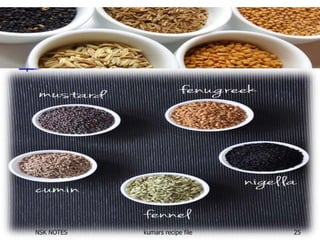
 The pãch phoron spice mixture is very commonly used for vegetables.
A touch of gôrom môshla or hot spices (elachi cardamom, darchini
cinnamon, lông clove, tej pata bay leaves, and peppercorn) is often
used to enliven food.
NSK NOTES kumars recipe file 8
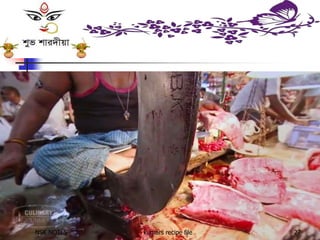
Another characteristic of Bengali food is the use of a
unique cutting instrument, the bothi. (This
instrument is also used in Maharashtra, where it is
known as vili and in Andhra Pradesh, known as
kathi peeta (kathi = knife and peeta = platform) ).
It is a long curved blade on a platform held down by
foot; both hands are used to hold whatever is
being cut and move it against the blade.
The method gives excellent control over the cutting
process, and can be used to cut anything from tiny
shrimp to large pumpkins.
NSK NOTES kumars recipe file 9
 The Mughal influence is most distinct in preparations
involving meat especially mutton.
 However, even chicken and other meats became more
prevalent.
 The influence was also seen in desserts; traditional
desserts were based on rice pastes and jaggery but under
the Mughal influence moved towards significantly
increased use of milk, cream and sugar along with
expensive spices such as cardamom and saffron.
NSK NOTES kumars recipe file 10
THE EATING HABIT
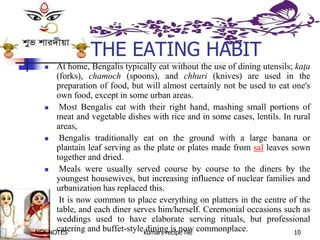
 At home, Bengalis typically eat without the use of dining utensils; kaţa
(forks), chamoch (spoons), and chhuri (knives) are used in the
preparation of food, but will almost certainly not be used to eat one's
own food, except in some urban areas.
 Most Bengalis eat with their right hand, mashing small portions of
meat and vegetable dishes with rice and in some cases, lentils. In rural
areas,
 Bengalis traditionally eat on the ground with a large banana or
plantain leaf serving as the plate or plates made from sal leaves sown
together and dried.
 Meals were usually served course by course to the diners by the
youngest housewives, but increasing influence of nuclear families and
urbanization has replaced this.
 It is now common to place everything on platters in the centre of the
table, and each diner serves him/herself. Ceremonial occasions such as
weddings used to have elaborate serving rituals, but professional
catering and buffet-style dining is now commonplace.
NSK NOTES kumars recipe file 11
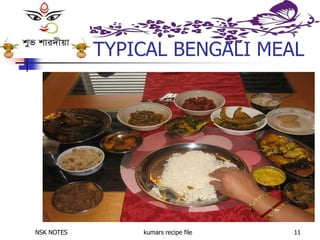
TYPICAL BENGALI MEAL
NSK NOTES kumars recipe file 12
NSK NOTES kumars recipe file 13
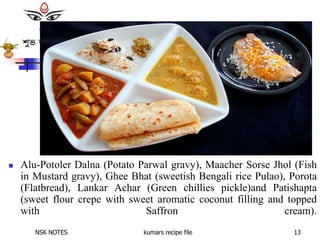
 Alu-Potoler Dalna (Potato Parwal gravy), Maacher Sorse Jhol (Fish
in Mustard gravy), Ghee Bhat (sweetish Bengali rice Pulao), Porota
(Flatbread), Lankar Achar (Green chillies pickle)and Patishapta
(sweet flour crepe with sweet aromatic coconut filling and topped
with Saffron cream).
NSK NOTES kumars recipe file 14
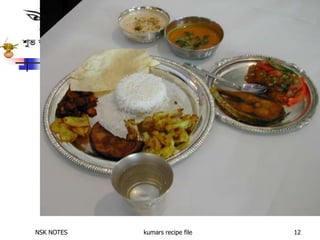
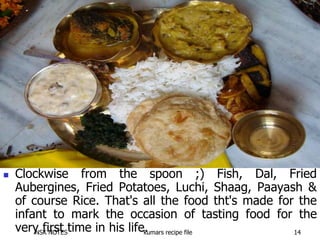
 Clockwise from the spoon ;) Fish, Dal, Fried
Aubergines, Fried Potatoes, Luchi, Shaag, Paayash &
of course Rice. That's all the food tht's made for the
infant to mark the occasion of tasting food for the
very first time in his life.
NSK NOTES kumars recipe file 15
THE MEAL
 A Bengali day begins with big bowl containing MOORI
( puffed rice), thick creamy milk and healthy dollops
of freshly mashed fruits such as sweet, ripe mangoes
or musky jack fruit.
 A lunch time favorite is shukto. It starts the meal
consists of diced and fried vegetables, some bitter
gourds, some pungent like white radish, some starch
like potatoes, some stiff like besan and other soft
such as stem and leaves.
 Some rice and dhal is always accompanied by fried
bhajjis made out of fish and vegetables.
NSK NOTES kumars recipe file 16
SALIENT FEATURES
 Bengalis are one of the greatest food lovers
in the Indian continent.
 Their passion for fish (river fish especially) is
so that no meal is complete without it.
 Varieties of fishes are available in the ganges
such as the Perch, Mullet, Carp, Prawn,
Crayfish and Lobster which are loved by
everyone.
NSK NOTES kumars recipe file 17
 Bengalis staple food is rice. Though coconut and its oil is
available, pure golden mustard oil is mostly used as a cooking
medium.
 Like others in India, Bengalis eat everything with their fingers.
 Vegetables especially the bitter ones are the first course
followed by dhal, perhaps accompanied by fritters or fries of fish
or vegetables.
 Meat will always follow fish and chutneys and ambals will
provide a refreshing touch. Finally comes the dessert.
NSK NOTES kumars recipe file 18
SIGNATURE DISHES
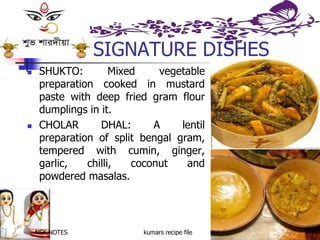
 SHUKTO: Mixed vegetable
preparation cooked in mustard
paste with deep fried gram flour
dumplings in it.
 CHOLAR DHAL: A lentil
preparation of split bengal gram,
tempered with cumin, ginger,
garlic, chilli, coconut and
powdered masalas.
NSK NOTES kumars recipe file 19
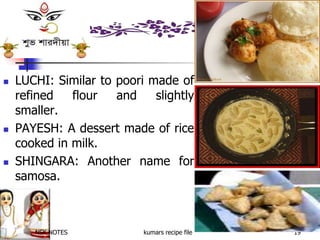
 LUCHI: Similar to poori made of
refined flour and slightly
smaller.
 PAYESH: A dessert made of rice
cooked in milk.
 SHINGARA: Another name for
samosa.
NSK NOTES kumars recipe file 20
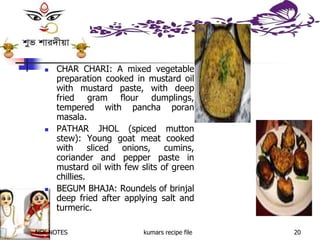
 CHAR CHARI: A mixed vegetable
preparation cooked in mustard oil
with mustard paste, with deep
fried gram flour dumplings,
tempered with pancha poran
masala.
 PATHAR JHOL (spiced mutton
stew): Young goat meat cooked
with sliced onions, cumins,
coriander and pepper paste in
mustard oil with few slits of green
chillies.
 BEGUM BHAJA: Roundels of brinjal
deep fried after applying salt and
turmeric.
NSK NOTES kumars recipe file 21
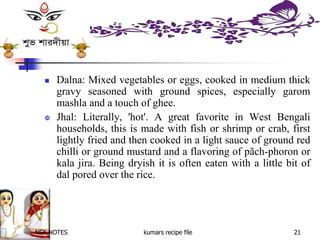
 Dalna: Mixed vegetables or eggs, cooked in medium thick
gravy seasoned with ground spices, especially garom
mashla and a touch of ghee.
 Jhal: Literally, 'hot'. A great favorite in West Bengali
households, this is made with fish or shrimp or crab, first
lightly fried and then cooked in a light sauce of ground red
chilli or ground mustard and a flavoring of pãch-phoron or
kala jira. Being dryish it is often eaten with a little bit of
dal pored over the rice.
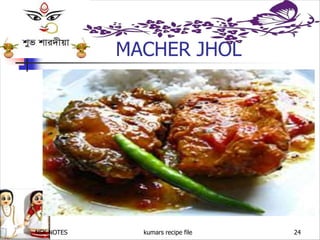
 Jhol: A light fish or vegetable stew seasoned with
ground spices like ginger, cumin, coriander, chili, and
turmeric with pieces of fish and longitudinal slices of
vegetables floating in it. The gravy is thin yet
extremely flavourful. Whole green chillies are usually
added at the end and green coriander leaves are
used to season for extra taste. This term is also used
to refer to any type of stew in meat, fish or vegetable
dishes.
NSK NOTES kumars recipe file 22
NSK NOTES kumars recipe file 23
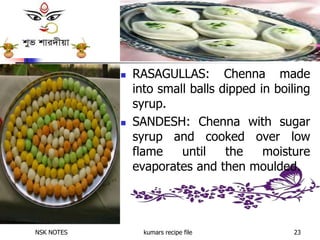
 RASAGULLAS: Chenna made
into small balls dipped in boiling
syrup.
 SANDESH: Chenna with sugar
syrup and cooked over low
flame until the moisture
evaporates and then moulded.
NSK NOTES kumars recipe file 24
MACHER JHOL
NSK NOTES kumars recipe file 25
NSK NOTES kumars recipe file 26
NSK NOTES kumars recipe file 27
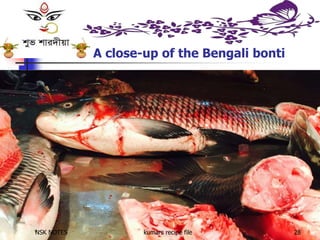
A close-up of the Bengali bonti
NSK NOTES kumars recipe file 28

Bengal cuisine

  • 1.
    NSK NOTES kumarsrecipe file 1
  • 2.
    NSK NOTES kumarsrecipe file 2 HISTORY  Bengali food has inherited a large number of influences, both foreign and South Asian, arising from a turbulent history and strong trade links with many parts of the world.  Originally inhabited by Dravidians and other ethnic groups, and later further settled by the Aryans during the Gupta era, Bengal fell under the sway of various Muslim rulers from the early thirteenth century onwards, and was then ruled by the British for two centuries (1757-1947).  It also saw a fair share of immigrants from various parts of the world - most prominently Jews, Chinese and Afghans who settled down in their own distinct communities in and around Kolkata.
  • 3.
    NSK NOTES kumarsrecipe file 3  Bengal (before its partition into eastern and western parts) has been ruled by Muslim rules since the Delhi Sultanate in early 12th century. However, for over five hundred years the center of Muslim rule in Bengal was centered in Dhaka.  Trade routes going from Delhi to Dhaka travered the entire width of today's West Bengal but seems to have little influence beyond that. West Bengal came under Muslim influence only when Murshid Quli Khan became the governor of Bengal and moved the capital from Dhaka to the newly founded city of Murshidabad in the late 17th century.
  • 4.
     From theculinary point of view, a key influence to the food came much later, when Wajid Ali Shah, the last Nawab of Avadh was exiled to Metia Bruz, in the outskirts of Kolkata. He is said to have brought with him hundreds of cooks and masalchis (spice mixers) who, on his death, dissipated into the population, starting restaurants and food carts all over Bengal. NSK NOTES kumars recipe file 4
  • 5.
    NSK NOTES kumarsrecipe file 5 THE FOOD  Bengali food today has some broad (though not so distinct) variations - Traditional, Mughal, Anglo-Indian and Chinese.  Fish is the dominant kind of meat, cultivated in ponds and fished with nets in the fresh-water rivers of the Ganges delta. More than forty types of mostly freshwater fish are common, including carp varieties like rui (rohu), katla, magur (catfish), chingŗi (prawn or shrimp), as well as shuţki (small dried sea fish).
  • 6.
     Salt waterfish (not sea fish though) Ilish (hilsa ilisha) is very popular among Bengalis, can be called an icon of Bengali cuisine. Almost every part of the fish (except fins and innards) is eaten; the head and other parts are usually used to flavor curries.  Khashi (referred to as mutton in Indian English, the meat of sterilized goats) is the most popular red meat.  Other characteristic ingredients of traditional Bengali food include rice, moshur đal (red lentils), mug đal (mung beans), shorsher tel mustard oil, mustard paste, posto (poppyseed) and narkel (ripe coconut). NSK NOTES kumars recipe file 6
  • 7.
    NSK NOTES kumarsrecipe file 7  Bengal is also the land of am (mangoes), which are used extensively— ripe, unripe, or in pickles. Ilish machh (hilsa fish), which migrates upstream to breed is a delicacy; the varied salt content at different stages of the journey is of particular interest to the connoisseur, as is the river from which the fish comes - fish from the river Pôdda (Padma or Lower Ganges) in Bangladesh, for example, is traditionally considered the best.  To some part of the community, particularly from West Bengal, Gangatic Ilish is considered as the best variety.  The pãch phoron spice mixture is very commonly used for vegetables. A touch of gôrom môshla or hot spices (elachi cardamom, darchini cinnamon, lông clove, tej pata bay leaves, and peppercorn) is often used to enliven food.
  • 8.
    NSK NOTES kumarsrecipe file 8 Another characteristic of Bengali food is the use of a unique cutting instrument, the bothi. (This instrument is also used in Maharashtra, where it is known as vili and in Andhra Pradesh, known as kathi peeta (kathi = knife and peeta = platform) ). It is a long curved blade on a platform held down by foot; both hands are used to hold whatever is being cut and move it against the blade. The method gives excellent control over the cutting process, and can be used to cut anything from tiny shrimp to large pumpkins.
  • 9.
    NSK NOTES kumarsrecipe file 9  The Mughal influence is most distinct in preparations involving meat especially mutton.  However, even chicken and other meats became more prevalent.  The influence was also seen in desserts; traditional desserts were based on rice pastes and jaggery but under the Mughal influence moved towards significantly increased use of milk, cream and sugar along with expensive spices such as cardamom and saffron.
  • 10.
    NSK NOTES kumarsrecipe file 10 THE EATING HABIT  At home, Bengalis typically eat without the use of dining utensils; kaţa (forks), chamoch (spoons), and chhuri (knives) are used in the preparation of food, but will almost certainly not be used to eat one's own food, except in some urban areas.  Most Bengalis eat with their right hand, mashing small portions of meat and vegetable dishes with rice and in some cases, lentils. In rural areas,  Bengalis traditionally eat on the ground with a large banana or plantain leaf serving as the plate or plates made from sal leaves sown together and dried.  Meals were usually served course by course to the diners by the youngest housewives, but increasing influence of nuclear families and urbanization has replaced this.  It is now common to place everything on platters in the centre of the table, and each diner serves him/herself. Ceremonial occasions such as weddings used to have elaborate serving rituals, but professional catering and buffet-style dining is now commonplace.
  • 11.
    NSK NOTES kumarsrecipe file 11 TYPICAL BENGALI MEAL
  • 12.
    NSK NOTES kumarsrecipe file 12
  • 13.
    NSK NOTES kumarsrecipe file 13  Alu-Potoler Dalna (Potato Parwal gravy), Maacher Sorse Jhol (Fish in Mustard gravy), Ghee Bhat (sweetish Bengali rice Pulao), Porota (Flatbread), Lankar Achar (Green chillies pickle)and Patishapta (sweet flour crepe with sweet aromatic coconut filling and topped with Saffron cream).
  • 14.
    NSK NOTES kumarsrecipe file 14  Clockwise from the spoon ;) Fish, Dal, Fried Aubergines, Fried Potatoes, Luchi, Shaag, Paayash & of course Rice. That's all the food tht's made for the infant to mark the occasion of tasting food for the very first time in his life.
  • 15.
    NSK NOTES kumarsrecipe file 15 THE MEAL  A Bengali day begins with big bowl containing MOORI ( puffed rice), thick creamy milk and healthy dollops of freshly mashed fruits such as sweet, ripe mangoes or musky jack fruit.  A lunch time favorite is shukto. It starts the meal consists of diced and fried vegetables, some bitter gourds, some pungent like white radish, some starch like potatoes, some stiff like besan and other soft such as stem and leaves.  Some rice and dhal is always accompanied by fried bhajjis made out of fish and vegetables.
  • 16.
    NSK NOTES kumarsrecipe file 16 SALIENT FEATURES  Bengalis are one of the greatest food lovers in the Indian continent.  Their passion for fish (river fish especially) is so that no meal is complete without it.  Varieties of fishes are available in the ganges such as the Perch, Mullet, Carp, Prawn, Crayfish and Lobster which are loved by everyone.
  • 17.
    NSK NOTES kumarsrecipe file 17  Bengalis staple food is rice. Though coconut and its oil is available, pure golden mustard oil is mostly used as a cooking medium.  Like others in India, Bengalis eat everything with their fingers.  Vegetables especially the bitter ones are the first course followed by dhal, perhaps accompanied by fritters or fries of fish or vegetables.  Meat will always follow fish and chutneys and ambals will provide a refreshing touch. Finally comes the dessert.
  • 18.
    NSK NOTES kumarsrecipe file 18 SIGNATURE DISHES  SHUKTO: Mixed vegetable preparation cooked in mustard paste with deep fried gram flour dumplings in it.  CHOLAR DHAL: A lentil preparation of split bengal gram, tempered with cumin, ginger, garlic, chilli, coconut and powdered masalas.
  • 19.
    NSK NOTES kumarsrecipe file 19  LUCHI: Similar to poori made of refined flour and slightly smaller.  PAYESH: A dessert made of rice cooked in milk.  SHINGARA: Another name for samosa.
  • 20.
    NSK NOTES kumarsrecipe file 20  CHAR CHARI: A mixed vegetable preparation cooked in mustard oil with mustard paste, with deep fried gram flour dumplings, tempered with pancha poran masala.  PATHAR JHOL (spiced mutton stew): Young goat meat cooked with sliced onions, cumins, coriander and pepper paste in mustard oil with few slits of green chillies.  BEGUM BHAJA: Roundels of brinjal deep fried after applying salt and turmeric.
  • 21.
    NSK NOTES kumarsrecipe file 21  Dalna: Mixed vegetables or eggs, cooked in medium thick gravy seasoned with ground spices, especially garom mashla and a touch of ghee.  Jhal: Literally, 'hot'. A great favorite in West Bengali households, this is made with fish or shrimp or crab, first lightly fried and then cooked in a light sauce of ground red chilli or ground mustard and a flavoring of pãch-phoron or kala jira. Being dryish it is often eaten with a little bit of dal pored over the rice.
  • 22.
     Jhol: Alight fish or vegetable stew seasoned with ground spices like ginger, cumin, coriander, chili, and turmeric with pieces of fish and longitudinal slices of vegetables floating in it. The gravy is thin yet extremely flavourful. Whole green chillies are usually added at the end and green coriander leaves are used to season for extra taste. This term is also used to refer to any type of stew in meat, fish or vegetable dishes. NSK NOTES kumars recipe file 22
  • 23.
    NSK NOTES kumarsrecipe file 23  RASAGULLAS: Chenna made into small balls dipped in boiling syrup.  SANDESH: Chenna with sugar syrup and cooked over low flame until the moisture evaporates and then moulded.
  • 24.
    NSK NOTES kumarsrecipe file 24 MACHER JHOL
  • 25.
    NSK NOTES kumarsrecipe file 25
  • 26.
    NSK NOTES kumarsrecipe file 26
  • 27.
    NSK NOTES kumarsrecipe file 27
  • 28.
    A close-up ofthe Bengali bonti NSK NOTES kumars recipe file 28