Satu Öystilä 2015
Constructive alignment in university teaching
Eduta Oy
Puh. +35850 564 4887
info@eduta.fi
www.eduta.fi
The mission of the university (2 §)
• The mission of the university is to promote free research and
scientific and artistic education, and to give research-based
education and to educate students to serve their country and
humanity. Universities are expected to promote life-long
learning and interacting with the surrounding society and
promote the social effectiveness of research results and
artistic activities.
• The activities at the university have to be organized so that a
high international level in research, in artistic activity, in
education and teaching are ensured according to ethical
principles and a good scientific practice.
What is university pedagogy?
University pedagogy means facilitating and educating
university students to experts and researchers in their own
field and substance.
This facilitation and education have to take place in every
university forum - face to face and online: in lectures,
seminars, group works, exercises, thesis counselling and
learning at work.
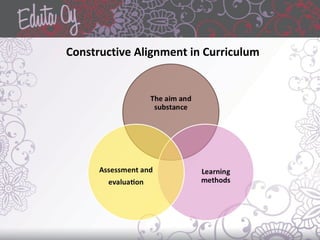
Constructive Alignment in Curriculum
Constructive alignment (Biggs and Tang)
1. What do we want our students to learn?
2. What are the best learning methods in our
circumstances and within available resources of
getting them to learn it?
3. When and how do we assess how well they have
learned it?
4. How do we ensure that the new knowledge will be
applied into future?
The implementation of constructive alignment
1. The exact definition of learning aims – not lists of
content topics, but through action and verbs
2. How should work performance be improved by
education?
3. The most suitable, collaborative teaching methods in
order to get best learning outcomes
4. Choosing effective assessment methods and exact
assessment criteria
5. Quality assurance and development of training in
order to get the previous factors supplied
Design of constructively aligned training and
assessment (John Biggs) 1/2
1. Describe the intended learning outcome in the form
of a verb (learning activity), its object (the content)
and specify the context and a standard the
participants are to attain.
2. Create a learning environment using teaching or
learning activities (collaborative methods)
addressing the verb in question and therefore are
likely to bring about the intended outcome.
Design of constructively aligned training and
assessment (John Biggs) 2/2
3. Use assessment tasks that also contain that verb,
thus enabling you to judge if and how well
students’ performances meet the criteria.
4. Transform these judgments into standard grading
criteria-
Desirable but unintended outcomes
And remember!
Even if the term the ”intended” learning outcomes
is used, the training and assessment should always
allow for desirable but unintended outcomes, as
these will inevitably occur when participants have
freedom to construct their own knowledge.
Biggs, Constructive university teaching
• The constructive learning theory in the
backround
• The principles of the inquiry-based learning
• Collaborative learning, peer learning
• Formative assessment
Learning methods
Co-operative, collaborative and experiential
learning methods and peer learning facilitating
assure the learner-centredness.
Assessment of learning
Self-assessment
Peer learning, peer assessment and peer
feedback
Assessment promoting the learning process
The constructive learning theory 1/2
• Learning is a selective and interpreting process and
always contextual.
• The learners construct knowledge with their own
activities, building on what they already know.
Teaching is not a matter of transmitting but of
engaging students in active learning, building their
knowledge in terms what they already know.
The constructive learning theory 2/2
• The effective learning changes the way we see the
world. The acquisition of information in itself does
not bring about such a change, but the way we
structure that information and think with it does.
Thus, educaton is about conceptual change, not just
the acquisition of information.
Conceptual change in university teaching
1. It is clear to both teachers and students what the
intended outcomes of learning are.
2. Students experience the felt need to get there: for
example motivation is as much a product of good
teaching as its prerequisite.
3. Students feel free to focus on the task, not on
watching their backs.
4. Students work collaboratively and in dialogue with
others, both peers and teachers. Good dialogue
elicits those activities that shape, elaborate, and
deepen understanding.
What are your theories of teaching and learning?
All university teachers have some theory of what
teaching, even if they are not explicity aware of that
theory, and their theories deeply affect the kind of
learning environment they create in their
classrooms.
Learning is?
Teaching is?
Biggs & Tang: The 3P model of teaching and learning
• How effectively we teach depends, first, on what we
think teaching is.
• Three levels of thinking about teaching are
distinguished. The first two are “blame” models: the
first blaming the learner, the second the teacher. The
third level integrates learning and teaching seeing
effective teaching as encouraging students to use the
learning activities most likely to achieve the outcomes
intended. Students may use inappropriate activities,
resulting in a surface approach to learning, or high-level
activities resulting in a deep approach to learning.
1. Biggs & Tang: The first level of teaching 1/2
• Teachers at level 1 focus on the differences between
students, as most beginning teachers do: there are
good students and poor students.
• Level 1 teachers see their responsibility as knowing
the content well, and expounding it clearly.
• The students have to attend lectures, to take notes,
to read the recommendes readings etc.
• At level 1 teaching is transmitting information, usually
by lecturing – so differences in learning are due to
differences between students in ability and
motivation.
1. Biggs & Tang: The first level of teaching 2/2
• The curriculum is a list of items of content that have
been covered.
• How the students receive the content and what their
depth of understanding of it might be are not
specifically interested.
• A teacher is the knowledgeable, the sage on the stage,
who expounds the information the students are to
absorb and to report back accurately.
• If students don’t learn, it’s not that there is anything
wrong with the teaching, but that they are incapable,
unmotivated…
2. Biggs & Tang: The second level of teaching 1/2
• Teachers at level focus on what teachers do. This view
of teaching is still based on transmission, but
transmitting concepts and understanding, not just
information.
• Learning is seen as more a function of what the
teacher is doing , than of what sort of student the
teacher has to deal with.
• The responsibility for ”getting it across” rests to a
significant extent on what the teacher does.
• There may be more effective ways of teaching than
what one is currently doing.
2. Biggs & Tang: The second level of teaching 2/2
• At level 2 the teaching skills are important. The
teacher uses plenty of variaton in technique, but the
focus is teacher-centred and it is concerned with
management, not with facilitating learning.
3. Biggs & Tang: The third level of teaching 1/2
• Teachers at level 3 focus on what the student does and
how that relates to teaching.
• Level 3 is a student-centred model of teaching , with
teaching supporting learning. Is it no longer possible to
say: I taught them, but they didn’t learn.
• Expert teaching includes mastery over a variety of
teaching methods, but unless learning takes place, they
are irrelevant; the focus is on how well the intended
outcomes are achieved.
• The teacher is a reflective practitioner.
3. Biggs & Tang: The third level of teaching 2/2
• The level 3 implies a view of teaching that is not just
about facts, concepts and principles to be covered
and understood, but also to be clear about:
1. What it means to understand content in the way that is
stipulated in the intended learning outcomes?
2. What kind of teaching/learning activities are required to
achieve the levels of understanding?
3. How do you define those levels of understanding?
4. What do students have to reach the level specified?
5. What do you have to do to find out if the outcomes have
been reached?
Reflective university teacher
• By reflection can the university teacher develop
his/her own teaching, both the experience and
understanding of the learning process. The teacher has
also the ability to deal with problematic situations in
the teaching
Reflection on a critical teaching/assessment incident
1. What was the problem? What went wrong? What
was the evidence for the problem?
2. What was the cause of the problem?
3. How did you deal with the problem then?
4. How did your solution to the problem relate to your
theory of teaching and learning?
Reflective university teacher
• Experience – The teacher compares the experiences and
think about his/her previous operating models: What I
did? What worked well? Why? Which resources I used?
What I learned?
• Substantive expertise
• Knowledge of learning theories: Why the students
didn’t learn well? How can I motivate students?
Donald Schön: The reflective practitioner
• Reflective teaching is not applying general principle
of teaching according to rule: they need to adapting
to each teacher’s own personal strenghts and
teaching context.
• The university teachers need to reflect when faced
with problems or difficulties for which they have not
been specifically trained to cope.
• Transformative reflection: the teacher uses theory
to enable the transformation from the unsatisfactory
what-is to the more effective what-might-be
situation.
Information on different aspects of the teaching
1. The university teacher´s own reflections on teaching:
successes, failures, experiences, emotions
2. The feedback of the students
3. A colleague in the role of the observer
4. A staff developer or supervisor of work as a facilitator
The competencies, skills, attitudes and knowledge of a
good university teacher?
• Describe the competencies first alone.
• Discuss and complete the list in small groups.
Effective university teaching (Biggs & Moore, Biggs)
• Well-structured knowledge bases
• Motivating context
• Learner-centredness (peer learning and interaction
with others)
• Self assessment of students
Ramsden:
Effective university teaching 1/2
• The desire to share the own affection to the
discipline with the students
• The ability to present the substance in a activating
and interesting way
• The ability to stand in the position of students
• The ability to explain the matter simplifying
• The ability to underline what should be understood
and why
• The attitude of respect for students
Ramsden:
Effective university teaching 2/2
• Encouraging the students to self-direction
• The ability to improvise and be fexible according to
the situation
• The ability to use collaborative learning methods,
which require responsible learning in dialogue
• The ability to use valid assessment methods and
peer and self-assessment
• Focus on key concepts
• Desire to learn from the students

Constructive alignment in university teaching and curriculum

  • 1.
    Satu Öystilä 2015 Constructivealignment in university teaching Eduta Oy Puh. +35850 564 4887 info@eduta.fi www.eduta.fi
  • 2.
    The mission ofthe university (2 §) • The mission of the university is to promote free research and scientific and artistic education, and to give research-based education and to educate students to serve their country and humanity. Universities are expected to promote life-long learning and interacting with the surrounding society and promote the social effectiveness of research results and artistic activities. • The activities at the university have to be organized so that a high international level in research, in artistic activity, in education and teaching are ensured according to ethical principles and a good scientific practice.
  • 3.
    What is universitypedagogy? University pedagogy means facilitating and educating university students to experts and researchers in their own field and substance. This facilitation and education have to take place in every university forum - face to face and online: in lectures, seminars, group works, exercises, thesis counselling and learning at work.
  • 4.
  • 5.
    Constructive alignment (Biggsand Tang) 1. What do we want our students to learn? 2. What are the best learning methods in our circumstances and within available resources of getting them to learn it? 3. When and how do we assess how well they have learned it? 4. How do we ensure that the new knowledge will be applied into future?
  • 6.
    The implementation ofconstructive alignment 1. The exact definition of learning aims – not lists of content topics, but through action and verbs 2. How should work performance be improved by education? 3. The most suitable, collaborative teaching methods in order to get best learning outcomes 4. Choosing effective assessment methods and exact assessment criteria 5. Quality assurance and development of training in order to get the previous factors supplied
  • 7.
    Design of constructivelyaligned training and assessment (John Biggs) 1/2 1. Describe the intended learning outcome in the form of a verb (learning activity), its object (the content) and specify the context and a standard the participants are to attain. 2. Create a learning environment using teaching or learning activities (collaborative methods) addressing the verb in question and therefore are likely to bring about the intended outcome.
  • 8.
    Design of constructivelyaligned training and assessment (John Biggs) 2/2 3. Use assessment tasks that also contain that verb, thus enabling you to judge if and how well students’ performances meet the criteria. 4. Transform these judgments into standard grading criteria-
  • 9.
    Desirable but unintendedoutcomes And remember! Even if the term the ”intended” learning outcomes is used, the training and assessment should always allow for desirable but unintended outcomes, as these will inevitably occur when participants have freedom to construct their own knowledge.
  • 10.
    Biggs, Constructive universityteaching • The constructive learning theory in the backround • The principles of the inquiry-based learning • Collaborative learning, peer learning • Formative assessment
  • 11.
    Learning methods Co-operative, collaborativeand experiential learning methods and peer learning facilitating assure the learner-centredness.
  • 12.
    Assessment of learning Self-assessment Peerlearning, peer assessment and peer feedback Assessment promoting the learning process
  • 13.
    The constructive learningtheory 1/2 • Learning is a selective and interpreting process and always contextual. • The learners construct knowledge with their own activities, building on what they already know. Teaching is not a matter of transmitting but of engaging students in active learning, building their knowledge in terms what they already know.
  • 14.
    The constructive learningtheory 2/2 • The effective learning changes the way we see the world. The acquisition of information in itself does not bring about such a change, but the way we structure that information and think with it does. Thus, educaton is about conceptual change, not just the acquisition of information.
  • 15.
    Conceptual change inuniversity teaching 1. It is clear to both teachers and students what the intended outcomes of learning are. 2. Students experience the felt need to get there: for example motivation is as much a product of good teaching as its prerequisite. 3. Students feel free to focus on the task, not on watching their backs. 4. Students work collaboratively and in dialogue with others, both peers and teachers. Good dialogue elicits those activities that shape, elaborate, and deepen understanding.
  • 16.
    What are yourtheories of teaching and learning? All university teachers have some theory of what teaching, even if they are not explicity aware of that theory, and their theories deeply affect the kind of learning environment they create in their classrooms. Learning is? Teaching is?
  • 17.
    Biggs & Tang:The 3P model of teaching and learning • How effectively we teach depends, first, on what we think teaching is. • Three levels of thinking about teaching are distinguished. The first two are “blame” models: the first blaming the learner, the second the teacher. The third level integrates learning and teaching seeing effective teaching as encouraging students to use the learning activities most likely to achieve the outcomes intended. Students may use inappropriate activities, resulting in a surface approach to learning, or high-level activities resulting in a deep approach to learning.
  • 18.
    1. Biggs &Tang: The first level of teaching 1/2 • Teachers at level 1 focus on the differences between students, as most beginning teachers do: there are good students and poor students. • Level 1 teachers see their responsibility as knowing the content well, and expounding it clearly. • The students have to attend lectures, to take notes, to read the recommendes readings etc. • At level 1 teaching is transmitting information, usually by lecturing – so differences in learning are due to differences between students in ability and motivation.
  • 19.
    1. Biggs &Tang: The first level of teaching 2/2 • The curriculum is a list of items of content that have been covered. • How the students receive the content and what their depth of understanding of it might be are not specifically interested. • A teacher is the knowledgeable, the sage on the stage, who expounds the information the students are to absorb and to report back accurately. • If students don’t learn, it’s not that there is anything wrong with the teaching, but that they are incapable, unmotivated…
  • 20.
    2. Biggs &Tang: The second level of teaching 1/2 • Teachers at level focus on what teachers do. This view of teaching is still based on transmission, but transmitting concepts and understanding, not just information. • Learning is seen as more a function of what the teacher is doing , than of what sort of student the teacher has to deal with. • The responsibility for ”getting it across” rests to a significant extent on what the teacher does. • There may be more effective ways of teaching than what one is currently doing.
  • 21.
    2. Biggs &Tang: The second level of teaching 2/2 • At level 2 the teaching skills are important. The teacher uses plenty of variaton in technique, but the focus is teacher-centred and it is concerned with management, not with facilitating learning.
  • 22.
    3. Biggs &Tang: The third level of teaching 1/2 • Teachers at level 3 focus on what the student does and how that relates to teaching. • Level 3 is a student-centred model of teaching , with teaching supporting learning. Is it no longer possible to say: I taught them, but they didn’t learn. • Expert teaching includes mastery over a variety of teaching methods, but unless learning takes place, they are irrelevant; the focus is on how well the intended outcomes are achieved. • The teacher is a reflective practitioner.
  • 23.
    3. Biggs &Tang: The third level of teaching 2/2 • The level 3 implies a view of teaching that is not just about facts, concepts and principles to be covered and understood, but also to be clear about: 1. What it means to understand content in the way that is stipulated in the intended learning outcomes? 2. What kind of teaching/learning activities are required to achieve the levels of understanding? 3. How do you define those levels of understanding? 4. What do students have to reach the level specified? 5. What do you have to do to find out if the outcomes have been reached?
  • 24.
    Reflective university teacher •By reflection can the university teacher develop his/her own teaching, both the experience and understanding of the learning process. The teacher has also the ability to deal with problematic situations in the teaching
  • 25.
    Reflection on acritical teaching/assessment incident 1. What was the problem? What went wrong? What was the evidence for the problem? 2. What was the cause of the problem? 3. How did you deal with the problem then? 4. How did your solution to the problem relate to your theory of teaching and learning?
  • 26.
    Reflective university teacher •Experience – The teacher compares the experiences and think about his/her previous operating models: What I did? What worked well? Why? Which resources I used? What I learned? • Substantive expertise • Knowledge of learning theories: Why the students didn’t learn well? How can I motivate students?
  • 27.
    Donald Schön: Thereflective practitioner • Reflective teaching is not applying general principle of teaching according to rule: they need to adapting to each teacher’s own personal strenghts and teaching context. • The university teachers need to reflect when faced with problems or difficulties for which they have not been specifically trained to cope. • Transformative reflection: the teacher uses theory to enable the transformation from the unsatisfactory what-is to the more effective what-might-be situation.
  • 28.
    Information on differentaspects of the teaching 1. The university teacher´s own reflections on teaching: successes, failures, experiences, emotions 2. The feedback of the students 3. A colleague in the role of the observer 4. A staff developer or supervisor of work as a facilitator
  • 29.
    The competencies, skills,attitudes and knowledge of a good university teacher? • Describe the competencies first alone. • Discuss and complete the list in small groups.
  • 30.
    Effective university teaching(Biggs & Moore, Biggs) • Well-structured knowledge bases • Motivating context • Learner-centredness (peer learning and interaction with others) • Self assessment of students
  • 31.
    Ramsden: Effective university teaching1/2 • The desire to share the own affection to the discipline with the students • The ability to present the substance in a activating and interesting way • The ability to stand in the position of students • The ability to explain the matter simplifying • The ability to underline what should be understood and why • The attitude of respect for students
  • 32.
    Ramsden: Effective university teaching2/2 • Encouraging the students to self-direction • The ability to improvise and be fexible according to the situation • The ability to use collaborative learning methods, which require responsible learning in dialogue • The ability to use valid assessment methods and peer and self-assessment • Focus on key concepts • Desire to learn from the students