Lineation And Linear structural
Saif Elden Abo Khashaba
Prepared by
Kafrelsheikh University
Faculty of science
Geology Department
2017
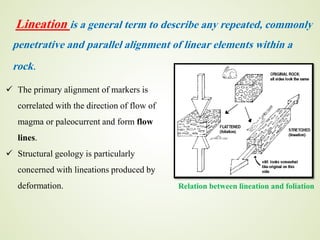
Lineation is a general term to describe any repeated, commonly
penetrative and parallel alignment of linear elements within a
rock.
 The primary alignment of markers is
correlated with the direction of flow of
magma or paleocurrent and form flow
lines.
 Structural geology is particularly
concerned with lineations produced by
deformation. Relation between lineation and foliation
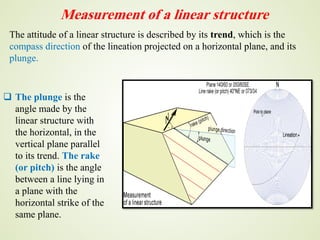
The attitude of a linear structure is described by its trend, which is the
compass direction of the lineation projected on a horizontal plane, and its
plunge.
Measurement of a linear structure
 The plunge is the
angle made by the
linear structure with
the horizontal, in the
vertical plane parallel
to its trend. The rake
(or pitch) is the angle
between a line lying in
a plane with the
horizontal strike of the
same plane.
1. Primary lineation
Types of lineation
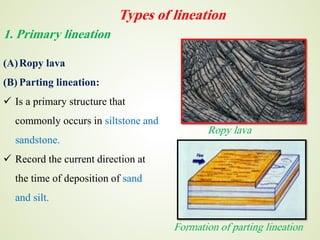
(A)Ropy lava
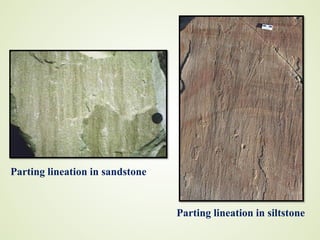
(B) Parting lineation:
 Is a primary structure that
commonly occurs in siltstone and
sandstone.
 Record the current direction at
the time of deposition of sand
and silt.
Formation of parting lineation
Ropy lava
Parting lineation in siltstone
Parting lineation in sandstone
(A):Non-penetrative lineation
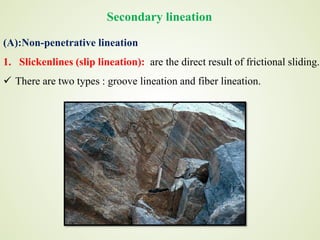
1. Slickenlines (slip lineation): are the direct result of frictional sliding.
 There are two types : groove lineation and fiber lineation.
Secondary lineation
2. slickensides: refer to the entire movement surface develop on the
fault surface, bedding and foliation.
(B): penetrative lineation: the dominant types are
1. Mineral lineation
 Is the expression of aligned minerals or mineral aggregates
in a rock, generally occurring within the foliation plane in
a metamorphic rock.
 Varieties of mineral lineation:
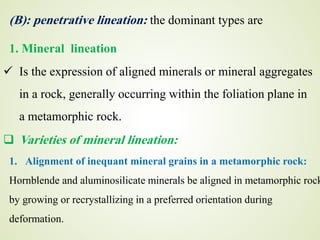
1. Alignment of inequant mineral grains in a metamorphic rock:
Hornblende and aluminosilicate minerals be aligned in metamorphic rock
by growing or recrystallizing in a preferred orientation during
deformation.
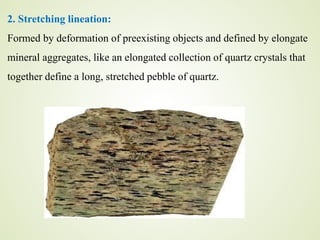
2. Stretching lineation:
Formed by deformation of preexisting objects and defined by elongate
mineral aggregates, like an elongated collection of quartz crystals that
together define a long, stretched pebble of quartz.
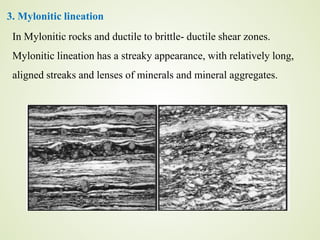
3. Mylonitic lineation
In Mylonitic rocks and ductile to brittle- ductile shear zones.
Mylonitic lineation has a streaky appearance, with relatively long,
aligned streaks and lenses of minerals and mineral aggregates.
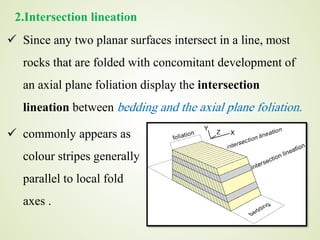
2.Intersection lineation
 Since any two planar surfaces intersect in a line, most
rocks that are folded with concomitant development of
an axial plane foliation display the intersection
lineation between bedding and the axial plane foliation.
 commonly appears as
colour stripes generally
parallel to local fold
axes .
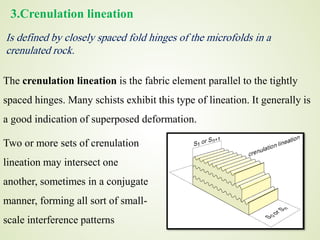
3.Crenulation lineation
Is defined by closely spaced fold hinges of the microfolds in a
crenulated rock.
The crenulation lineation is the fabric element parallel to the tightly
spaced hinges. Many schists exhibit this type of lineation. It generally is
a good indication of superposed deformation.
Two or more sets of crenulation
lineation may intersect one
another, sometimes in a conjugate
manner, forming all sort of small-
scale interference patterns
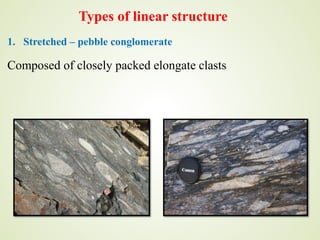
Types of linear structure
1. Stretched – pebble conglomerate
Composed of closely packed elongate clasts
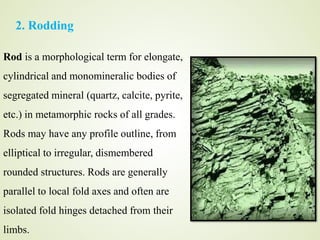
Rod is a morphological term for elongate,
cylindrical and monomineralic bodies of
segregated mineral (quartz, calcite, pyrite,
etc.) in metamorphic rocks of all grades.
Rods may have any profile outline, from
elliptical to irregular, dismembered
rounded structures. Rods are generally
parallel to local fold axes and often are
isolated fold hinges detached from their
limbs.
2. Rodding
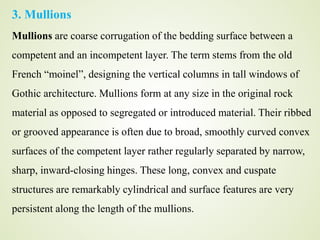
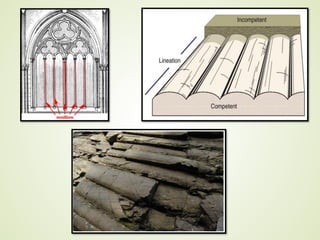
3. Mullions
Mullions are coarse corrugation of the bedding surface between a
competent and an incompetent layer. The term stems from the old
French “moinel”, designing the vertical columns in tall windows of
Gothic architecture. Mullions form at any size in the original rock
material as opposed to segregated or introduced material. Their ribbed
or grooved appearance is often due to broad, smoothly curved convex
surfaces of the competent layer rather regularly separated by narrow,
sharp, inward-closing hinges. These long, convex and cuspate
structures are remarkably cylindrical and surface features are very
persistent along the length of the mullions.
4. Pencil structure
Is a very distinctive linear structure associated with folded
and cleaved mudstone and siltstones.
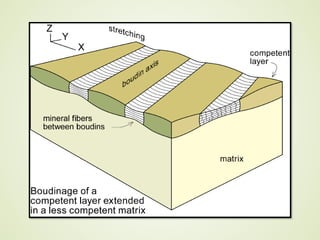
5. Boudinage
The geological boudins are side by side segments of a layer or object
sandwiched in a less competent (i.e more deformable) matrix.
Boudinage describes the process of stretching, necking and
eventually segmentation and separation of these segments; this is
produced in general by extension parallel to the bedding plane and
failure of the competent, boudinaged layer during the ductile flow of
the less competent host. Objects such as fossils, pebbles and minerals
can also be boudinaged (linear streaking of minerals).
Description
Boudinage ranges from micro- to macroscopic scales; typically, a strong
layer or dyke is broken up at regular intervals into a series of elongate
and aligned blocks whose profiles, seen orthogonal to the long axis of
boudins, are the basis for the classification of boudinage structures
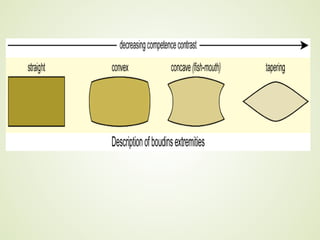
Boudin profiles are variable, symmetrical or asymmetrical. Long faces,
usually layer boundaries of the boudins, can be concave (bone-shaped
boudins), convex (barrel-shaped boudins) or parallel to each other
(blocky boudins). These shapes reflect ductility contrasts between
layer and matrix. Large contrasts produce boudins with sharp edges,
and small contrasts produce rounded boudins.
Lineation And Linear structural

Lineation And Linear structural

  • 1.
    Lineation And Linearstructural Saif Elden Abo Khashaba Prepared by Kafrelsheikh University Faculty of science Geology Department 2017
  • 2.
    Lineation is ageneral term to describe any repeated, commonly penetrative and parallel alignment of linear elements within a rock.  The primary alignment of markers is correlated with the direction of flow of magma or paleocurrent and form flow lines.  Structural geology is particularly concerned with lineations produced by deformation. Relation between lineation and foliation
  • 3.
    The attitude ofa linear structure is described by its trend, which is the compass direction of the lineation projected on a horizontal plane, and its plunge. Measurement of a linear structure  The plunge is the angle made by the linear structure with the horizontal, in the vertical plane parallel to its trend. The rake (or pitch) is the angle between a line lying in a plane with the horizontal strike of the same plane.
  • 4.
    1. Primary lineation Typesof lineation (A)Ropy lava (B) Parting lineation:  Is a primary structure that commonly occurs in siltstone and sandstone.  Record the current direction at the time of deposition of sand and silt. Formation of parting lineation Ropy lava
  • 5.
    Parting lineation insiltstone Parting lineation in sandstone
  • 6.
    (A):Non-penetrative lineation 1. Slickenlines(slip lineation): are the direct result of frictional sliding.  There are two types : groove lineation and fiber lineation. Secondary lineation
  • 7.
    2. slickensides: referto the entire movement surface develop on the fault surface, bedding and foliation.
  • 8.
    (B): penetrative lineation:the dominant types are 1. Mineral lineation  Is the expression of aligned minerals or mineral aggregates in a rock, generally occurring within the foliation plane in a metamorphic rock.  Varieties of mineral lineation: 1. Alignment of inequant mineral grains in a metamorphic rock: Hornblende and aluminosilicate minerals be aligned in metamorphic rock by growing or recrystallizing in a preferred orientation during deformation.
  • 10.
    2. Stretching lineation: Formedby deformation of preexisting objects and defined by elongate mineral aggregates, like an elongated collection of quartz crystals that together define a long, stretched pebble of quartz.
  • 11.
    3. Mylonitic lineation InMylonitic rocks and ductile to brittle- ductile shear zones. Mylonitic lineation has a streaky appearance, with relatively long, aligned streaks and lenses of minerals and mineral aggregates.
  • 12.
    2.Intersection lineation  Sinceany two planar surfaces intersect in a line, most rocks that are folded with concomitant development of an axial plane foliation display the intersection lineation between bedding and the axial plane foliation.  commonly appears as colour stripes generally parallel to local fold axes .
  • 13.
    3.Crenulation lineation Is definedby closely spaced fold hinges of the microfolds in a crenulated rock. The crenulation lineation is the fabric element parallel to the tightly spaced hinges. Many schists exhibit this type of lineation. It generally is a good indication of superposed deformation. Two or more sets of crenulation lineation may intersect one another, sometimes in a conjugate manner, forming all sort of small- scale interference patterns
  • 14.
    Types of linearstructure 1. Stretched – pebble conglomerate Composed of closely packed elongate clasts
  • 15.
    Rod is amorphological term for elongate, cylindrical and monomineralic bodies of segregated mineral (quartz, calcite, pyrite, etc.) in metamorphic rocks of all grades. Rods may have any profile outline, from elliptical to irregular, dismembered rounded structures. Rods are generally parallel to local fold axes and often are isolated fold hinges detached from their limbs. 2. Rodding
  • 16.
    3. Mullions Mullions arecoarse corrugation of the bedding surface between a competent and an incompetent layer. The term stems from the old French “moinel”, designing the vertical columns in tall windows of Gothic architecture. Mullions form at any size in the original rock material as opposed to segregated or introduced material. Their ribbed or grooved appearance is often due to broad, smoothly curved convex surfaces of the competent layer rather regularly separated by narrow, sharp, inward-closing hinges. These long, convex and cuspate structures are remarkably cylindrical and surface features are very persistent along the length of the mullions.
  • 18.
    4. Pencil structure Isa very distinctive linear structure associated with folded and cleaved mudstone and siltstones.
  • 19.
    5. Boudinage The geologicalboudins are side by side segments of a layer or object sandwiched in a less competent (i.e more deformable) matrix. Boudinage describes the process of stretching, necking and eventually segmentation and separation of these segments; this is produced in general by extension parallel to the bedding plane and failure of the competent, boudinaged layer during the ductile flow of the less competent host. Objects such as fossils, pebbles and minerals can also be boudinaged (linear streaking of minerals).
  • 21.
    Description Boudinage ranges frommicro- to macroscopic scales; typically, a strong layer or dyke is broken up at regular intervals into a series of elongate and aligned blocks whose profiles, seen orthogonal to the long axis of boudins, are the basis for the classification of boudinage structures Boudin profiles are variable, symmetrical or asymmetrical. Long faces, usually layer boundaries of the boudins, can be concave (bone-shaped boudins), convex (barrel-shaped boudins) or parallel to each other (blocky boudins). These shapes reflect ductility contrasts between layer and matrix. Large contrasts produce boudins with sharp edges, and small contrasts produce rounded boudins.