
Dark Matter – Or What?Sabine Hossenfelder
In collaboration with Tobias Mistele
71.4 %
24 %
4.6 %
Dunkle Energie
Dunkle Materie
Normale Materie
The Content of Our Universe
71.4 %
24 %
4.6 %
Dark Energy
Dark Matter
Normal Matter
71.4 %
24 %
4.6 %
Dark Energy
Dark Matter
Normal Matter
What is Dark Matter?
 Neither emits nor adsorbs light, not at any frequency. It’s really
transparent rather than dark.
 Its energy-density decreases with the inverse volume.
 It rarely interacts, both with itself and with normal matter. Just exactly
how rarely, no one knows.
Why do we think that dark matter exists?
Numerous independent lines of evidence that have accumulated for
more than 80 years.
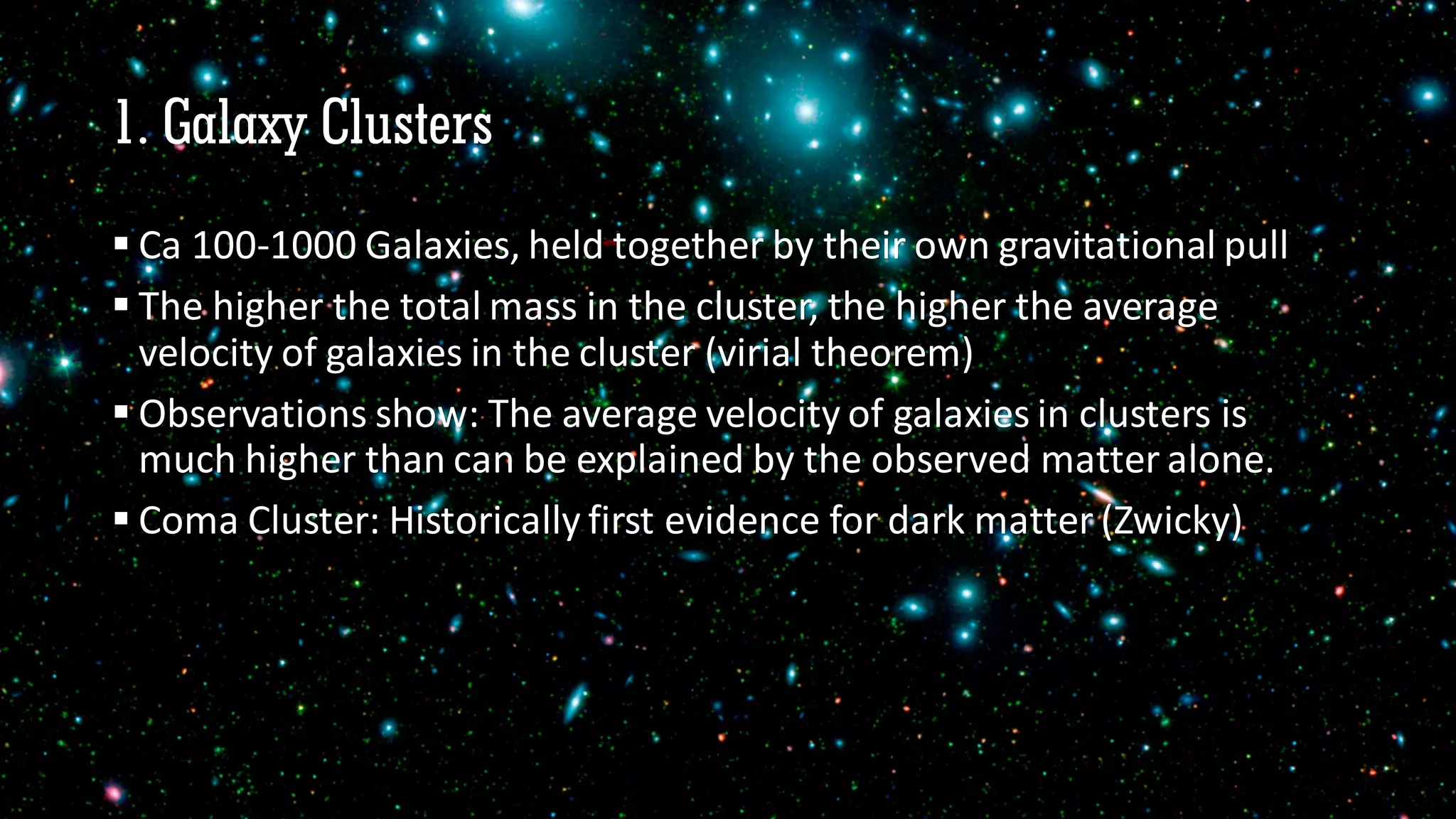
1. Galaxy Clusters
 Ca 100-1000 Galaxies, held together by their own gravitational pull
 The higher the total mass in the cluster, the higher the average
velocity of galaxies in the cluster (virial theorem)
 Observations show: The average velocity of galaxies in clusters is
much higher than can be explained by the observed matter alone.
 Coma Cluster: Historically first evidence for dark matter (Zwicky)
2. Galactic Rotation Curves
• Infer velocity of stars from red/blue
shift of absorption lines.
• The velocity of a star on a stable orbits
depends only on the mass inside the orbit.
• Known masses combined are not
sufficient to explain the observed velocities.
3. Gravitational Lensing
 According to General Relativity, gravitation is caused by the curvature
of space-time. Mass curves space. Light is deviated from a straight
line by that curvature: Masses act like lenses.
 From the strength of the deviation one can calculatethe mass of the
lensing object.
 Observations show: Normal matter is not sufficient, neither for
galaxies (strong lensing) nor galaxy clusters (weak lensing)
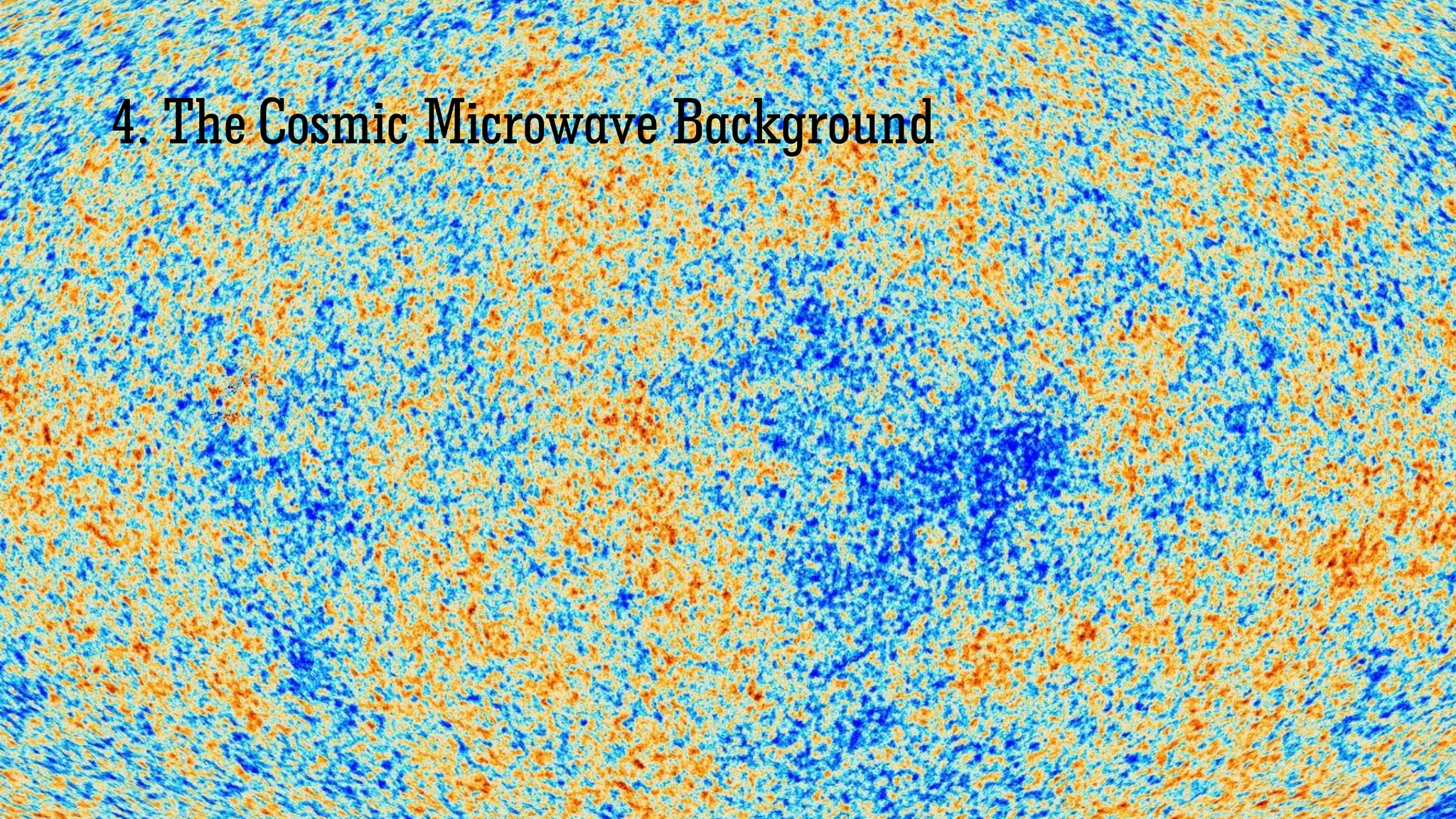
4. The Cosmic Microwave Background
Abb: Planck Collaboration
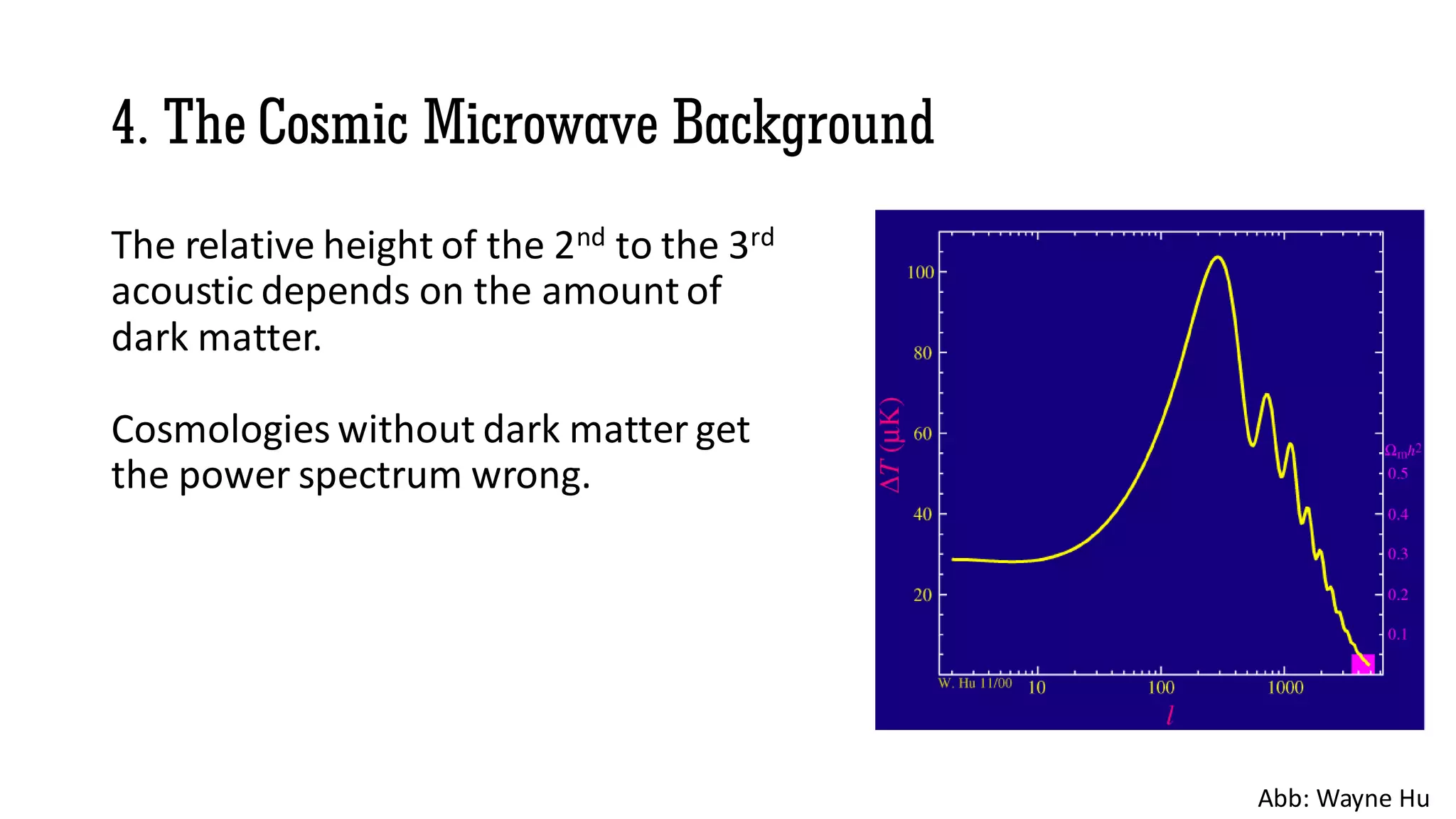
4. The Cosmic Microwave Background
Abb: Wayne Hu
The relative height of the 2nd to the 3rd
acoustic depends on the amount of
dark matter.
Cosmologies without dark matter get
the power spectrum wrong.
5. Structure Formation
 Dark matter cannot build up radiation pressure and therefore starts
forming structures sooner than normal matter
 Normal matter on its own does not produce suffient structures on
short scales to be compatiblewith observation
Abb: Dolag et al. 2015
So, without Dark Matter…
 Galaxies in clusters are too fast.
 Stars in galaxies are too fast.
 Galaxies and galaxy clusters bend light too strongly.
 The CMB doesn’t come out right.
 Structure formation starts too slowly.
How Dark Matter solves the problem
Function of (curvature) = (mass and energy) + X
There is always an X! Important: X has properties of matter. That’s not
trivial. X is a Tensor with 10 entries. We need only one entry.
Dark matter is a parametrically simple explanation.
Can Dark Matter be “normal” matter?
No, because:
 No known particle fits the bill: They either interact with light or, in the
case of neutrinos, are too light (don’t clump enough)
 Brown dwarfs, black holes, and exotic compact, dark object: would
make too many gravitational lenses which have not been seen.
It has to be something new.
Problems that Dark Matter does
not solve
 The brightness of galaxies is strongly
correlated with the (asymptotic)
rotational velocity (“Tully-Fisher Law”).
Dark matter doesn’t explain this.
 Dark matter leads to density peaks in galactic centers which badly fits
with observations (“galaxy cusps”).
 Dark matter predicts too many dwarf galaxies.*
 Satellitegalaxies are more often aligned in planes with their host than
dark matter simulations predict.
* Or maybe too many ¯_(ツ)_/¯
Figure: McGaugh et al
Alternative Explanation: Modified Gravity
 Mordehai Milgrom, Astrophysical Journal 270, 365–370 (1983):
Modified Newtonian Dynamics (MOND)
 We know that MOND is only an approximation
 MOND relates to modified gravity the same way that Newtonian
Gravity relates to General Relativity
 There are various approaches to the full theory of modified gravity
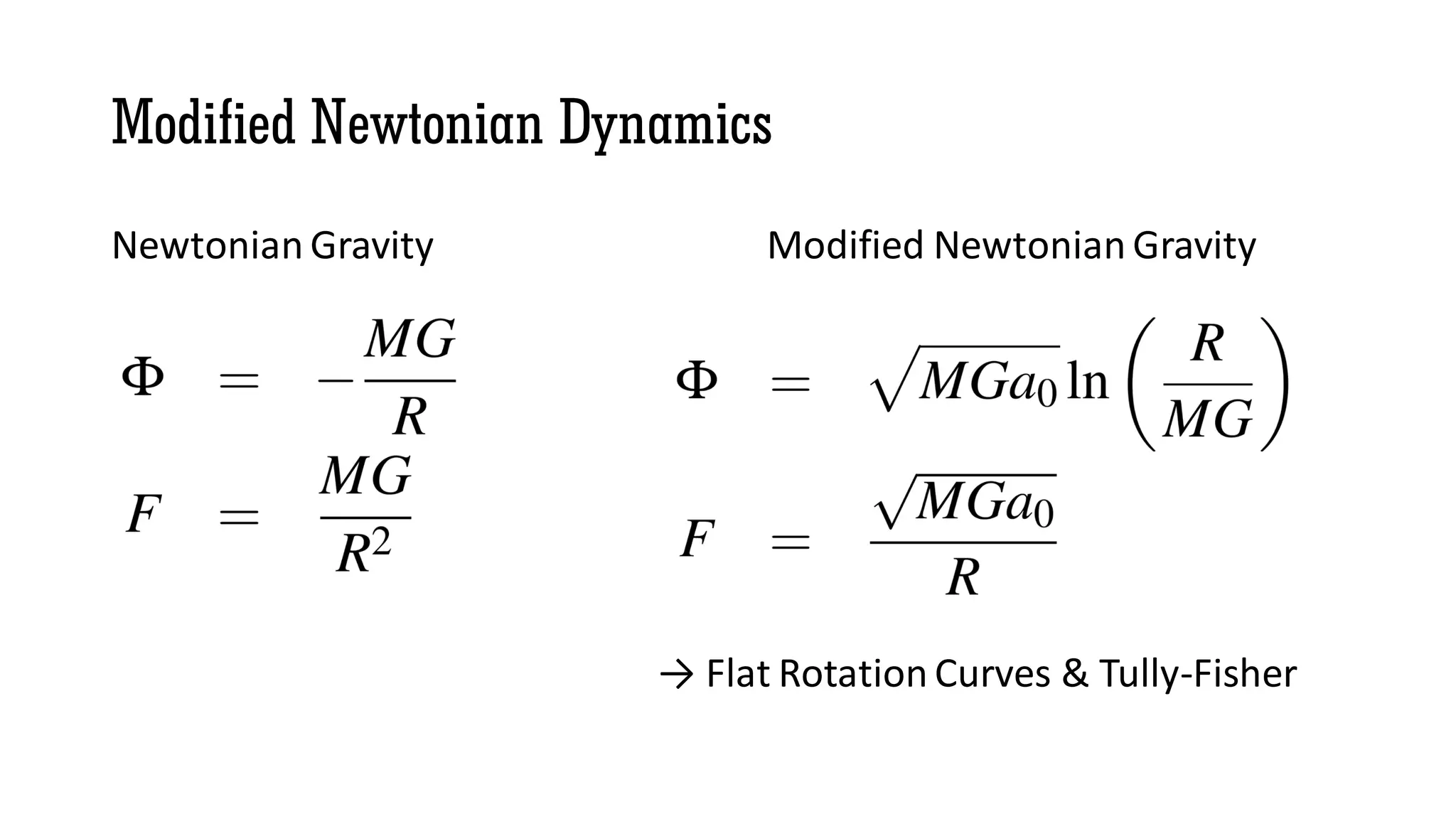
Modified Newtonian Dynamics
Newtonian Gravity Modified Newtonian Gravity
→ Flat Rotation Curves & Tully-Fisher
Modified Newtonian Dynamics
Requires an “interpolation function” to
transition between Newtonian gravity
and modified Newtonian gravity
Effects of MOND become relevant below a certain acceleration ( ) and
not beyond a certain distance.
The acceleration scale that best fits the data turns out to be related to
the cosmological constant. No one has any idea why:
What is the difference between
Modified Gravity and Dark Matter?
Dark matter: The (remaining) long-range force that acts on normal
matter is the normal gravitational force. If the force is larger than
expected, this means there must be additional matter.
Modified Gravity: The (remaining) long-range force that acts on normal
matter is not the same as the normal gravitational force or there is an
additional force.
Note: Forces are always mediated by particles and particles always carry energy.
This means that in modified gravity one also always has additional energy. But the
gravitational pull of this additional energy is not sufficient to explain observations.
Modified Gravity
Can do:
 Correlation between mass and rotational velocity (giving rise to flat
rotation curves and Tully-Fisher)
 Avoids galaxy cusps
 Reduces number of dwarf galaxies
 Helps with planar arrangements of satellite galaxies
Can’t do: CMB, early universe, galaxy clusters
Unclear: Solar System.
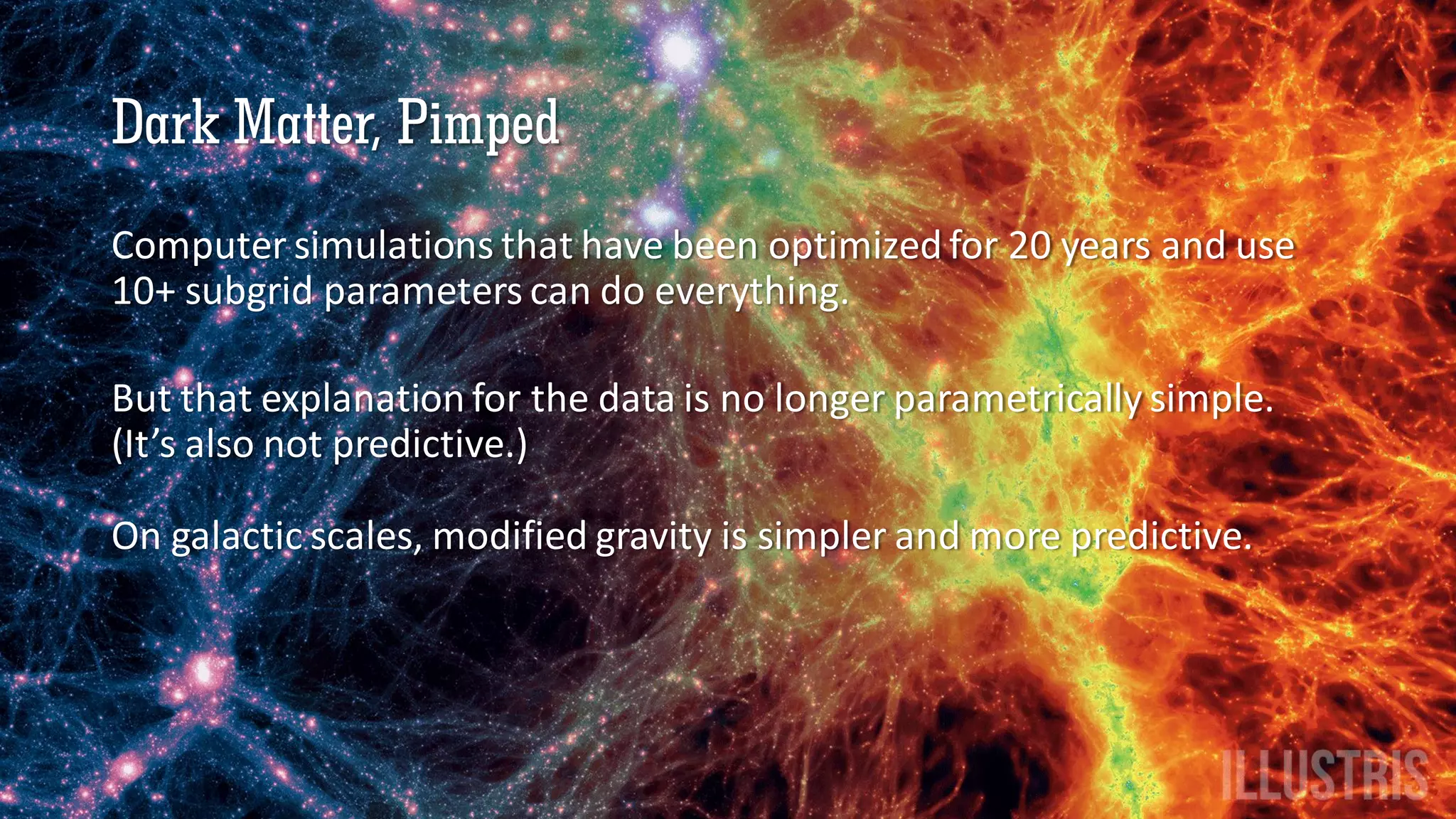
Dark Matter, Pimped
Computer simulations that have been optimized for 20 years and use
10+ subgrid parameters can do everything.
But that explanation for the data is no longer parametrically simple.
(It’s also not predictive.)
On galactic scales, modified gravity is simpler and more predictive.
Can we have both?
Khoury & Berezhiani,
Phys. Rev. D 92, 103510 (2015):
Dark matter has two phases,
a normal fluid and a superfluid
Superfluid Dark Matter
 Normal phase: At high temperatures, the fluid acts like particle dark
matter, particles with masses of about eV.
 Superfluid phase: At low temperature, the fluid condenses and
phonons mediate a new long-range force that looks like modified
gravity
This explains why sometimes particle dark matter works better and
sometimes modified gravity! Requires no interpolation function!
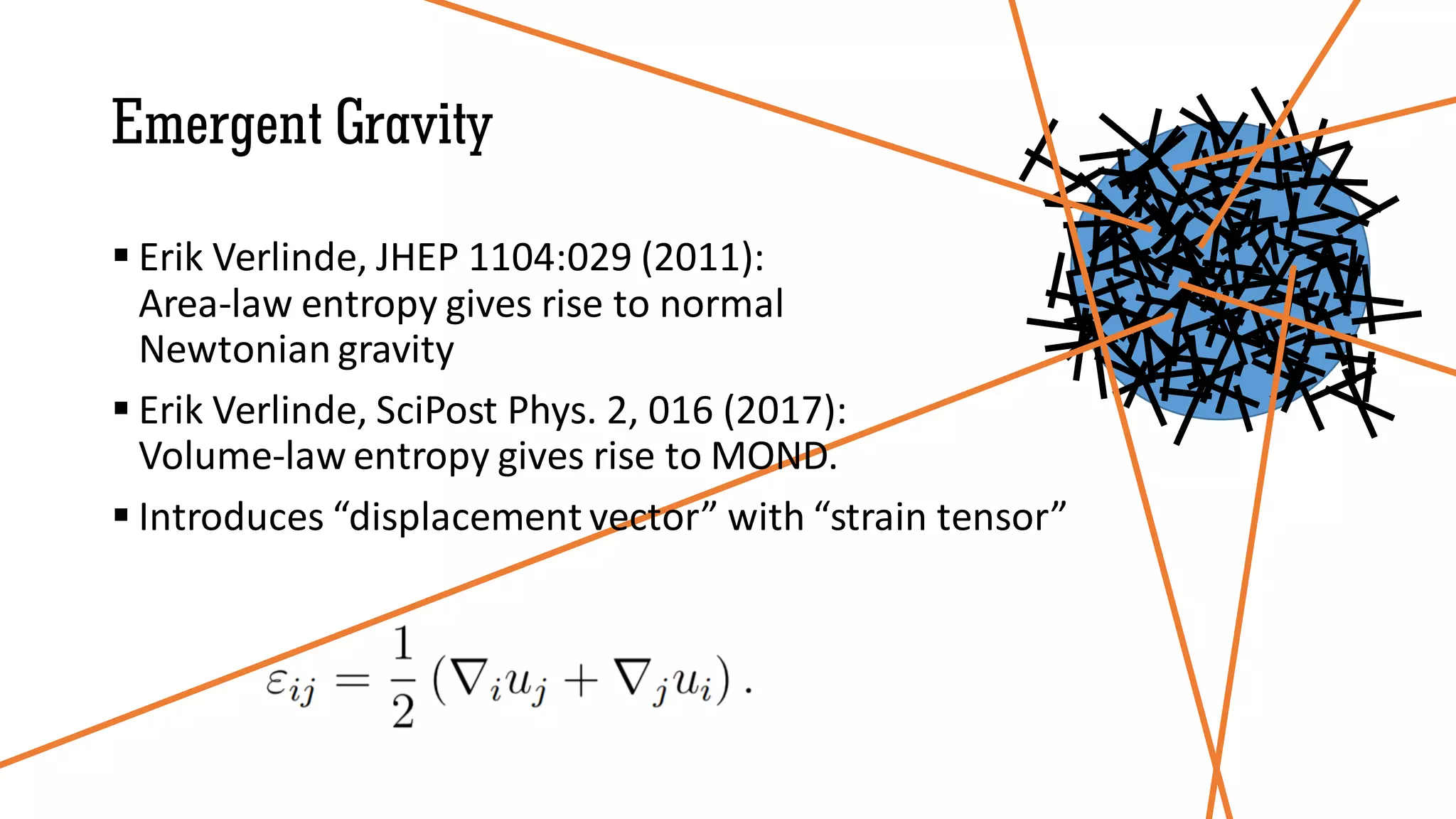
Emergent Gravity
 Erik Verlinde, JHEP 1104:029 (2011):
Area-law entropy gives rise to normal
Newtonian gravity
 Erik Verlinde, SciPost Phys. 2, 016 (2017):
Volume-law entropy gives rise to MOND.
 Introduces “displacement vector” with “strain tensor”
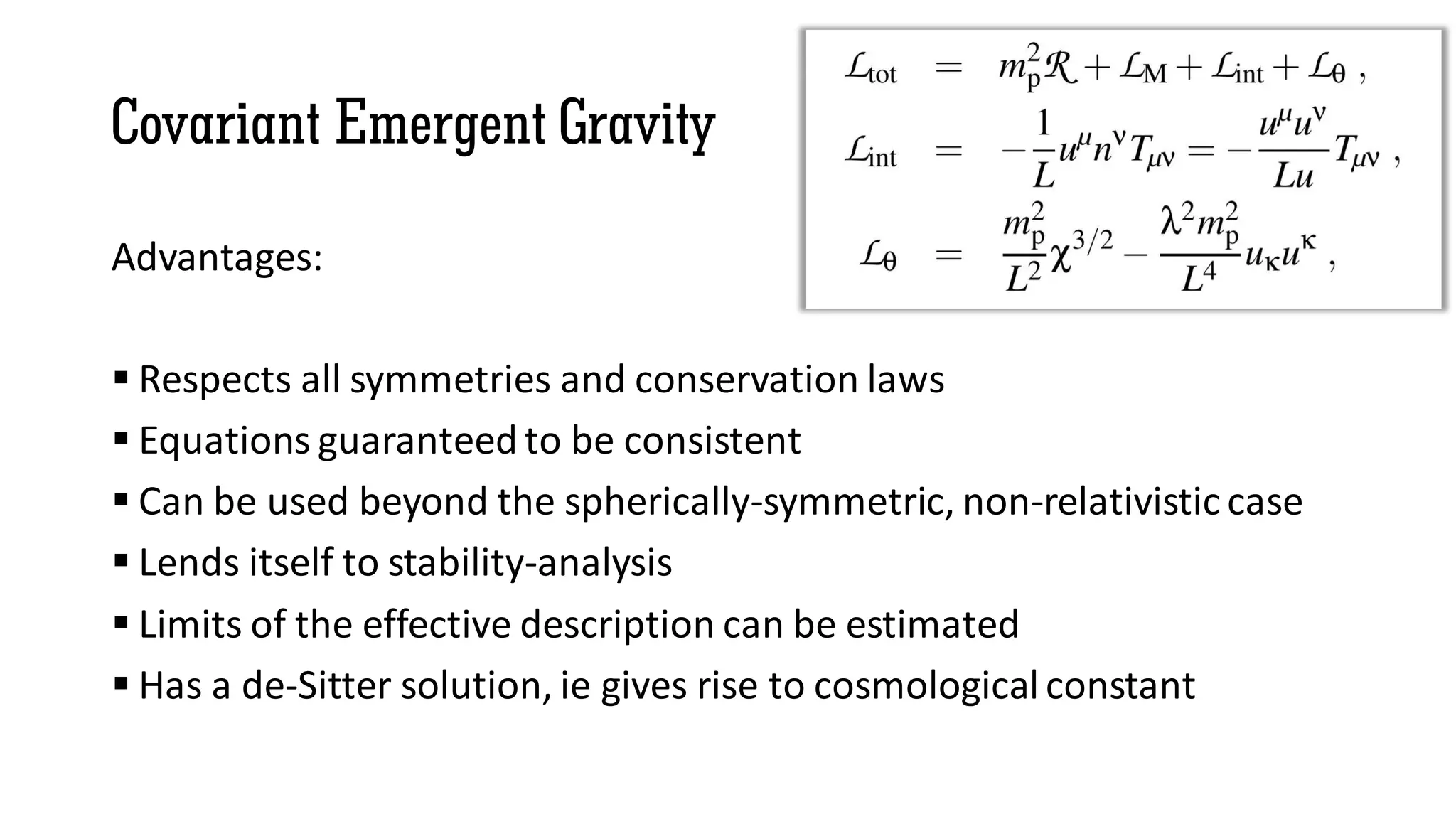
Covariant Emergent Gravity
Covariant, Lagrangian formulation of Verlinde’s ansatz.
SH, Phys. Rev. D 95, 124018 (2017).
The “impostor-field”.
Gives rise to a force that
looks like gravity but isn’t.
Covariant Emergent Gravity
Advantages:
 Respects all symmetries and conservation laws
 Equations guaranteed to be consistent
 Can be used beyond the spherically-symmetric, non-relativistic case
 Lends itself to stability-analysis
 Limits of the effective description can be estimated
 Has a de-Sitter solution, ie gives rise to cosmological constant
Covariant Emergent Gravity
Relation to superfluid:
 Same power of kinetic term
 Same couplingto normal matter
 In non-relativistic limit, vector field is described by one scalar
component
 On galactic scales, the two approaches are almost identical
SH, Phys. Rev. D 95, 124018 (2017).
The Radial Acceleration Relation
In MOND-like theories, the total
observed acceleration is strongly
correlated with the acceleration of
normal matter. This correlation is
clearly present in the data.
Covariant Emergent Gravity
reproduces it reasonably well already
in the spherically-symmetric limit.
This curve is derived from the Lagrangian.
It has no free parameters.
SH, Tobias Mistele, IJMPD 27, 14, 1847010 (2018)
Data from McGaugh et al, Phys. Rev. Lett. 117, 201101 (2016).
Reshift-Dependence of Radial Acceleration Relation:
Modified Gravity predicts less redshift-dependence of the radial
acceleration relation than cold dark matter. May become observable soon.
SH, Tobias Mistele, IJMPD 27, 14, 1847010 (2018) CDM simulation: Keller & Wadsley, ApJL 835 L17 (2017)
Galaxy Lensing
Superfluid/vector field cannot couple to photons
because of constraints from neutron-star merger.
Consequence: Amount of dark matter inferred
from gravitational lensing should be less than the
amount inferred from kinematic measurements.
But: Strong gravitational lensing dominated by galactic core, ie by
normal mass. Can always fit both kinematicand lensing measurements.
SH, Tobias Mistele, JCAP… (2019), arXiv: 1809.00840
Other ways to test superfluid dark matter
 Look for particles in local experiments. Difficult because UV-
completion is missing, thus unclear what to look for. Also, probably
too weak/light to measure (guessing here).
 The phase-transition to a superfluid should leave a mark in the
evolution of galaxies. This should in principle be observable. Problem:
Unclear what to look for because equation of state unknown. Also,
probably requires large-scale simulations.
 If superfluids collide, they can create interference patterns. Problem:
current observational data can’t resolve such the structures.
Summary
A two-phase system is almost certainly the parametrically most simple
explanation of all current evidence for dark matter. It combines the
achievements of both modified gravity and cold dark matter.
The hypothesis of dark matter being a superfluid is well-motivated and
makes testable predictions.
After a long phase of stagnation, we are finally getting closer to solving
an 80+ year old riddle.

Dark Matter - Or What?

  • 1.
    Dark Matter –Or What?Sabine Hossenfelder In collaboration with Tobias Mistele
  • 2.
    71.4 % 24 % 4.6% Dunkle Energie Dunkle Materie Normale Materie The Content of Our Universe 71.4 % 24 % 4.6 % Dark Energy Dark Matter Normal Matter 71.4 % 24 % 4.6 % Dark Energy Dark Matter Normal Matter
  • 3.
    What is DarkMatter?  Neither emits nor adsorbs light, not at any frequency. It’s really transparent rather than dark.  Its energy-density decreases with the inverse volume.  It rarely interacts, both with itself and with normal matter. Just exactly how rarely, no one knows.
  • 4.
    Why do wethink that dark matter exists? Numerous independent lines of evidence that have accumulated for more than 80 years.
  • 5.
    1. Galaxy Clusters Ca 100-1000 Galaxies, held together by their own gravitational pull  The higher the total mass in the cluster, the higher the average velocity of galaxies in the cluster (virial theorem)  Observations show: The average velocity of galaxies in clusters is much higher than can be explained by the observed matter alone.  Coma Cluster: Historically first evidence for dark matter (Zwicky)
  • 6.
    2. Galactic RotationCurves • Infer velocity of stars from red/blue shift of absorption lines. • The velocity of a star on a stable orbits depends only on the mass inside the orbit. • Known masses combined are not sufficient to explain the observed velocities.
  • 7.
    3. Gravitational Lensing According to General Relativity, gravitation is caused by the curvature of space-time. Mass curves space. Light is deviated from a straight line by that curvature: Masses act like lenses.  From the strength of the deviation one can calculatethe mass of the lensing object.  Observations show: Normal matter is not sufficient, neither for galaxies (strong lensing) nor galaxy clusters (weak lensing)
  • 8.
    4. The CosmicMicrowave Background
  • 9.
    4. The CosmicMicrowave Background Abb: Planck Collaboration
  • 10.
    4. The CosmicMicrowave Background Abb: Wayne Hu The relative height of the 2nd to the 3rd acoustic depends on the amount of dark matter. Cosmologies without dark matter get the power spectrum wrong.
  • 11.
    5. Structure Formation Dark matter cannot build up radiation pressure and therefore starts forming structures sooner than normal matter  Normal matter on its own does not produce suffient structures on short scales to be compatiblewith observation Abb: Dolag et al. 2015
  • 12.
    So, without DarkMatter…  Galaxies in clusters are too fast.  Stars in galaxies are too fast.  Galaxies and galaxy clusters bend light too strongly.  The CMB doesn’t come out right.  Structure formation starts too slowly.
  • 13.
    How Dark Mattersolves the problem Function of (curvature) = (mass and energy) + X There is always an X! Important: X has properties of matter. That’s not trivial. X is a Tensor with 10 entries. We need only one entry. Dark matter is a parametrically simple explanation.
  • 14.
    Can Dark Matterbe “normal” matter? No, because:  No known particle fits the bill: They either interact with light or, in the case of neutrinos, are too light (don’t clump enough)  Brown dwarfs, black holes, and exotic compact, dark object: would make too many gravitational lenses which have not been seen. It has to be something new.
  • 15.
    Problems that DarkMatter does not solve  The brightness of galaxies is strongly correlated with the (asymptotic) rotational velocity (“Tully-Fisher Law”). Dark matter doesn’t explain this.  Dark matter leads to density peaks in galactic centers which badly fits with observations (“galaxy cusps”).  Dark matter predicts too many dwarf galaxies.*  Satellitegalaxies are more often aligned in planes with their host than dark matter simulations predict. * Or maybe too many ¯_(ツ)_/¯ Figure: McGaugh et al
  • 16.
    Alternative Explanation: ModifiedGravity  Mordehai Milgrom, Astrophysical Journal 270, 365–370 (1983): Modified Newtonian Dynamics (MOND)  We know that MOND is only an approximation  MOND relates to modified gravity the same way that Newtonian Gravity relates to General Relativity  There are various approaches to the full theory of modified gravity
  • 17.
    Modified Newtonian Dynamics NewtonianGravity Modified Newtonian Gravity → Flat Rotation Curves & Tully-Fisher
  • 18.
    Modified Newtonian Dynamics Requiresan “interpolation function” to transition between Newtonian gravity and modified Newtonian gravity Effects of MOND become relevant below a certain acceleration ( ) and not beyond a certain distance. The acceleration scale that best fits the data turns out to be related to the cosmological constant. No one has any idea why:
  • 19.
    What is thedifference between Modified Gravity and Dark Matter? Dark matter: The (remaining) long-range force that acts on normal matter is the normal gravitational force. If the force is larger than expected, this means there must be additional matter. Modified Gravity: The (remaining) long-range force that acts on normal matter is not the same as the normal gravitational force or there is an additional force. Note: Forces are always mediated by particles and particles always carry energy. This means that in modified gravity one also always has additional energy. But the gravitational pull of this additional energy is not sufficient to explain observations.
  • 20.
    Modified Gravity Can do: Correlation between mass and rotational velocity (giving rise to flat rotation curves and Tully-Fisher)  Avoids galaxy cusps  Reduces number of dwarf galaxies  Helps with planar arrangements of satellite galaxies Can’t do: CMB, early universe, galaxy clusters Unclear: Solar System.
  • 21.
    Dark Matter, Pimped Computersimulations that have been optimized for 20 years and use 10+ subgrid parameters can do everything. But that explanation for the data is no longer parametrically simple. (It’s also not predictive.) On galactic scales, modified gravity is simpler and more predictive.
  • 22.
    Can we haveboth? Khoury & Berezhiani, Phys. Rev. D 92, 103510 (2015): Dark matter has two phases, a normal fluid and a superfluid
  • 23.
    Superfluid Dark Matter Normal phase: At high temperatures, the fluid acts like particle dark matter, particles with masses of about eV.  Superfluid phase: At low temperature, the fluid condenses and phonons mediate a new long-range force that looks like modified gravity This explains why sometimes particle dark matter works better and sometimes modified gravity! Requires no interpolation function!
  • 24.
    Emergent Gravity  ErikVerlinde, JHEP 1104:029 (2011): Area-law entropy gives rise to normal Newtonian gravity  Erik Verlinde, SciPost Phys. 2, 016 (2017): Volume-law entropy gives rise to MOND.  Introduces “displacement vector” with “strain tensor”
  • 25.
    Covariant Emergent Gravity Covariant,Lagrangian formulation of Verlinde’s ansatz. SH, Phys. Rev. D 95, 124018 (2017). The “impostor-field”. Gives rise to a force that looks like gravity but isn’t.
  • 26.
    Covariant Emergent Gravity Advantages: Respects all symmetries and conservation laws  Equations guaranteed to be consistent  Can be used beyond the spherically-symmetric, non-relativistic case  Lends itself to stability-analysis  Limits of the effective description can be estimated  Has a de-Sitter solution, ie gives rise to cosmological constant
  • 27.
    Covariant Emergent Gravity Relationto superfluid:  Same power of kinetic term  Same couplingto normal matter  In non-relativistic limit, vector field is described by one scalar component  On galactic scales, the two approaches are almost identical SH, Phys. Rev. D 95, 124018 (2017).
  • 28.
    The Radial AccelerationRelation In MOND-like theories, the total observed acceleration is strongly correlated with the acceleration of normal matter. This correlation is clearly present in the data. Covariant Emergent Gravity reproduces it reasonably well already in the spherically-symmetric limit. This curve is derived from the Lagrangian. It has no free parameters. SH, Tobias Mistele, IJMPD 27, 14, 1847010 (2018) Data from McGaugh et al, Phys. Rev. Lett. 117, 201101 (2016).
  • 29.
    Reshift-Dependence of RadialAcceleration Relation: Modified Gravity predicts less redshift-dependence of the radial acceleration relation than cold dark matter. May become observable soon. SH, Tobias Mistele, IJMPD 27, 14, 1847010 (2018) CDM simulation: Keller & Wadsley, ApJL 835 L17 (2017)
  • 30.
    Galaxy Lensing Superfluid/vector fieldcannot couple to photons because of constraints from neutron-star merger. Consequence: Amount of dark matter inferred from gravitational lensing should be less than the amount inferred from kinematic measurements. But: Strong gravitational lensing dominated by galactic core, ie by normal mass. Can always fit both kinematicand lensing measurements. SH, Tobias Mistele, JCAP… (2019), arXiv: 1809.00840
  • 31.
    Other ways totest superfluid dark matter  Look for particles in local experiments. Difficult because UV- completion is missing, thus unclear what to look for. Also, probably too weak/light to measure (guessing here).  The phase-transition to a superfluid should leave a mark in the evolution of galaxies. This should in principle be observable. Problem: Unclear what to look for because equation of state unknown. Also, probably requires large-scale simulations.  If superfluids collide, they can create interference patterns. Problem: current observational data can’t resolve such the structures.
  • 32.
    Summary A two-phase systemis almost certainly the parametrically most simple explanation of all current evidence for dark matter. It combines the achievements of both modified gravity and cold dark matter. The hypothesis of dark matter being a superfluid is well-motivated and makes testable predictions. After a long phase of stagnation, we are finally getting closer to solving an 80+ year old riddle.