Social Representations of
Community Multimedia
Centres in Mozambique
Dissertation presented by Sara Vannini!
Supervised by Lorenzo Cantoni!
Structure
Conclusions	
  Outcomes	
  Methodology	
  Theoretical Framework	
  Research Trends
Context
Conclusions	
  Outcomes	
  Methodology	
  Theoretical Framework	
  Research Trends
Context
Conclusions	
  Outcomes	
  Methodology	
  Theoretical Framework	
  Research Trends
Context
Research Trends
Social Representations
[Moscovici, 1961]!
Conclusions	
  Outcomes	
  Methodology	
  Theoretical Framework	
  Research Trends
Context
Conclusions	
  Outcomes	
  Methodology	
  Theoretical Framework	
  Research Gap
Context
Research Questions
Conclusions	
  Outcomes	
  Methodology	
  Theoretical Framework	
  Research Trends
Context
Conclusions	
  Outcomes	
  Methodology	
  Theoretical Framework	
  Research Gap
Context
 Conclusions	
  Outcomes	
  Methodology	
  Theoretical Framework	
  Research Trends
Context
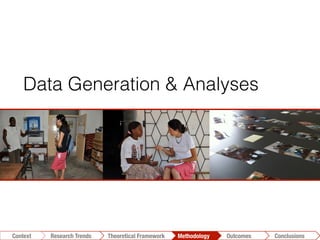
Data Generation & Analyses
Vannini, S., Rega, I., Cantoni, L. (2013). Information and Communication Flows through
Community Multimedia Centres: Perspectives from Mozambican Communities.
Information Technology for Development (ITD). Pp. 1-14. !
Rega, I., Vannini, S., Fino, E., Cantoni, L. (2013). Exploring the Meanings of Community
Multimedia Centers in Mozambique: A Social Representations Perspective.
Information Technology and International Development (ITID), Vol. 9, Issue 4.!
Vannini, S., Rega, I., Sala, S., Cantoni, L., (accepted). Using Photo-elicitation to Explore
Social Representations of Community Multimedia Centres in Mozambique. Submitted to
the Electronic Journal of Information Systems in Developing Countries (EJISDC).!
Conclusions	
  Outcomes	
  Methodology	
  Theoretical Framework	
  Research Trends
Context
Conclusions	
  Outcomes	
  Methodology	
  Theoretical Framework	
  Research Trends
Context
Conclusions
Context
Conclusions	
  Outcomes	
  Methodology	
  Theoretical Framework	
  Research Trends
Context
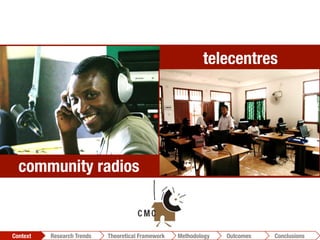
telecentres
community radios
Conclusions	
  Outcomes	
  Methodology	
  Theoretical Framework	
  Research Trends
Context
Research Trends
Conclusions	
  Outcomes	
  Methodology	
  Theoretical Framework	
  Research Trends
Context
Conclusions	
  Outcomes	
  Methodology	
  Theoretical Framework	
  Research Trends
Context

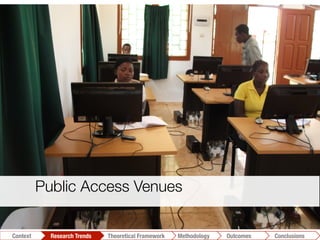
Public Access Venues
enthusiasm and failures
Conclusions	
  Outcomes	
  Methodology	
  Theoretical Framework	
  Research Trends
Context
[Gómez, 2013; Rega, 2010]!
sustainability
Conclusions	
  Outcomes	
  Methodology	
  Theoretical Framework	
  Research Trends
Context
[Best, Thakur & Kolko, 2010; Kleine, 2013]!
(financial, technical, political, social) sustainability
Conclusions	
  Outcomes	
  Methodology	
  Theoretical Framework	
  Research Trends
Context
[Ali & Bailur, 2007; Bailey, 2009]!
impacts
digital inclusion
Conclusions	
  Outcomes	
  Methodology	
  Theoretical Framework	
  Research Trends
Context
[Sey et al., 2013]!
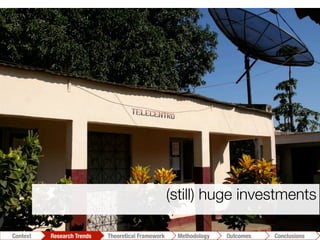
(still) huge investments
Conclusions	
  Outcomes	
  Methodology	
  Theoretical Framework	
  Research Trends
Context
one-size-fits-all
[Unwin, 2009]!
Conclusions	
  Outcomes	
  Methodology	
  Theoretical Framework	
  Research Trends
Context
Design-reality gaps
[Heeks, 2002; 2003]!
Conclusions	
  Outcomes	
  Methodology	
  Theoretical Framework	
  Research Trends
Context
stronger focus on the
context
[Irani, Vertesi, Dourish, Philip & Grinter, 2010; Johri & Pal, 2012;
Tedre, Sutinen, Kähkönen & Kommers, 2006; Van Zyl, 2013]!
Conclusions	
  Outcomes	
  Methodology	
  Theoretical Framework	
  Research Trends
Context
participatory
approaches
[Gómez, 2013; Kleine & Unwin, 2009]!
Conclusions	
  Outcomes	
  Methodology	
  Theoretical Framework	
  Research Trends
Context
Theoretical Framework
Conclusions	
  Outcomes	
  Methodology	
  Theoretical Framework	
  Research Trends
Context
Social Representations
[Moscovici, 1961]!
Conclusions	
  Outcomes	
  Methodology	
  Theoretical Framework	
  Research Trends
Context
Social Representations
[Moscovici, 1961]!
systems of values, ideas and practices,
that are shared among a given social group
Conclusions	
  Outcomes	
  Methodology	
  Theoretical Framework	
  Research Trends
Context
Social Representations
enable individuals to
orientate themselves and
interpret their world
Conclusions	
  Outcomes	
  Methodology	
  Theoretical Framework	
  Research Trends
Context
[Moscovici, 1961]!
Social Representations
enable individuals to
orientate themselves and
interpret their world
provide a code that enables
communication among the
members of a community
Conclusions	
  Outcomes	
  Methodology	
  Theoretical Framework	
  Research Trends
Context
[Moscovici, 1961]!
EGO! ALTER!
OBJECT!
Conclusions	
  Outcomes	
  Methodology	
  Theoretical Framework	
  Research Trends
Context
[Moscovici, 2000]!
EGO! ALTER!
OBJECT!
Conclusions	
  Outcomes	
  Methodology	
  Theoretical Framework	
  Research Trends
Context
inter-subjectivity
relationship with the other and with the context to give
meaning
[Billig, 1996; Byford, 2002; Moscovici, 1984; 2000; Wagner et al., 1999]!
agency and creative power of the
human being are allowed
Conclusions	
  Outcomes	
  Methodology	
  Theoretical Framework	
  Research Trends
Context
[Moscovici, 1961; Voelklein & Howarth, 2005]!
cognitive polyphasia
development and negotiation of social representations
lead to contradictions and conflicts
[Moscovici, 1961; Voelklein & Howarth, 2005]!
agency and creative power of the
human being are allowed
Conclusions	
  Outcomes	
  Methodology	
  Theoretical Framework	
  Research Trends
Context
[Bauer & Gaskell, 1999; Markovà, 2003; Mauri, 2007]!
Conclusions	
  Outcomes	
  Methodology	
  Theoretical Framework	
  Research Trends
Context
Emergence
[Bauer & Gaskell, 1999; Markovà, 2003; Mauri, 2007]!
Conclusions	
  Outcomes	
  Methodology	
  Theoretical Framework	
  Research Trends
Context
Emergence
Stability
[Bauer & Gaskell, 1999; Markovà, 2003; Mauri, 2007]!
Conclusions	
  Outcomes	
  Methodology	
  Theoretical Framework	
  Research Trends
Context
Emergence
Transformation
Stability
SRT &
ICT4D
Conclusions	
  Outcomes	
  Methodology	
  Theoretical Framework	
  Research Trends
Context
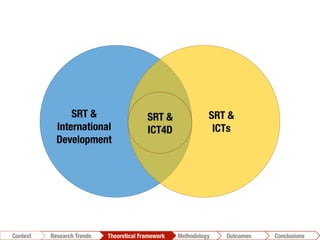
SRT &
ICT4D
SRT &
International
Development
Conclusions	
  Outcomes	
  Methodology	
  Theoretical Framework	
  Research Trends
Context
SRT &
ICTs
inclusion of the context & different social groups
Conclusions	
  Outcomes	
  Methodology	
  Theoretical Framework	
  Research Trends
Context
[Bailey & Ngwenyama, 2011; Contarello et al., 2008]!
inclusion of the context & different social groups

participatory, design-oriented approach
Conclusions	
  Outcomes	
  Methodology	
  Theoretical Framework	
  Research Trends
Context
[Duarte et al., 2009; Siddique & Kagan, 2006; Winskell et al., 2011]!
inclusion of the context & different social groups

participatory, design-oriented approach 
fitting for rapidly evolving phenomena
Conclusions	
  Outcomes	
  Methodology	
  Theoretical Framework	
  Research Trends
Context
[Fortunati & Manganelli, 2008; Sarrica, 2011]!
inclusion of the context & different social groups

participatory, design-oriented approach 
fitting for rapidly evolving phenomena

 
used to inform policy-makers and to

 
find drivers for individual actions
Conclusions	
  Outcomes	
  Methodology	
  Theoretical Framework	
  Research Trends
Context
[Araujo, 2010; Cruz & Marinho, 2012]!
Methods:
Conclusions	
  Outcomes	
  Methodology	
  Theoretical Framework	
  Research Trends
Context
Methods:
mixed methods prevailing


Conclusions	
  Outcomes	
  Methodology	
  Theoretical Framework	
  Research Trends
Context
Methods:
mixed methods prevailing


small variety for SRT & ICT4D
Conclusions	
  Outcomes	
  Methodology	
  Theoretical Framework	
  Research Trends
Context
Research Questions
Conclusions	
  Outcomes	
  Methodology	
  Theoretical Framework	
  Research Gap
Context
 Conclusions	
  Outcomes	
  Methodology	
  Theoretical Framework	
  Research Trends
Context
What are the social
representations of
Community Multimedia
Centres in Mozambique
according to their different
stakeholders?
1.	
  
Conclusions	
  Outcomes	
  Methodology	
  Theoretical Framework	
  Research Gap
Context
 Conclusions	
  Outcomes	
  Methodology	
  Theoretical Framework	
  Research Trends
Context
Is
Social Representations
Theory "
a suitable theoretical paradigm
to be employed for
advancements in ICT4D?
2.	
  
Conclusions	
  Outcomes	
  Methodology	
  Theoretical Framework	
  Research Gap
Context
 Conclusions	
  Outcomes	
  Methodology	
  Theoretical Framework	
  Research Trends
Context
Is the chosen
research strategy suitable
to assess
Social Representations 
in ICT4D?
3.	
  
Conclusions	
  Outcomes	
  Methodology	
  Theoretical Framework	
  Research Gap
Context
 Conclusions	
  Outcomes	
  Methodology	
  Theoretical Framework	
  Research Trends
Context
Participants’ Selection
Conclusions	
  Outcomes	
  Methodology	
  Theoretical Framework	
  Research Gap
Context
 Conclusions	
  Outcomes	
  Methodology	
  Theoretical Framework	
  Research Trends
Context
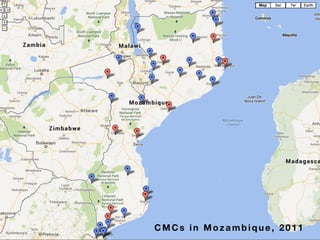
CMCs in Mozambique, 2011
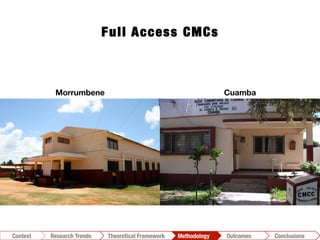
Morrumbene
 Cuamba
Full Access CMCs
Conclusions	
  Outcomes	
  Methodology	
  Theoretical Framework	
  Research Gap
Context
 Conclusions	
  Outcomes	
  Methodology	
  Theoretical Framework	
  Research Trends
Context
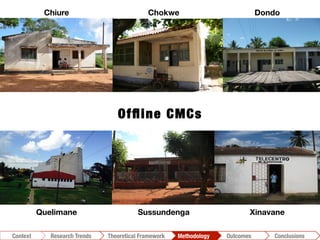
Chiure
 Chokwe
 Dondo
Quelimane
 Sussundenga
 Xinavane
Offline CMCs
Conclusions	
  Outcomes	
  Methodology	
  Theoretical Framework	
  Research Gap
Context
 Conclusions	
  Outcomes	
  Methodology	
  Theoretical Framework	
  Research Trends
Context
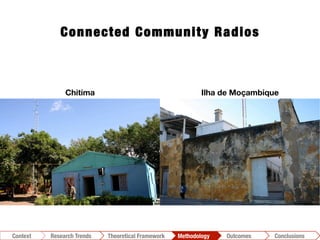
Chitima
 Ilha de Moçambique
Connected Community Radios
Conclusions	
  Outcomes	
  Methodology	
  Theoretical Framework	
  Research Gap
Context
 Conclusions	
  Outcomes	
  Methodology	
  Theoretical Framework	
  Research Trends
Context
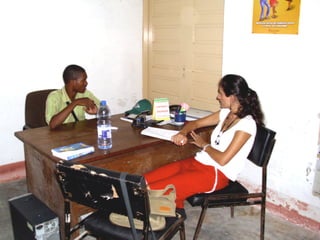
Data Generation
Conclusions	
  Outcomes	
  Methodology	
  Theoretical Framework	
  Research Gap
Context
 Conclusions	
  Outcomes	
  Methodology	
  Theoretical Framework	
  Research Trends
Context
Conclusions	
  Outcomes	
  Methodology	
  Theoretical Framework	
  Research Gap
Context
 Conclusions	
  Outcomes	
  Methodology	
  Theoretical Framework	
  Research Trends
Context
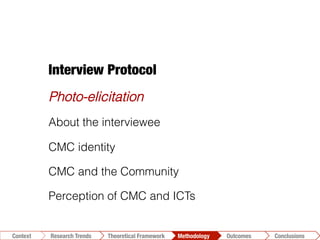
Interview Protocol
Photo-elicitation
About the interviewee
CMC identity
CMC and the Community
Perception of CMC and ICTs
Conclusions	
  Outcomes	
  Methodology	
  Theoretical Framework	
  Research Gap
Context
 Conclusions	
  Outcomes	
  Methodology	
  Theoretical Framework	
  Research Trends
Context

 
images provide valuable
information on social representations that
is not accessible otherwise
[Mamali, 2006]!
Conclusions	
  Outcomes	
  Methodology	
  Theoretical Framework	
  Research Gap
Context
 Conclusions	
  Outcomes	
  Methodology	
  Theoretical Framework	
  Research Trends
Context
empowering
foster participants’ reflection
decrease risk of pre-conceived responses
richer data to the researcher
[Bignante, 2010; Clark-Ibáñez, 2004; Collier, 1967; Dodman, 2003;
Nemer, 2013; Uimonen, 2013; Young & Barrett, 2001]!
Conclusions	
  Outcomes	
  Methodology	
  Theoretical Framework	
  Research Gap
Context
 Conclusions	
  Outcomes	
  Methodology	
  Theoretical Framework	
  Research Trends
Context
empowering
foster participants’ reflection
decrease risk of pre-conceived responses
richer data to the researcher
[Bignante, 2010; Clark-Ibáñez, 2004; Collier, 1967; Dodman, 2003;
Nemer, 2013; Uimonen, 2013; Young & Barrett, 2001]!
Conclusions	
  Outcomes	
  Methodology	
  Theoretical Framework	
  Research Gap
Context
 Conclusions	
  Outcomes	
  Methodology	
  Theoretical Framework	
  Research Trends
Context
empowering
foster participants’ reflection
decrease risk of pre-conceived responses
richer data to the researcher
[Bignante, 2010; Clark-Ibáñez, 2004; Collier, 1967; Dodman, 2003;
Nemer, 2013; Uimonen, 2013; Young & Barrett, 2001]!
Conclusions	
  Outcomes	
  Methodology	
  Theoretical Framework	
  Research Gap
Context
 Conclusions	
  Outcomes	
  Methodology	
  Theoretical Framework	
  Research Trends
Context
empowering
foster participants’ reflection
decrease risk of pre-conceived responses
richer data to the researcher
[Bignante, 2010; Clark-Ibáñez, 2004; Collier, 1967; Dodman, 2003;
Nemer, 2013; Uimonen, 2013; Young & Barrett, 2001]!
Participant-Driven
 Photo-Elicitation
Conclusions	
  Outcomes	
  Methodology	
  Theoretical Framework	
  Research Gap
Context
 Conclusions	
  Outcomes	
  Methodology	
  Theoretical Framework	
  Research Trends
Context
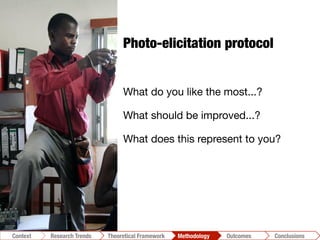
Photo-elicitation protocol
What do you like the most...?
What should be improved...?
What does this represent to you?
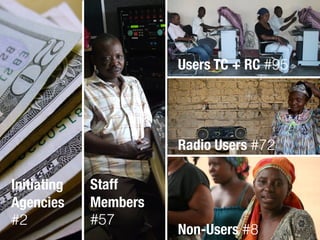
Initiating 
Agencies
#2
Staff 
Members
#57
Users TC + RC #95
Radio Users #72
Non-Users #8
Data Analysis
Conclusions	
  Outcomes	
  Methodology	
  Theoretical Framework	
  Research Gap
Context
 Conclusions	
  Outcomes	
  Methodology	
  Theoretical Framework	
  Research Trends
Context
Conclusions	
  Outcomes	
  Methodology	
  Theoretical Framework	
  Research Gap
Context
 Conclusions	
  Outcomes	
  Methodology	
  Theoretical Framework	
  Research Trends
Context
1.  Photo-taxonomy
2.  Deductive Content Analysis on photos-
related text [Online Communication Model]!
3.  Inductive Content Analysis"
[N-Vivo]!
4.  Automatic analysis of the reciprocal
relationships among textual units"
[T-Lab]!
Conclusions	
  Outcomes	
  Methodology	
  Theoretical Framework	
  Research Gap
Context
 Conclusions	
  Outcomes	
  Methodology	
  Theoretical Framework	
  Research Trends
Context
1.  Photo-taxonomy
2.  Deductive Content Analysis on photos-
related text [Online Communication Model]!
3.  Inductive Content Analysis"
[N-Vivo]!
4.  Automatic analysis of the reciprocal
relationships among textual units"
[T-Lab]!
Conclusions	
  Outcomes	
  Methodology	
  Theoretical Framework	
  Research Gap
Context
 Conclusions	
  Outcomes	
  Methodology	
  Theoretical Framework	
  Research Trends
Context
1.  Photo-taxonomy
2.  Deductive Content Analysis on photos-
related text [Online Communication
Model]
3.  Inductive Content Analysis"
[N-Vivo]
4.  Automatic analysis of the reciprocal
relationships among textual units"
[T-Lab]
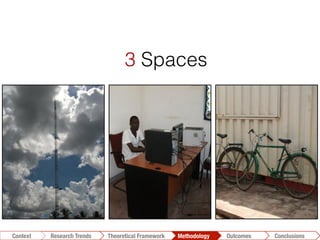
3 Spaces
Conclusions	
  Outcomes	
  Methodology	
  Theoretical Framework	
  Research Gap
Context
 Conclusions	
  Outcomes	
  Methodology	
  Theoretical Framework	
  Research Trends
Context
Conclusions	
  Outcomes	
  Methodology	
  Theoretical Framework	
  Research Gap
Context
 Conclusions	
  Outcomes	
  Methodology	
  Theoretical Framework	
  Research Trends
Context
1.  Photo-taxonomy
2.  Deductive Content Analysis on photos-
related text [Online Communication Model]!
3.  Inductive Content Analysis"
[N-Vivo]!
4.  Automatic analysis of the reciprocal
relationships among textual units"
[T-Lab]!
1.  Photo-taxonomy
2.  Deductive Content Analysis on photos-
related text [Online Communication Model]!
3.  Inductive Content Analysis"
[N-Vivo]!
4.  Automatic analysis of the reciprocal
relationships among textual units"
[T-Lab]!
Conclusions	
  Outcomes	
  Methodology	
  Theoretical Framework	
  Research Gap
Context
 Conclusions	
  Outcomes	
  Methodology	
  Theoretical Framework	
  Research Trends
Context
[Cantoni & Tardini, 2006; Inversini & Cantoni, 2014; Rega, 2010]!
Services
Facilities & Tools
People Managing
People Using
Conclusions	
  Outcomes	
  Methodology	
  Theoretical Framework	
  Research Gap
Context
 Conclusions	
  Outcomes	
  Methodology	
  Theoretical Framework	
  Research Trends
Context
1.  Photo-taxonomy
2.  Deductive Content Analysis on photos-
related text [Online Communication Model]!
3.  Inductive Content Analysis"
[N-Vivo]!
4.  Automatic analysis of the reciprocal
relationships among textual units"
[T-Lab]!
Conclusions	
  Outcomes	
  Methodology	
  Theoretical Framework	
  Research Gap
Context
 Conclusions	
  Outcomes	
  Methodology	
  Theoretical Framework	
  Research Trends
Context
Conclusions	
  Outcomes	
  Methodology	
  Theoretical Framework	
  Research Gap
Context
 Conclusions	
  Outcomes	
  Methodology	
  Theoretical Framework	
  Research Trends
Context
Outcomes
Conclusions	
  Outcomes	
  Methodology	
  Theoretical Framework	
  Research Trends
Context
Conclusions	
  Outcomes	
  Methodology	
  Theoretical Framework	
  Research Trends
Context
Conclusions	
  Outcomes	
  Methodology	
  Theoretical Framework	
  Research Trends
Context
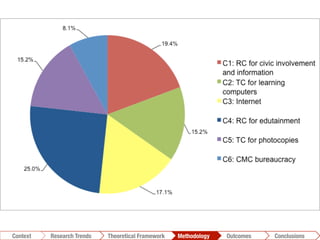
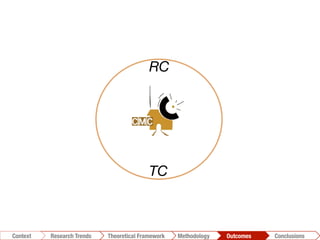
RC
TC
INFORMATION,
COMMUNICATION, 
SOCIO-POLITICAL ROLE
RC
Conclusions	
  Outcomes	
  Methodology	
  Theoretical Framework	
  Research Trends
Context
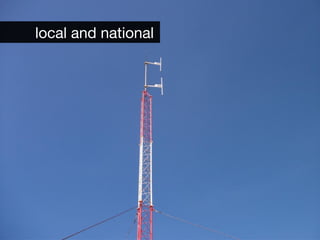
local and national
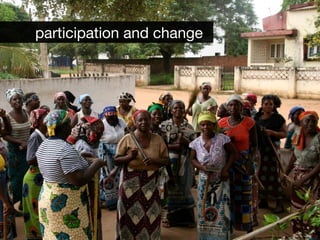
participation and change
EDUTAINMENT
RC
Conclusions	
  Outcomes	
  Methodology	
  Theoretical Framework	
  Research Trends
Context
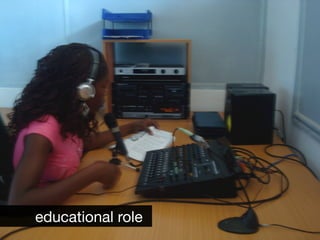
educational role
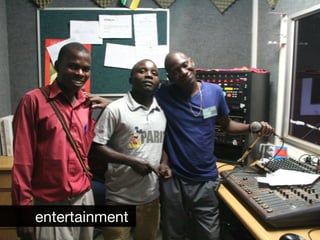
entertainment
LEARNING
CENTRE
Conclusions	
  Outcomes	
  Methodology	
  Theoretical Framework	
  Research Gap
Context
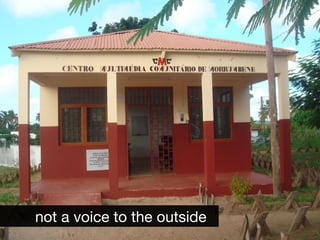
TC
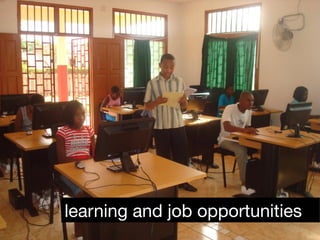
learning and job opportunities
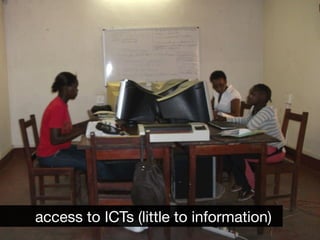
access to ICTs (little to information)
not a voice to the outside
COPY-CENTRE
Conclusions	
  Outcomes	
  Methodology	
  Theoretical Framework	
  Research Trends
Context
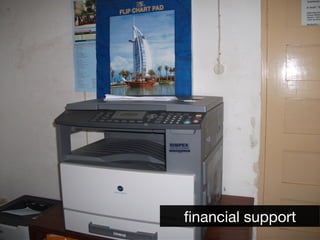
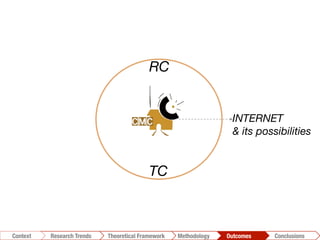
TC
financial support
INTERNET 
& its possibilities
Conclusions	
  Outcomes	
  Methodology	
  Theoretical Framework	
  Research Trends
Context
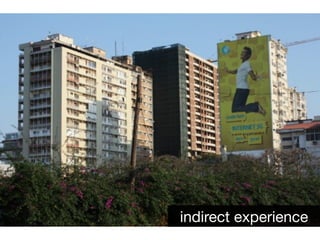
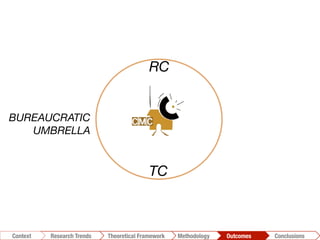
RC
TC
indirect experience
BUREAUCRATIC
UMBRELLA
Conclusions	
  Outcomes	
  Methodology	
  Theoretical Framework	
  Research Trends
Context
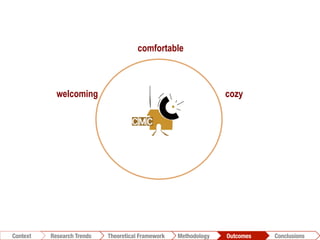
RC
TC
welcoming cozy
comfortable
Conclusions	
  Outcomes	
  Methodology	
  Theoretical Framework	
  Research Trends
Context
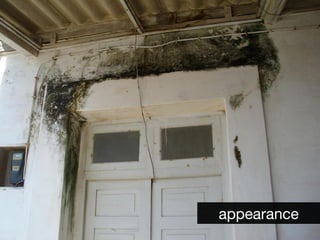
appearance
unhealthy
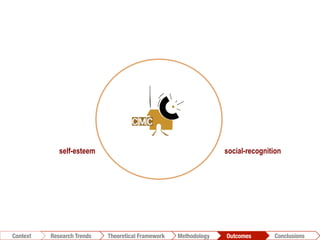
social-recognitionself-esteem
Conclusions	
  Outcomes	
  Methodology	
  Theoretical Framework	
  Research Trends
Context
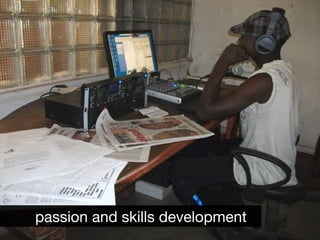
passion and skills development
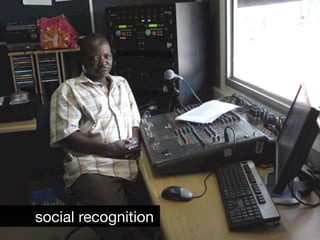
social recognition
Conclusions 
Conclusions	
  Outcomes	
  Methodology	
  Theoretical Framework	
  Research Trends
Context
What are the social
representations of
Community Multimedia
Centres in Mozambique
according to their different
stakeholders?
1.	
  
Conclusions	
  Outcomes	
  Methodology	
  Theoretical Framework	
  Research Trends
Context
BUREAUCRATIC
UMBRELLA
INTERNET 
& its possibilities
INFORMATION,
COMMUNICATION, 
SOCIO-POLITICAL ROLE
 EDUTAINMENT
LEARNING
CENTRE
COPY-CENTRE
cozy
RC
TC
Conclusions	
  Outcomes	
  Methodology	
  Theoretical Framework	
  Research Trends
Context
Is
Social Representations
Theory "
a suitable theoretical paradigm
to be employed for
advancements in ICT4D?
2.	
  
Conclusions	
  Outcomes	
  Methodology	
  Theoretical Framework	
  Research Trends
Context
Design-Reality Gap is addressed
Conclusions	
  Outcomes	
  Methodology	
  Theoretical Framework	
  Research Trends
Context
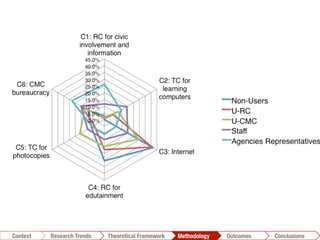
integrated view: Initiating Agencies’
expectations & Local Ownership
Design-Reality Gap is addressed
Conclusions	
  Outcomes	
  Methodology	
  Theoretical Framework	
  Research Trends
Context
integrated view: Initiating Agencies’
expectations & Local Ownership
insights on appropriation and reinvention
of a (new) social object
Design-Reality Gap is addressed
Conclusions	
  Outcomes	
  Methodology	
  Theoretical Framework	
  Research Trends
Context
Is the chosen
research strategy 
suitable to assess
Social Representations 
in ICT4D?
3.	
  
Conclusions	
  Outcomes	
  Methodology	
  Theoretical Framework	
  Research Trends
Context
mixed methods allow to grab the
complexity of the phenomenon
Conclusions	
  Outcomes	
  Methodology	
  Theoretical Framework	
  Research Trends
Context
photo-elicitation allowed for participation
and for gaining different and original
insights
Conclusions	
  Outcomes	
  Methodology	
  Theoretical Framework	
  Research Trends
Context
Contributions 
Conclusions	
  Outcomes	
  Methodology	
  Theoretical Framework	
  Research Trends
Context
about Mozambican CMCs
Conclusions	
  Outcomes	
  Methodology	
  Theoretical Framework	
  Research Trends
Context
synergies between Community Radios and
Telecentres?
Conclusions	
  Outcomes	
  Methodology	
  Theoretical Framework	
  Research Trends
Context
Telecentres do not offer contextualized
services
about Mozambican CMCs
Conclusions	
  Outcomes	
  Methodology	
  Theoretical Framework	
  Research Trends
Context
Telecentres do not offer contextualized
services
more advanced services!!!
about Mozambican CMCs
Conclusions	
  Outcomes	
  Methodology	
  Theoretical Framework	
  Research Trends
Context
need for training Staff members
more advanced services!!!
about Mozambican CMCs
Limitations
Conclusions	
  Outcomes	
  Methodology	
  Theoretical Framework	
  Research Trends
Context
photo-elicitation protocol
Conclusions	
  Outcomes	
  Methodology	
  Theoretical Framework	
  Research Trends
Context
relationship “donors”-recipient bias
photo-elicitation protocol
Conclusions	
  Outcomes	
  Methodology	
  Theoretical Framework	
  Research Trends
Context
only a static snapshot
Conclusions	
  Outcomes	
  Methodology	
  Theoretical Framework	
  Research Trends
Context
Future Lines of Work
Conclusions	
  Outcomes	
  Methodology	
  Theoretical Framework	
  Research Trends
Context
the “cool” factor and the dimension of leisure
diachronic dimension
the whole ecosystem of public access in
Mozambique
improve photo-elicitation protocol
faster methods for data analysis
uses for design
[Gómez & Gould, 2010; Gómez, 2011]!
Conclusions	
  Outcomes	
  Methodology	
  Theoretical Framework	
  Research Trends
Context
the “cool” factor and the dimension of leisure
explore the use of SRs for design
Conclusions	
  Outcomes	
  Methodology	
  Theoretical Framework	
  Research Trends
Context
[see: David, Vannini, Rega & Cantoni, 2013; Van Zyl & Vannini,
2013; Aguirre, Vannini, Rega & Cantoni, 2013]!
the “cool” factor and the dimension of leisure
explore the use of SRs for design
dynamic dimension to Social Representations
diachronically
changes for kind of PAVs
influence on capabilities and
activities
[Bauer & Gaskell, 1999; Maury, 2007; Markovà, 2003]!
Conclusions	
  Outcomes	
  Methodology	
  Theoretical Framework	
  Research Trends
Context
the “cool” factor and the dimension of leisure
explore the use of SRs for design
dynamic dimension to Social Representations
diachronically
changes for kind of PAVs
influence on capabilities and
activities
[Bauer & Gaskell, 1999; Maury, 2007; Markovà, 2003]!
Conclusions	
  Outcomes	
  Methodology	
  Theoretical Framework	
  Research Trends
Context
THANK YOU!

Dissertation Defense - Social Representations of CMCs in Mozambique

  • 1.
    Social Representations of CommunityMultimedia Centres in Mozambique Dissertation presented by Sara Vannini! Supervised by Lorenzo Cantoni!
  • 2.
    Structure Conclusions  Outcomes  Methodology  Theoretical Framework  Research Trends Context
  • 3.
    Conclusions  Outcomes  Methodology  Theoretical Framework  Research Trends Context
  • 4.
    Conclusions  Outcomes  Methodology  Theoretical Framework  Research Trends Context Research Trends
  • 5.
    Social Representations [Moscovici, 1961]! Conclusions  Outcomes  Methodology  Theoretical Framework  Research Trends Context
  • 6.
    Conclusions  Outcomes  Methodology  Theoretical Framework  Research Gap Context Research Questions Conclusions  Outcomes  Methodology  Theoretical Framework  Research Trends Context
  • 7.
    Conclusions  Outcomes  Methodology  Theoretical Framework  Research Gap Context Conclusions  Outcomes  Methodology  Theoretical Framework  Research Trends Context Data Generation & Analyses
  • 8.
    Vannini, S., Rega,I., Cantoni, L. (2013). Information and Communication Flows through Community Multimedia Centres: Perspectives from Mozambican Communities. Information Technology for Development (ITD). Pp. 1-14. ! Rega, I., Vannini, S., Fino, E., Cantoni, L. (2013). Exploring the Meanings of Community Multimedia Centers in Mozambique: A Social Representations Perspective. Information Technology and International Development (ITID), Vol. 9, Issue 4.! Vannini, S., Rega, I., Sala, S., Cantoni, L., (accepted). Using Photo-elicitation to Explore Social Representations of Community Multimedia Centres in Mozambique. Submitted to the Electronic Journal of Information Systems in Developing Countries (EJISDC).! Conclusions  Outcomes  Methodology  Theoretical Framework  Research Trends Context
  • 9.
    Conclusions  Outcomes  Methodology  Theoretical Framework  Research Trends Context Conclusions
  • 10.
    Context Conclusions  Outcomes  Methodology  Theoretical Framework  Research Trends Context
  • 11.
    telecentres community radios Conclusions  Outcomes  Methodology  Theoretical Framework  Research Trends Context
  • 12.
    Research Trends Conclusions  Outcomes  Methodology  Theoretical Framework  Research Trends Context
  • 13.
    Conclusions  Outcomes  Methodology  Theoretical Framework  Research Trends Context Public Access Venues
  • 14.
    enthusiasm and failures Conclusions  Outcomes  Methodology  Theoretical Framework  Research Trends Context [Gómez, 2013; Rega, 2010]!
  • 15.
    sustainability Conclusions  Outcomes  Methodology  Theoretical Framework  Research Trends Context [Best, Thakur & Kolko, 2010; Kleine, 2013]!
  • 16.
    (financial, technical, political,social) sustainability Conclusions  Outcomes  Methodology  Theoretical Framework  Research Trends Context [Ali & Bailur, 2007; Bailey, 2009]!
  • 17.
    impacts digital inclusion Conclusions  Outcomes  Methodology  Theoretical Framework  Research Trends Context [Sey et al., 2013]!
  • 18.
    (still) huge investments Conclusions  Outcomes  Methodology  Theoretical Framework  Research Trends Context
  • 19.
    one-size-fits-all [Unwin, 2009]! Conclusions  Outcomes  Methodology  Theoretical Framework  Research Trends Context
  • 20.
    Design-reality gaps [Heeks, 2002;2003]! Conclusions  Outcomes  Methodology  Theoretical Framework  Research Trends Context
  • 21.
    stronger focus onthe context [Irani, Vertesi, Dourish, Philip & Grinter, 2010; Johri & Pal, 2012; Tedre, Sutinen, Kähkönen & Kommers, 2006; Van Zyl, 2013]! Conclusions  Outcomes  Methodology  Theoretical Framework  Research Trends Context
  • 22.
    participatory approaches [Gómez, 2013; Kleine& Unwin, 2009]! Conclusions  Outcomes  Methodology  Theoretical Framework  Research Trends Context
  • 23.
    Theoretical Framework Conclusions  Outcomes  Methodology  Theoretical Framework  Research Trends Context
  • 24.
    Social Representations [Moscovici, 1961]! Conclusions  Outcomes  Methodology  Theoretical Framework  Research Trends Context
  • 25.
    Social Representations [Moscovici, 1961]! systemsof values, ideas and practices, that are shared among a given social group Conclusions  Outcomes  Methodology  Theoretical Framework  Research Trends Context
  • 26.
    Social Representations enable individualsto orientate themselves and interpret their world Conclusions  Outcomes  Methodology  Theoretical Framework  Research Trends Context [Moscovici, 1961]!
  • 27.
    Social Representations enable individualsto orientate themselves and interpret their world provide a code that enables communication among the members of a community Conclusions  Outcomes  Methodology  Theoretical Framework  Research Trends Context [Moscovici, 1961]!
  • 28.
    EGO! ALTER! OBJECT! Conclusions  Outcomes  Methodology  Theoretical Framework  Research Trends Context [Moscovici, 2000]!
  • 29.
    EGO! ALTER! OBJECT! Conclusions  Outcomes  Methodology  Theoretical Framework  Research Trends Context inter-subjectivity relationship with the other and with the context to give meaning [Billig, 1996; Byford, 2002; Moscovici, 1984; 2000; Wagner et al., 1999]!
  • 30.
    agency and creativepower of the human being are allowed Conclusions  Outcomes  Methodology  Theoretical Framework  Research Trends Context [Moscovici, 1961; Voelklein & Howarth, 2005]!
  • 31.
    cognitive polyphasia development andnegotiation of social representations lead to contradictions and conflicts [Moscovici, 1961; Voelklein & Howarth, 2005]! agency and creative power of the human being are allowed Conclusions  Outcomes  Methodology  Theoretical Framework  Research Trends Context
  • 32.
    [Bauer & Gaskell,1999; Markovà, 2003; Mauri, 2007]! Conclusions  Outcomes  Methodology  Theoretical Framework  Research Trends Context Emergence
  • 33.
    [Bauer & Gaskell,1999; Markovà, 2003; Mauri, 2007]! Conclusions  Outcomes  Methodology  Theoretical Framework  Research Trends Context Emergence Stability
  • 34.
    [Bauer & Gaskell,1999; Markovà, 2003; Mauri, 2007]! Conclusions  Outcomes  Methodology  Theoretical Framework  Research Trends Context Emergence Transformation Stability
  • 35.
    SRT & ICT4D Conclusions  Outcomes  Methodology  Theoretical Framework  Research Trends Context
  • 36.
    SRT & ICT4D SRT & International Development Conclusions  Outcomes  Methodology  Theoretical Framework  Research Trends Context SRT & ICTs
  • 37.
    inclusion of thecontext & different social groups Conclusions  Outcomes  Methodology  Theoretical Framework  Research Trends Context [Bailey & Ngwenyama, 2011; Contarello et al., 2008]!
  • 38.
    inclusion of thecontext & different social groups participatory, design-oriented approach Conclusions  Outcomes  Methodology  Theoretical Framework  Research Trends Context [Duarte et al., 2009; Siddique & Kagan, 2006; Winskell et al., 2011]!
  • 39.
    inclusion of thecontext & different social groups participatory, design-oriented approach fitting for rapidly evolving phenomena Conclusions  Outcomes  Methodology  Theoretical Framework  Research Trends Context [Fortunati & Manganelli, 2008; Sarrica, 2011]!
  • 40.
    inclusion of thecontext & different social groups participatory, design-oriented approach fitting for rapidly evolving phenomena used to inform policy-makers and to find drivers for individual actions Conclusions  Outcomes  Methodology  Theoretical Framework  Research Trends Context [Araujo, 2010; Cruz & Marinho, 2012]!
  • 41.
    Methods: Conclusions  Outcomes  Methodology  Theoretical Framework  Research Trends Context
  • 42.
    Methods: mixed methods prevailing Conclusions  Outcomes  Methodology  Theoretical Framework  Research Trends Context
  • 43.
    Methods: mixed methods prevailing small variety for SRT & ICT4D Conclusions  Outcomes  Methodology  Theoretical Framework  Research Trends Context
  • 44.
    Research Questions Conclusions  Outcomes  Methodology  Theoretical Framework  Research Gap Context Conclusions  Outcomes  Methodology  Theoretical Framework  Research Trends Context
  • 45.
    What are thesocial representations of Community Multimedia Centres in Mozambique according to their different stakeholders? 1.   Conclusions  Outcomes  Methodology  Theoretical Framework  Research Gap Context Conclusions  Outcomes  Methodology  Theoretical Framework  Research Trends Context
  • 46.
    Is Social Representations Theory " asuitable theoretical paradigm to be employed for advancements in ICT4D? 2.   Conclusions  Outcomes  Methodology  Theoretical Framework  Research Gap Context Conclusions  Outcomes  Methodology  Theoretical Framework  Research Trends Context
  • 47.
    Is the chosen researchstrategy suitable to assess Social Representations in ICT4D? 3.   Conclusions  Outcomes  Methodology  Theoretical Framework  Research Gap Context Conclusions  Outcomes  Methodology  Theoretical Framework  Research Trends Context
  • 48.
    Participants’ Selection Conclusions  Outcomes  Methodology  Theoretical Framework  Research Gap Context Conclusions  Outcomes  Methodology  Theoretical Framework  Research Trends Context
  • 49.
  • 50.
    Morrumbene Cuamba Full AccessCMCs Conclusions  Outcomes  Methodology  Theoretical Framework  Research Gap Context Conclusions  Outcomes  Methodology  Theoretical Framework  Research Trends Context
  • 51.
    Chiure Chokwe Dondo Quelimane Sussundenga Xinavane Offline CMCs Conclusions  Outcomes  Methodology  Theoretical Framework  Research Gap Context Conclusions  Outcomes  Methodology  Theoretical Framework  Research Trends Context
  • 52.
    Chitima Ilha deMoçambique Connected Community Radios Conclusions  Outcomes  Methodology  Theoretical Framework  Research Gap Context Conclusions  Outcomes  Methodology  Theoretical Framework  Research Trends Context
  • 53.
    Data Generation Conclusions  Outcomes  Methodology  Theoretical Framework  Research Gap Context Conclusions  Outcomes  Methodology  Theoretical Framework  Research Trends Context
  • 55.
    Conclusions  Outcomes  Methodology  Theoretical Framework  Research Gap Context Conclusions  Outcomes  Methodology  Theoretical Framework  Research Trends Context Interview Protocol Photo-elicitation About the interviewee CMC identity CMC and the Community Perception of CMC and ICTs
  • 56.
    Conclusions  Outcomes  Methodology  Theoretical Framework  Research Gap Context Conclusions  Outcomes  Methodology  Theoretical Framework  Research Trends Context images provide valuable information on social representations that is not accessible otherwise [Mamali, 2006]!
  • 57.
    Conclusions  Outcomes  Methodology  Theoretical Framework  Research Gap Context Conclusions  Outcomes  Methodology  Theoretical Framework  Research Trends Context empowering foster participants’ reflection decrease risk of pre-conceived responses richer data to the researcher [Bignante, 2010; Clark-Ibáñez, 2004; Collier, 1967; Dodman, 2003; Nemer, 2013; Uimonen, 2013; Young & Barrett, 2001]!
  • 58.
    Conclusions  Outcomes  Methodology  Theoretical Framework  Research Gap Context Conclusions  Outcomes  Methodology  Theoretical Framework  Research Trends Context empowering foster participants’ reflection decrease risk of pre-conceived responses richer data to the researcher [Bignante, 2010; Clark-Ibáñez, 2004; Collier, 1967; Dodman, 2003; Nemer, 2013; Uimonen, 2013; Young & Barrett, 2001]!
  • 59.
    Conclusions  Outcomes  Methodology  Theoretical Framework  Research Gap Context Conclusions  Outcomes  Methodology  Theoretical Framework  Research Trends Context empowering foster participants’ reflection decrease risk of pre-conceived responses richer data to the researcher [Bignante, 2010; Clark-Ibáñez, 2004; Collier, 1967; Dodman, 2003; Nemer, 2013; Uimonen, 2013; Young & Barrett, 2001]!
  • 60.
    Conclusions  Outcomes  Methodology  Theoretical Framework  Research Gap Context Conclusions  Outcomes  Methodology  Theoretical Framework  Research Trends Context empowering foster participants’ reflection decrease risk of pre-conceived responses richer data to the researcher [Bignante, 2010; Clark-Ibáñez, 2004; Collier, 1967; Dodman, 2003; Nemer, 2013; Uimonen, 2013; Young & Barrett, 2001]!
  • 61.
  • 62.
    Conclusions  Outcomes  Methodology  Theoretical Framework  Research Gap Context Conclusions  Outcomes  Methodology  Theoretical Framework  Research Trends Context Photo-elicitation protocol What do you like the most...? What should be improved...? What does this represent to you?
  • 63.
    Initiating Agencies #2 Staff Members #57 UsersTC + RC #95 Radio Users #72 Non-Users #8
  • 64.
    Data Analysis Conclusions  Outcomes  Methodology  Theoretical Framework  Research Gap Context Conclusions  Outcomes  Methodology  Theoretical Framework  Research Trends Context
  • 65.
    Conclusions  Outcomes  Methodology  Theoretical Framework  Research Gap Context Conclusions  Outcomes  Methodology  Theoretical Framework  Research Trends Context 1.  Photo-taxonomy 2.  Deductive Content Analysis on photos- related text [Online Communication Model]! 3.  Inductive Content Analysis" [N-Vivo]! 4.  Automatic analysis of the reciprocal relationships among textual units" [T-Lab]!
  • 66.
    Conclusions  Outcomes  Methodology  Theoretical Framework  Research Gap Context Conclusions  Outcomes  Methodology  Theoretical Framework  Research Trends Context 1.  Photo-taxonomy 2.  Deductive Content Analysis on photos- related text [Online Communication Model]! 3.  Inductive Content Analysis" [N-Vivo]! 4.  Automatic analysis of the reciprocal relationships among textual units" [T-Lab]!
  • 67.
    Conclusions  Outcomes  Methodology  Theoretical Framework  Research Gap Context Conclusions  Outcomes  Methodology  Theoretical Framework  Research Trends Context 1.  Photo-taxonomy 2.  Deductive Content Analysis on photos- related text [Online Communication Model] 3.  Inductive Content Analysis" [N-Vivo] 4.  Automatic analysis of the reciprocal relationships among textual units" [T-Lab]
  • 68.
    3 Spaces Conclusions  Outcomes  Methodology  Theoretical Framework  Research Gap Context Conclusions  Outcomes  Methodology  Theoretical Framework  Research Trends Context
  • 69.
    Conclusions  Outcomes  Methodology  Theoretical Framework  Research Gap Context Conclusions  Outcomes  Methodology  Theoretical Framework  Research Trends Context 1.  Photo-taxonomy 2.  Deductive Content Analysis on photos- related text [Online Communication Model]! 3.  Inductive Content Analysis" [N-Vivo]! 4.  Automatic analysis of the reciprocal relationships among textual units" [T-Lab]!
  • 70.
    1.  Photo-taxonomy 2.  DeductiveContent Analysis on photos- related text [Online Communication Model]! 3.  Inductive Content Analysis" [N-Vivo]! 4.  Automatic analysis of the reciprocal relationships among textual units" [T-Lab]! Conclusions  Outcomes  Methodology  Theoretical Framework  Research Gap Context Conclusions  Outcomes  Methodology  Theoretical Framework  Research Trends Context [Cantoni & Tardini, 2006; Inversini & Cantoni, 2014; Rega, 2010]! Services Facilities & Tools People Managing People Using
  • 71.
    Conclusions  Outcomes  Methodology  Theoretical Framework  Research Gap Context Conclusions  Outcomes  Methodology  Theoretical Framework  Research Trends Context 1.  Photo-taxonomy 2.  Deductive Content Analysis on photos- related text [Online Communication Model]! 3.  Inductive Content Analysis" [N-Vivo]! 4.  Automatic analysis of the reciprocal relationships among textual units" [T-Lab]!
  • 72.
    Conclusions  Outcomes  Methodology  Theoretical Framework  Research Gap Context Conclusions  Outcomes  Methodology  Theoretical Framework  Research Trends Context
  • 73.
    Conclusions  Outcomes  Methodology  Theoretical Framework  Research Gap Context Conclusions  Outcomes  Methodology  Theoretical Framework  Research Trends Context
  • 74.
    Outcomes Conclusions  Outcomes  Methodology  Theoretical Framework  Research Trends Context
  • 75.
    Conclusions  Outcomes  Methodology  Theoretical Framework  Research Trends Context
  • 76.
    Conclusions  Outcomes  Methodology  Theoretical Framework  Research Trends Context RC TC
  • 77.
    INFORMATION, COMMUNICATION, SOCIO-POLITICAL ROLE RC Conclusions  Outcomes  Methodology  Theoretical Framework  Research Trends Context
  • 78.
  • 79.
  • 80.
    EDUTAINMENT RC Conclusions  Outcomes  Methodology  Theoretical Framework  Research Trends Context
  • 81.
  • 82.
  • 83.
    LEARNING CENTRE Conclusions  Outcomes  Methodology  Theoretical Framework  Research Gap Context TC
  • 84.
    learning and jobopportunities
  • 85.
    access to ICTs(little to information)
  • 86.
    not a voiceto the outside
  • 87.
    COPY-CENTRE Conclusions  Outcomes  Methodology  Theoretical Framework  Research Trends Context TC
  • 88.
  • 89.
    INTERNET & itspossibilities Conclusions  Outcomes  Methodology  Theoretical Framework  Research Trends Context RC TC
  • 90.
  • 91.
    BUREAUCRATIC UMBRELLA Conclusions  Outcomes  Methodology  Theoretical Framework  Research Trends Context RC TC
  • 92.
    welcoming cozy comfortable Conclusions  Outcomes  Methodology  Theoretical Framework  Research Trends Context
  • 93.
  • 94.
  • 95.
    social-recognitionself-esteem Conclusions  Outcomes  Methodology  Theoretical Framework  Research Trends Context
  • 96.
    passion and skillsdevelopment
  • 97.
  • 98.
    Conclusions Conclusions  Outcomes  Methodology  Theoretical Framework  Research Trends Context
  • 99.
    What are thesocial representations of Community Multimedia Centres in Mozambique according to their different stakeholders? 1.   Conclusions  Outcomes  Methodology  Theoretical Framework  Research Trends Context
  • 100.
    BUREAUCRATIC UMBRELLA INTERNET & itspossibilities INFORMATION, COMMUNICATION, SOCIO-POLITICAL ROLE EDUTAINMENT LEARNING CENTRE COPY-CENTRE cozy RC TC Conclusions  Outcomes  Methodology  Theoretical Framework  Research Trends Context
  • 101.
    Is Social Representations Theory " asuitable theoretical paradigm to be employed for advancements in ICT4D? 2.   Conclusions  Outcomes  Methodology  Theoretical Framework  Research Trends Context
  • 102.
    Design-Reality Gap isaddressed Conclusions  Outcomes  Methodology  Theoretical Framework  Research Trends Context
  • 103.
    integrated view: InitiatingAgencies’ expectations & Local Ownership Design-Reality Gap is addressed Conclusions  Outcomes  Methodology  Theoretical Framework  Research Trends Context
  • 104.
    integrated view: InitiatingAgencies’ expectations & Local Ownership insights on appropriation and reinvention of a (new) social object Design-Reality Gap is addressed Conclusions  Outcomes  Methodology  Theoretical Framework  Research Trends Context
  • 105.
    Is the chosen researchstrategy suitable to assess Social Representations in ICT4D? 3.   Conclusions  Outcomes  Methodology  Theoretical Framework  Research Trends Context
  • 106.
    mixed methods allowto grab the complexity of the phenomenon Conclusions  Outcomes  Methodology  Theoretical Framework  Research Trends Context
  • 107.
    photo-elicitation allowed forparticipation and for gaining different and original insights Conclusions  Outcomes  Methodology  Theoretical Framework  Research Trends Context
  • 108.
    Contributions Conclusions  Outcomes  Methodology  Theoretical Framework  Research Trends Context
  • 109.
    about Mozambican CMCs Conclusions  Outcomes  Methodology  Theoretical Framework  Research Trends Context synergies between Community Radios and Telecentres?
  • 110.
    Conclusions  Outcomes  Methodology  Theoretical Framework  Research Trends Context Telecentres do not offer contextualized services about Mozambican CMCs
  • 111.
    Conclusions  Outcomes  Methodology  Theoretical Framework  Research Trends Context Telecentres do not offer contextualized services more advanced services!!! about Mozambican CMCs
  • 112.
    Conclusions  Outcomes  Methodology  Theoretical Framework  Research Trends Context need for training Staff members more advanced services!!! about Mozambican CMCs
  • 113.
    Limitations Conclusions  Outcomes  Methodology  Theoretical Framework  Research Trends Context
  • 114.
    photo-elicitation protocol Conclusions  Outcomes  Methodology  Theoretical Framework  Research Trends Context
  • 115.
    relationship “donors”-recipient bias photo-elicitationprotocol Conclusions  Outcomes  Methodology  Theoretical Framework  Research Trends Context
  • 116.
    only a staticsnapshot Conclusions  Outcomes  Methodology  Theoretical Framework  Research Trends Context
  • 117.
    Future Lines ofWork Conclusions  Outcomes  Methodology  Theoretical Framework  Research Trends Context
  • 118.
    the “cool” factorand the dimension of leisure diachronic dimension the whole ecosystem of public access in Mozambique improve photo-elicitation protocol faster methods for data analysis uses for design [Gómez & Gould, 2010; Gómez, 2011]! Conclusions  Outcomes  Methodology  Theoretical Framework  Research Trends Context
  • 119.
    the “cool” factorand the dimension of leisure explore the use of SRs for design Conclusions  Outcomes  Methodology  Theoretical Framework  Research Trends Context [see: David, Vannini, Rega & Cantoni, 2013; Van Zyl & Vannini, 2013; Aguirre, Vannini, Rega & Cantoni, 2013]!
  • 120.
    the “cool” factorand the dimension of leisure explore the use of SRs for design dynamic dimension to Social Representations diachronically changes for kind of PAVs influence on capabilities and activities [Bauer & Gaskell, 1999; Maury, 2007; Markovà, 2003]! Conclusions  Outcomes  Methodology  Theoretical Framework  Research Trends Context
  • 121.
    the “cool” factorand the dimension of leisure explore the use of SRs for design dynamic dimension to Social Representations diachronically changes for kind of PAVs influence on capabilities and activities [Bauer & Gaskell, 1999; Maury, 2007; Markovà, 2003]! Conclusions  Outcomes  Methodology  Theoretical Framework  Research Trends Context
  • 122.