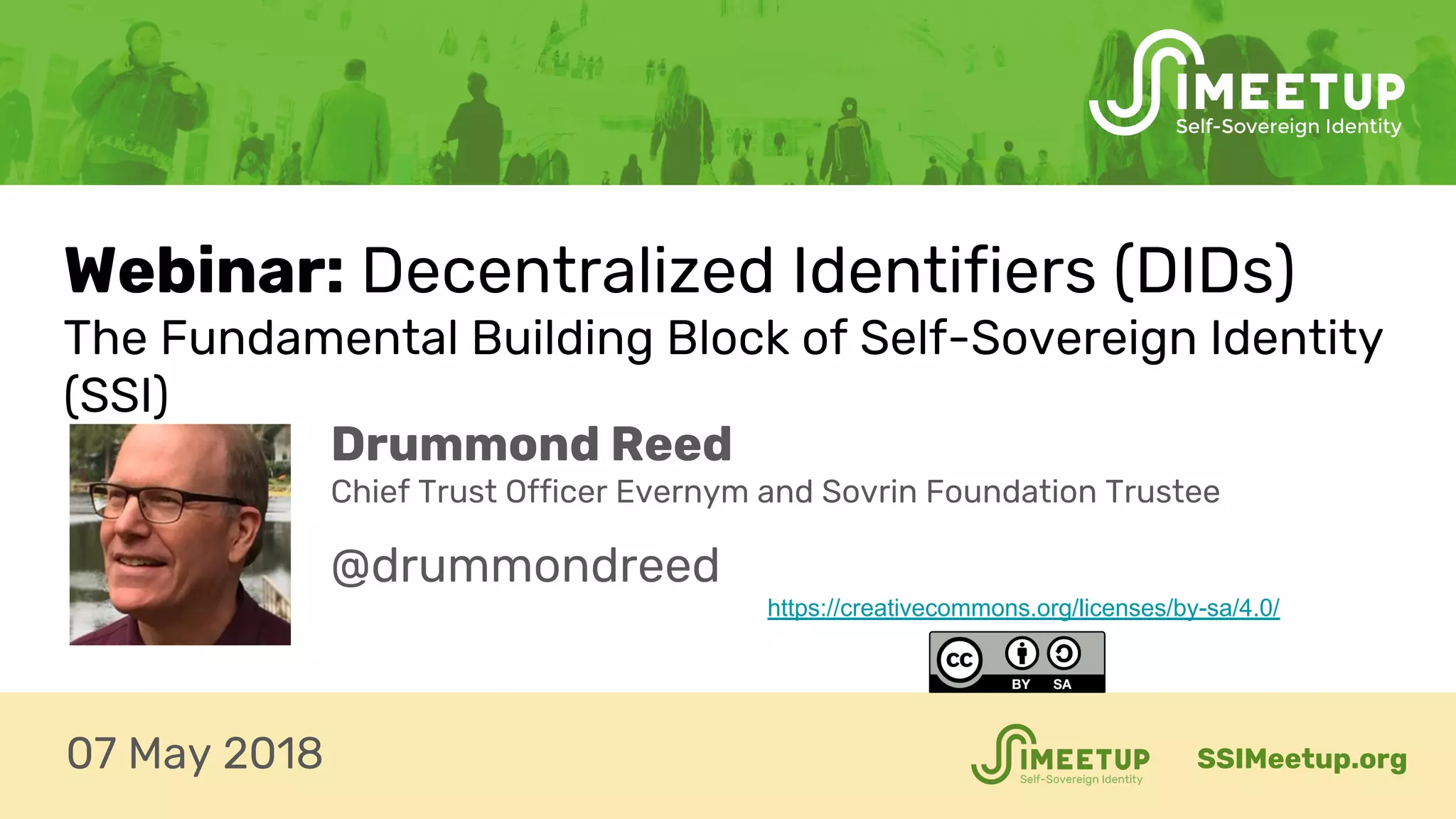
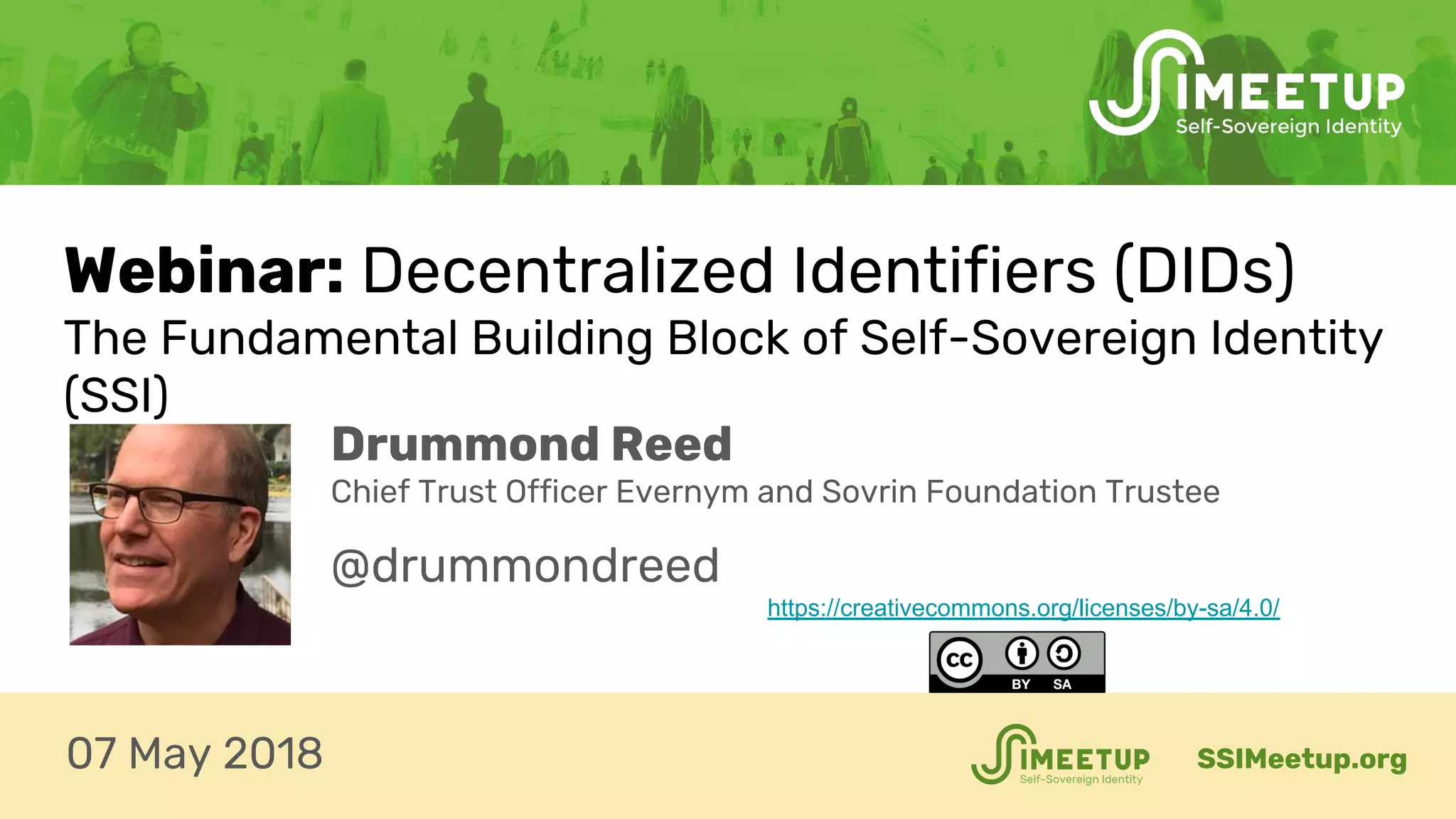
Webinar: Decentralized Identifiers (DIDs)
The Fundamental Building Block of Self-Sovereign Identity
(SSI)
SSIMeetup.org07 May 2018
Drummond Reed
Chief Trust Officer Evernym and Sovrin Foundation Trustee
@drummondreed
https://creativecommons.org/licenses/by-sa/4.0/
1. Empower global SSI communities
2. Open to everyone interested in SSI
3. All content is shared with CC BY SA
SSIMeetup.org
Alex Preukschat @SSIMeetup @AlexPreukschat
Coordinating Node SSIMeetup.org
https://creativecommons.org/licenses/by-sa/4.0/
SSIMeetup objectives
07 May 2018
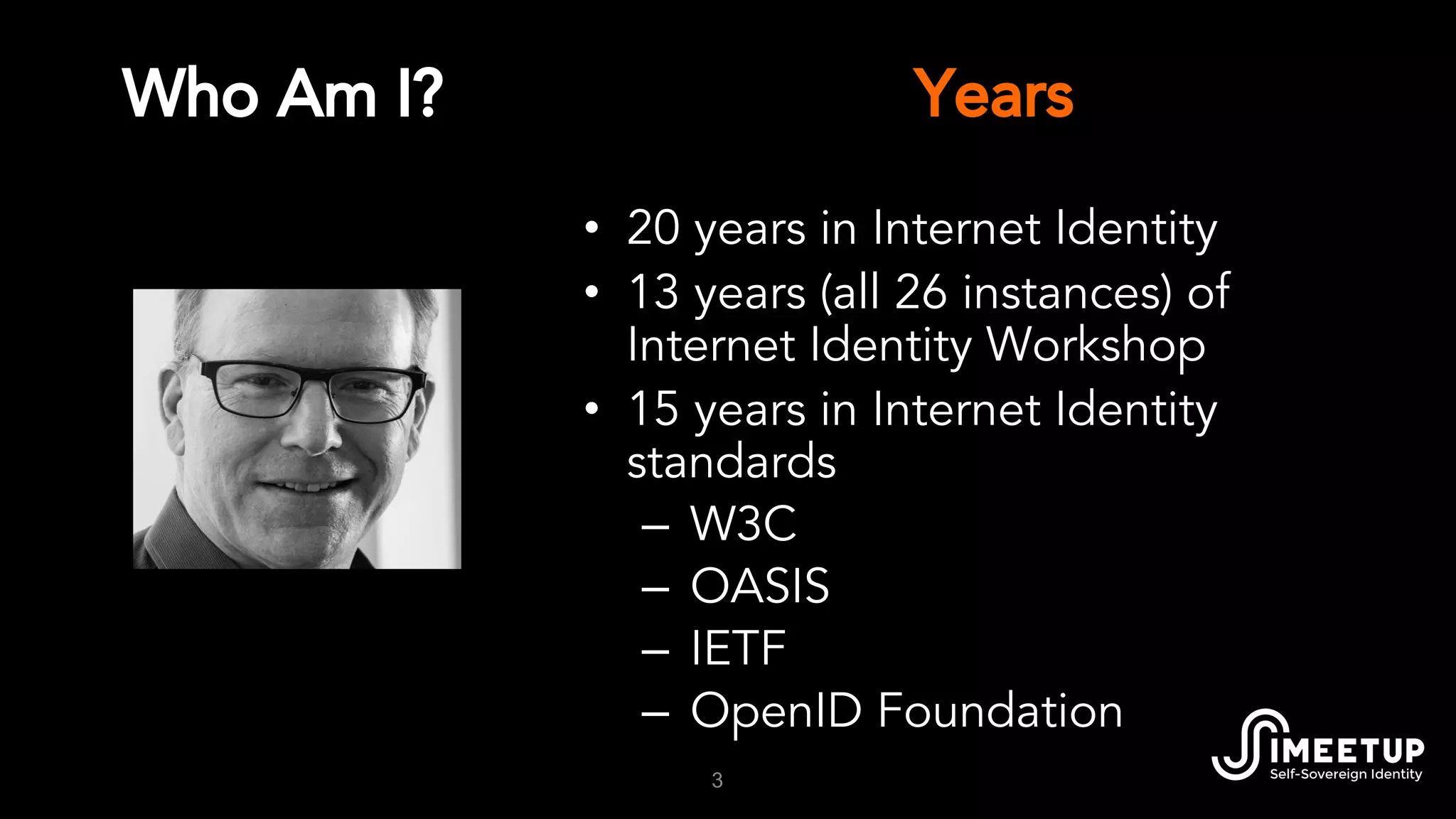
Who Am I?
3
• 20 years in Internet Identity
• 13 years (all 26 instances) of
Internet Identity Workshop
• 15 years in Internet Identity
standards
– W3C
– OASIS
– IETF
– OpenID Foundation
Years
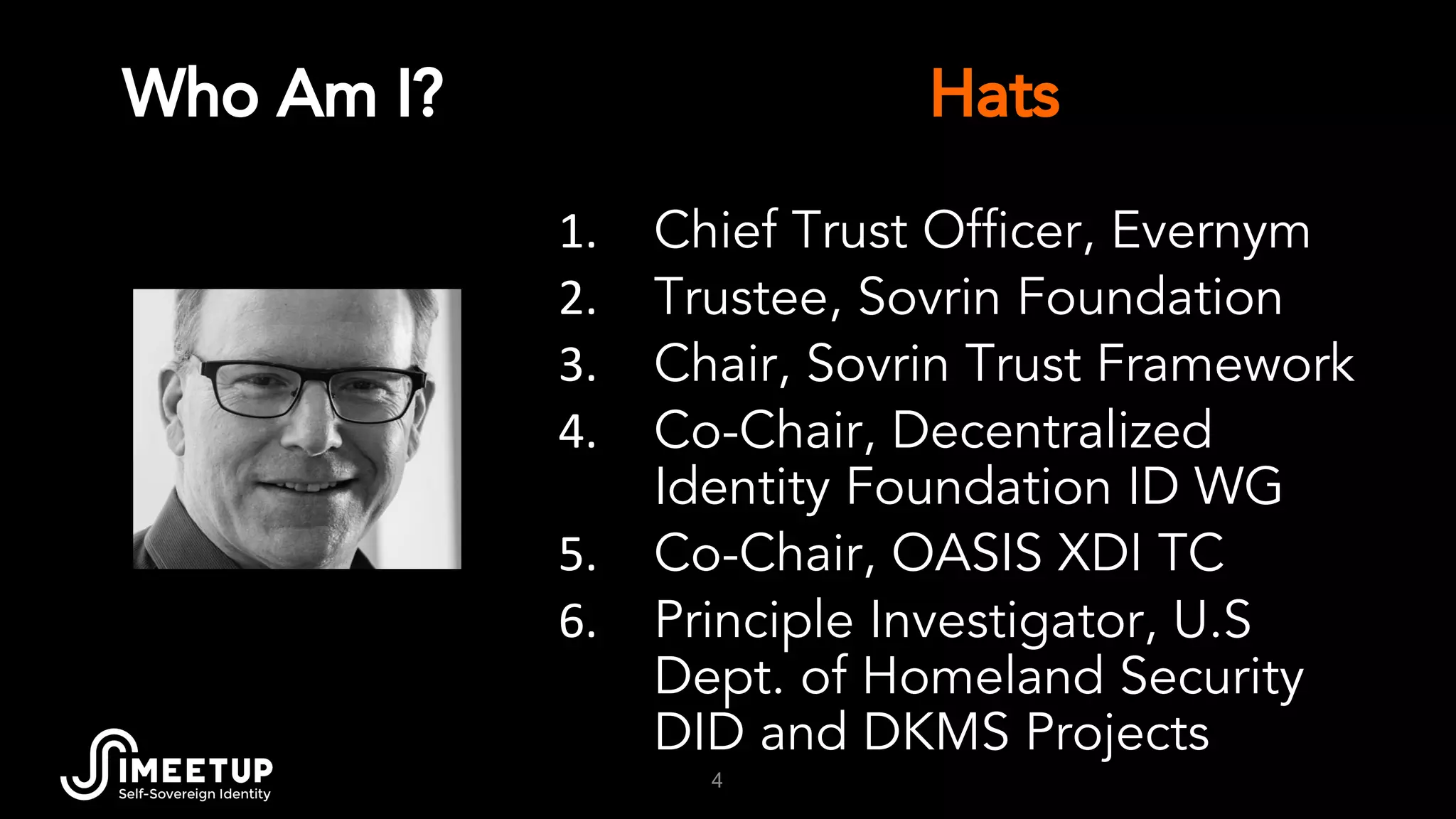
Who Am I?
4
Chief Trust Officer, Evernym
Trustee, Sovrin Foundation
Chair, Sovrin Trust Framework
Co-Chair, Decentralized
Identity Foundation ID WG
Co-Chair, OASIS XDI TC
Principle Investigator, U.S
Dept. of Homeland Security
DID and DKMS Projects
Hats
Three Models of
Digital Identity
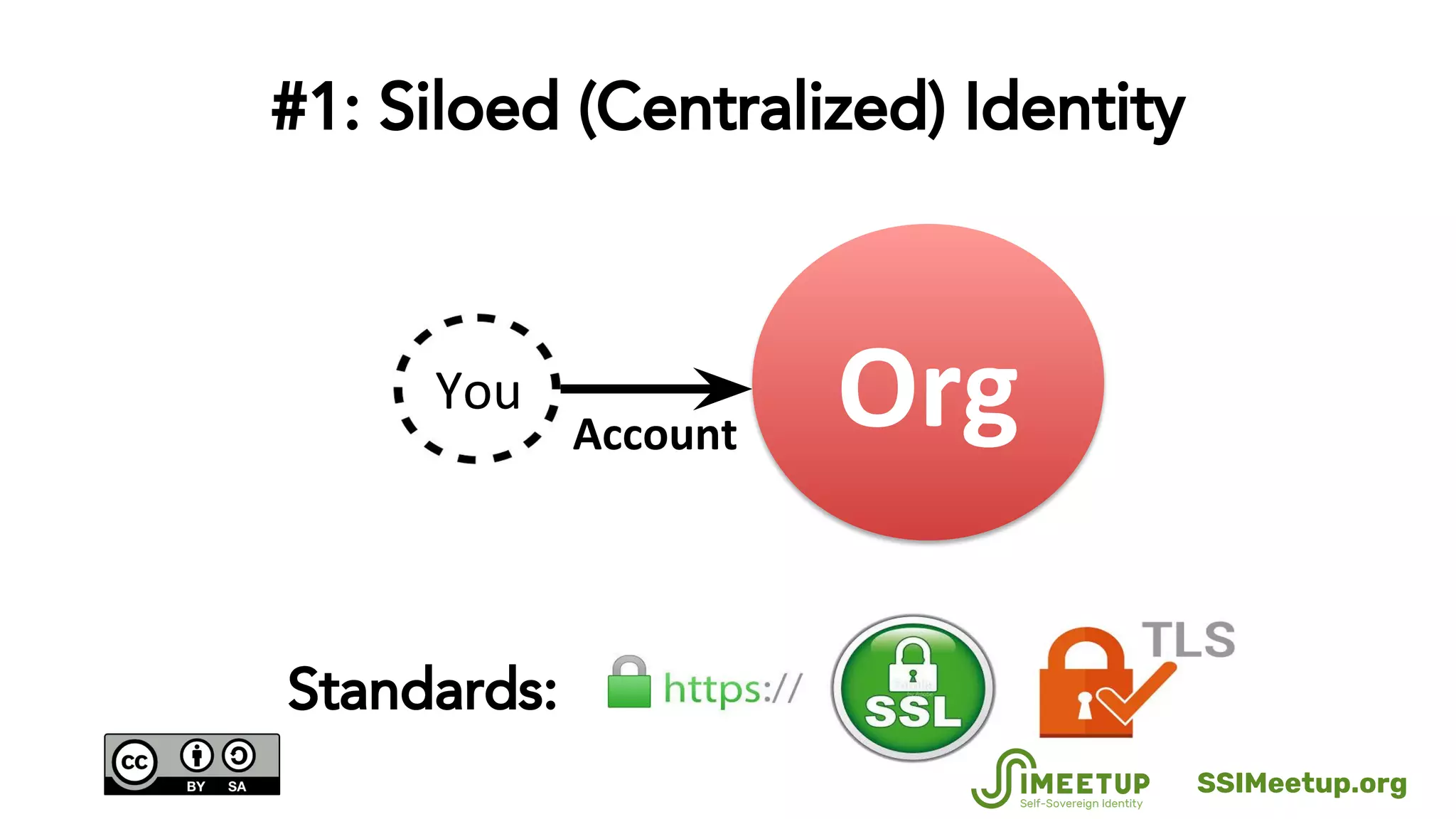
#1: Siloed (Centralized) Identity
Standards:
SSIMeetup.org
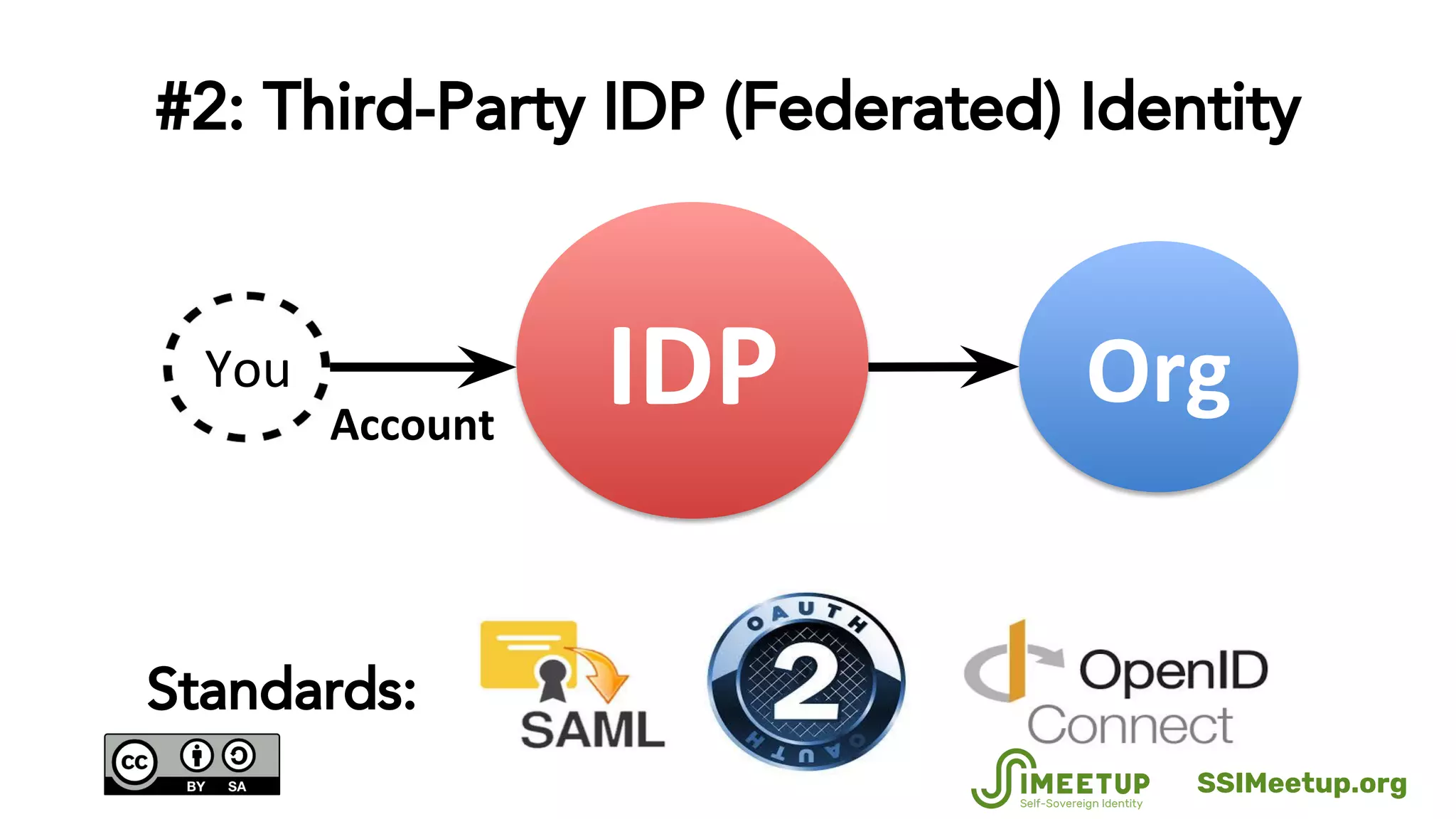
#2: Third-Party IDP (Federated) Identity
Standards:
SSIMeetup.org
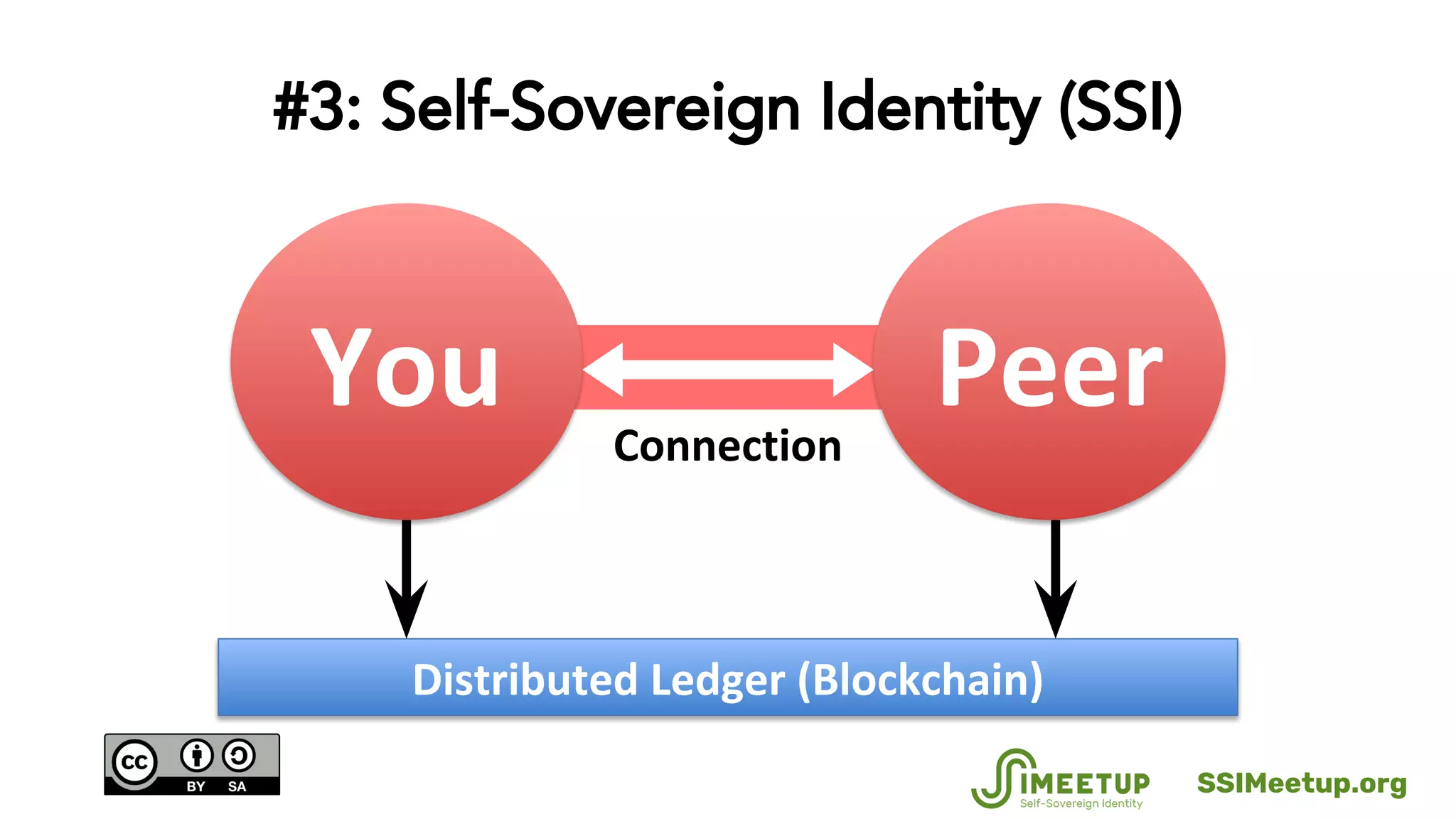
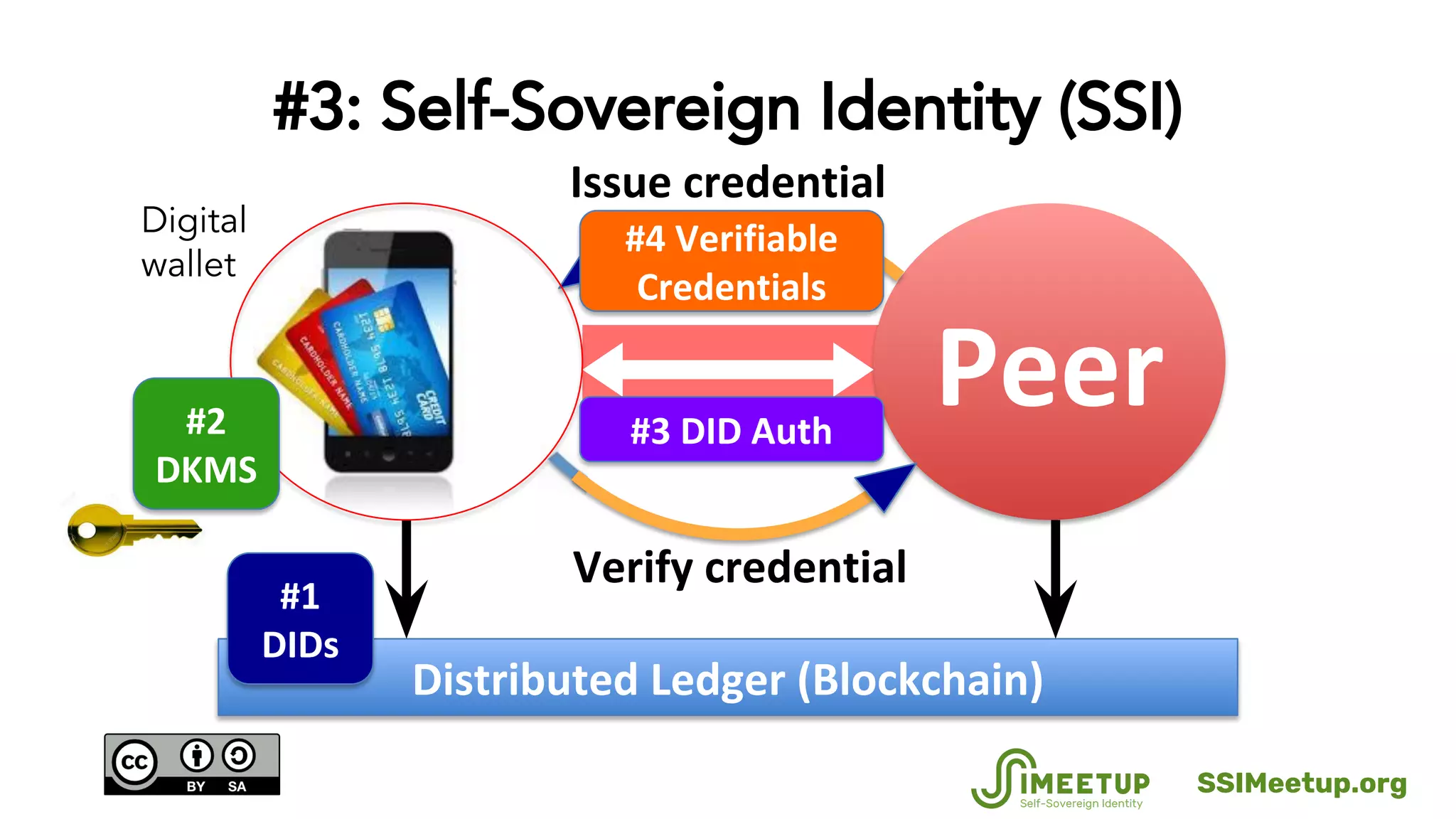
#3: Self-Sovereign Identity (SSI)
SSIMeetup.org
#3: Self-Sovereign Identity (SSI)
Digital
wallet
SSIMeetup.org
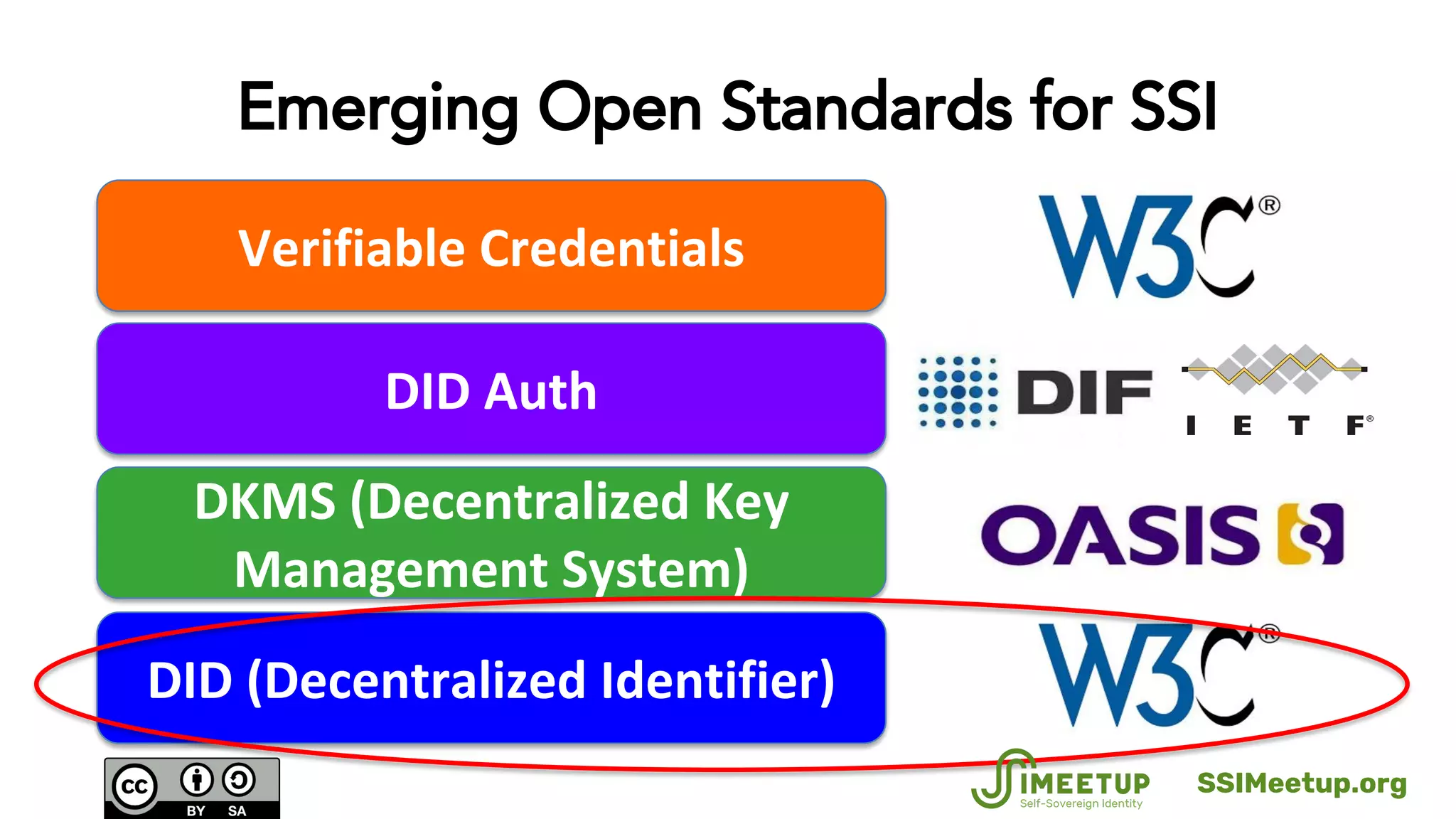
Emerging Open Standards for SSI
SSIMeetup.org
What is a DID?
078-05-1120
SSIMeetup.org
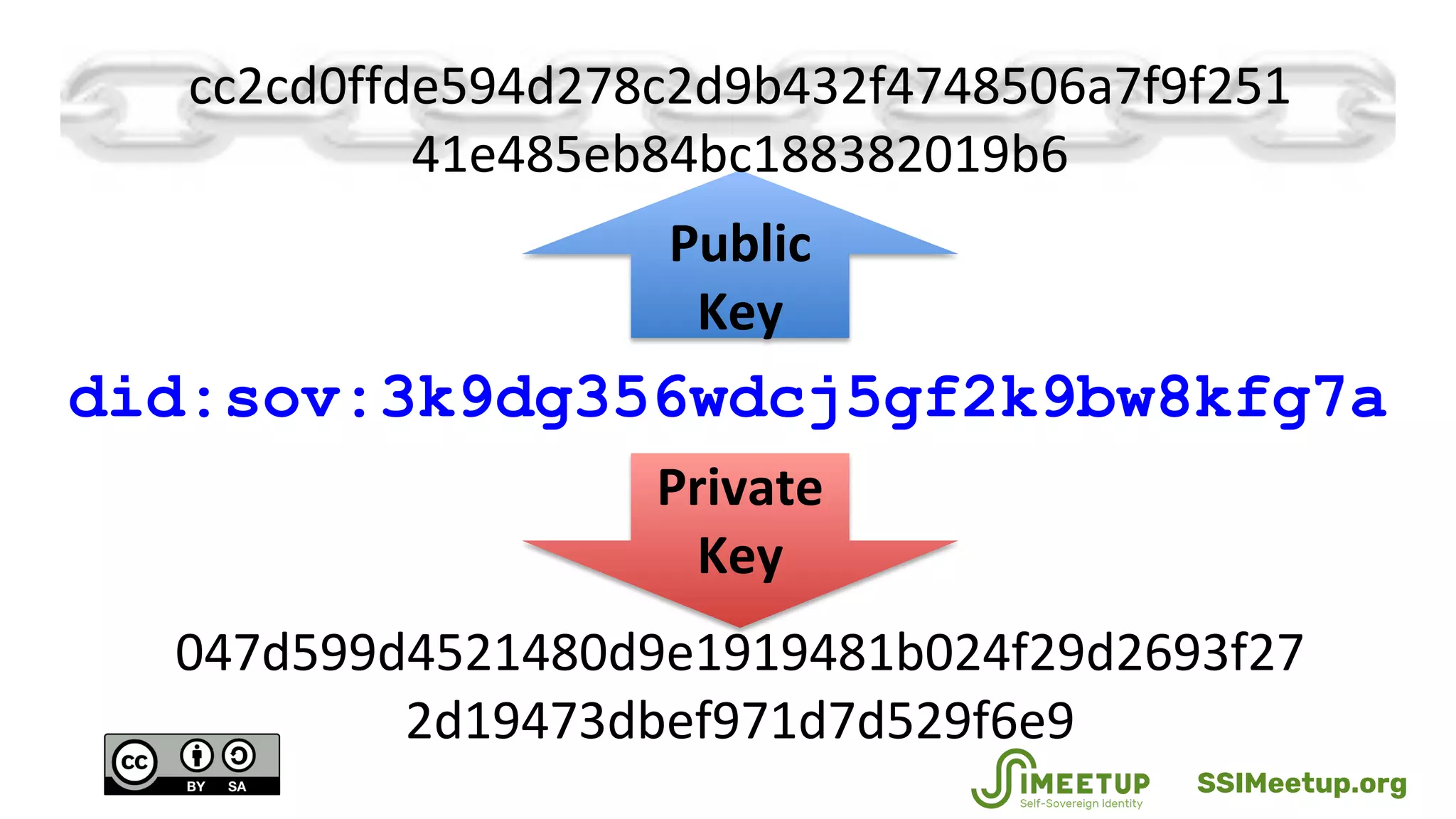
did:sov:3k9dg356wdcj5gf2k9bw8kfg7a
SSIMeetup.org
14
SSIMeetup.org
15
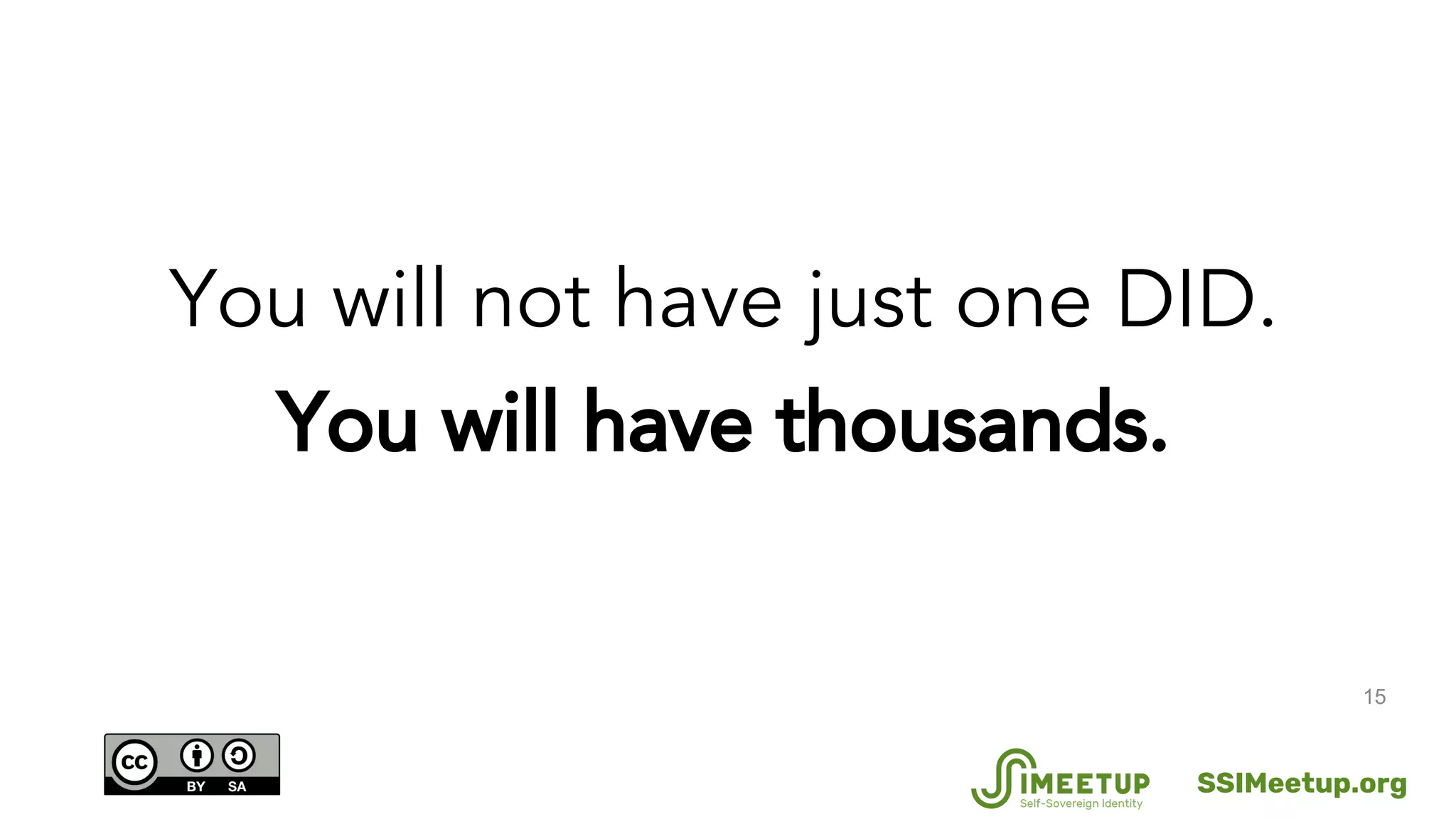
You will not have just one DID.
You will have thousands.
SSIMeetup.org
16
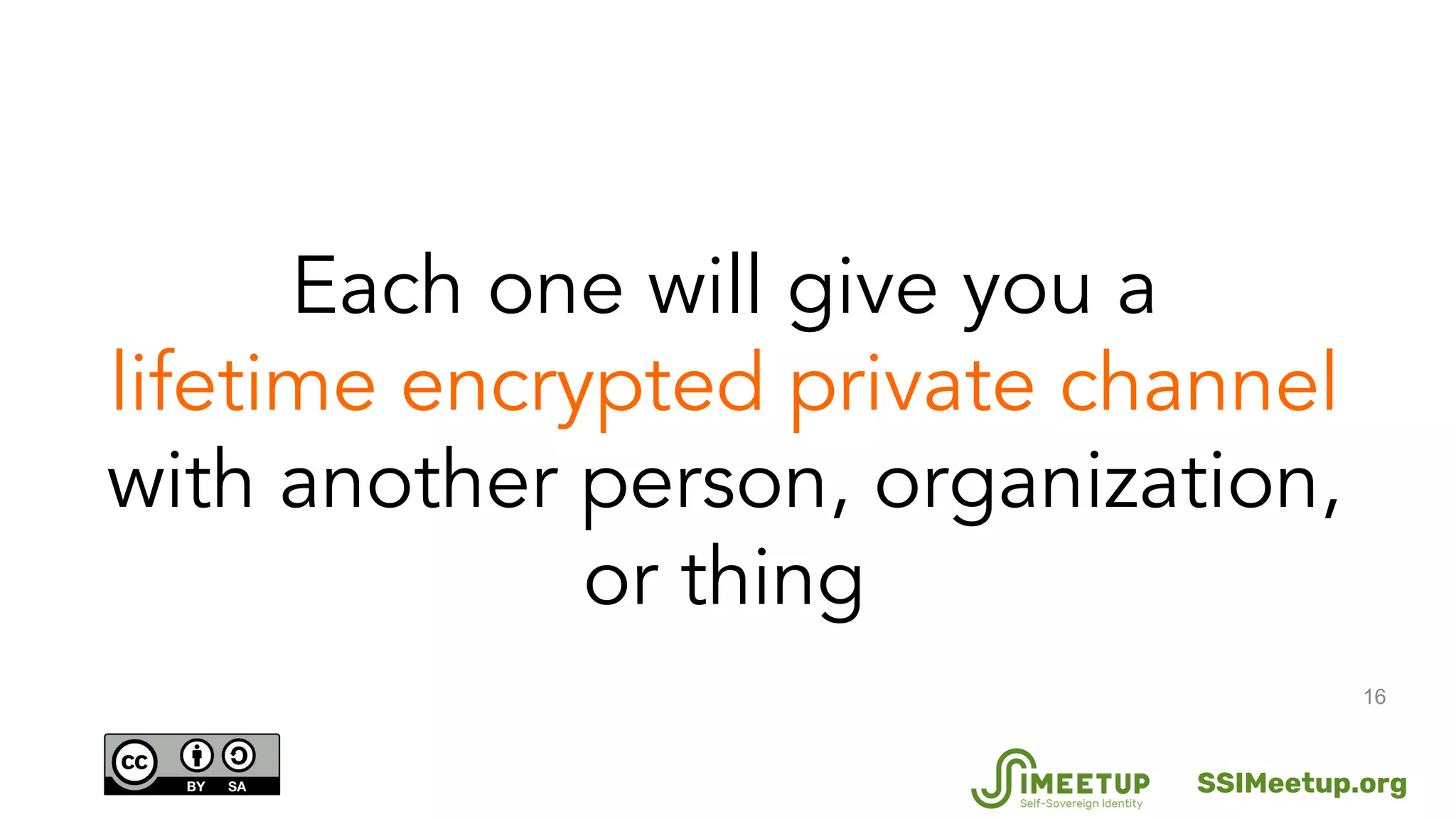
Each one will give you a
lifetime encrypted private channel
with another person, organization,
or thing
SSIMeetup.org
17
You will use it not just for
authentication, but to exchange
verifiable digital credentials
SSIMeetup.org
18
Best of all: there is
no central registration authority—
every DID is registered directly by
you on a public or private
blockchain or distributed network
SSIMeetup.org
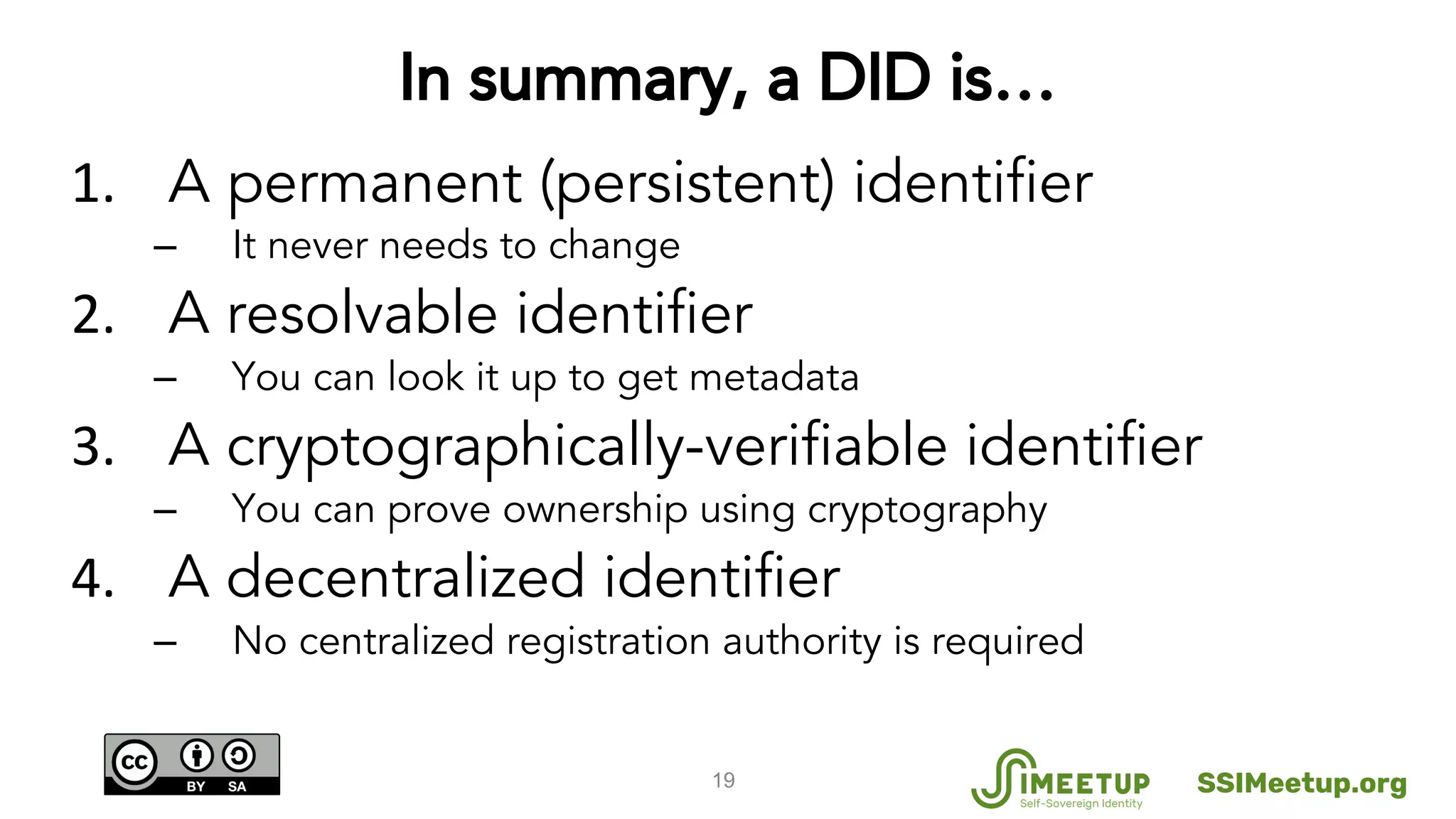
In summary, a DID is…
A permanent (persistent) identifier
– It never needs to change
A resolvable identifier
– You can look it up to get metadata
A cryptographically-verifiable identifier
– You can prove ownership using cryptography
A decentralized identifier
– No centralized registration authority is required
19 SSIMeetup.org
20
No identifier in history has had all
four of these properties—because
what fundamentally enables DIDs is
blockchain technology
SSIMeetup.org
What does a DID
look like?
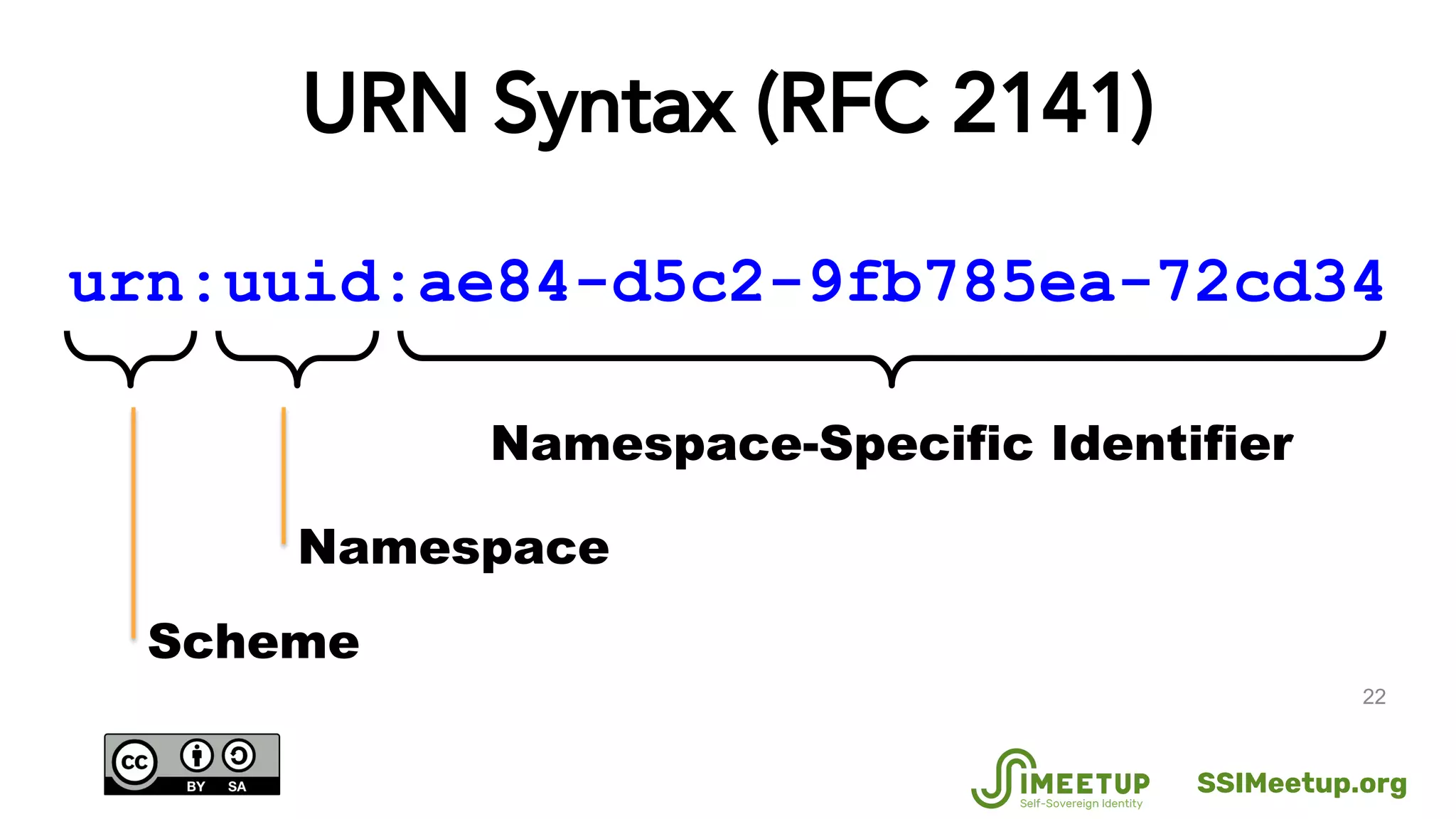
URN Syntax (RFC 2141)
22
urn:uuid:ae84-d5c2-9fb785ea-72cd34
Namespace
Scheme
Namespace-Specific Identifier
SSIMeetup.org
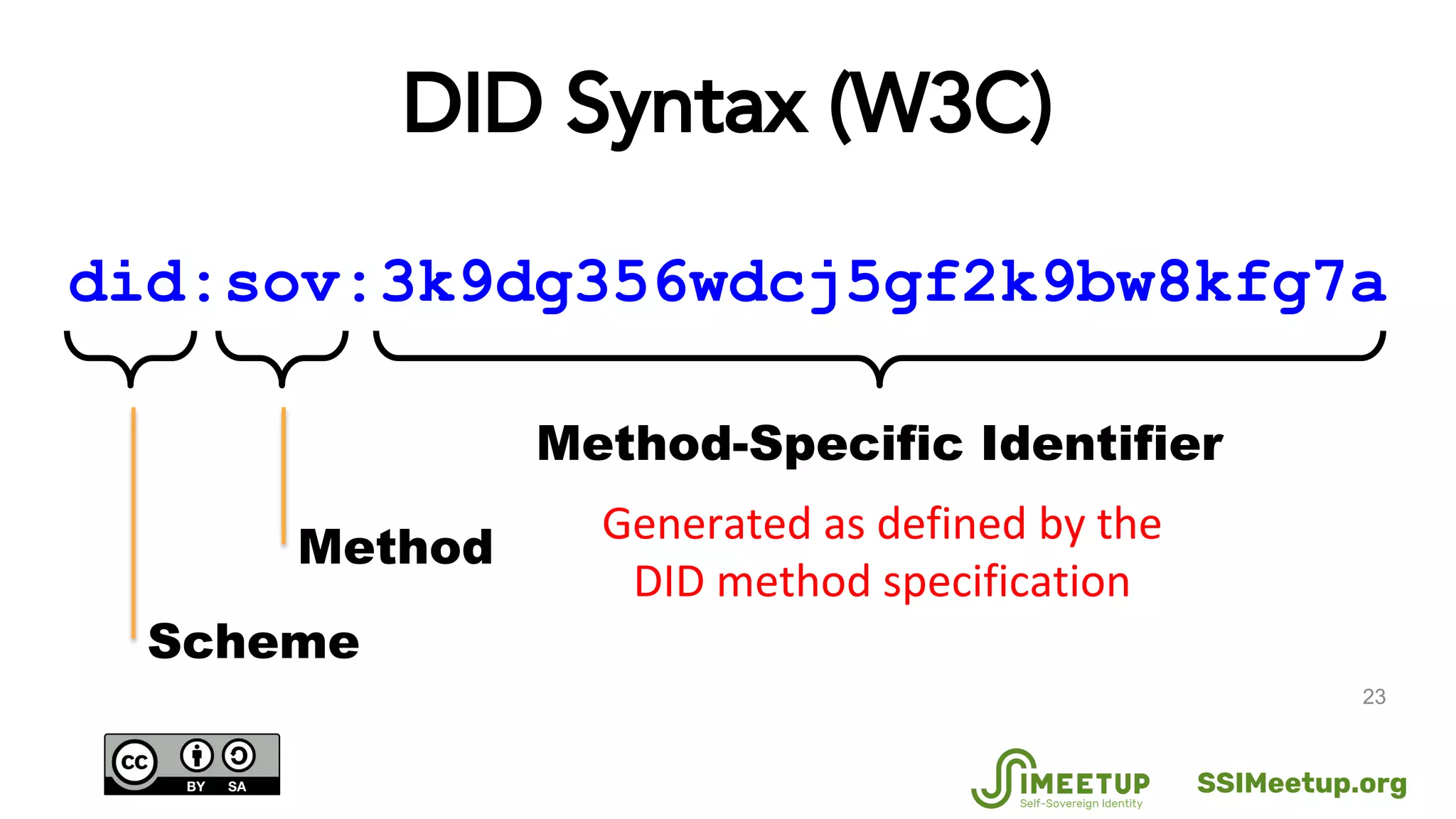
23
did:sov:3k9dg356wdcj5gf2k9bw8kfg7a
Method
Scheme
Method-Specific Identifier
DID Syntax (W3C)
SSIMeetup.org
What is a DID
method spec?
25
A DID method specification
defines how to read and write
a DID (and its DID document)
on a specific blockchain or
distributed network
SSIMeetup.org
26
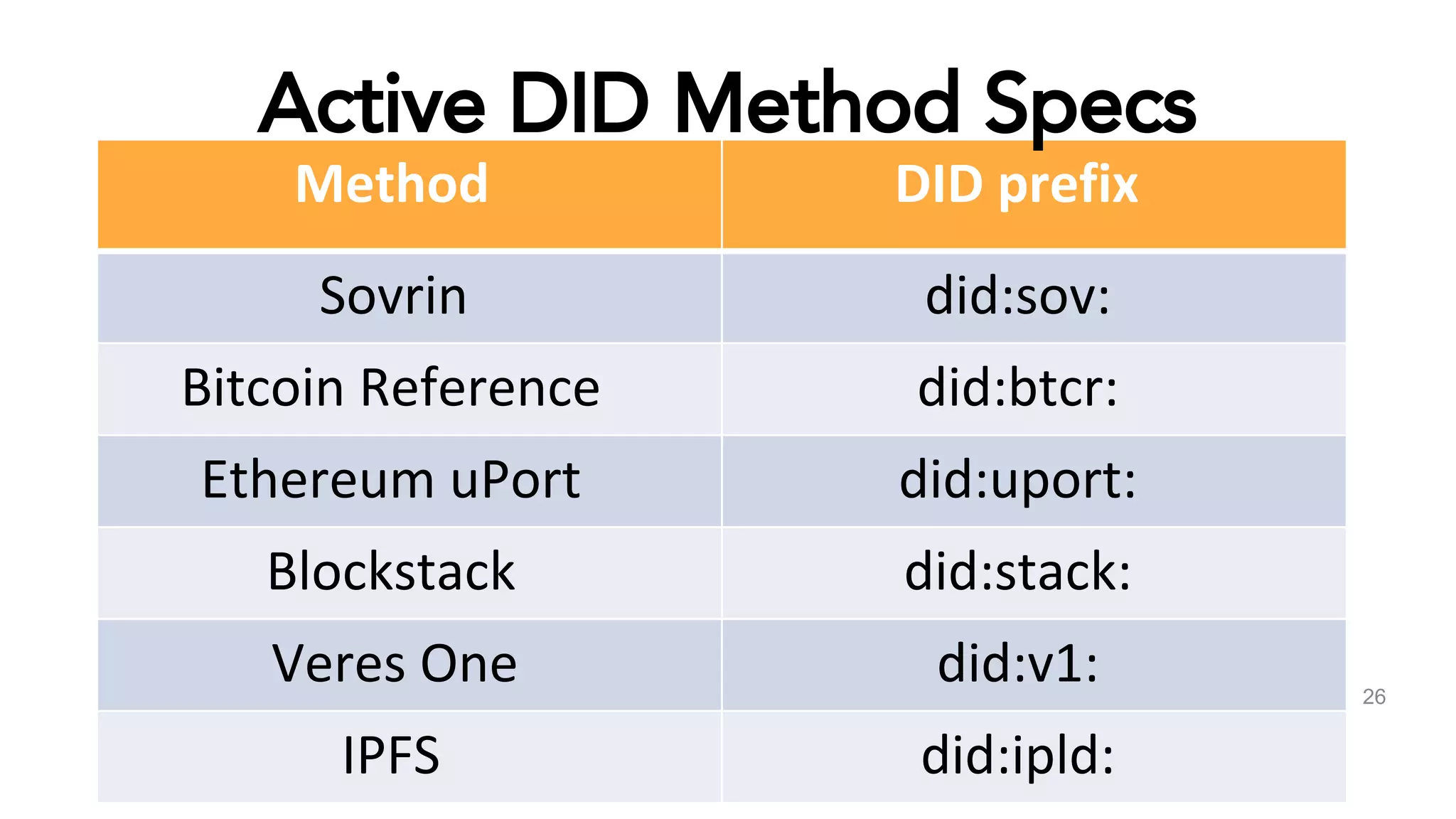
Active DID Method Specs
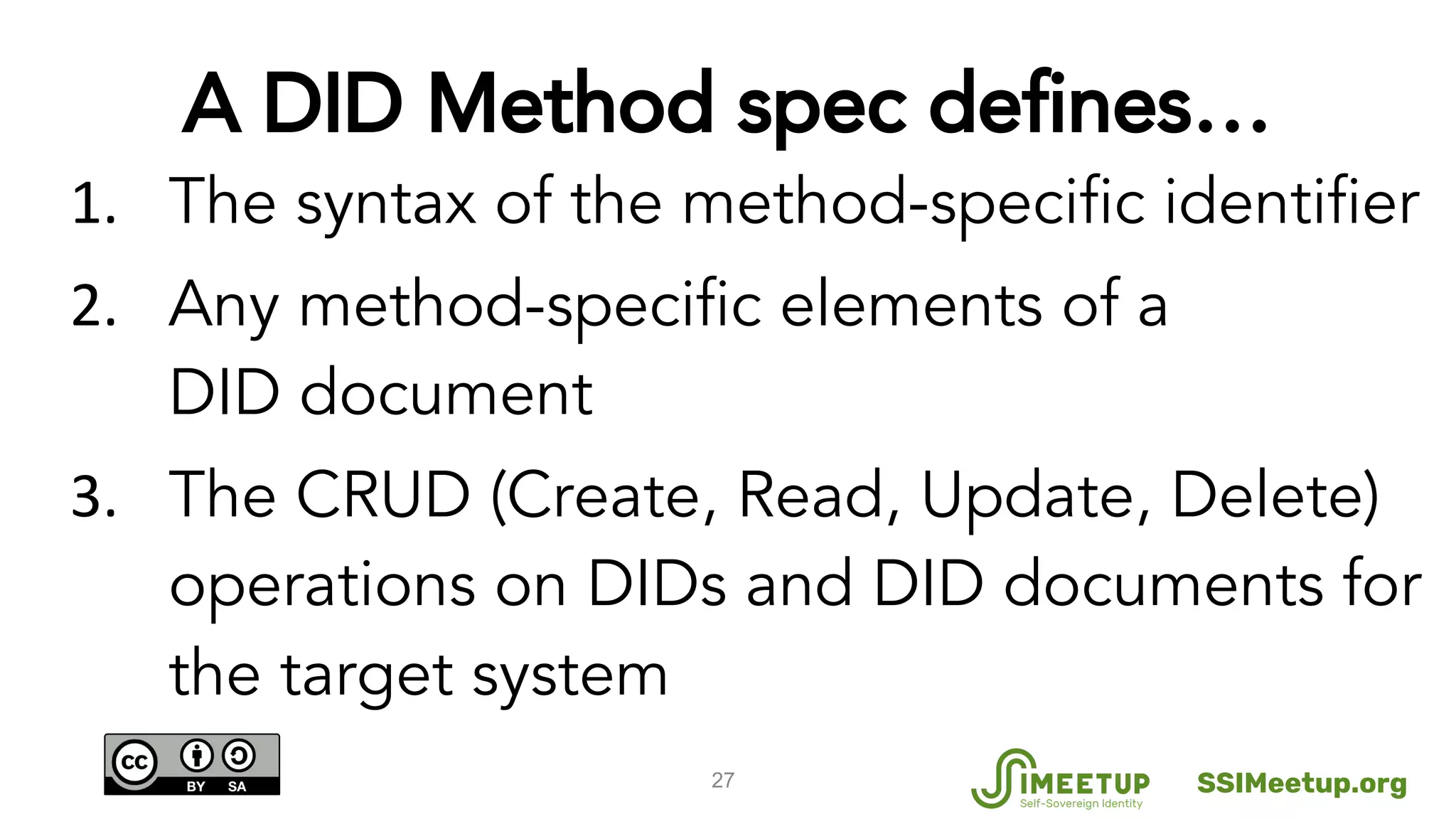
The syntax of the method-specific identifier
Any method-specific elements of a
DID document
The CRUD (Create, Read, Update, Delete)
operations on DIDs and DID documents for
the target system
27
A DID Method spec defines…
SSIMeetup.org
What is a DID
document?
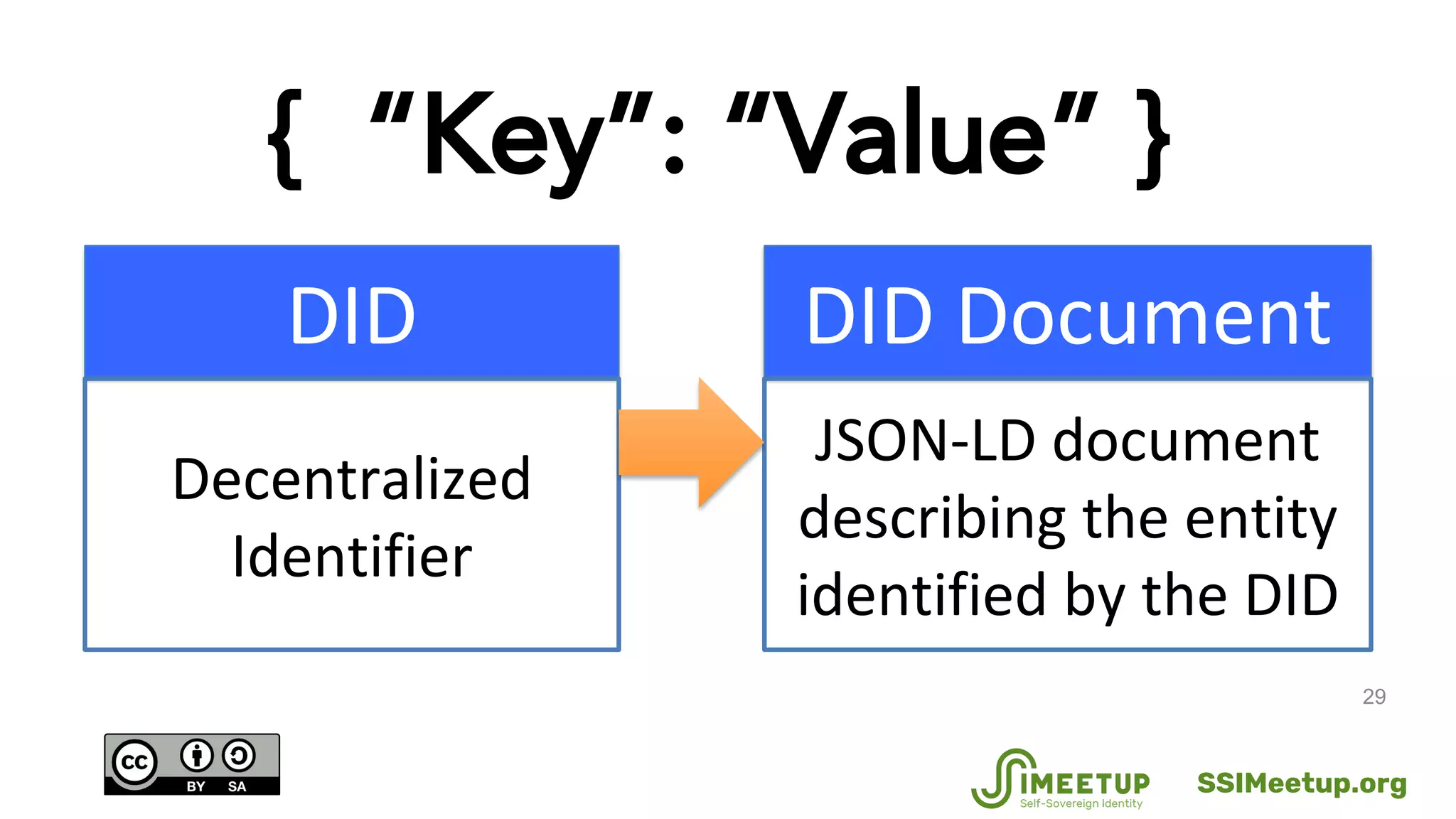
29
{ “Key”: “Value” }
SSIMeetup.org
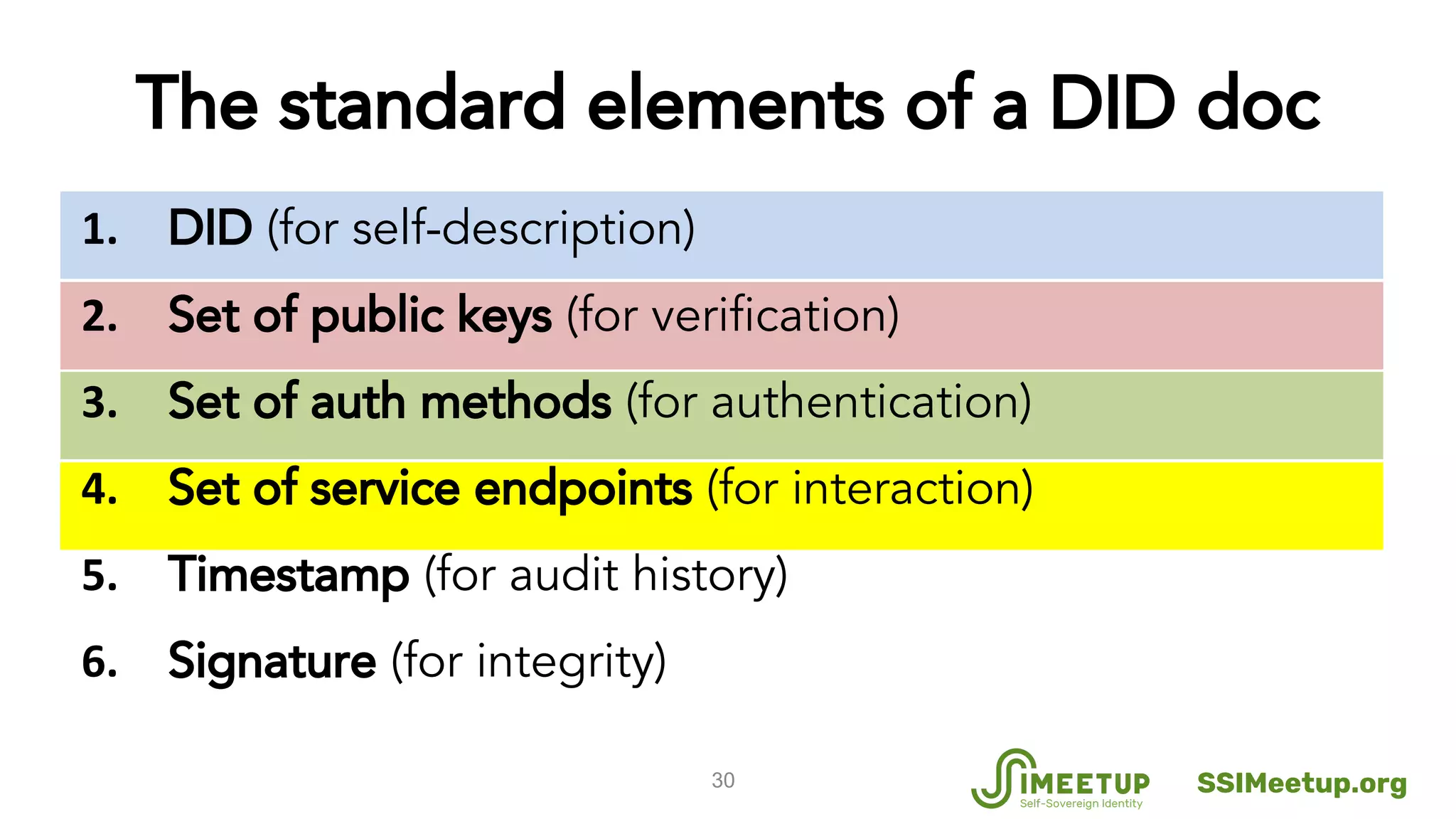
DID (for self-description)
Set of public keys (for verification)
Set of auth methods (for authentication)
Set of service endpoints (for interaction)
Timestamp (for audit history)
Signature (for integrity)
30
The standard elements of a DID doc
SSIMeetup.org
{
"@context": "https://w3id.org/did/v1",
"id": "did:example:123456789abcdefghi",
"publicKey": [{
"id": "did:example:123456789abcdefghi#keys-1",
"type": "RsaSigningKey2018",
"owner": "did:example:123456789abcdefghi",
"publicKeyPem": "-----BEGIN PUBLIC KEY...END PUBLIC KEY-----rn"
}],
"authentication": [{
"type": "RsaSignatureAuthentication2018",
"publicKey": "did:example:123456789abcdefghi#keys-1"
}],
"service": [{
"type": "ExampleService",
"serviceEndpoint": "https://example.com/endpoint/8377464"
}],
Example DID Document (Part 1)
31
SSIMeetup.org
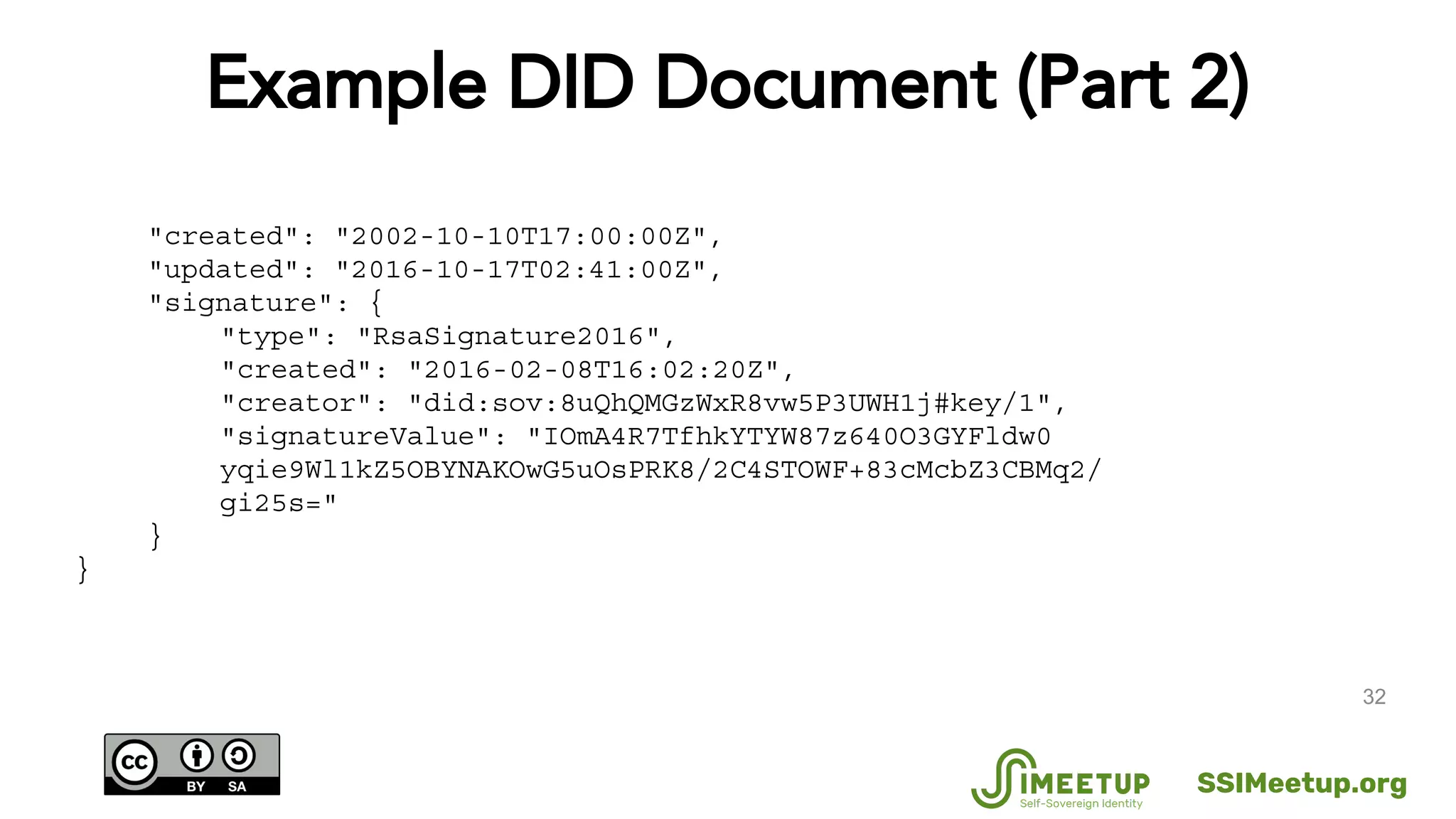
Example DID Document (Part 2)
32
"created": "2002-10-10T17:00:00Z",
"updated": "2016-10-17T02:41:00Z",
"signature": {
"type": "RsaSignature2016",
"created": "2016-02-08T16:02:20Z",
"creator": "did:sov:8uQhQMGzWxR8vw5P3UWH1j#key/1",
"signatureValue": "IOmA4R7TfhkYTYW87z640O3GYFldw0
yqie9Wl1kZ5OBYNAKOwG5uOsPRK8/2C4STOWF+83cMcbZ3CBMq2/
gi25s="
}
}
SSIMeetup.org
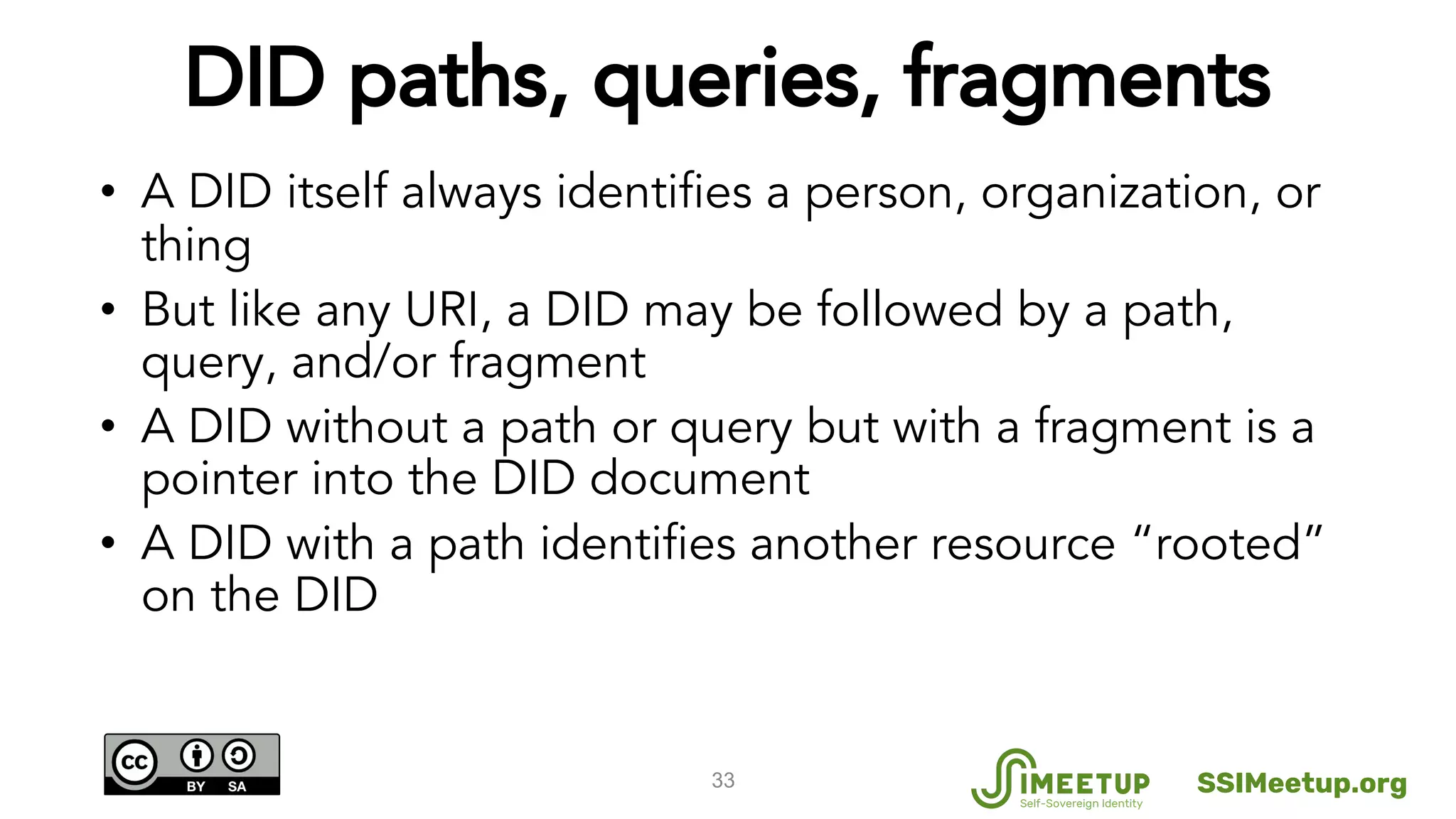
DID paths, queries, fragments
• A DID itself always identifies a person, organization, or
thing
• But like any URI, a DID may be followed by a path,
query, and/or fragment
• A DID without a path or query but with a fragment is a
pointer into the DID document
• A DID with a path identifies another resource “rooted”
on the DID
33 SSIMeetup.org
DIDs and
Decentralized Identity
35
DIDs only represent the very
bottom layer of the
decentralized identity stack
SSIMeetup.org
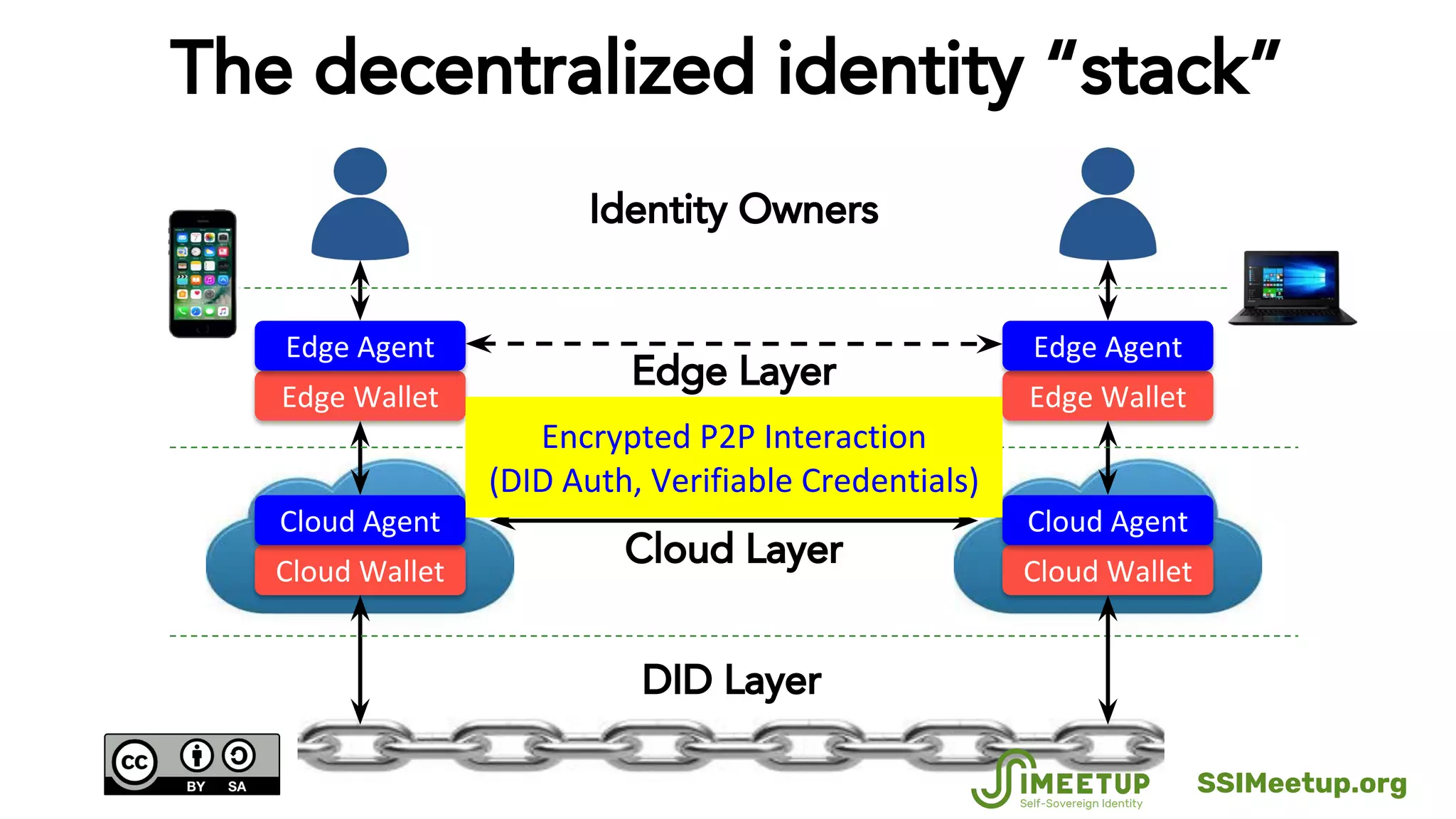
DID Layer
The decentralized identity “stack”
Cloud Layer
Identity Owners
Edge Layer
SSIMeetup.org
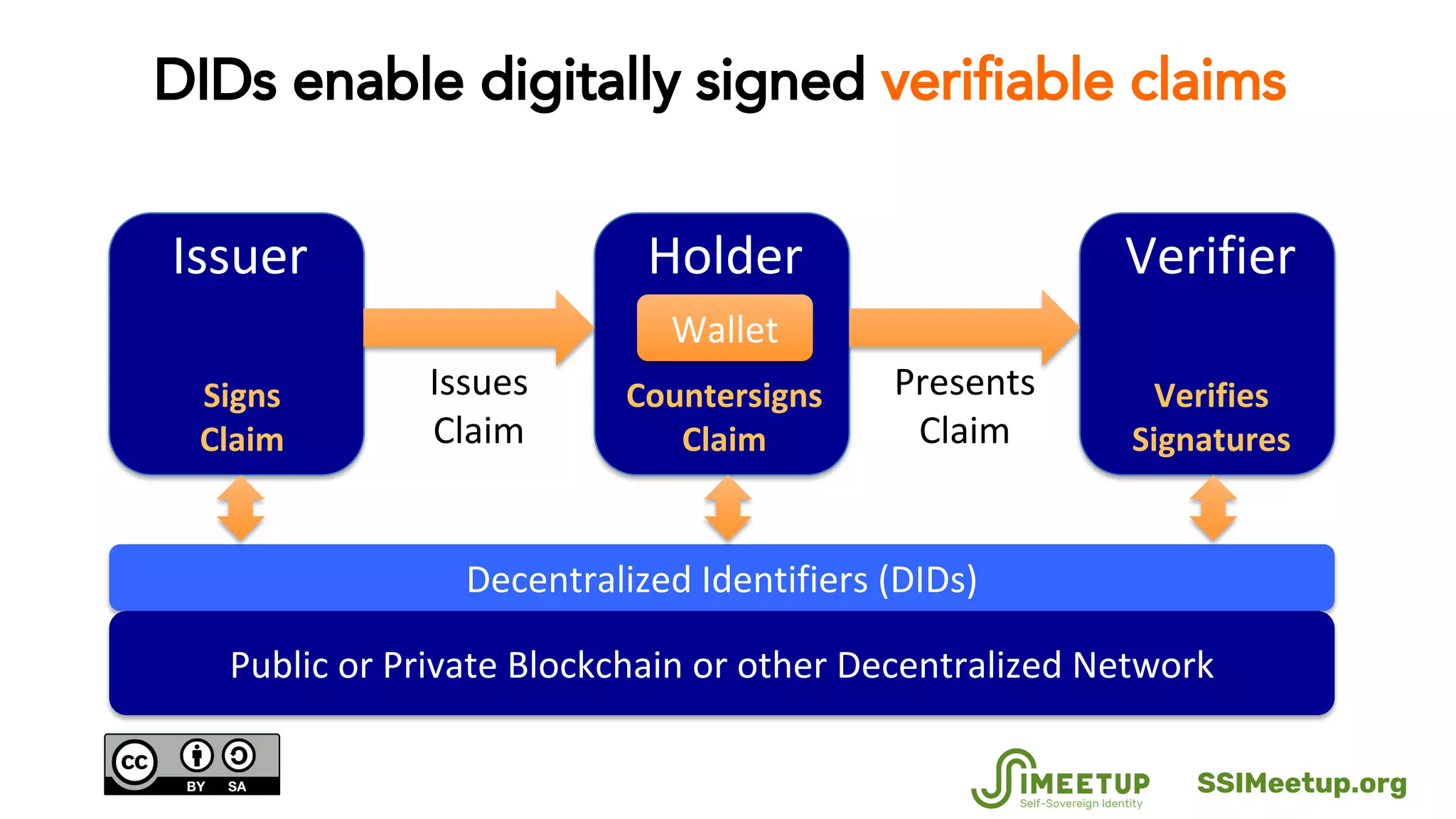
DIDs enable digitally signed verifiable claims
SSIMeetup.org
DID Standardization
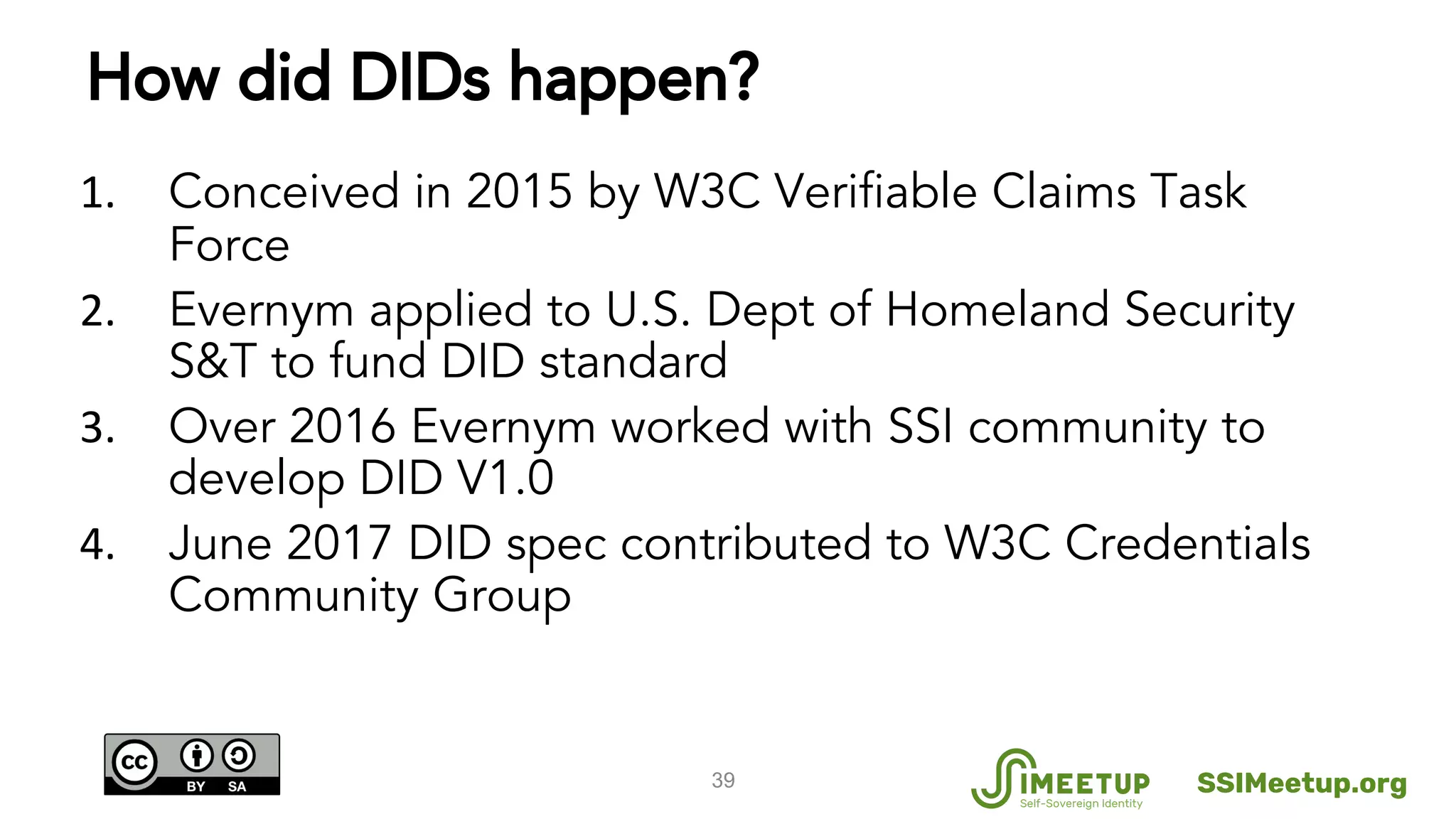
How did DIDs happen?
Conceived in 2015 by W3C Verifiable Claims Task
Force
Evernym applied to U.S. Dept of Homeland Security
S&T to fund DID standard
Over 2016 Evernym worked with SSI community to
develop DID V1.0
June 2017 DID spec contributed to W3C Credentials
Community Group
39 SSIMeetup.org
40
The second generation DID spec
is currently being standardized by
the W3C Credentials Community
Group—membership is free
and open to all
SSIMeetup.org
41
Work has begun to form the
W3C DID Working Group—this is
where the DID specification will
become an official
W3C open standard
SSIMeetup.org
42
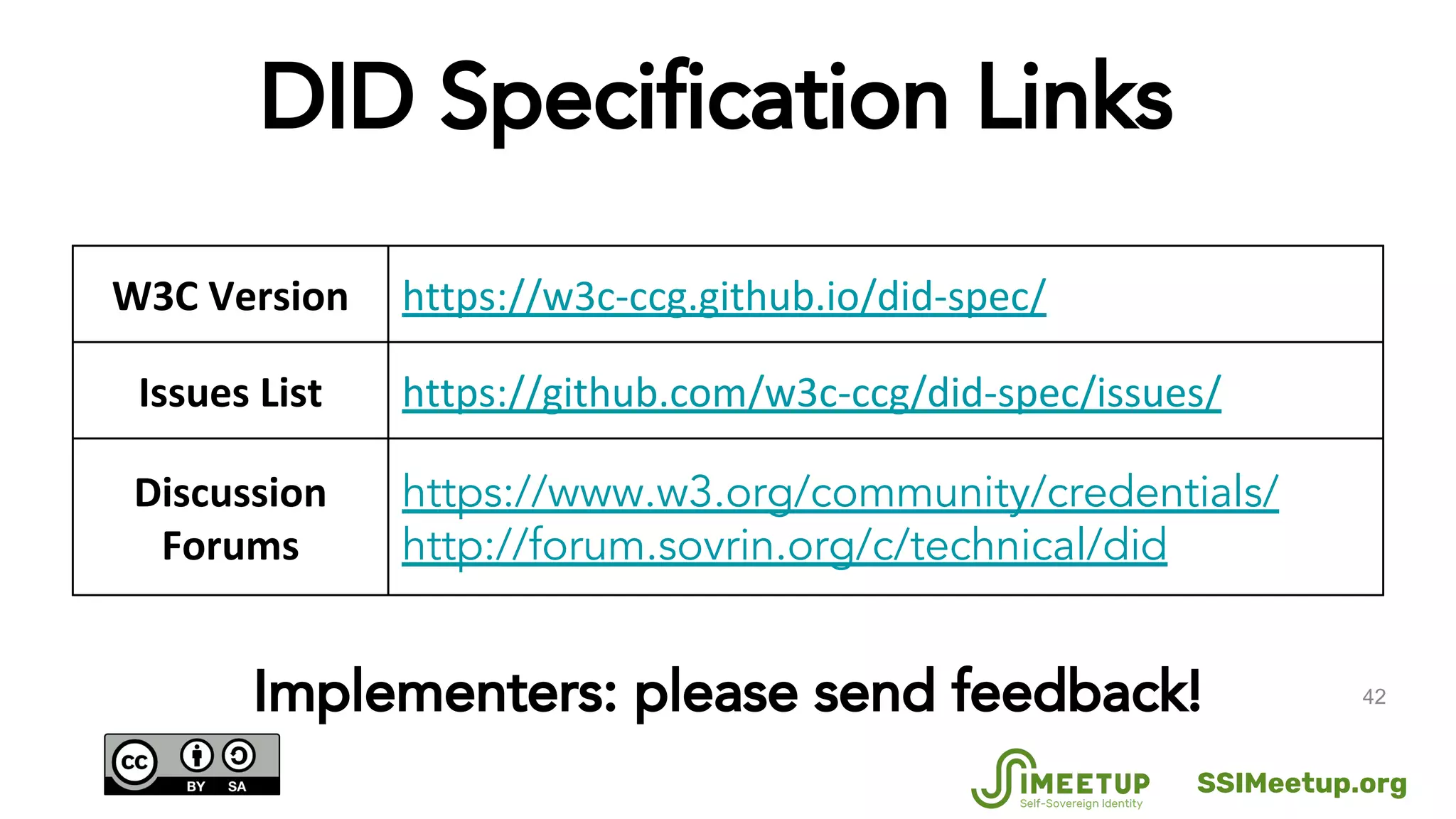
DID Specification Links
Implementers: please send feedback!
https://www.w3.org/community/credentials/
http://forum.sovrin.org/c/technical/did
SSIMeetup.org
43
Thank You
SSIMeetup.org
Webinar: Decentralized Identifiers (DIDs)
The Fundamental Building Block of Self-Sovereign Identity
(SSI)
SSIMeetup.org07 May 2018
Drummond Reed
Chief Trust Officer Evernym and Sovrin Foundation Trustee
@drummondreed
https://creativecommons.org/licenses/by-sa/4.0/

Decentralized Identifiers (DIDs): The Fundamental Building Block of Self-Sovereign Identity (SSI)

  • 1.
    Webinar: Decentralized Identifiers(DIDs) The Fundamental Building Block of Self-Sovereign Identity (SSI) SSIMeetup.org07 May 2018 Drummond Reed Chief Trust Officer Evernym and Sovrin Foundation Trustee @drummondreed https://creativecommons.org/licenses/by-sa/4.0/
  • 2.
    1. Empower globalSSI communities 2. Open to everyone interested in SSI 3. All content is shared with CC BY SA SSIMeetup.org Alex Preukschat @SSIMeetup @AlexPreukschat Coordinating Node SSIMeetup.org https://creativecommons.org/licenses/by-sa/4.0/ SSIMeetup objectives 07 May 2018
  • 3.
    Who Am I? 3 •20 years in Internet Identity • 13 years (all 26 instances) of Internet Identity Workshop • 15 years in Internet Identity standards – W3C – OASIS – IETF – OpenID Foundation Years
  • 4.
    Who Am I? 4 ChiefTrust Officer, Evernym Trustee, Sovrin Foundation Chair, Sovrin Trust Framework Co-Chair, Decentralized Identity Foundation ID WG Co-Chair, OASIS XDI TC Principle Investigator, U.S Dept. of Homeland Security DID and DKMS Projects Hats
  • 5.
  • 6.
    #1: Siloed (Centralized)Identity Standards: SSIMeetup.org
  • 7.
    #2: Third-Party IDP(Federated) Identity Standards: SSIMeetup.org
  • 8.
    #3: Self-Sovereign Identity(SSI) SSIMeetup.org
  • 9.
    #3: Self-Sovereign Identity(SSI) Digital wallet SSIMeetup.org
  • 10.
    Emerging Open Standardsfor SSI SSIMeetup.org
  • 11.
  • 12.
  • 13.
  • 14.
  • 15.
    15 You will nothave just one DID. You will have thousands. SSIMeetup.org
  • 16.
    16 Each one willgive you a lifetime encrypted private channel with another person, organization, or thing SSIMeetup.org
  • 17.
    17 You will useit not just for authentication, but to exchange verifiable digital credentials SSIMeetup.org
  • 18.
    18 Best of all:there is no central registration authority— every DID is registered directly by you on a public or private blockchain or distributed network SSIMeetup.org
  • 19.
    In summary, aDID is… A permanent (persistent) identifier – It never needs to change A resolvable identifier – You can look it up to get metadata A cryptographically-verifiable identifier – You can prove ownership using cryptography A decentralized identifier – No centralized registration authority is required 19 SSIMeetup.org
  • 20.
    20 No identifier inhistory has had all four of these properties—because what fundamentally enables DIDs is blockchain technology SSIMeetup.org
  • 21.
    What does aDID look like?
  • 22.
    URN Syntax (RFC2141) 22 urn:uuid:ae84-d5c2-9fb785ea-72cd34 Namespace Scheme Namespace-Specific Identifier SSIMeetup.org
  • 23.
  • 24.
    What is aDID method spec?
  • 25.
    25 A DID methodspecification defines how to read and write a DID (and its DID document) on a specific blockchain or distributed network SSIMeetup.org
  • 26.
  • 27.
    The syntax ofthe method-specific identifier Any method-specific elements of a DID document The CRUD (Create, Read, Update, Delete) operations on DIDs and DID documents for the target system 27 A DID Method spec defines… SSIMeetup.org
  • 28.
    What is aDID document?
  • 29.
  • 30.
    DID (for self-description) Setof public keys (for verification) Set of auth methods (for authentication) Set of service endpoints (for interaction) Timestamp (for audit history) Signature (for integrity) 30 The standard elements of a DID doc SSIMeetup.org
  • 31.
    { "@context": "https://w3id.org/did/v1", "id": "did:example:123456789abcdefghi", "publicKey":[{ "id": "did:example:123456789abcdefghi#keys-1", "type": "RsaSigningKey2018", "owner": "did:example:123456789abcdefghi", "publicKeyPem": "-----BEGIN PUBLIC KEY...END PUBLIC KEY-----rn" }], "authentication": [{ "type": "RsaSignatureAuthentication2018", "publicKey": "did:example:123456789abcdefghi#keys-1" }], "service": [{ "type": "ExampleService", "serviceEndpoint": "https://example.com/endpoint/8377464" }], Example DID Document (Part 1) 31 SSIMeetup.org
  • 32.
    Example DID Document(Part 2) 32 "created": "2002-10-10T17:00:00Z", "updated": "2016-10-17T02:41:00Z", "signature": { "type": "RsaSignature2016", "created": "2016-02-08T16:02:20Z", "creator": "did:sov:8uQhQMGzWxR8vw5P3UWH1j#key/1", "signatureValue": "IOmA4R7TfhkYTYW87z640O3GYFldw0 yqie9Wl1kZ5OBYNAKOwG5uOsPRK8/2C4STOWF+83cMcbZ3CBMq2/ gi25s=" } } SSIMeetup.org
  • 33.
    DID paths, queries,fragments • A DID itself always identifies a person, organization, or thing • But like any URI, a DID may be followed by a path, query, and/or fragment • A DID without a path or query but with a fragment is a pointer into the DID document • A DID with a path identifies another resource “rooted” on the DID 33 SSIMeetup.org
  • 34.
  • 35.
    35 DIDs only representthe very bottom layer of the decentralized identity stack SSIMeetup.org
  • 36.
    DID Layer The decentralizedidentity “stack” Cloud Layer Identity Owners Edge Layer SSIMeetup.org
  • 37.
    DIDs enable digitallysigned verifiable claims SSIMeetup.org
  • 38.
  • 39.
    How did DIDshappen? Conceived in 2015 by W3C Verifiable Claims Task Force Evernym applied to U.S. Dept of Homeland Security S&T to fund DID standard Over 2016 Evernym worked with SSI community to develop DID V1.0 June 2017 DID spec contributed to W3C Credentials Community Group 39 SSIMeetup.org
  • 40.
    40 The second generationDID spec is currently being standardized by the W3C Credentials Community Group—membership is free and open to all SSIMeetup.org
  • 41.
    41 Work has begunto form the W3C DID Working Group—this is where the DID specification will become an official W3C open standard SSIMeetup.org
  • 42.
    42 DID Specification Links Implementers:please send feedback! https://www.w3.org/community/credentials/ http://forum.sovrin.org/c/technical/did SSIMeetup.org
  • 43.
  • 44.
    Webinar: Decentralized Identifiers(DIDs) The Fundamental Building Block of Self-Sovereign Identity (SSI) SSIMeetup.org07 May 2018 Drummond Reed Chief Trust Officer Evernym and Sovrin Foundation Trustee @drummondreed https://creativecommons.org/licenses/by-sa/4.0/