Gastrointestinal Tract
Special Procedure
BY
Roshan shah
B.Sc.MIT 2nd year
3rd Batch
Definition:-
 It is an x-ray examination of the
esophagus, stomach, duodenum,
small intestine & large intestine.
 Diagnostic test
- GI-series
- CT-scan
- MRI
- Endoscopy
- Endoscopic USG etc.
Contrast examination:-
 Barium sulphate is the best CM for demonstrating the GI-tract.
- Single CM is used to outline the structure.
- Double CM is used for detail viewing of the mucosal
pattern.
 Water soluble CM is used in some cases such as perforation, small
bowel obstruction, pediatric patient.
Characteristic of barium:-
 High density with low viscosity.
 Particles size 0.1 to 0.3 µm
 pH = 5.3
 Inert compound with no adverse reaction
Route: Orally & Rectally
Method: Single contrast & double contrast
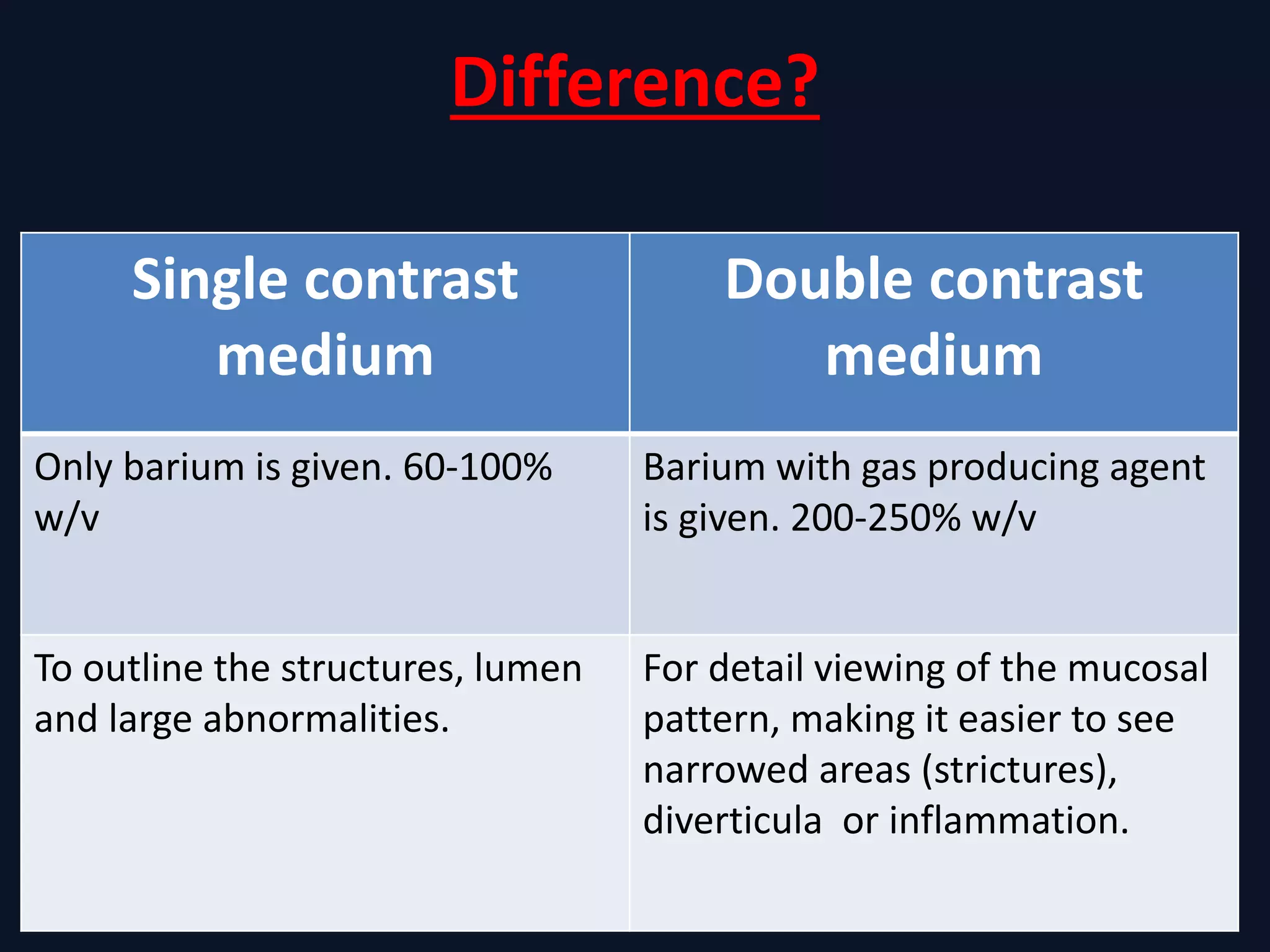
Difference?
Single contrast
medium
Double contrast
medium
Only barium is given. 60-100%
w/v
Barium with gas producing agent
is given. 200-250% w/v
To outline the structures, lumen
and large abnormalities.
For detail viewing of the mucosal
pattern, making it easier to see
narrowed areas (strictures),
diverticula or inflammation.
Cont…
GI-series:-
1. Barium swallow
2. Barium meal
3. Barium follow-through
4. Small bowel enema
5. Barium enema
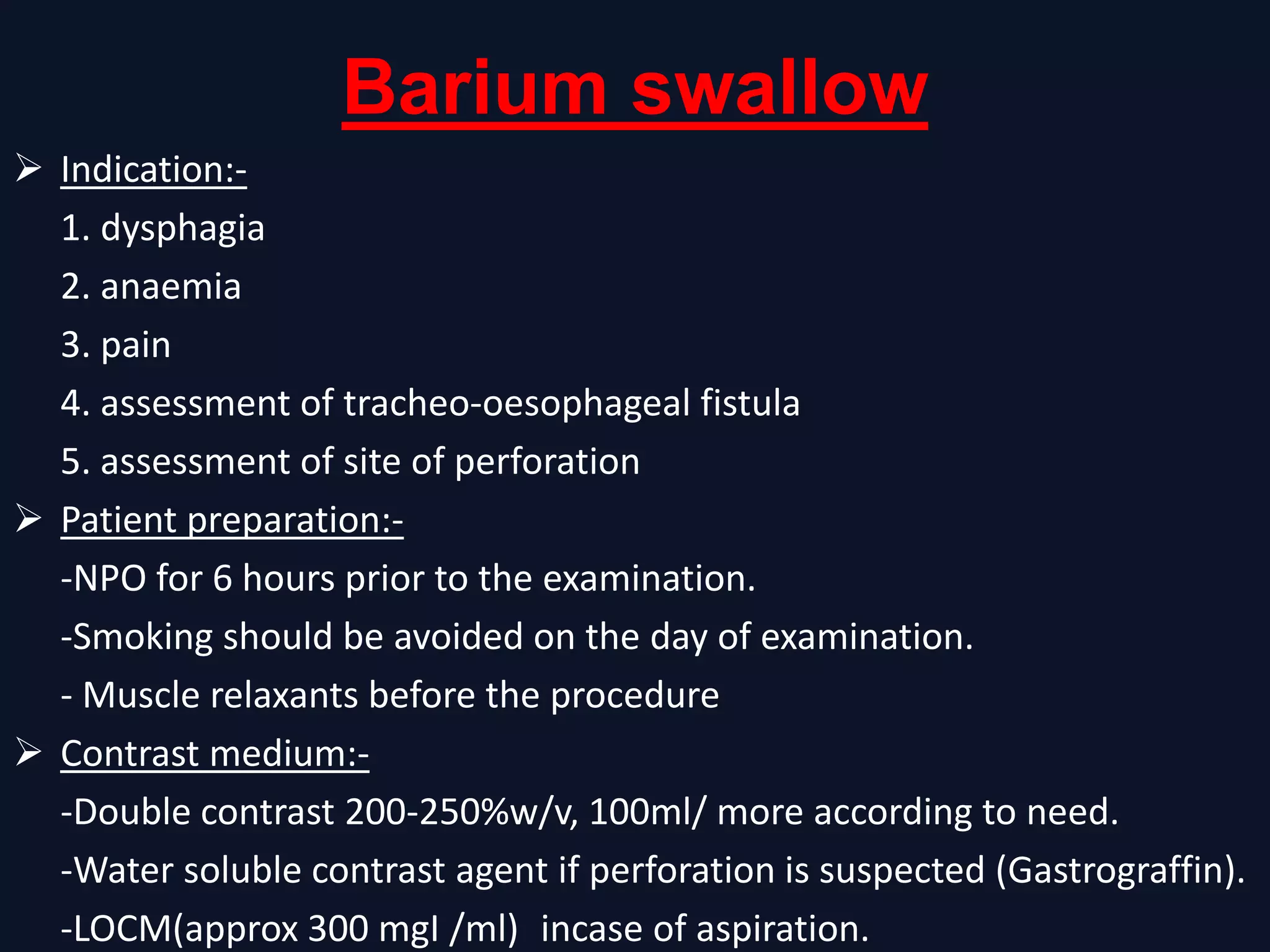
Barium swallow
 Indication:-
1. dysphagia
2. anaemia
3. pain
4. assessment of tracheo-oesophageal fistula
5. assessment of site of perforation
 Patient preparation:-
-NPO for 6 hours prior to the examination.
-Smoking should be avoided on the day of examination.
- Muscle relaxants before the procedure
 Contrast medium:-
-Double contrast 200-250%w/v, 100ml/ more according to need.
-Water soluble contrast agent if perforation is suspected (Gastrograffin).
-LOCM(approx 300 mgI /ml) incase of aspiration.
Technique:-
 AP or PA Projection:-
• Pt. supine or prone
• Center midsagittal plane to
cassette
• Bottom of cassette should be
placed just below tip of
xiphoid
• Pt. drinks contrast before
exposure and continues
drinking during exposure.
• Shield!
Cont..,
 RAO or LAO Positions:-
• To throw the esophagus clear
of the spine.
• Pt should be rotated 35 - 40
degrees
• Center about 2 inches lateral
to MSP
• Bottom of cassette below
xiphoid.
Cont…
 Lateral projection:-
• Place pt in lateral position.
• Center midcoronal plane to
cassette.
• Bottom of cassette below
xiphoid process.
• Pt must drink continuously
before and during exposure.
• Use shielding!
Cont…
Barium meal
 indication:-
-dyspepsia
-weight loss
-upper abdominal mass
-partial obstruction
-GI hemorrhage
 Contraindication:-
-complete large bowel obstruction
 Patient preparation;-
-Pt. should follow a low residue diet for 2 days prior to exam
-NPO for 6 hours prior to the examination.
 Contrast medium:-
-E-Z HD 250%w/v, 135ml
Technique:-
• A gas producing agent is
swallowed. The patient drinks
barium while lying on the left
side.
• The patient then lies supine &
slightly on the right side .
• Ask to roll onto the right side &
then quickly over in a complete
circle, to finish in an RAO
position.
Single vs double contrast:-
 Single contrast:-
• Shows size, shape, and
position of stomach.
• Examines changing
contour of stomach during
peristalsis.
• Observe filling and
emptying of duodenal
bulb.
 Double contrast:-
• Mucosal lining is well
visualized
• Small lesions are less
easily obscured
Compare Single and Double Contrast:-
Compare AP & PA projection:-
LATERAL PROJECTION:-
 Position:-
• Lateral recumbent - right side
 CR:-
• Level of L1-L2
• Between midcoronal and anterior
of abdomen
Film technique:-
• RAO: to demonstrate antrum & greater curve
• Supine: antrum & body
• LAO: lesser curve
• Left lateral tilted, head up: fundus
 From the left lateral position the patient returns to a supine position
& then rolls onto the left side & over into a prone position.
-Prone
-RAO
-Supine
-LAO
Barium follow-through:-
 Methods:-
-single contrast.
-with the addition of an effervescent agent.
-with the addition of a pneumocolon technique.
 Indication:-
-Diarrhoea
-Anaemia
-Partial obstruction
-Malabsorption
-Abdominal mass
 Contraindication:-
-Complete obstruction
-Suspected perforation
Cont…
 Contrast medium:-
-E-Z paque 100% w/v 300ml
 Patient preparation:-
-Low residue diet for 2 days prior when possible
-NPO after midnight before exam.
-Metoclopramide (maxolon) 20 mg orally may be given before or
during the examination.
Technique:-
 Prone PA film of the abdomen
are taken every 15-20min
during the first hour.
 And subsequently every 20-30
min until the colon is reached.
 Spot film of the terminal ileum
are taken in supine.
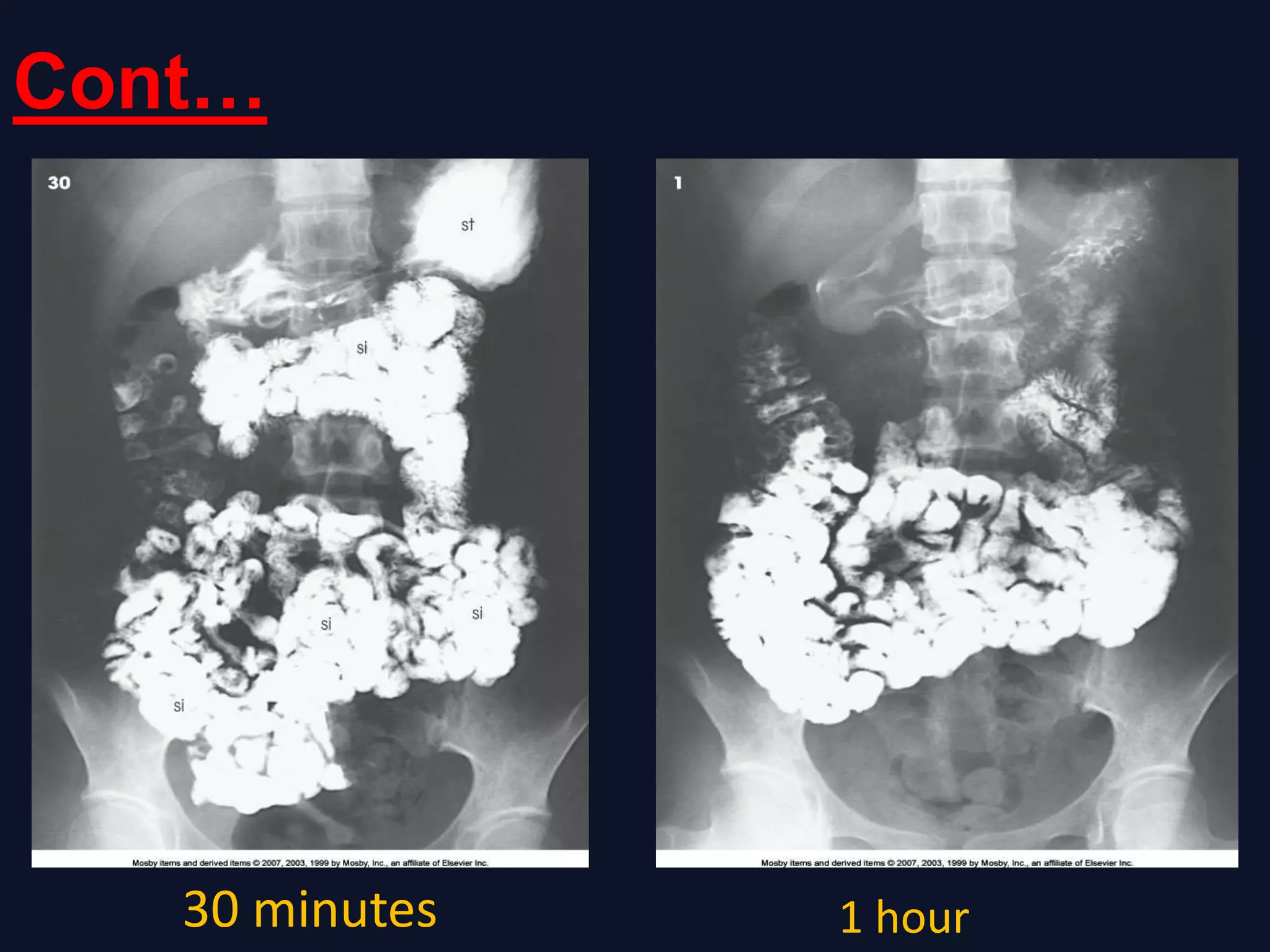
Film series:-
Immediate 15 minutes
Cont…
30 minutes 1 hour
Aftercare:-
The patient should be warned that his bowel
motion will be white for a few days after the
examination and may be difficult to flush away.
The patient should be advised to eat and drink
normally to avoid barium impaction. Laxative may
be taken if required.
The patient must not leave the department until
any blurring of vision produced by the Buscopan
has resolved.
Complications:-
• Leakage of barium from an unsuspected
perforation.
• Aspiration of stomach content due to the Buscopan.
• Conversion of partial obstruction into a complete
obstruction by the impaction of barium.
• Barium appendicitis, if barium impact in the
appendix.
Barium series

Barium series

  • 1.
  • 2.
    Definition:-  It isan x-ray examination of the esophagus, stomach, duodenum, small intestine & large intestine.  Diagnostic test - GI-series - CT-scan - MRI - Endoscopy - Endoscopic USG etc.
  • 3.
    Contrast examination:-  Bariumsulphate is the best CM for demonstrating the GI-tract. - Single CM is used to outline the structure. - Double CM is used for detail viewing of the mucosal pattern.  Water soluble CM is used in some cases such as perforation, small bowel obstruction, pediatric patient.
  • 4.
    Characteristic of barium:- High density with low viscosity.  Particles size 0.1 to 0.3 µm  pH = 5.3  Inert compound with no adverse reaction Route: Orally & Rectally Method: Single contrast & double contrast
  • 5.
    Difference? Single contrast medium Double contrast medium Onlybarium is given. 60-100% w/v Barium with gas producing agent is given. 200-250% w/v To outline the structures, lumen and large abnormalities. For detail viewing of the mucosal pattern, making it easier to see narrowed areas (strictures), diverticula or inflammation.
  • 6.
  • 7.
    GI-series:- 1. Barium swallow 2.Barium meal 3. Barium follow-through 4. Small bowel enema 5. Barium enema
  • 8.
    Barium swallow  Indication:- 1.dysphagia 2. anaemia 3. pain 4. assessment of tracheo-oesophageal fistula 5. assessment of site of perforation  Patient preparation:- -NPO for 6 hours prior to the examination. -Smoking should be avoided on the day of examination. - Muscle relaxants before the procedure  Contrast medium:- -Double contrast 200-250%w/v, 100ml/ more according to need. -Water soluble contrast agent if perforation is suspected (Gastrograffin). -LOCM(approx 300 mgI /ml) incase of aspiration.
  • 9.
    Technique:-  AP orPA Projection:- • Pt. supine or prone • Center midsagittal plane to cassette • Bottom of cassette should be placed just below tip of xiphoid • Pt. drinks contrast before exposure and continues drinking during exposure. • Shield!
  • 10.
    Cont..,  RAO orLAO Positions:- • To throw the esophagus clear of the spine. • Pt should be rotated 35 - 40 degrees • Center about 2 inches lateral to MSP • Bottom of cassette below xiphoid.
  • 11.
    Cont…  Lateral projection:- •Place pt in lateral position. • Center midcoronal plane to cassette. • Bottom of cassette below xiphoid process. • Pt must drink continuously before and during exposure. • Use shielding!
  • 12.
  • 13.
    Barium meal  indication:- -dyspepsia -weightloss -upper abdominal mass -partial obstruction -GI hemorrhage  Contraindication:- -complete large bowel obstruction  Patient preparation;- -Pt. should follow a low residue diet for 2 days prior to exam -NPO for 6 hours prior to the examination.  Contrast medium:- -E-Z HD 250%w/v, 135ml
  • 14.
    Technique:- • A gasproducing agent is swallowed. The patient drinks barium while lying on the left side. • The patient then lies supine & slightly on the right side . • Ask to roll onto the right side & then quickly over in a complete circle, to finish in an RAO position.
  • 15.
    Single vs doublecontrast:-  Single contrast:- • Shows size, shape, and position of stomach. • Examines changing contour of stomach during peristalsis. • Observe filling and emptying of duodenal bulb.  Double contrast:- • Mucosal lining is well visualized • Small lesions are less easily obscured
  • 16.
    Compare Single andDouble Contrast:-
  • 17.
    Compare AP &PA projection:-
  • 18.
    LATERAL PROJECTION:-  Position:- •Lateral recumbent - right side  CR:- • Level of L1-L2 • Between midcoronal and anterior of abdomen
  • 19.
    Film technique:- • RAO:to demonstrate antrum & greater curve • Supine: antrum & body • LAO: lesser curve • Left lateral tilted, head up: fundus  From the left lateral position the patient returns to a supine position & then rolls onto the left side & over into a prone position. -Prone -RAO -Supine -LAO
  • 20.
    Barium follow-through:-  Methods:- -singlecontrast. -with the addition of an effervescent agent. -with the addition of a pneumocolon technique.  Indication:- -Diarrhoea -Anaemia -Partial obstruction -Malabsorption -Abdominal mass  Contraindication:- -Complete obstruction -Suspected perforation
  • 21.
    Cont…  Contrast medium:- -E-Zpaque 100% w/v 300ml  Patient preparation:- -Low residue diet for 2 days prior when possible -NPO after midnight before exam. -Metoclopramide (maxolon) 20 mg orally may be given before or during the examination.
  • 22.
    Technique:-  Prone PAfilm of the abdomen are taken every 15-20min during the first hour.  And subsequently every 20-30 min until the colon is reached.  Spot film of the terminal ileum are taken in supine.
  • 23.
  • 24.
  • 25.
    Aftercare:- The patient shouldbe warned that his bowel motion will be white for a few days after the examination and may be difficult to flush away. The patient should be advised to eat and drink normally to avoid barium impaction. Laxative may be taken if required. The patient must not leave the department until any blurring of vision produced by the Buscopan has resolved.
  • 26.
    Complications:- • Leakage ofbarium from an unsuspected perforation. • Aspiration of stomach content due to the Buscopan. • Conversion of partial obstruction into a complete obstruction by the impaction of barium. • Barium appendicitis, if barium impact in the appendix.