VERT.X
M I C R O S E R V I C E S 	 W E R E 	 N E V E R 	 S O
E A S Y
	
CLEMENT	ESCOFFIER
Vert.x	Core	Developer,	Red	Hat
VERT.X
I N 	 1 0 	 S L I D E S . . .
V E R T. X 	I S 	 A 	 TO O L K I T 	T O 	 B U I L D
D I S T R I B U T E D 	 A N D 	 R E AC T I V E
A P P L I C A T I O N S 	 O N 	 T O P 	 O F 	 T H E 	 J V M
U S I N G 	 A N 	 A S Y N C H R O N O U S 	 N O N -
B L O C K I N G 	D E V E L O P M E N T 	 M O D E L .
TOOLKIT
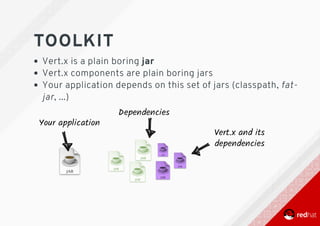
Vert.x	is	a	plain	boring	jar
Vert.x	components	are	plain	boring	jars
Your	application	depends	on	this	set	of	jars	(classpath,	fat-
jar,	...)
TOOLKIT
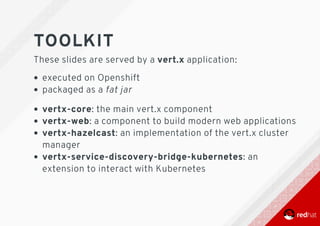
These	slides	are	served	by	a	vert.x	application:
executed	on	Openshift
packaged	as	a	fat	jar
vertx-core:	the	main	vert.x	component
vertx-web:	a	component	to	build	modern	web	applications
vertx-hazelcast:	an	implementation	of	the	vert.x	cluster
manager
vertx-service-discovery-bridge-kubernetes:	an
extension	to	interact	with	Kubernetes
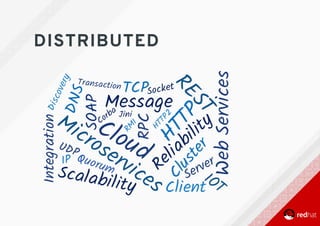
DISTRIBUTED
DISTRIBUTED
“ 	You	know	you	have	a	distributed	system	when	the	crash
of	a	computer	you've	never	heards	of	stops	you	from	getting
any	work	done.	(Leslie	Lamport)
REACTIVE
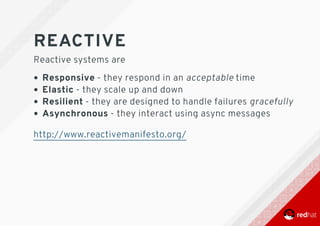
Reactive	systems	are
Responsive	-	they	respond	in	an	acceptable	time
Elastic	-	they	scale	up	and	down
Resilient	-	they	are	designed	to	handle	failures	gracefully
Asynchronous	-	they	interact	using	async	messages 	
http://www.reactivemanifesto.org/
REACTIVE
“ 	"Moore's	law"	is	the	observation	that,	over	the	history	of
computing	hardware,	the	number	of	transistors	in	a	dense
integrated	circuit	has	doubled	approximately	every	2	years.
Unfortunately,	no	free	lunch	anymore...
REACTIVE
CPU	manufacturers	cannot	get	a	single-core	CPU	to	go	any
faster
Multi-core	Processors
Require	parallel	execution
Require	a	different	way	to	design,	develop	and	execute
software
Reactive	systems	is	one	solution	to	this	issue
POLYGLOT
Vert.x	applications	can	be	developed	using
Java
Groovy
Ruby	(JRuby)
JavaScript	(Nashorn)
Ceylon
MICROSERVICES
R E B R A N D I N G
D I S T R I B U T E D
A P P L I C A T I O N S
MICROSERVICES
“ 	The	microservice	architectural	style	is	an	approach	to
developing	a	single	application	as	a	suite	of	small	services,
each	running	in	its	own	process	and	communicating	with
lightweight	mechanisms,	often	an	HTTP	resource	API.
These	services	are	built	around	business	capabilities	and
independently	deployable	by	fully	automated	deployment
machinery.	There	is	a	bare	minimum	of	centralized
management	of	these	services,	which	may	be	written	in
different	programming	languages	and	use	different	data
storage	technologies.	(Martin	Fowler)
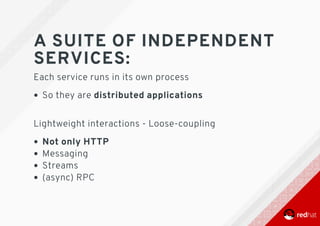
A	SUITE	OF	INDEPENDENT
SERVICES:
Each	service	runs	in	its	own	process
So	they	are	distributed	applications 	
Lightweight	interactions	-	Loose-coupling
Not	only	HTTP
Messaging
Streams
(async)	RPC
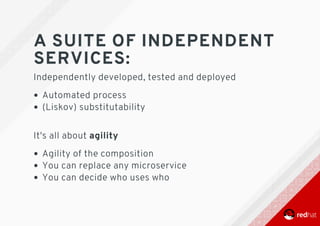
A	SUITE	OF	INDEPENDENT
SERVICES:
Independently	developed,	tested	and	deployed
Automated	process
(Liskov)	substitutability 	
It's	all	about	agility
Agility	of	the	composition
You	can	replace	any	microservice
You	can	decide	who	uses	who
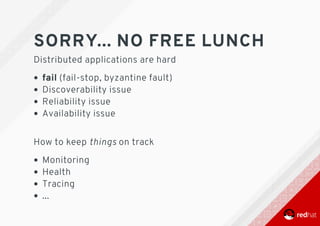
SORRY...	NO	FREE	LUNCH
Distributed	applications	are	hard
fail	(fail-stop,	byzantine	fault)
Discoverability	issue
Reliability	issue
Availability	issue 	
How	to	keep	things	on	track
Monitoring
Health
Tracing
...
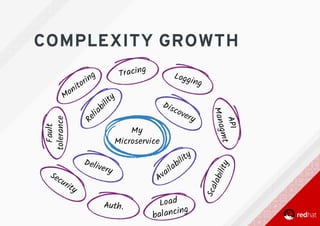
COMPLEXITY	GROWTH
VERT.X	&	MICROSERVICES
We	wont'	build	regular	microservices,	but	reactive
microservices
Responsive	-	fast,	is	able	to	handle	a	large	number	of
events	/	connections
Elastic	-	scale	up	and	down	by	just	starting	and	stopping
nodes,	round-robin
Resilient	-	failure	as	first-class	citizen,	fail-over
Asynchronous	message-passing	-	asynchronous	and	non-
blocking	development	model
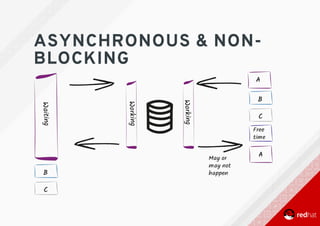
ASYNCHRONOUS	&	NON-
BLOCKING
WHAT	DOES	VERT.X
PROVIDE	TO	BUILD
MICROSERVICES?
TCP,	UDP,	HTTP	1	&	2	servers	and	clients
(non-blocking)	DNS	client
Event	bus	(messaging)
Distributed	data	structures
Load-balancing
Fail-over
Service	discovery
Failure	management,	Circuit-breaker
Shell,	Metrics,	Deployment	support
HTTP	&	REST
B E C A U S E 	 I T 	 A L W A Y S
B E G I N 	 W I T H 	 A 	 R E S T
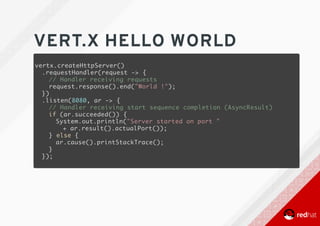
VERT.X	HELLO	WORLD
vertx.createHttpServer()
.requestHandler(request -> {
// Handler receiving requests
request.response().end("World !");
})
.listen(8080, ar -> {
// Handler receiving start sequence completion (AsyncResult)
if (ar.succeeded()) {
System.out.println("Server started on port "
+ ar.result().actualPort());
} else {
ar.cause().printStackTrace();
}
});
VERT.X	HELLO	WORLD
Invoke
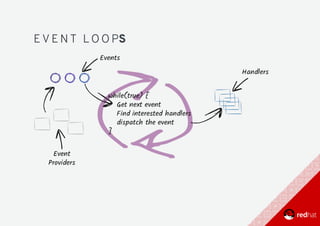
E V E N T 	 L O O PS
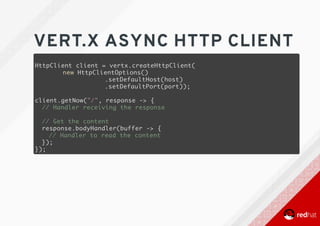
VERT.X	ASYNC	HTTP	CLIENT
HttpClient client = vertx.createHttpClient(
new HttpClientOptions()
.setDefaultHost(host)
.setDefaultPort(port));
client.getNow("/", response -> {
// Handler receiving the response
// Get the content
response.bodyHandler(buffer -> {
// Handler to read the content
});
});
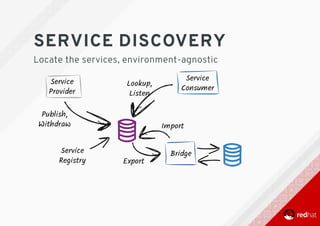
SERVICE	DISCOVERY
Locate	the	services,	environment-agnostic
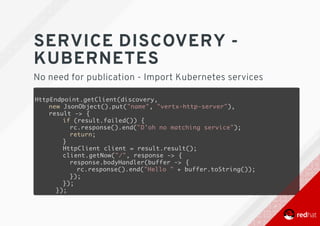
SERVICE	DISCOVERY	-
KUBERNETES
No	need	for	publication	-	Import	Kubernetes	services
HttpEndpoint.getClient(discovery,
new JsonObject().put("name", "vertx-http-server"),
result -> {
if (result.failed()) {
rc.response().end("D'oh no matching service");
return;
}
HttpClient client = result.result();
client.getNow("/", response -> {
response.bodyHandler(buffer -> {
rc.response().end("Hello " + buffer.toString());
});
});
});
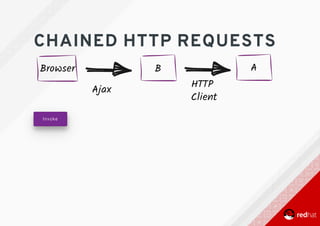
CHAINED	HTTP	REQUESTS
Invoke
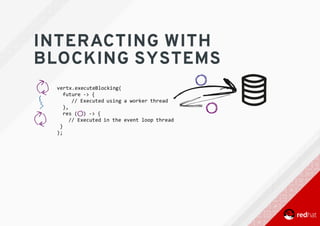
INTERACTING	WITH
BLOCKING	SYSTEMS
MESSAGING	WITH
THE	EVENT	BUS
T H E 	 S P I N E 	 O F 	 V E R T . X
A P P L I C A T I O N S
THE	EVENT	BUS
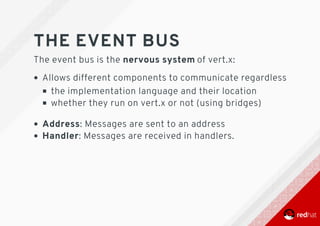
The	event	bus	is	the	nervous	system	of	vert.x:
Allows	different	components	to	communicate	regardless
the	implementation	language	and	their	location
whether	they	run	on	vert.x	or	not	(using	bridges)
Address:	Messages	are	sent	to	an	address
Handler:	Messages	are	received	in	handlers.
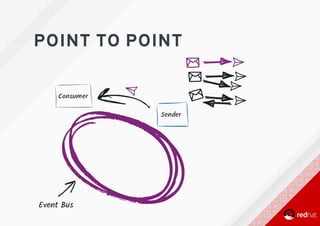
POINT	TO	POINT
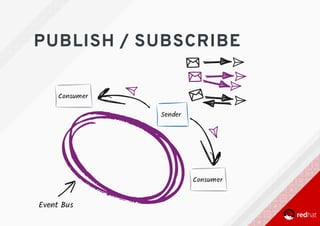
PUBLISH	/	SUBSCRIBE
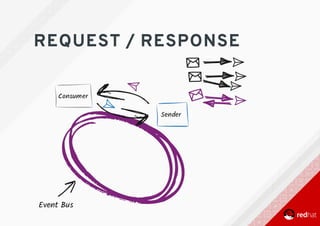
REQUEST	/	RESPONSE
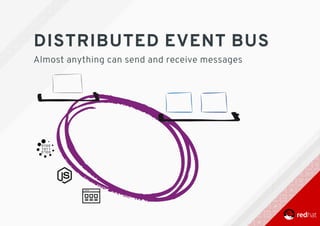
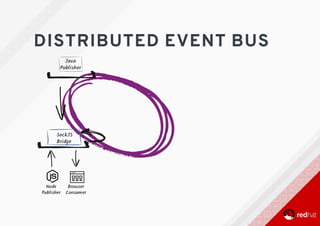
DISTRIBUTED	EVENT	BUS
Almost	anything	can	send	and	receive	messages
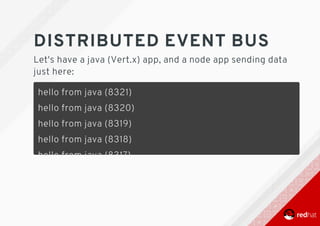
DISTRIBUTED	EVENT	BUS
Let's	have	a	java	(Vert.x)	app,	and	a	node	app	sending	data
just	here:
hello	from	java	(8321)
hello	from	java	(8320)
hello	from	java	(8319)
hello	from	java	(8318)
hello	from	java	(8317)
hello	from	java	(8316)
hello	from	java	(8315)
hello	from	java	(8314)
hello	from	java	(8313)
DISTRIBUTED	EVENT	BUS
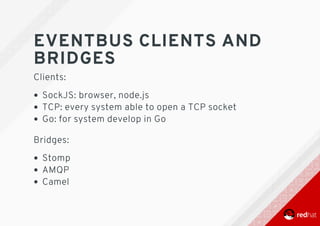
EVENTBUS	CLIENTS	AND
BRIDGES
Clients:
SockJS:	browser,	node.js
TCP:	every	system	able	to	open	a	TCP	socket
Go:	for	system	develop	in	Go 	
Bridges:
Stomp
AMQP
Camel
RELIABILITY
PATTERNS
D O N ' T 	 B E 	 F O O L , 	 B E
P R E P A R E D 	 T O 	 FA I L
RELIABILITY
It's	not	about	being	bug-free	or	bullet	proof,
it's	impossible.
It's	about	being	prepared	to	fail,
and	handling	these	failures.
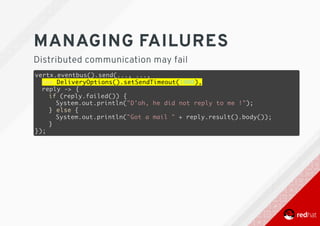
MANAGING	FAILURES
Distributed	communication	may	fail
vertx.eventbus().send(..., ...,
new DeliveryOptions().setSendTimeout(1000),
reply -> {
if (reply.failed()) {
System.out.println("D'oh, he did not reply to me !");
} else {
System.out.println("Got a mail " + reply.result().body());
}
});
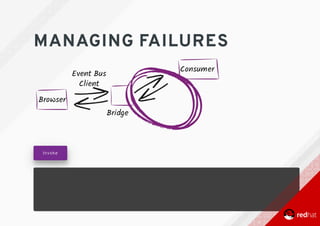
MANAGING	FAILURES
	
Invoke
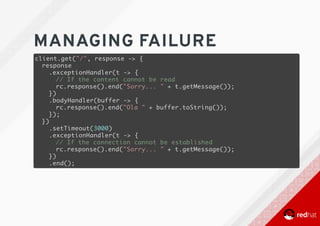
MANAGING	FAILURE
client.get("/", response -> {
response
.exceptionHandler(t -> {
// If the content cannot be read
rc.response().end("Sorry... " + t.getMessage());
})
.bodyHandler(buffer -> {
rc.response().end("Ola " + buffer.toString());
});
})
.setTimeout(3000)
.exceptionHandler(t -> {
// If the connection cannot be established
rc.response().end("Sorry... " + t.getMessage());
})
.end();
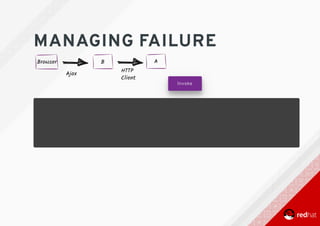
MANAGING	FAILURE
	 Invoke
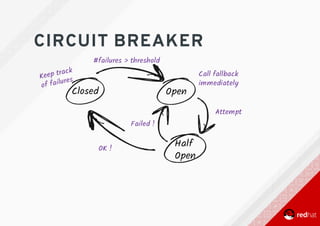
CIRCUIT	BREAKER
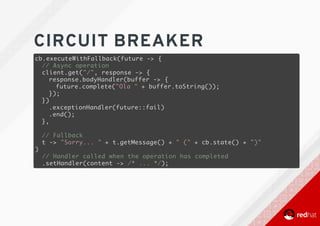
CIRCUIT	BREAKER
cb.executeWithFallback(future -> {
// Async operation
client.get("/", response -> {
response.bodyHandler(buffer -> {
future.complete("Ola " + buffer.toString());
});
})
.exceptionHandler(future::fail)
.end();
},
// Fallback
t -> "Sorry... " + t.getMessage() + " (" + cb.state() + ")"
)
// Handler called when the operation has completed
.setHandler(content -> /* ... */);
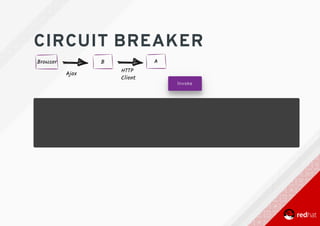
CIRCUIT	BREAKER
	 Invoke
SCALABILITY
PATTERNS
B E 	 P R E P A R E D 	 T O 	 B E
F A M O U S
BALANCING	THE	LOAD
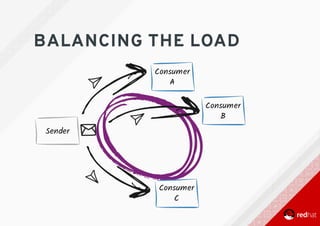
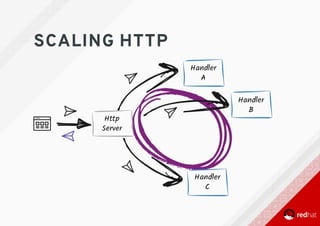
When	several	consumers	listen	to	the	same	address,	Vert.x
dispatches	the	sent	messages	using	a	round	robin.
So,	to	improve	the	scalability,	just	spawn	a	new	node!
BALANCING	THE	LOAD
BALANCING	THE	LOAD
Invoke
SCALING	HTTP
THIS	IS	NOT	THE
END()
BUT	THE	FIRST	STEP	ON	THE	REACTIVE
MICROSERVICE	ROAD
HOW	TO	START	?
http://vertx.io
http://vertx.io/blog/posts/introduction-to-vertx.html
http://vertx-lab.dynamis-technologies.com
https://github.com/vert-x3/vertx-examples
Red	HatNews
youtube.com/Red	Hat
facebook.com/redhatinc
THANK	YOU!
linkedin.com/company/red-hat

Vert.X: Microservices Were Never So Easy (Clement Escoffier)