John Archer
Principal Solution Architect, Cloud Platform
archer@redhat.com
Red Hat Java Update
1
MEET THE SPEAKER
John Archer
Principal Energy Solution Architect, Cloud Platform
Red Hat since 2015
Oracle, Petris, BEA Systems, SilverStream, BSI Consulting, DocuQuest, Andrews & Kurth LLP
Upstream Data Management, DoD, APIs, eCommerce, Mobile, IoT, Data Science and Blockchain
Open Group OSDU, Energistics, SPE, SEG, PPDM, OMG, HJUG (Founder), HDUG, HAL-PC
3
4
History of HJUG - 22 years later
5
AGENDA
6
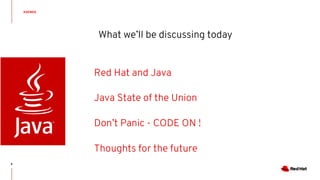
Red Hat and Java
Java State of the Union
Don’t Panic - CODE ON !
Thoughts for the future
What we’ll be discussing today
7
RED HAT AND JAVA
● 2006 -Acquired JBoss
● 2007 - Founding member of OpenJDK
● 2008 - OpenJDK supported in RHEL XX
● 2009 - Oracle acquires Sun Microsystems
● 2012 - Acquired FuseSource
● 2013 - Assumed leadership of OpenJDK 6
● 2016 - Founding member of Eclipse MicroProfile
● 2018 - Founding member of Eclipse Jakarta EE
8
9
RED HAT AND JAVA
● Project lead for OpenJDK 6 (now EOL)
● Project lead for OpenJDK 8 and OpenJDK 11
● Member of OpenJDK Vulnerability Group Governing Board
● Pioneered Java and Kubernetes (OpenShift)
● Wrote and lead the 64-bit ARMv8 port
● Wrote and lead the ultra low-pausetime Shenandoah garbage
collector project
● Lead and collaborate on many popular Java projects -
ActiveMQ, Eclipse CHE, Eclipse IDE, Hibernate, Camel, Drools,
WildFly, SmallRye, Strimzi...
● Established Quarkus project (more on this later)
10
JAVA STATE OF THE UNION
● Still a de-facto language for enterprise developers*
● Large skills base (7-10 million Java devs.)**
● Large and Increasingly diverse ecosystem
○ Amazon, Fujitsu, Google, IBM, Microsoft, Netflix,
Oracle, Pivotal, Red Hat, ...
Sources:
*Tiobe Index : https://www.tiobe.com/tiobe-index/
* IEEE Spectrum : https://spectrum.ieee.org/static/interactive-the-top-programming-languages-2018
I** SlashData - 7.6 million active Java developers (State of Developer Nation, 16th Edition, Q4 2018)
11
JAVA STATE OF THE UNION
● OpenJDK - release model changes
● Oracle JDK - business model changes
● MicroProfile created to support cloud native Java
● Java EE moved to Eclipse Jakarta EE
● Oracle Trademark impasse
Major changes to Java SE & EE
12
DON’T PANIC
● Large, resilient community
● Many tried and trusted technologies
● Not dependent on a single vendor
● The innovation continues
● New leaders emerging
○ OpenJDK Supporters
○ Eclipse MicroProfile ecosystem
○ Cloud providers
13
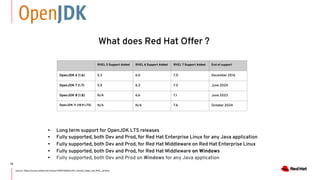
What does Red Hat Offer ?
Sources : https://access.redhat.com/articles/1299013#OpenJDK_Lifecycle_Dates_and_RHEL_versions
• Long term support for OpenJDK LTS releases
• Fully supported, both Dev and Prod, for Red Hat Enterprise Linux for any Java application
• Fully supported, both Dev and Prod, for Red Hat Middleware on Red Hat Enterprise Linux
• Fully supported, both Dev and Prod, for Red Hat Middleware on Windows
• Fully supported, both Dev and Prod on Windows for any Java application
RHEL 5 Support Added RHEL 6 Support Added RHEL 7 Support Added End of support
OpenJDK 6 (1.6) 5.3 6.0 7.0 December 2016
OpenJDK 7 (1.7) 5.9 6.3 7.0 June 2020
OpenJDK 8 (1.8) N/A 6.6 7.1 June 2023
OpenJDK 11 (18.9 LTS) N/A N/A 7.6 October 2024
Thoughts on the Future
14
Growth in Application Architecture Choices
THOUGHTS FOR THE FUTURE
Cloud Native Microservices Serverless
Event-Driven
Architecture
Monolith
AMQ Streams
Thoughts for the Future
16
AMQ Streams
• Enterprise distribution of Apache
Kafka
• Simplified deployment on OpenShift
• Based on OSS project called Strimzi
• Provides:
• Container images for running Apache
Kafka and Zookeeper
• Operators for managing and configuring
Apache Kafka clusters and topics
THOUGHTS FOR THE FUTURE
17
● Responsive: fast, is able to handle a large
number of events / connections
● Elastic: scale up and down by juststarting
and stopping nodes, round-robin
● Resilient: failure as first-class citizen, self-
healing
● Asynchronous message-passing: asynchronous
non-blocking development model
Vert.x is a toolkit to build distributed and
reactive applications on top of the JVM using an
asynchronous non-blocking development model.
Vert.x Reactive Toolkit for Writing Microservices
Eclipse MicroProfile
THOUGHTS FOR THE FUTURE
18
● Open Source community specifications for
Enterprise Java microservices
● 9 releases in 3 years
● 5 specifications in the pipeline
ImplementationsCommunity
Common Deployment Platform
THOUGHTS FOR THE FUTURE
19
Cloud Native Microservices Serverless
Event-Driven
Architecture
Monolith
Istio Knative
The Hidden Truth About Java + Containers
THOUGHTS FOR THE FUTURE
20
Container platform
Node
NodeJS
NodeJS
NodeJS
NodeJS
NodeJS
NodeJS
NodeJS
Node
Go Go
Go Go
Go Go
Go Go
Go Go
Go Go
Go Go
Node
HotSpot Heap
HotSpot Heap
HotSpot Heap
HotSpot Heap
Historical Enterprise Java Stack
Thoughts for the Future
21
Operating System + Hardware/VM
Java Virtual Machine (Hotspot)
Application Server
App App App App App
Dynamic Application Frameworks
Architecture: Monoliths
Deployment: multi-app,
appserver
App Lifecycle: Months
Memory: 1GB+ RAM
Startup Time: 10s of sec
Modern Enterprise Java Stack
Thoughts for the Future
22
Java Virtual Machine (Hotspot)
Application Server
App
Dynamic Application Frameworks
Architecture: Microservices
Deployment: Single App
App Lifecycle: Days
Memory: 100MBs+ RAM
Startup Time: Seconds
No Change
Java Serverless Stack
Thoughts for the Future
23
Java Virtual Machine (Hotspot)
Application Server
App
Dynamic Application Frameworks
Architecture: Microservices
Deployment: Single App
App Lifecycle: Days
Memory: 100MBs+ RAM
Startup Time: Seconds
No Change
THOUGHTS FOR THE FUTURE
24
Monolith
Quarkus - Kubernetes Native Java
Cloud Native Microservices Serverless
Event-Driven
Architecture
Istio Knative
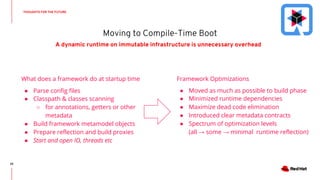
Moving to Compile-Time Boot
THOUGHTS FOR THE FUTURE
25
What does a framework do at startup time
● Parse config files
● Classpath & classes scanning
○ for annotations, getters or other
metadata
● Build framework metamodel objects
● Prepare reflection and build proxies
● Start and open IO, threads etc
● Moved as much as possible to build phase
● Minimized runtime dependencies
● Maximize dead code elimination
● Introduced clear metadata contracts
● Spectrum of optimization levels
(all → some → minimal runtime reflection)
Framework Optimizations
A dynamic runtime on immutable infrastructure is unnecessary overhead
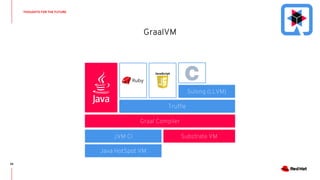
GraalVM
THOUGHTS FOR THE FUTURE
26
JVM CI
Sulong (LLVM)
Truffle
Graal Compiler
Substrate VM
Java HotSpot VM
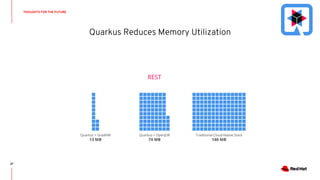
Quarkus Reduces Memory Utilization
THOUGHTS FOR THE FUTURE
27
Quarkus + GraalVM
13 MB
Quarkus + OpenJDK
74 MB
Traditional Cloud-Native Stack
140 MB
REST
Quarkus Reduces Memory Utilization
THOUGHTS FOR THE FUTURE
28
REST + CRUD
Quarkus + GraalVM
35 MB
Quarkus + OpenJDK
130 MB
Traditional Cloud-Native Stack
218 MB
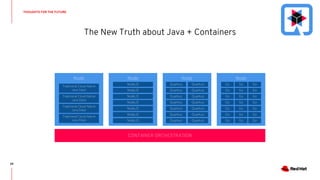
The New Truth about Java + Containers
THOUGHTS FOR THE FUTURE
29
CONTAINER ORCHESTRATION
NodeNode
Traditional Cloud-Native
Java Stack
Traditional Cloud-Native
Java Stack
Traditional Cloud-Native
Java Stack
Traditional Cloud-Native
Java Stack
Node
NodeJS
NodeJS
NodeJS
NodeJS
NodeJS
NodeJS
NodeJS
Go Go Go
Go Go Go
Go Go Go
Go Go Go
Go Go Go
Go Go Go
Go Go Go
Node
Quarkus
Quarkus
Quarkus
Quarkus
Quarkus
Quarkus
Quarkus
Quarkus
Quarkus
Quarkus
Quarkus
Quarkus
Quarkus
Quarkus
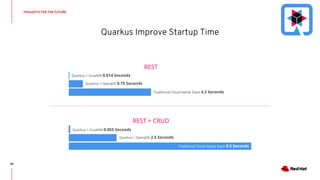
Quarkus Improve Startup Time
THOUGHTS FOR THE FUTURE
30
Quarkus + GraalVM 0.014 Seconds
REST
REST + CRUD
Quarkus + OpenJDK 0.75 Seconds
Quarkus + GraalVM 0.055 Seconds
Quarkus + OpenJDK 2.5 Seconds
Traditional Cloud-Native Stack 9.5 Seconds
Traditional Cloud-Native Stack 4.3 Seconds
Quarkus
Thoughts for the Future
31
App
Optimized Application Frameworks
Architecture: Microservices,
Serverless
Deployment: Single App
App Lifecycle: Seconds to
Days
Memory: 10MBs+ RAM
Startup Time: Milliseconds
Java Virtual Machine (Hotspot)
Optional
Developer Joy
THOUGHTS FOR THE FUTURE
32
A cohesive platform for optimized developer joy:
● Based on standards, but not limited
● Unified configuration
● Zero config, live reload in the blink of an eye
● Streamlined code for the 80% common usages,
flexible for the 20%
● No hassle native executable generation
Unifies Imperative and Reactive
THOUGHTS FOR THE FUTURE
33
● Combine both Reactive and imperative development in the same
application
● Inject the EventBus or the Vertx context
● Use the technology that fits your use-case
@Inject
SayService say;
@GET
@Produces(MediaType.TEXT_PLAIN)
public String hello() {
return say.hello();
}
@Inject @Stream(”kafka”)
Publisher<String> reactiveSay;
@GET
@Produces(MediaType.SERVER_SENT_EVENTS)
public Publisher<String> stream() {
return reactiveSay;
}
Best of Breed Frameworks and Standards
THOUGHTS FOR THE FUTURE
34
Eclipse Vert.x Hibernate RESTEasy Apache Camel Eclipse MicroProfile Netty
Kubernetes OpenShift Jaeger Prometheus Apache Kafka Infinispan
“Feels familiar and new at the same time”
Thoughts for the Future
35
QUESTIONS ?
36
CONFIDENTIAL DesignatorRED HAT AND JAVA - FURTHER READING
37
HISTORY AND FUTURE OF OPENJDK
https://www.redhat.com/en/blog/history-and-future-openjdk?source=author&term=28071
JAKARTA EE IS OFFICIALLY OUT
https://developers.redhat.com/blog/2018/04/24/jakarta-ee-is-officially-out/
QUARKUS - WHY COMPILE TO NATIVE
https://developers.redhat.com/blog/2019/03/29/quarkus-why-compile-to-native/
OPENJDK 8 AND 11: STILL IN SAFE HANDS
https://developers.redhat.com/blog/2019/05/22/openjdk-8-and-11-still-in-safe-hands/
MICROPROFILE – COLLABORATING TO BRING MICROSERVICES TO
ENTERPRISE JAVA
https://middlewareblog.redhat.com/2016/06/27/microprofile-collaborating-to-bring-microservices-to-enterprise-java/
CONFIDENTIAL Designator
linkedin.com/company/red-hat
youtube.com/user/RedHatVideos
facebook.com/redhatinc
twitter.com/RedHat
Red Hat is the world’s leading provider of enterprise
open source software solutions. Award-winning
support, training, and consulting services make
Red Hat a trusted adviser to the Fortune 500.
Thank you
38
BACKUP SLIDES
39
40
JDK version adoption lags releases
Version
Release Date
JDK Beta 1995
JDK 1.0
January 1996
JDK 1.1
February 1997
J2SE 1.2 December 1998
J2SE 1.3 May 2000
J2SE 1.4 February 2002
J2SE 5.0 September 2004
Java SE 6 December 2006
Java SE 7 July 2011
Java SE 8 March 2014
Java SE 9 September 2017
Java SE 10 March 2018
Java SE 11 September 2018
Source: Java Magazine Oct. 2018 - JVM Ecosystem Report 2018
41
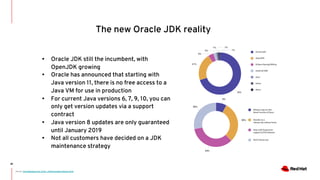
The new Oracle JDK reality
• Oracle JDK still the incumbent, with
OpenJDK growing
• Oracle has announced that starting with
Java version 11, there is no free access to a
Java VM for use in production
• For current Java versions 6, 7, 9, 10, you can
only get version updates via a support
contract
• Java version 8 updates are only guaranteed
until January 2019
• Not all customers have decided on a JDK
maintenance strategy
Source: Java Magazine Oct. 2018 - JVM Ecosystem Report 2018

Red Hat Java Update and Quarkus Introduction

  • 1.
    John Archer Principal SolutionArchitect, Cloud Platform archer@redhat.com Red Hat Java Update 1
  • 2.
    MEET THE SPEAKER JohnArcher Principal Energy Solution Architect, Cloud Platform Red Hat since 2015 Oracle, Petris, BEA Systems, SilverStream, BSI Consulting, DocuQuest, Andrews & Kurth LLP Upstream Data Management, DoD, APIs, eCommerce, Mobile, IoT, Data Science and Blockchain Open Group OSDU, Energistics, SPE, SEG, PPDM, OMG, HJUG (Founder), HDUG, HAL-PC
  • 3.
  • 4.
  • 5.
    History of HJUG- 22 years later 5
  • 6.
    AGENDA 6 Red Hat andJava Java State of the Union Don’t Panic - CODE ON ! Thoughts for the future What we’ll be discussing today
  • 7.
    7 RED HAT ANDJAVA ● 2006 -Acquired JBoss ● 2007 - Founding member of OpenJDK ● 2008 - OpenJDK supported in RHEL XX ● 2009 - Oracle acquires Sun Microsystems ● 2012 - Acquired FuseSource ● 2013 - Assumed leadership of OpenJDK 6 ● 2016 - Founding member of Eclipse MicroProfile ● 2018 - Founding member of Eclipse Jakarta EE
  • 8.
  • 9.
    9 RED HAT ANDJAVA ● Project lead for OpenJDK 6 (now EOL) ● Project lead for OpenJDK 8 and OpenJDK 11 ● Member of OpenJDK Vulnerability Group Governing Board ● Pioneered Java and Kubernetes (OpenShift) ● Wrote and lead the 64-bit ARMv8 port ● Wrote and lead the ultra low-pausetime Shenandoah garbage collector project ● Lead and collaborate on many popular Java projects - ActiveMQ, Eclipse CHE, Eclipse IDE, Hibernate, Camel, Drools, WildFly, SmallRye, Strimzi... ● Established Quarkus project (more on this later)
  • 10.
    10 JAVA STATE OFTHE UNION ● Still a de-facto language for enterprise developers* ● Large skills base (7-10 million Java devs.)** ● Large and Increasingly diverse ecosystem ○ Amazon, Fujitsu, Google, IBM, Microsoft, Netflix, Oracle, Pivotal, Red Hat, ... Sources: *Tiobe Index : https://www.tiobe.com/tiobe-index/ * IEEE Spectrum : https://spectrum.ieee.org/static/interactive-the-top-programming-languages-2018 I** SlashData - 7.6 million active Java developers (State of Developer Nation, 16th Edition, Q4 2018)
  • 11.
    11 JAVA STATE OFTHE UNION ● OpenJDK - release model changes ● Oracle JDK - business model changes ● MicroProfile created to support cloud native Java ● Java EE moved to Eclipse Jakarta EE ● Oracle Trademark impasse Major changes to Java SE & EE
  • 12.
    12 DON’T PANIC ● Large,resilient community ● Many tried and trusted technologies ● Not dependent on a single vendor ● The innovation continues ● New leaders emerging ○ OpenJDK Supporters ○ Eclipse MicroProfile ecosystem ○ Cloud providers
  • 13.
    13 What does RedHat Offer ? Sources : https://access.redhat.com/articles/1299013#OpenJDK_Lifecycle_Dates_and_RHEL_versions • Long term support for OpenJDK LTS releases • Fully supported, both Dev and Prod, for Red Hat Enterprise Linux for any Java application • Fully supported, both Dev and Prod, for Red Hat Middleware on Red Hat Enterprise Linux • Fully supported, both Dev and Prod, for Red Hat Middleware on Windows • Fully supported, both Dev and Prod on Windows for any Java application RHEL 5 Support Added RHEL 6 Support Added RHEL 7 Support Added End of support OpenJDK 6 (1.6) 5.3 6.0 7.0 December 2016 OpenJDK 7 (1.7) 5.9 6.3 7.0 June 2020 OpenJDK 8 (1.8) N/A 6.6 7.1 June 2023 OpenJDK 11 (18.9 LTS) N/A N/A 7.6 October 2024
  • 14.
    Thoughts on theFuture 14
  • 15.
    Growth in ApplicationArchitecture Choices THOUGHTS FOR THE FUTURE Cloud Native Microservices Serverless Event-Driven Architecture Monolith
  • 16.
    AMQ Streams Thoughts forthe Future 16 AMQ Streams • Enterprise distribution of Apache Kafka • Simplified deployment on OpenShift • Based on OSS project called Strimzi • Provides: • Container images for running Apache Kafka and Zookeeper • Operators for managing and configuring Apache Kafka clusters and topics
  • 17.
    THOUGHTS FOR THEFUTURE 17 ● Responsive: fast, is able to handle a large number of events / connections ● Elastic: scale up and down by juststarting and stopping nodes, round-robin ● Resilient: failure as first-class citizen, self- healing ● Asynchronous message-passing: asynchronous non-blocking development model Vert.x is a toolkit to build distributed and reactive applications on top of the JVM using an asynchronous non-blocking development model. Vert.x Reactive Toolkit for Writing Microservices
  • 18.
    Eclipse MicroProfile THOUGHTS FORTHE FUTURE 18 ● Open Source community specifications for Enterprise Java microservices ● 9 releases in 3 years ● 5 specifications in the pipeline ImplementationsCommunity
  • 19.
    Common Deployment Platform THOUGHTSFOR THE FUTURE 19 Cloud Native Microservices Serverless Event-Driven Architecture Monolith Istio Knative
  • 20.
    The Hidden TruthAbout Java + Containers THOUGHTS FOR THE FUTURE 20 Container platform Node NodeJS NodeJS NodeJS NodeJS NodeJS NodeJS NodeJS Node Go Go Go Go Go Go Go Go Go Go Go Go Go Go Node HotSpot Heap HotSpot Heap HotSpot Heap HotSpot Heap
  • 21.
    Historical Enterprise JavaStack Thoughts for the Future 21 Operating System + Hardware/VM Java Virtual Machine (Hotspot) Application Server App App App App App Dynamic Application Frameworks Architecture: Monoliths Deployment: multi-app, appserver App Lifecycle: Months Memory: 1GB+ RAM Startup Time: 10s of sec
  • 22.
    Modern Enterprise JavaStack Thoughts for the Future 22 Java Virtual Machine (Hotspot) Application Server App Dynamic Application Frameworks Architecture: Microservices Deployment: Single App App Lifecycle: Days Memory: 100MBs+ RAM Startup Time: Seconds No Change
  • 23.
    Java Serverless Stack Thoughtsfor the Future 23 Java Virtual Machine (Hotspot) Application Server App Dynamic Application Frameworks Architecture: Microservices Deployment: Single App App Lifecycle: Days Memory: 100MBs+ RAM Startup Time: Seconds No Change
  • 24.
    THOUGHTS FOR THEFUTURE 24 Monolith Quarkus - Kubernetes Native Java Cloud Native Microservices Serverless Event-Driven Architecture Istio Knative
  • 25.
    Moving to Compile-TimeBoot THOUGHTS FOR THE FUTURE 25 What does a framework do at startup time ● Parse config files ● Classpath & classes scanning ○ for annotations, getters or other metadata ● Build framework metamodel objects ● Prepare reflection and build proxies ● Start and open IO, threads etc ● Moved as much as possible to build phase ● Minimized runtime dependencies ● Maximize dead code elimination ● Introduced clear metadata contracts ● Spectrum of optimization levels (all → some → minimal runtime reflection) Framework Optimizations A dynamic runtime on immutable infrastructure is unnecessary overhead
  • 26.
    GraalVM THOUGHTS FOR THEFUTURE 26 JVM CI Sulong (LLVM) Truffle Graal Compiler Substrate VM Java HotSpot VM
  • 27.
    Quarkus Reduces MemoryUtilization THOUGHTS FOR THE FUTURE 27 Quarkus + GraalVM 13 MB Quarkus + OpenJDK 74 MB Traditional Cloud-Native Stack 140 MB REST
  • 28.
    Quarkus Reduces MemoryUtilization THOUGHTS FOR THE FUTURE 28 REST + CRUD Quarkus + GraalVM 35 MB Quarkus + OpenJDK 130 MB Traditional Cloud-Native Stack 218 MB
  • 29.
    The New Truthabout Java + Containers THOUGHTS FOR THE FUTURE 29 CONTAINER ORCHESTRATION NodeNode Traditional Cloud-Native Java Stack Traditional Cloud-Native Java Stack Traditional Cloud-Native Java Stack Traditional Cloud-Native Java Stack Node NodeJS NodeJS NodeJS NodeJS NodeJS NodeJS NodeJS Go Go Go Go Go Go Go Go Go Go Go Go Go Go Go Go Go Go Go Go Go Node Quarkus Quarkus Quarkus Quarkus Quarkus Quarkus Quarkus Quarkus Quarkus Quarkus Quarkus Quarkus Quarkus Quarkus
  • 30.
    Quarkus Improve StartupTime THOUGHTS FOR THE FUTURE 30 Quarkus + GraalVM 0.014 Seconds REST REST + CRUD Quarkus + OpenJDK 0.75 Seconds Quarkus + GraalVM 0.055 Seconds Quarkus + OpenJDK 2.5 Seconds Traditional Cloud-Native Stack 9.5 Seconds Traditional Cloud-Native Stack 4.3 Seconds
  • 31.
    Quarkus Thoughts for theFuture 31 App Optimized Application Frameworks Architecture: Microservices, Serverless Deployment: Single App App Lifecycle: Seconds to Days Memory: 10MBs+ RAM Startup Time: Milliseconds Java Virtual Machine (Hotspot) Optional
  • 32.
    Developer Joy THOUGHTS FORTHE FUTURE 32 A cohesive platform for optimized developer joy: ● Based on standards, but not limited ● Unified configuration ● Zero config, live reload in the blink of an eye ● Streamlined code for the 80% common usages, flexible for the 20% ● No hassle native executable generation
  • 33.
    Unifies Imperative andReactive THOUGHTS FOR THE FUTURE 33 ● Combine both Reactive and imperative development in the same application ● Inject the EventBus or the Vertx context ● Use the technology that fits your use-case @Inject SayService say; @GET @Produces(MediaType.TEXT_PLAIN) public String hello() { return say.hello(); } @Inject @Stream(”kafka”) Publisher<String> reactiveSay; @GET @Produces(MediaType.SERVER_SENT_EVENTS) public Publisher<String> stream() { return reactiveSay; }
  • 34.
    Best of BreedFrameworks and Standards THOUGHTS FOR THE FUTURE 34 Eclipse Vert.x Hibernate RESTEasy Apache Camel Eclipse MicroProfile Netty Kubernetes OpenShift Jaeger Prometheus Apache Kafka Infinispan
  • 35.
    “Feels familiar andnew at the same time” Thoughts for the Future 35
  • 36.
  • 37.
    CONFIDENTIAL DesignatorRED HATAND JAVA - FURTHER READING 37 HISTORY AND FUTURE OF OPENJDK https://www.redhat.com/en/blog/history-and-future-openjdk?source=author&term=28071 JAKARTA EE IS OFFICIALLY OUT https://developers.redhat.com/blog/2018/04/24/jakarta-ee-is-officially-out/ QUARKUS - WHY COMPILE TO NATIVE https://developers.redhat.com/blog/2019/03/29/quarkus-why-compile-to-native/ OPENJDK 8 AND 11: STILL IN SAFE HANDS https://developers.redhat.com/blog/2019/05/22/openjdk-8-and-11-still-in-safe-hands/ MICROPROFILE – COLLABORATING TO BRING MICROSERVICES TO ENTERPRISE JAVA https://middlewareblog.redhat.com/2016/06/27/microprofile-collaborating-to-bring-microservices-to-enterprise-java/
  • 38.
    CONFIDENTIAL Designator linkedin.com/company/red-hat youtube.com/user/RedHatVideos facebook.com/redhatinc twitter.com/RedHat Red Hatis the world’s leading provider of enterprise open source software solutions. Award-winning support, training, and consulting services make Red Hat a trusted adviser to the Fortune 500. Thank you 38
  • 39.
  • 40.
    40 JDK version adoptionlags releases Version Release Date JDK Beta 1995 JDK 1.0 January 1996 JDK 1.1 February 1997 J2SE 1.2 December 1998 J2SE 1.3 May 2000 J2SE 1.4 February 2002 J2SE 5.0 September 2004 Java SE 6 December 2006 Java SE 7 July 2011 Java SE 8 March 2014 Java SE 9 September 2017 Java SE 10 March 2018 Java SE 11 September 2018 Source: Java Magazine Oct. 2018 - JVM Ecosystem Report 2018
  • 41.
    41 The new OracleJDK reality • Oracle JDK still the incumbent, with OpenJDK growing • Oracle has announced that starting with Java version 11, there is no free access to a Java VM for use in production • For current Java versions 6, 7, 9, 10, you can only get version updates via a support contract • Java version 8 updates are only guaranteed until January 2019 • Not all customers have decided on a JDK maintenance strategy Source: Java Magazine Oct. 2018 - JVM Ecosystem Report 2018