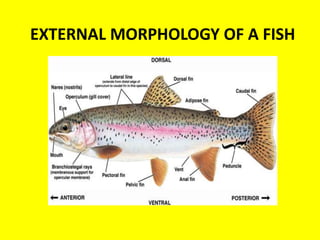
EXTERNAL MORPHOLOGY OF A FISH
OBJECTIVE:
It is important to study the essential features
of fishes for their body structures and
functions on the basis of their morphological
characteristics. This exercise helps the
students to distinguish the different kinds of
fishes among cultivated carps of Nepal.
INTRODUCTION:
Fishes are the first successful class of
chordates. They are aquatic cold blooded, gill
breathing vertebrates which propel and
balance themselves by means of fins.
In the different types of water systems of the
world there exist a large number of fish
species differing widely in shape, size, habits
and habitats.
Inspite of many variations, body of fishes is
generally fusiform and steamlined. However,
in puffers the body is globe shape and in eels
is of serpentine form. The ground plan of body
is bilateral symmetrical with prominent lateral
line system. Appendages of fishes comprise
the fins and cirrhi (flaps of flesh). Paired fins
are pectorals and pelvics (Ventrals) while
dorsal, anal and caudal fins are unpaired fin.
In some forms there are two dorsal fins, the
first being spiny and second being soft,
supported by fin rays. Cultivated carps of
Nepal include both indigenous and exotic
fishes. These are Rohu (Labeo rohita), Bhakur
(Catla catla), Mrigal (Cirrhinus mrigala),
Common carp (Cyprinus carpio), Silver carp
(Hypophmthaalmichthys molitrix), Bighead
carp (Aristichthys nobilis) and Grass carp
(Ctenopharyngodon idella).
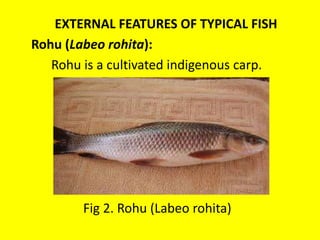
EXTERNAL FEATURES OF TYPICAL FISH
Rohu (Labeo rohita):
Rohu is a cultivated indigenous carp.
Fig 2. Rohu (Labeo rohita)
Of all the cultivated carps, the Rohu is
considered as the most tastiest fish in this
subcontinent and is common in the rivers and
streams of Terai parts of Nepal. It varies
greatly in size according to its environment. In
large rivers it may grow to nearly a meter in
length.
Body regions:
Entire body of a fish may be divided into heads,
trunk and tail. The region from the snout to the
posterior edge of the operculum is the head. The
trunk extends from the operculum to the anus.
The post anal region is the tail.
The body is moderately elongated, rounded,
thickest in the middle and tapering to the tail.
The mouth is situated anteriorly, opening
ventrally in the head in terminal position with
thick fringed lower lip. A pair of small maxillary
barbells present.
The large eyes are situated on lateral side of
the head is the operculum or gill cover, a large
flap which when raised, displays the gills.
On the ventral surface of the body at about
two thirds distance from the snout to the end
of the tail is the anus.
Fins:
There is a single dorsal fin supported by 16 branched rays.
The caudal fin is deeply forked and supported by 19 fin
rays. There is single large anal fin supported by 7 rays. The
pectoral fin has 17 rays and is situated in the normal
position. Close behind the gill opening, but the pelvic
(ventral) fin shifted its position and lies some distance
infront of the vent. It is supported by 9 rays. Both pectorals
and the pelvic fins are paired fin. The dorsal, caudal and
anal fins are also called the median fins.
Body covering and colouration:
The body is covered by a soft slimy skin along with the
scales of moderate size. On the head and fins skin is
smooth and devoid of scales. Body color bluish black along
dorsal side becoming silvery with reddish tinge on sides.
Fins are black.
Identifiable Peculiar characteristics of different cultivated
fish species in IAAS, Sundarbazar, Lamjung as follows;
ii. Common carp (Cyprinus carpio):
Common carp is characterized by a flat and deep body,
short and small head, protactile mouth and two pairs of
maxillary barbells. The dorsal fin is long with a sharp
spine.
iii. Grass carp (Ctemopharyngodon idella):The body of fish
is elongated and cylindrical with large greenish scales.
Head broad, barbells absent and mouth subterminal
with upper jaw slightly longer than the lower jaw.
Usually it has toothless mouth, but has a
specialized pharyngeal teeth for grasping aquatic
vegetation. Gil rackers are short and sparse.
Bighead carp (Aristichthys nobilis):
The body of fish is flat, laterally compressed and
covered by small silvery scales brownish above.
Head long and massive, barbells absent, mouth
large, upturned with lower jaw longer than upper
and the abdominal keel is incomplete. The
posterior margin of the pectoral fin extends
beyond the base of the pelvic fin.
Mrigal (Cirrhinus mrigala):
This fish is characterized by elongated and
cylindrical body, small head and sub-terminal
mouth with thin non-fringed lips. One pairs of
small barbells are present. The upper jaw is
longer than the lower jaw. The body color is
grayish on dorsal side and whitish on belly, but
is not pinkish as rohu.
Lateral line:
A well marked lateral line extends along each side from head to tail.
And is continued into branching lines on the head. The lateral line is
a small line of nerve cells and is an area of sensitivity that helps the
fish feel pressure and temperature changes in the water around it.
Materials Required:
Freshly killed or formalin preserved fish.
Tray
Forceps
Needles
Gloves
Procedure:
Take a freshly killed or formalin preserved fish and identify its major
body parts. Count the fin rays and lateral line scales.

Study of Fish Morphology

  • 1.
  • 2.
    OBJECTIVE: It is importantto study the essential features of fishes for their body structures and functions on the basis of their morphological characteristics. This exercise helps the students to distinguish the different kinds of fishes among cultivated carps of Nepal.
  • 3.
    INTRODUCTION: Fishes are thefirst successful class of chordates. They are aquatic cold blooded, gill breathing vertebrates which propel and balance themselves by means of fins. In the different types of water systems of the world there exist a large number of fish species differing widely in shape, size, habits and habitats.
  • 4.
    Inspite of manyvariations, body of fishes is generally fusiform and steamlined. However, in puffers the body is globe shape and in eels is of serpentine form. The ground plan of body is bilateral symmetrical with prominent lateral line system. Appendages of fishes comprise the fins and cirrhi (flaps of flesh). Paired fins are pectorals and pelvics (Ventrals) while dorsal, anal and caudal fins are unpaired fin.
  • 5.
    In some formsthere are two dorsal fins, the first being spiny and second being soft, supported by fin rays. Cultivated carps of Nepal include both indigenous and exotic fishes. These are Rohu (Labeo rohita), Bhakur (Catla catla), Mrigal (Cirrhinus mrigala), Common carp (Cyprinus carpio), Silver carp (Hypophmthaalmichthys molitrix), Bighead carp (Aristichthys nobilis) and Grass carp (Ctenopharyngodon idella).
  • 6.
    EXTERNAL FEATURES OFTYPICAL FISH Rohu (Labeo rohita): Rohu is a cultivated indigenous carp. Fig 2. Rohu (Labeo rohita)
  • 7.
    Of all thecultivated carps, the Rohu is considered as the most tastiest fish in this subcontinent and is common in the rivers and streams of Terai parts of Nepal. It varies greatly in size according to its environment. In large rivers it may grow to nearly a meter in length.
  • 8.
    Body regions: Entire bodyof a fish may be divided into heads, trunk and tail. The region from the snout to the posterior edge of the operculum is the head. The trunk extends from the operculum to the anus. The post anal region is the tail. The body is moderately elongated, rounded, thickest in the middle and tapering to the tail. The mouth is situated anteriorly, opening ventrally in the head in terminal position with thick fringed lower lip. A pair of small maxillary barbells present.
  • 9.
    The large eyesare situated on lateral side of the head is the operculum or gill cover, a large flap which when raised, displays the gills. On the ventral surface of the body at about two thirds distance from the snout to the end of the tail is the anus.
  • 10.
    Fins: There is asingle dorsal fin supported by 16 branched rays. The caudal fin is deeply forked and supported by 19 fin rays. There is single large anal fin supported by 7 rays. The pectoral fin has 17 rays and is situated in the normal position. Close behind the gill opening, but the pelvic (ventral) fin shifted its position and lies some distance infront of the vent. It is supported by 9 rays. Both pectorals and the pelvic fins are paired fin. The dorsal, caudal and anal fins are also called the median fins. Body covering and colouration: The body is covered by a soft slimy skin along with the scales of moderate size. On the head and fins skin is smooth and devoid of scales. Body color bluish black along dorsal side becoming silvery with reddish tinge on sides. Fins are black.
  • 11.
    Identifiable Peculiar characteristicsof different cultivated fish species in IAAS, Sundarbazar, Lamjung as follows; ii. Common carp (Cyprinus carpio): Common carp is characterized by a flat and deep body, short and small head, protactile mouth and two pairs of maxillary barbells. The dorsal fin is long with a sharp spine. iii. Grass carp (Ctemopharyngodon idella):The body of fish is elongated and cylindrical with large greenish scales. Head broad, barbells absent and mouth subterminal with upper jaw slightly longer than the lower jaw.
  • 12.
    Usually it hastoothless mouth, but has a specialized pharyngeal teeth for grasping aquatic vegetation. Gil rackers are short and sparse. Bighead carp (Aristichthys nobilis): The body of fish is flat, laterally compressed and covered by small silvery scales brownish above. Head long and massive, barbells absent, mouth large, upturned with lower jaw longer than upper and the abdominal keel is incomplete. The posterior margin of the pectoral fin extends beyond the base of the pelvic fin.
  • 13.
    Mrigal (Cirrhinus mrigala): Thisfish is characterized by elongated and cylindrical body, small head and sub-terminal mouth with thin non-fringed lips. One pairs of small barbells are present. The upper jaw is longer than the lower jaw. The body color is grayish on dorsal side and whitish on belly, but is not pinkish as rohu.
  • 14.
    Lateral line: A wellmarked lateral line extends along each side from head to tail. And is continued into branching lines on the head. The lateral line is a small line of nerve cells and is an area of sensitivity that helps the fish feel pressure and temperature changes in the water around it. Materials Required: Freshly killed or formalin preserved fish. Tray Forceps Needles Gloves Procedure: Take a freshly killed or formalin preserved fish and identify its major body parts. Count the fin rays and lateral line scales.