Channiformes
Prepared by :
Md. Inja-Mamun Haque
&
Tanvir Ahmed
Presentation
on
Order : Channiformes
- Elongated, serpent haead fishes, sub cylindrical
anteriorly, compressed, posteriorly.
-Head depressed with large shield like scales
above.
- Long spineless dorsal and anal fins.
- Pelvics thoracic.
- Two accessory air breathing branchial air
cavities.
- One local family
Family : Channidae (snake heads)Family : Channidae (snake heads)
- Head depressed with large shield like scalesHead depressed with large shield like scales
above and with pits.above and with pits.
- Mouth large and protractile.Mouth large and protractile.
- Teeth in jaws, palate, vomer and tongue someTeeth in jaws, palate, vomer and tongue some
of while may be conical or canniform.of while may be conical or canniform.
- Lateral line abrupty curved or interruptedLateral line abrupty curved or interrupted
- Great predatorsGreat predators
- A single local genus.A single local genus.
Genus : ChannaGenus : Channa
Five local species under the genus:Five local species under the genus:
ChannaChanna maruliusmarulius (Hamilton,1822)(Hamilton,1822)
C. striatusC. striatus (Bloch 1794)(Bloch 1794)
C. puntuatusC. puntuatus (Bloch 1794)(Bloch 1794)
C.C. bracabraca (Hamilton,1822)(Hamilton,1822)
C. orientalis (schneider,1801)C. orientalis (schneider,1801)
Key: based on colour patternKey: based on colour pattern
1.1. Pectorals plain …………….2Pectorals plain …………….2
Pectorals spotted or barred ……. 4Pectorals spotted or barred ……. 4
2. A consipicuous black, light edge ocells at upper base of caudal2. A consipicuous black, light edge ocells at upper base of caudal
fin ……….c.fin ……….c.maruliusmarulius
No conspicuous ocellus at the base of caudal fin ………3No conspicuous ocellus at the base of caudal fin ………3
3.Lateral line with penisulas of darked colour extending into3.Lateral line with penisulas of darked colour extending into
yellow……c. striatusyellow……c. striatus
Darker and lighter pattern alternating above and below lateralDarker and lighter pattern alternating above and below lateral
line.Scales and vertical fins dotted in some………………….line.Scales and vertical fins dotted in some………………….
c.punctatus.c.punctatus.
4.Pectorals with innumerable round spots scales.Spotted along sides4.Pectorals with innumerable round spots scales.Spotted along sides
…….. C.barca…….. C.barca
Pectorals with a basal spot and a series of vertical bars, scales notPectorals with a basal spot and a series of vertical bars, scales not
spotted …..c.Orientals.spotted …..c.Orientals.
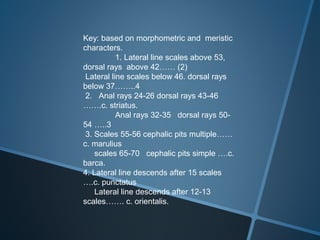
Key: based on morphometric and meristic
characters.
1. Lateral line scales above 53,
dorsal rays above 42…… (2)
Lateral line scales below 46. dorsal rays
below 37……..4
2. Anal rays 24-26 dorsal rays 43-46
…….c. striatus.
Anal rays 32-35 dorsal rays 50-
54 …..3
3. Scales 55-56 cephalic pits multiple……
c. marulius
scales 65-70 cephalic pits simple ….c.
barca.
4. Lateral line descends after 15 scales
….c. punctatus
Lateral line descends after 12-13
scales……. c. orientalis.
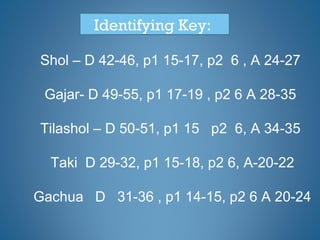
Shol – D 42-46, p1 15-17, p2 6 , A 24-27
Gajar- D 49-55, p1 17-19 , p2 6 A 28-35
Tilashol – D 50-51, p1 15 p2 6, A 34-35
Taki D 29-32, p1 15-18, p2 6, A-20-22
Gachua D 31-36 , p1 14-15, p2 6 A 20-24
Identifying Key:
Fish fish base nane
Shol snakehead murrel
Gajar Great snakehead
Tila shoal Barca Snakehead
Taki spotted snake
head
Gachua Walking
snakehead
Similarities :Similarities :
Body almost cylindrical anteriorly lateralyBody almost cylindrical anteriorly lateraly
compressed posteriorly.compressed posteriorly.
Anteriror nasal opening produced into aAnteriror nasal opening produced into a
tubular process.tubular process.
 Large plate like scales on head.Large plate like scales on head.
* Tilashol – critical endenger* Tilashol – critical endenger
DISSIMILARITIES
Charateristics shol Gajar Tilashol Taki G achua
no. of scales
between
orbit and an
gle of
preopercle
9 9-10 10 5 5
Cephalicpits multiple multiple simple simple simple
no. of scales
between snout
and dorsal bas
15 15-16 rows 15-16 11 rows 11-12
Mouth deeply cleft deeply cleft moderate cleft moderate cleft
maxilla extends to eye
diameter
behind orbit
extends to ¾ eye
diameter
behind orbit
extends to 1
diameters
behind orbit
hind edge of orbit ¾ eye diameter b
ehind orbit
Teeth /
villiform
viliform in jaws
and plate
small conical
ones in
vomer
jaws vomer and
palate
jaws jaws small conical
ones or
vomer and
plate
jaws, large
cronical ones
on vomer
and plate
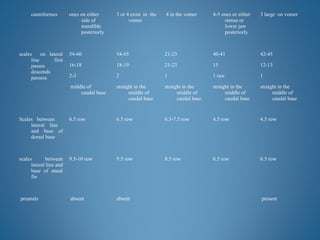
canniformes ones on either
side of
mandible
posteriorly
3 or 4 exist in the
vomer
4 in the vomer 4-5 ones or either
ramus or
lower jaw
posteriorly
3 large on vomer
scales on lateral
line first
passes
descends
passess
54-60 54-65 21-23 40-41 42-45
16-18 18-19 21-23 15 12-13
2-3 2 1 1 raw 1
middle of
caudal base
straight in the
middle of
caudal base
straight in the
middle of
caudal base
straight in the
middle of
caudal base
straight in the
middle of
caudal base
Scales between
lateral line
and base of
dorsal base
6.5 row 6.5 row 6.5-7.5 row 4.5 row 4.5 row
scales between
lateral line and
base of annal
fin
9.5-10 row 9.5 row 8.5 row 6.5 row 6.5 row
preanals absent absent present
Caudal fin rounded
pectorals plain
Founds beels hoars,
ponds,
ditches,
swamps
Mymensingh
and Sylhet district
greater sylhet and
Mymensingh
district
ponds ditches
beels
swamps
drains of muncipal
areas and
towns.
Highest length
( large
specimen)
mm
900 1200 400 240 135
SholShol
color varies with age and the habitat theycolor varies with age and the habitat they
living.living.
Dark grey superiorly becoming yellowishDark grey superiorly becoming yellowish
beneath.beneath.
Lateral line with penninsulas of the darkerLateral line with penninsulas of the darker
colour extending into the yellow.colour extending into the yellow.
The Fries orange red.The Fries orange red.
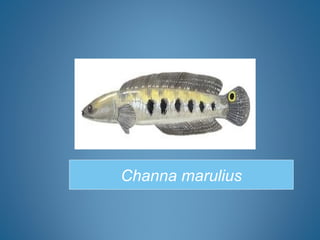
Gajar :Gajar :
Varies with age and habitat.Varies with age and habitat.
Back greyBack grey
Young with a brilliant orange band along theYoung with a brilliant orange band along the
middle of sides.middle of sides.
 When mature form there are four or fiveWhen mature form there are four or five
large black blotches along the sides.large black blotches along the sides.
A conspicuous black light edged ocellus atA conspicuous black light edged ocellus at
the upper base of caudal fin.the upper base of caudal fin.
Channa marulius
Tila sholTila shol
 Dark brown above.Dark brown above.
Below brownBelow brown
Dorsal caudal and anal fin darkDorsal caudal and anal fin dark
pectoral densly spotted.pectoral densly spotted.
Edge of dorsal anal and caudal red.Edge of dorsal anal and caudal red.
Scales spotted; spots most numerous a long theScales spotted; spots most numerous a long the
upper half of body.upper half of body.
A large black spot above the base of pectoral.A large black spot above the base of pectoral.
Taki :Taki :
Color varies with water they reside.Color varies with water they reside.
Usually grey on the back fading to lighterUsually grey on the back fading to lighter
beneath.beneath.
A series of 8 or 9 verticle bands above theA series of 8 or 9 verticle bands above the
lateral line.lateral line.
Similar series below it.Similar series below it.
scales on the sides in some speciments withscales on the sides in some speciments with
small black spots.small black spots.
Gachua :Gachua :
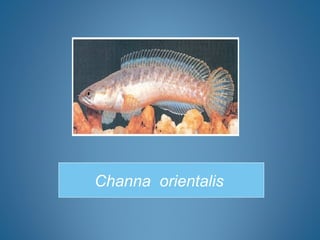
 Light brownLight brown
grey abovegrey above
 Lighter ventrallyLighter ventrally
 Dorsal caudal and anal slate coloured withDorsal caudal and anal slate coloured with
orange margin.orange margin.
 Base of pectoral with a dark blotch followedBase of pectoral with a dark blotch followed
by few bars of blue and orange.by few bars of blue and orange.
Channa orientalis
Habitat, feeding and breedingHabitat, feeding and breeding
The genus is carnivore.The genus is carnivore.
 Subsists on a variety of living creaturesSubsists on a variety of living creatures
including fish, frogs, snakes, insects,including fish, frogs, snakes, insects,
earthworm and tadpoles.earthworm and tadpoles.
Setting in the bottom mud of the pond ditchesSetting in the bottom mud of the pond ditches
and the swamps as the water dry up and ofand the swamps as the water dry up and of
going deeper and deeper into the mud asgoing deeper and deeper into the mud as
desiccation proceeds.desiccation proceeds.
Skin and breathing apparatus kept moist, theSkin and breathing apparatus kept moist, the
fish can survive without water for a number offish can survive without water for a number of
months.months.
Occupying pockets in the stiff mud sometimesOccupying pockets in the stiff mud sometimes
nearly a meter below the surface andnearly a meter below the surface and
subsisting on the stored fat until rains set in.subsisting on the stored fat until rains set in.
During the onset of monsoon in ditches,During the onset of monsoon in ditches,
ponds flooded paddy fields they breed.ponds flooded paddy fields they breed.
The young remain at the surface in shoalsThe young remain at the surface in shoals
guarded by their parents. Hiding below theguarded by their parents. Hiding below the
surface of water.surface of water.
Disease :Disease :
During the winter and dry season the fleshDuring the winter and dry season the flesh
around the coelomic cavity of this fish isaround the coelomic cavity of this fish is
heavily infested by a larval trematodaheavily infested by a larval trematoda
Isoparorchis hypsilobargi.Isoparorchis hypsilobargi.
 Other parsites infecting fishOther parsites infecting fish
 pallisentis ophicephali - intestinepallisentis ophicephali - intestine
 Neocamallanus ophicephali -Neocamallanus ophicephali -
pyloricaecapyloricaeca
Capturing :Capturing :
 By fixing hook and line with a live small fishBy fixing hook and line with a live small fish
as bait in the ponds or beels .as bait in the ponds or beels .

Channifirmies

  • 1.
    Channiformes Prepared by : Md.Inja-Mamun Haque & Tanvir Ahmed Presentation on
  • 2.
    Order : Channiformes -Elongated, serpent haead fishes, sub cylindrical anteriorly, compressed, posteriorly. -Head depressed with large shield like scales above. - Long spineless dorsal and anal fins. - Pelvics thoracic. - Two accessory air breathing branchial air cavities. - One local family
  • 3.
    Family : Channidae(snake heads)Family : Channidae (snake heads) - Head depressed with large shield like scalesHead depressed with large shield like scales above and with pits.above and with pits. - Mouth large and protractile.Mouth large and protractile. - Teeth in jaws, palate, vomer and tongue someTeeth in jaws, palate, vomer and tongue some of while may be conical or canniform.of while may be conical or canniform. - Lateral line abrupty curved or interruptedLateral line abrupty curved or interrupted - Great predatorsGreat predators - A single local genus.A single local genus.
  • 4.
    Genus : ChannaGenus: Channa Five local species under the genus:Five local species under the genus: ChannaChanna maruliusmarulius (Hamilton,1822)(Hamilton,1822) C. striatusC. striatus (Bloch 1794)(Bloch 1794) C. puntuatusC. puntuatus (Bloch 1794)(Bloch 1794) C.C. bracabraca (Hamilton,1822)(Hamilton,1822) C. orientalis (schneider,1801)C. orientalis (schneider,1801)
  • 5.
    Key: based oncolour patternKey: based on colour pattern 1.1. Pectorals plain …………….2Pectorals plain …………….2 Pectorals spotted or barred ……. 4Pectorals spotted or barred ……. 4 2. A consipicuous black, light edge ocells at upper base of caudal2. A consipicuous black, light edge ocells at upper base of caudal fin ……….c.fin ……….c.maruliusmarulius No conspicuous ocellus at the base of caudal fin ………3No conspicuous ocellus at the base of caudal fin ………3 3.Lateral line with penisulas of darked colour extending into3.Lateral line with penisulas of darked colour extending into yellow……c. striatusyellow……c. striatus Darker and lighter pattern alternating above and below lateralDarker and lighter pattern alternating above and below lateral line.Scales and vertical fins dotted in some………………….line.Scales and vertical fins dotted in some…………………. c.punctatus.c.punctatus. 4.Pectorals with innumerable round spots scales.Spotted along sides4.Pectorals with innumerable round spots scales.Spotted along sides …….. C.barca…….. C.barca Pectorals with a basal spot and a series of vertical bars, scales notPectorals with a basal spot and a series of vertical bars, scales not spotted …..c.Orientals.spotted …..c.Orientals.
  • 6.
    Key: based onmorphometric and meristic characters. 1. Lateral line scales above 53, dorsal rays above 42…… (2) Lateral line scales below 46. dorsal rays below 37……..4 2. Anal rays 24-26 dorsal rays 43-46 …….c. striatus. Anal rays 32-35 dorsal rays 50- 54 …..3 3. Scales 55-56 cephalic pits multiple…… c. marulius scales 65-70 cephalic pits simple ….c. barca. 4. Lateral line descends after 15 scales ….c. punctatus Lateral line descends after 12-13 scales……. c. orientalis.
  • 7.
    Shol – D42-46, p1 15-17, p2 6 , A 24-27 Gajar- D 49-55, p1 17-19 , p2 6 A 28-35 Tilashol – D 50-51, p1 15 p2 6, A 34-35 Taki D 29-32, p1 15-18, p2 6, A-20-22 Gachua D 31-36 , p1 14-15, p2 6 A 20-24 Identifying Key:
  • 8.
    Fish fish basenane Shol snakehead murrel Gajar Great snakehead Tila shoal Barca Snakehead Taki spotted snake head Gachua Walking snakehead
  • 9.
    Similarities :Similarities : Bodyalmost cylindrical anteriorly lateralyBody almost cylindrical anteriorly lateraly compressed posteriorly.compressed posteriorly. Anteriror nasal opening produced into aAnteriror nasal opening produced into a tubular process.tubular process.  Large plate like scales on head.Large plate like scales on head. * Tilashol – critical endenger* Tilashol – critical endenger
  • 10.
  • 11.
    Charateristics shol GajarTilashol Taki G achua no. of scales between orbit and an gle of preopercle 9 9-10 10 5 5 Cephalicpits multiple multiple simple simple simple no. of scales between snout and dorsal bas 15 15-16 rows 15-16 11 rows 11-12 Mouth deeply cleft deeply cleft moderate cleft moderate cleft maxilla extends to eye diameter behind orbit extends to ¾ eye diameter behind orbit extends to 1 diameters behind orbit hind edge of orbit ¾ eye diameter b ehind orbit Teeth / villiform viliform in jaws and plate small conical ones in vomer jaws vomer and palate jaws jaws small conical ones or vomer and plate jaws, large cronical ones on vomer and plate
  • 12.
    canniformes ones oneither side of mandible posteriorly 3 or 4 exist in the vomer 4 in the vomer 4-5 ones or either ramus or lower jaw posteriorly 3 large on vomer scales on lateral line first passes descends passess 54-60 54-65 21-23 40-41 42-45 16-18 18-19 21-23 15 12-13 2-3 2 1 1 raw 1 middle of caudal base straight in the middle of caudal base straight in the middle of caudal base straight in the middle of caudal base straight in the middle of caudal base Scales between lateral line and base of dorsal base 6.5 row 6.5 row 6.5-7.5 row 4.5 row 4.5 row scales between lateral line and base of annal fin 9.5-10 row 9.5 row 8.5 row 6.5 row 6.5 row preanals absent absent present
  • 13.
    Caudal fin rounded pectoralsplain Founds beels hoars, ponds, ditches, swamps Mymensingh and Sylhet district greater sylhet and Mymensingh district ponds ditches beels swamps drains of muncipal areas and towns. Highest length ( large specimen) mm 900 1200 400 240 135
  • 14.
    SholShol color varies withage and the habitat theycolor varies with age and the habitat they living.living. Dark grey superiorly becoming yellowishDark grey superiorly becoming yellowish beneath.beneath. Lateral line with penninsulas of the darkerLateral line with penninsulas of the darker colour extending into the yellow.colour extending into the yellow. The Fries orange red.The Fries orange red.
  • 16.
    Gajar :Gajar : Varieswith age and habitat.Varies with age and habitat. Back greyBack grey Young with a brilliant orange band along theYoung with a brilliant orange band along the middle of sides.middle of sides.  When mature form there are four or fiveWhen mature form there are four or five large black blotches along the sides.large black blotches along the sides. A conspicuous black light edged ocellus atA conspicuous black light edged ocellus at the upper base of caudal fin.the upper base of caudal fin.
  • 17.
  • 18.
    Tila sholTila shol Dark brown above.Dark brown above. Below brownBelow brown Dorsal caudal and anal fin darkDorsal caudal and anal fin dark pectoral densly spotted.pectoral densly spotted. Edge of dorsal anal and caudal red.Edge of dorsal anal and caudal red. Scales spotted; spots most numerous a long theScales spotted; spots most numerous a long the upper half of body.upper half of body. A large black spot above the base of pectoral.A large black spot above the base of pectoral.
  • 20.
    Taki :Taki : Colorvaries with water they reside.Color varies with water they reside. Usually grey on the back fading to lighterUsually grey on the back fading to lighter beneath.beneath. A series of 8 or 9 verticle bands above theA series of 8 or 9 verticle bands above the lateral line.lateral line. Similar series below it.Similar series below it. scales on the sides in some speciments withscales on the sides in some speciments with small black spots.small black spots.
  • 22.
    Gachua :Gachua : Light brownLight brown grey abovegrey above  Lighter ventrallyLighter ventrally  Dorsal caudal and anal slate coloured withDorsal caudal and anal slate coloured with orange margin.orange margin.  Base of pectoral with a dark blotch followedBase of pectoral with a dark blotch followed by few bars of blue and orange.by few bars of blue and orange.
  • 23.
  • 24.
    Habitat, feeding andbreedingHabitat, feeding and breeding The genus is carnivore.The genus is carnivore.  Subsists on a variety of living creaturesSubsists on a variety of living creatures including fish, frogs, snakes, insects,including fish, frogs, snakes, insects, earthworm and tadpoles.earthworm and tadpoles. Setting in the bottom mud of the pond ditchesSetting in the bottom mud of the pond ditches and the swamps as the water dry up and ofand the swamps as the water dry up and of going deeper and deeper into the mud asgoing deeper and deeper into the mud as desiccation proceeds.desiccation proceeds. Skin and breathing apparatus kept moist, theSkin and breathing apparatus kept moist, the fish can survive without water for a number offish can survive without water for a number of months.months.
  • 25.
    Occupying pockets inthe stiff mud sometimesOccupying pockets in the stiff mud sometimes nearly a meter below the surface andnearly a meter below the surface and subsisting on the stored fat until rains set in.subsisting on the stored fat until rains set in. During the onset of monsoon in ditches,During the onset of monsoon in ditches, ponds flooded paddy fields they breed.ponds flooded paddy fields they breed. The young remain at the surface in shoalsThe young remain at the surface in shoals guarded by their parents. Hiding below theguarded by their parents. Hiding below the surface of water.surface of water.
  • 26.
    Disease :Disease : Duringthe winter and dry season the fleshDuring the winter and dry season the flesh around the coelomic cavity of this fish isaround the coelomic cavity of this fish is heavily infested by a larval trematodaheavily infested by a larval trematoda Isoparorchis hypsilobargi.Isoparorchis hypsilobargi.  Other parsites infecting fishOther parsites infecting fish  pallisentis ophicephali - intestinepallisentis ophicephali - intestine  Neocamallanus ophicephali -Neocamallanus ophicephali - pyloricaecapyloricaeca Capturing :Capturing :  By fixing hook and line with a live small fishBy fixing hook and line with a live small fish as bait in the ponds or beels .as bait in the ponds or beels .