
RIPER
AUTONOMOUS
NAAC &
NBA (UG)
SIRO- DSIR
Raghavendra Institute of Pharmaceutical Education and Research - Autonomous
K.R.Palli Cross, Chiyyedu, Anantapuramu, A. P- 515721 1
A Seminar as a part of curricular requirement
for I year M. Pharm II semester
Presented by
Ms. I. Sai Reddemma.
(Reg. No. 20L81S0101)
Department of Pharmacology
Under the guidance/Mentorship of
Dr. K. Somasekhar Reddy. M. Pharm., Ph.D.
Associate Professor and Head Department of Pharmacology.
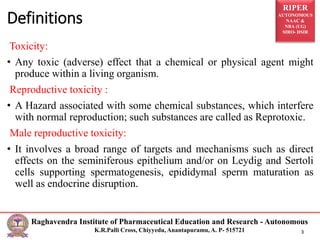
REPRODUCTIVE TOXICITY STUDIES
RIPER
AUTONOMOUS
NAAC &
NBA (UG)
SIRO- DSIR
Raghavendra Institute of Pharmaceutical Education and Research - Autonomous
K.R.Palli Cross, Chiyyedu, Anantapuramu, A. P- 515721 2
• Definition
• Introduction
• OECD guidelines for reproductive toxicity studies
• Principle of the test
• Description of Method
• Procedure
• Experimental Schedule
• Data and Reporting
• Results
• Male Fertility Toxicological Studies
Contents
RIPER
AUTONOMOUS
NAAC &
NBA (UG)
SIRO- DSIR
Raghavendra Institute of Pharmaceutical Education and Research - Autonomous
K.R.Palli Cross, Chiyyedu, Anantapuramu, A. P- 515721 3
Toxicity:
• Any toxic (adverse) effect that a chemical or physical agent might
produce within a living organism.
Reproductive toxicity :
• A Hazard associated with some chemical substances, which interfere
with normal reproduction; such substances are called as Reprotoxic.
Male reproductive toxicity:
• It involves a broad range of targets and mechanisms such as direct
effects on the seminiferous epithelium and/or on Leydig and Sertoli
cells supporting spermatogenesis, epididymal sperm maturation as
well as endocrine disruption.
Definitions
RIPER
AUTONOMOUS
NAAC &
NBA (UG)
SIRO- DSIR
Raghavendra Institute of Pharmaceutical Education and Research - Autonomous
K.R.Palli Cross, Chiyyedu, Anantapuramu, A. P- 515721 4
What is Reproductive Toxicology?
• Reproductive toxicity refers to structural and functional
alterations that affect reproductive system in sexually mature
males and females.
• Reproductive toxicity includes effects on male fertility, female
fertility and lactation.
RIPER
AUTONOMOUS
NAAC &
NBA (UG)
SIRO- DSIR
Raghavendra Institute of Pharmaceutical Education and Research - Autonomous
K.R.Palli Cross, Chiyyedu, Anantapuramu, A. P- 515721 5
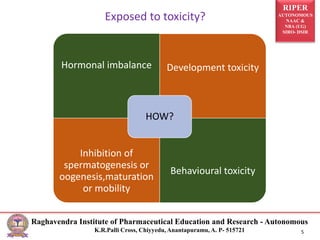
Exposed to toxicity?
Hormonal imbalance Development toxicity
Inhibition of
spermatogenesis or
oogenesis,maturation
or mobility
Behavioural toxicity
HOW?
RIPER
AUTONOMOUS
NAAC &
NBA (UG)
SIRO- DSIR
Raghavendra Institute of Pharmaceutical Education and Research - Autonomous
K.R.Palli Cross, Chiyyedu, Anantapuramu, A. P- 515721 6
Principle of the test
• The test chemical is administered in graduated doses to several
groups of males and females.
• Males should be dosed for a minimum of four weeks and
including the day before scheduled kill.
• Therefore, a detailed histological examination of the testes is
essential.
• Histopathology of the male gonads, is considered sufficient to
enable detection of the majority of effects on male fertility and
spermatogenesis.
OECD guidelines for reproductive toxicity
studies
RIPER
AUTONOMOUS
NAAC &
NBA (UG)
SIRO- DSIR
Raghavendra Institute of Pharmaceutical Education and Research - Autonomous
K.R.Palli Cross, Chiyyedu, Anantapuramu, A. P- 515721 7
• Females should be dosed throughout the study.
• This includes mating, the duration of pregnancy and including the
day before scheduled kill.
• Duration of study, following acclimatisation and pre-dosing oestrous
cycle evaluation, is dependent on the female performance and is
approximately 63 days.
RIPER
AUTONOMOUS
NAAC &
NBA (UG)
SIRO- DSIR
Raghavendra Institute of Pharmaceutical Education and Research - Autonomous
K.R.Palli Cross, Chiyyedu, Anantapuramu, A. P- 515721 8
DESCRIPTION OF THE METHOD
• Selection of animal species guideline is designed for use with the
rat.
• The rat was the only species used.
• The test animals should be characterized as to species, strain, sex,
weight and age.
• weight variation of animals used should be minimal and not
exceed 20% of the mean weight of each sex.
• Animals from the same strain and source are used in both studies.
RIPER
AUTONOMOUS
NAAC &
NBA (UG)
SIRO- DSIR
Raghavendra Institute of Pharmaceutical Education and Research - Autonomous
K.R.Palli Cross, Chiyyedu, Anantapuramu, A. P- 515721 9
Housing and feeding
• Temperature 20℃(± 3).
• Relative humidity 30% .
• Lighting should be artificial.
• The photoperiod being 12 hours light and 12 hours dark.
• Laboratory diets used with an unlimited supply of drinking water.
• No more than five animals should be housed per cage.
• Pregnant females should be caged individually and provided with
nesting materials.
RIPER
AUTONOMOUS
NAAC &
NBA (UG)
SIRO- DSIR
Raghavendra Institute of Pharmaceutical Education and Research - Autonomous
K.R.Palli Cross, Chiyyedu, Anantapuramu, A. P- 515721 10
Cont..,
• Lactating females will be caged individually with their offspring.
• Cages should be arranged in such a way that possible effects due
to cage placement are minimized.
• The animals are uniquely identified and kept in their cages for at
least five days prior to the start of the study to allow for
acclimatisation to the laboratory conditions.
• Preparation of doses the test chemical is dissolved or suspended
in a suitable vehicle.
RIPER
AUTONOMOUS
NAAC &
NBA (UG)
SIRO- DSIR
Raghavendra Institute of Pharmaceutical Education and Research - Autonomous
K.R.Palli Cross, Chiyyedu, Anantapuramu, A. P- 515721 11
PROCEDURE
• Number and sex of animals : 10 males and 12-13 females.
• Dosage at least three test groups and a control group.
• Dose levels may be based on information from acute toxicity tests or
on results from repeated dose studies.
• If a vehicle is used in administering the test chemical, the control
group should receive the vehicle in the highest volume used.
• Dose levels should be selected taking into account any existing
toxicity and toxicokinetic data available.
RIPER
AUTONOMOUS
NAAC &
NBA (UG)
SIRO- DSIR
Raghavendra Institute of Pharmaceutical Education and Research - Autonomous
K.R.Palli Cross, Chiyyedu, Anantapuramu, A. P- 515721 12
• Administration of doses, the animals are dosed with the test chemical
daily for 7 days a week.
• The volume should not exceed 1 ml/100 g body weight, except in the
case of aqueous solutions where 2 ml/100 g body weight may be
used.
• For test chemical administered via the diet or drinking water, it is
important to ensure that the quantities of the test chemical involved
do not interfere with normal nutrition or water balance.
RIPER
AUTONOMOUS
NAAC &
NBA (UG)
SIRO- DSIR
Raghavendra Institute of Pharmaceutical Education and Research - Autonomous
K.R.Palli Cross, Chiyyedu, Anantapuramu, A. P- 515721 13
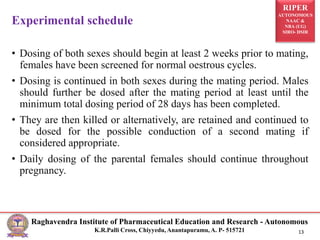
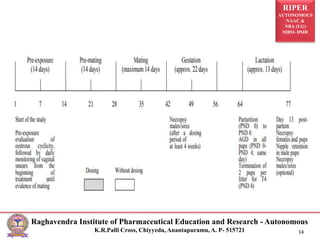
Experimental schedule
• Dosing of both sexes should begin at least 2 weeks prior to mating,
females have been screened for normal oestrous cycles.
• Dosing is continued in both sexes during the mating period. Males
should further be dosed after the mating period at least until the
minimum total dosing period of 28 days has been completed.
• They are then killed or alternatively, are retained and continued to
be dosed for the possible conduction of a second mating if
considered appropriate.
• Daily dosing of the parental females should continue throughout
pregnancy.
RIPER
AUTONOMOUS
NAAC &
NBA (UG)
SIRO- DSIR
Raghavendra Institute of Pharmaceutical Education and Research - Autonomous
K.R.Palli Cross, Chiyyedu, Anantapuramu, A. P- 515721 14
RIPER
AUTONOMOUS
NAAC &
NBA (UG)
SIRO- DSIR
Raghavendra Institute of Pharmaceutical Education and Research - Autonomous
K.R.Palli Cross, Chiyyedu, Anantapuramu, A. P- 515721 15
Mating procedure
• Normally, 1:1 (one male to one female) mating should be used in this
study.
• Each morning the females should be examined for the presence of
sperm or a vaginal plug.
Clinical Observation
• Throughout the test period, general clinical observations should be
made at least once a day, and more frequently when signs of toxicity are
observed.
• They should be made preferably at the same time(s) each day. all signs
of toxicity, including mortality, should be recorded.
• These records should include time of onset, degree and duration of
toxicity signs.
RIPER
AUTONOMOUS
NAAC &
NBA (UG)
SIRO- DSIR
Raghavendra Institute of Pharmaceutical Education and Research - Autonomous
K.R.Palli Cross, Chiyyedu, Anantapuramu, A. P- 515721 16
Body weight and food/water consumption
• Males and females should be weighed on the first day of dosing, at
least weekly thereafter, and at termination. During pregnancy,
females should be weighed on days 0, 7, 14 and 20.
Oestrous cycles
• Oestrous cycles should be monitored before treatment starts to
select for the study females with regular cycle.
• Vaginal smears should also be monitored daily from the beginning
of the treatment period until evidence of mating.
• If there is concern about acute stress effects that could alter
oestrous cycles.
RIPER
AUTONOMOUS
NAAC &
NBA (UG)
SIRO- DSIR
Raghavendra Institute of Pharmaceutical Education and Research - Autonomous
K.R.Palli Cross, Chiyyedu, Anantapuramu, A. P- 515721 17
Offspring parameters
• The duration of gestation should be recorded and is calculated from
day 0 of pregnancy. Any abnormal behaviour of the offspring
should be recorded.
Clinical biochemistry
• Blood samples from a defined site are taken.
• Plasma samples specifically for hormone determination should be
obtained at a comparable time of the day.
• The numerical value obtained when analysing hormone
concentration.
RIPER
AUTONOMOUS
NAAC &
NBA (UG)
SIRO- DSIR
Raghavendra Institute of Pharmaceutical Education and Research - Autonomous
K.R.Palli Cross, Chiyyedu, Anantapuramu, A. P- 515721 18
Pathology
• Gross necropsy
• At the time of sacrifice or death during the study, the adult animals
should be examined macroscopically for any abnormalities or
pathological changes.
• Vaginal smears should be examined in the morning on the day of
necropsy to determine the stage of the oestrous cycle and histopathology
of ovaries.
• The testes and epididymides of all male adult animals should be
weighed.
Histopathology
• Histological examination should be performed on the ovaries, testes and
epididymides of the animals of the highest dose group and the control
group.
RIPER
AUTONOMOUS
NAAC &
NBA (UG)
SIRO- DSIR
Raghavendra Institute of Pharmaceutical Education and Research - Autonomous
K.R.Palli Cross, Chiyyedu, Anantapuramu, A. P- 515721 19
Data and Reporting
• Individual animal data should be provided.
• Additionally, all data should be summarised in tabular form, showing
for each test group the number of animals at the start of the test, the
number of animals found dead during the test or killed the time of
any death or humane kill, the number of fertile animals, the number
of pregnant females, the number of animals showing signs of toxicity
and a description of the signs of toxicity observed.
RIPER
AUTONOMOUS
NAAC &
NBA (UG)
SIRO- DSIR
Raghavendra Institute of Pharmaceutical Education and Research - Autonomous
K.R.Palli Cross, Chiyyedu, Anantapuramu, A. P- 515721 20
Evaluation of results
• The findings of this toxicity study should be evaluated in terms of the
observed effects, necropsy and microscopic findings.
• Test report
Test chemical:
• Source, limit date for use, if available stability of the test chemical
physical appearance, water solubility, additional relevant
physicochemical properties and Vehicle
RIPER
AUTONOMOUS
NAAC &
NBA (UG)
SIRO- DSIR
Raghavendra Institute of Pharmaceutical Education and Research - Autonomous
K.R.Palli Cross, Chiyyedu, Anantapuramu, A. P- 515721 21
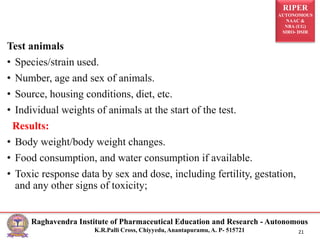
Test animals
• Species/strain used.
• Number, age and sex of animals.
• Source, housing conditions, diet, etc.
• Individual weights of animals at the start of the test.
Results:
• Body weight/body weight changes.
• Food consumption, and water consumption if available.
• Toxic response data by sex and dose, including fertility, gestation,
and any other signs of toxicity;
RIPER
AUTONOMOUS
NAAC &
NBA (UG)
SIRO- DSIR
Raghavendra Institute of Pharmaceutical Education and Research - Autonomous
K.R.Palli Cross, Chiyyedu, Anantapuramu, A. P- 515721 22
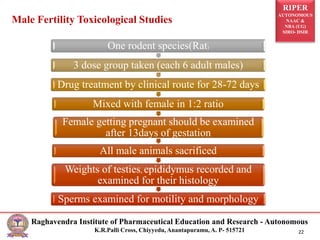
One rodent species(Rat)
3 dose group taken (each 6 adult males)
Drug treatment by clinical route for 28-72 days
Mixed with female in 1:2 ratio
Female getting pregnant should be examined
after 13days of gestation
All male animals sacrificed
Weights of testies, epididymus recorded and
examined for their histology
Sperms examined for motility and morphology
Male Fertility Toxicological Studies
RIPER
AUTONOMOUS
NAAC &
NBA (UG)
SIRO- DSIR
Raghavendra Institute of Pharmaceutical Education and Research - Autonomous
K.R.Palli Cross, Chiyyedu, Anantapuramu, A. P- 515721 23
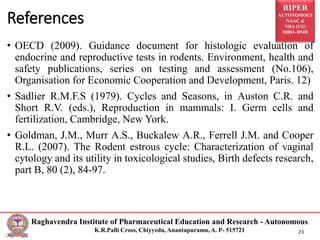
• OECD (2009). Guidance document for histologic evaluation of
endocrine and reproductive tests in rodents. Environment, health and
safety publications, series on testing and assessment (No.106),
Organisation for Economic Cooperation and Development, Paris. 12)
• Sadlier R.M.F.S (1979). Cycles and Seasons, in Auston C.R. and
Short R.V. (eds.), Reproduction in mammals: I. Germ cells and
fertilization, Cambridge, New York.
• Goldman, J.M., Murr A.S., Buckalew A.R., Ferrell J.M. and Cooper
R.L. (2007). The Rodent estrous cycle: Characterization of vaginal
cytology and its utility in toxicological studies, Birth defects research,
part B, 80 (2), 84-97.
References
RIPER
AUTONOMOUS
NAAC &
NBA (UG)
SIRO- DSIR
Raghavendra Institute of Pharmaceutical Education and Research - Autonomous
K.R.Palli Cross, Chiyyedu, Anantapuramu, A. P- 515721 24

REPRODUCTIVE TOXICITY STUDIES

  • 1.
    RIPER AUTONOMOUS NAAC & NBA (UG) SIRO-DSIR Raghavendra Institute of Pharmaceutical Education and Research - Autonomous K.R.Palli Cross, Chiyyedu, Anantapuramu, A. P- 515721 1 A Seminar as a part of curricular requirement for I year M. Pharm II semester Presented by Ms. I. Sai Reddemma. (Reg. No. 20L81S0101) Department of Pharmacology Under the guidance/Mentorship of Dr. K. Somasekhar Reddy. M. Pharm., Ph.D. Associate Professor and Head Department of Pharmacology. REPRODUCTIVE TOXICITY STUDIES
  • 2.
    RIPER AUTONOMOUS NAAC & NBA (UG) SIRO-DSIR Raghavendra Institute of Pharmaceutical Education and Research - Autonomous K.R.Palli Cross, Chiyyedu, Anantapuramu, A. P- 515721 2 • Definition • Introduction • OECD guidelines for reproductive toxicity studies • Principle of the test • Description of Method • Procedure • Experimental Schedule • Data and Reporting • Results • Male Fertility Toxicological Studies Contents
  • 3.
    RIPER AUTONOMOUS NAAC & NBA (UG) SIRO-DSIR Raghavendra Institute of Pharmaceutical Education and Research - Autonomous K.R.Palli Cross, Chiyyedu, Anantapuramu, A. P- 515721 3 Toxicity: • Any toxic (adverse) effect that a chemical or physical agent might produce within a living organism. Reproductive toxicity : • A Hazard associated with some chemical substances, which interfere with normal reproduction; such substances are called as Reprotoxic. Male reproductive toxicity: • It involves a broad range of targets and mechanisms such as direct effects on the seminiferous epithelium and/or on Leydig and Sertoli cells supporting spermatogenesis, epididymal sperm maturation as well as endocrine disruption. Definitions
  • 4.
    RIPER AUTONOMOUS NAAC & NBA (UG) SIRO-DSIR Raghavendra Institute of Pharmaceutical Education and Research - Autonomous K.R.Palli Cross, Chiyyedu, Anantapuramu, A. P- 515721 4 What is Reproductive Toxicology? • Reproductive toxicity refers to structural and functional alterations that affect reproductive system in sexually mature males and females. • Reproductive toxicity includes effects on male fertility, female fertility and lactation.
  • 5.
    RIPER AUTONOMOUS NAAC & NBA (UG) SIRO-DSIR Raghavendra Institute of Pharmaceutical Education and Research - Autonomous K.R.Palli Cross, Chiyyedu, Anantapuramu, A. P- 515721 5 Exposed to toxicity? Hormonal imbalance Development toxicity Inhibition of spermatogenesis or oogenesis,maturation or mobility Behavioural toxicity HOW?
  • 6.
    RIPER AUTONOMOUS NAAC & NBA (UG) SIRO-DSIR Raghavendra Institute of Pharmaceutical Education and Research - Autonomous K.R.Palli Cross, Chiyyedu, Anantapuramu, A. P- 515721 6 Principle of the test • The test chemical is administered in graduated doses to several groups of males and females. • Males should be dosed for a minimum of four weeks and including the day before scheduled kill. • Therefore, a detailed histological examination of the testes is essential. • Histopathology of the male gonads, is considered sufficient to enable detection of the majority of effects on male fertility and spermatogenesis. OECD guidelines for reproductive toxicity studies
  • 7.
    RIPER AUTONOMOUS NAAC & NBA (UG) SIRO-DSIR Raghavendra Institute of Pharmaceutical Education and Research - Autonomous K.R.Palli Cross, Chiyyedu, Anantapuramu, A. P- 515721 7 • Females should be dosed throughout the study. • This includes mating, the duration of pregnancy and including the day before scheduled kill. • Duration of study, following acclimatisation and pre-dosing oestrous cycle evaluation, is dependent on the female performance and is approximately 63 days.
  • 8.
    RIPER AUTONOMOUS NAAC & NBA (UG) SIRO-DSIR Raghavendra Institute of Pharmaceutical Education and Research - Autonomous K.R.Palli Cross, Chiyyedu, Anantapuramu, A. P- 515721 8 DESCRIPTION OF THE METHOD • Selection of animal species guideline is designed for use with the rat. • The rat was the only species used. • The test animals should be characterized as to species, strain, sex, weight and age. • weight variation of animals used should be minimal and not exceed 20% of the mean weight of each sex. • Animals from the same strain and source are used in both studies.
  • 9.
    RIPER AUTONOMOUS NAAC & NBA (UG) SIRO-DSIR Raghavendra Institute of Pharmaceutical Education and Research - Autonomous K.R.Palli Cross, Chiyyedu, Anantapuramu, A. P- 515721 9 Housing and feeding • Temperature 20℃(± 3). • Relative humidity 30% . • Lighting should be artificial. • The photoperiod being 12 hours light and 12 hours dark. • Laboratory diets used with an unlimited supply of drinking water. • No more than five animals should be housed per cage. • Pregnant females should be caged individually and provided with nesting materials.
  • 10.
    RIPER AUTONOMOUS NAAC & NBA (UG) SIRO-DSIR Raghavendra Institute of Pharmaceutical Education and Research - Autonomous K.R.Palli Cross, Chiyyedu, Anantapuramu, A. P- 515721 10 Cont.., • Lactating females will be caged individually with their offspring. • Cages should be arranged in such a way that possible effects due to cage placement are minimized. • The animals are uniquely identified and kept in their cages for at least five days prior to the start of the study to allow for acclimatisation to the laboratory conditions. • Preparation of doses the test chemical is dissolved or suspended in a suitable vehicle.
  • 11.
    RIPER AUTONOMOUS NAAC & NBA (UG) SIRO-DSIR Raghavendra Institute of Pharmaceutical Education and Research - Autonomous K.R.Palli Cross, Chiyyedu, Anantapuramu, A. P- 515721 11 PROCEDURE • Number and sex of animals : 10 males and 12-13 females. • Dosage at least three test groups and a control group. • Dose levels may be based on information from acute toxicity tests or on results from repeated dose studies. • If a vehicle is used in administering the test chemical, the control group should receive the vehicle in the highest volume used. • Dose levels should be selected taking into account any existing toxicity and toxicokinetic data available.
  • 12.
    RIPER AUTONOMOUS NAAC & NBA (UG) SIRO-DSIR Raghavendra Institute of Pharmaceutical Education and Research - Autonomous K.R.Palli Cross, Chiyyedu, Anantapuramu, A. P- 515721 12 • Administration of doses, the animals are dosed with the test chemical daily for 7 days a week. • The volume should not exceed 1 ml/100 g body weight, except in the case of aqueous solutions where 2 ml/100 g body weight may be used. • For test chemical administered via the diet or drinking water, it is important to ensure that the quantities of the test chemical involved do not interfere with normal nutrition or water balance.
  • 13.
    RIPER AUTONOMOUS NAAC & NBA (UG) SIRO-DSIR Raghavendra Institute of Pharmaceutical Education and Research - Autonomous K.R.Palli Cross, Chiyyedu, Anantapuramu, A. P- 515721 13 Experimental schedule • Dosing of both sexes should begin at least 2 weeks prior to mating, females have been screened for normal oestrous cycles. • Dosing is continued in both sexes during the mating period. Males should further be dosed after the mating period at least until the minimum total dosing period of 28 days has been completed. • They are then killed or alternatively, are retained and continued to be dosed for the possible conduction of a second mating if considered appropriate. • Daily dosing of the parental females should continue throughout pregnancy.
  • 14.
    RIPER AUTONOMOUS NAAC & NBA (UG) SIRO-DSIR Raghavendra Institute of Pharmaceutical Education and Research - Autonomous K.R.Palli Cross, Chiyyedu, Anantapuramu, A. P- 515721 14
  • 15.
    RIPER AUTONOMOUS NAAC & NBA (UG) SIRO-DSIR Raghavendra Institute of Pharmaceutical Education and Research - Autonomous K.R.Palli Cross, Chiyyedu, Anantapuramu, A. P- 515721 15 Mating procedure • Normally, 1:1 (one male to one female) mating should be used in this study. • Each morning the females should be examined for the presence of sperm or a vaginal plug. Clinical Observation • Throughout the test period, general clinical observations should be made at least once a day, and more frequently when signs of toxicity are observed. • They should be made preferably at the same time(s) each day. all signs of toxicity, including mortality, should be recorded. • These records should include time of onset, degree and duration of toxicity signs.
  • 16.
    RIPER AUTONOMOUS NAAC & NBA (UG) SIRO-DSIR Raghavendra Institute of Pharmaceutical Education and Research - Autonomous K.R.Palli Cross, Chiyyedu, Anantapuramu, A. P- 515721 16 Body weight and food/water consumption • Males and females should be weighed on the first day of dosing, at least weekly thereafter, and at termination. During pregnancy, females should be weighed on days 0, 7, 14 and 20. Oestrous cycles • Oestrous cycles should be monitored before treatment starts to select for the study females with regular cycle. • Vaginal smears should also be monitored daily from the beginning of the treatment period until evidence of mating. • If there is concern about acute stress effects that could alter oestrous cycles.
  • 17.
    RIPER AUTONOMOUS NAAC & NBA (UG) SIRO-DSIR Raghavendra Institute of Pharmaceutical Education and Research - Autonomous K.R.Palli Cross, Chiyyedu, Anantapuramu, A. P- 515721 17 Offspring parameters • The duration of gestation should be recorded and is calculated from day 0 of pregnancy. Any abnormal behaviour of the offspring should be recorded. Clinical biochemistry • Blood samples from a defined site are taken. • Plasma samples specifically for hormone determination should be obtained at a comparable time of the day. • The numerical value obtained when analysing hormone concentration.
  • 18.
    RIPER AUTONOMOUS NAAC & NBA (UG) SIRO-DSIR Raghavendra Institute of Pharmaceutical Education and Research - Autonomous K.R.Palli Cross, Chiyyedu, Anantapuramu, A. P- 515721 18 Pathology • Gross necropsy • At the time of sacrifice or death during the study, the adult animals should be examined macroscopically for any abnormalities or pathological changes. • Vaginal smears should be examined in the morning on the day of necropsy to determine the stage of the oestrous cycle and histopathology of ovaries. • The testes and epididymides of all male adult animals should be weighed. Histopathology • Histological examination should be performed on the ovaries, testes and epididymides of the animals of the highest dose group and the control group.
  • 19.
    RIPER AUTONOMOUS NAAC & NBA (UG) SIRO-DSIR Raghavendra Institute of Pharmaceutical Education and Research - Autonomous K.R.Palli Cross, Chiyyedu, Anantapuramu, A. P- 515721 19 Data and Reporting • Individual animal data should be provided. • Additionally, all data should be summarised in tabular form, showing for each test group the number of animals at the start of the test, the number of animals found dead during the test or killed the time of any death or humane kill, the number of fertile animals, the number of pregnant females, the number of animals showing signs of toxicity and a description of the signs of toxicity observed.
  • 20.
    RIPER AUTONOMOUS NAAC & NBA (UG) SIRO-DSIR Raghavendra Institute of Pharmaceutical Education and Research - Autonomous K.R.Palli Cross, Chiyyedu, Anantapuramu, A. P- 515721 20 Evaluation of results • The findings of this toxicity study should be evaluated in terms of the observed effects, necropsy and microscopic findings. • Test report Test chemical: • Source, limit date for use, if available stability of the test chemical physical appearance, water solubility, additional relevant physicochemical properties and Vehicle
  • 21.
    RIPER AUTONOMOUS NAAC & NBA (UG) SIRO-DSIR Raghavendra Institute of Pharmaceutical Education and Research - Autonomous K.R.Palli Cross, Chiyyedu, Anantapuramu, A. P- 515721 21 Test animals • Species/strain used. • Number, age and sex of animals. • Source, housing conditions, diet, etc. • Individual weights of animals at the start of the test. Results: • Body weight/body weight changes. • Food consumption, and water consumption if available. • Toxic response data by sex and dose, including fertility, gestation, and any other signs of toxicity;
  • 22.
    RIPER AUTONOMOUS NAAC & NBA (UG) SIRO-DSIR Raghavendra Institute of Pharmaceutical Education and Research - Autonomous K.R.Palli Cross, Chiyyedu, Anantapuramu, A. P- 515721 22 One rodent species(Rat) 3 dose group taken (each 6 adult males) Drug treatment by clinical route for 28-72 days Mixed with female in 1:2 ratio Female getting pregnant should be examined after 13days of gestation All male animals sacrificed Weights of testies, epididymus recorded and examined for their histology Sperms examined for motility and morphology Male Fertility Toxicological Studies
  • 23.
    RIPER AUTONOMOUS NAAC & NBA (UG) SIRO-DSIR Raghavendra Institute of Pharmaceutical Education and Research - Autonomous K.R.Palli Cross, Chiyyedu, Anantapuramu, A. P- 515721 23 • OECD (2009). Guidance document for histologic evaluation of endocrine and reproductive tests in rodents. Environment, health and safety publications, series on testing and assessment (No.106), Organisation for Economic Cooperation and Development, Paris. 12) • Sadlier R.M.F.S (1979). Cycles and Seasons, in Auston C.R. and Short R.V. (eds.), Reproduction in mammals: I. Germ cells and fertilization, Cambridge, New York. • Goldman, J.M., Murr A.S., Buckalew A.R., Ferrell J.M. and Cooper R.L. (2007). The Rodent estrous cycle: Characterization of vaginal cytology and its utility in toxicological studies, Birth defects research, part B, 80 (2), 84-97. References
  • 24.
    RIPER AUTONOMOUS NAAC & NBA (UG) SIRO-DSIR Raghavendra Institute of Pharmaceutical Education and Research - Autonomous K.R.Palli Cross, Chiyyedu, Anantapuramu, A. P- 515721 24