The Problems With and Solutions for
Ventilated Attics
RCI 30TH INTERNATIONAL CONVENTION - SAN ANTONIO, TX
MARCH 9, 2015
GRAHAM FINCH, MASC, P.ENG – RDH BUILDING ENGINEERING LTD.
Presentation Overview
à  Current Issues with Ventilated Attics
à  Case Study of Repairs
à  Attic Roof Hut Research & Monitoring Study –
Key Findings
à  Performance of Potential Solutions
à  Ongoing Research & Field Trials
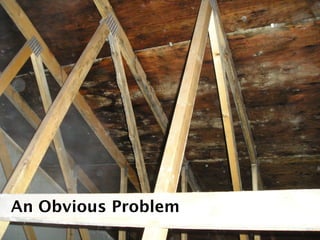
An Obvious Problem
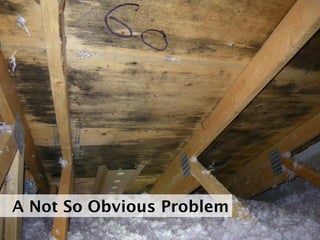
A Not So Obvious Problem
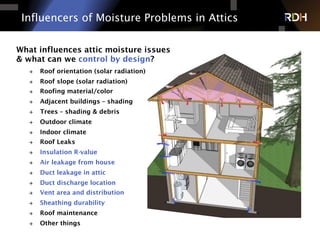
Influencers of Moisture Problems in Attics
What influences attic moisture issues
& what can we control by design?
à  Roof orientation (solar radiation)
à  Roof slope (solar radiation)
à  Roofing material/color
à  Adjacent buildings – shading
à  Trees – shading & debris
à  Outdoor climate
à  Indoor climate
à  Roof Leaks
à  Insulation R-value
à  Air leakage from house
à  Duct leakage in attic
à  Duct discharge location
à  Vent area and distribution
à  Sheathing durability
à  Roof maintenance
à  Other things
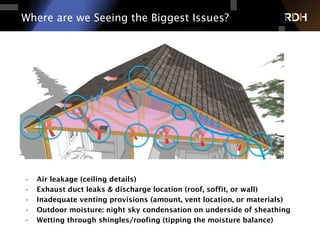
Where are we Seeing the Biggest Issues?
•  Air leakage (ceiling details)
•  Exhaust duct leaks & discharge location (roof, soffit, or wall)
•  Inadequate venting provisions (amount, vent location, or materials)
•  Outdoor moisture: night sky condensation on underside of sheathing
•  Wetting through shingles/roofing (tipping the moisture balance)
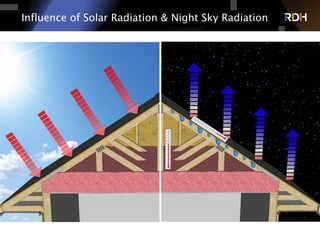
Influence of Solar Radiation & Night Sky Radiation
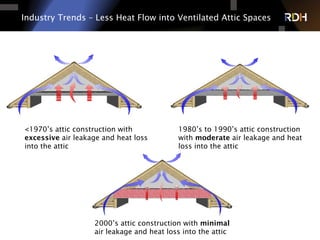
Industry Trends – Less Heat Flow into Ventilated Attic Spaces
<1970’s attic construction with
excessive air leakage and heat loss
into the attic
1980’s to 1990’s attic construction
with moderate air leakage and heat
loss into the attic
2000’s attic construction with minimal
air leakage and heat loss into the attic
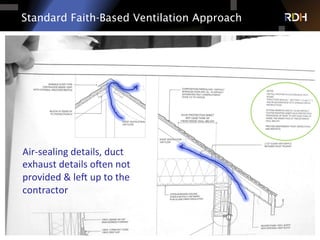
Standard Faith-Based Ventilation Approach
Air-­‐sealing	
  details,	
  duct	
  
exhaust	
  details	
  o4en	
  not	
  
provided	
  &	
  le4	
  up	
  to	
  the	
  
contractor	
  
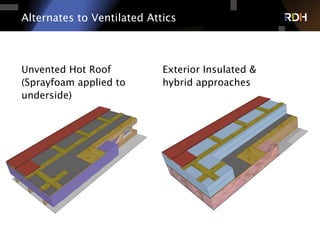
Alternates to Ventilated Attics
Unvented Hot Roof
(Sprayfoam applied to
underside)
Exterior Insulated &
hybrid approaches
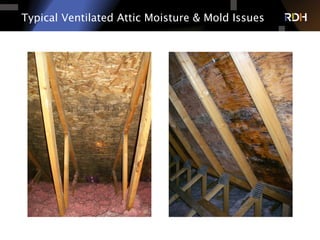
Typical Ventilated Attic Moisture & Mold Issues
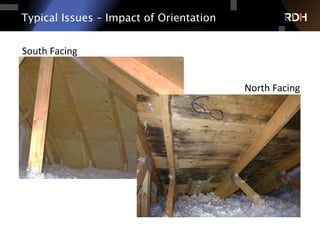
Typical Issues – Impact of Orientation
South	
  Facing	
  
North	
  Facing	
  
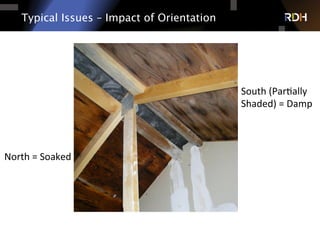
Typical Issues – Impact of Orientation
North	
  =	
  Soaked	
  
South	
  (Par?ally	
  
Shaded)	
  =	
  Damp	
  
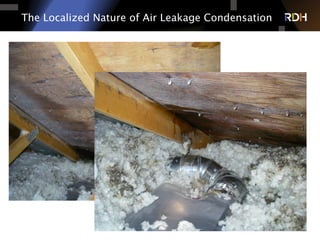
The Localized Nature of Air Leakage Condensation
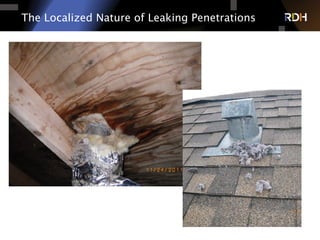
The Localized Nature of Leaking Penetrations
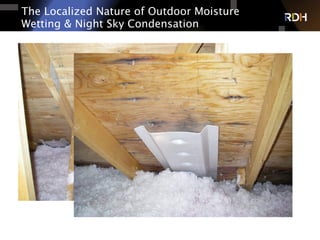
The Localized Nature of Outdoor Moisture
Wetting & Night Sky Condensation
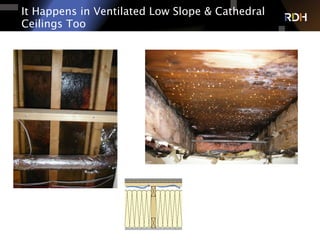
It Happens in Ventilated Low Slope & Cathedral
Ceilings Too
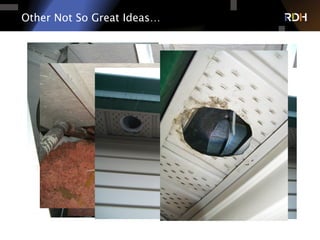
Other Not So Great Ideas…
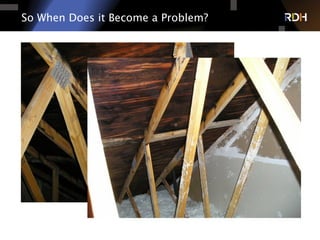
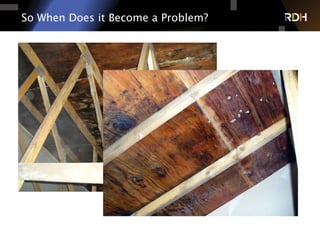
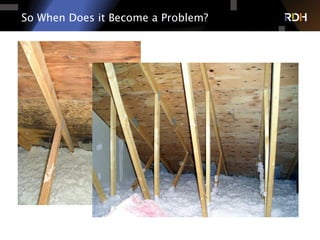
So When Does it Become a Problem?
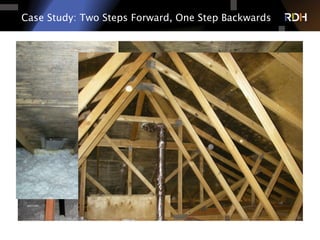
Case Study: Two Steps Forward, One Step Backwards
•  2007 investigation of 5 yr old large
townhouse complex
•  Was experiencing all of the problems we
were and still are currently seeing
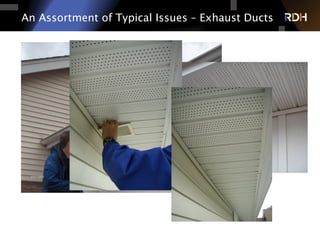
An Assortment of Typical Issues – Exhaust Ducts
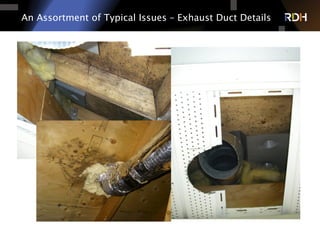
An Assortment of Typical Issues – Exhaust Duct Details
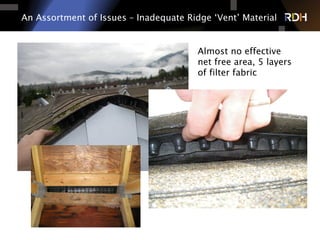
An Assortment of Issues – Inadequate Ridge ‘Vent’ Material
Almost no effective
net free area, 5 layers
of filter fabric
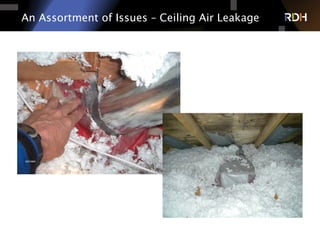
An Assortment of Issues – Ceiling Air Leakage
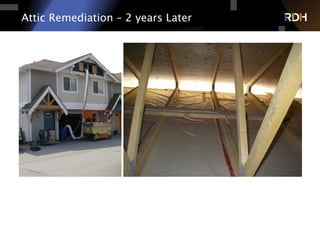
Attic Remediation – 2 years Later
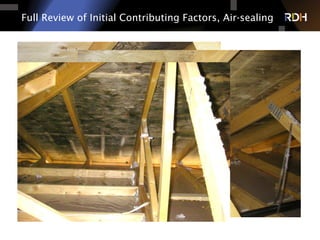
Full Review of Initial Contributing Factors, Air-sealing
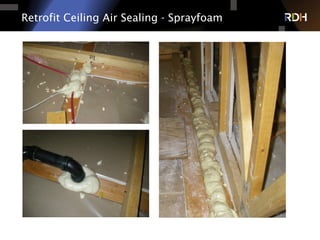
Retrofit Ceiling Air Sealing - Sprayfoam
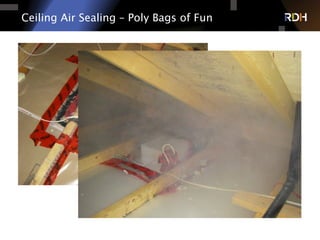
Ceiling Air Sealing – Poly Bags of Fun
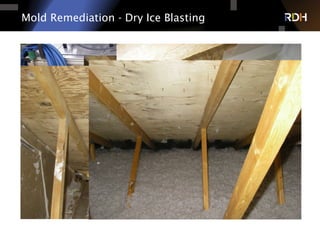
Mold Remediation - Dry Ice Blasting
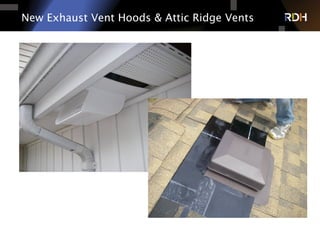
New Exhaust Vent Hoods & Attic Ridge Vents
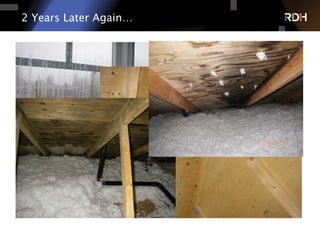
2 Years Later Again…
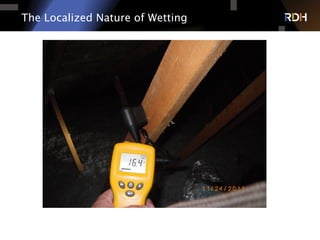
The Localized Nature of Wetting
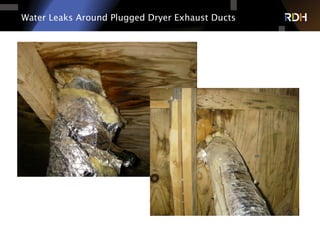
Water Leaks Around Plugged Dryer Exhaust Ducts
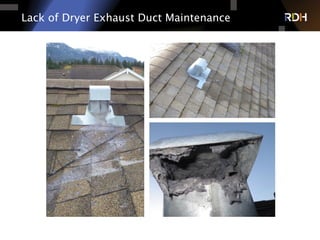
Lack of Dryer Exhaust Duct Maintenance
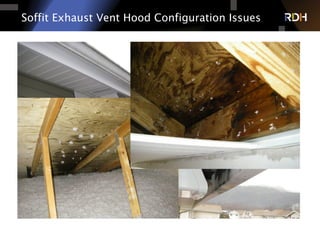
Soffit Exhaust Vent Hood Configuration Issues
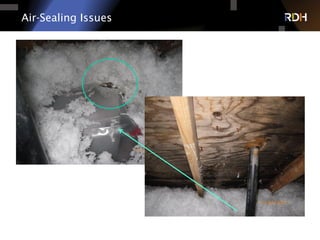
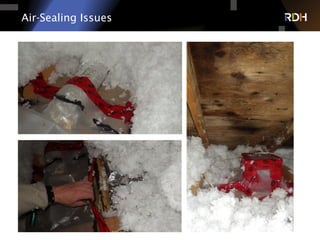
Air-Sealing Issues
Air-Sealing Issues
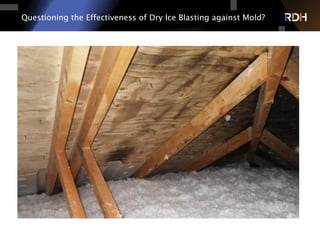
Questioning the Effectiveness of Dry Ice Blasting against Mold?
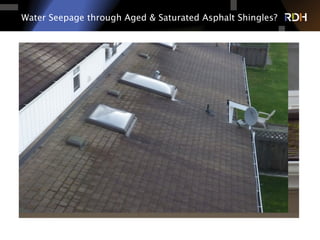
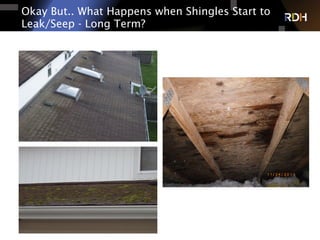
Water Seepage through Aged & Saturated Asphalt Shingles?
Key Findings from Field Investigations & Field
Monitoring
à  Seeing widespread issues with
mold growth in newer wood-
frame attics in Pacific Northwest
à  Wetting is exceeding drying
capacity provided by ventilation
à  Problem is most often NOT due
to a lack of ventilation
à  Usual culprits of air-leakage
condensation (leaky ceiling,
leaky ducts & discharge point)
à  Also seeing supplemental
exterior moisture sources (night
sky condensation, rainwater
seepage)
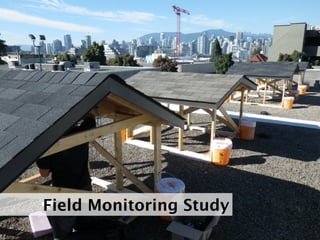
Field Monitoring Study
Research Study Premise
à  Controlled field monitoring
study to isolate exterior wetting
mechanisms from interior
sources (air, vapour)
à  To specifically evaluate impact
of orientation, slope (3:12,
4:12 and 6:12) & shingle
underlay
à  Remove influence of air leakage
or heat gain from house
à  Monitor the performance of
surface treatments
Typical ventilated attic
construction with air
leakage and heat loss
into the attic
Theoretical attic with no
air leakage or heat loss
into the attic and
unrestricted ventilation –
Study setup here
Concurrent Companion Research in Pacific
Northwest
à  Homeowner Protection Office of BC
à  RDH – monitoring field conditions & controlled
field study (covered here)
à  MH – monitoring of attic moisture levels and air-
leakage from indoors into attic spaces
à  FP Innovations – monitoring of effectiveness of
various surface treatments
à  BCIT – modeling of attic ventilation rates &
moisture movement
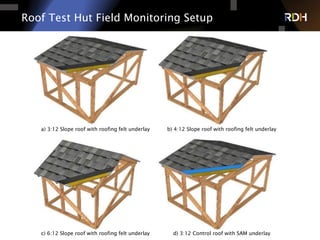
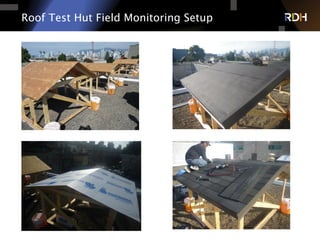
Roof Test Hut Field Monitoring Setup
a) 3:12 Slope roof with roofing felt underlay b) 4:12 Slope roof with roofing felt underlay
c) 6:12 Slope roof with roofing felt underlay d) 3:12 Control roof with SAM underlay
Roof Test Hut Field Monitoring Setup
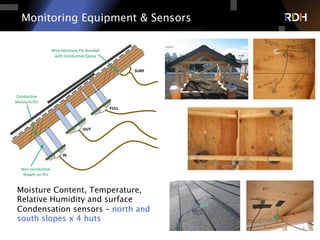
Monitoring Equipment & Sensors
Moisture Content, Temperature,
Relative Humidity and surface
Condensation sensors – north and
south slopes x 4 huts
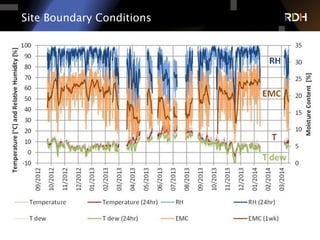
Site Boundary Conditions
0
5
10
15
20
25
30
09-­‐2012
10-­‐2012
11-­‐2012
12-­‐2012
01-­‐2013
02-­‐2013
03-­‐2013
04-­‐2013
05-­‐2013
06-­‐2013
07-­‐2013
08-­‐2013
09-­‐2013
10-­‐2013
11-­‐2013
12-­‐2013
01-­‐2014
02-­‐2014
03-­‐2014
Moisture	
  Content	
  [%]
	
  MC-­‐FULL-­‐S-­‐CONT 	
  MC-­‐FULL-­‐S-­‐312 	
  MC-­‐FULL-­‐S-­‐412
	
  MC-­‐FULL-­‐S-­‐612 EMC	
  (1	
  wk)
Seasonal Roof Sheathing Moisture Contents
EMC calculated - Hailwood and Horrobin (1946)
0
5
10
15
20
25
30
09-­‐2012
10-­‐2012
11-­‐2012
12-­‐2012
01-­‐2013
02-­‐2013
03-­‐2013
04-­‐2013
05-­‐2013
06-­‐2013
07-­‐2013
08-­‐2013
09-­‐2013
10-­‐2013
11-­‐2013
12-­‐2013
01-­‐2014
02-­‐2014
03-­‐2014
Moisture	
  Content	
  [%]
	
  MC-­‐FULL-­‐N-­‐CONT 	
  MC-­‐FULL-­‐N-­‐312 	
  MC-­‐FULL-­‐N-­‐412
	
  MC-­‐FULL-­‐N-­‐612 EMC	
  (1	
  wk)
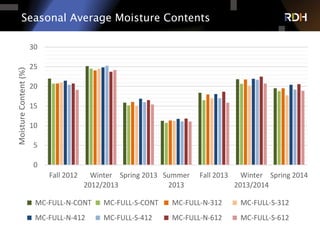
Seasonal Average Moisture Contents
0
5
10
15
20
25
30
Fall	
  2012 Winter
2012/2013
Spring	
  2013 Summer
2013
Fall	
  2013 Winter
2013/2014
Spring	
  2014
Moisture	
  Content	
  (%)
	
  MC-­‐FULL-­‐N-­‐CONT 	
  MC-­‐FULL-­‐S-­‐CONT 	
  MC-­‐FULL-­‐N-­‐312 	
  MC-­‐FULL-­‐S-­‐312
	
  MC-­‐FULL-­‐N-­‐412 	
  MC-­‐FULL-­‐S-­‐412 	
  MC-­‐FULL-­‐N-­‐612 	
  MC-­‐FULL-­‐S-­‐612
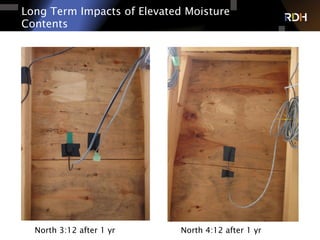
Long Term Impacts of Elevated Moisture
Contents
North 3:12 after 1 yr North 4:12 after 1 yr
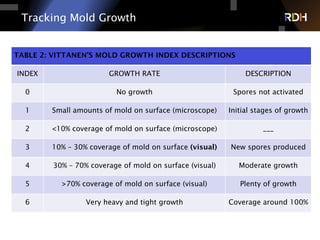
Tracking Mold Growth
TABLE 2: VITTANEN’S MOLD GROWTH INDEX DESCRIPTIONS
INDEX GROWTH RATE DESCRIPTION
0 No growth Spores not activated
1 Small amounts of mold on surface (microscope) Initial stages of growth
2 <10% coverage of mold on surface (microscope) ___
3 10% – 30% coverage of mold on surface (visual) New spores produced
4 30% – 70% coverage of mold on surface (visual) Moderate growth
5 >70% coverage of mold on surface (visual) Plenty of growth
6 Very heavy and tight growth Coverage around 100%
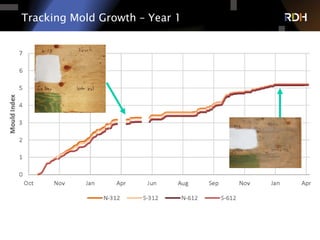
Tracking Mold Growth – Year 1
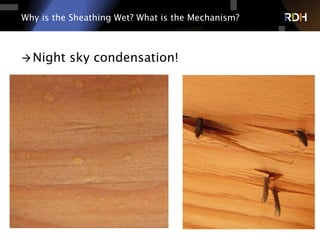
Why is the Sheathing Wet? What is the Mechanism?
à Night sky condensation!
Radiative heat loss from roof
surface to colder night sky
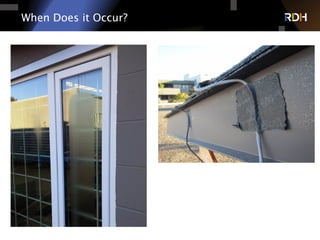
When Does it Occur?
When Does it Occur?
0
100
200
300
Oct	
  02 Oct	
  03 Oct	
  04 Oct	
  05 Oct	
  06
Sol
Solar	
  Radiation 	
  CONDENSE-­‐Plywood-­‐312
Increasin
0
5
10
15
20
25
30
Oct	
  02 Oct	
  03 Oct	
  04 Oct	
  05 Oct	
  06
Moisture	
  Content	
  [%]	
  and	
  Temperature	
  [°C]
Condensation
0
5
10
15
20
25
30
Oct	
  02 Oct	
  03 Oct	
  04 Oct	
  05 Oct	
  06
Moisture	
  Content	
  [%]	
  and	
  Temperature	
  [°C]
	
  MC-­‐FULL-­‐N-­‐312 	
  MC-­‐IN-­‐SURF-­‐N-­‐312 	
  T-­‐IN-­‐N-­‐312-­‐Plywood
T-­‐N-­‐312-­‐Embedded Outdoor	
  -­‐	
  Temperature Outdoor	
  -­‐	
  Dewpoint
COND-­‐N-­‐312	
  Sheathing Solar	
  Radiation
Condensation
When Does it Occur on the Underside of the
Sheathing?
0
100
200
300
400
Oct	
  02 Oct	
  03 Oct	
  04 Oct	
  05 Oct	
  06
Solar	
  Rad
Solar	
  Radiation 	
  CONDENSE-­‐Plywood-­‐312
IncreasingSurf
0
5
10
15
20
25
30
Oct	
  02 Oct	
  03 Oct	
  04 Oct	
  05 Oct	
  06
Moisture	
  Content	
  [%]	
  and	
  Temperature	
  [°C]
Condensation
0
100
200
300
400
500
600
700
800
900
1000
Oct	
  02 Oct	
  03 Oct	
  04 Oct	
  05 Oct	
  06
Solar	
  Radiation	
  [W/m2]
Solar	
  Radiation 	
  CONDENSE-­‐Plywood-­‐312
IncreasingSurfaceCondensation
25
30
perature	
  [°C]
0
100
200
Oct	
  02 Oct	
  03 Oct	
  04 Oct	
  05 Oct	
  06
Solar	
  Radiation 	
  CONDENSE-­‐Plywood-­‐312
Incre
0
5
10
15
20
25
30
Oct	
  02 Oct	
  03 Oct	
  04 Oct	
  05 Oct	
  06
Moisture	
  Content	
  [%]	
  and	
  Temperature	
  [°C]
Condensation
0
5
10
15
20
25
30
Oct	
  02 Oct	
  03 Oct	
  04 Oct	
  05 Oct	
  06
Moisture	
  Content	
  [%]	
  and	
  Temperature	
  [°C]
	
  MC-­‐FULL-­‐N-­‐312 	
  MC-­‐IN-­‐SURF-­‐N-­‐312 	
  T-­‐IN-­‐N-­‐312-­‐Plywood
T-­‐N-­‐312-­‐Embedded Outdoor	
  -­‐	
  Temperature Outdoor	
  -­‐	
  Dewpoint
COND-­‐N-­‐312	
  Sheathing Solar	
  Radiation
Condensation
Dry	
  
Heavy	
  Condensa.on	
  
Light	
  Condensa.on	
  
Daily	
  Solar	
  
Radia.on	
  Cycles	
  
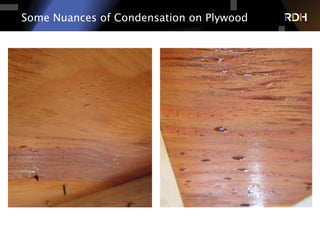
Some Nuances of Condensation on Plywood
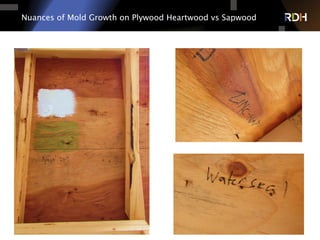
Nuances of Mold Growth on Plywood Heartwood vs Sapwood
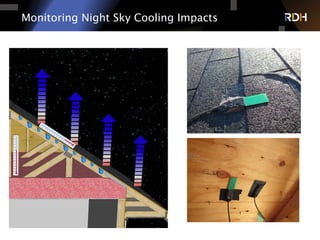
Monitoring Night Sky Cooling Impacts
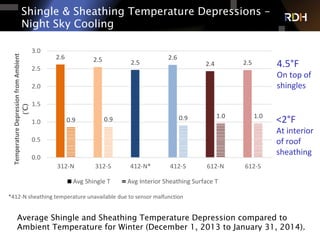
Shingle & Sheathing Temperature Depressions –
Night Sky Cooling
2.6 2.5 2.5
2.6
2.4 2.5
0.9 0.9 0.9 1.0 1.0
0.0
0.5
1.0
1.5
2.0
2.5
3.0
312-­‐N 312-­‐S 412-­‐N* 412-­‐S 612-­‐N 612-­‐S
Temperature	
  Depression	
  from	
  Ambient	
  
(°C)
Avg	
  Shingle	
  T Avg	
  Interior	
  Sheathing	
  Surface	
  T
*412-­‐N	
  sheathing	
  temperature	
  unavailable due	
  to	
  sensor	
  malfunction
4.5°F	
  
On	
  top	
  of	
  
shingles	
  
<2°F	
  
At	
  interior	
  
of	
  roof	
  
sheathing	
  
Average Shingle and Sheathing Temperature Depression compared to
Ambient Temperature for Winter (December 1, 2013 to January 31, 2014).
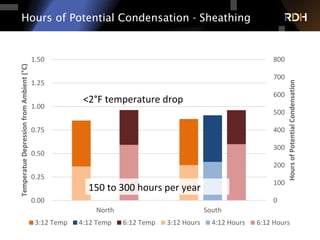
Hours of Potential Condensation - Sheathing
0
100
200
300
400
500
600
700
800
0.00
0.25
0.50
0.75
1.00
1.25
1.50
North South
Hours	
  of	
  Potential	
  Condensation
Temperatue	
  Depression	
  from	
  Ambient	
  (°C)
3:12	
  Temp 4:12	
  Temp 6:12	
  Temp 3:12	
  Hours 4:12	
  Hours 6:12	
  Hours
<2°F	
  temperature	
  drop	
  
150	
  to	
  300	
  hours	
  per	
  year	
  	
  
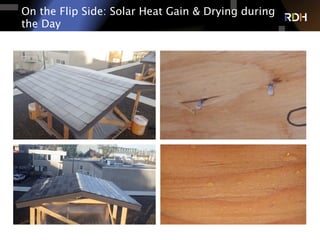
On the Flip Side: Solar Heat Gain & Drying during
the Day
On the Flip Side: Solar Heat Gain & Drying
Potential
0
5
10
15
20
25
30
35
40
45
50
55
60
Aug	
  21	
  00:00 Aug	
  21	
  06:00 Aug	
  21	
  12:00 Aug	
  21	
  18:00 Aug	
  22	
  00:00
Temperature	
  [°C]
Temperatures	
  -­‐ 3:12	
  and	
  6:12	
  Slope	
  Roofs	
  -­‐ Early	
  Spring	
  Conditions
	
  T-­‐OUT-­‐N-­‐612-­‐Shingle
	
  T-­‐OUT-­‐S-­‐612-­‐Shingle
	
  T-­‐IN-­‐N-­‐612-­‐Plywood
	
  T-­‐IN-­‐S-­‐612-­‐Plywood
	
  T-­‐OUT-­‐N-­‐312-­‐Shingle
	
  T-­‐OUT-­‐S-­‐312-­‐Shingle
	
  T-­‐IN-­‐N-­‐312-­‐Plywood
	
  T-­‐IN-­‐S-­‐312-­‐Plywood
Outdoor	
  -­‐	
  Dewpoint
Outdoor	
  -­‐	
  Temperature
South Shingles
130 -140°F
North Shingles
100-110°F
Ambient
Air up to
79°F
South Sheathing = 98°F
North Sheathing = 90°F
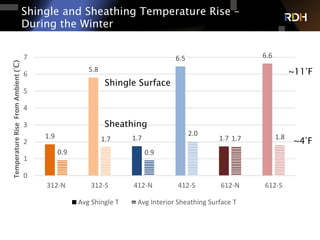
Shingle and Sheathing Temperature Rise –
During the Winter
1.9
5.8
1.7
6.5
1.7
6.6
0.9
1.7
0.9
2.0
1.7 1.8
0
1
2
3
4
5
6
7
312-­‐N 312-­‐S 412-­‐N 412-­‐S 612-­‐N 612-­‐S
Temperature	
  Rise	
  	
  From	
  Ambient	
  (°C)
Avg	
  Shingle	
  T Avg	
  Interior	
  Sheathing	
  Surface	
  T
Shingle Surface
Sheathing
~11°F
~4°F
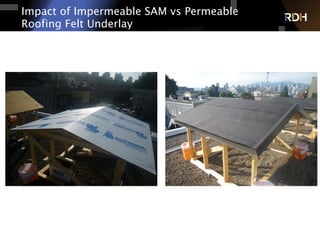
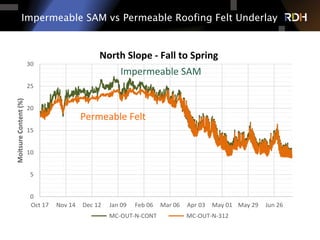
Impact of Impermeable SAM vs Permeable
Roofing Felt Underlay
0
5
10
15
20
25
30
Oct	
  17 Nov	
  14 Dec	
  12 Jan	
  09 Feb	
  06 Mar	
  06 Apr	
  03 May	
  01 May	
  29 Jun	
  26
Moitsure	
  Content	
  (%)
	
  MC-­‐OUT-­‐S-­‐CONT 	
  MC-­‐OUT-­‐S-­‐312
South	
  Slope	
  -­‐	
  Fall	
  to	
  Spring	
  
Impermeable SAM vs Permeable Roofing Felt Underlay
0
5
10
15
20
25
30
Oct	
  17 Nov	
  14 Dec	
  12 Jan	
  09 Feb	
  06 Mar	
  06 Apr	
  03 May	
  01 May	
  29 Jun	
  26
Moitsure	
  Content	
  (%)
	
  MC-­‐OUT-­‐N-­‐CONT 	
  MC-­‐OUT-­‐N-­‐312
Permeable	
  Felt	
  
Impermeable	
  SAM	
  
North	
  Slope	
  -­‐	
  Fall	
  to	
  Spring	
  
Okay But.. What Happens when Shingles Start to
Leak/Seep - Long Term?
Key Findings – The Cause of the Problem in the
Pacific Northwest
à  Roof sheathing in well ventilated attics (also soffits, canopies)
experiences elevated moisture levels in winter
à  Occurs despite elimination of typical wetting mechanisms
within attics (air leakage, duct leakage, rain water leaks etc.)
à  Moisture level is above equilibrium level indicating additional
wetting sources
à  Night sky cooling causes wetting when sheathing drops below
ambient dewpoint (few hundred hours per year) in attic
à  Difficult to stop it from occurring
à  Fungal growth occurs due elevated moisture and
condensation on underside of sheathing
à  More fungal growth on north than south – drying matters, the
heat from a ceiling above a house will also help too
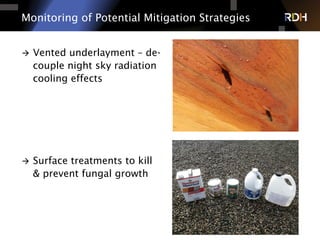
Monitoring of Potential Mitigation Strategies
à  Vented underlayment – de-
couple night sky radiation
cooling effects
à  Surface treatments to kill
& prevent fungal growth
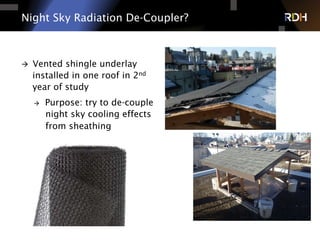
Night Sky Radiation De-Coupler?
à  Vented shingle underlay
installed in one roof in 2nd
year of study
à  Purpose: try to de-couple
night sky cooling effects
from sheathing
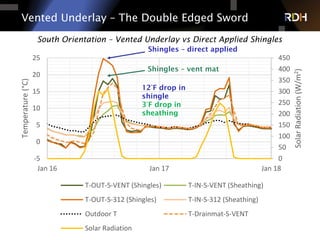
Vented Underlay – The Double Edged Sword
South Orientation – Vented Underlay vs Direct Applied Shingles
0
50
100
150
200
250
300
350
400
450
-­‐5
0
5
10
15
20
25
Jan	
  16 Jan	
  17 Jan	
  18
Solar	
  Radiation	
  (W/m2)
Temperature	
  (°C)
T-­‐OUT-­‐S-­‐VENT	
  (Shingles) T-­‐IN-­‐S-­‐VENT	
  (Sheathing)
T-­‐OUT-­‐S-­‐312	
  (Shingles) T-­‐IN-­‐S-­‐312	
  (Sheathing)
Outdoor	
  T T-­‐Drainmat-­‐S-­‐VENT
Solar	
  Radiation
Shingles – direct applied
Shingles – vent mat
12°F drop in
shingle
3°F drop in
sheathing
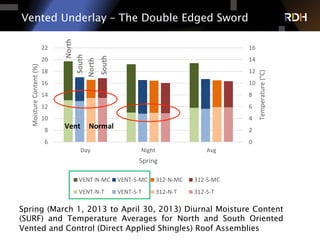
Vented Underlay – The Double Edged Sword
0
2
4
6
8
10
12
14
16
6
8
10
12
14
16
18
20
22
Day Night Avg
Temperature	
  (°C)
Moisture	
  Content	
  (%)
Spring
VENT-­‐N-­‐MC VENT-­‐S-­‐MC 312-­‐N-­‐MC 312-­‐S-­‐MC
VENT-­‐N-­‐T VENT-­‐S-­‐T 312-­‐N-­‐T 312-­‐S-­‐T
Vent	
   Normal	
  
North	
  	
  
South	
  
North	
  
South	
  
Spring (March 1, 2013 to April 30, 2013) Diurnal Moisture Content
(SURF) and Temperature Averages for North and South Oriented
Vented and Control (Direct Applied Shingles) Roof Assemblies
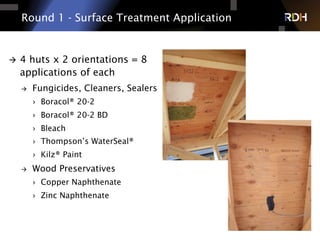
Round 1 - Surface Treatment Application
à  4 huts x 2 orientations = 8
applications of each
à  Fungicides, Cleaners, Sealers
›  Boracol® 20-2
›  Boracol® 20-2 BD
›  Bleach
›  Thompson’s WaterSeal®
›  Kilz® Paint
à  Wood Preservatives
›  Copper Naphthenate
›  Zinc Naphthenate
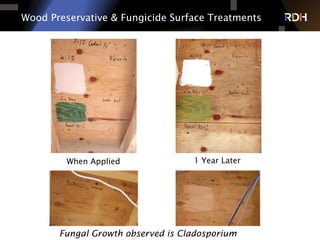
Wood Preservative & Fungicide Surface Treatments
When Applied 1 Year Later
Fungal Growth observed is Cladosporium
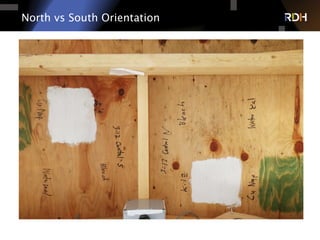
North vs South Orientation
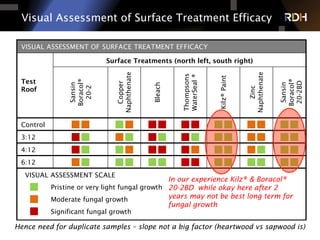
Visual Assessment of Surface Treatment Efficacy
VISUAL ASSESSMENT OF SURFACE TREATMENT EFFICACY
Test
Roof
Surface Treatments (north left, south right)
Sansin
Boracol®
20-2
Copper
Naphthenate
Bleach
Thompsons
WaterSeal®
Kilz®Paint
Zinc
Naphthenate
Sansin
Boracol®
20-2BD
Control
3:12
4:12
6:12
VISUAL ASSESSMENT SCALE
Pristine or very light fungal growth
Moderate fungal growth
Significant fungal growth
Hence need for duplicate samples – slope not a big factor (heartwood vs sapwood is)
In our experience Kilz® & Boracol®
20-2BD while okay here after 2
years may not be best long term for
fungal growth
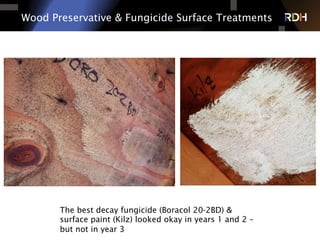
Wood Preservative & Fungicide Surface Treatments
The best decay fungicide (Boracol 20-2BD) &
surface paint (Kilz) looked okay in years 1 and 2 –
but not in year 3
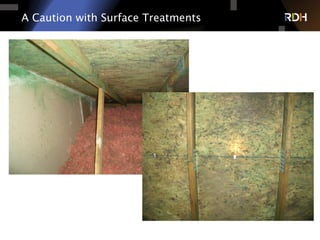
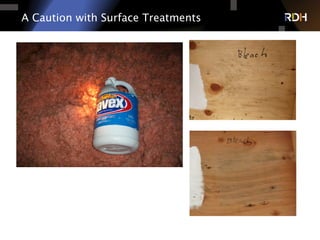
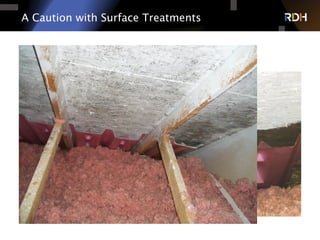
A Caution with Surface Treatments
Summary – Mitigation Strategy Performance
à  Thermally de-coupling the exposed shingles from the
sheathing did not work well
à  Did not significantly “warm” sheathing temperature at night
à  On flip-side – the sheathing did not get as hot during the day,
so less drying and resulting prolonged wet periods
à  Surface treatments appear to be a potential viable solution if
right product is developed - current products not quite
effective (nor developed specifically for this application)
à  Concurrent work by FP to perform accelerated testing of
some new biocides/fungicides
à  Ongoing monitoring at our huts to monitor long-term field
performance of next generation treatments
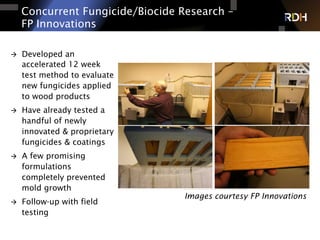
Concurrent Fungicide/Biocide Research –
FP Innovations
Images courtesy FP Innovations
à  Developed an
accelerated 12 week
test method to evaluate
new fungicides applied
to wood products
à  Have already tested a
handful of newly
innovated & proprietary
fungicides & coatings
à  A few promising
formulations
completely prevented
mold growth
à  Follow-up with field
testing
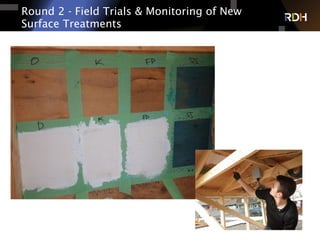
Round 2 - Field Trials & Monitoring of New
Surface Treatments
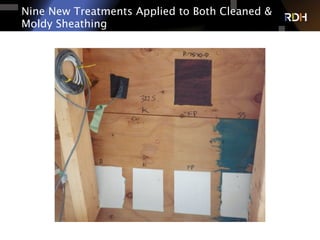
Nine New Treatments Applied to Both Cleaned &
Moldy Sheathing
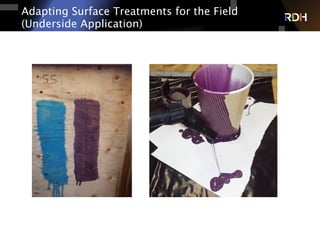
Adapting Surface Treatments for the Field
(Underside Application)
Ongoing Monitoring of New Surface Treatments
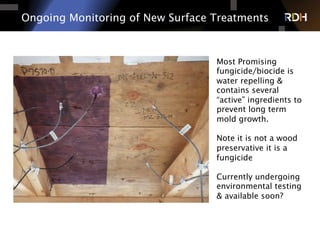
Most Promising
fungicide/biocide is
water repelling &
contains several
“active” ingredients to
prevent long term
mold growth.
Note it is not a wood
preservative it is a
fungicide
Currently undergoing
environmental testing
& available soon?
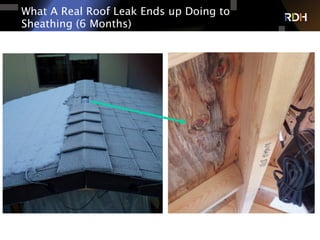
What A Real Roof Leak Ends up Doing to
Sheathing (6 Months)
Final Thoughts
à  Ventilated attics & roof assemblies ‘built to code’ are
experiencing mold growth on underside of sheathing
(plywood or OSB)
à  Wetting from night sky condensation and may be
exacerbated by air leaks & water leaks
à  Hard to reliably stop night sky condensation
à  More ventilation makes it worse, less may also
à  Mold growth may be minor but perceived as risk
à  Could build other attic assemblies but unlikely to replace
ventilated attics any time soon
à  Need to address durability & sensitivity of wood based
sheathings to mold growth
à  Just make sure the fungicide is no more harmful to
humans that the mold is
à  rdh.com
Discussion + Questions
Graham Finch – gfinch@rdh.com – 604-873-1181

The Problems With and Solutions for Ventilated Attics

  • 1.
    The Problems Withand Solutions for Ventilated Attics RCI 30TH INTERNATIONAL CONVENTION - SAN ANTONIO, TX MARCH 9, 2015 GRAHAM FINCH, MASC, P.ENG – RDH BUILDING ENGINEERING LTD.
  • 2.
    Presentation Overview à  CurrentIssues with Ventilated Attics à  Case Study of Repairs à  Attic Roof Hut Research & Monitoring Study – Key Findings à  Performance of Potential Solutions à  Ongoing Research & Field Trials
  • 3.
  • 4.
    A Not SoObvious Problem
  • 5.
    Influencers of MoistureProblems in Attics What influences attic moisture issues & what can we control by design? à  Roof orientation (solar radiation) à  Roof slope (solar radiation) à  Roofing material/color à  Adjacent buildings – shading à  Trees – shading & debris à  Outdoor climate à  Indoor climate à  Roof Leaks à  Insulation R-value à  Air leakage from house à  Duct leakage in attic à  Duct discharge location à  Vent area and distribution à  Sheathing durability à  Roof maintenance à  Other things
  • 6.
    Where are weSeeing the Biggest Issues? •  Air leakage (ceiling details) •  Exhaust duct leaks & discharge location (roof, soffit, or wall) •  Inadequate venting provisions (amount, vent location, or materials) •  Outdoor moisture: night sky condensation on underside of sheathing •  Wetting through shingles/roofing (tipping the moisture balance)
  • 7.
    Influence of SolarRadiation & Night Sky Radiation
  • 8.
    Industry Trends –Less Heat Flow into Ventilated Attic Spaces <1970’s attic construction with excessive air leakage and heat loss into the attic 1980’s to 1990’s attic construction with moderate air leakage and heat loss into the attic 2000’s attic construction with minimal air leakage and heat loss into the attic
  • 9.
    Standard Faith-Based VentilationApproach Air-­‐sealing  details,  duct   exhaust  details  o4en  not   provided  &  le4  up  to  the   contractor  
  • 10.
    Alternates to VentilatedAttics Unvented Hot Roof (Sprayfoam applied to underside) Exterior Insulated & hybrid approaches
  • 11.
    Typical Ventilated AtticMoisture & Mold Issues
  • 12.
    Typical Issues –Impact of Orientation South  Facing   North  Facing  
  • 13.
    Typical Issues –Impact of Orientation North  =  Soaked   South  (Par?ally   Shaded)  =  Damp  
  • 14.
    The Localized Natureof Air Leakage Condensation
  • 15.
    The Localized Natureof Leaking Penetrations
  • 16.
    The Localized Natureof Outdoor Moisture Wetting & Night Sky Condensation
  • 17.
    It Happens inVentilated Low Slope & Cathedral Ceilings Too
  • 18.
    Other Not SoGreat Ideas…
  • 19.
    So When Doesit Become a Problem?
  • 20.
    So When Doesit Become a Problem?
  • 21.
    So When Doesit Become a Problem?
  • 22.
    Case Study: TwoSteps Forward, One Step Backwards •  2007 investigation of 5 yr old large townhouse complex •  Was experiencing all of the problems we were and still are currently seeing
  • 23.
    An Assortment ofTypical Issues – Exhaust Ducts
  • 24.
    An Assortment ofTypical Issues – Exhaust Duct Details
  • 25.
    An Assortment ofIssues – Inadequate Ridge ‘Vent’ Material Almost no effective net free area, 5 layers of filter fabric
  • 26.
    An Assortment ofIssues – Ceiling Air Leakage
  • 27.
    Attic Remediation –2 years Later
  • 28.
    Full Review ofInitial Contributing Factors, Air-sealing
  • 29.
    Retrofit Ceiling AirSealing - Sprayfoam
  • 30.
    Ceiling Air Sealing– Poly Bags of Fun
  • 31.
    Mold Remediation -Dry Ice Blasting
  • 32.
    New Exhaust VentHoods & Attic Ridge Vents
  • 33.
    2 Years LaterAgain…
  • 34.
  • 35.
    Water Leaks AroundPlugged Dryer Exhaust Ducts
  • 36.
    Lack of DryerExhaust Duct Maintenance
  • 37.
    Soffit Exhaust VentHood Configuration Issues
  • 38.
  • 39.
  • 40.
    Questioning the Effectivenessof Dry Ice Blasting against Mold?
  • 41.
    Water Seepage throughAged & Saturated Asphalt Shingles?
  • 42.
    Key Findings fromField Investigations & Field Monitoring à  Seeing widespread issues with mold growth in newer wood- frame attics in Pacific Northwest à  Wetting is exceeding drying capacity provided by ventilation à  Problem is most often NOT due to a lack of ventilation à  Usual culprits of air-leakage condensation (leaky ceiling, leaky ducts & discharge point) à  Also seeing supplemental exterior moisture sources (night sky condensation, rainwater seepage)
  • 43.
  • 44.
    Research Study Premise à Controlled field monitoring study to isolate exterior wetting mechanisms from interior sources (air, vapour) à  To specifically evaluate impact of orientation, slope (3:12, 4:12 and 6:12) & shingle underlay à  Remove influence of air leakage or heat gain from house à  Monitor the performance of surface treatments Typical ventilated attic construction with air leakage and heat loss into the attic Theoretical attic with no air leakage or heat loss into the attic and unrestricted ventilation – Study setup here
  • 45.
    Concurrent Companion Researchin Pacific Northwest à  Homeowner Protection Office of BC à  RDH – monitoring field conditions & controlled field study (covered here) à  MH – monitoring of attic moisture levels and air- leakage from indoors into attic spaces à  FP Innovations – monitoring of effectiveness of various surface treatments à  BCIT – modeling of attic ventilation rates & moisture movement
  • 46.
    Roof Test HutField Monitoring Setup a) 3:12 Slope roof with roofing felt underlay b) 4:12 Slope roof with roofing felt underlay c) 6:12 Slope roof with roofing felt underlay d) 3:12 Control roof with SAM underlay
  • 47.
    Roof Test HutField Monitoring Setup
  • 48.
    Monitoring Equipment &Sensors Moisture Content, Temperature, Relative Humidity and surface Condensation sensors – north and south slopes x 4 huts
  • 49.
  • 50.
    0 5 10 15 20 25 30 09-­‐2012 10-­‐2012 11-­‐2012 12-­‐2012 01-­‐2013 02-­‐2013 03-­‐2013 04-­‐2013 05-­‐2013 06-­‐2013 07-­‐2013 08-­‐2013 09-­‐2013 10-­‐2013 11-­‐2013 12-­‐2013 01-­‐2014 02-­‐2014 03-­‐2014 Moisture  Content  [%]  MC-­‐FULL-­‐S-­‐CONT  MC-­‐FULL-­‐S-­‐312  MC-­‐FULL-­‐S-­‐412  MC-­‐FULL-­‐S-­‐612 EMC  (1  wk) Seasonal Roof Sheathing Moisture Contents EMC calculated - Hailwood and Horrobin (1946) 0 5 10 15 20 25 30 09-­‐2012 10-­‐2012 11-­‐2012 12-­‐2012 01-­‐2013 02-­‐2013 03-­‐2013 04-­‐2013 05-­‐2013 06-­‐2013 07-­‐2013 08-­‐2013 09-­‐2013 10-­‐2013 11-­‐2013 12-­‐2013 01-­‐2014 02-­‐2014 03-­‐2014 Moisture  Content  [%]  MC-­‐FULL-­‐N-­‐CONT  MC-­‐FULL-­‐N-­‐312  MC-­‐FULL-­‐N-­‐412  MC-­‐FULL-­‐N-­‐612 EMC  (1  wk)
  • 51.
    Seasonal Average MoistureContents 0 5 10 15 20 25 30 Fall  2012 Winter 2012/2013 Spring  2013 Summer 2013 Fall  2013 Winter 2013/2014 Spring  2014 Moisture  Content  (%)  MC-­‐FULL-­‐N-­‐CONT  MC-­‐FULL-­‐S-­‐CONT  MC-­‐FULL-­‐N-­‐312  MC-­‐FULL-­‐S-­‐312  MC-­‐FULL-­‐N-­‐412  MC-­‐FULL-­‐S-­‐412  MC-­‐FULL-­‐N-­‐612  MC-­‐FULL-­‐S-­‐612
  • 52.
    Long Term Impactsof Elevated Moisture Contents North 3:12 after 1 yr North 4:12 after 1 yr
  • 53.
    Tracking Mold Growth TABLE2: VITTANEN’S MOLD GROWTH INDEX DESCRIPTIONS INDEX GROWTH RATE DESCRIPTION 0 No growth Spores not activated 1 Small amounts of mold on surface (microscope) Initial stages of growth 2 <10% coverage of mold on surface (microscope) ___ 3 10% – 30% coverage of mold on surface (visual) New spores produced 4 30% – 70% coverage of mold on surface (visual) Moderate growth 5 >70% coverage of mold on surface (visual) Plenty of growth 6 Very heavy and tight growth Coverage around 100%
  • 54.
  • 55.
    Why is theSheathing Wet? What is the Mechanism? à Night sky condensation! Radiative heat loss from roof surface to colder night sky
  • 56.
  • 57.
    When Does itOccur? 0 100 200 300 Oct  02 Oct  03 Oct  04 Oct  05 Oct  06 Sol Solar  Radiation  CONDENSE-­‐Plywood-­‐312 Increasin 0 5 10 15 20 25 30 Oct  02 Oct  03 Oct  04 Oct  05 Oct  06 Moisture  Content  [%]  and  Temperature  [°C] Condensation 0 5 10 15 20 25 30 Oct  02 Oct  03 Oct  04 Oct  05 Oct  06 Moisture  Content  [%]  and  Temperature  [°C]  MC-­‐FULL-­‐N-­‐312  MC-­‐IN-­‐SURF-­‐N-­‐312  T-­‐IN-­‐N-­‐312-­‐Plywood T-­‐N-­‐312-­‐Embedded Outdoor  -­‐  Temperature Outdoor  -­‐  Dewpoint COND-­‐N-­‐312  Sheathing Solar  Radiation Condensation
  • 58.
    When Does itOccur on the Underside of the Sheathing? 0 100 200 300 400 Oct  02 Oct  03 Oct  04 Oct  05 Oct  06 Solar  Rad Solar  Radiation  CONDENSE-­‐Plywood-­‐312 IncreasingSurf 0 5 10 15 20 25 30 Oct  02 Oct  03 Oct  04 Oct  05 Oct  06 Moisture  Content  [%]  and  Temperature  [°C] Condensation 0 100 200 300 400 500 600 700 800 900 1000 Oct  02 Oct  03 Oct  04 Oct  05 Oct  06 Solar  Radiation  [W/m2] Solar  Radiation  CONDENSE-­‐Plywood-­‐312 IncreasingSurfaceCondensation 25 30 perature  [°C] 0 100 200 Oct  02 Oct  03 Oct  04 Oct  05 Oct  06 Solar  Radiation  CONDENSE-­‐Plywood-­‐312 Incre 0 5 10 15 20 25 30 Oct  02 Oct  03 Oct  04 Oct  05 Oct  06 Moisture  Content  [%]  and  Temperature  [°C] Condensation 0 5 10 15 20 25 30 Oct  02 Oct  03 Oct  04 Oct  05 Oct  06 Moisture  Content  [%]  and  Temperature  [°C]  MC-­‐FULL-­‐N-­‐312  MC-­‐IN-­‐SURF-­‐N-­‐312  T-­‐IN-­‐N-­‐312-­‐Plywood T-­‐N-­‐312-­‐Embedded Outdoor  -­‐  Temperature Outdoor  -­‐  Dewpoint COND-­‐N-­‐312  Sheathing Solar  Radiation Condensation Dry   Heavy  Condensa.on   Light  Condensa.on   Daily  Solar   Radia.on  Cycles  
  • 59.
    Some Nuances ofCondensation on Plywood
  • 60.
    Nuances of MoldGrowth on Plywood Heartwood vs Sapwood
  • 61.
    Monitoring Night SkyCooling Impacts
  • 62.
    Shingle & SheathingTemperature Depressions – Night Sky Cooling 2.6 2.5 2.5 2.6 2.4 2.5 0.9 0.9 0.9 1.0 1.0 0.0 0.5 1.0 1.5 2.0 2.5 3.0 312-­‐N 312-­‐S 412-­‐N* 412-­‐S 612-­‐N 612-­‐S Temperature  Depression  from  Ambient   (°C) Avg  Shingle  T Avg  Interior  Sheathing  Surface  T *412-­‐N  sheathing  temperature  unavailable due  to  sensor  malfunction 4.5°F   On  top  of   shingles   <2°F   At  interior   of  roof   sheathing   Average Shingle and Sheathing Temperature Depression compared to Ambient Temperature for Winter (December 1, 2013 to January 31, 2014).
  • 63.
    Hours of PotentialCondensation - Sheathing 0 100 200 300 400 500 600 700 800 0.00 0.25 0.50 0.75 1.00 1.25 1.50 North South Hours  of  Potential  Condensation Temperatue  Depression  from  Ambient  (°C) 3:12  Temp 4:12  Temp 6:12  Temp 3:12  Hours 4:12  Hours 6:12  Hours <2°F  temperature  drop   150  to  300  hours  per  year    
  • 64.
    On the FlipSide: Solar Heat Gain & Drying during the Day
  • 65.
    On the FlipSide: Solar Heat Gain & Drying Potential 0 5 10 15 20 25 30 35 40 45 50 55 60 Aug  21  00:00 Aug  21  06:00 Aug  21  12:00 Aug  21  18:00 Aug  22  00:00 Temperature  [°C] Temperatures  -­‐ 3:12  and  6:12  Slope  Roofs  -­‐ Early  Spring  Conditions  T-­‐OUT-­‐N-­‐612-­‐Shingle  T-­‐OUT-­‐S-­‐612-­‐Shingle  T-­‐IN-­‐N-­‐612-­‐Plywood  T-­‐IN-­‐S-­‐612-­‐Plywood  T-­‐OUT-­‐N-­‐312-­‐Shingle  T-­‐OUT-­‐S-­‐312-­‐Shingle  T-­‐IN-­‐N-­‐312-­‐Plywood  T-­‐IN-­‐S-­‐312-­‐Plywood Outdoor  -­‐  Dewpoint Outdoor  -­‐  Temperature South Shingles 130 -140°F North Shingles 100-110°F Ambient Air up to 79°F South Sheathing = 98°F North Sheathing = 90°F
  • 66.
    Shingle and SheathingTemperature Rise – During the Winter 1.9 5.8 1.7 6.5 1.7 6.6 0.9 1.7 0.9 2.0 1.7 1.8 0 1 2 3 4 5 6 7 312-­‐N 312-­‐S 412-­‐N 412-­‐S 612-­‐N 612-­‐S Temperature  Rise    From  Ambient  (°C) Avg  Shingle  T Avg  Interior  Sheathing  Surface  T Shingle Surface Sheathing ~11°F ~4°F
  • 67.
    Impact of ImpermeableSAM vs Permeable Roofing Felt Underlay
  • 68.
    0 5 10 15 20 25 30 Oct  17 Nov  14 Dec  12 Jan  09 Feb  06 Mar  06 Apr  03 May  01 May  29 Jun  26 Moitsure  Content  (%)  MC-­‐OUT-­‐S-­‐CONT  MC-­‐OUT-­‐S-­‐312 South  Slope  -­‐  Fall  to  Spring   Impermeable SAM vs Permeable Roofing Felt Underlay 0 5 10 15 20 25 30 Oct  17 Nov  14 Dec  12 Jan  09 Feb  06 Mar  06 Apr  03 May  01 May  29 Jun  26 Moitsure  Content  (%)  MC-­‐OUT-­‐N-­‐CONT  MC-­‐OUT-­‐N-­‐312 Permeable  Felt   Impermeable  SAM   North  Slope  -­‐  Fall  to  Spring  
  • 69.
    Okay But.. WhatHappens when Shingles Start to Leak/Seep - Long Term?
  • 70.
    Key Findings –The Cause of the Problem in the Pacific Northwest à  Roof sheathing in well ventilated attics (also soffits, canopies) experiences elevated moisture levels in winter à  Occurs despite elimination of typical wetting mechanisms within attics (air leakage, duct leakage, rain water leaks etc.) à  Moisture level is above equilibrium level indicating additional wetting sources à  Night sky cooling causes wetting when sheathing drops below ambient dewpoint (few hundred hours per year) in attic à  Difficult to stop it from occurring à  Fungal growth occurs due elevated moisture and condensation on underside of sheathing à  More fungal growth on north than south – drying matters, the heat from a ceiling above a house will also help too
  • 71.
    Monitoring of PotentialMitigation Strategies à  Vented underlayment – de- couple night sky radiation cooling effects à  Surface treatments to kill & prevent fungal growth
  • 72.
    Night Sky RadiationDe-Coupler? à  Vented shingle underlay installed in one roof in 2nd year of study à  Purpose: try to de-couple night sky cooling effects from sheathing
  • 73.
    Vented Underlay –The Double Edged Sword South Orientation – Vented Underlay vs Direct Applied Shingles 0 50 100 150 200 250 300 350 400 450 -­‐5 0 5 10 15 20 25 Jan  16 Jan  17 Jan  18 Solar  Radiation  (W/m2) Temperature  (°C) T-­‐OUT-­‐S-­‐VENT  (Shingles) T-­‐IN-­‐S-­‐VENT  (Sheathing) T-­‐OUT-­‐S-­‐312  (Shingles) T-­‐IN-­‐S-­‐312  (Sheathing) Outdoor  T T-­‐Drainmat-­‐S-­‐VENT Solar  Radiation Shingles – direct applied Shingles – vent mat 12°F drop in shingle 3°F drop in sheathing
  • 74.
    Vented Underlay –The Double Edged Sword 0 2 4 6 8 10 12 14 16 6 8 10 12 14 16 18 20 22 Day Night Avg Temperature  (°C) Moisture  Content  (%) Spring VENT-­‐N-­‐MC VENT-­‐S-­‐MC 312-­‐N-­‐MC 312-­‐S-­‐MC VENT-­‐N-­‐T VENT-­‐S-­‐T 312-­‐N-­‐T 312-­‐S-­‐T Vent   Normal   North     South   North   South   Spring (March 1, 2013 to April 30, 2013) Diurnal Moisture Content (SURF) and Temperature Averages for North and South Oriented Vented and Control (Direct Applied Shingles) Roof Assemblies
  • 75.
    Round 1 -Surface Treatment Application à  4 huts x 2 orientations = 8 applications of each à  Fungicides, Cleaners, Sealers ›  Boracol® 20-2 ›  Boracol® 20-2 BD ›  Bleach ›  Thompson’s WaterSeal® ›  Kilz® Paint à  Wood Preservatives ›  Copper Naphthenate ›  Zinc Naphthenate
  • 76.
    Wood Preservative &Fungicide Surface Treatments When Applied 1 Year Later Fungal Growth observed is Cladosporium
  • 77.
    North vs SouthOrientation
  • 78.
    Visual Assessment ofSurface Treatment Efficacy VISUAL ASSESSMENT OF SURFACE TREATMENT EFFICACY Test Roof Surface Treatments (north left, south right) Sansin Boracol® 20-2 Copper Naphthenate Bleach Thompsons WaterSeal® Kilz®Paint Zinc Naphthenate Sansin Boracol® 20-2BD Control 3:12 4:12 6:12 VISUAL ASSESSMENT SCALE Pristine or very light fungal growth Moderate fungal growth Significant fungal growth Hence need for duplicate samples – slope not a big factor (heartwood vs sapwood is) In our experience Kilz® & Boracol® 20-2BD while okay here after 2 years may not be best long term for fungal growth
  • 79.
    Wood Preservative &Fungicide Surface Treatments The best decay fungicide (Boracol 20-2BD) & surface paint (Kilz) looked okay in years 1 and 2 – but not in year 3
  • 80.
    A Caution withSurface Treatments
  • 81.
    A Caution withSurface Treatments
  • 82.
    A Caution withSurface Treatments
  • 83.
    Summary – MitigationStrategy Performance à  Thermally de-coupling the exposed shingles from the sheathing did not work well à  Did not significantly “warm” sheathing temperature at night à  On flip-side – the sheathing did not get as hot during the day, so less drying and resulting prolonged wet periods à  Surface treatments appear to be a potential viable solution if right product is developed - current products not quite effective (nor developed specifically for this application) à  Concurrent work by FP to perform accelerated testing of some new biocides/fungicides à  Ongoing monitoring at our huts to monitor long-term field performance of next generation treatments
  • 84.
    Concurrent Fungicide/Biocide Research– FP Innovations Images courtesy FP Innovations à  Developed an accelerated 12 week test method to evaluate new fungicides applied to wood products à  Have already tested a handful of newly innovated & proprietary fungicides & coatings à  A few promising formulations completely prevented mold growth à  Follow-up with field testing
  • 85.
    Round 2 -Field Trials & Monitoring of New Surface Treatments
  • 86.
    Nine New TreatmentsApplied to Both Cleaned & Moldy Sheathing
  • 87.
    Adapting Surface Treatmentsfor the Field (Underside Application)
  • 88.
    Ongoing Monitoring ofNew Surface Treatments Most Promising fungicide/biocide is water repelling & contains several “active” ingredients to prevent long term mold growth. Note it is not a wood preservative it is a fungicide Currently undergoing environmental testing & available soon?
  • 89.
    What A RealRoof Leak Ends up Doing to Sheathing (6 Months)
  • 90.
    Final Thoughts à  Ventilatedattics & roof assemblies ‘built to code’ are experiencing mold growth on underside of sheathing (plywood or OSB) à  Wetting from night sky condensation and may be exacerbated by air leaks & water leaks à  Hard to reliably stop night sky condensation à  More ventilation makes it worse, less may also à  Mold growth may be minor but perceived as risk à  Could build other attic assemblies but unlikely to replace ventilated attics any time soon à  Need to address durability & sensitivity of wood based sheathings to mold growth à  Just make sure the fungicide is no more harmful to humans that the mold is
  • 91.
    à  rdh.com Discussion +Questions Graham Finch – gfinch@rdh.com – 604-873-1181