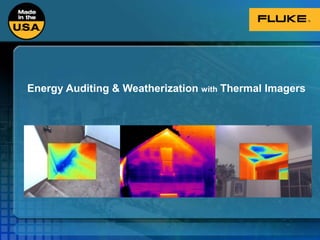
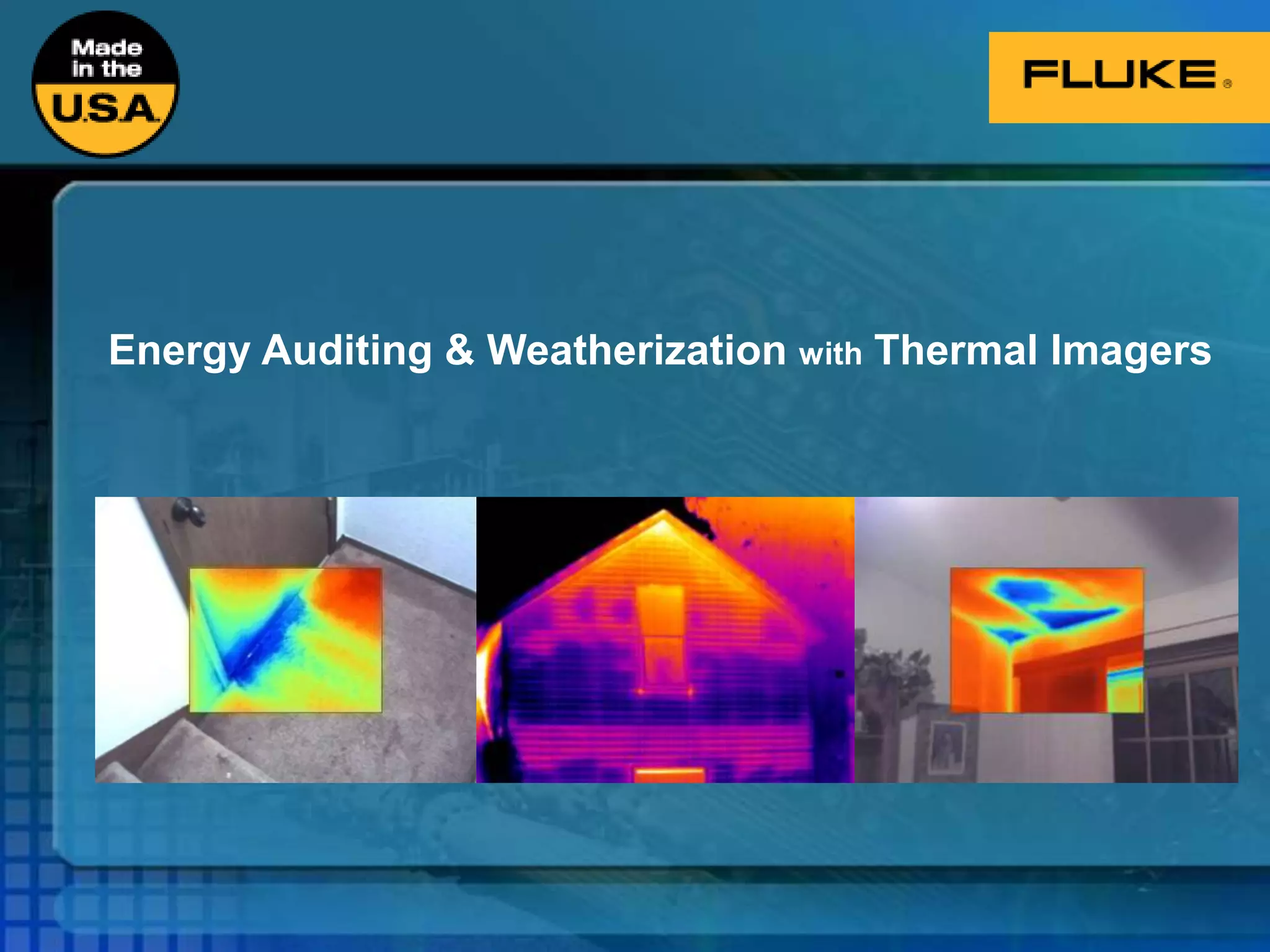
Energy Auditing & Weatherization with Thermal Imagers
AgendaEnergy Auditing, Weatherization & Energy UseWhere & How Thermal Imaging Fits InIR-Fusion® technology Air Leaks & InsulationMoistureElectrical RoofsThermography physics and heat transferHow a thermal imager worksResolving detail and parameters of a good imageFluke Thermal ImagersSmartView® Software
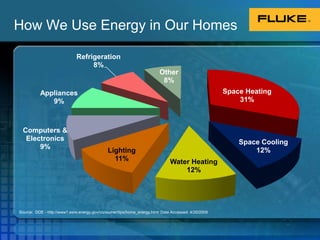
How We Use Energy in Our HomesSource:  DOE - http://www1.eere.energy.gov/consumer/tips/home_energy.html  Date Accessed: 4/20/2009
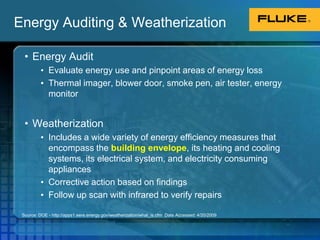
Energy Auditing & WeatherizationEnergy AuditEvaluate energy use and pinpoint areas of energy lossThermal imager, blower door, smoke pen, air tester, energy monitorWeatherization Includes a wide variety of energy efficiency measures that encompass the building envelope, its heating and cooling systems, its electrical system, and electricity consuming appliancesCorrective action based on findingsFollow up scan with infrared to verify repairsSource: DOE - http://apps1.eere.energy.gov/weatherization/what_is.cfm  Date Accessed: 4/20/2009
According to ENERGY STAR®:  “…sealing and insulating the "envelope" or "shell" of your home — its outer walls, ceiling, windows, doors, and floors — is often the most cost effective way to improve energy efficiency and comfort.”Source - http://www.energystar.gov/index.cfm?c=home_sealing.hm_improvement_sealing  Date Accessed:  4/20/2009
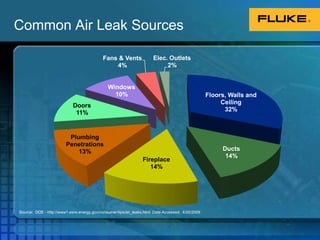
Common Air Leak SourcesSource:  DOE - http://www1.eere.energy.gov/consumer/tips/air_leaks.html  Date Accessed:  4/20/2009
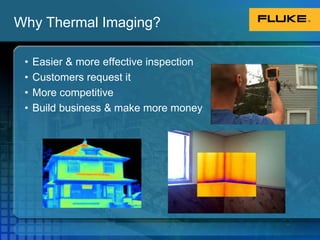
Why Thermal Imaging?Easier & more effective inspectionCustomers request itMore competitiveBuild business & make more money
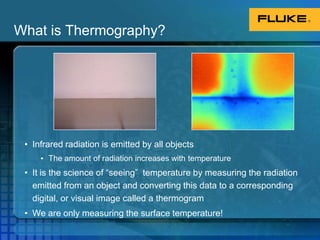
What is Thermography?Infrared radiation is emitted by all objectsThe amount of radiation increases with temperatureIt is the science of “seeing”  temperature by measuring the radiation emitted from an object and converting this data to a corresponding digital, or visual image called a thermogramWe are only measuring the surface temperature!
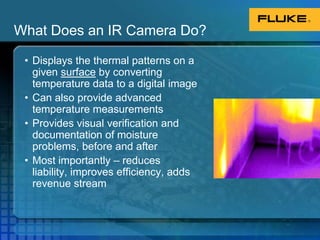
What Does an IR Camera Do?Displays the thermal patterns on a given surface by converting temperature data to a digital imageCan also provide advanced temperature measurementsProvides visual verification and documentation of moisture problems, before and afterMost importantly – reduces liability, improves efficiency, adds revenue stream
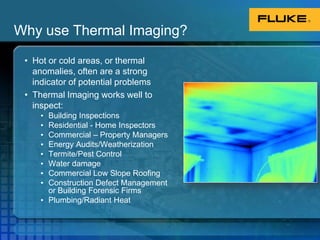
Why use Thermal Imaging?Hot or cold areas, or thermal anomalies, often are a strong indicator of potential problemsThermal Imaging works well to inspect:Building InspectionsResidential - Home InspectorsCommercial – Property ManagersEnergy Audits/WeatherizationTermite/Pest ControlWater damageCommercial Low Slope RoofingConstruction Defect Management or Building Forensic FirmsPlumbing/Radiant Heat
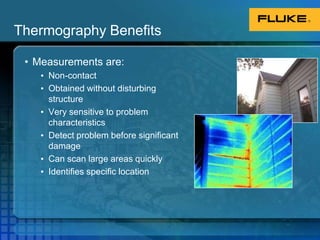
Thermography BenefitsMeasurements are:Non-contactObtained without disturbing structureVery sensitive to problem characteristics Detect problem before significant damageCan scan large areas quicklyIdentifies specific location
Why Thermal Imaging?“The time savings alone made my investment in thermal imaging well worth it.  Infrared allows me to quickly and easily locate air leaks and missing insulation without having to drill and probe with a manometer.”		- Andy Imig		Owner, Arrowhead Energy and Comfort Solutions – Esko, MN		Instructor, Dunwoody Institute & Fond du Lac Tribal and Community College
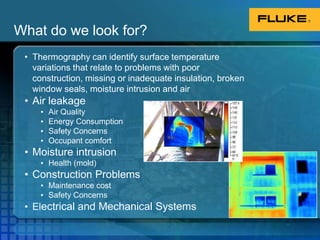
What do we look for? Thermography can identify surface temperature variations that relate to problems with poor construction, missing or inadequate insulation, broken window seals, moisture intrusion and airAir leakageAir QualityEnergy ConsumptionSafety ConcernsOccupant comfortMoisture intrusionHealth (mold)Construction ProblemsMaintenance costSafety ConcernsElectrical and Mechanical Systems
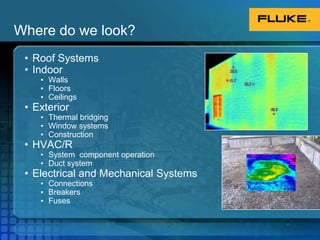
Where do we look?Roof SystemsIndoorWallsFloorsCeilingsExteriorThermal bridgingWindow systemsConstructionHVAC/R System  component operationDuct systemElectrical and Mechanical SystemsConnectionsBreakersFuses
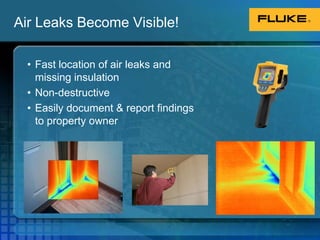
Air Leaks Become Visible!Fast location of air leaks and missing insulationNon-destructiveEasily document & report findings to property owner
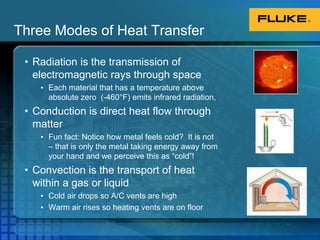
Three Modes of Heat TransferRadiation is the transmission of electromagnetic rays through space Each material that has a temperature above absolute zero  (-460°F) emits infrared radiation, Conduction is direct heat flow through matter Fun fact: Notice how metal feels cold?  It is not – that is only the metal taking energy away from your hand and we perceive this as “cold”!Convection is the transport of heat within a gas or liquidCold air drops so A/C vents are highWarm air rises so heating vents are on floor
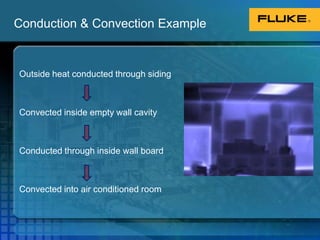
Conduction & Convection ExampleOutside heat conducted through sidingConvected inside empty wall cavityConducted through inside wall boardConvected into air conditioned room
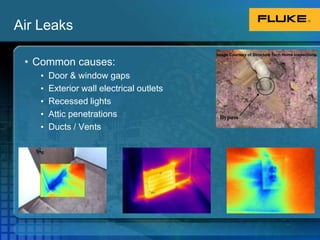
Air LeaksImage Courtesy of Structure Tech Home InspectionsCommon causes:Door & window gapsExterior wall electrical outletsRecessed lightsAttic penetrationsDucts / Vents
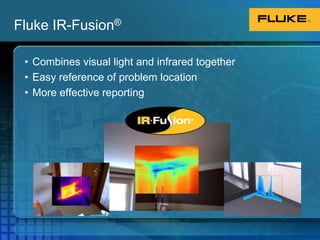
Fluke IR-Fusion®Combines visual light and infrared togetherEasy reference of problem locationMore effective reporting
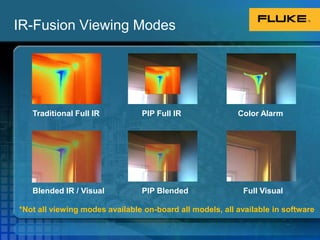
IR-Fusion Viewing ModesTraditional Full IRColor AlarmPIP Full IRFull VisualPIP BlendedBlended IR / Visual*Not all viewing modes available on-board all models, all available in software
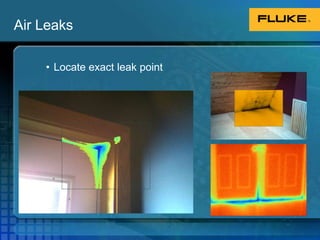
Air LeaksLocate exact leak point
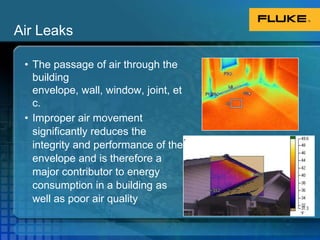
Air LeaksThe passage of air through the building envelope, wall, window, joint, etc.Improper air movement significantly reduces the integrity and performance of the envelope and is therefore a major contributor to energy consumption in a building as well as poor air quality
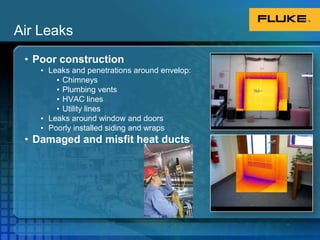
Air LeaksPoor constructionLeaks and penetrations around envelop:ChimneysPlumbing ventsHVAC linesUtility linesLeaks around window and doorsPoorly installed siding and wrapsDamaged and misfit heat ducts
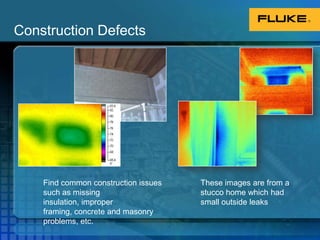
Construction DefectsFind common construction issues such as missing insulation, improper framing, concrete and masonry problems, etc.These images are from a stucco home which had small outside leaks
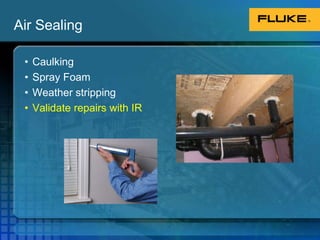
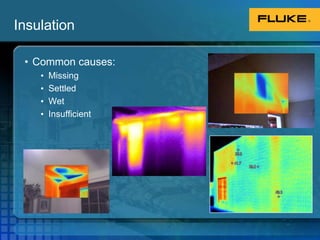
Air SealingCaulkingSpray FoamWeather strippingValidate repairs with IRInsulationCommon causes:MissingSettledWetInsufficient
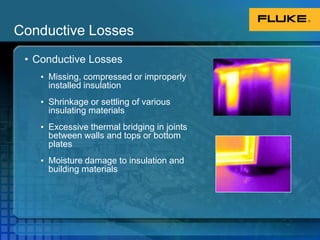
Conductive LossesConductive LossesMissing, compressed or improperly installed insulationShrinkage or settling of various insulating materialsExcessive thermal bridging in joints between walls and tops or bottom platesMoisture damage to insulation and building materials
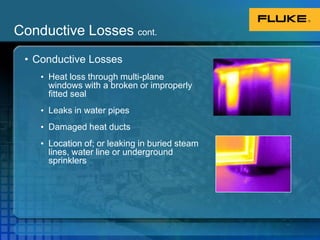
Conductive Losses cont.Conductive LossesHeat loss through multi-plane windows with a broken or improperly fitted sealLeaks in water pipesDamaged heat ductsLocation of; or leaking in buried steam lines, water line or underground sprinklers
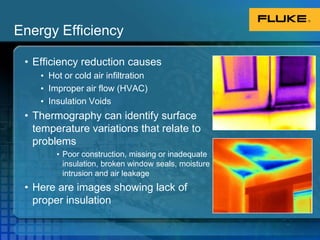
Energy EfficiencyEfficiency reduction causesHot or cold air infiltrationImproper air flow (HVAC)Insulation VoidsThermography can identify surface temperature variations that relate to problemsPoor construction, missing or inadequate insulation, broken window seals, moisture intrusion and air leakageHere are images showing lack of proper insulation
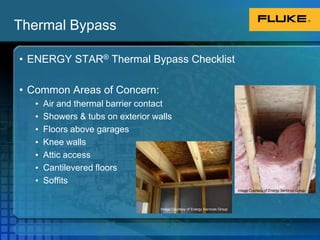
Thermal BypassENERGY STAR® Thermal Bypass ChecklistCommon Areas of Concern:Air and thermal barrier contactShowers & tubs on exterior wallsFloors above garagesKnee wallsAttic accessCantilevered floorsSoffitsImage Courtesy of Energy Services GroupImage Courtesy of Energy Services Group
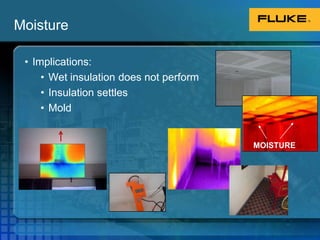
MoistureImplications:
Wet insulation does not perform
Insulation settles
MoldMOISTURE
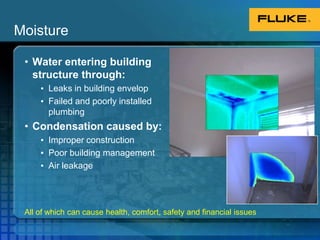
MoistureWater entering building structure through:Leaks in building envelopFailed and poorly installed plumbingCondensation caused by:Improper constructionPoor building managementAir leakageAll of which can cause health, comfort, safety and financial issues
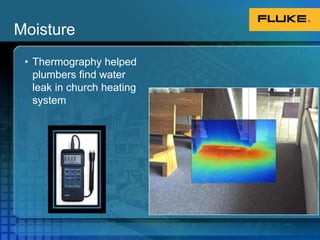
MoistureThermography helped plumbers find water leak in church heating system
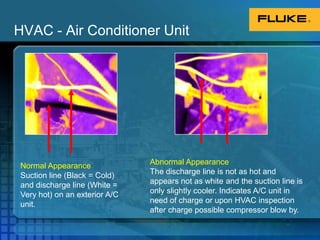
HVAC - Air Conditioner UnitAbnormal AppearanceThe discharge line is not as hot and appears not as white and the suction line is only slightly cooler. Indicates A/C unit in need of charge or upon HVAC inspection after charge possible compressor blow by.Normal AppearanceSuction line (Black = Cold)and discharge line (White = Very hot) on an exterior A/C unit.
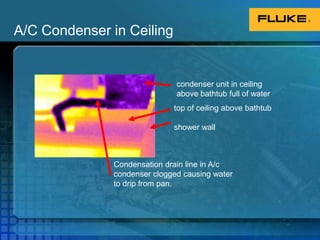
A/C Condenser in Ceilingcondenser unit in ceiling above bathtub full of watertop of ceiling above bathtubshower wallCondensation drain line in A/c condenser clogged causing water to drip from pan.
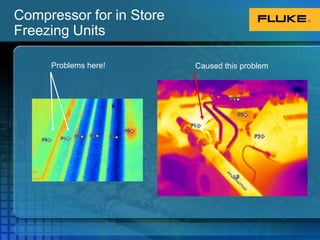
Compressor for in Store Freezing UnitsProblems here!Caused this problem
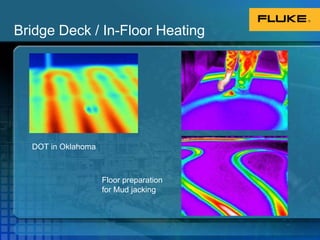
Bridge Deck / In-Floor HeatingDOT in OklahomaFloor preparation for Mud jacking
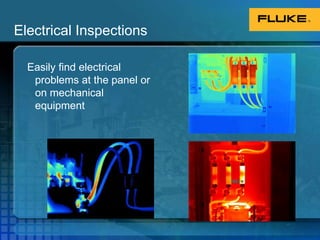
Electrical InspectionsEasily find electrical     problems at the panel or on mechanical equipment
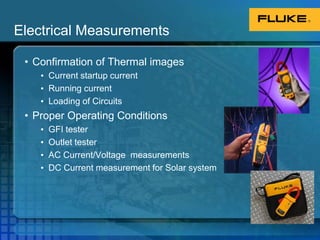
Electrical MeasurementsConfirmation of Thermal imagesCurrent startup currentRunning currentLoading of CircuitsProper Operating ConditionsGFI testerOutlet testerAC Current/Voltage  measurementsDC Current measurement for Solar system
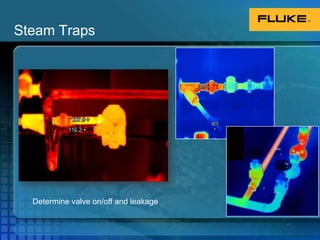
Steam TrapsDetermine valve on/off and leakage
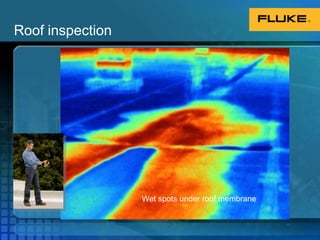
Roof inspectionWet spots under roof membrane
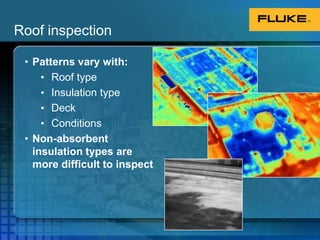
Roof inspectionPatterns vary with: Roof type Insulation type Deck ConditionsNon-absorbent insulation types are more difficult to inspect
It’s not just about energy loss!Excessive leakage can also cause condensation to form within and on walls which can create many problems:Permanently damage insulationSeriously degrade materialsRot woodCorrode metals Stain brick, concrete or surfacesExtreme cases will cause concrete to spall, bricks to separate, mortar to crumble and sections of wall to fallCorrode structural steal, re-bar and metal hangers and bolts
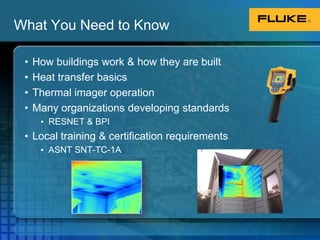
What You Need to KnowHow buildings work & how they are builtHeat transfer basicsThermal imager operationMany organizations developing standardsRESNET & BPILocal training & certification requirementsASNT SNT-TC-1A
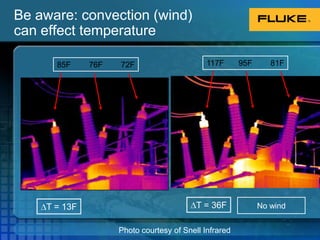
Be aware: convection (wind) can effect temperature117F	95F	81F85F	76F	72FNo windT = 36FT = 13FPhoto courtesy of Snell Infrared
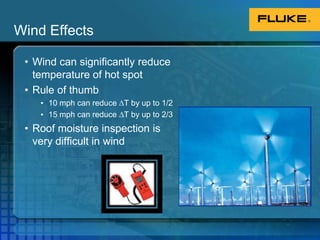
Wind can significantly reduce temperature of hot spotRule of thumb10 mph can reduce T by up to 1/215 mph can reduce T by up to 2/3Roof moisture inspection is very difficult in windWind Effects
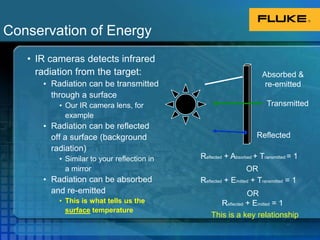
Conservation of EnergyIR cameras detects infrared radiation from the target:Radiation can be transmitted through a surfaceOur IR camera lens, for exampleRadiation can be reflected off a surface (background radiation)Similar to your reflection in a mirrorRadiation can be absorbed and re-emittedThis is what tells us the surface temperatureAbsorbed & re-emittedTransmittedReflectedReflected + Absorbed + Transmitted = 1ORReflected + Emitted + Transmitted = 1ORReflected+ Emitted = 1This is a key relationship
Surfaces emit radiation differently, this is called emissivityPronunciation: "Em`is*siv"i*ty ”Ability for absorbed heat energy to radiate (leave) an object as compared to a device called a black bodyA true black body radiates 100% of its absorbed energy (nothing is reflected or transmitted) so the ε  = 1 Materials that are not black bodies only radiate a fraction of the radiation so the ε is <1 and we have to account for reflected energyWe have to “tell” our camera how much radiation is being “emitted” relative to “100%”	Putting it all together
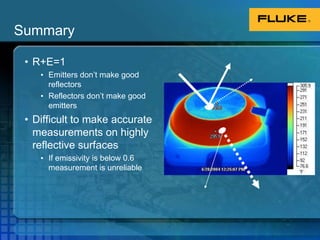
SummaryR+E=1Emitters don’t make good reflectorsReflectors don’t make good emittersDifficult to make accurate measurements on highly reflective surfacesIf emissivity is below 0.6 measurement is unreliable
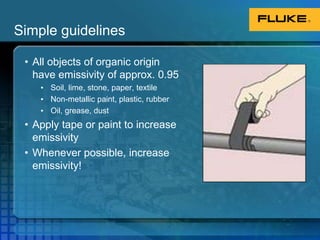
Simple guidelinesAll objects of organic origin have emissivity of approx. 0.95 Soil, lime, stone, paper, textile Non-metallic paint, plastic, rubber Oil, grease, dustApply tape or paint to increase emissivityWhenever possible, increase emissivity!
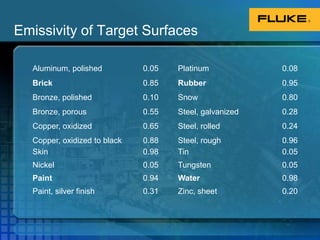
Emissivity of Target Surfaces
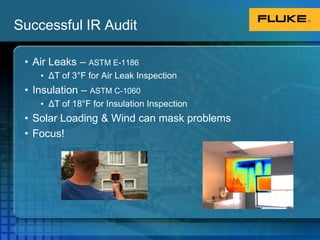
Successful IR AuditAir Leaks – ASTM E-1186ΔT of 3°F for Air Leak InspectionInsulation – ASTM C-1060ΔT of 18°F for Insulation InspectionSolar Loading & Wind can mask problemsFocus!
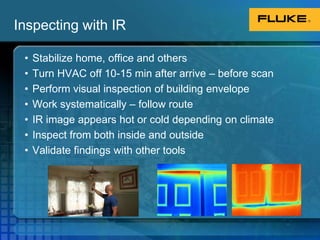
Inspecting with IRStabilize home, office and othersTurn HVAC off 10-15 min after arrive – before scanPerform visual inspection of building envelopeWork systematically – follow routeIR image appears hot or cold depending on climateInspect from both inside and outsideValidate findings with other tools
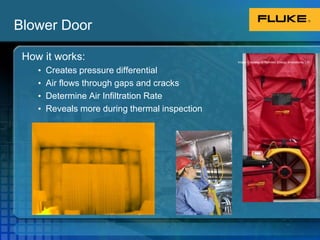
Blower DoorHow it works:Creates pressure differentialAir flows through gaps and cracks Determine Air Infiltration RateReveals more during thermal inspectionImage Courtesy of Retrotec Energy Innovations, Ltd.
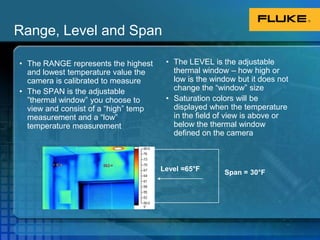
Range, Level and SpanThe LEVEL is the adjustable thermal window – how high or low is the window but it does not change the “window” size
Saturation colors will be displayed when the temperature in the field of view is above or below the thermal window defined on the camera
The RANGE represents the highest and lowest temperature value the camera is calibrated to measure
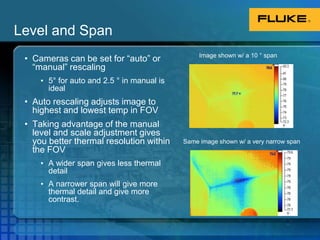
The SPAN is the adjustable ”thermal window” you choose to view and consist of a “high” temp measurement and a “low” temperature measurement Level =65°FSpan =30°F
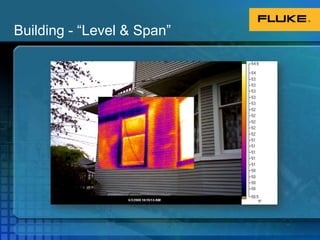
Level and SpanImage shown w/ a 10 ° spanCameras can be set for “auto” or “manual” rescaling5° for auto and 2.5 ° in manual is idealAuto rescaling adjusts image to highest and lowest temp in FOVTaking advantage of the manual level and scale adjustment gives you better thermal resolution within the FOVA wider span gives less thermal detailA narrower span will give more thermal detail and give more contrast.Same image shown w/ a very narrow span
Building - “Level & Span”
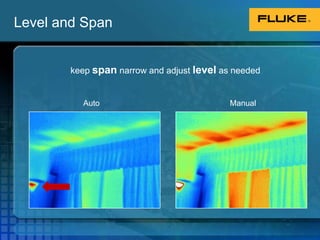
Level and Spankeep span narrow and adjust level as neededAutoManual
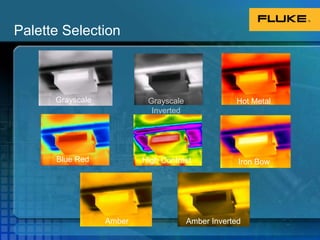
Palette SelectionGrayscaleGrayscale InvertedHot MetalBlue RedHigh ContrastIron BowAmberAmber Inverted
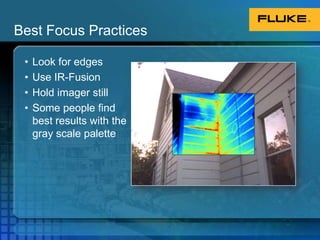
Best Focus Practices Look for edgesUse IR-FusionHold imager still Some people find best results with the gray scale palette
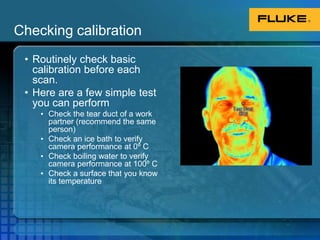
Checking calibrationRoutinely check basic calibration before each scan.Here are a few simple test you can performCheck the tear duct of a work partner (recommend the same person)Check an ice bath to verify camera performance at 0º CCheck boiling water to verify camera performance at 100º CCheck a surface that you know its temperature
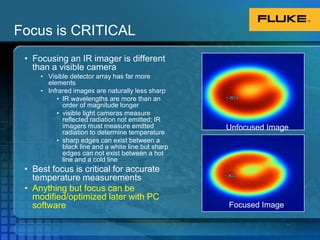
Focus is CRITICALFocusing an IR imager is different than a visible cameraVisible detector array has far more elementsInfrared images are naturally less sharp IR wavelengths are more than an order of magnitude longervisible light cameras measure reflected radiation not emitted; IR imagers must measure emitted radiation to determine temperature sharp edges can exist between a black line and a white line but sharp edges can not exist between a hot line and a cold lineBest focus is critical for accurate temperature measurementsAnything but focus can be modified/optimized later with PC softwareUnfocused ImageFocused Image
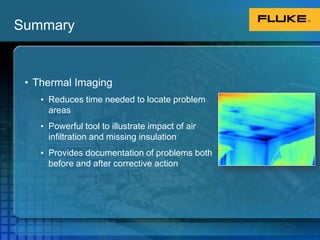
SummaryThermal ImagingReduces time needed to locate problem areasPowerful tool to illustrate impact of air infiltration and missing insulationProvides documentation of problems both before and after corrective action
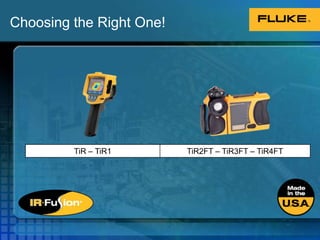
Choosing the Right One!TiR – TiR1TiR2FT – TiR3FT – TiR4FT
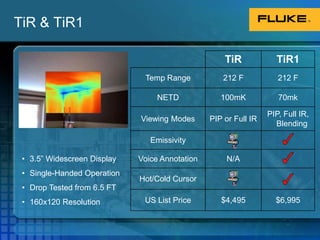
TiR & TiR13.5” Widescreen Display
Single-Handed Operation
Drop Tested from 6.5 FT
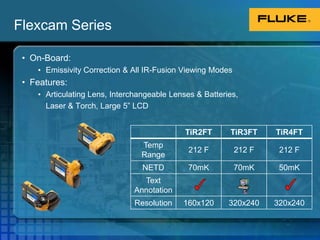
160x120 ResolutionFlexcam SeriesOn-Board:Emissivity Correction & All IR-Fusion Viewing Modes Features:Articulating Lens, Interchangeable Lenses & Batteries, 	Laser & Torch, Large 5” LCD
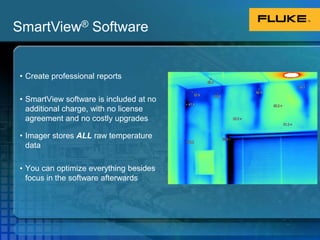
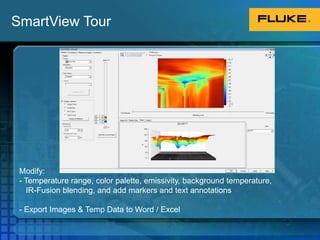
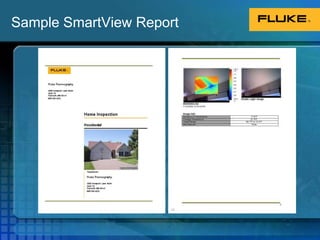
SmartView®SoftwareCreate professional reportsSmartView software is included at no additional charge, with no license agreement and no costly upgrades Imager stores ALL raw temperature dataYou can optimize everything besides focus in the software afterwards

Bd Weather

  • 1.
    Energy Auditing &Weatherization with Thermal Imagers
  • 2.
    AgendaEnergy Auditing, Weatherization& Energy UseWhere & How Thermal Imaging Fits InIR-Fusion® technology Air Leaks & InsulationMoistureElectrical RoofsThermography physics and heat transferHow a thermal imager worksResolving detail and parameters of a good imageFluke Thermal ImagersSmartView® Software
  • 3.
    How We UseEnergy in Our HomesSource: DOE - http://www1.eere.energy.gov/consumer/tips/home_energy.html Date Accessed: 4/20/2009
  • 4.
    Energy Auditing &WeatherizationEnergy AuditEvaluate energy use and pinpoint areas of energy lossThermal imager, blower door, smoke pen, air tester, energy monitorWeatherization Includes a wide variety of energy efficiency measures that encompass the building envelope, its heating and cooling systems, its electrical system, and electricity consuming appliancesCorrective action based on findingsFollow up scan with infrared to verify repairsSource: DOE - http://apps1.eere.energy.gov/weatherization/what_is.cfm Date Accessed: 4/20/2009
  • 5.
    According to ENERGYSTAR®: “…sealing and insulating the "envelope" or "shell" of your home — its outer walls, ceiling, windows, doors, and floors — is often the most cost effective way to improve energy efficiency and comfort.”Source - http://www.energystar.gov/index.cfm?c=home_sealing.hm_improvement_sealing Date Accessed: 4/20/2009
  • 6.
    Common Air LeakSourcesSource: DOE - http://www1.eere.energy.gov/consumer/tips/air_leaks.html Date Accessed: 4/20/2009
  • 7.
    Why Thermal Imaging?Easier& more effective inspectionCustomers request itMore competitiveBuild business & make more money
  • 8.
    What is Thermography?Infraredradiation is emitted by all objectsThe amount of radiation increases with temperatureIt is the science of “seeing” temperature by measuring the radiation emitted from an object and converting this data to a corresponding digital, or visual image called a thermogramWe are only measuring the surface temperature!
  • 9.
    What Does anIR Camera Do?Displays the thermal patterns on a given surface by converting temperature data to a digital imageCan also provide advanced temperature measurementsProvides visual verification and documentation of moisture problems, before and afterMost importantly – reduces liability, improves efficiency, adds revenue stream
  • 10.
    Why use ThermalImaging?Hot or cold areas, or thermal anomalies, often are a strong indicator of potential problemsThermal Imaging works well to inspect:Building InspectionsResidential - Home InspectorsCommercial – Property ManagersEnergy Audits/WeatherizationTermite/Pest ControlWater damageCommercial Low Slope RoofingConstruction Defect Management or Building Forensic FirmsPlumbing/Radiant Heat
  • 11.
    Thermography BenefitsMeasurements are:Non-contactObtainedwithout disturbing structureVery sensitive to problem characteristics Detect problem before significant damageCan scan large areas quicklyIdentifies specific location
  • 12.
    Why Thermal Imaging?“Thetime savings alone made my investment in thermal imaging well worth it.  Infrared allows me to quickly and easily locate air leaks and missing insulation without having to drill and probe with a manometer.” - Andy Imig Owner, Arrowhead Energy and Comfort Solutions – Esko, MN Instructor, Dunwoody Institute & Fond du Lac Tribal and Community College
  • 13.
    What do welook for? Thermography can identify surface temperature variations that relate to problems with poor construction, missing or inadequate insulation, broken window seals, moisture intrusion and airAir leakageAir QualityEnergy ConsumptionSafety ConcernsOccupant comfortMoisture intrusionHealth (mold)Construction ProblemsMaintenance costSafety ConcernsElectrical and Mechanical Systems
  • 14.
    Where do welook?Roof SystemsIndoorWallsFloorsCeilingsExteriorThermal bridgingWindow systemsConstructionHVAC/R System component operationDuct systemElectrical and Mechanical SystemsConnectionsBreakersFuses
  • 15.
    Air Leaks BecomeVisible!Fast location of air leaks and missing insulationNon-destructiveEasily document & report findings to property owner
  • 16.
    Three Modes ofHeat TransferRadiation is the transmission of electromagnetic rays through space Each material that has a temperature above absolute zero (-460°F) emits infrared radiation, Conduction is direct heat flow through matter Fun fact: Notice how metal feels cold? It is not – that is only the metal taking energy away from your hand and we perceive this as “cold”!Convection is the transport of heat within a gas or liquidCold air drops so A/C vents are highWarm air rises so heating vents are on floor
  • 17.
    Conduction & ConvectionExampleOutside heat conducted through sidingConvected inside empty wall cavityConducted through inside wall boardConvected into air conditioned room
  • 18.
    Air LeaksImage Courtesyof Structure Tech Home InspectionsCommon causes:Door & window gapsExterior wall electrical outletsRecessed lightsAttic penetrationsDucts / Vents
  • 19.
    Fluke IR-Fusion®Combines visuallight and infrared togetherEasy reference of problem locationMore effective reporting
  • 20.
    IR-Fusion Viewing ModesTraditionalFull IRColor AlarmPIP Full IRFull VisualPIP BlendedBlended IR / Visual*Not all viewing modes available on-board all models, all available in software
  • 21.
  • 22.
    Air LeaksThe passageof air through the building envelope, wall, window, joint, etc.Improper air movement significantly reduces the integrity and performance of the envelope and is therefore a major contributor to energy consumption in a building as well as poor air quality
  • 23.
    Air LeaksPoor constructionLeaksand penetrations around envelop:ChimneysPlumbing ventsHVAC linesUtility linesLeaks around window and doorsPoorly installed siding and wrapsDamaged and misfit heat ducts
  • 24.
    Construction DefectsFind commonconstruction issues such as missing insulation, improper framing, concrete and masonry problems, etc.These images are from a stucco home which had small outside leaks
  • 25.
    Air SealingCaulkingSpray FoamWeatherstrippingValidate repairs with IRInsulationCommon causes:MissingSettledWetInsufficient
  • 26.
    Conductive LossesConductive LossesMissing,compressed or improperly installed insulationShrinkage or settling of various insulating materialsExcessive thermal bridging in joints between walls and tops or bottom platesMoisture damage to insulation and building materials
  • 27.
    Conductive Losses cont.ConductiveLossesHeat loss through multi-plane windows with a broken or improperly fitted sealLeaks in water pipesDamaged heat ductsLocation of; or leaking in buried steam lines, water line or underground sprinklers
  • 28.
    Energy EfficiencyEfficiency reductioncausesHot or cold air infiltrationImproper air flow (HVAC)Insulation VoidsThermography can identify surface temperature variations that relate to problemsPoor construction, missing or inadequate insulation, broken window seals, moisture intrusion and air leakageHere are images showing lack of proper insulation
  • 29.
    Thermal BypassENERGY STAR®Thermal Bypass ChecklistCommon Areas of Concern:Air and thermal barrier contactShowers & tubs on exterior wallsFloors above garagesKnee wallsAttic accessCantilevered floorsSoffitsImage Courtesy of Energy Services GroupImage Courtesy of Energy Services Group
  • 30.
  • 31.
  • 32.
  • 33.
  • 34.
    MoistureWater entering buildingstructure through:Leaks in building envelopFailed and poorly installed plumbingCondensation caused by:Improper constructionPoor building managementAir leakageAll of which can cause health, comfort, safety and financial issues
  • 35.
    MoistureThermography helped plumbersfind water leak in church heating system
  • 36.
    HVAC - AirConditioner UnitAbnormal AppearanceThe discharge line is not as hot and appears not as white and the suction line is only slightly cooler. Indicates A/C unit in need of charge or upon HVAC inspection after charge possible compressor blow by.Normal AppearanceSuction line (Black = Cold)and discharge line (White = Very hot) on an exterior A/C unit.
  • 37.
    A/C Condenser inCeilingcondenser unit in ceiling above bathtub full of watertop of ceiling above bathtubshower wallCondensation drain line in A/c condenser clogged causing water to drip from pan.
  • 38.
    Compressor for inStore Freezing UnitsProblems here!Caused this problem
  • 39.
    Bridge Deck /In-Floor HeatingDOT in OklahomaFloor preparation for Mud jacking
  • 40.
    Electrical InspectionsEasily findelectrical problems at the panel or on mechanical equipment
  • 41.
    Electrical MeasurementsConfirmation ofThermal imagesCurrent startup currentRunning currentLoading of CircuitsProper Operating ConditionsGFI testerOutlet testerAC Current/Voltage measurementsDC Current measurement for Solar system
  • 42.
    Steam TrapsDetermine valveon/off and leakage
  • 43.
    Roof inspectionWet spotsunder roof membrane
  • 44.
    Roof inspectionPatterns varywith: Roof type Insulation type Deck ConditionsNon-absorbent insulation types are more difficult to inspect
  • 45.
    It’s not justabout energy loss!Excessive leakage can also cause condensation to form within and on walls which can create many problems:Permanently damage insulationSeriously degrade materialsRot woodCorrode metals Stain brick, concrete or surfacesExtreme cases will cause concrete to spall, bricks to separate, mortar to crumble and sections of wall to fallCorrode structural steal, re-bar and metal hangers and bolts
  • 46.
    What You Needto KnowHow buildings work & how they are builtHeat transfer basicsThermal imager operationMany organizations developing standardsRESNET & BPILocal training & certification requirementsASNT SNT-TC-1A
  • 47.
    Be aware: convection(wind) can effect temperature117F 95F 81F85F 76F 72FNo windT = 36FT = 13FPhoto courtesy of Snell Infrared
  • 48.
    Wind can significantlyreduce temperature of hot spotRule of thumb10 mph can reduce T by up to 1/215 mph can reduce T by up to 2/3Roof moisture inspection is very difficult in windWind Effects
  • 49.
    Conservation of EnergyIRcameras detects infrared radiation from the target:Radiation can be transmitted through a surfaceOur IR camera lens, for exampleRadiation can be reflected off a surface (background radiation)Similar to your reflection in a mirrorRadiation can be absorbed and re-emittedThis is what tells us the surface temperatureAbsorbed & re-emittedTransmittedReflectedReflected + Absorbed + Transmitted = 1ORReflected + Emitted + Transmitted = 1ORReflected+ Emitted = 1This is a key relationship
  • 50.
    Surfaces emit radiationdifferently, this is called emissivityPronunciation: "Em`is*siv"i*ty ”Ability for absorbed heat energy to radiate (leave) an object as compared to a device called a black bodyA true black body radiates 100% of its absorbed energy (nothing is reflected or transmitted) so the ε = 1 Materials that are not black bodies only radiate a fraction of the radiation so the ε is <1 and we have to account for reflected energyWe have to “tell” our camera how much radiation is being “emitted” relative to “100%” Putting it all together
  • 51.
    SummaryR+E=1Emitters don’t makegood reflectorsReflectors don’t make good emittersDifficult to make accurate measurements on highly reflective surfacesIf emissivity is below 0.6 measurement is unreliable
  • 52.
    Simple guidelinesAll objectsof organic origin have emissivity of approx. 0.95 Soil, lime, stone, paper, textile Non-metallic paint, plastic, rubber Oil, grease, dustApply tape or paint to increase emissivityWhenever possible, increase emissivity!
  • 53.
  • 54.
    Successful IR AuditAirLeaks – ASTM E-1186ΔT of 3°F for Air Leak InspectionInsulation – ASTM C-1060ΔT of 18°F for Insulation InspectionSolar Loading & Wind can mask problemsFocus!
  • 55.
    Inspecting with IRStabilizehome, office and othersTurn HVAC off 10-15 min after arrive – before scanPerform visual inspection of building envelopeWork systematically – follow routeIR image appears hot or cold depending on climateInspect from both inside and outsideValidate findings with other tools
  • 56.
    Blower DoorHow itworks:Creates pressure differentialAir flows through gaps and cracks Determine Air Infiltration RateReveals more during thermal inspectionImage Courtesy of Retrotec Energy Innovations, Ltd.
  • 57.
    Range, Level andSpanThe LEVEL is the adjustable thermal window – how high or low is the window but it does not change the “window” size
  • 58.
    Saturation colors willbe displayed when the temperature in the field of view is above or below the thermal window defined on the camera
  • 59.
    The RANGE representsthe highest and lowest temperature value the camera is calibrated to measure
  • 60.
    The SPAN isthe adjustable ”thermal window” you choose to view and consist of a “high” temp measurement and a “low” temperature measurement Level =65°FSpan =30°F
  • 61.
    Level and SpanImageshown w/ a 10 ° spanCameras can be set for “auto” or “manual” rescaling5° for auto and 2.5 ° in manual is idealAuto rescaling adjusts image to highest and lowest temp in FOVTaking advantage of the manual level and scale adjustment gives you better thermal resolution within the FOVA wider span gives less thermal detailA narrower span will give more thermal detail and give more contrast.Same image shown w/ a very narrow span
  • 62.
  • 63.
    Level and Spankeepspan narrow and adjust level as neededAutoManual
  • 64.
    Palette SelectionGrayscaleGrayscale InvertedHotMetalBlue RedHigh ContrastIron BowAmberAmber Inverted
  • 65.
    Best Focus PracticesLook for edgesUse IR-FusionHold imager still Some people find best results with the gray scale palette
  • 66.
    Checking calibrationRoutinely checkbasic calibration before each scan.Here are a few simple test you can performCheck the tear duct of a work partner (recommend the same person)Check an ice bath to verify camera performance at 0º CCheck boiling water to verify camera performance at 100º CCheck a surface that you know its temperature
  • 67.
    Focus is CRITICALFocusingan IR imager is different than a visible cameraVisible detector array has far more elementsInfrared images are naturally less sharp IR wavelengths are more than an order of magnitude longervisible light cameras measure reflected radiation not emitted; IR imagers must measure emitted radiation to determine temperature sharp edges can exist between a black line and a white line but sharp edges can not exist between a hot line and a cold lineBest focus is critical for accurate temperature measurementsAnything but focus can be modified/optimized later with PC softwareUnfocused ImageFocused Image
  • 68.
    SummaryThermal ImagingReduces timeneeded to locate problem areasPowerful tool to illustrate impact of air infiltration and missing insulationProvides documentation of problems both before and after corrective action
  • 69.
    Choosing the RightOne!TiR – TiR1TiR2FT – TiR3FT – TiR4FT
  • 70.
    TiR & TiR13.5”Widescreen Display
  • 71.
  • 72.
  • 73.
    160x120 ResolutionFlexcam SeriesOn-Board:EmissivityCorrection & All IR-Fusion Viewing Modes Features:Articulating Lens, Interchangeable Lenses & Batteries, Laser & Torch, Large 5” LCD
  • 74.
    SmartView®SoftwareCreate professional reportsSmartViewsoftware is included at no additional charge, with no license agreement and no costly upgrades Imager stores ALL raw temperature dataYou can optimize everything besides focus in the software afterwards