The United Nations
and its Efforts
to ensure
lasting World Peace
Event : Group Discussion
Participants: Students of Class VII
World Peace
World peace is an ideal of freedom, peace, and happiness among and within all
nations and/or people. World peace is an idea of planetary non-violence by which
nations willingly cooperate, either voluntarily or by virtue of a system of
governance that prevents warfare. The term is sometimes used to refer to a cessation
of all hostility amongst all humanity.
For example: World Peace could be crossing boundaries via human
rights, technology, education, engineering, medicine, diplomats and/or an end to all
forms of fighting. Since 1945, the United Nations and the 5 permanent members of
its Security Council (the US, Russia, China, France, and the UK) have worked to
resolve conflicts without war or declarations of war. However, nations have entered
numerous military conflicts since that time.
Why do we have the UN?
• After World War I, the League of Nations was created to prevent
another world war.
• During World War II, the League of Nations was eliminated because it
failed to prevent another war.
• In 1945, with the end of WWII nearing, the United Nations was
created to replace the failed League of Nations.
UN World Headquarters New York
Facts related to the UN
• 193 member states
• Un headquarters are situated in New York.
• The US has always been by far the largest single contributor to the UN budget.
• In June 2004 the US owed the UN just over $1 billion – almost half the total $2.5
billion owed to the UN by its members.
• The budget for the UN's main operations is $2.5 billion a year.
• In theory, any member state that owes more than its two previous years’ assessments
cannot vote in the General Assembly.
• The UN Secretariat worldwide employs some 15,000 people from 170 different
countries
• Six official languages are used at the UN: Arabic, Chinese, English, French, Russian,
and Spanish.
• The current secretary general is Ban Ki-moon of South Korea.
Functions of the United Nations
• Maintaining international peace and security,
• Promoting human rights,
• Fostering social and economic development,
• Protecting the environment,
• Providing humanitarian aid in cases of famine, natural disaster, and
armed conflict
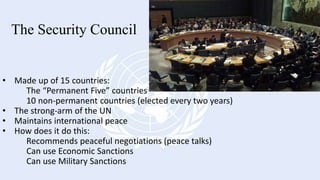
The Security Council
• Made up of 15 countries:
The “Permanent Five” countries
10 non-permanent countries (elected every two years)
• The strong-arm of the UN
• Maintains international peace
• How does it do this:
Recommends peaceful negotiations (peace talks)
Can use Economic Sanctions
Can use Military Sanctions
Peace Keeping
Peacekeeping has proven to be one of the most effective tools available to the
UN to assist host countries navigate the difficult path from conflict to peace.
• Military
• Police
• Civil affairs
• Rule of law
• Electoral assistance
• Security Sector Reform
• Mine action
• Gender and peacekeeping
• Protection of civilians
• Environment and sustainability
• Disarmament, demobilization and reintegration
• Children in conflict
• Human rights
Key challenges of peacekeeping:
Current peacekeeping operations
There are currently 16 peacekeeping operations and one special political mission – the United Nations Assistance
Mission in Afghanistan (UNAMA) – led by the Department of Peacekeeping Operations
• MINURSO, Western Sahara
• MINUSCA, C.A.R.
• MINUSMA, Mali
• MINUSTAH, Haiti
• MONUSCO, D.R. of the Congo
• UNAMA, Afghanistan
• UNAMID, Darfur
• UNDOF, Golan
• UNFICYP, Cyprus
• UNIFIL, Lebanon
• UNISFA, Abyei
• UNMIK, Kosovo
• UNMIL, Liberia
• UNMISS, South Sudan
• UNMOGIP, India and Pakistan
• UNOCI, Côte d'Ivoire
• UNTSO, Middle East
Evolution of UN Peacekeeping
• First Generation - Traditional Peacekeeping (1948-1990)
• Second Generation - Expanded Peacekeeping that included peace
enforcement operations (1990-1995)
• Third Generation - Expanded peacekeeping within the limits of the
UN’s ability. More complex, smaller in size and focused on peace
building. Generally this does not include peace enforcement (Chapter
VII) operations (1995-1999)
• Fourth Generation - Expanded peacekeeping, but the United Nations is
taking on more peacebuilding activities. Lead Nations and Regional
Organizations conducting peace enforcement operations.
OLD
• Consent
• Impartiality
• Non-use of force except in self-
defense
NEW
• Consent
• Impartiality
• Non-use of Force except in self defense &
defense of the mandate
• New doctrine adds: Key Factors for
Mission Success
• Credibility
• Legitimacy
• Promotion of National and Local
Ownership
FUNDAMENTAL GUIDING PRINCIPLES
for conducting
UN PEACEKEEPING OPERATIONS
UN Peacekeepers
The International Day of Peace, sometimes unofficially known as World Peace Day, is observed
annually on 21 September.
It is dedicated to world peace, and specifically the absence of war and violence, such as might be
occasioned by a temporary ceasefire in a combat zone for humanitarian aid access. The day was first
celebrated in 1982, and is kept by many nations, political groups, military groups, and peoples.
In 2013, for the first time, the Day was dedicated by the Secretary-General of the United Nations to peace
education, the key preventive means to reduce war sustainably.
Efforts by countries to ensure world peace
Troop and police contributors
• They come from nations large and small, rich and poor. They bring
different cultures and experience to the job, but they are united in their
determination to foster peace.
• Countries also contribute by sending experts, equipment and training.
Civilian contributors
•Civil affairs and human rights officers play vital advisory and
monitoring roles in remote regions.
Rule of Law
•Concrete programme building and assessment
Successful operations
UN peacekeeping missions operate in the most dangerous and difficult
environments in the world, dealing with conflicts – or their aftermath –
which others cannot or will not address. However, success is never
guaranteed.
An impressive record of peacekeeping achievements over more than 60
years of our existence, including winning the Nobel Peace Prize.
Since 1948, the UN has helped end conflicts and foster reconciliation by
conducting successful peacekeeping operations in dozens of countries,
including Cambodia, El Salvador, Guatemala, Mozambique, Namibia
and Tajikistan.
Factors required for success:
• Be guided by the principles of consent, impartiality and the non-use of force except in self-defense and
defense of the mandate;
• Be perceived as legitimate and credible, particularly in the eyes of the local population;
• Promote national and local ownership of the peace process in the host country.
• Genuine commitment to a political process by the parties in working towards peace (there must be a peace to
keep);
• Unity of purpose within the Security Council, with active support to UN operations in the field;
• Supportive engagement by neighbouring countries and regional actors;
• An integrated UN approach, effective coordination with other actors on the ground and good communication
with host country authorities and population;
• The utmost sensitivity towards the local population and upholding the highest standards of professionalism
and good conduct (peacekeepers must avoid becoming part of the problem).
• A unique global partnership: It brings together the General Assembly, the Security Council, the Secretariat,
troop and police contributors and the host governments in a combined effort to maintain international peace
and security.
A few failures…
In other instances, however, UN peacekeeping – and the response by the
international community as a whole – have been challenged and found
wanting, for instance in Somalia, Rwanda and the former Yugoslavia in
the early 1990s.
These setbacks provided important lessons for the international
community when deciding how and when to deploy and support UN
peacekeeping as a tool to restore and maintain international peace and
security

Lasting World Peace

  • 1.
    The United Nations andits Efforts to ensure lasting World Peace Event : Group Discussion Participants: Students of Class VII
  • 2.
    World Peace World peaceis an ideal of freedom, peace, and happiness among and within all nations and/or people. World peace is an idea of planetary non-violence by which nations willingly cooperate, either voluntarily or by virtue of a system of governance that prevents warfare. The term is sometimes used to refer to a cessation of all hostility amongst all humanity. For example: World Peace could be crossing boundaries via human rights, technology, education, engineering, medicine, diplomats and/or an end to all forms of fighting. Since 1945, the United Nations and the 5 permanent members of its Security Council (the US, Russia, China, France, and the UK) have worked to resolve conflicts without war or declarations of war. However, nations have entered numerous military conflicts since that time.
  • 3.
    Why do wehave the UN? • After World War I, the League of Nations was created to prevent another world war. • During World War II, the League of Nations was eliminated because it failed to prevent another war. • In 1945, with the end of WWII nearing, the United Nations was created to replace the failed League of Nations.
  • 4.
  • 5.
    Facts related tothe UN • 193 member states • Un headquarters are situated in New York. • The US has always been by far the largest single contributor to the UN budget. • In June 2004 the US owed the UN just over $1 billion – almost half the total $2.5 billion owed to the UN by its members. • The budget for the UN's main operations is $2.5 billion a year. • In theory, any member state that owes more than its two previous years’ assessments cannot vote in the General Assembly. • The UN Secretariat worldwide employs some 15,000 people from 170 different countries • Six official languages are used at the UN: Arabic, Chinese, English, French, Russian, and Spanish. • The current secretary general is Ban Ki-moon of South Korea.
  • 6.
    Functions of theUnited Nations • Maintaining international peace and security, • Promoting human rights, • Fostering social and economic development, • Protecting the environment, • Providing humanitarian aid in cases of famine, natural disaster, and armed conflict
  • 7.
    The Security Council •Made up of 15 countries: The “Permanent Five” countries 10 non-permanent countries (elected every two years) • The strong-arm of the UN • Maintains international peace • How does it do this: Recommends peaceful negotiations (peace talks) Can use Economic Sanctions Can use Military Sanctions
  • 8.
    Peace Keeping Peacekeeping hasproven to be one of the most effective tools available to the UN to assist host countries navigate the difficult path from conflict to peace. • Military • Police • Civil affairs • Rule of law • Electoral assistance • Security Sector Reform • Mine action • Gender and peacekeeping • Protection of civilians • Environment and sustainability • Disarmament, demobilization and reintegration • Children in conflict • Human rights Key challenges of peacekeeping:
  • 9.
    Current peacekeeping operations Thereare currently 16 peacekeeping operations and one special political mission – the United Nations Assistance Mission in Afghanistan (UNAMA) – led by the Department of Peacekeeping Operations • MINURSO, Western Sahara • MINUSCA, C.A.R. • MINUSMA, Mali • MINUSTAH, Haiti • MONUSCO, D.R. of the Congo • UNAMA, Afghanistan • UNAMID, Darfur • UNDOF, Golan • UNFICYP, Cyprus • UNIFIL, Lebanon • UNISFA, Abyei • UNMIK, Kosovo • UNMIL, Liberia • UNMISS, South Sudan • UNMOGIP, India and Pakistan • UNOCI, Côte d'Ivoire • UNTSO, Middle East
  • 10.
    Evolution of UNPeacekeeping • First Generation - Traditional Peacekeeping (1948-1990) • Second Generation - Expanded Peacekeeping that included peace enforcement operations (1990-1995) • Third Generation - Expanded peacekeeping within the limits of the UN’s ability. More complex, smaller in size and focused on peace building. Generally this does not include peace enforcement (Chapter VII) operations (1995-1999) • Fourth Generation - Expanded peacekeeping, but the United Nations is taking on more peacebuilding activities. Lead Nations and Regional Organizations conducting peace enforcement operations.
  • 11.
    OLD • Consent • Impartiality •Non-use of force except in self- defense NEW • Consent • Impartiality • Non-use of Force except in self defense & defense of the mandate • New doctrine adds: Key Factors for Mission Success • Credibility • Legitimacy • Promotion of National and Local Ownership FUNDAMENTAL GUIDING PRINCIPLES for conducting UN PEACEKEEPING OPERATIONS
  • 12.
    UN Peacekeepers The InternationalDay of Peace, sometimes unofficially known as World Peace Day, is observed annually on 21 September. It is dedicated to world peace, and specifically the absence of war and violence, such as might be occasioned by a temporary ceasefire in a combat zone for humanitarian aid access. The day was first celebrated in 1982, and is kept by many nations, political groups, military groups, and peoples. In 2013, for the first time, the Day was dedicated by the Secretary-General of the United Nations to peace education, the key preventive means to reduce war sustainably.
  • 13.
    Efforts by countriesto ensure world peace Troop and police contributors • They come from nations large and small, rich and poor. They bring different cultures and experience to the job, but they are united in their determination to foster peace. • Countries also contribute by sending experts, equipment and training. Civilian contributors •Civil affairs and human rights officers play vital advisory and monitoring roles in remote regions. Rule of Law •Concrete programme building and assessment
  • 14.
    Successful operations UN peacekeepingmissions operate in the most dangerous and difficult environments in the world, dealing with conflicts – or their aftermath – which others cannot or will not address. However, success is never guaranteed. An impressive record of peacekeeping achievements over more than 60 years of our existence, including winning the Nobel Peace Prize. Since 1948, the UN has helped end conflicts and foster reconciliation by conducting successful peacekeeping operations in dozens of countries, including Cambodia, El Salvador, Guatemala, Mozambique, Namibia and Tajikistan.
  • 15.
    Factors required forsuccess: • Be guided by the principles of consent, impartiality and the non-use of force except in self-defense and defense of the mandate; • Be perceived as legitimate and credible, particularly in the eyes of the local population; • Promote national and local ownership of the peace process in the host country. • Genuine commitment to a political process by the parties in working towards peace (there must be a peace to keep); • Unity of purpose within the Security Council, with active support to UN operations in the field; • Supportive engagement by neighbouring countries and regional actors; • An integrated UN approach, effective coordination with other actors on the ground and good communication with host country authorities and population; • The utmost sensitivity towards the local population and upholding the highest standards of professionalism and good conduct (peacekeepers must avoid becoming part of the problem). • A unique global partnership: It brings together the General Assembly, the Security Council, the Secretariat, troop and police contributors and the host governments in a combined effort to maintain international peace and security.
  • 16.
    A few failures… Inother instances, however, UN peacekeeping – and the response by the international community as a whole – have been challenged and found wanting, for instance in Somalia, Rwanda and the former Yugoslavia in the early 1990s. These setbacks provided important lessons for the international community when deciding how and when to deploy and support UN peacekeeping as a tool to restore and maintain international peace and security