Area between Two Curves
• 𝐴 = 𝑎
𝑏
𝑓 𝑥 − 𝑔(𝑥) 𝑑𝑥 as long as 𝑓 𝑥 ≥ 𝑔(𝑥)
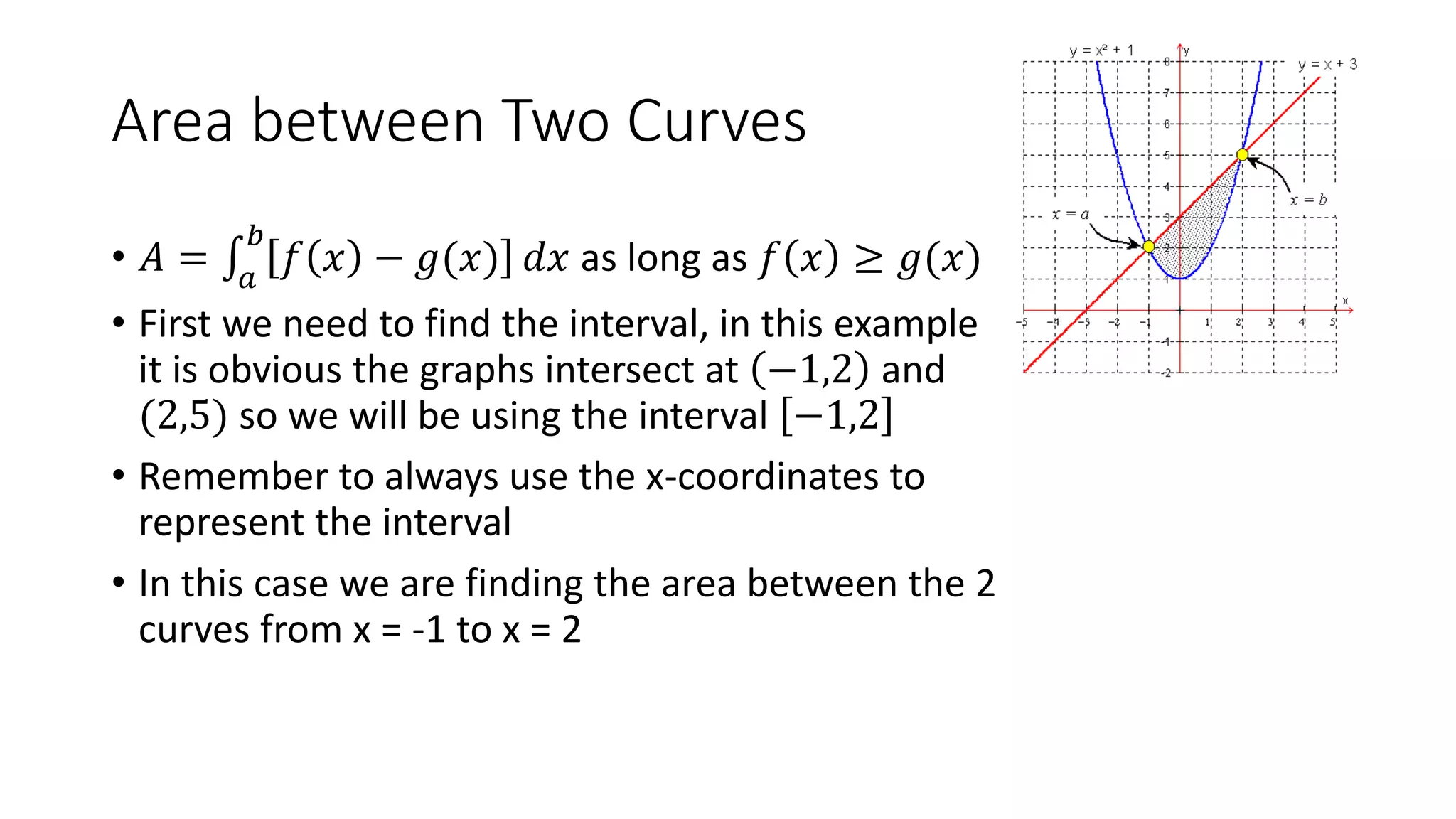
• First we need to find the interval, in this example
it is obvious the graphs intersect at −1,2 and
(2,5) so we will be using the interval −1,2
• Remember to always use the x-coordinates to
represent the interval
• In this case we are finding the area between the 2
curves from x = -1 to x = 2
Area between Two Curves
• Next we will apply the
fundamental theorem of calculus.
• To do this we must first take the
antiderivative. In this case be we
find the antiderivative we can
simplify the function.
• 𝐴 = −1
2
𝑥 + 3 − 𝑥2
+ 1 𝑑𝑥
• 𝐴 = −1
2
−𝑥2
+ 𝑥 + 2 𝑑𝑥
• 𝐴 = −
𝑥3
3
+
𝑥2
2
+ 2𝑥
−1
2
Area between Two Curves
• 𝐴 = −
23
3
+
22
2
+ 2 2 − −
−1 3
3
+
−1 2
2
+ 2 −1
•
10
3
− −
7
6
=
9
2
• 𝐴 = −1
2
𝑥 + 3 − 𝑥2 + 1 𝑑𝑥 =
9
2
Finally to find the area we will plug in the top number and
the bottom numbers and subtract to find the area between
the two curves.
𝐴 = −
𝑥3
3
+
𝑥2
2
+ 2𝑥
−1
2

Area between two curves

  • 1.
    Area between TwoCurves • 𝐴 = 𝑎 𝑏 𝑓 𝑥 − 𝑔(𝑥) 𝑑𝑥 as long as 𝑓 𝑥 ≥ 𝑔(𝑥) • First we need to find the interval, in this example it is obvious the graphs intersect at −1,2 and (2,5) so we will be using the interval −1,2 • Remember to always use the x-coordinates to represent the interval • In this case we are finding the area between the 2 curves from x = -1 to x = 2
  • 2.
    Area between TwoCurves • Next we will apply the fundamental theorem of calculus. • To do this we must first take the antiderivative. In this case be we find the antiderivative we can simplify the function. • 𝐴 = −1 2 𝑥 + 3 − 𝑥2 + 1 𝑑𝑥 • 𝐴 = −1 2 −𝑥2 + 𝑥 + 2 𝑑𝑥 • 𝐴 = − 𝑥3 3 + 𝑥2 2 + 2𝑥 −1 2
  • 3.
    Area between TwoCurves • 𝐴 = − 23 3 + 22 2 + 2 2 − − −1 3 3 + −1 2 2 + 2 −1 • 10 3 − − 7 6 = 9 2 • 𝐴 = −1 2 𝑥 + 3 − 𝑥2 + 1 𝑑𝑥 = 9 2 Finally to find the area we will plug in the top number and the bottom numbers and subtract to find the area between the two curves. 𝐴 = − 𝑥3 3 + 𝑥2 2 + 2𝑥 −1 2