Wallerstein’s
Modern World
System
JOREN PAUL DALAGUIT & FLOREMAE CUEVAS
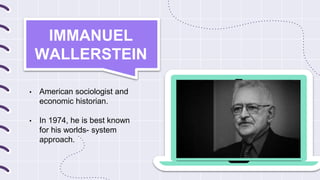
IMMANUEL
WALLERSTEIN
• American sociologist and
economic historian.
• In 1974, he is best known
for his worlds- system
approach.
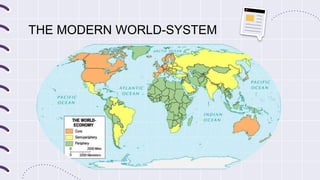
THE MODERN WORLD-SYSTEM
Modern World System
The Modern World system is
also known as the Modern
Capitalist World-Economy. It is
a system which relies on
economic domination.
Countries around the world is
divided according to their
economic power in the global
arena.
Wallerstein’s Modern World System
● The world system is the result of the increasing
interdependence of cultures and ecosystems that were
once relatively isolated by distance and boundaries.
● The World system is a largely self-contained system
with a set of boundaries and a definable life span; --- it
does not last FOREVER.
● The world systems have existed before and not a
unique feature of the contemporary world.
● In the past, the system that binds the world together was
based on political and military domination.
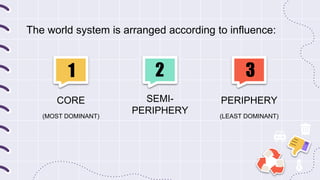
The world system is arranged according to influence:
(MOST DOMINANT) (LEAST DOMINANT)
SEMI-
PERIPHERY
CORE PERIPHERY
1 2 3
THE MODERN WORLD-SYSTEM
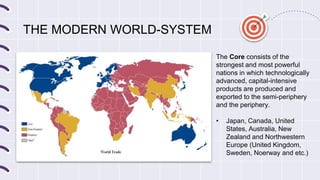
The Core consists of the
strongest and most powerful
nations in which technologically
advanced, capital-intensive
products are produced and
exported to the semi-periphery
and the periphery.
• Japan, Canada, United
States, Australia, New
Zealand and Northwestern
Europe (United Kingdom,
Sweden, Noerway and etc.)
THE MODERN WORLD-SYSTEM
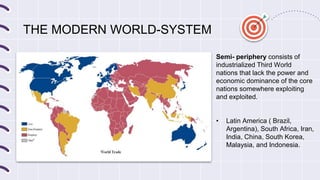
Semi- periphery consists of
industrialized Third World
nations that lack the power and
economic dominance of the core
nations somewhere exploiting
and exploited.
• Latin America ( Brazil,
Argentina), South Africa, Iran,
India, China, South Korea,
Malaysia, and Indonesia.
THE MODERN WORLD-SYSTEM
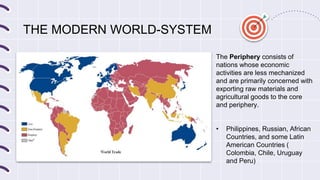
The Periphery consists of
nations whose economic
activities are less mechanized
and are primarily concerned with
exporting raw materials and
agricultural goods to the core
and periphery.
• Philippines, Russian, African
Countries, and some Latin
American Countries (
Colombia, Chile, Uruguay
and Peru)

contemporary-world.pptx

  • 1.
  • 2.
    IMMANUEL WALLERSTEIN • American sociologistand economic historian. • In 1974, he is best known for his worlds- system approach.
  • 3.
  • 4.
    Modern World System TheModern World system is also known as the Modern Capitalist World-Economy. It is a system which relies on economic domination. Countries around the world is divided according to their economic power in the global arena.
  • 5.
    Wallerstein’s Modern WorldSystem ● The world system is the result of the increasing interdependence of cultures and ecosystems that were once relatively isolated by distance and boundaries. ● The World system is a largely self-contained system with a set of boundaries and a definable life span; --- it does not last FOREVER. ● The world systems have existed before and not a unique feature of the contemporary world. ● In the past, the system that binds the world together was based on political and military domination.
  • 6.
    The world systemis arranged according to influence: (MOST DOMINANT) (LEAST DOMINANT) SEMI- PERIPHERY CORE PERIPHERY 1 2 3
  • 7.
    THE MODERN WORLD-SYSTEM TheCore consists of the strongest and most powerful nations in which technologically advanced, capital-intensive products are produced and exported to the semi-periphery and the periphery. • Japan, Canada, United States, Australia, New Zealand and Northwestern Europe (United Kingdom, Sweden, Noerway and etc.)
  • 8.
    THE MODERN WORLD-SYSTEM Semi-periphery consists of industrialized Third World nations that lack the power and economic dominance of the core nations somewhere exploiting and exploited. • Latin America ( Brazil, Argentina), South Africa, Iran, India, China, South Korea, Malaysia, and Indonesia.
  • 9.
    THE MODERN WORLD-SYSTEM ThePeriphery consists of nations whose economic activities are less mechanized and are primarily concerned with exporting raw materials and agricultural goods to the core and periphery. • Philippines, Russian, African Countries, and some Latin American Countries ( Colombia, Chile, Uruguay and Peru)