





@pati_gallardo
Secure Programming
Practices in C++
@pati_gallardo Patricia Aas
NDC { Security } 2018
@pati_gallardo
How To Avoid Blowing Your Leg Off With C++
Patricia Aas - Vivaldi Browser
Programmer - mainly in C++
Currently : Vivaldi Technologies
Previously : Cisco Systems, Knowit, Opera Software
Master in Computer Science
Twitter : @pati_gallardo
Photos: pixabay.com - CC0
Bjarne Stroustrup
“C makes it easy to shoot yourself in the
foot; C++ makes it harder, but when you do
it blows your whole leg off.”
@pati_gallardo
@pati_gallardo
Segmentation fault (core dumped)
Bjarne Stroustrup
“Within C++, there is a much smaller and
cleaner language struggling to get out.”
@pati_gallardo
- What specs exist?
- Here be dragons
- The Eight I'd Really Rather You Didn'ts
- Take your vitamins
@pati_gallardo
What specs exist?
@pati_gallardo
CG: C++ Core Guidelines (328 pages!)
@pati_gallardo
@pati_gallardo
SEI: CERT C++ Coding Standard (435 pages!)
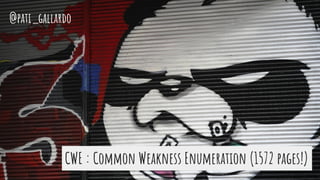
CWE : Common Weakness Enumeration (1572 pages!)
@pati_gallardo
Here be dragons
@pati_gallardo
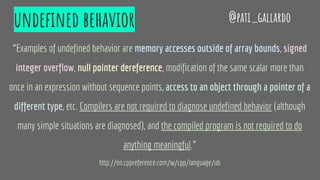
undefined behavior
“Examples of undefined behavior are memory accesses outside of array bounds, signed
integer overflow, null pointer dereference, modification of the same scalar more than
once in an expression without sequence points, access to an object through a pointer of a
different type, etc. Compilers are not required to diagnose undefined behavior (although
many simple situations are diagnosed), and the compiled program is not required to do
anything meaningful.”
http://en.cppreference.com/w/cpp/language/ub
@pati_gallardo
- Don’t reason about undefined
behaviour
- Assume that it crashes or is
never executed
- Changing compiler, compiler
version or optimization level
can break your application
Undefined Behaviour
@pati_gallardo
The Case Of The Disappearing Memset
0) CWE-14: Compiler Removal of Code to Clear Buffers
void GetData(char *MFAddr) {
char pwd[64];
if (GetPasswordFromUser(pwd, sizeof(pwd))) {
if (ConnectToMainframe(MFAddr, pwd)) {
// Interaction with mainframe
}
}
memset(pwd, 0, sizeof(pwd)); // <- Removed by the optimizer
}
@pati_gallardo
SEI: MSC06-C. Beware of compiler optimizations
SEI: MEM03-C. Clear sensitive information stored in reusable resources
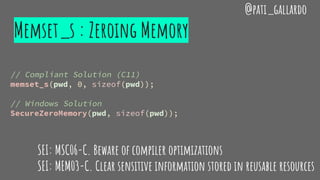
Memset_s : Zeroing Memory
// Compliant Solution (C11)
memset_s(pwd, 0, sizeof(pwd));
// Windows Solution
SecureZeroMemory(pwd, sizeof(pwd));
@pati_gallardo
SEI: MSC06-C. Beware of compiler optimizations
SEI: MEM03-C. Clear sensitive information stored in reusable resources
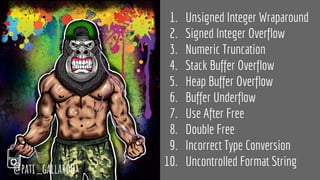
1. Unsigned Integer Wraparound
2. Signed Integer Overflow
3. Numeric Truncation
4. Stack Buffer Overflow
5. Heap Buffer Overflow
6. Buffer Underflow
7. Use After Free
8. Double Free
9. Incorrect Type Conversion
10. Uncontrolled Format String
@pati_gallardo
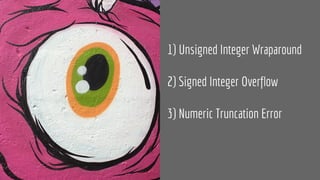
1) Unsigned Integer Wraparound
2) Signed Integer Overflow
3) Numeric Truncation Error
1) CWE-190: Unsigned Integer Wraparound
int main(void) {
unsigned int first_len = UINT_MAX;
unsigned int second_len = 256;
unsigned int buf_len = 256;
char first[first_len], second[second_len], buf[buf_len];
if((first_len + second_len) <= 256) { // <- sum == 255
memcpy(buf, first, first_len);
memcpy(buf + first_len, second, second_len);
}
}
@pati_gallardo
SEI-INT30-C. Ensure that unsigned integer operations do not wrap
2) CWE-190: Signed Integer Overflow
int main(void) {
int first_len = INT_MAX;
int second_len = 256;
int buf_len = 256;
char first[first_len], second[second_len], buf[buf_len];
if((first_len + second_len) <= 256) { // <- UB (negative)
memcpy(buf, first, first_len);
memcpy(buf + first_len, second, second_len);
}
}
@pati_gallardo
SEI-INT32-C. Ensure that operations on signed integers do not result in overflow
3) CWE-197: Numeric Truncation Error
int main(void) {
unsigned int first_len = UINT_MAX - 256;
unsigned int second_len = 256;
unsigned int buf_len = 256;
char first[first_len], second[second_len], buf[buf_len];
int new_len = (first_len+second_len); // <- IDB (negative)
if(new_len <= 256) {
memcpy(buf, first, first_len);
memcpy(buf + first_len, second, second_len);
}
}
@pati_gallardo
SEI-INT31-C. Ensure that integer conversions do not result in lost or misinterpreted data
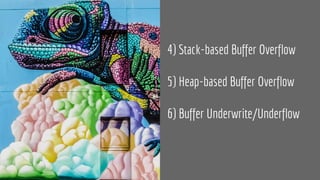
4) Stack-based Buffer Overflow
5) Heap-based Buffer Overflow
6) Buffer Underwrite/Underflow
4) CWE-121: Stack-based Buffer Overflow
@pati_gallardo
int main(void) {
char buffer[10];
gets(buffer); // <- Write outside
}
SEI-STR31-C. Guarantee that storage for strings has sufficient space for character data and the null terminator
5) CWE-122: Heap-based Buffer Overflow
int main(int argc, char * argv[]) {
char* buf = (char*) malloc(sizeof(char)*10);
strcpy(buf, argv[1]); // <- Write outside
free(buf);
}
@pati_gallardo
SEI-ARR38-C. Guarantee that library functions do not form invalid pointers
6) CWE-124: Buffer Underwrite / Underflow
int main(void) {
char src[] = "Hello World";
size_t length = strlen(src);
unsigned long index = (length -1);
while (src[index] != 'x') {
src[index] = '0';
index--;
}
}
@pati_gallardo
SEI-ARR30-C. Do not form or use out-of-bounds pointers or array subscripts
7) Use After Free
8) Double Free
7) CWE-416: Use After Free
@pati_gallardo
int main(void) {
char* buffer = (char*)malloc (256);
bool error = true;
if (error)
free(buffer);
// [...]
if (error)
printf("%lun", strlen(buffer)); //<- Use after free
} SEI-MEM30-C. Do not access freed memory
8) CWE-415: Double Free
@pati_gallardo
int main(void) {
char* buffer = (char*)malloc (256);
bool error = true;
if (error)
free(buffer);
// [...]
free(buffer); // second free
}
SEI-MEM51-CPP. Properly deallocate dynamically allocated resources
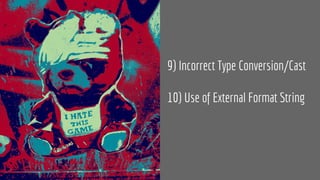
9) Incorrect Type Conversion/Cast
10) Use of External Format String
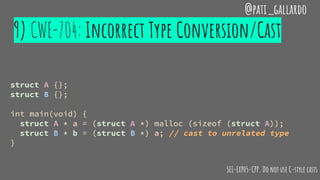
9) CWE-704: Incorrect Type Conversion/Cast
@pati_gallardo
struct A {};
struct B {};
int main(void) {
struct A * a = (struct A *) malloc (sizeof (struct A));
struct B * b = (struct B *) a; // cast to unrelated type
}
SEI-EXP05-CPP. Do not use C-style casts
10) CWE-134: Use of External Format String
@pati_gallardo
int main(int argc, char * argv[]) {
char * format = argv[1];
char * str = argv[2];
printf(format, str);
}
$ ./format_string "%s %d" "Hello World"
Hello World 1745066888
SEI-FIO47-C. Use valid format strings
The Eight I'd Really Rather You Didn'ts*
*The Eight Condiments (Pastafarianism)
@pati_gallardo
Caution: Don’t take me too
seriously. But seriously, think
about it! *wink*
@pati_gallardo
The Eight I'd Really
Rather You Didn'ts
1. Use C
2. Allocate with new
3. Do math a lot
4. Trust your external input
5. Write “clever” code
6. Use pointers a lot
7. Use shared_ptr a lot
8. Use threads a lot
@pati_gallardo
1. I'd Really Rather You Didn't:
Use C
@pati_gallardo
CG : CPL.1: Prefer C++ to C
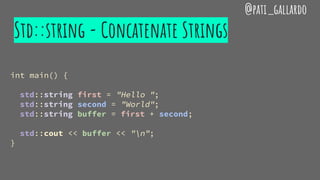
Std::string - Concatenate Strings
int main() {
std::string first = "Hello ";
std::string second = "World";
std::string buffer = first + second;
std::cout << buffer << "n";
}
@pati_gallardo
Std::cout/cin : Using the Command Line
int main(int argc, char * argv[]) {
std::string first = argv[1];
std::string second;
std::cin >> second;
std::string buffer = first + second;
std::cout << buffer << "n";
}
$ ./command_line "Hello "
World
Hello World
@pati_gallardo
Algorithms : Remove Trailing X’s
int main() {
auto isx = [](int ch) { return ch != 'x'; };
auto firstx = find_if(rbegin(str), rend(str), isx);
str.erase(firstx.base(), end(str));
}
@pati_gallardo
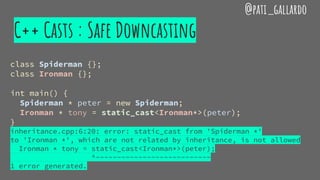
C++ Casts : Safe Downcasting
class Spiderman {};
class Ironman {};
int main() {
Spiderman * peter = new Spiderman;
Ironman * tony = static_cast<Ironman*>(peter);
}
inheritance.cpp:6:20: error: static_cast from 'Spiderman *'
to 'Ironman *', which are not related by inheritance, is not allowed
Ironman * tony = static_cast<Ironman*>(peter);
^~~~~~~~~~~~~~~~~~~~~~~~~~~~
1 error generated.
@pati_gallardo
@pati_gallardo
CG : R: Resource management
CG : R.11: Avoid calling new
and delete explicitly
2. I'd Really Rather You Didn't:
Allocate With New
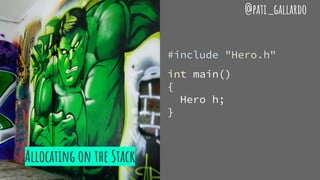
Allocating on the Stack
#include "Hero.h"
int main()
{
Hero h;
}
@pati_gallardo
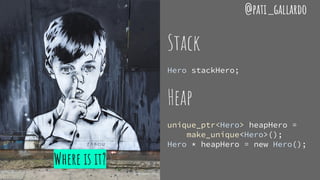
Where is it?
Stack
Hero stackHero;
Heap
unique_ptr<Hero> heapHero =
make_unique<Hero>();
Hero * heapHero = new Hero();
@pati_gallardo
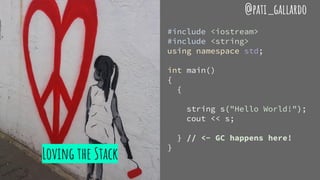
Loving the Stack
#include <iostream>
#include <string>
using namespace std;
int main()
{
{
string s("Hello World!");
cout << s;
} // <- GC happens here!
}
@pati_gallardo
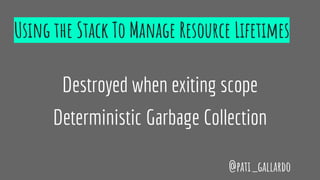
Using the Stack To Manage Resource Lifetimes
Destroyed when exiting scope
Deterministic Garbage Collection
@pati_gallardo
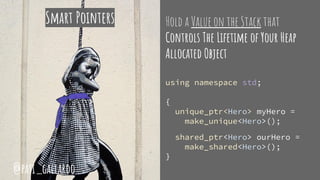
Hold a Value on the Stack that
Controls The Lifetime of Your Heap
Allocated Object
using namespace std;
{
unique_ptr<Hero> myHero =
make_unique<Hero>();
shared_ptr<Hero> ourHero =
make_shared<Hero>();
}
Smart Pointers
@pati_gallardo
@pati_gallardo
3. I'd Really Rather You Didn't:
Do Math A Lot
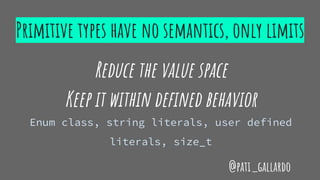
Primitive types have no semantics, only limits
Reduce the value space
Keep it within defined behavior
Enum class, string literals, user defined
literals, size_t
@pati_gallardo
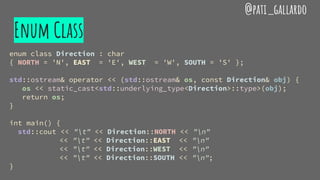
Enum Class
@pati_gallardo
enum class Direction : char
{ NORTH = 'N', EAST = 'E', WEST = 'W', SOUTH = 'S' };
std::ostream& operator << (std::ostream& os, const Direction& obj) {
os << static_cast<std::underlying_type<Direction>::type>(obj);
return os;
}
int main() {
std::cout << "t" << Direction::NORTH << "n"
<< "t" << Direction::EAST << "n"
<< "t" << Direction::WEST << "n"
<< "t" << Direction::SOUTH << "n";
}
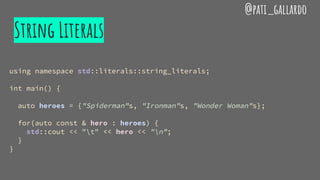
String Literals
@pati_gallardo
using namespace std::literals::string_literals;
int main() {
auto heroes = {"Spiderman"s, "Ironman"s, "Wonder Woman"s};
for(auto const & hero : heroes) {
std::cout << "t" << hero << "n";
}
}
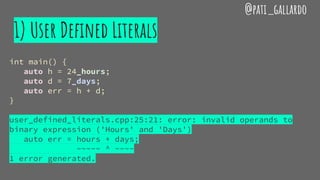
1) User Defined Literals
@pati_gallardo
int main() {
auto h = 24_hours;
auto d = 7_days;
auto err = h + d;
}
user_defined_literals.cpp:25:21: error: invalid operands to
binary expression ('Hours' and 'Days')
auto err = hours + days;
~~~~~ ^ ~~~~
1 error generated.
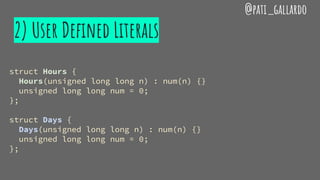
2) User Defined Literals
@pati_gallardo
struct Hours {
Hours(unsigned long long n) : num(n) {}
unsigned long long num = 0;
};
struct Days {
Days(unsigned long long n) : num(n) {}
unsigned long long num = 0;
};
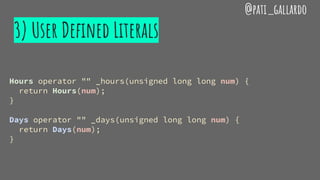
3) User Defined Literals
@pati_gallardo
Hours operator "" _hours(unsigned long long num) {
return Hours(num);
}
Days operator "" _days(unsigned long long num) {
return Days(num);
}
Use Size_t for Sizes
- Unsigned integer type
- Result of the sizeof
operator
- Use for object sizes
- Use for array indexing and
loop counting
@pati_gallardo
@pati_gallardo
4. I'd Really Rather You Didn't:
Trust Your External Input
Taint
- Is the source of this value
in your code?
- Command line args, size
fields in headers, exported
functions, APIs
@pati_gallardo
@pati_gallardo
5. I'd Really Rather You Didn't:
Write “clever” code
@pati_gallardo
6. I'd Really Rather You Didn't:
Use Pointers a Lot
@pati_gallardo
7. I'd Really Rather You Didn't:
Use shared_ptr a Lot
@pati_gallardo
8. I'd Really Rather You Didn't:
Use Threads a Lot
Take your vitamins
@pati_gallardo
Use Your Tools
@pati_gallardo
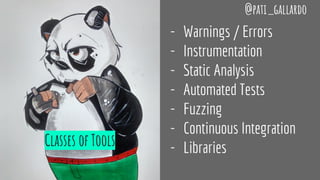
Classes of Tools
- Warnings / Errors
- Instrumentation
- Static Analysis
- Automated Tests
- Fuzzing
- Continuous Integration
- Libraries
@pati_gallardo
1. I'd Really Rather You Didn't:
Use C
@pati_gallardo
Learn some Modern C++ Instead!
@pati_gallardo
@pati_gallardo

Secure Programming Practices in C++ (NDC Security 2018)

  • 1.
  • 2.
    Secure Programming Practices inC++ @pati_gallardo Patricia Aas NDC { Security } 2018
  • 3.
    @pati_gallardo How To AvoidBlowing Your Leg Off With C++
  • 4.
    Patricia Aas - VivaldiBrowser Programmer - mainly in C++ Currently : Vivaldi Technologies Previously : Cisco Systems, Knowit, Opera Software Master in Computer Science Twitter : @pati_gallardo Photos: pixabay.com - CC0
  • 5.
    Bjarne Stroustrup “C makesit easy to shoot yourself in the foot; C++ makes it harder, but when you do it blows your whole leg off.” @pati_gallardo
  • 6.
  • 7.
    Bjarne Stroustrup “Within C++,there is a much smaller and cleaner language struggling to get out.” @pati_gallardo
  • 8.
    - What specsexist? - Here be dragons - The Eight I'd Really Rather You Didn'ts - Take your vitamins @pati_gallardo
  • 9.
  • 10.
    CG: C++ CoreGuidelines (328 pages!) @pati_gallardo
  • 11.
    @pati_gallardo SEI: CERT C++Coding Standard (435 pages!)
  • 12.
    CWE : CommonWeakness Enumeration (1572 pages!) @pati_gallardo
  • 13.
  • 14.
    undefined behavior “Examples ofundefined behavior are memory accesses outside of array bounds, signed integer overflow, null pointer dereference, modification of the same scalar more than once in an expression without sequence points, access to an object through a pointer of a different type, etc. Compilers are not required to diagnose undefined behavior (although many simple situations are diagnosed), and the compiled program is not required to do anything meaningful.” http://en.cppreference.com/w/cpp/language/ub @pati_gallardo
  • 15.
    - Don’t reasonabout undefined behaviour - Assume that it crashes or is never executed - Changing compiler, compiler version or optimization level can break your application Undefined Behaviour
  • 16.
    @pati_gallardo The Case OfThe Disappearing Memset
  • 17.
    0) CWE-14: CompilerRemoval of Code to Clear Buffers void GetData(char *MFAddr) { char pwd[64]; if (GetPasswordFromUser(pwd, sizeof(pwd))) { if (ConnectToMainframe(MFAddr, pwd)) { // Interaction with mainframe } } memset(pwd, 0, sizeof(pwd)); // <- Removed by the optimizer } @pati_gallardo SEI: MSC06-C. Beware of compiler optimizations SEI: MEM03-C. Clear sensitive information stored in reusable resources
  • 18.
    Memset_s : ZeroingMemory // Compliant Solution (C11) memset_s(pwd, 0, sizeof(pwd)); // Windows Solution SecureZeroMemory(pwd, sizeof(pwd)); @pati_gallardo SEI: MSC06-C. Beware of compiler optimizations SEI: MEM03-C. Clear sensitive information stored in reusable resources
  • 19.
    1. Unsigned IntegerWraparound 2. Signed Integer Overflow 3. Numeric Truncation 4. Stack Buffer Overflow 5. Heap Buffer Overflow 6. Buffer Underflow 7. Use After Free 8. Double Free 9. Incorrect Type Conversion 10. Uncontrolled Format String @pati_gallardo
  • 20.
    1) Unsigned IntegerWraparound 2) Signed Integer Overflow 3) Numeric Truncation Error
  • 21.
    1) CWE-190: UnsignedInteger Wraparound int main(void) { unsigned int first_len = UINT_MAX; unsigned int second_len = 256; unsigned int buf_len = 256; char first[first_len], second[second_len], buf[buf_len]; if((first_len + second_len) <= 256) { // <- sum == 255 memcpy(buf, first, first_len); memcpy(buf + first_len, second, second_len); } } @pati_gallardo SEI-INT30-C. Ensure that unsigned integer operations do not wrap
  • 22.
    2) CWE-190: SignedInteger Overflow int main(void) { int first_len = INT_MAX; int second_len = 256; int buf_len = 256; char first[first_len], second[second_len], buf[buf_len]; if((first_len + second_len) <= 256) { // <- UB (negative) memcpy(buf, first, first_len); memcpy(buf + first_len, second, second_len); } } @pati_gallardo SEI-INT32-C. Ensure that operations on signed integers do not result in overflow
  • 23.
    3) CWE-197: NumericTruncation Error int main(void) { unsigned int first_len = UINT_MAX - 256; unsigned int second_len = 256; unsigned int buf_len = 256; char first[first_len], second[second_len], buf[buf_len]; int new_len = (first_len+second_len); // <- IDB (negative) if(new_len <= 256) { memcpy(buf, first, first_len); memcpy(buf + first_len, second, second_len); } } @pati_gallardo SEI-INT31-C. Ensure that integer conversions do not result in lost or misinterpreted data
  • 24.
    4) Stack-based BufferOverflow 5) Heap-based Buffer Overflow 6) Buffer Underwrite/Underflow
  • 25.
    4) CWE-121: Stack-basedBuffer Overflow @pati_gallardo int main(void) { char buffer[10]; gets(buffer); // <- Write outside } SEI-STR31-C. Guarantee that storage for strings has sufficient space for character data and the null terminator
  • 26.
    5) CWE-122: Heap-basedBuffer Overflow int main(int argc, char * argv[]) { char* buf = (char*) malloc(sizeof(char)*10); strcpy(buf, argv[1]); // <- Write outside free(buf); } @pati_gallardo SEI-ARR38-C. Guarantee that library functions do not form invalid pointers
  • 27.
    6) CWE-124: BufferUnderwrite / Underflow int main(void) { char src[] = "Hello World"; size_t length = strlen(src); unsigned long index = (length -1); while (src[index] != 'x') { src[index] = '0'; index--; } } @pati_gallardo SEI-ARR30-C. Do not form or use out-of-bounds pointers or array subscripts
  • 28.
    7) Use AfterFree 8) Double Free
  • 29.
    7) CWE-416: UseAfter Free @pati_gallardo int main(void) { char* buffer = (char*)malloc (256); bool error = true; if (error) free(buffer); // [...] if (error) printf("%lun", strlen(buffer)); //<- Use after free } SEI-MEM30-C. Do not access freed memory
  • 30.
    8) CWE-415: DoubleFree @pati_gallardo int main(void) { char* buffer = (char*)malloc (256); bool error = true; if (error) free(buffer); // [...] free(buffer); // second free } SEI-MEM51-CPP. Properly deallocate dynamically allocated resources
  • 31.
    9) Incorrect TypeConversion/Cast 10) Use of External Format String
  • 32.
    9) CWE-704: IncorrectType Conversion/Cast @pati_gallardo struct A {}; struct B {}; int main(void) { struct A * a = (struct A *) malloc (sizeof (struct A)); struct B * b = (struct B *) a; // cast to unrelated type } SEI-EXP05-CPP. Do not use C-style casts
  • 33.
    10) CWE-134: Useof External Format String @pati_gallardo int main(int argc, char * argv[]) { char * format = argv[1]; char * str = argv[2]; printf(format, str); } $ ./format_string "%s %d" "Hello World" Hello World 1745066888 SEI-FIO47-C. Use valid format strings
  • 34.
    The Eight I'dReally Rather You Didn'ts* *The Eight Condiments (Pastafarianism) @pati_gallardo
  • 35.
    Caution: Don’t takeme too seriously. But seriously, think about it! *wink* @pati_gallardo
  • 36.
    The Eight I'dReally Rather You Didn'ts 1. Use C 2. Allocate with new 3. Do math a lot 4. Trust your external input 5. Write “clever” code 6. Use pointers a lot 7. Use shared_ptr a lot 8. Use threads a lot @pati_gallardo
  • 37.
    1. I'd ReallyRather You Didn't: Use C @pati_gallardo CG : CPL.1: Prefer C++ to C
  • 38.
    Std::string - ConcatenateStrings int main() { std::string first = "Hello "; std::string second = "World"; std::string buffer = first + second; std::cout << buffer << "n"; } @pati_gallardo
  • 39.
    Std::cout/cin : Usingthe Command Line int main(int argc, char * argv[]) { std::string first = argv[1]; std::string second; std::cin >> second; std::string buffer = first + second; std::cout << buffer << "n"; } $ ./command_line "Hello " World Hello World @pati_gallardo
  • 40.
    Algorithms : RemoveTrailing X’s int main() { auto isx = [](int ch) { return ch != 'x'; }; auto firstx = find_if(rbegin(str), rend(str), isx); str.erase(firstx.base(), end(str)); } @pati_gallardo
  • 41.
    C++ Casts :Safe Downcasting class Spiderman {}; class Ironman {}; int main() { Spiderman * peter = new Spiderman; Ironman * tony = static_cast<Ironman*>(peter); } inheritance.cpp:6:20: error: static_cast from 'Spiderman *' to 'Ironman *', which are not related by inheritance, is not allowed Ironman * tony = static_cast<Ironman*>(peter); ^~~~~~~~~~~~~~~~~~~~~~~~~~~~ 1 error generated. @pati_gallardo
  • 42.
    @pati_gallardo CG : R:Resource management CG : R.11: Avoid calling new and delete explicitly 2. I'd Really Rather You Didn't: Allocate With New
  • 43.
    Allocating on theStack #include "Hero.h" int main() { Hero h; } @pati_gallardo
  • 44.
    Where is it? Stack HerostackHero; Heap unique_ptr<Hero> heapHero = make_unique<Hero>(); Hero * heapHero = new Hero(); @pati_gallardo
  • 45.
    Loving the Stack #include<iostream> #include <string> using namespace std; int main() { { string s("Hello World!"); cout << s; } // <- GC happens here! } @pati_gallardo
  • 46.
    Using the StackTo Manage Resource Lifetimes Destroyed when exiting scope Deterministic Garbage Collection @pati_gallardo
  • 47.
    Hold a Valueon the Stack that Controls The Lifetime of Your Heap Allocated Object using namespace std; { unique_ptr<Hero> myHero = make_unique<Hero>(); shared_ptr<Hero> ourHero = make_shared<Hero>(); } Smart Pointers @pati_gallardo
  • 48.
    @pati_gallardo 3. I'd ReallyRather You Didn't: Do Math A Lot
  • 49.
    Primitive types haveno semantics, only limits Reduce the value space Keep it within defined behavior Enum class, string literals, user defined literals, size_t @pati_gallardo
  • 50.
    Enum Class @pati_gallardo enum classDirection : char { NORTH = 'N', EAST = 'E', WEST = 'W', SOUTH = 'S' }; std::ostream& operator << (std::ostream& os, const Direction& obj) { os << static_cast<std::underlying_type<Direction>::type>(obj); return os; } int main() { std::cout << "t" << Direction::NORTH << "n" << "t" << Direction::EAST << "n" << "t" << Direction::WEST << "n" << "t" << Direction::SOUTH << "n"; }
  • 51.
    String Literals @pati_gallardo using namespacestd::literals::string_literals; int main() { auto heroes = {"Spiderman"s, "Ironman"s, "Wonder Woman"s}; for(auto const & hero : heroes) { std::cout << "t" << hero << "n"; } }
  • 52.
    1) User DefinedLiterals @pati_gallardo int main() { auto h = 24_hours; auto d = 7_days; auto err = h + d; } user_defined_literals.cpp:25:21: error: invalid operands to binary expression ('Hours' and 'Days') auto err = hours + days; ~~~~~ ^ ~~~~ 1 error generated.
  • 53.
    2) User DefinedLiterals @pati_gallardo struct Hours { Hours(unsigned long long n) : num(n) {} unsigned long long num = 0; }; struct Days { Days(unsigned long long n) : num(n) {} unsigned long long num = 0; };
  • 54.
    3) User DefinedLiterals @pati_gallardo Hours operator "" _hours(unsigned long long num) { return Hours(num); } Days operator "" _days(unsigned long long num) { return Days(num); }
  • 55.
    Use Size_t forSizes - Unsigned integer type - Result of the sizeof operator - Use for object sizes - Use for array indexing and loop counting @pati_gallardo
  • 56.
    @pati_gallardo 4. I'd ReallyRather You Didn't: Trust Your External Input
  • 57.
    Taint - Is thesource of this value in your code? - Command line args, size fields in headers, exported functions, APIs @pati_gallardo
  • 58.
    @pati_gallardo 5. I'd ReallyRather You Didn't: Write “clever” code
  • 59.
    @pati_gallardo 6. I'd ReallyRather You Didn't: Use Pointers a Lot
  • 60.
    @pati_gallardo 7. I'd ReallyRather You Didn't: Use shared_ptr a Lot
  • 61.
    @pati_gallardo 8. I'd ReallyRather You Didn't: Use Threads a Lot
  • 62.
  • 63.
  • 64.
    Classes of Tools -Warnings / Errors - Instrumentation - Static Analysis - Automated Tests - Fuzzing - Continuous Integration - Libraries @pati_gallardo
  • 65.
    1. I'd ReallyRather You Didn't: Use C @pati_gallardo
  • 66.
    Learn some ModernC++ Instead! @pati_gallardo
  • 67.