Downloaded 25 times
![Ancient History
• C created by Dennis Ritchie, 1972 [9]
• “C with Classes” created by Bjarne Stroustrup, 1979
[9]
• Renamed to C++, 1983 [9]
• The C++ Programming Language, 1985 [9]
• The C++ Programming Language 2nd Ed. and C++ 2.0,
1989 [9]
• ISO Standardization as C++98, 1998 [9]
• Minor ISO revision in C++03, 2003 [9,4]](https://image.slidesharecdn.com/modernclunchandlearn-140905144210-phpapp02/85/Modern-C-Lunch-and-Learn-2-320.jpg)
![C++ is “C with Classes”
• Often, C can be used in C++ [1]
• C is fast, portable, and versatile [1]
• Therefore so is C++
• C has only structs to define composite types
• Passed by-value unless with a pointer
• No inheritance, polymorphism, encapsulation
• So not object-oriented
• C++ adds classes that bring OO to C
• But, knowing C is not a prerequisite for learning
C++ [1]](https://image.slidesharecdn.com/modernclunchandlearn-140905144210-phpapp02/85/Modern-C-Lunch-and-Learn-3-320.jpg)
![C++ invalidates some C approaches
• Macros are almost never necessary [1]
• Don’t use malloc() [1]
• Avoid void*, pointer arithmetic, unions, and casts
[1]
• Minimize use of arrays and C-style strings [1]
• C does not provide a native Boolean type [2]](https://image.slidesharecdn.com/modernclunchandlearn-140905144210-phpapp02/85/Modern-C-Lunch-and-Learn-4-320.jpg)
![When Should I C++?
• For Performance
• Raw algorithms
• C++/CLI code called from C#
• For Interop
• Got a native lib on your hands? Create a C++/CLI interop DLL.
• For Portability
• C++ can run on just about any device, any platform, any CPU
that matters
• For Resource Optimization
• With nearly identical simple demo apps in C++ and C#, C++ used
~90% less memory
• Instant memory cleanup – all objects are “IDisposable“ [4]
• Important for embedded devices, mobile, certain server
applications](https://image.slidesharecdn.com/modernclunchandlearn-140905144210-phpapp02/85/Modern-C-Lunch-and-Learn-5-320.jpg)
![C++ Templates Primer
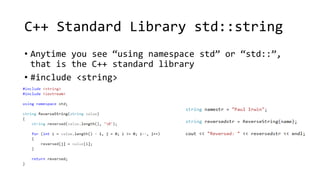
• vector<int> better than int[]
• Looks like a generic type – kinda is, kinda isn’t
• Created at compile time](https://image.slidesharecdn.com/modernclunchandlearn-140905144210-phpapp02/85/Modern-C-Lunch-and-Learn-12-320.jpg)
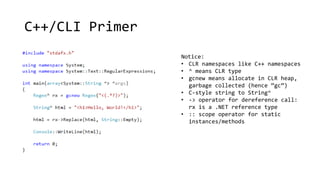
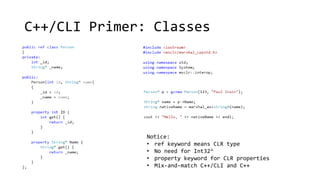
![Modern History
• After C++03…
• C++0x draft – expected to be released before 2010
• C++0x -> C++11 – a wee bit late
• First major release of C++ since C++98 – 13 years!
• C++14 Working Draft
• Minor release, 3 year cadence [4]
• C++17 (expected)
• Next major release, 3 year cadence [4]](https://image.slidesharecdn.com/modernclunchandlearn-140905144210-phpapp02/85/Modern-C-Lunch-and-Learn-15-320.jpg)
![C++11: move semantics
• Prior to C++11, this code could
result in a deep copy of v
• v is created on the stack
• We fill v with values
• “return v” copies all values into v2
when called – O(n)
• C++11 now implicitly “moves” v
into v2
• Much better performance, esp. with
large objects – O(1)
• Further reading: std::move [3]](https://image.slidesharecdn.com/modernclunchandlearn-140905144210-phpapp02/85/Modern-C-Lunch-and-Learn-16-320.jpg)
![C++11: initializer lists
• From previous slide, now we
can do this instead
• Calls ctor on vector<int>
taking initializer_list<int>
• You can return objects this
way too [3]
• Neat! But may still want ctors
• You can write methods that
take initializer_list<T> [3]](https://image.slidesharecdn.com/modernclunchandlearn-140905144210-phpapp02/85/Modern-C-Lunch-and-Learn-17-320.jpg)
![C++11: type inference
• “var” spelled “auto” [4]](https://image.slidesharecdn.com/modernclunchandlearn-140905144210-phpapp02/85/Modern-C-Lunch-and-Learn-18-320.jpg)
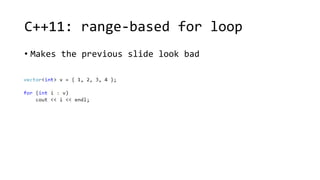
![C++11: lambda functions (!!!)
• YAY
So this clearly prints even numbers to the console.
And actually, you really should be using range-based for here.
But what’s up with that [] syntax?](https://image.slidesharecdn.com/modernclunchandlearn-140905144210-phpapp02/85/Modern-C-Lunch-and-Learn-20-320.jpg)
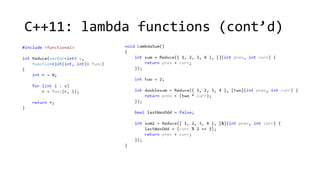
 { return x + 1; }
• Captures no closures [5]
• [y](int x) { return x + y; }
• Captures y by value (copy) [5]
• [&](int x) { y += x; }
• Capture any referenced variable (y here) by reference [5]
• [=](int x) { return x + y; }
• Capture any referenced variable (y here) by value (copy) [5]
• [=, &y](int x) { y += x + z; }
• Capture any referenced variable (z here) by value (copy); but capture
y by reference [5]
• [this](int x) { return x + _privateFieldY; }
• Capture the “this” pointer in the scope of the lambda [5]](https://image.slidesharecdn.com/modernclunchandlearn-140905144210-phpapp02/85/Modern-C-Lunch-and-Learn-21-320.jpg)
![C++11: strongly typed enums
• In C++03, enums are not type safe [6]
• C++11 adds “enum class” for type safety [3]](https://image.slidesharecdn.com/modernclunchandlearn-140905144210-phpapp02/85/Modern-C-Lunch-and-Learn-23-320.jpg)
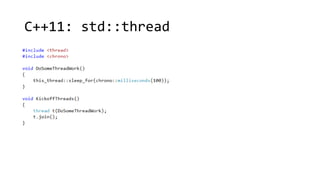
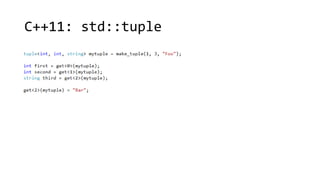
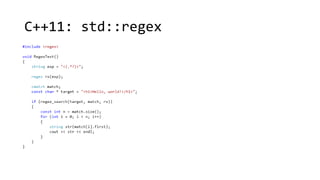
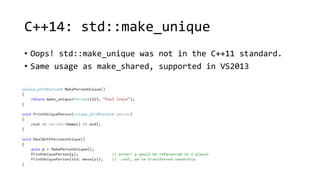
![C++11: shared_ptr, unique_ptr
• Consider: Person* GetPerson() { … }
• What should be done with the results? [7]
• Who owns the pointer?
• If I “delete” it, what will happen downstream?
• Enter std::shared_ptr and std::unique_ptr [7]
• shared_ptr: reference-counted ownership of pointer
• unique_ptr: only one unique_ptr object can own at a given
time
• unique_ptr deprecates auto_ptr](https://image.slidesharecdn.com/modernclunchandlearn-140905144210-phpapp02/85/Modern-C-Lunch-and-Learn-27-320.jpg)
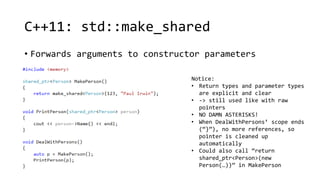
![C++14: generic lambdas
• Use auto to make a generic lambda [8]](https://image.slidesharecdn.com/modernclunchandlearn-140905144210-phpapp02/85/Modern-C-Lunch-and-Learn-32-320.jpg)
![C++17?: pattern matching
int eval(Expr& e) // expression evaluator
{
Expr* a,*b;
int n;
match (e)
{
case (C<Value>(n)): return n;
case (C<Plus>(a,b)): return eval(*a) + eval(*b);
case (C<Minus>(a,b)): return eval(*a) - eval(*b);
case (C<Times>(a,b)): return eval(*a) * eval(*b);
case (C<Divide>(a,b)): return eval(*a) / eval(*b);
}
}
// From [10], possible syntax mine (not indicative of any proposed syntax I’ve seen)](https://image.slidesharecdn.com/modernclunchandlearn-140905144210-phpapp02/85/Modern-C-Lunch-and-Learn-33-320.jpg)
![C++17?: async/await
future<void> f(stream str) async
{
shared_ptr<vector> buf = ...;
int count = await str.read(512, buf);
return count + 11;
}
future g() async
{
stream s = ...;
int pls11 = await f(s);
s.close();
}
// Code from [11]
Notice:
• future<T> equivalent to Task<T>
• async/await very similar to C#
• std::future already in the
standard since C++11!](https://image.slidesharecdn.com/modernclunchandlearn-140905144210-phpapp02/85/Modern-C-Lunch-and-Learn-34-320.jpg)
![C++17?: modules
// File_1.cpp:
export Lib:
import std;
using namespace std;
public:
namespace N {
struct S {
S() {
cout << “S()n”;
}
};
}
// File_2.cpp:
import Lib; // no guard needed
int main() {
N::S s;
}
// Code modified from [12]](https://image.slidesharecdn.com/modernclunchandlearn-140905144210-phpapp02/85/Modern-C-Lunch-and-Learn-35-320.jpg)
![References
1. The C++ Programming Language, Special Edition, B. Stroustrup, 1997
2. Differences Between C and C++, http://www.cprogramming.com/tutorial/c-vs-c++.html
3. C++11, http://en.wikipedia.org/wiki/C%2B%2B11
4. Modern C++: What You Need To Know [Video], http://channel9.msdn.com/Events/Build/2014/2-661
5. C++11 – Lambda Closures, The Definitive Guide, http://www.cprogramming.com/c++11/c++11-
lambda-closures.html
6. C++ Enumeration Declarations, http://msdn.microsoft.com/en-us/library/2dzy4k6e.aspx
7. Smart Pointers, http://en.wikipedia.org/wiki/Smart_pointer
8. C++14, http://en.wikipedia.org/wiki/C%2B%2B14
9. C++, http://en.wikipedia.org/wiki/C%2B%2B
10. C++14 and early thoughts about C++17 [Slides PDF], B. Stroutstrup,
https://parasol.tamu.edu/people/bs/622-GP/C++14TAMU.pdf
11. Resumable Functions – Async and await – Meeting C++,
http://meetingcpp.com/index.php/br/items/resumable-functions-async-and-await.html
12. Modules in C++, D. Vandevoorde, http://www.open-std.
org/jtc1/sc22/wg21/docs/papers/2007/n2316.pdf](https://image.slidesharecdn.com/modernclunchandlearn-140905144210-phpapp02/85/Modern-C-Lunch-and-Learn-36-320.jpg)

This document provides an overview of the history and development of C++, highlighting its evolution from C, its object-oriented features, and various C++ standards up to C++17. It covers key concepts including memory management, C++ classes, templates, the standard library, and new features introduced in recent standards like C++11 and C++14. Additionally, it discusses comparisons with C# and the implications of C++ for performance and resource optimization.


![谷歌留痕技术教程[ 𝙩𝙤𝙥 𝟮𝟯𝟯. 𝙘 𝙤𝙢 ]](https://cdn.slidesharecdn.com/ss_thumbnails/top233-260130173900-2eb784f9-thumbnail.jpg?width=640&height=640&fit=bounds)


![20260201 [FOSDEM] gomodjail - library sandboxing for Go modules.pdf](https://cdn.slidesharecdn.com/ss_thumbnails/20260201fosdemgomodjail-librarysandboxingforgomodules-260201225659-76609ec4-thumbnail.jpg?width=640&height=640&fit=bounds)


