Oil Rig Disaster:
Piper Alpha 1988
Presented By
Parth R. Gangadiya
About Piper Alpha
Construction
Timeline
Aftermath
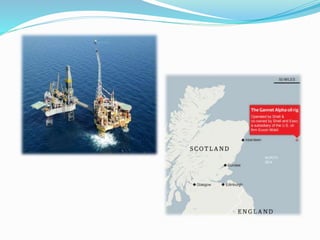
Piper Alpha located about 120 miles north east of Aberdeen,
Scotland.
The platform began production in 1976.
 Oil production started in 1976 with about 250,000 barrels
(40,000 m3) of oil per day increasing to 300,000 barrels (48,000
m3).
A gas recovery module was installed by 1980. Production
declined to 125,000 barrels (19,900 m3) by 1988.
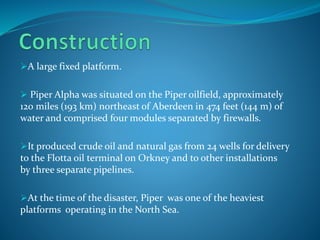
A large fixed platform.
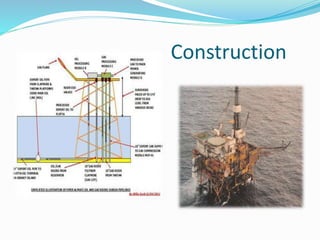
 Piper Alpha was situated on the Piper oilfield, approximately
120 miles (193 km) northeast of Aberdeen in 474 feet (144 m) of
water and comprised four modules separated by firewalls.
It produced crude oil and natural gas from 24 wells for delivery
to the Flotta oil terminal on Orkney and to other installations
by three separate pipelines.
At the time of the disaster, Piper was one of the heaviest
platforms operating in the North Sea.
Construction
12:00 p.m. Two condensate pumps, designated A and B,
displaced the platform’s condensate for transport to the coast.
6:00 p.m. The day shift ended, and the night shift started with
62 men running Piper Alpha.
7:00 p.m. Like many other offshore platforms, Piper Alpha had
an automatic fire-fighting system, driven by both diesel and
electric pumps.
9:45 p.m. Condensate (Natural Gas Liquids NGL) Pump B stopped
suddenly and could not be restarted.
9:52 p.m. The permit for the overhaul was found, but not the other
permit stating that the pump must be started under any
circumstances due to the missing safety valve.
9:55 p.m. Condensate Pump A was switched on, Gas flowed into
the pump.
10:04 p.m. The control room was abandoned.
10:20 p.m. Tartan’s gas line (pressurised to 120 Atmospheres)
melted and burst, releasing 15-30 tonnes of gas every second, which
immediately ignited.
10:30 p.m. The Tharos, a large semisubmersible fire fighting,
rescue and accommodation vessel, drew alongside Piper Alpha.
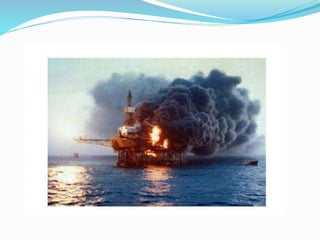
10:50 p.m. The second gas line ruptured, spilling millions of liters
of gas into the conflagration.
11:20 p.m. The pipeline connecting Piper Alpha to the Claymore
Platform burst.
11:50 p.m. The generation and utilities Module (D), which
included the fireproofed accommodation block, slipped into the
sea. The largest part of the platform followed it.
12:45 a.m., 7 July The entire platform had gone. Module (A) was
all that remained of Piper Alpha.
There is controversy about whether there was sufficient time for
more effective emergency evacuation.
This was a consequence of the platform design, including the
absence of blast walls.
Another contributing factor was that the nearby connected
platforms Tartan and Claymore continued to pump gas and oil to
Piper Alpha until its pipeline ruptured in the heat in the second
explosion.
Their operations crews did not believe they had authority to shut
off production.
Piper alpha

Piper alpha

  • 1.
    Oil Rig Disaster: PiperAlpha 1988 Presented By Parth R. Gangadiya
  • 2.
  • 3.
    Piper Alpha locatedabout 120 miles north east of Aberdeen, Scotland. The platform began production in 1976.  Oil production started in 1976 with about 250,000 barrels (40,000 m3) of oil per day increasing to 300,000 barrels (48,000 m3). A gas recovery module was installed by 1980. Production declined to 125,000 barrels (19,900 m3) by 1988.
  • 5.
    A large fixedplatform.  Piper Alpha was situated on the Piper oilfield, approximately 120 miles (193 km) northeast of Aberdeen in 474 feet (144 m) of water and comprised four modules separated by firewalls. It produced crude oil and natural gas from 24 wells for delivery to the Flotta oil terminal on Orkney and to other installations by three separate pipelines. At the time of the disaster, Piper was one of the heaviest platforms operating in the North Sea.
  • 6.
  • 7.
    12:00 p.m. Twocondensate pumps, designated A and B, displaced the platform’s condensate for transport to the coast. 6:00 p.m. The day shift ended, and the night shift started with 62 men running Piper Alpha. 7:00 p.m. Like many other offshore platforms, Piper Alpha had an automatic fire-fighting system, driven by both diesel and electric pumps.
  • 8.
    9:45 p.m. Condensate(Natural Gas Liquids NGL) Pump B stopped suddenly and could not be restarted. 9:52 p.m. The permit for the overhaul was found, but not the other permit stating that the pump must be started under any circumstances due to the missing safety valve. 9:55 p.m. Condensate Pump A was switched on, Gas flowed into the pump.
  • 10.
    10:04 p.m. Thecontrol room was abandoned. 10:20 p.m. Tartan’s gas line (pressurised to 120 Atmospheres) melted and burst, releasing 15-30 tonnes of gas every second, which immediately ignited. 10:30 p.m. The Tharos, a large semisubmersible fire fighting, rescue and accommodation vessel, drew alongside Piper Alpha.
  • 11.
    10:50 p.m. Thesecond gas line ruptured, spilling millions of liters of gas into the conflagration. 11:20 p.m. The pipeline connecting Piper Alpha to the Claymore Platform burst. 11:50 p.m. The generation and utilities Module (D), which included the fireproofed accommodation block, slipped into the sea. The largest part of the platform followed it. 12:45 a.m., 7 July The entire platform had gone. Module (A) was all that remained of Piper Alpha.
  • 13.
    There is controversyabout whether there was sufficient time for more effective emergency evacuation. This was a consequence of the platform design, including the absence of blast walls. Another contributing factor was that the nearby connected platforms Tartan and Claymore continued to pump gas and oil to Piper Alpha until its pipeline ruptured in the heat in the second explosion. Their operations crews did not believe they had authority to shut off production.