POPULATION AND HEALTH : TECHNIQUES OF
      ANALYSIS AND POLICY PERSPECTIVE


    MIGRATION CONCEPTS AND TECHNIQUES
               OF ANALYSIS
1          MA (SDP), 2nd Semester, 2012
INTRODUCTION
   Uneven distribution of human population in space-
    undergoes changes over time

   Modern times- uneven distribution disproportionately
    higher for urban areas

 Migration is the third basic factor affecting change in
the population of an area

   Important element in growth of labour-force

   Demography of migrants and non-migrants- its
    importance in socio-economic, development aspects
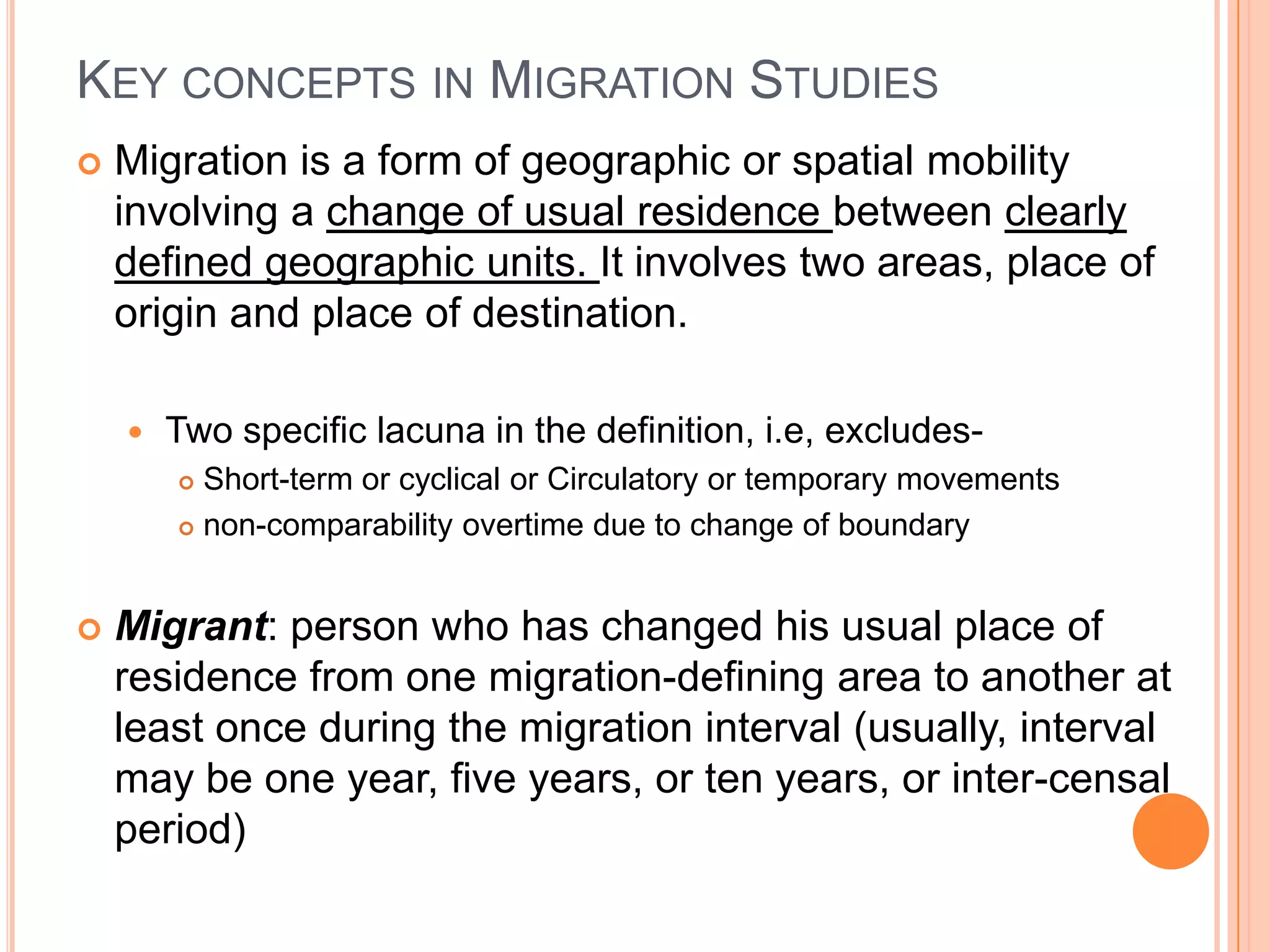
KEY CONCEPTS IN MIGRATION STUDIES
   Migration is a form of geographic or spatial mobility
    involving a change of usual residence between clearly
    defined geographic units. It involves two areas, place of
    origin and place of destination.

       Two specific lacuna in the definition, i.e, excludes-
         Short-term or cyclical or Circulatory or temporary movements
         non-comparability overtime due to change of boundary


   Migrant: person who has changed his usual place of
    residence from one migration-defining area to another at
    least once during the migration interval (usually, interval
    may be one year, five years, or ten years, or inter-censal
    period)
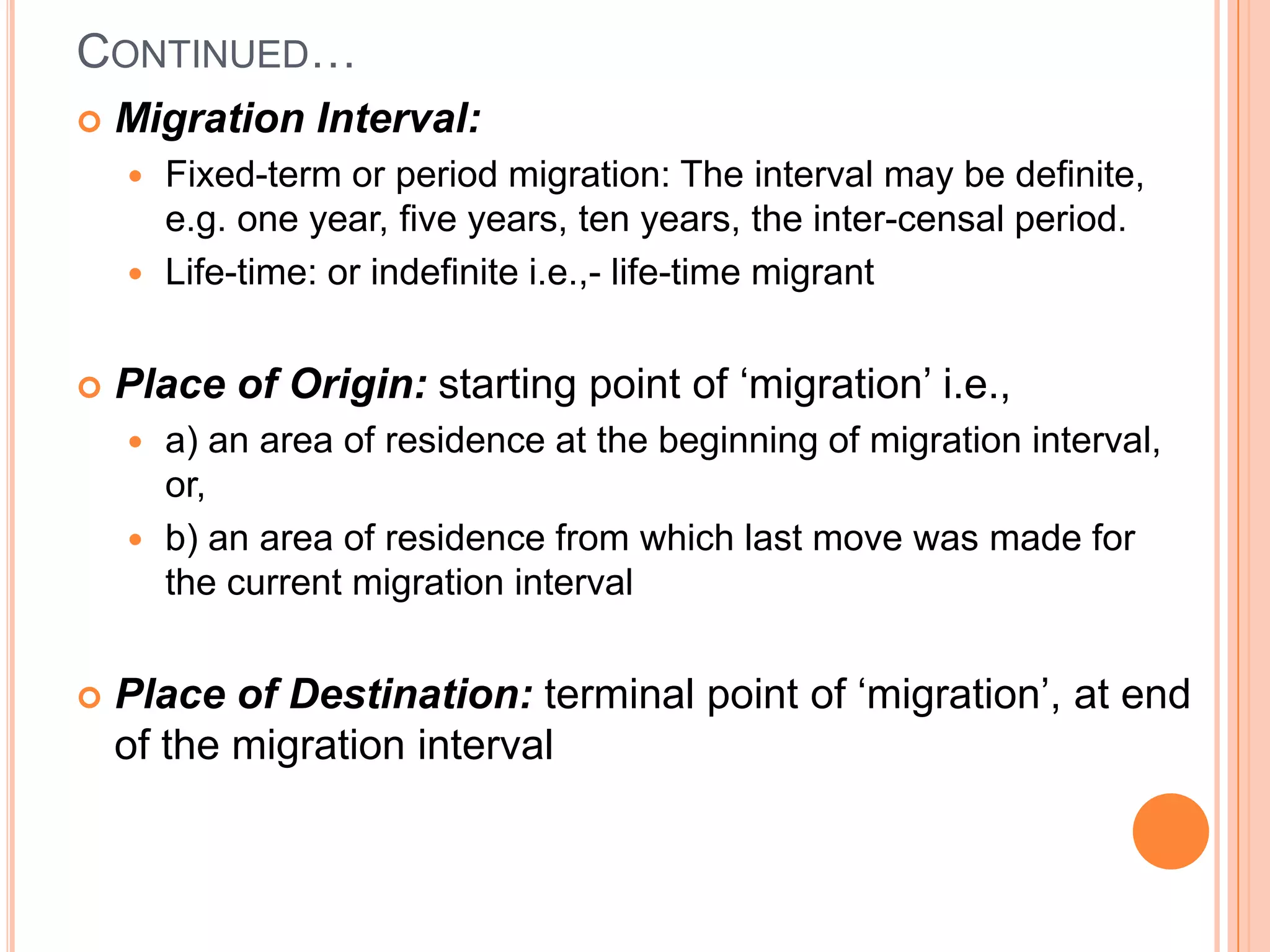
CONTINUED…
   Migration Interval:
     Fixed-term or period migration: The interval may be definite,
      e.g. one year, five years, ten years, the inter-censal period.
     Life-time: or indefinite i.e.,- life-time migrant


   Place of Origin: starting point of ‘migration’ i.e.,
     a) an area of residence at the beginning of migration interval,
      or,
     b) an area of residence from which last move was made for
      the current migration interval


   Place of Destination: terminal point of ‘migration’, at end
    of the migration interval
CONTINUED…
   In-migration: ‘move’ in respect to place of destination. International
    move- Immigrant, within country- In-migrant

   Out-migration: ‘move’ in respect to place of origin. International move-
    Emigrant, within country- Out-migrant

   Gross Migration: data referring all migration (in/out) in respect to
    specific origin/destination, over a specific interval

   Net Migration: data referring to only ‘balance’ of movement in opposite
    directions, in respect to specific origin/destination, over a specific
    interval

   Migration Stream: group of people moving during a given migration
    interval that have a common area of origin and of destination

   Lifetime Migration: A person whose place of residence at
    census/survey date is different from his place of birth is a lifetime
    migrant
TYPES OF MIGRATION
   International migration- takes place across international
    boundary. Refers to socio-economic and political conditions,
    especially immigration and emigration laws and policies

   Internal Migration- occurs within a country. Refers to socio-
    economic spatial situations within a country. Further grouped
    into;
    I.     Rural to Rural migration
    II.    Rural to Urban migration
    III.   Urban to Rural migration
    IV.    Urban to Urban migration

   R-U: most important. Contributes to transfer of labour force
    from the traditional agricultural sector to the urbanised industrial
    sector

   Each of these migration streams has different premises, causes
    and consequences.
TYPES OF MIGRATION
   Migration Stream may be further categorized into-
     Intra-district migration
     Inter-district migration
     Inter-State migration
     International migration


   Categories based on reasons for migration:
      Marriage migration;
      Labour migration or migration of people for work, employment, etc.;
      Migration for prosperity;
      Refugee migration arising due to political or other reasons
      Migration due to natural calamities;
      Return migration; and
      Brain-drain, migration of professionals from developing to developed
       countries.

   ‘Single migration’ & ‘Family migration’
SOURCES OF DATA- MIGRATION
   Analyzing changes in pop-structure and labor force of an area:
    number and characteristics of persons entering or leaving an area
    is required, together with census data on population size and
    vital statistics.

   Three most vital sources of migration data-
     Censuses
     Surveys
     Population Registers


   Basic migration data and their characteristics
     Place of birth data: difficulties in collection and interpretation, i.e., return
      migrants
     Place of last residence: Data on the place of last residence also suffer
      from absence of a definite time reference
     Duration of residence: return migrants and provides the timing of last
      move
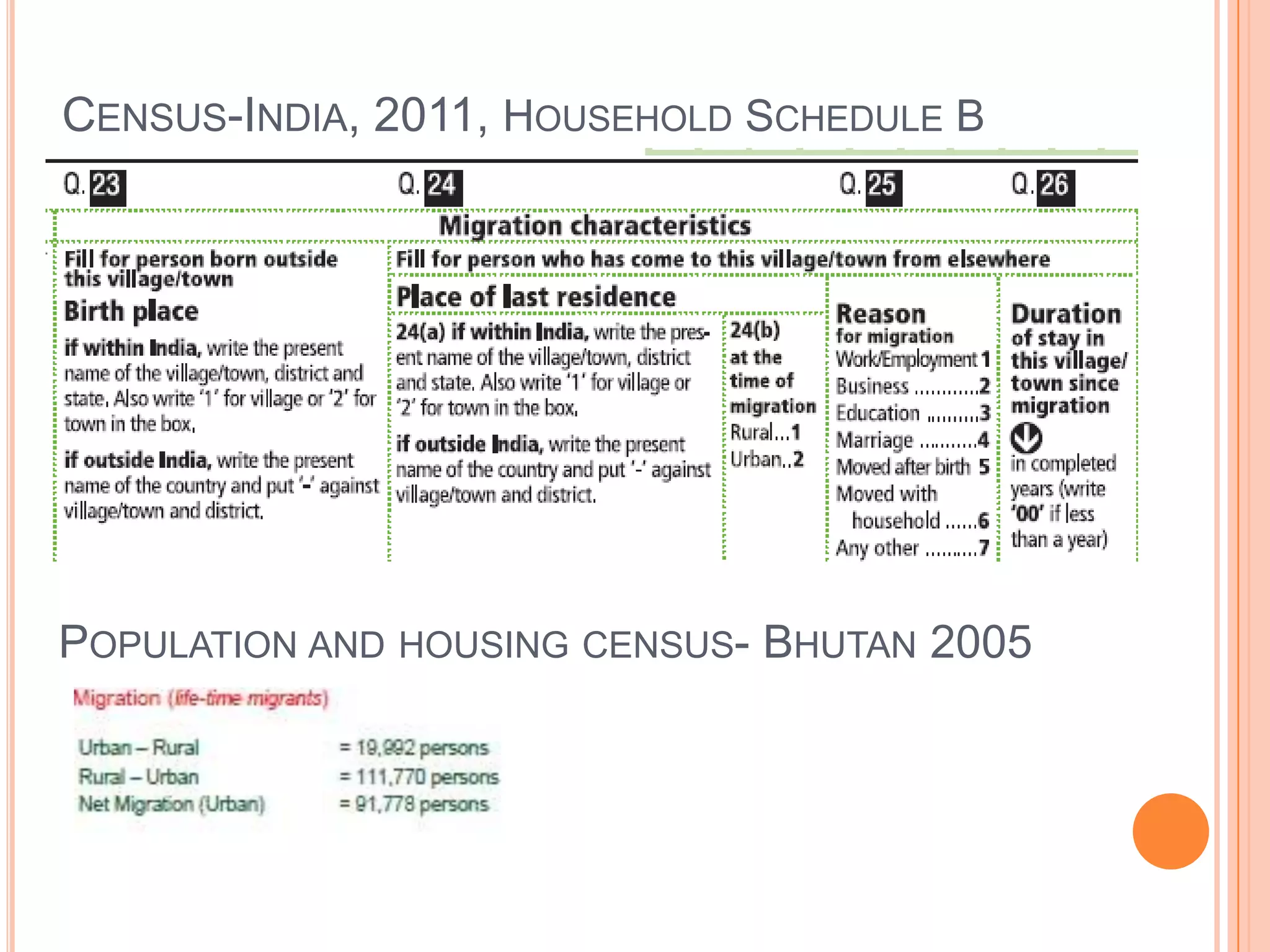
CENSUS-INDIA, 2011, HOUSEHOLD SCHEDULE B


POPULATION AND HOUSING CENSUS- BHUTAN 2005
DETERMINANTS AND CONSEQUENCES OF INTERNAL
MIGRATION

Determinants:
i) Development/Underdevelopment and Migration
ii)Spatial disorganization and Internal Migration

Consequences:
 Consequences on Rural Areas
    Effect on rural incomes and its distribution
    Effect on rural capital formation and technological
     change
    Effect on modes of rural production
    Effect on rural fertility
   Consequence on urban areas:

       Effect on wages and unemployment
       Effect on labour force participation
       Effect on availability of urban amenities
       Effect on urban income distribution
       Effect on urban development
       Effect on demographic structure of urban population
MEASURES IN            MIGRATION
  Measurement and analysis of migration for population
   estimates and projections-
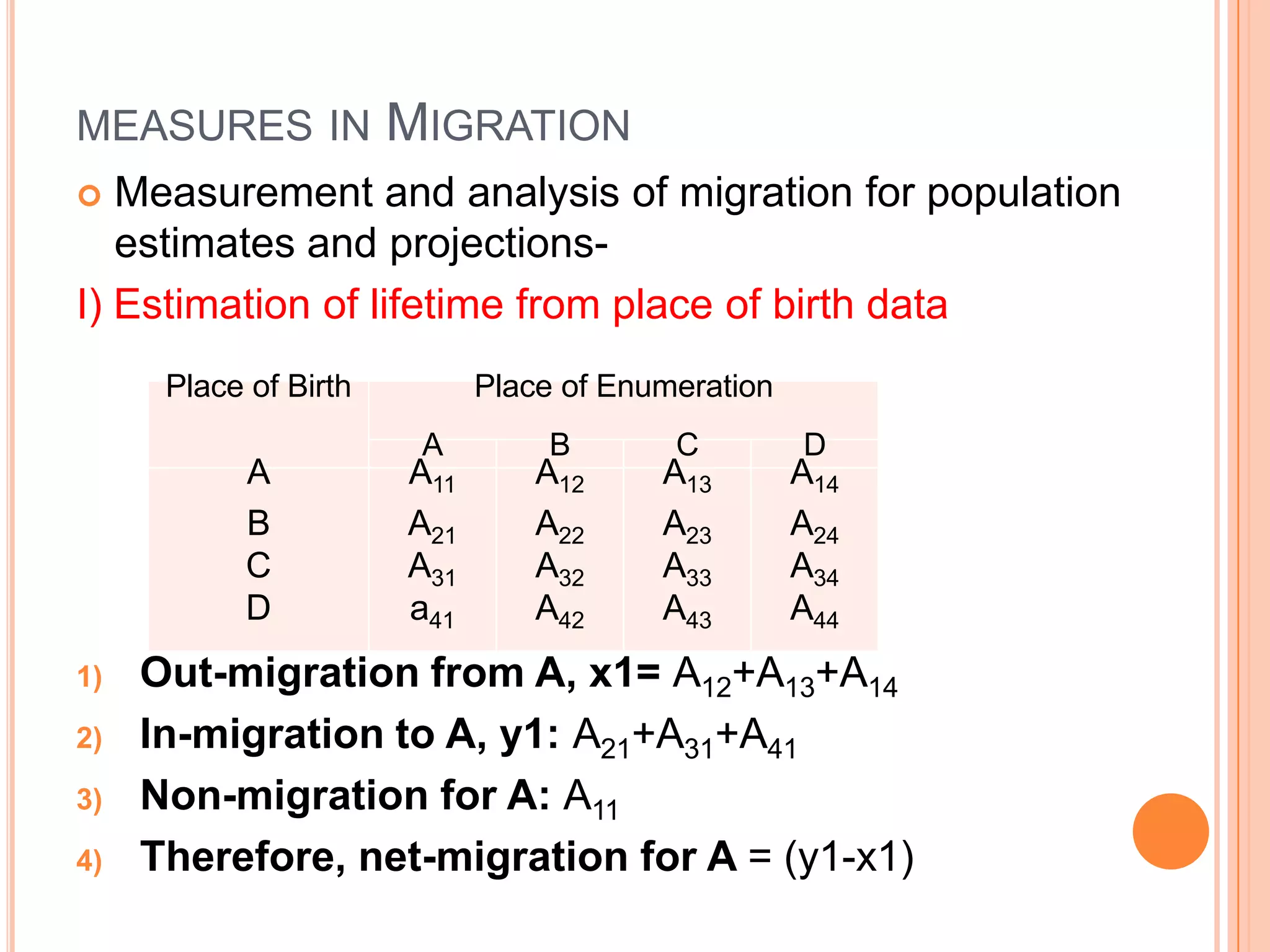
I) Estimation of lifetime from place of birth data
      Place of Birth         Place of Enumeration
                        A         B       C         D
            A          A11       A12     A13        A14
            B          A21       A22     A23        A24
            C          A31       A32     A33        A34
            D          a41       A42     A43        A44
1)   Out-migration from A, x1= A12+A13+A14
2)   In-migration to A, y1: A21+A31+A41
3)   Non-migration for A: A11
4)   Therefore, net-migration for A = (y1-x1)
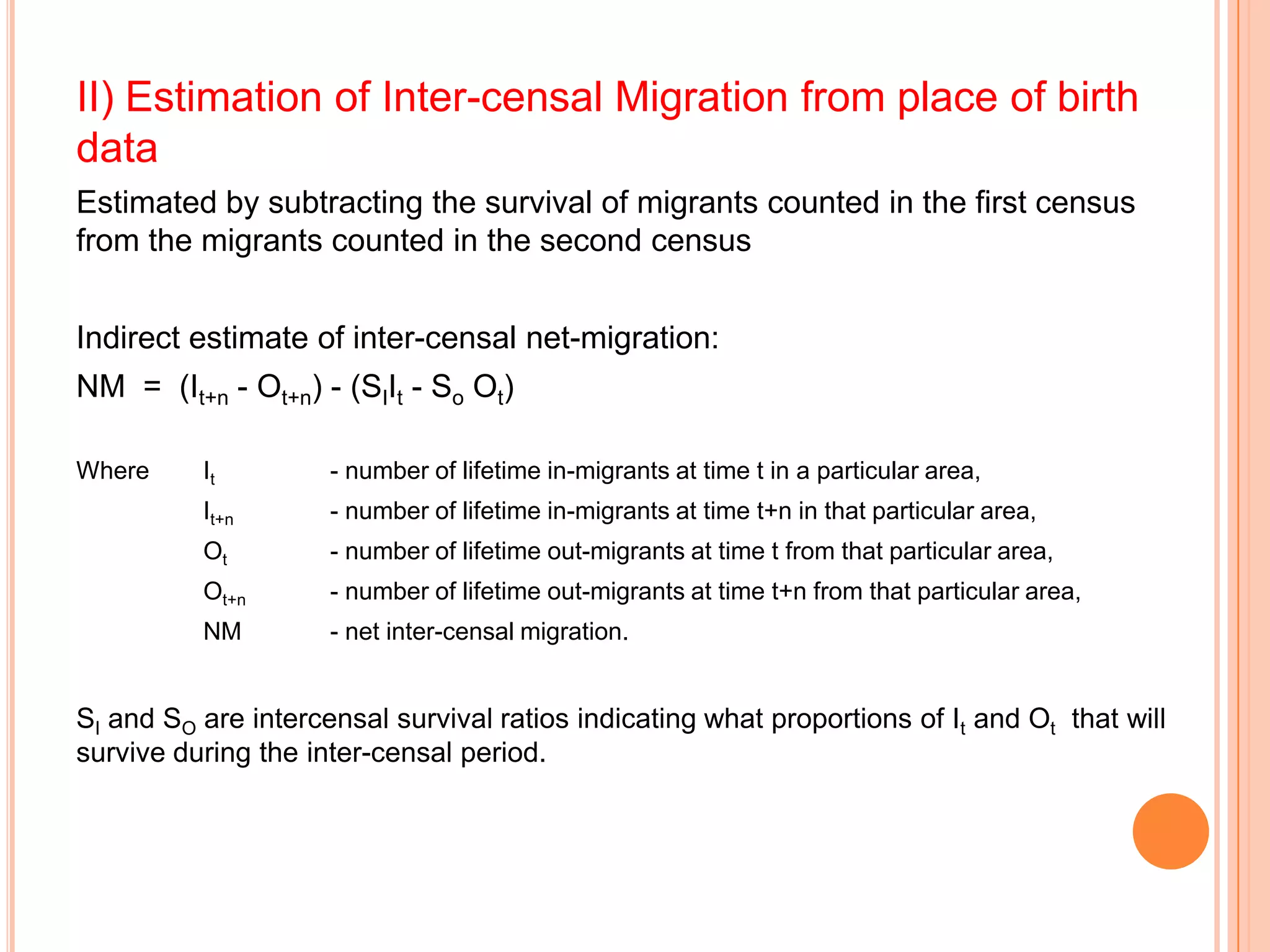
II) Estimation of Inter-censal Migration from place of birth
data
Estimated by subtracting the survival of migrants counted in the first census
from the migrants counted in the second census


Indirect estimate of inter-censal net-migration:
NM = (It+n - Ot+n) - (SIIt - So Ot)

Where     It         - number of lifetime in-migrants at time t in a particular area,
          It+n       - number of lifetime in-migrants at time t+n in that particular area,
          Ot         - number of lifetime out-migrants at time t from that particular area,
          Ot+n       - number of lifetime out-migrants at time t+n from that particular area,
          NM         - net inter-censal migration.


SI and SO are intercensal survival ratios indicating what proportions of It and Ot that will
survive during the inter-censal period.
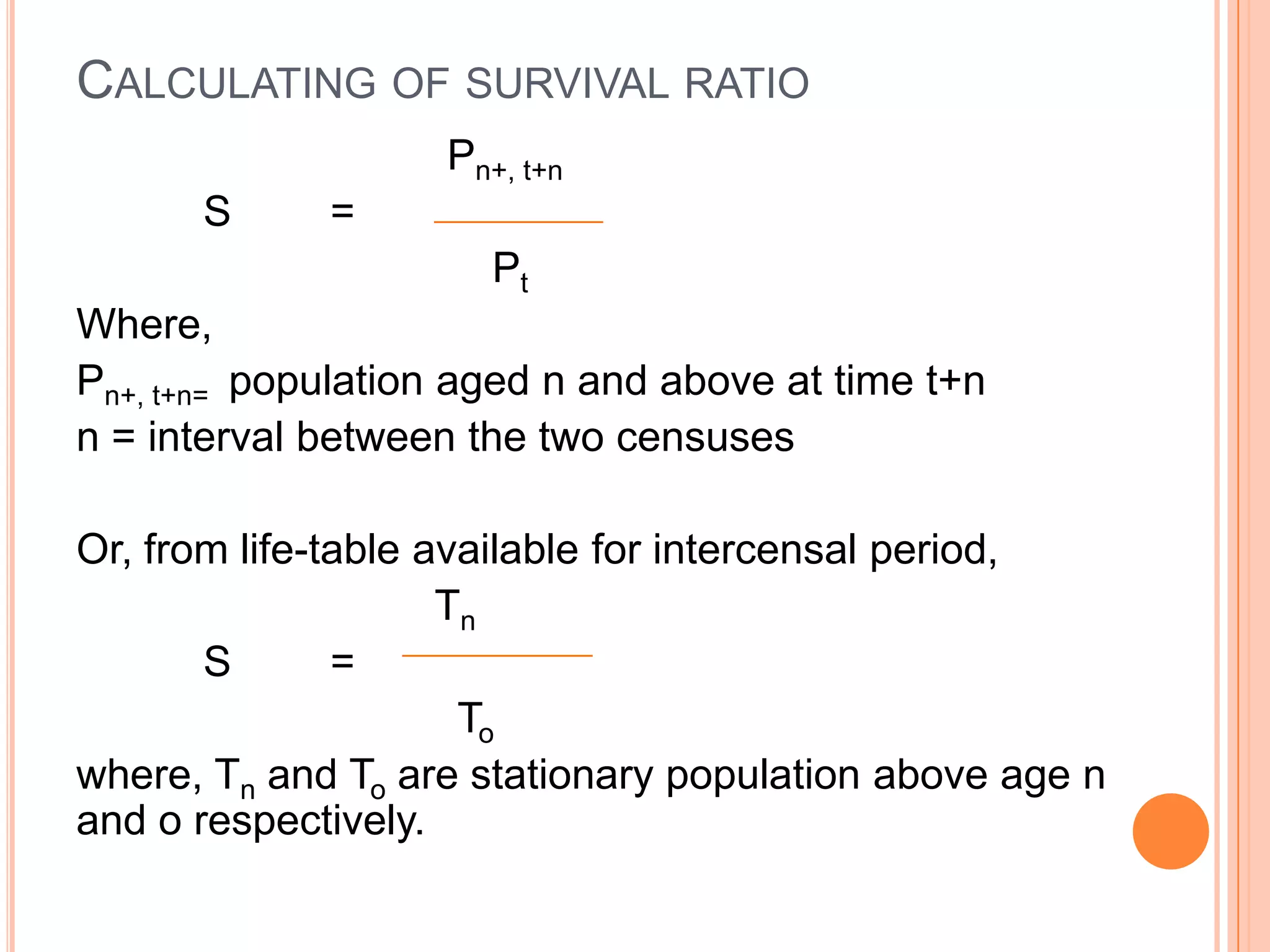
CALCULATING OF SURVIVAL RATIO
                   Pn+, t+n
      S      =
                      Pt
Where,
Pn+, t+n= population aged n and above at time t+n
n = interval between the two censuses

Or, from life-table available for intercensal period,
                     Tn
       S       =
                      To
where, Tn and To are stationary population above age n
and o respectively.
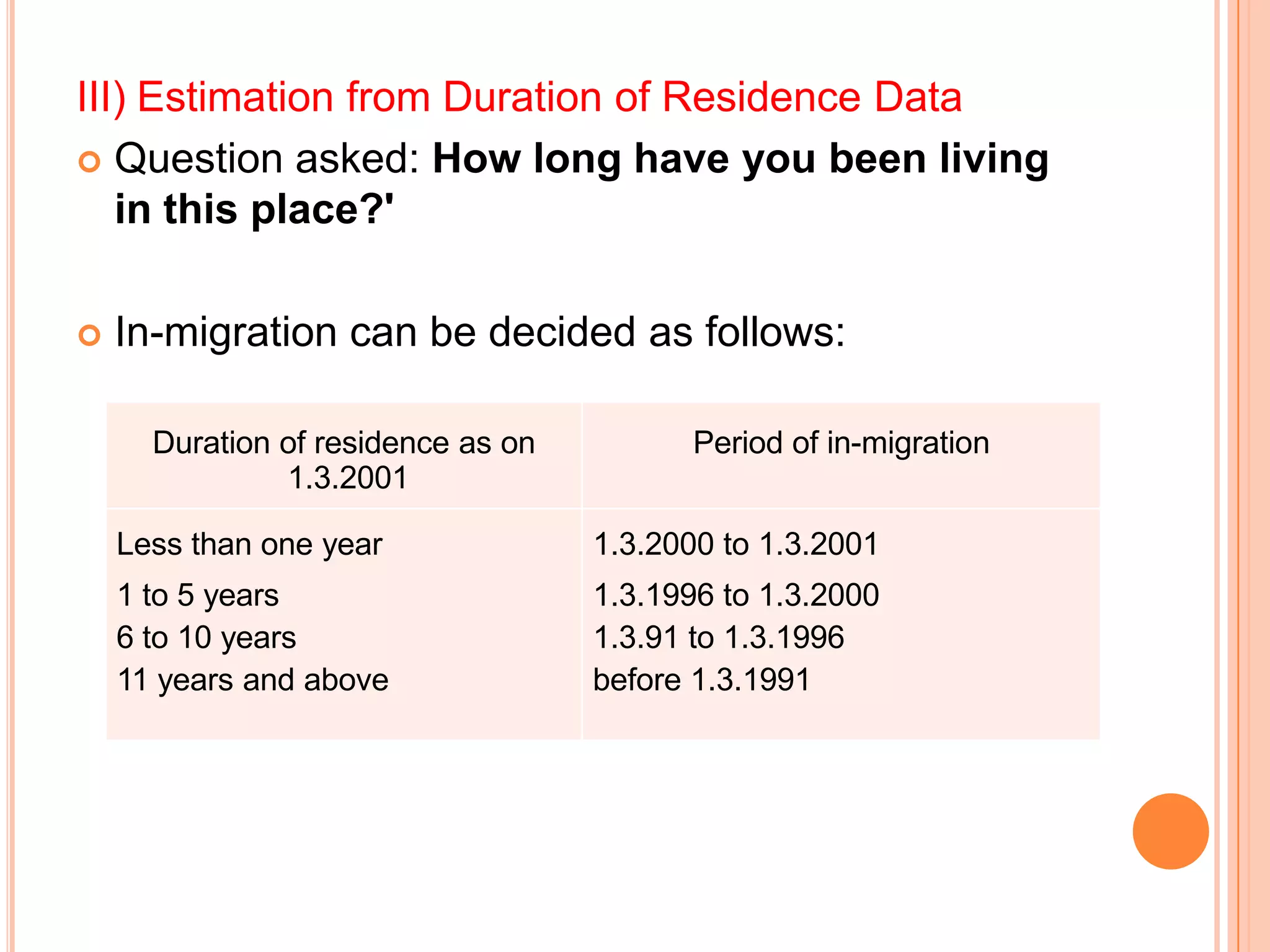
III) Estimation from Duration of Residence Data
 Question asked: How long have you been living
   in this place?'

   In-migration can be decided as follows:

      Duration of residence as on         Period of in-migration
               1.3.2001

    Less than one year              1.3.2000 to 1.3.2001
    1 to 5 years                    1.3.1996 to 1.3.2000
    6 to 10 years                   1.3.91 to 1.3.1996
    11 years and above              before 1.3.1991
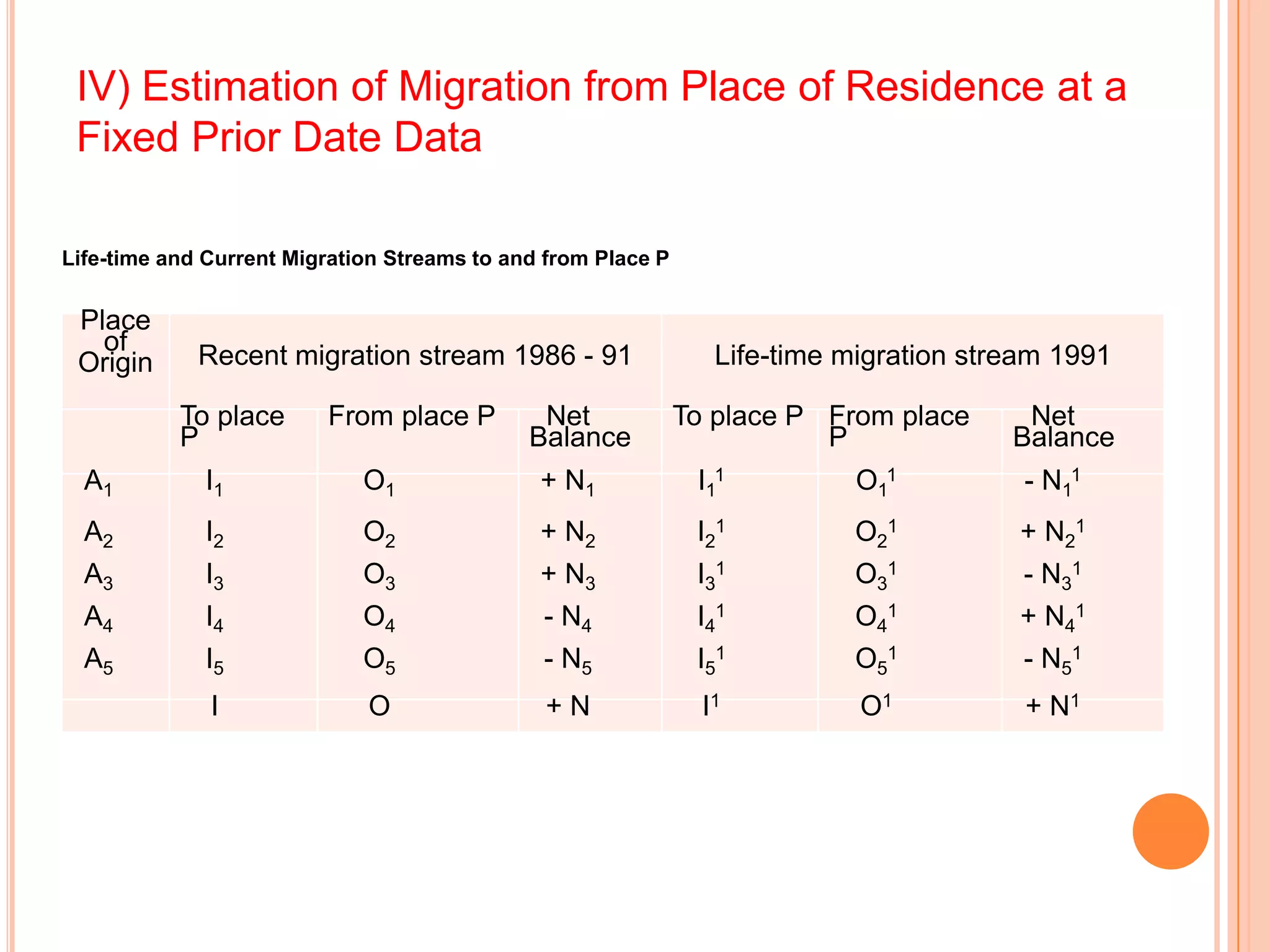
IV) Estimation of Migration from Place of Residence at a
 Fixed Prior Date Data

Life-time and Current Migration Streams to and from Place P


 Place
   of
 Origin      Recent migration stream 1986 - 91                   Life-time migration stream 1991

           To place      From place P         Net             To place P From place      Net
           P                                 Balance                     P              Balance
  A1         I1              O1               + N1             I11          O11          - N11
  A2         I2              O2               + N2             I21         O21          + N21
  A3         I3              O3               + N3             I31         O31           - N31
  A4         I4              O4               - N4             I41         O41          + N41
  A5         I5              O5               - N5             I51         O51           - N51
              I              O                +N                I1          O1           + N1
INDIRECT MEASURES:
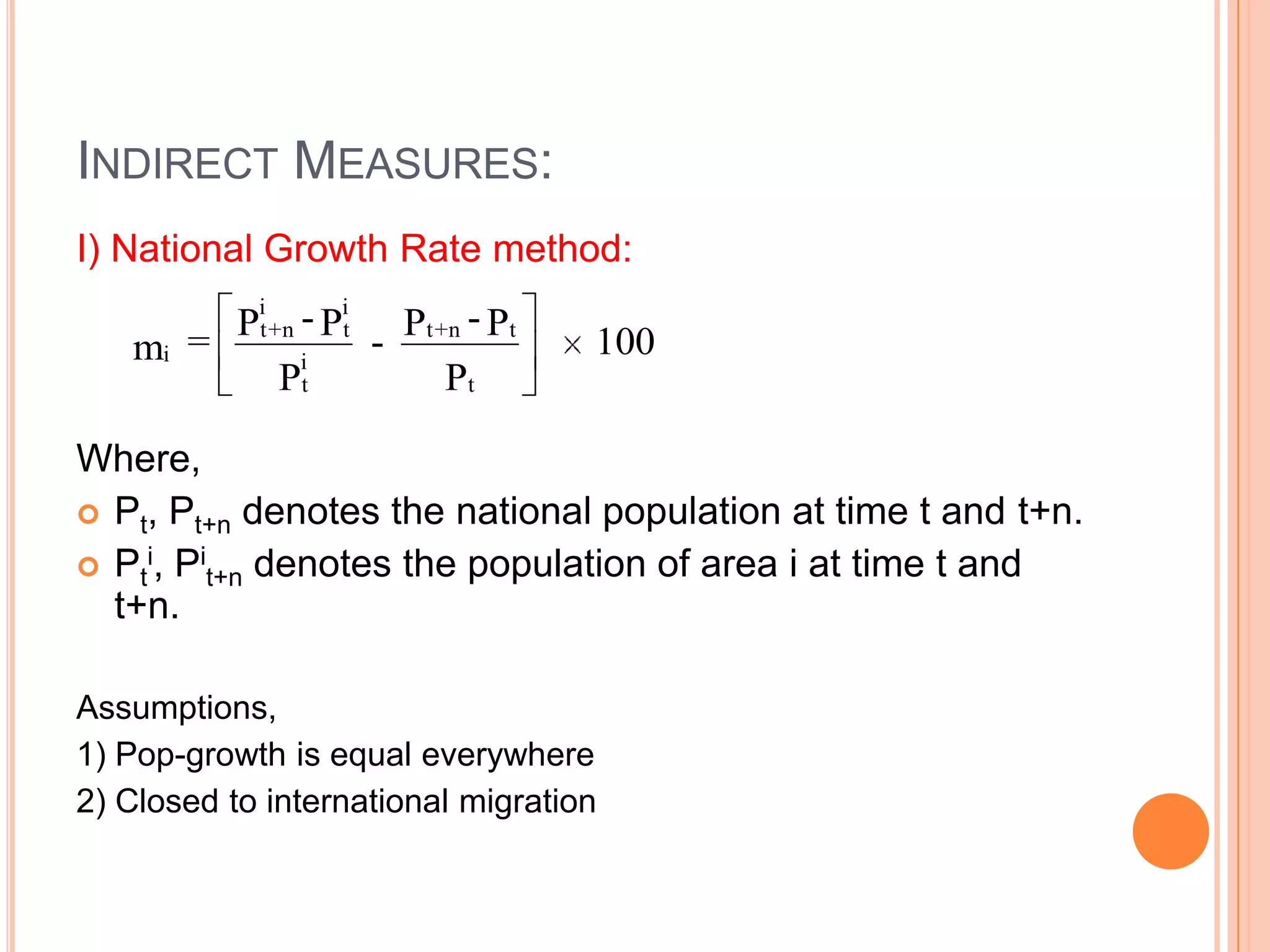
I) National Growth Rate method:
            i      i
        Pt + n - Pt - Pt + n - Pt
   mi =        i
                                    100
            Pt            Pt

Where,
 Pt, Pt+n denotes the national population at time t and t+n.
 Pti, Pit+n denotes the population of area i at time t and
  t+n.

Assumptions,
1) Pop-growth is equal everywhere
2) Closed to international migration
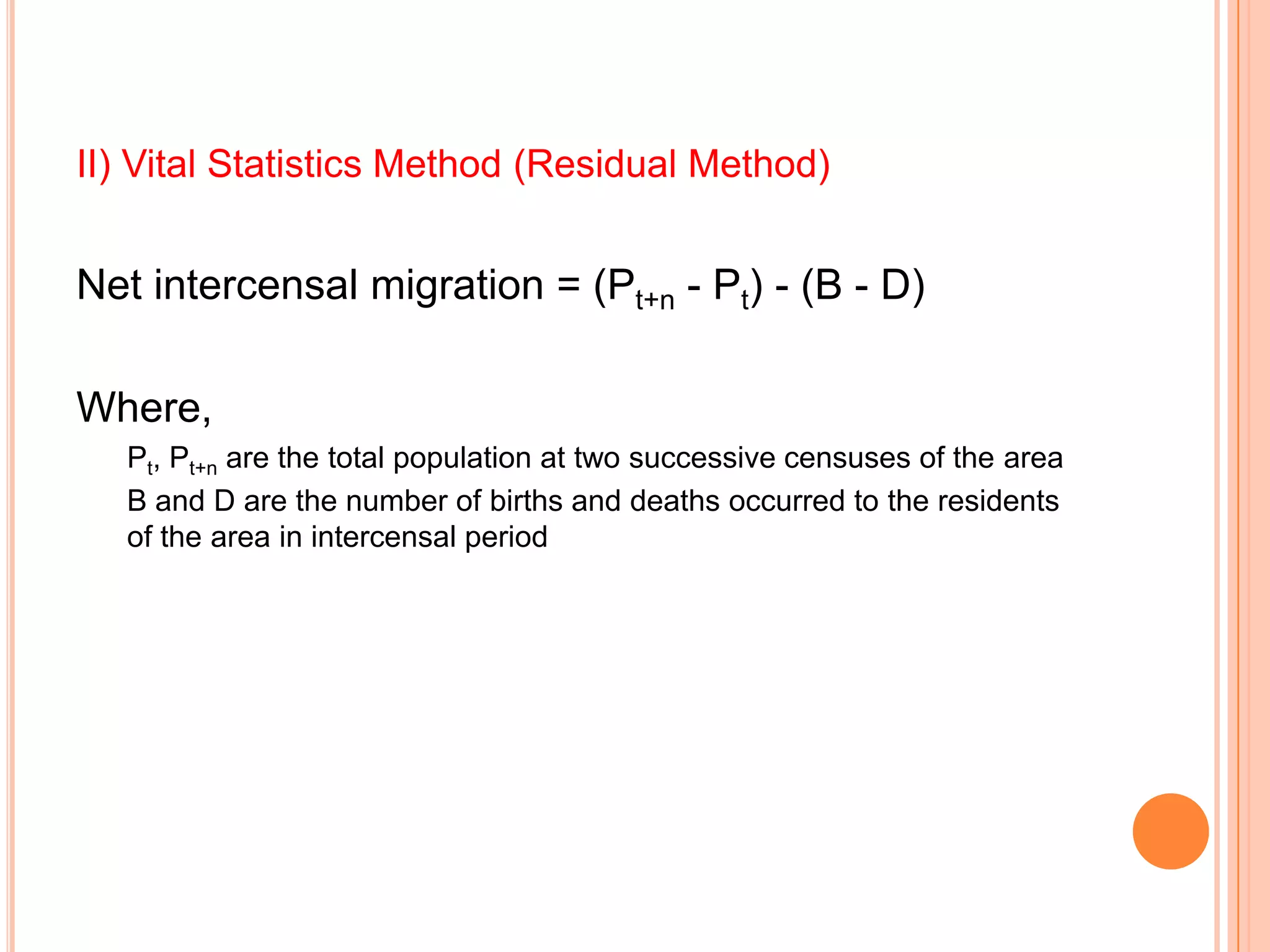
II) Vital Statistics Method (Residual Method)


Net intercensal migration = (Pt+n - Pt) - (B - D)

Where,
   Pt, Pt+n are the total population at two successive censuses of the area
   B and D are the number of births and deaths occurred to the residents
   of the area in intercensal period
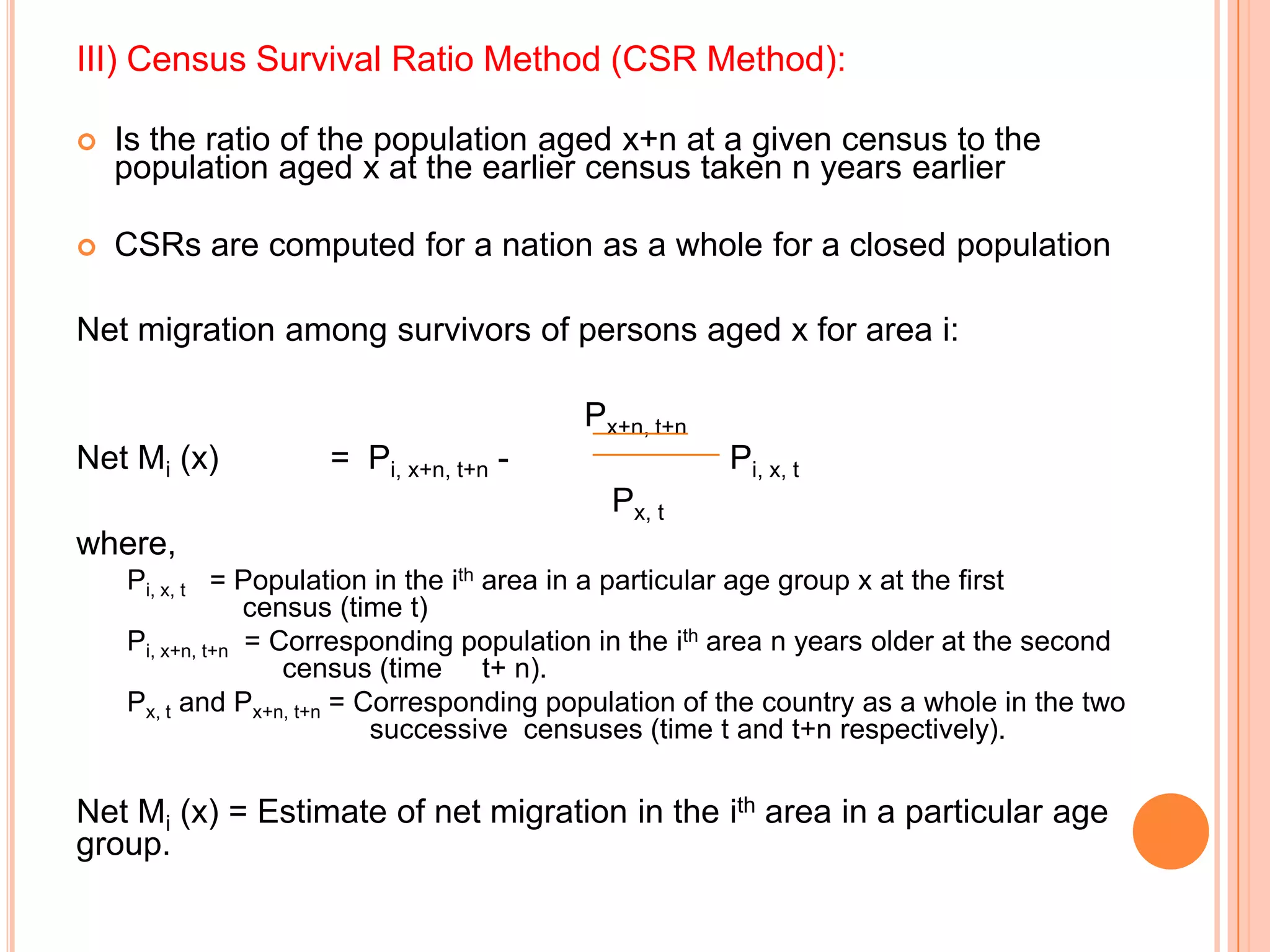
III) Census Survival Ratio Method (CSR Method):

   Is the ratio of the population aged x+n at a given census to the
    population aged x at the earlier census taken n years earlier

   CSRs are computed for a nation as a whole for a closed population

Net migration among survivors of persons aged x for area i:

                                          Px+n, t+n
Net Mi (x)          = Pi, x+n, t+n -                  Pi, x, t
                                            Px, t
where,
    Pi, x, t = Population in the ith area in a particular age group x at the first
                 census (time t)
    Pi, x+n, t+n = Corresponding population in the ith area n years older at the second
                    census (time t+ n).
    Px, t and Px+n, t+n = Corresponding population of the country as a whole in the two
                           successive censuses (time t and t+n respectively).

Net Mi (x) = Estimate of net migration in the ith area in a particular age
group.
REFERENCES:
 Methods and Materials, Chapter 19 and Chapter 18
 DPS Migration Module, IIPS

Session 9 migration techniques

  • 1.
    POPULATION AND HEALTH: TECHNIQUES OF ANALYSIS AND POLICY PERSPECTIVE MIGRATION CONCEPTS AND TECHNIQUES OF ANALYSIS 1 MA (SDP), 2nd Semester, 2012
  • 2.
    INTRODUCTION  Uneven distribution of human population in space- undergoes changes over time  Modern times- uneven distribution disproportionately higher for urban areas  Migration is the third basic factor affecting change in the population of an area  Important element in growth of labour-force  Demography of migrants and non-migrants- its importance in socio-economic, development aspects
  • 3.
    KEY CONCEPTS INMIGRATION STUDIES  Migration is a form of geographic or spatial mobility involving a change of usual residence between clearly defined geographic units. It involves two areas, place of origin and place of destination.  Two specific lacuna in the definition, i.e, excludes-  Short-term or cyclical or Circulatory or temporary movements  non-comparability overtime due to change of boundary  Migrant: person who has changed his usual place of residence from one migration-defining area to another at least once during the migration interval (usually, interval may be one year, five years, or ten years, or inter-censal period)
  • 4.
    CONTINUED…  Migration Interval:  Fixed-term or period migration: The interval may be definite, e.g. one year, five years, ten years, the inter-censal period.  Life-time: or indefinite i.e.,- life-time migrant  Place of Origin: starting point of ‘migration’ i.e.,  a) an area of residence at the beginning of migration interval, or,  b) an area of residence from which last move was made for the current migration interval  Place of Destination: terminal point of ‘migration’, at end of the migration interval
  • 5.
    CONTINUED…  In-migration: ‘move’ in respect to place of destination. International move- Immigrant, within country- In-migrant  Out-migration: ‘move’ in respect to place of origin. International move- Emigrant, within country- Out-migrant  Gross Migration: data referring all migration (in/out) in respect to specific origin/destination, over a specific interval  Net Migration: data referring to only ‘balance’ of movement in opposite directions, in respect to specific origin/destination, over a specific interval  Migration Stream: group of people moving during a given migration interval that have a common area of origin and of destination  Lifetime Migration: A person whose place of residence at census/survey date is different from his place of birth is a lifetime migrant
  • 6.
    TYPES OF MIGRATION  International migration- takes place across international boundary. Refers to socio-economic and political conditions, especially immigration and emigration laws and policies  Internal Migration- occurs within a country. Refers to socio- economic spatial situations within a country. Further grouped into; I. Rural to Rural migration II. Rural to Urban migration III. Urban to Rural migration IV. Urban to Urban migration  R-U: most important. Contributes to transfer of labour force from the traditional agricultural sector to the urbanised industrial sector  Each of these migration streams has different premises, causes and consequences.
  • 7.
    TYPES OF MIGRATION  Migration Stream may be further categorized into-  Intra-district migration  Inter-district migration  Inter-State migration  International migration  Categories based on reasons for migration:  Marriage migration;  Labour migration or migration of people for work, employment, etc.;  Migration for prosperity;  Refugee migration arising due to political or other reasons  Migration due to natural calamities;  Return migration; and  Brain-drain, migration of professionals from developing to developed countries.  ‘Single migration’ & ‘Family migration’
  • 8.
    SOURCES OF DATA-MIGRATION  Analyzing changes in pop-structure and labor force of an area: number and characteristics of persons entering or leaving an area is required, together with census data on population size and vital statistics.  Three most vital sources of migration data-  Censuses  Surveys  Population Registers  Basic migration data and their characteristics  Place of birth data: difficulties in collection and interpretation, i.e., return migrants  Place of last residence: Data on the place of last residence also suffer from absence of a definite time reference  Duration of residence: return migrants and provides the timing of last move
  • 9.
    CENSUS-INDIA, 2011, HOUSEHOLDSCHEDULE B POPULATION AND HOUSING CENSUS- BHUTAN 2005
  • 10.
    DETERMINANTS AND CONSEQUENCESOF INTERNAL MIGRATION Determinants: i) Development/Underdevelopment and Migration ii)Spatial disorganization and Internal Migration Consequences:  Consequences on Rural Areas  Effect on rural incomes and its distribution  Effect on rural capital formation and technological change  Effect on modes of rural production  Effect on rural fertility
  • 11.
    Consequence on urban areas:  Effect on wages and unemployment  Effect on labour force participation  Effect on availability of urban amenities  Effect on urban income distribution  Effect on urban development  Effect on demographic structure of urban population
  • 12.
    MEASURES IN MIGRATION  Measurement and analysis of migration for population estimates and projections- I) Estimation of lifetime from place of birth data Place of Birth Place of Enumeration A B C D A A11 A12 A13 A14 B A21 A22 A23 A24 C A31 A32 A33 A34 D a41 A42 A43 A44 1) Out-migration from A, x1= A12+A13+A14 2) In-migration to A, y1: A21+A31+A41 3) Non-migration for A: A11 4) Therefore, net-migration for A = (y1-x1)
  • 13.
    II) Estimation ofInter-censal Migration from place of birth data Estimated by subtracting the survival of migrants counted in the first census from the migrants counted in the second census Indirect estimate of inter-censal net-migration: NM = (It+n - Ot+n) - (SIIt - So Ot) Where It - number of lifetime in-migrants at time t in a particular area, It+n - number of lifetime in-migrants at time t+n in that particular area, Ot - number of lifetime out-migrants at time t from that particular area, Ot+n - number of lifetime out-migrants at time t+n from that particular area, NM - net inter-censal migration. SI and SO are intercensal survival ratios indicating what proportions of It and Ot that will survive during the inter-censal period.
  • 14.
    CALCULATING OF SURVIVALRATIO Pn+, t+n S = Pt Where, Pn+, t+n= population aged n and above at time t+n n = interval between the two censuses Or, from life-table available for intercensal period, Tn S = To where, Tn and To are stationary population above age n and o respectively.
  • 15.
    III) Estimation fromDuration of Residence Data  Question asked: How long have you been living in this place?'  In-migration can be decided as follows: Duration of residence as on Period of in-migration 1.3.2001 Less than one year 1.3.2000 to 1.3.2001 1 to 5 years 1.3.1996 to 1.3.2000 6 to 10 years 1.3.91 to 1.3.1996 11 years and above before 1.3.1991
  • 16.
    IV) Estimation ofMigration from Place of Residence at a Fixed Prior Date Data Life-time and Current Migration Streams to and from Place P Place of Origin Recent migration stream 1986 - 91 Life-time migration stream 1991 To place From place P Net To place P From place Net P Balance P Balance A1 I1 O1 + N1 I11 O11 - N11 A2 I2 O2 + N2 I21 O21 + N21 A3 I3 O3 + N3 I31 O31 - N31 A4 I4 O4 - N4 I41 O41 + N41 A5 I5 O5 - N5 I51 O51 - N51 I O +N I1 O1 + N1
  • 17.
    INDIRECT MEASURES: I) NationalGrowth Rate method: i i Pt + n - Pt - Pt + n - Pt mi = i 100 Pt Pt Where,  Pt, Pt+n denotes the national population at time t and t+n.  Pti, Pit+n denotes the population of area i at time t and t+n. Assumptions, 1) Pop-growth is equal everywhere 2) Closed to international migration
  • 18.
    II) Vital StatisticsMethod (Residual Method) Net intercensal migration = (Pt+n - Pt) - (B - D) Where, Pt, Pt+n are the total population at two successive censuses of the area B and D are the number of births and deaths occurred to the residents of the area in intercensal period
  • 19.
    III) Census SurvivalRatio Method (CSR Method):  Is the ratio of the population aged x+n at a given census to the population aged x at the earlier census taken n years earlier  CSRs are computed for a nation as a whole for a closed population Net migration among survivors of persons aged x for area i: Px+n, t+n Net Mi (x) = Pi, x+n, t+n - Pi, x, t Px, t where, Pi, x, t = Population in the ith area in a particular age group x at the first census (time t) Pi, x+n, t+n = Corresponding population in the ith area n years older at the second census (time t+ n). Px, t and Px+n, t+n = Corresponding population of the country as a whole in the two successive censuses (time t and t+n respectively). Net Mi (x) = Estimate of net migration in the ith area in a particular age group.
  • 20.
    REFERENCES:  Methods andMaterials, Chapter 19 and Chapter 18  DPS Migration Module, IIPS