BOOLEAN
ALGEBRA
E C E 126
Boolean Algebra
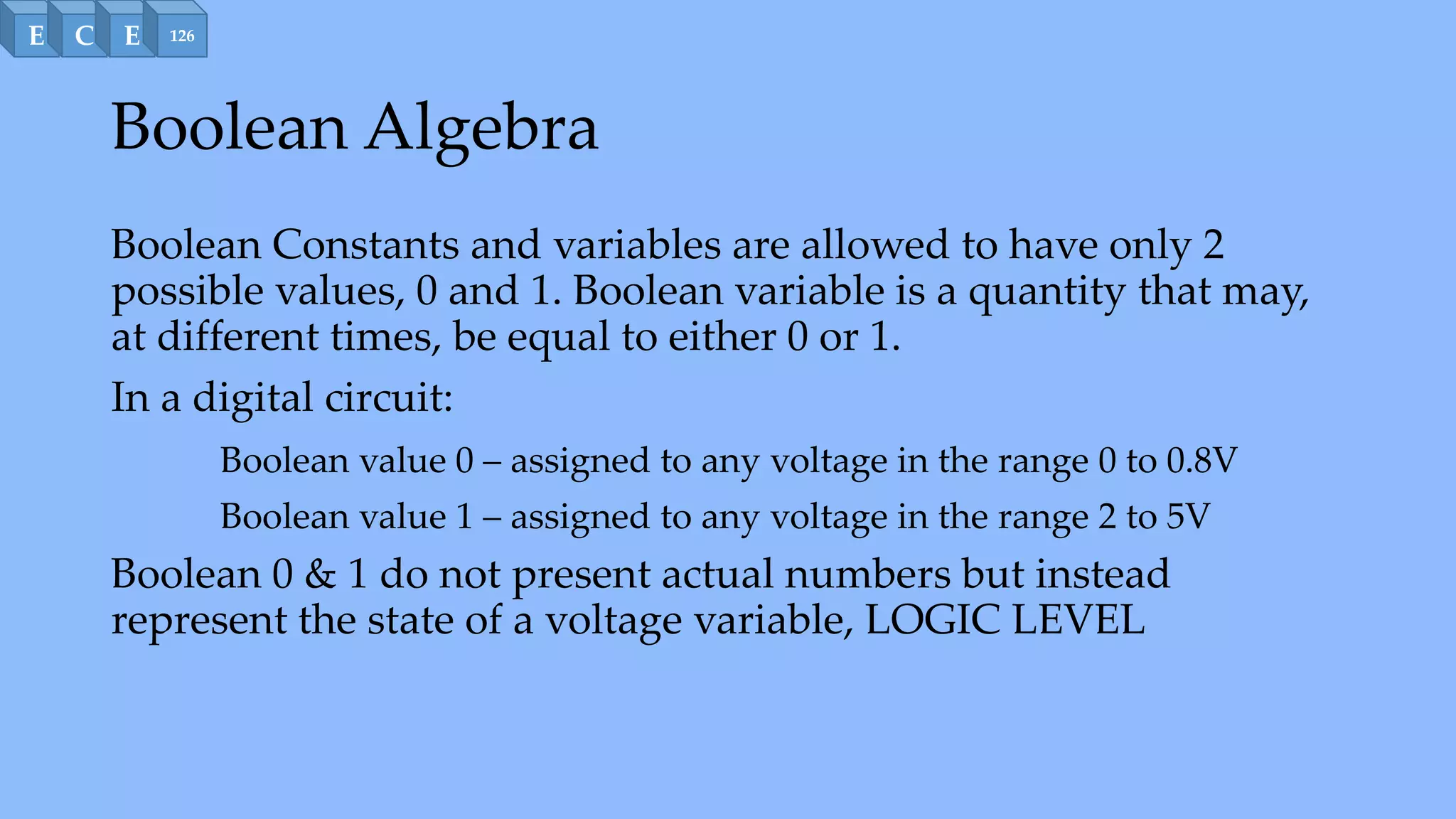
Boolean Constants and variables are allowed to have only 2
possible values, 0 and 1. Boolean variable is a quantity that may,
at different times, be equal to either 0 or 1.
In a digital circuit:
Boolean value 0 – assigned to any voltage in the range 0 to 0.8V
Boolean value 1 – assigned to any voltage in the range 2 to 5V
Boolean 0 & 1 do not present actual numbers but instead
represent the state of a voltage variable, LOGIC LEVEL
E C E 126
Boolean Algebra
Logical Operations
• 3 basic logical operations
- AND (denoted by ∙ or *)
- OR (denoted by +)
- NOT (denoted by an overbar , a single quote
mark ‘ after, or ~ before the variable)
E C E 126
Boolean Identities
Indempotent Law
𝐴 + 𝐴 = 𝐴
𝐴 ∙ 𝐴 = 𝐴
Commutative Law
𝐴 + 𝐵 = 𝐵 + 𝐴
𝐴 ∙ 𝐵 = 𝐵 ∙ 𝐴
Associative Law
𝐴 + 𝐵 + 𝐶 = 𝐴 + 𝐵 + 𝐶
𝐴 ∙ 𝐵 ∙ 𝐶 = 𝐴 ∙ 𝐵 ∙ 𝐶
E C E 126
Boolean Identities
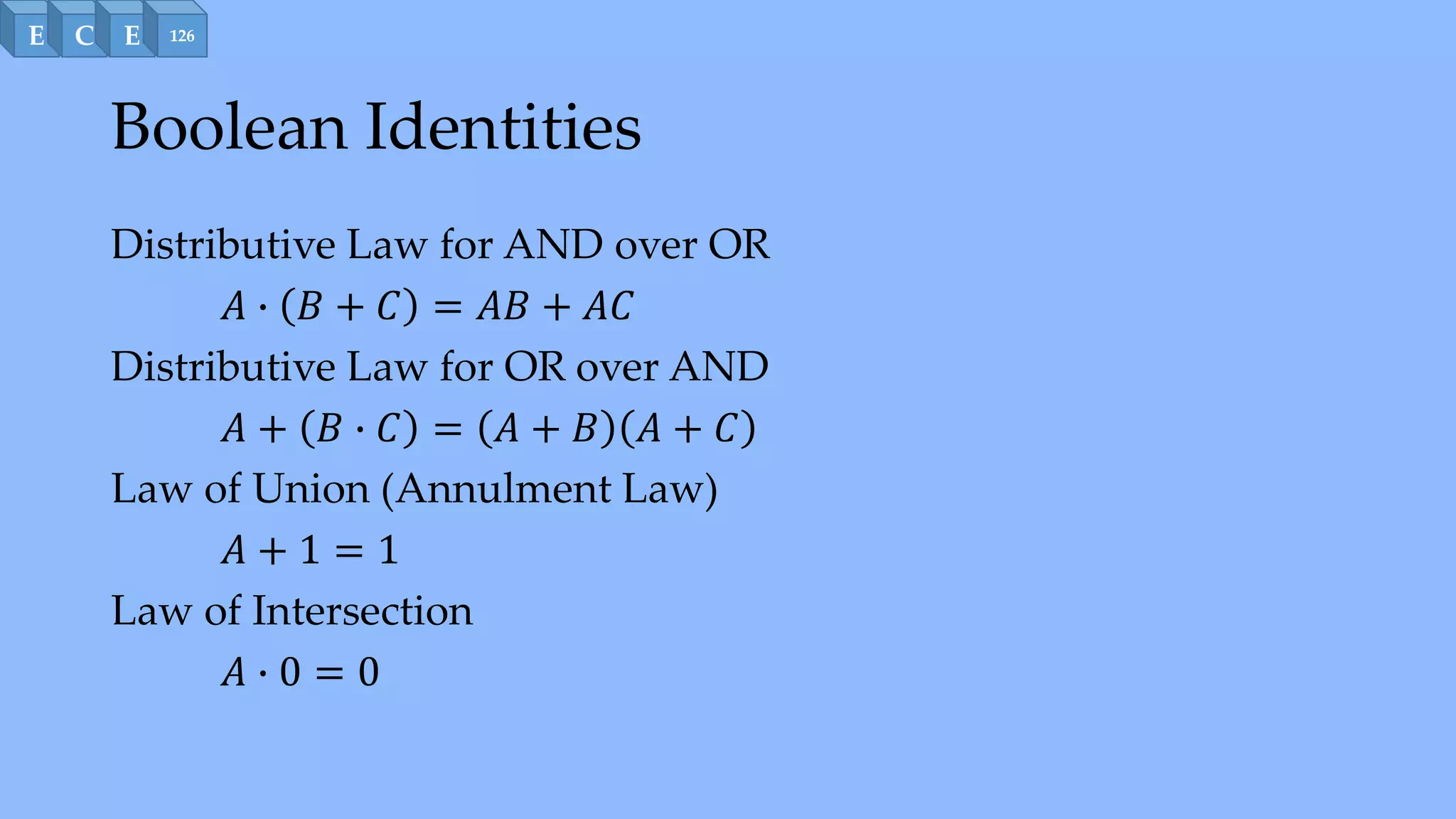
Distributive Law for AND over OR
𝐴 ∙ 𝐵 + 𝐶 = 𝐴𝐵 + 𝐴𝐶
Distributive Law for OR over AND
𝐴 + 𝐵 ∙ 𝐶 = 𝐴 + 𝐵 𝐴 + 𝐶
Law of Union (Annulment Law)
𝐴 + 1 = 1
Law of Intersection
𝐴 ∙ 0 = 0
E C E 126
Boolean Identities
Law of Absorption
𝐴 ∙ 𝐴 + 𝐵 = 𝐴
𝐴 + 𝐴 ∙ 𝐵 = 𝐴
Identity Law
𝐴 ∙ 1 = 𝐴
𝐴 + 0 = 𝐴
Double Negative Law
𝐴 = 𝐴
E C E 126
Boolean Identities
Law of Complement
𝐴 + 𝐴 = 1
𝐴 ∙ 𝐴 = 0
Law of “disappearing opposite”
𝐴 + 𝐴 ∙ 𝐵 = 𝐴 + 𝐵
E C E 126
Boolean Identities
DeMorgan’s Law – states that the complement of the product of
all the terms is equal to the sum of the complement of each term.
Likewise, the complement of the sum of all terms is equal to the
product of the complement of each term
𝐴 + 𝐵 = 𝐴 ∙ 𝐵
𝐴 ∙ 𝐵 = 𝐴 + 𝐵
E C E 126
Boolean Identities
Principle of Duality – any theorem or identity in switching
algebra remains true if 0 and 1 are swapped
and ∙ and + are swapped throughout.
The dual of an algebraic expression is obtained by interchanging
+ and ∙ and interchanging 0 and 1.
+ ↔ ∙
0 ↔ 1
E C E 126
Boolean Identities
Consensus Theorem (Redundancy Theorem)
- consensus term is formed from a pair of terms in which
variables V and its complement V are present.
Conditions for applying Consensus theorem:
1. Three variables must be present in the expression
2. Each variable is repeated twice
3. One variable must present in complemented form
E C E 126
Examples
E C E 126
Examples
E C E 126
Examples
E C E 126
Examples
E C E 126
Examples
E C E 126
Examples
E C E 126
Examples
E C E 126
Examples
E C E 126
Examples
E C E 126
Examples
E C E 126
Examples
E C E 126
Examples
E C E 126
Examples
E C E 126
Examples

BOOLEAN ALGEBRA.pptx

  • 1.
  • 2.
    E C E126 Boolean Algebra Boolean Constants and variables are allowed to have only 2 possible values, 0 and 1. Boolean variable is a quantity that may, at different times, be equal to either 0 or 1. In a digital circuit: Boolean value 0 – assigned to any voltage in the range 0 to 0.8V Boolean value 1 – assigned to any voltage in the range 2 to 5V Boolean 0 & 1 do not present actual numbers but instead represent the state of a voltage variable, LOGIC LEVEL
  • 3.
    E C E126 Boolean Algebra Logical Operations • 3 basic logical operations - AND (denoted by ∙ or *) - OR (denoted by +) - NOT (denoted by an overbar , a single quote mark ‘ after, or ~ before the variable)
  • 4.
    E C E126 Boolean Identities Indempotent Law 𝐴 + 𝐴 = 𝐴 𝐴 ∙ 𝐴 = 𝐴 Commutative Law 𝐴 + 𝐵 = 𝐵 + 𝐴 𝐴 ∙ 𝐵 = 𝐵 ∙ 𝐴 Associative Law 𝐴 + 𝐵 + 𝐶 = 𝐴 + 𝐵 + 𝐶 𝐴 ∙ 𝐵 ∙ 𝐶 = 𝐴 ∙ 𝐵 ∙ 𝐶
  • 5.
    E C E126 Boolean Identities Distributive Law for AND over OR 𝐴 ∙ 𝐵 + 𝐶 = 𝐴𝐵 + 𝐴𝐶 Distributive Law for OR over AND 𝐴 + 𝐵 ∙ 𝐶 = 𝐴 + 𝐵 𝐴 + 𝐶 Law of Union (Annulment Law) 𝐴 + 1 = 1 Law of Intersection 𝐴 ∙ 0 = 0
  • 6.
    E C E126 Boolean Identities Law of Absorption 𝐴 ∙ 𝐴 + 𝐵 = 𝐴 𝐴 + 𝐴 ∙ 𝐵 = 𝐴 Identity Law 𝐴 ∙ 1 = 𝐴 𝐴 + 0 = 𝐴 Double Negative Law 𝐴 = 𝐴
  • 7.
    E C E126 Boolean Identities Law of Complement 𝐴 + 𝐴 = 1 𝐴 ∙ 𝐴 = 0 Law of “disappearing opposite” 𝐴 + 𝐴 ∙ 𝐵 = 𝐴 + 𝐵
  • 8.
    E C E126 Boolean Identities DeMorgan’s Law – states that the complement of the product of all the terms is equal to the sum of the complement of each term. Likewise, the complement of the sum of all terms is equal to the product of the complement of each term 𝐴 + 𝐵 = 𝐴 ∙ 𝐵 𝐴 ∙ 𝐵 = 𝐴 + 𝐵
  • 9.
    E C E126 Boolean Identities Principle of Duality – any theorem or identity in switching algebra remains true if 0 and 1 are swapped and ∙ and + are swapped throughout. The dual of an algebraic expression is obtained by interchanging + and ∙ and interchanging 0 and 1. + ↔ ∙ 0 ↔ 1
  • 10.
    E C E126 Boolean Identities Consensus Theorem (Redundancy Theorem) - consensus term is formed from a pair of terms in which variables V and its complement V are present. Conditions for applying Consensus theorem: 1. Three variables must be present in the expression 2. Each variable is repeated twice 3. One variable must present in complemented form
  • 11.
    E C E126 Examples
  • 12.
    E C E126 Examples
  • 13.
    E C E126 Examples
  • 14.
    E C E126 Examples
  • 15.
    E C E126 Examples
  • 16.
    E C E126 Examples
  • 17.
    E C E126 Examples
  • 18.
    E C E126 Examples
  • 19.
    E C E126 Examples
  • 20.
    E C E126 Examples
  • 21.
    E C E126 Examples
  • 22.
    E C E126 Examples
  • 23.
    E C E126 Examples
  • 24.
    E C E126 Examples