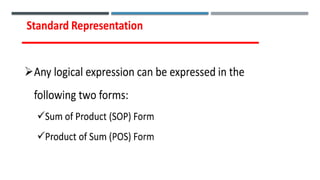
COURSE NAME: DIGITAL SYSTEM
COURSE CODE : ECE 1001
LECTURE SERIES NO : 01(ONE)
CREDITS : 3
MODE OF DELIVERY : ONLINE (POWER POINT PRESENTATION)
FACULTY : MRS. AMISHA BENIWAL AND MR. ASHVINEE DEO MESHRAM
EMAIL-ID : amisha.beniwal@jaipur.manipal.edu, ashvinee.meshram@jaipur.manipal.edu
PROPOSED DATE OF DELIVERY:
B.TECH FIRST YEAR
ACADEMIC YEAR: 2025-2026
SESSION OUTCOME
“APPLY BOOLEAN ALGEBRA TO
SIMPLIFY LOGICAL EXPRESSIONS
AND IMPLEMENT LOGIC FUNCTIONS
USING BASIC AND UNIVERSAL
GATES ”
ASSESSMENT CRITERIA’S
ASSIGNMENT
QUIZ
MID TERM EXAMINATION –II
END TERM EXAMINATION
PROGRAM
OUTCOMES
MAPPING WITH
CO1
[PO1]
APPLY BOOLEAN ALGEBRA TO SIMPLIFY
LOGICAL EXPRESSIONS AND IMPLEMENT
LOGIC FUNCTIONS USING BASIC AND
UNIVERSAL GATES.
5
BOOLEAN ALGEBRA
Boolean algebra is the mathematical framework on which logic design based.
It is used in synthesis & analysis of binary logical function.
George Boole in 1854 invented a new kind of algebra known as Boolean
algebra.
It is sometimes called switching algebra.
6
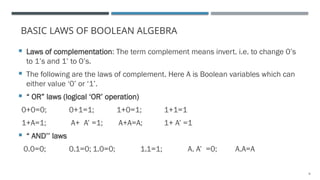
BASIC LAWS OF BOOLEAN ALGEBRA
 Laws of complementation: The term complement means invert. i.e. to change 0’s
to 1’s and 1’ to 0’s.
 The following are the laws of complement. Here A is Boolean variables which can
either value ‘0’ or ‘1’.
 “ OR” laws (logical ‘OR’ operation)
0+0=0; 0+1=1; 1+0=1; 1+1=1
1+A=1; A+ A’ =1; A+A=A; 1+ A’ =1
 “ AND’’ laws
0.0=0; 0.1=0; 1.0=0; 1.1=1; A. A’ =0; A.A=A
7
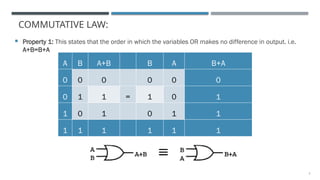
COMMUTATIVE LAW:
 Property 1: This states that the order in which the variables OR makes no difference in output. i.e.
A+B=B+A
A B A+B B A B+A
0 0 0 0 0 0
0 1 1 = 1 0 1
1 0 1 0 1 1
1 1 1 1 1 1
8
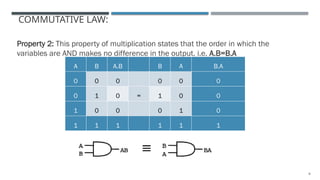
COMMUTATIVE LAW:
Property 2: This property of multiplication states that the order in which the
variables are AND makes no difference in the output. i.e. A.B=B.A
A B A.B B A B.A
0 0 0 0 0 0
0 1 0 = 1 0 0
1 0 0 0 1 0
1 1 1 1 1 1
9
ASSOCIATIVE PROPERTY
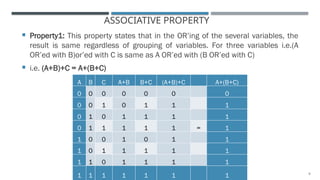
 Property1: This property states that in the OR’ing of the several variables, the
result is same regardless of grouping of variables. For three variables i.e.(A
OR’ed with B)or’ed with C is same as A OR’ed with (B OR’ed with C)
 i.e. (A+B)+C = A+(B+C)
A B C A+B B+C (A+B)+C A+(B+C)
0 0 0 0 0 0 0
0 0 1 0 1 1 1
0 1 0 1 1 1 1
0 1 1 1 1 1 = 1
1 0 0 1 0 1 1
1 0 1 1 1 1 1
1 1 0 1 1 1 1
1 1 1 1 1 1 1
10
ASSOCIATIVE PROPERTY
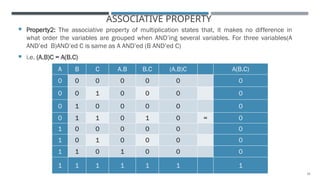
 Property2: The associative property of multiplication states that, it makes no difference in
what order the variables are grouped when AND’ing several variables. For three variables(A
AND’ed B)AND’ed C is same as A AND’ed (B AND’ed C)
 i.e. (A.B)C = A(B.C)
A B C A.B B.C (A.B)C A(B.C)
0 0 0 0 0 0 0
0 0 1 0 0 0 0
0 1 0 0 0 0 0
0 1 1 0 1 0 = 0
1 0 0 0 0 0 0
1 0 1 0 0 0 0
1 1 0 1 0 0 0
1 1 1 1 1 1 1
ASSOCIATIVE LAWS
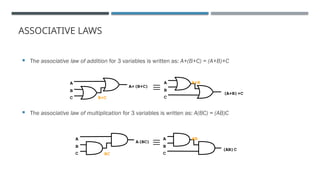
 The associative law of addition for 3 variables is written as: A+(B+C) = (A+B)+C
 The associative law of multiplication for 3 variables is written as: A(BC) = (AB)C
A
B
A+(B+C)
C
A
B
(A+B)+C
C
A
B
A(BC)
C
A
B
(AB)C
C


B+C
A+B
BC
AB
12
DISTRIBUTIVE PROPERTY
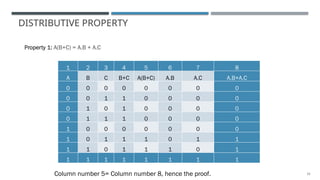
Property 1: A(B+C) = A.B + A.C
1 2 3 4 5 6 7 8
A B C B+C A(B+C) A.B A.C A.B+A.C
0 0 0 0 0 0 0 0
0 0 1 1 0 0 0 0
0 1 0 1 0 0 0 0
0 1 1 1 0 0 0 0
1 0 0 0 0 0 0 0
1 0 1 1 1 0 1 1
1 1 0 1 1 1 0 1
1 1 1 1 1 1 1 1
Column number 5= Column number 8, hence the proof.
13
DISTRIBUTIVE PROPERTY
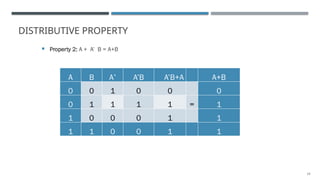
 Property 2: A + A’ B = A+B
A B A’ A’B A’B+A A+B
0 0 1 0 0 0
0 1 1 1 1 = 1
1 0 0 0 1 1
1 1 0 0 1 1
DISTRIBUTIVE LAWS
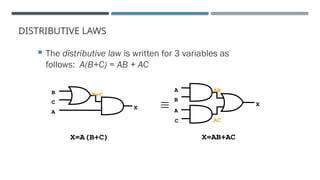
 The distributive law is written for 3 variables as
follows: A(B+C) = AB + AC
B
C
A
B+C

A
B
C
A
X
X
AB
AC
X=A(B+C) X=AB+AC
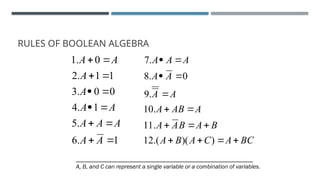
RULES OF BOOLEAN ALGEBRA
1
.
6
.
5
1
.
4
0
0
.
3
1
1
.
2
0
.
1












A
A
A
A
A
A
A
A
A
A
A
BC
A
C
A
B
A
B
A
B
A
A
A
AB
A
A
A
A
A
A
A
A














)
)(
.(
12
.
11
.
10
.
9
0
.
8
.
7
___________________________________________________________
A, B, and C can represent a single variable or a combination of variables.
16
DUALITY
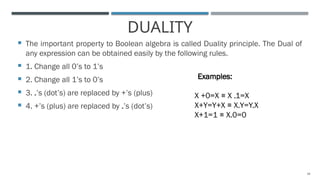
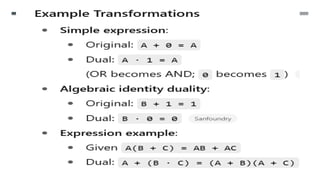
 The important property to Boolean algebra is called Duality principle. The Dual of
any expression can be obtained easily by the following rules.
 1. Change all 0’s to 1’s
 2. Change all 1’s to 0’s
 3. .’s (dot’s) are replaced by +’s (plus)
 4. +’s (plus) are replaced by .’s (dot’s)
Examples:
X +0=X ≡ X .1=X
X+Y=Y+X ≡ X.Y=Y.X
X+1=1 ≡ X.0=0
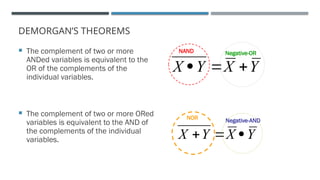
DEMORGAN’S THEOREMS
 The complement of two or more
ANDed variables is equivalent to the
OR of the complements of the
individual variables.
 The complement of two or more ORed
variables is equivalent to the AND of
the complements of the individual
variables.
Y
X
Y
X 


Y
X
Y
X 


NAND Negative-OR
Negative-AND
NOR
19
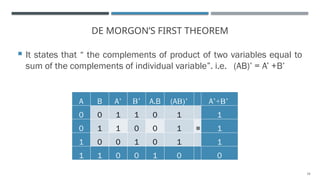
DE MORGON’S FIRST THEOREM
 It states that “ the complements of product of two variables equal to
sum of the complements of individual variable”. i.e. (AB)’ = A’ +B’
A B A’ B’ A.B (AB)’ A’+B’
0 0 1 1 0 1 1
0 1 1 0 0 1 ≡ 1
1 0 0 1 0 1 1
1 1 0 0 1 0 0
20
A B A’ B’ A+B (A+B)’ A’ *B’
0 0 1 1 0 1 1
0 1 1 0 1 0 ≡ 0
1 0 0 1 1 0 0
1 1 0 0 1 0 0
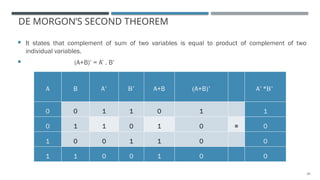
DE MORGON’S SECOND THEOREM
 It states that complement of sum of two variables is equal to product of complement of two
individual variables.
 (A+B)’ = A’ . B’
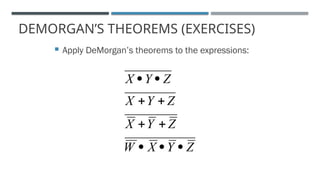
DEMORGAN’S THEOREMS (EXERCISES)
 Apply DeMorgan’s theorems to the expressions:
Z
Y
X
W
Z
Y
X
Z
Y
X
Z
Y
X









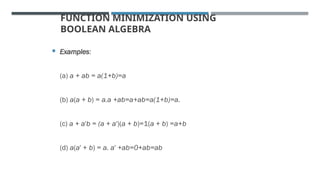
FUNCTION MINIMIZATION USING
BOOLEAN ALGEBRA
 Examples:
(a) a + ab = a(1+b)=a
(b) a(a + b) = a.a +ab=a+ab=a(1+b)=a.
(c) a + a'b = (a + a')(a + b)=1(a + b) =a+b
(d) a(a' + b) = a. a' +ab=0+ab=ab
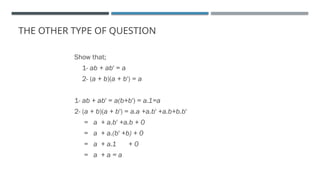
THE OTHER TYPE OF QUESTION
Show that;
1- ab + ab' = a
2- (a + b)(a + b') = a
1- ab + ab' = a(b+b') = a.1=a
2- (a + b)(a + b') = a.a +a.b' +a.b+b.b'
= a + a.b' +a.b + 0
= a + a.(b' +b) + 0
= a + a.1 + 0
= a + a = a
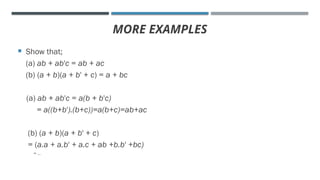
MORE EXAMPLES
 Show that;
(a) ab + ab'c = ab + ac
(b) (a + b)(a + b' + c) = a + bc
(a) ab + ab'c = a(b + b'c)
= a((b+b').(b+c))=a(b+c)=ab+ac
(b) (a + b)(a + b' + c)
= (a.a + a.b' + a.c + ab +b.b' +bc)
= …
25
SIMPLIFY THE BOOLEAN EXPRESSION
 1. X’Y’ Z+ X’ YZ
= ZX’[ Y’ +Y]
= Z X’[1]= ZX’
 2. f = B(A+C)+C
=BA+BC+C
=BA+C(1+B)
=BA+C
X
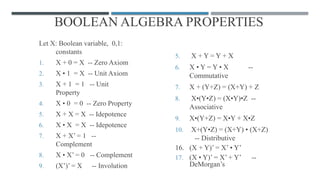
BOOLEAN ALGEBRA PROPERTIES
Let X: Boolean variable, 0,1:
constants
1. X + 0 = X -- Zero Axiom
2. X • 1 = X -- Unit Axiom
3. X + 1 = 1 -- Unit
Property
4. X • 0 = 0 -- Zero Property
5. X + X = X -- Idepotence
6. X • X = X -- Idepotence
7. X + X’ = 1 --
Complement
8. X • X’ = 0 -- Complement
9. (X’)’ = X -- Involution
5. X + Y = Y + X
6. X • Y = Y • X --
Commutative
7. X + (Y+Z) = (X+Y) + Z
8. X•(Y•Z) = (X•Y)•Z --
Associative
9. X•(Y+Z) = X•Y + X•Z
10. X+(Y•Z) = (X+Y) • (X+Z)
-- Distributive
16. (X + Y)’ = X’ • Y’
17. (X • Y)’ = X’ + Y’ --
DeMorgan’s
27
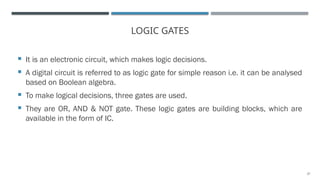
LOGIC GATES
 It is an electronic circuit, which makes logic decisions.
 A digital circuit is referred to as logic gate for simple reason i.e. it can be analysed
based on Boolean algebra.
 To make logical decisions, three gates are used.
 They are OR, AND & NOT gate. These logic gates are building blocks, which are
available in the form of IC.
28
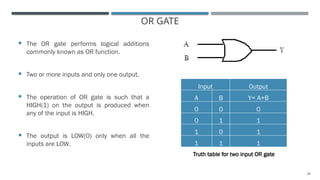
OR GATE
 The OR gate performs logical additions
commonly known as OR function.
 Two or more inputs and only one output.
 The operation of OR gate is such that a
HIGH(1) on the output is produced when
any of the input is HIGH.
 The output is LOW(0) only when all the
inputs are LOW.
Input Output
A B Y= A+B
0 0 0
0 1 1
1 0 1
1 1 1
Truth table for two input OR gate
29
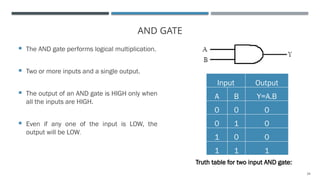
AND GATE
 The AND gate performs logical multiplication.
 Two or more inputs and a single output.
 The output of an AND gate is HIGH only when
all the inputs are HIGH.
 Even if any one of the input is LOW, the
output will be LOW.
Input Output
A B Y=A.B
0 0 0
0 1 0
1 0 0
1 1 1
Truth table for two input AND gate:
30
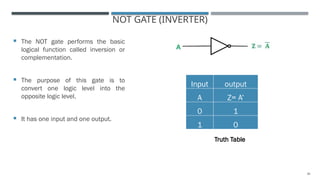
NOT GATE (INVERTER)
 The NOT gate performs the basic
logical function called inversion or
complementation.
 The purpose of this gate is to
convert one logic level into the
opposite logic level.
 It has one input and one output.
Input output
A Z= A’
0 1
1 0
Truth Table
31
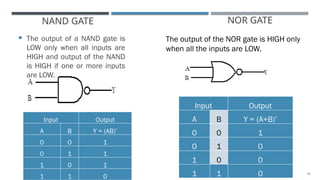
NAND GATE
 The output of a NAND gate is
LOW only when all inputs are
HIGH and output of the NAND
is HIGH if one or more inputs
are LOW.
Input Output
A B Y = (AB)’
0 0 1
0 1 1
1 0 1
1 1 0
NOR GATE
Input Output
A B Y = (A+B)’
0 0 1
0 1 0
1 0 0
1 1 0
The output of the NOR gate is HIGH only
when all the inputs are LOW.
32
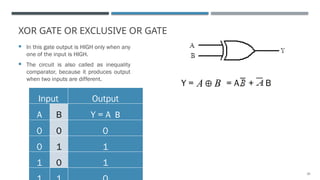
XOR GATE OR EXCLUSIVE OR GATE
 In this gate output is HIGH only when any
one of the input is HIGH.
 The circuit is also called as inequality
comparator, because it produces output
when two inputs are different.
Input Output
A B Y = A B
0 0 0
0 1 1
1 0 1
Y = = A + B
B
A
33
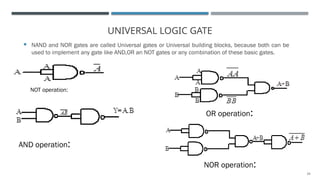
UNIVERSAL LOGIC GATE
 NAND and NOR gates are called Universal gates or Universal building blocks, because both can be
used to implement any gate like AND,OR an NOT gates or any combination of these basic gates.
NOT operation:
AND operation:
OR operation:
NOR operation:
34
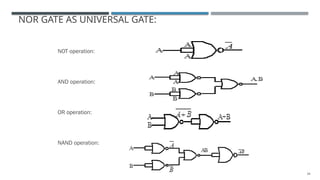
NOR GATE AS UNIVERSAL GATE:
NOT operation:
AND operation:
OR operation:
NAND operation:

CO1veryimportantandhighlyrecommended.pptx

CO1veryimportantandhighlyrecommended.pptx

  • 1.
    COURSE NAME: DIGITALSYSTEM COURSE CODE : ECE 1001 LECTURE SERIES NO : 01(ONE) CREDITS : 3 MODE OF DELIVERY : ONLINE (POWER POINT PRESENTATION) FACULTY : MRS. AMISHA BENIWAL AND MR. ASHVINEE DEO MESHRAM EMAIL-ID : amisha.beniwal@jaipur.manipal.edu, ashvinee.meshram@jaipur.manipal.edu PROPOSED DATE OF DELIVERY: B.TECH FIRST YEAR ACADEMIC YEAR: 2025-2026
  • 2.
    SESSION OUTCOME “APPLY BOOLEANALGEBRA TO SIMPLIFY LOGICAL EXPRESSIONS AND IMPLEMENT LOGIC FUNCTIONS USING BASIC AND UNIVERSAL GATES ”
  • 3.
    ASSESSMENT CRITERIA’S ASSIGNMENT QUIZ MID TERMEXAMINATION –II END TERM EXAMINATION
  • 4.
    PROGRAM OUTCOMES MAPPING WITH CO1 [PO1] APPLY BOOLEANALGEBRA TO SIMPLIFY LOGICAL EXPRESSIONS AND IMPLEMENT LOGIC FUNCTIONS USING BASIC AND UNIVERSAL GATES.
  • 5.
    5 BOOLEAN ALGEBRA Boolean algebrais the mathematical framework on which logic design based. It is used in synthesis & analysis of binary logical function. George Boole in 1854 invented a new kind of algebra known as Boolean algebra. It is sometimes called switching algebra.
  • 6.
    6 BASIC LAWS OFBOOLEAN ALGEBRA  Laws of complementation: The term complement means invert. i.e. to change 0’s to 1’s and 1’ to 0’s.  The following are the laws of complement. Here A is Boolean variables which can either value ‘0’ or ‘1’.  “ OR” laws (logical ‘OR’ operation) 0+0=0; 0+1=1; 1+0=1; 1+1=1 1+A=1; A+ A’ =1; A+A=A; 1+ A’ =1  “ AND’’ laws 0.0=0; 0.1=0; 1.0=0; 1.1=1; A. A’ =0; A.A=A
  • 7.
    7 COMMUTATIVE LAW:  Property1: This states that the order in which the variables OR makes no difference in output. i.e. A+B=B+A A B A+B B A B+A 0 0 0 0 0 0 0 1 1 = 1 0 1 1 0 1 0 1 1 1 1 1 1 1 1
  • 8.
    8 COMMUTATIVE LAW: Property 2:This property of multiplication states that the order in which the variables are AND makes no difference in the output. i.e. A.B=B.A A B A.B B A B.A 0 0 0 0 0 0 0 1 0 = 1 0 0 1 0 0 0 1 0 1 1 1 1 1 1
  • 9.
    9 ASSOCIATIVE PROPERTY  Property1:This property states that in the OR’ing of the several variables, the result is same regardless of grouping of variables. For three variables i.e.(A OR’ed with B)or’ed with C is same as A OR’ed with (B OR’ed with C)  i.e. (A+B)+C = A+(B+C) A B C A+B B+C (A+B)+C A+(B+C) 0 0 0 0 0 0 0 0 0 1 0 1 1 1 0 1 0 1 1 1 1 0 1 1 1 1 1 = 1 1 0 0 1 0 1 1 1 0 1 1 1 1 1 1 1 0 1 1 1 1 1 1 1 1 1 1 1
  • 10.
    10 ASSOCIATIVE PROPERTY  Property2:The associative property of multiplication states that, it makes no difference in what order the variables are grouped when AND’ing several variables. For three variables(A AND’ed B)AND’ed C is same as A AND’ed (B AND’ed C)  i.e. (A.B)C = A(B.C) A B C A.B B.C (A.B)C A(B.C) 0 0 0 0 0 0 0 0 0 1 0 0 0 0 0 1 0 0 0 0 0 0 1 1 0 1 0 = 0 1 0 0 0 0 0 0 1 0 1 0 0 0 0 1 1 0 1 0 0 0 1 1 1 1 1 1 1
  • 11.
    ASSOCIATIVE LAWS  Theassociative law of addition for 3 variables is written as: A+(B+C) = (A+B)+C  The associative law of multiplication for 3 variables is written as: A(BC) = (AB)C A B A+(B+C) C A B (A+B)+C C A B A(BC) C A B (AB)C C   B+C A+B BC AB
  • 12.
    12 DISTRIBUTIVE PROPERTY Property 1:A(B+C) = A.B + A.C 1 2 3 4 5 6 7 8 A B C B+C A(B+C) A.B A.C A.B+A.C 0 0 0 0 0 0 0 0 0 0 1 1 0 0 0 0 0 1 0 1 0 0 0 0 0 1 1 1 0 0 0 0 1 0 0 0 0 0 0 0 1 0 1 1 1 0 1 1 1 1 0 1 1 1 0 1 1 1 1 1 1 1 1 1 Column number 5= Column number 8, hence the proof.
  • 13.
    13 DISTRIBUTIVE PROPERTY  Property2: A + A’ B = A+B A B A’ A’B A’B+A A+B 0 0 1 0 0 0 0 1 1 1 1 = 1 1 0 0 0 1 1 1 1 0 0 1 1
  • 14.
    DISTRIBUTIVE LAWS  Thedistributive law is written for 3 variables as follows: A(B+C) = AB + AC B C A B+C  A B C A X X AB AC X=A(B+C) X=AB+AC
  • 15.
    RULES OF BOOLEANALGEBRA 1 . 6 . 5 1 . 4 0 0 . 3 1 1 . 2 0 . 1             A A A A A A A A A A A BC A C A B A B A B A A A AB A A A A A A A A               ) )( .( 12 . 11 . 10 . 9 0 . 8 . 7 ___________________________________________________________ A, B, and C can represent a single variable or a combination of variables.
  • 16.
    16 DUALITY  The importantproperty to Boolean algebra is called Duality principle. The Dual of any expression can be obtained easily by the following rules.  1. Change all 0’s to 1’s  2. Change all 1’s to 0’s  3. .’s (dot’s) are replaced by +’s (plus)  4. +’s (plus) are replaced by .’s (dot’s) Examples: X +0=X ≡ X .1=X X+Y=Y+X ≡ X.Y=Y.X X+1=1 ≡ X.0=0
  • 18.
    DEMORGAN’S THEOREMS  Thecomplement of two or more ANDed variables is equivalent to the OR of the complements of the individual variables.  The complement of two or more ORed variables is equivalent to the AND of the complements of the individual variables. Y X Y X    Y X Y X    NAND Negative-OR Negative-AND NOR
  • 19.
    19 DE MORGON’S FIRSTTHEOREM  It states that “ the complements of product of two variables equal to sum of the complements of individual variable”. i.e. (AB)’ = A’ +B’ A B A’ B’ A.B (AB)’ A’+B’ 0 0 1 1 0 1 1 0 1 1 0 0 1 ≡ 1 1 0 0 1 0 1 1 1 1 0 0 1 0 0
  • 20.
    20 A B A’B’ A+B (A+B)’ A’ *B’ 0 0 1 1 0 1 1 0 1 1 0 1 0 ≡ 0 1 0 0 1 1 0 0 1 1 0 0 1 0 0 DE MORGON’S SECOND THEOREM  It states that complement of sum of two variables is equal to product of complement of two individual variables.  (A+B)’ = A’ . B’
  • 21.
    DEMORGAN’S THEOREMS (EXERCISES) Apply DeMorgan’s theorems to the expressions: Z Y X W Z Y X Z Y X Z Y X         
  • 22.
    FUNCTION MINIMIZATION USING BOOLEANALGEBRA  Examples: (a) a + ab = a(1+b)=a (b) a(a + b) = a.a +ab=a+ab=a(1+b)=a. (c) a + a'b = (a + a')(a + b)=1(a + b) =a+b (d) a(a' + b) = a. a' +ab=0+ab=ab
  • 23.
    THE OTHER TYPEOF QUESTION Show that; 1- ab + ab' = a 2- (a + b)(a + b') = a 1- ab + ab' = a(b+b') = a.1=a 2- (a + b)(a + b') = a.a +a.b' +a.b+b.b' = a + a.b' +a.b + 0 = a + a.(b' +b) + 0 = a + a.1 + 0 = a + a = a
  • 24.
    MORE EXAMPLES  Showthat; (a) ab + ab'c = ab + ac (b) (a + b)(a + b' + c) = a + bc (a) ab + ab'c = a(b + b'c) = a((b+b').(b+c))=a(b+c)=ab+ac (b) (a + b)(a + b' + c) = (a.a + a.b' + a.c + ab +b.b' +bc) = …
  • 25.
    25 SIMPLIFY THE BOOLEANEXPRESSION  1. X’Y’ Z+ X’ YZ = ZX’[ Y’ +Y] = Z X’[1]= ZX’  2. f = B(A+C)+C =BA+BC+C =BA+C(1+B) =BA+C X
  • 26.
    BOOLEAN ALGEBRA PROPERTIES LetX: Boolean variable, 0,1: constants 1. X + 0 = X -- Zero Axiom 2. X • 1 = X -- Unit Axiom 3. X + 1 = 1 -- Unit Property 4. X • 0 = 0 -- Zero Property 5. X + X = X -- Idepotence 6. X • X = X -- Idepotence 7. X + X’ = 1 -- Complement 8. X • X’ = 0 -- Complement 9. (X’)’ = X -- Involution 5. X + Y = Y + X 6. X • Y = Y • X -- Commutative 7. X + (Y+Z) = (X+Y) + Z 8. X•(Y•Z) = (X•Y)•Z -- Associative 9. X•(Y+Z) = X•Y + X•Z 10. X+(Y•Z) = (X+Y) • (X+Z) -- Distributive 16. (X + Y)’ = X’ • Y’ 17. (X • Y)’ = X’ + Y’ -- DeMorgan’s
  • 27.
    27 LOGIC GATES  Itis an electronic circuit, which makes logic decisions.  A digital circuit is referred to as logic gate for simple reason i.e. it can be analysed based on Boolean algebra.  To make logical decisions, three gates are used.  They are OR, AND & NOT gate. These logic gates are building blocks, which are available in the form of IC.
  • 28.
    28 OR GATE  TheOR gate performs logical additions commonly known as OR function.  Two or more inputs and only one output.  The operation of OR gate is such that a HIGH(1) on the output is produced when any of the input is HIGH.  The output is LOW(0) only when all the inputs are LOW. Input Output A B Y= A+B 0 0 0 0 1 1 1 0 1 1 1 1 Truth table for two input OR gate
  • 29.
    29 AND GATE  TheAND gate performs logical multiplication.  Two or more inputs and a single output.  The output of an AND gate is HIGH only when all the inputs are HIGH.  Even if any one of the input is LOW, the output will be LOW. Input Output A B Y=A.B 0 0 0 0 1 0 1 0 0 1 1 1 Truth table for two input AND gate:
  • 30.
    30 NOT GATE (INVERTER) The NOT gate performs the basic logical function called inversion or complementation.  The purpose of this gate is to convert one logic level into the opposite logic level.  It has one input and one output. Input output A Z= A’ 0 1 1 0 Truth Table
  • 31.
    31 NAND GATE  Theoutput of a NAND gate is LOW only when all inputs are HIGH and output of the NAND is HIGH if one or more inputs are LOW. Input Output A B Y = (AB)’ 0 0 1 0 1 1 1 0 1 1 1 0 NOR GATE Input Output A B Y = (A+B)’ 0 0 1 0 1 0 1 0 0 1 1 0 The output of the NOR gate is HIGH only when all the inputs are LOW.
  • 32.
    32 XOR GATE OREXCLUSIVE OR GATE  In this gate output is HIGH only when any one of the input is HIGH.  The circuit is also called as inequality comparator, because it produces output when two inputs are different. Input Output A B Y = A B 0 0 0 0 1 1 1 0 1 Y = = A + B B A
  • 33.
    33 UNIVERSAL LOGIC GATE NAND and NOR gates are called Universal gates or Universal building blocks, because both can be used to implement any gate like AND,OR an NOT gates or any combination of these basic gates. NOT operation: AND operation: OR operation: NOR operation:
  • 34.
    34 NOR GATE ASUNIVERSAL GATE: NOT operation: AND operation: OR operation: NAND operation: