1
Digital Logic Design
Boolean Algebra and Logic
Gate
September 13, 2025 2
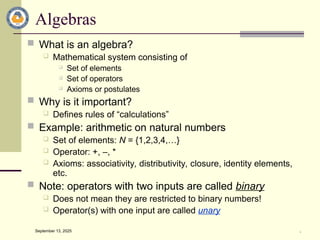
Algebras
 What is an algebra?
 Mathematical system consisting of
 Set of elements
 Set of operators
 Axioms or postulates
 Why is it important?
 Defines rules of “calculations”
 Example: arithmetic on natural numbers
 Set of elements: N = {1,2,3,4,…}
 Operator: +, –, *
 Axioms: associativity, distributivity, closure, identity elements,
etc.
 Note: operators with two inputs are called binary
 Does not mean they are restricted to binary numbers!
 Operator(s) with one input are called unary
September 13, 2025 3
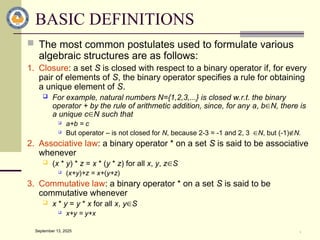
BASIC DEFINITIONS
 The most common postulates used to formulate various
algebraic structures are as follows:
1. Closure: a set S is closed with respect to a binary operator if, for every
pair of elements of S, the binary operator specifies a rule for obtaining
a unique element of S.
 For example, natural numbers N={1,2,3,...} is closed w.r.t. the binary
operator + by the rule of arithmetic addition, since, for any a, bN, there is
a unique cN such that
 a+b = c
 But operator – is not closed for N, because 2-3 = -1 and 2, 3N, but (-1)N.
2. Associative law: a binary operator * on a set S is said to be associative
whenever
 (x * y) * z = x * (y * z) for all x, y, zS
 (x+y)+z = x+(y+z)
3. Commutative law: a binary operator * on a set S is said to be
commutative whenever
 x * y = y * x for all x, yS
 x+y = y+x
September 13, 2025 4
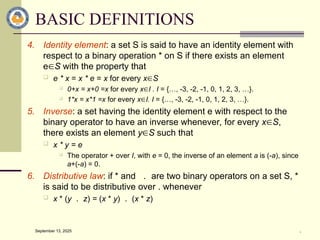
BASIC DEFINITIONS
4. Identity element: a set S is said to have an identity element with
respect to a binary operation * on S if there exists an element
eS with the property that
 e * x = x * e = x for every xS
 0+x = x+0 =x for every xI . I = {…, -3, -2, -1, 0, 1, 2, 3, …}.
 1*x = x*1 =x for every xI. I = {…, -3, -2, -1, 0, 1, 2, 3, …}.
5. Inverse: a set having the identity element e with respect to the
binary operator to have an inverse whenever, for every xS,
there exists an element yS such that
 x * y = e
 The operator + over I, with e = 0, the inverse of an element a is (-a), since
a+(-a) = 0.
6. Distributive law: if * and . are two binary operators on a set S, *
is said to be distributive over . whenever
 x * (y . z) = (x * y) . (x * z)
September 13, 2025 5
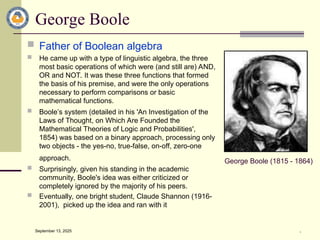
George Boole
 Father of Boolean algebra
 He came up with a type of linguistic algebra, the three
most basic operations of which were (and still are) AND,
OR and NOT. It was these three functions that formed
the basis of his premise, and were the only operations
necessary to perform comparisons or basic
mathematical functions.
 Boole’s system (detailed in his 'An Investigation of the
Laws of Thought, on Which Are Founded the
Mathematical Theories of Logic and Probabilities',
1854) was based on a binary approach, processing only
two objects - the yes-no, true-false, on-off, zero-one
approach.
 Surprisingly, given his standing in the academic
community, Boole's idea was either criticized or
completely ignored by the majority of his peers.
 Eventually, one bright student, Claude Shannon (1916-
2001), picked up the idea and ran with it
George Boole (1815 - 1864)
September 13, 2025 6
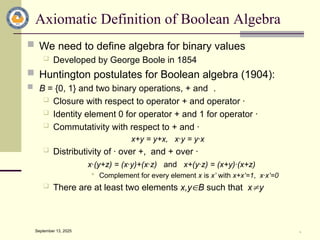
Axiomatic Definition of Boolean Algebra
 We need to define algebra for binary values
 Developed by George Boole in 1854
 Huntington postulates for Boolean algebra (1904):
 B = {0, 1} and two binary operations, + and .
 Closure with respect to operator + and operator ·
 Identity element 0 for operator + and 1 for operator ·
 Commutativity with respect to + and ·
x+y = y+x, x·y = y·x
 Distributivity of · over +, and + over ·
x·(y+z) = (x·y)+(x·z) and x+(y·z) = (x+y)·(x+z)
 Complement for every element x is x’ with x+x’=1, x·x’=0
 There are at least two elements x,yB such that xy
September 13, 2025 7
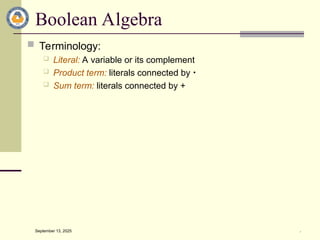
Boolean Algebra
 Terminology:
 Literal: A variable or its complement
 Product term: literals connected by •
 Sum term: literals connected by +
September 13, 2025 8
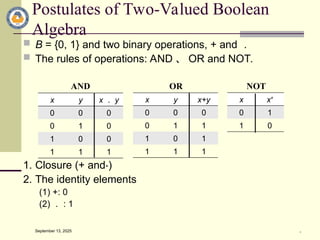
Postulates of Two-Valued Boolean
Algebra
 B = {0, 1} and two binary operations, + and .
 The rules of operations: AND 、 OR and NOT.
1. Closure (+ and )
‧
2. The identity elements
(1) +: 0
(2) . : 1
x y x . y
0 0 0
0 1 0
1 0 0
1 1 1
x y x+y
0 0 0
0 1 1
1 0 1
1 1 1
x x'
0 1
1 0
AND OR NOT
September 13, 2025 9
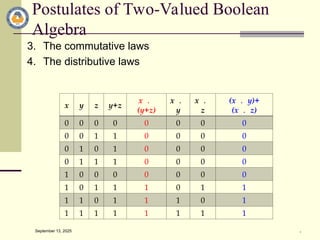
Postulates of Two-Valued Boolean
Algebra
3. The commutative laws
4. The distributive laws
x y z y+z
x .
(y+z)
x .
y
x .
z
(x . y)+
(x . z)
0 0 0 0 0 0 0 0
0 0 1 1 0 0 0 0
0 1 0 1 0 0 0 0
0 1 1 1 0 0 0 0
1 0 0 0 0 0 0 0
1 0 1 1 1 0 1 1
1 1 0 1 1 1 0 1
1 1 1 1 1 1 1 1
September 13, 2025 10
Postulates of Two-Valued Boolean
Algebra
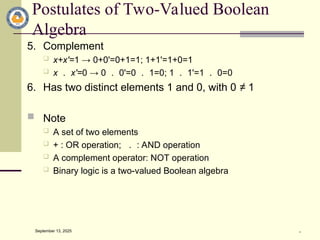
5. Complement
 x+x'=1 → 0+0'=0+1=1; 1+1'=1+0=1
 x . x'=0 → 0 . 0'=0 . 1=0; 1 . 1'=1 . 0=0
6. Has two distinct elements 1 and 0, with 0 ≠ 1
 Note
 A set of two elements
 + : OR operation; . : AND operation
 A complement operator: NOT operation
 Binary logic is a two-valued Boolean algebra
September 13, 2025 11
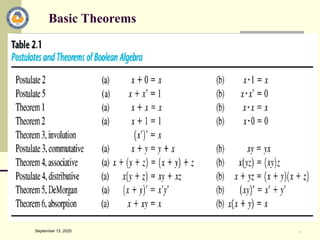
Basic Theorems
September 13, 2025 12
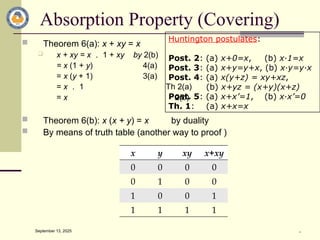
Absorption Property (Covering)
 Theorem 6(a): x + xy = x
 x + xy = x . 1 + xy by 2(b)
= x (1 + y) 4(a)
= x (y + 1) 3(a)
= x . 1 Th 2(a)
= x 2(b)
 Theorem 6(b): x (x + y) = x by duality
 By means of truth table (another way to proof )
x y xy x+xy
0 0 0 0
0 1 0 0
1 0 0 1
1 1 1 1
Huntington postulates:
Post. 2: (a) x+0=x, (b) x·1=x
Post. 3: (a) x+y=y+x, (b) x·y=y·x
Post. 4: (a) x(y+z) = xy+xz,
(b) x+yz = (x+y)(x+z)
Post. 5: (a) x+x’=1, (b) x·x’=0
Th. 1: (a) x+x=x
September 13, 2025 13
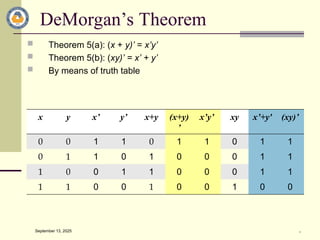
DeMorgan’s Theorem
 Theorem 5(a): (x + y)’ = x’y’
 Theorem 5(b): (xy)’ = x’ + y’
 By means of truth table
x y x’ y’ x+y (x+y)
’
x’y’ xy x’+y' (xy)’
0 0 1 1 0 1 1 0 1 1
0 1 1 0 1 0 0 0 1 1
1 0 0 1 1 0 0 0 1 1
1 1 0 0 1 0 0 1 0 0
September 13, 2025 14
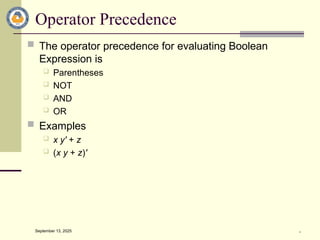
Operator Precedence
 The operator precedence for evaluating Boolean
Expression is
 Parentheses
 NOT
 AND
 OR
 Examples
 x y' + z
 (x y + z)'
September 13, 2025 15
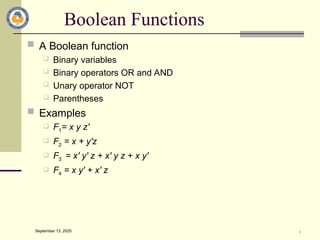
Boolean Functions
 A Boolean function
 Binary variables
 Binary operators OR and AND
 Unary operator NOT
 Parentheses
 Examples
 F1= x y z'
 F2 = x + y'z
 F3 = x' y' z + x' y z + x y'
 F4 = x y' + x' z
September 13, 2025 16
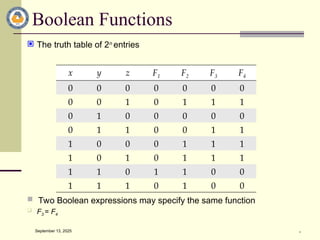
Boolean Functions
 The truth table of 2n
entries
 Two Boolean expressions may specify the same function
 F3 = F4
x y z F1 F2 F3 F4
0 0 0 0 0 0 0
0 0 1 0 1 1 1
0 1 0 0 0 0 0
0 1 1 0 0 1 1
1 0 0 0 1 1 1
1 0 1 0 1 1 1
1 1 0 1 1 0 0
1 1 1 0 1 0 0
September 13, 2025 17
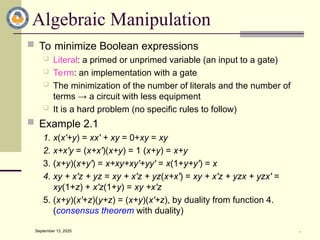
Algebraic Manipulation
 To minimize Boolean expressions
 Literal: a primed or unprimed variable (an input to a gate)
 Term: an implementation with a gate
 The minimization of the number of literals and the number of
terms → a circuit with less equipment
 It is a hard problem (no specific rules to follow)
 Example 2.1
1. x(x'+y) = xx' + xy = 0+xy = xy
2. x+x'y = (x+x')(x+y) = 1 (x+y) = x+y
3. (x+y)(x+y') = x+xy+xy'+yy' = x(1+y+y') = x
4. xy + x'z + yz = xy + x'z + yz(x+x') = xy + x'z + yzx + yzx' =
xy(1+z) + x'z(1+y) = xy +x'z
5. (x+y)(x'+z)(y+z) = (x+y)(x'+z), by duality from function 4.
(consensus theorem with duality)
September 13, 2025 18
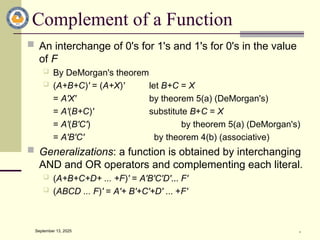
Complement of a Function
 An interchange of 0's for 1's and 1's for 0's in the value
of F
 By DeMorgan's theorem
 (A+B+C)' = (A+X)' let B+C = X
= A'X' by theorem 5(a) (DeMorgan's)
= A'(B+C)' substitute B+C = X
= A'(B'C') by theorem 5(a) (DeMorgan's)
= A'B'C' by theorem 4(b) (associative)
 Generalizations: a function is obtained by interchanging
AND and OR operators and complementing each literal.
 (A+B+C+D+ ... +F)' = A'B'C'D'... F'
 (ABCD ... F)' = A'+ B'+C'+D' ... +F'
September 13, 2025 19
Examples
 Example 2.2
 F1' = (x'yz' + x'y'z)' = (x'yz')' (x'y'z)' = (x+y'+z) (x+y+z')
 F2' = [x(y'z'+yz)]' = x' + (y'z'+yz)' = x' + (y'z')' (yz)‘
= x' + (y+z) (y'+z')
= x' + yz‘+y'z
 Example 2.3: a simpler procedure
 Take the dual of the function and complement each literal
1. F1 = x'yz' + x'y'z.
The dual of F1 is (x'+y+z') (x'+y'+z).
Complement each literal: (x+y'+z)(x+y+z') = F1'
2. F2 = x(y' z' + yz).
The dual of F2 is x+(y'+z') (y+z).
Complement each literal: x'+(y+z)(y' +z') = F2'
September 13, 2025 20
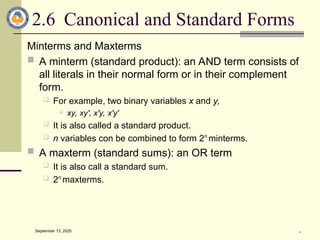
2.6 Canonical and Standard Forms
Minterms and Maxterms
 A minterm (standard product): an AND term consists of
all literals in their normal form or in their complement
form.
 For example, two binary variables x and y,
 xy, xy', x'y, x'y'
 It is also called a standard product.
 n variables con be combined to form 2n
minterms.
 A maxterm (standard sums): an OR term
 It is also call a standard sum.
 2n
maxterms.
September 13, 2025 21
Minterms and Maxterms
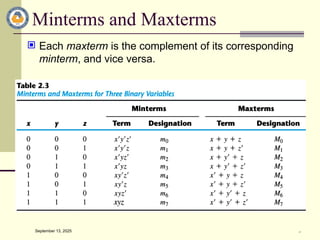
 Each maxterm is the complement of its corresponding
minterm, and vice versa.
September 13, 2025 22
Minterms and Maxterms
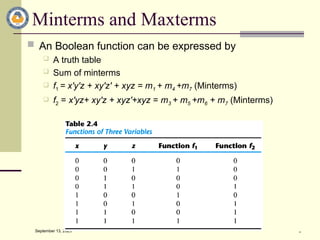
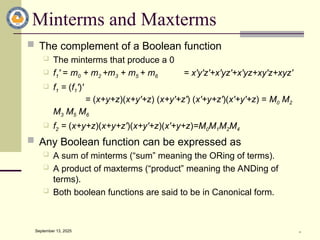
 An Boolean function can be expressed by
 A truth table
 Sum of minterms
 f1 = x'y'z + xy'z' + xyz = m1 + m4 +m7 (Minterms)
 f2 = x'yz+ xy'z + xyz'+xyz = m3 + m5 +m6 + m7 (Minterms)
September 13, 2025 23
Minterms and Maxterms
 The complement of a Boolean function
 The minterms that produce a 0
 f1' = m0 + m2 +m3 + m5 + m6 = x'y'z'+x'yz'+x'yz+xy'z+xyz'
 f1 = (f1')'
= (x+y+z)(x+y'+z) (x+y'+z') (x'+y+z')(x'+y'+z) = M0 M2
M3 M5 M6
 f2 = (x+y+z)(x+y+z')(x+y'+z)(x'+y+z)=M0M1M2M4
 Any Boolean function can be expressed as
 A sum of minterms (“sum” meaning the ORing of terms).
 A product of maxterms (“product” meaning the ANDing of
terms).
 Both boolean functions are said to be in Canonical form.
September 13, 2025 24
Sum of Minterms
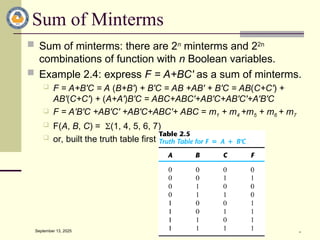
 Sum of minterms: there are 2n
minterms and 22n
combinations of function with n Boolean variables.
 Example 2.4: express F = A+BC' as a sum of minterms.
 F = A+B'C = A (B+B') + B'C = AB +AB' + B'C = AB(C+C') +
AB'(C+C') + (A+A')B'C = ABC+ABC'+AB'C+AB'C'+A'B'C
 F = A'B'C +AB'C' +AB'C+ABC'+ ABC = m1 + m4 +m5 + m6 + m7
 F(A, B, C) = (1, 4, 5, 6, 7)
 or, built the truth table first
September 13, 2025 25
Product of Maxterms
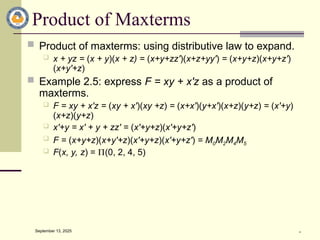
 Product of maxterms: using distributive law to expand.
 x + yz = (x + y)(x + z) = (x+y+zz')(x+z+yy') = (x+y+z)(x+y+z')
(x+y'+z)
 Example 2.5: express F = xy + x'z as a product of
maxterms.
 F = xy + x'z = (xy + x')(xy +z) = (x+x')(y+x')(x+z)(y+z) = (x'+y)
(x+z)(y+z)
 x'+y = x' + y + zz' = (x'+y+z)(x'+y+z')
 F = (x+y+z)(x+y'+z)(x'+y+z)(x'+y+z') = M0M2M4M5
 F(x, y, z) = (0, 2, 4, 5)
September 13, 2025 26
Conversion between Canonical Forms
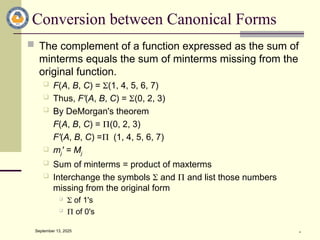
 The complement of a function expressed as the sum of
minterms equals the sum of minterms missing from the
original function.
 F(A, B, C) = (1, 4, 5, 6, 7)
 Thus, F'(A, B, C) = (0, 2, 3)
 By DeMorgan's theorem
F(A, B, C) = (0, 2, 3)
F'(A, B, C) =(1, 4, 5, 6, 7)
 mj' = Mj
 Sum of minterms = product of maxterms
 Interchange the symbols  and  and list those numbers
missing from the original form
  of 1's
  of 0's
September 13, 2025 27
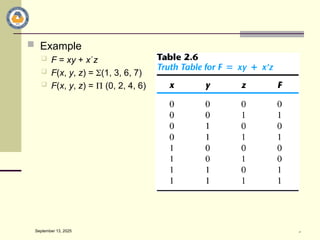
 Example
 F = xy + xz
 F(x, y, z) = (1, 3, 6, 7)
 F(x, y, z) =  (0, 2, 4, 6)
September 13, 2025 28
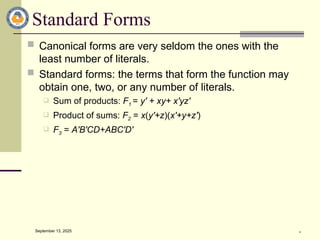
Standard Forms
 Canonical forms are very seldom the ones with the
least number of literals.
 Standard forms: the terms that form the function may
obtain one, two, or any number of literals.
 Sum of products: F1 = y' + xy+ x'yz'
 Product of sums: F2 = x(y'+z)(x'+y+z')
 F3 = A'B'CD+ABC'D'
September 13, 2025 29
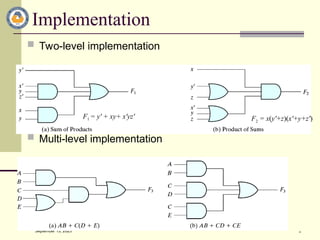
Implementation
 Two-level implementation
 Multi-level implementation
F1 = y' + xy+ x'yz' F2 = x(y'+z)(x'+y+z')
September 13, 2025 30
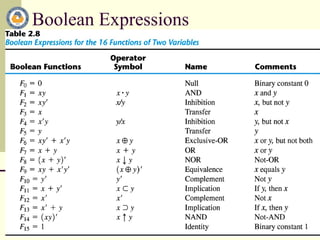
Boolean Expressions
September 13, 2025 31
2.8 Digital Logic Gates
 Boolean expression: AND, OR and NOT operations
 Constructing gates of other logic operations
 The feasibility and economy;
 The possibility of extending gate's inputs;
 The basic properties of the binary operations (commutative and
associative);
 The ability of the gate to implement Boolean functions.
September 13, 2025 32
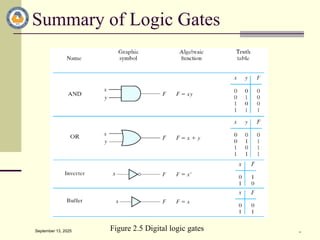
Figure 2.5 Digital logic gates
Summary of Logic Gates
September 13, 2025 33
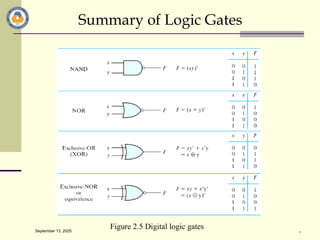
Figure 2.5 Digital logic gates
Summary of Logic Gates
September 13, 2025 34
Multiple Inputs
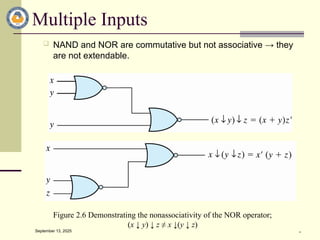
 NAND and NOR are commutative but not associative → they
are not extendable.
Figure 2.6 Demonstrating the nonassociativity of the NOR operator;
(x ↓ y) ↓ z ≠ x ↓(y ↓ z)
September 13, 2025 35
Multiple Inputs
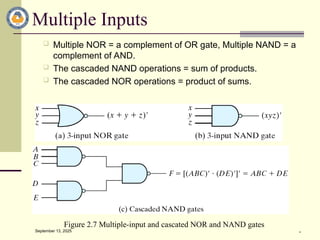
 Multiple NOR = a complement of OR gate, Multiple NAND = a
complement of AND.
 The cascaded NAND operations = sum of products.
 The cascaded NOR operations = product of sums.
Figure 2.7 Multiple-input and cascated NOR and NAND gates
September 13, 2025 36
Multiple Inputs
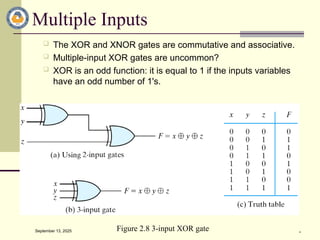
 The XOR and XNOR gates are commutative and associative.
 Multiple-input XOR gates are uncommon?
 XOR is an odd function: it is equal to 1 if the inputs variables
have an odd number of 1's.
Figure 2.8 3-input XOR gate
September 13, 2025 37
2.9 Integrated Circuits
Level of Integration
 An IC (a chip)
 Examples:
 Small-scale Integration (SSI): < 10 gates
 Medium-scale Integration (MSI): 10 ~ 100 gates
 Large-scale Integration (LSI): 100 ~ xk gates
 Very Large-scale Integration (VLSI): > xk gates
 VLSI
 Small size (compact size)
 Low cost
 Low power consumption
 High reliability
 High speed
September 13, 2025 38
CAD
 CAD – Computer-Aided Design
 Millions of transistors
 Computer-based representation and aid
 Automatic the design process
 Design entry
 Schematic capture
 HDL – Hardware Description Language
 Verilog, VHDL
 Simulation
 Physical realization
 ASIC, FPGA, PLD
September 13, 2025 39
Chip Design
 Why is it better to have more gates on a single chip?
 Easier to build systems
 Lower power consumption
 Higher clock frequencies
 What are the drawbacks of large circuits?
 Complex to design
 Chips have design constraints
 Hard to test
 Need tools to help develop integrated circuits
 Computer Aided Design (CAD) tools
 Automate tedious steps of design process
 Hardware description language (HDL) describe circuits
 VHDL (see the lab) is one such system
digital number and binary system chapter two.ppt

  • 1.
    1 Digital Logic Design BooleanAlgebra and Logic Gate
  • 2.
    September 13, 20252 Algebras  What is an algebra?  Mathematical system consisting of  Set of elements  Set of operators  Axioms or postulates  Why is it important?  Defines rules of “calculations”  Example: arithmetic on natural numbers  Set of elements: N = {1,2,3,4,…}  Operator: +, –, *  Axioms: associativity, distributivity, closure, identity elements, etc.  Note: operators with two inputs are called binary  Does not mean they are restricted to binary numbers!  Operator(s) with one input are called unary
  • 3.
    September 13, 20253 BASIC DEFINITIONS  The most common postulates used to formulate various algebraic structures are as follows: 1. Closure: a set S is closed with respect to a binary operator if, for every pair of elements of S, the binary operator specifies a rule for obtaining a unique element of S.  For example, natural numbers N={1,2,3,...} is closed w.r.t. the binary operator + by the rule of arithmetic addition, since, for any a, bN, there is a unique cN such that  a+b = c  But operator – is not closed for N, because 2-3 = -1 and 2, 3N, but (-1)N. 2. Associative law: a binary operator * on a set S is said to be associative whenever  (x * y) * z = x * (y * z) for all x, y, zS  (x+y)+z = x+(y+z) 3. Commutative law: a binary operator * on a set S is said to be commutative whenever  x * y = y * x for all x, yS  x+y = y+x
  • 4.
    September 13, 20254 BASIC DEFINITIONS 4. Identity element: a set S is said to have an identity element with respect to a binary operation * on S if there exists an element eS with the property that  e * x = x * e = x for every xS  0+x = x+0 =x for every xI . I = {…, -3, -2, -1, 0, 1, 2, 3, …}.  1*x = x*1 =x for every xI. I = {…, -3, -2, -1, 0, 1, 2, 3, …}. 5. Inverse: a set having the identity element e with respect to the binary operator to have an inverse whenever, for every xS, there exists an element yS such that  x * y = e  The operator + over I, with e = 0, the inverse of an element a is (-a), since a+(-a) = 0. 6. Distributive law: if * and . are two binary operators on a set S, * is said to be distributive over . whenever  x * (y . z) = (x * y) . (x * z)
  • 5.
    September 13, 20255 George Boole  Father of Boolean algebra  He came up with a type of linguistic algebra, the three most basic operations of which were (and still are) AND, OR and NOT. It was these three functions that formed the basis of his premise, and were the only operations necessary to perform comparisons or basic mathematical functions.  Boole’s system (detailed in his 'An Investigation of the Laws of Thought, on Which Are Founded the Mathematical Theories of Logic and Probabilities', 1854) was based on a binary approach, processing only two objects - the yes-no, true-false, on-off, zero-one approach.  Surprisingly, given his standing in the academic community, Boole's idea was either criticized or completely ignored by the majority of his peers.  Eventually, one bright student, Claude Shannon (1916- 2001), picked up the idea and ran with it George Boole (1815 - 1864)
  • 6.
    September 13, 20256 Axiomatic Definition of Boolean Algebra  We need to define algebra for binary values  Developed by George Boole in 1854  Huntington postulates for Boolean algebra (1904):  B = {0, 1} and two binary operations, + and .  Closure with respect to operator + and operator ·  Identity element 0 for operator + and 1 for operator ·  Commutativity with respect to + and · x+y = y+x, x·y = y·x  Distributivity of · over +, and + over · x·(y+z) = (x·y)+(x·z) and x+(y·z) = (x+y)·(x+z)  Complement for every element x is x’ with x+x’=1, x·x’=0  There are at least two elements x,yB such that xy
  • 7.
    September 13, 20257 Boolean Algebra  Terminology:  Literal: A variable or its complement  Product term: literals connected by •  Sum term: literals connected by +
  • 8.
    September 13, 20258 Postulates of Two-Valued Boolean Algebra  B = {0, 1} and two binary operations, + and .  The rules of operations: AND 、 OR and NOT. 1. Closure (+ and ) ‧ 2. The identity elements (1) +: 0 (2) . : 1 x y x . y 0 0 0 0 1 0 1 0 0 1 1 1 x y x+y 0 0 0 0 1 1 1 0 1 1 1 1 x x' 0 1 1 0 AND OR NOT
  • 9.
    September 13, 20259 Postulates of Two-Valued Boolean Algebra 3. The commutative laws 4. The distributive laws x y z y+z x . (y+z) x . y x . z (x . y)+ (x . z) 0 0 0 0 0 0 0 0 0 0 1 1 0 0 0 0 0 1 0 1 0 0 0 0 0 1 1 1 0 0 0 0 1 0 0 0 0 0 0 0 1 0 1 1 1 0 1 1 1 1 0 1 1 1 0 1 1 1 1 1 1 1 1 1
  • 10.
    September 13, 202510 Postulates of Two-Valued Boolean Algebra 5. Complement  x+x'=1 → 0+0'=0+1=1; 1+1'=1+0=1  x . x'=0 → 0 . 0'=0 . 1=0; 1 . 1'=1 . 0=0 6. Has two distinct elements 1 and 0, with 0 ≠ 1  Note  A set of two elements  + : OR operation; . : AND operation  A complement operator: NOT operation  Binary logic is a two-valued Boolean algebra
  • 11.
    September 13, 202511 Basic Theorems
  • 12.
    September 13, 202512 Absorption Property (Covering)  Theorem 6(a): x + xy = x  x + xy = x . 1 + xy by 2(b) = x (1 + y) 4(a) = x (y + 1) 3(a) = x . 1 Th 2(a) = x 2(b)  Theorem 6(b): x (x + y) = x by duality  By means of truth table (another way to proof ) x y xy x+xy 0 0 0 0 0 1 0 0 1 0 0 1 1 1 1 1 Huntington postulates: Post. 2: (a) x+0=x, (b) x·1=x Post. 3: (a) x+y=y+x, (b) x·y=y·x Post. 4: (a) x(y+z) = xy+xz, (b) x+yz = (x+y)(x+z) Post. 5: (a) x+x’=1, (b) x·x’=0 Th. 1: (a) x+x=x
  • 13.
    September 13, 202513 DeMorgan’s Theorem  Theorem 5(a): (x + y)’ = x’y’  Theorem 5(b): (xy)’ = x’ + y’  By means of truth table x y x’ y’ x+y (x+y) ’ x’y’ xy x’+y' (xy)’ 0 0 1 1 0 1 1 0 1 1 0 1 1 0 1 0 0 0 1 1 1 0 0 1 1 0 0 0 1 1 1 1 0 0 1 0 0 1 0 0
  • 14.
    September 13, 202514 Operator Precedence  The operator precedence for evaluating Boolean Expression is  Parentheses  NOT  AND  OR  Examples  x y' + z  (x y + z)'
  • 15.
    September 13, 202515 Boolean Functions  A Boolean function  Binary variables  Binary operators OR and AND  Unary operator NOT  Parentheses  Examples  F1= x y z'  F2 = x + y'z  F3 = x' y' z + x' y z + x y'  F4 = x y' + x' z
  • 16.
    September 13, 202516 Boolean Functions  The truth table of 2n entries  Two Boolean expressions may specify the same function  F3 = F4 x y z F1 F2 F3 F4 0 0 0 0 0 0 0 0 0 1 0 1 1 1 0 1 0 0 0 0 0 0 1 1 0 0 1 1 1 0 0 0 1 1 1 1 0 1 0 1 1 1 1 1 0 1 1 0 0 1 1 1 0 1 0 0
  • 17.
    September 13, 202517 Algebraic Manipulation  To minimize Boolean expressions  Literal: a primed or unprimed variable (an input to a gate)  Term: an implementation with a gate  The minimization of the number of literals and the number of terms → a circuit with less equipment  It is a hard problem (no specific rules to follow)  Example 2.1 1. x(x'+y) = xx' + xy = 0+xy = xy 2. x+x'y = (x+x')(x+y) = 1 (x+y) = x+y 3. (x+y)(x+y') = x+xy+xy'+yy' = x(1+y+y') = x 4. xy + x'z + yz = xy + x'z + yz(x+x') = xy + x'z + yzx + yzx' = xy(1+z) + x'z(1+y) = xy +x'z 5. (x+y)(x'+z)(y+z) = (x+y)(x'+z), by duality from function 4. (consensus theorem with duality)
  • 18.
    September 13, 202518 Complement of a Function  An interchange of 0's for 1's and 1's for 0's in the value of F  By DeMorgan's theorem  (A+B+C)' = (A+X)' let B+C = X = A'X' by theorem 5(a) (DeMorgan's) = A'(B+C)' substitute B+C = X = A'(B'C') by theorem 5(a) (DeMorgan's) = A'B'C' by theorem 4(b) (associative)  Generalizations: a function is obtained by interchanging AND and OR operators and complementing each literal.  (A+B+C+D+ ... +F)' = A'B'C'D'... F'  (ABCD ... F)' = A'+ B'+C'+D' ... +F'
  • 19.
    September 13, 202519 Examples  Example 2.2  F1' = (x'yz' + x'y'z)' = (x'yz')' (x'y'z)' = (x+y'+z) (x+y+z')  F2' = [x(y'z'+yz)]' = x' + (y'z'+yz)' = x' + (y'z')' (yz)‘ = x' + (y+z) (y'+z') = x' + yz‘+y'z  Example 2.3: a simpler procedure  Take the dual of the function and complement each literal 1. F1 = x'yz' + x'y'z. The dual of F1 is (x'+y+z') (x'+y'+z). Complement each literal: (x+y'+z)(x+y+z') = F1' 2. F2 = x(y' z' + yz). The dual of F2 is x+(y'+z') (y+z). Complement each literal: x'+(y+z)(y' +z') = F2'
  • 20.
    September 13, 202520 2.6 Canonical and Standard Forms Minterms and Maxterms  A minterm (standard product): an AND term consists of all literals in their normal form or in their complement form.  For example, two binary variables x and y,  xy, xy', x'y, x'y'  It is also called a standard product.  n variables con be combined to form 2n minterms.  A maxterm (standard sums): an OR term  It is also call a standard sum.  2n maxterms.
  • 21.
    September 13, 202521 Minterms and Maxterms  Each maxterm is the complement of its corresponding minterm, and vice versa.
  • 22.
    September 13, 202522 Minterms and Maxterms  An Boolean function can be expressed by  A truth table  Sum of minterms  f1 = x'y'z + xy'z' + xyz = m1 + m4 +m7 (Minterms)  f2 = x'yz+ xy'z + xyz'+xyz = m3 + m5 +m6 + m7 (Minterms)
  • 23.
    September 13, 202523 Minterms and Maxterms  The complement of a Boolean function  The minterms that produce a 0  f1' = m0 + m2 +m3 + m5 + m6 = x'y'z'+x'yz'+x'yz+xy'z+xyz'  f1 = (f1')' = (x+y+z)(x+y'+z) (x+y'+z') (x'+y+z')(x'+y'+z) = M0 M2 M3 M5 M6  f2 = (x+y+z)(x+y+z')(x+y'+z)(x'+y+z)=M0M1M2M4  Any Boolean function can be expressed as  A sum of minterms (“sum” meaning the ORing of terms).  A product of maxterms (“product” meaning the ANDing of terms).  Both boolean functions are said to be in Canonical form.
  • 24.
    September 13, 202524 Sum of Minterms  Sum of minterms: there are 2n minterms and 22n combinations of function with n Boolean variables.  Example 2.4: express F = A+BC' as a sum of minterms.  F = A+B'C = A (B+B') + B'C = AB +AB' + B'C = AB(C+C') + AB'(C+C') + (A+A')B'C = ABC+ABC'+AB'C+AB'C'+A'B'C  F = A'B'C +AB'C' +AB'C+ABC'+ ABC = m1 + m4 +m5 + m6 + m7  F(A, B, C) = (1, 4, 5, 6, 7)  or, built the truth table first
  • 25.
    September 13, 202525 Product of Maxterms  Product of maxterms: using distributive law to expand.  x + yz = (x + y)(x + z) = (x+y+zz')(x+z+yy') = (x+y+z)(x+y+z') (x+y'+z)  Example 2.5: express F = xy + x'z as a product of maxterms.  F = xy + x'z = (xy + x')(xy +z) = (x+x')(y+x')(x+z)(y+z) = (x'+y) (x+z)(y+z)  x'+y = x' + y + zz' = (x'+y+z)(x'+y+z')  F = (x+y+z)(x+y'+z)(x'+y+z)(x'+y+z') = M0M2M4M5  F(x, y, z) = (0, 2, 4, 5)
  • 26.
    September 13, 202526 Conversion between Canonical Forms  The complement of a function expressed as the sum of minterms equals the sum of minterms missing from the original function.  F(A, B, C) = (1, 4, 5, 6, 7)  Thus, F'(A, B, C) = (0, 2, 3)  By DeMorgan's theorem F(A, B, C) = (0, 2, 3) F'(A, B, C) =(1, 4, 5, 6, 7)  mj' = Mj  Sum of minterms = product of maxterms  Interchange the symbols  and  and list those numbers missing from the original form   of 1's   of 0's
  • 27.
    September 13, 202527  Example  F = xy + xz  F(x, y, z) = (1, 3, 6, 7)  F(x, y, z) =  (0, 2, 4, 6)
  • 28.
    September 13, 202528 Standard Forms  Canonical forms are very seldom the ones with the least number of literals.  Standard forms: the terms that form the function may obtain one, two, or any number of literals.  Sum of products: F1 = y' + xy+ x'yz'  Product of sums: F2 = x(y'+z)(x'+y+z')  F3 = A'B'CD+ABC'D'
  • 29.
    September 13, 202529 Implementation  Two-level implementation  Multi-level implementation F1 = y' + xy+ x'yz' F2 = x(y'+z)(x'+y+z')
  • 30.
    September 13, 202530 Boolean Expressions
  • 31.
    September 13, 202531 2.8 Digital Logic Gates  Boolean expression: AND, OR and NOT operations  Constructing gates of other logic operations  The feasibility and economy;  The possibility of extending gate's inputs;  The basic properties of the binary operations (commutative and associative);  The ability of the gate to implement Boolean functions.
  • 32.
    September 13, 202532 Figure 2.5 Digital logic gates Summary of Logic Gates
  • 33.
    September 13, 202533 Figure 2.5 Digital logic gates Summary of Logic Gates
  • 34.
    September 13, 202534 Multiple Inputs  NAND and NOR are commutative but not associative → they are not extendable. Figure 2.6 Demonstrating the nonassociativity of the NOR operator; (x ↓ y) ↓ z ≠ x ↓(y ↓ z)
  • 35.
    September 13, 202535 Multiple Inputs  Multiple NOR = a complement of OR gate, Multiple NAND = a complement of AND.  The cascaded NAND operations = sum of products.  The cascaded NOR operations = product of sums. Figure 2.7 Multiple-input and cascated NOR and NAND gates
  • 36.
    September 13, 202536 Multiple Inputs  The XOR and XNOR gates are commutative and associative.  Multiple-input XOR gates are uncommon?  XOR is an odd function: it is equal to 1 if the inputs variables have an odd number of 1's. Figure 2.8 3-input XOR gate
  • 37.
    September 13, 202537 2.9 Integrated Circuits Level of Integration  An IC (a chip)  Examples:  Small-scale Integration (SSI): < 10 gates  Medium-scale Integration (MSI): 10 ~ 100 gates  Large-scale Integration (LSI): 100 ~ xk gates  Very Large-scale Integration (VLSI): > xk gates  VLSI  Small size (compact size)  Low cost  Low power consumption  High reliability  High speed
  • 38.
    September 13, 202538 CAD  CAD – Computer-Aided Design  Millions of transistors  Computer-based representation and aid  Automatic the design process  Design entry  Schematic capture  HDL – Hardware Description Language  Verilog, VHDL  Simulation  Physical realization  ASIC, FPGA, PLD
  • 39.
    September 13, 202539 Chip Design  Why is it better to have more gates on a single chip?  Easier to build systems  Lower power consumption  Higher clock frequencies  What are the drawbacks of large circuits?  Complex to design  Chips have design constraints  Hard to test  Need tools to help develop integrated circuits  Computer Aided Design (CAD) tools  Automate tedious steps of design process  Hardware description language (HDL) describe circuits  VHDL (see the lab) is one such system