CASH FLOW
AND
FUND FLOW
CASH FLOW
Cash flow is the net amount of cash and cash-equivalents moving into and
out of a business.
Positive cash flow indicates that a company's liquid assets are increasing,
enabling it to settle debts, reinvest in its business, return money to
shareholders, pay expenses and provide a buffer against future financial
challenges.
Negative cash flow indicates that a company's liquid assets are decreasing.
Net cash flow is distinguished from net income, which includes accounts
receivable and other items for which payment has not actually been
received. Cash flow is used to assess the quality of a company's income,
that is, how liquid it is, which can indicate whether the company is positioned
to remain solvent
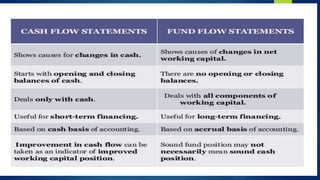
CASH FLOW STATEMENTS
 Concentrates on transactions that have a direct
impact on cash
 Deals with inflow and outflow of cash between two
balance sheet dates.
 An essential tool of short-term financial analysis
IMPORTANCE OF CASH FLOW STATEMENTS
 Facilitates to prepare sound financial policies
 Helps to evaluate the current cash position
 Projected cash flow statements helps to know the future cash position of a
concern so as to enable a firm to plan and co-ordinate its financial operations
properly.
 It helps in taking loans from banks and other financial institutions.
 Helps the management in taking short-term financial decisions
OBJECTIVES OF CFS
The primary objective of CFS is to provide information regarding the cash
receipts and payments of an enterprise for an accounting period
The secondary objective is to disclose information about the operating,
investing and financing activities of an enterprise during an accounting
period
LIMITATIONS
• Only reveals the inflow and outflow of the cash. The cash
balance disclosed by this statement may not depict the true
liquid position.
• It cannot be equated with income statement. Income
statement takes into account both cash and non-cash items.
Hence cash fund does not mean net income of the business.
What is a 'Fund Flow‘ ?
Fund flow is the net of all cash inflows and outflows in and
out of various financial assets. Fund flow is usually measured
on a monthly or quarterly basis; the performance of an asset or
fund is not taken into account, only share redemptions, or
outflows, and share purchases, or inflows. Net inflows create
excess cash for managers to invest, which theoretically creates
demand for securities such as stocks and bonds.
 Prepared to explain the changes which have taken place in the
working capital during the period under consideration.
 It is a report on movement of funds explaining where from
working capital originates and where into the same goes during
an accounting period.
 Essential tool for long-term financial analysis
IMPORTANCE OF FUND FLOW STAEMENTS
 Determines the financial consequences of business operations.it shows how the
funds were obtained and used in past. Financial manager can take corrective
actions.
 The management can formulate its financial policies-dividend, reserve etc. on
the basis of this statement.
 Points out sound and weak financial position of the enterprise
 Points out the causes for changes in working capital.
 Enables the bankers creditors or financial institutions in assessing the degree of
risk involved in granting credit to the business
LIMITATIONS OF FUND FLOW STATEMENTS
o Lacks originality because it is only rearrangement of data
appearing in accounts books.
o Indicates only the past position and not future.
o Indicates fund flow only in summary form and does not
show various changes which takes place continuously.
o Not an ideal tool for financial analysis.
THANK YOU !

Cash flow and fund flow

  • 1.
  • 2.
    CASH FLOW Cash flowis the net amount of cash and cash-equivalents moving into and out of a business. Positive cash flow indicates that a company's liquid assets are increasing, enabling it to settle debts, reinvest in its business, return money to shareholders, pay expenses and provide a buffer against future financial challenges. Negative cash flow indicates that a company's liquid assets are decreasing. Net cash flow is distinguished from net income, which includes accounts receivable and other items for which payment has not actually been received. Cash flow is used to assess the quality of a company's income, that is, how liquid it is, which can indicate whether the company is positioned to remain solvent
  • 3.
    CASH FLOW STATEMENTS Concentrates on transactions that have a direct impact on cash  Deals with inflow and outflow of cash between two balance sheet dates.  An essential tool of short-term financial analysis
  • 4.
    IMPORTANCE OF CASHFLOW STATEMENTS  Facilitates to prepare sound financial policies  Helps to evaluate the current cash position  Projected cash flow statements helps to know the future cash position of a concern so as to enable a firm to plan and co-ordinate its financial operations properly.  It helps in taking loans from banks and other financial institutions.  Helps the management in taking short-term financial decisions
  • 5.
    OBJECTIVES OF CFS Theprimary objective of CFS is to provide information regarding the cash receipts and payments of an enterprise for an accounting period The secondary objective is to disclose information about the operating, investing and financing activities of an enterprise during an accounting period
  • 6.
    LIMITATIONS • Only revealsthe inflow and outflow of the cash. The cash balance disclosed by this statement may not depict the true liquid position. • It cannot be equated with income statement. Income statement takes into account both cash and non-cash items. Hence cash fund does not mean net income of the business.
  • 7.
    What is a'Fund Flow‘ ? Fund flow is the net of all cash inflows and outflows in and out of various financial assets. Fund flow is usually measured on a monthly or quarterly basis; the performance of an asset or fund is not taken into account, only share redemptions, or outflows, and share purchases, or inflows. Net inflows create excess cash for managers to invest, which theoretically creates demand for securities such as stocks and bonds.
  • 8.
     Prepared toexplain the changes which have taken place in the working capital during the period under consideration.  It is a report on movement of funds explaining where from working capital originates and where into the same goes during an accounting period.  Essential tool for long-term financial analysis
  • 9.
    IMPORTANCE OF FUNDFLOW STAEMENTS  Determines the financial consequences of business operations.it shows how the funds were obtained and used in past. Financial manager can take corrective actions.  The management can formulate its financial policies-dividend, reserve etc. on the basis of this statement.  Points out sound and weak financial position of the enterprise  Points out the causes for changes in working capital.  Enables the bankers creditors or financial institutions in assessing the degree of risk involved in granting credit to the business
  • 10.
    LIMITATIONS OF FUNDFLOW STATEMENTS o Lacks originality because it is only rearrangement of data appearing in accounts books. o Indicates only the past position and not future. o Indicates fund flow only in summary form and does not show various changes which takes place continuously. o Not an ideal tool for financial analysis.
  • 12.