Oracle - ERP Presented By –
Nitin Maheshwari
Layout
• Introduction to ERP
• Business Need
• What is Oracle – ERP?
• Oracle as an ERP
• Modules of Oracle ERP
• How do ERP System Works
• ERP Components
• ERP Vendors
• Revenue, Profits & Investments of major ERP Vendors
Layout (Contd.)
 Services Offered
 Implemented modules of Oracle Apps
 Scope of ERP
 Career Track
 Benefits of ERP System
 Wrap Up
What is ERP?
 The practice of consolidating an enterprise’s
planning, manufacturing, sales and marketing
efforts into one management system.
 Combines all databases across departments into a
single database that can be accessed by all
employees.
 ERP automates the tasks involved in performing a
business process.
Business Needs
Global Operations Heterogeneous Solutions
Different locations
Different countries
Different languages
Different time zones
Central vs. distributed
Business Needs contd.
Global Operations Heterogeneous Solutions
Different applications
Different technologies
Different vendors
Point-to-point integration
Custom-made solutions
What is Oracle as an ERP?
• Oracle Applications comprise the application software or
business software of Oracle Corporation.
• Is a suite of back office software modules designed to
integrate and streamline a company’s business processes and
transactions.
• Great benefits can be made adopting an ERP system.
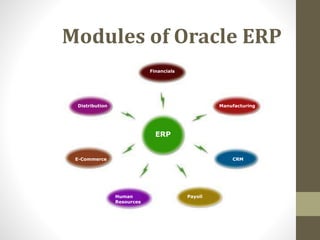
Modules of Oracle ERP
ERP
Financials
Distribution
E-Commerce
Human
Resources
Payoll
CRM
Manufacturing
ERP
Modules of Oracle ERP
(Contd.)
•Oracle HRMS
•Oracle Payroll
•Oracle CRM
•Oracle Financials
•Oracle Mobile Supply Chain Application
•Oracle Order Management
•Oracle Procurement
•Oracle Project Portfolio Management
•Oracle Quotes
•Oracle Transportation Management
•Oracle Warehouse Management Systems
•Oracle Inventory
•Oracle Enterprise Asset Management
•Product Life cycle Management
•Asset Lifecycle Management
•Manufacturing
Employees
Managers and
Stakeholders
How Do ERP Systems Work?
Central
Database
Payroll
Human
Resource
Management
Applications
Financial
Applications
Manufacturing
Applications
Inventory
And Supply
Applications
Human
Resource
Management
Applications
Service
Applications
Sales and
Delivery
Applications
Sales Force
And Customer
Service Reps
Customers Back-office
Administrators
And Workers
Suppliers
ERP Components
 HR: software for handling
personnel-related tasks for
corporate managers and
individual employees. Examples:
 HR administration
 Payroll
 Self-service HR
 Finance: modules for
bookkeeping and making sure
the bills are paid on time.
Examples:
 General ledger
 Accounts receivable
 Accounts payable
 Manufacturing and Logistics: A
group of applications for
planning production, taking
orders and delivering products
to the customer. Examples:
 Production planning
 Materials management
 Order entry and processing
 Warehouse management
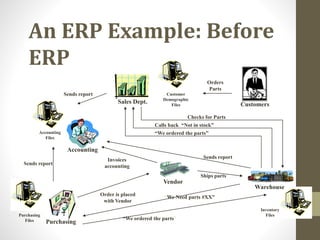
An ERP Example: Before
ERP
Customers
Customer
Demographic
Files
Sales Dept.
Vendor
Orders
Parts
Accounting
Accounting
Files
Purchasing
Purchasing
Files
Order is placed
with Vendor
Invoices
accounting
Inventory
Files
Warehouse
Checks for Parts
Calls back “Not in stock”
“We ordered the parts”
“We Need parts #XX”
“We ordered the parts”
Sends report
Sends report
Sends report
Ships parts
An ERP Example: After
ERP
Database
Customers Sales Dept.
Purchasing
Warehouse
Accounting
Vendor
Inventory Data
If no parts,
order is placed
through DB
Orders
Parts
Order is submitted
to Purchasing.
Purchasing record
order in DB
Order is placed
with Vendor
Add invoices accounting
Financial Data exchange;
Books invoice against PO
Books inventory
against PO
Ships parts
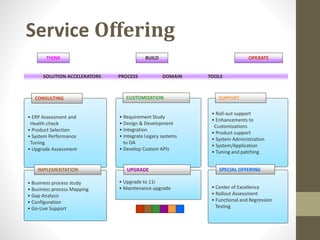
THINK BUILD OPERATE
SOLUTION ACCELERATORS PROCESS DOMAIN TOOLS
• ERP Assessment and
Health-check
• Product Selection
• System Performance
Tuning
• Upgrade Assessment
CONSULTING
• Business process study
• Business process Mapping
• Gap Analysis
• Configuration
• Go-Live Support
IMPLEMENTATION
• Requirement Study
• Design & Development
• Integration
• Integrate Legacy systems
to OA
• Develop Custom APIs
CUSTOMIZATION
• Roll-out support
• Enhancements to
Customizations
• Product support
• System Administration
• System/Application
• Tuning and patching
SUPPORT
• Upgrade to 11i
• Maintenance upgrade
UPGRADE
• Center of Excellence
• Rollout Assessment
• Functional and Regression
Testing
SPECIAL OFFERING
Service Offering
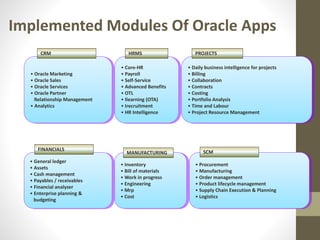
Implemented Modules Of Oracle Apps
• Core-HR
• Payroll
• Self-Service
• Advanced Benefits
• OTL
• Ilearning (OTA)
• Irecruitment
• HR Intelligence
• Oracle Marketing
• Oracle Sales
• Oracle Services
• Oracle Partner
Relationship Management
• Analytics
• General ledger
• Assets
• Cash management
• Payables / receivables
• Financial analyzer
• Enterprise planning &
budgeting
• Daily business intelligence for projects
• Billing
• Collaboration
• Contracts
• Costing
• Portfolio Analysis
• Time and Labour
• Project Resource Management
• Procurement
• Manufacturing
• Order management
• Product lifecycle management
• Supply Chain Execution & Planning
• Logistics
CRM
FINANCIALS
SCM
• Inventory
• Bill of materials
• Work in progress
• Engineering
• Mrp
• Cost
MANUFACTURING
PROJECTSHRMS
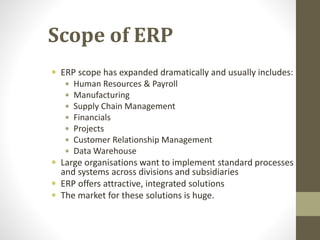
 ERP scope has expanded dramatically and usually includes:
 Human Resources & Payroll
 Manufacturing
 Supply Chain Management
 Financials
 Projects
 Customer Relationship Management
 Data Warehouse
 Large organisations want to implement standard processes
and systems across divisions and subsidiaries
 ERP offers attractive, integrated solutions
 The market for these solutions is huge.
Scope of ERP
Career Track
Benefits of ERP Systems
 Improving integration, flexibility
 Fewer errors
 Improved speed and efficiency
 More complete access to information
 Lower total costs in the complete supply chain
 Shorten throughput times
 Sustained involvement and commitment of the
top management
Benefits of ERP Systems
(cont’d) Reduce stock to a minimum
 Enlarge product assortment
 Improve product quality
 Provide more reliable delivery dates and higher
service to the customer
 Efficiently coordinate global demand, supply and
production
Wrap-up
 ERP is one of the dominant player
 ERP Service industry is huge
 Take right courses
 Be part of the community to learn
Thank You
Contact Us…
Mob: +91-9990049003
Nitin.maheshwari2000@gmail.com

Oracle ERP Introduction

  • 1.
    Oracle - ERPPresented By – Nitin Maheshwari
  • 2.
    Layout • Introduction toERP • Business Need • What is Oracle – ERP? • Oracle as an ERP • Modules of Oracle ERP • How do ERP System Works • ERP Components • ERP Vendors • Revenue, Profits & Investments of major ERP Vendors
  • 3.
    Layout (Contd.)  ServicesOffered  Implemented modules of Oracle Apps  Scope of ERP  Career Track  Benefits of ERP System  Wrap Up
  • 4.
    What is ERP? The practice of consolidating an enterprise’s planning, manufacturing, sales and marketing efforts into one management system.  Combines all databases across departments into a single database that can be accessed by all employees.  ERP automates the tasks involved in performing a business process.
  • 5.
    Business Needs Global OperationsHeterogeneous Solutions Different locations Different countries Different languages Different time zones Central vs. distributed
  • 6.
    Business Needs contd. GlobalOperations Heterogeneous Solutions Different applications Different technologies Different vendors Point-to-point integration Custom-made solutions
  • 7.
    What is Oracleas an ERP? • Oracle Applications comprise the application software or business software of Oracle Corporation. • Is a suite of back office software modules designed to integrate and streamline a company’s business processes and transactions. • Great benefits can be made adopting an ERP system.
  • 8.
    Modules of OracleERP ERP Financials Distribution E-Commerce Human Resources Payoll CRM Manufacturing ERP
  • 9.
    Modules of OracleERP (Contd.) •Oracle HRMS •Oracle Payroll •Oracle CRM •Oracle Financials •Oracle Mobile Supply Chain Application •Oracle Order Management •Oracle Procurement •Oracle Project Portfolio Management •Oracle Quotes •Oracle Transportation Management •Oracle Warehouse Management Systems •Oracle Inventory •Oracle Enterprise Asset Management •Product Life cycle Management •Asset Lifecycle Management •Manufacturing
  • 10.
    Employees Managers and Stakeholders How DoERP Systems Work? Central Database Payroll Human Resource Management Applications Financial Applications Manufacturing Applications Inventory And Supply Applications Human Resource Management Applications Service Applications Sales and Delivery Applications Sales Force And Customer Service Reps Customers Back-office Administrators And Workers Suppliers
  • 11.
    ERP Components  HR:software for handling personnel-related tasks for corporate managers and individual employees. Examples:  HR administration  Payroll  Self-service HR  Finance: modules for bookkeeping and making sure the bills are paid on time. Examples:  General ledger  Accounts receivable  Accounts payable  Manufacturing and Logistics: A group of applications for planning production, taking orders and delivering products to the customer. Examples:  Production planning  Materials management  Order entry and processing  Warehouse management
  • 12.
    An ERP Example:Before ERP Customers Customer Demographic Files Sales Dept. Vendor Orders Parts Accounting Accounting Files Purchasing Purchasing Files Order is placed with Vendor Invoices accounting Inventory Files Warehouse Checks for Parts Calls back “Not in stock” “We ordered the parts” “We Need parts #XX” “We ordered the parts” Sends report Sends report Sends report Ships parts
  • 13.
    An ERP Example:After ERP Database Customers Sales Dept. Purchasing Warehouse Accounting Vendor Inventory Data If no parts, order is placed through DB Orders Parts Order is submitted to Purchasing. Purchasing record order in DB Order is placed with Vendor Add invoices accounting Financial Data exchange; Books invoice against PO Books inventory against PO Ships parts
  • 14.
    THINK BUILD OPERATE SOLUTIONACCELERATORS PROCESS DOMAIN TOOLS • ERP Assessment and Health-check • Product Selection • System Performance Tuning • Upgrade Assessment CONSULTING • Business process study • Business process Mapping • Gap Analysis • Configuration • Go-Live Support IMPLEMENTATION • Requirement Study • Design & Development • Integration • Integrate Legacy systems to OA • Develop Custom APIs CUSTOMIZATION • Roll-out support • Enhancements to Customizations • Product support • System Administration • System/Application • Tuning and patching SUPPORT • Upgrade to 11i • Maintenance upgrade UPGRADE • Center of Excellence • Rollout Assessment • Functional and Regression Testing SPECIAL OFFERING Service Offering
  • 15.
    Implemented Modules OfOracle Apps • Core-HR • Payroll • Self-Service • Advanced Benefits • OTL • Ilearning (OTA) • Irecruitment • HR Intelligence • Oracle Marketing • Oracle Sales • Oracle Services • Oracle Partner Relationship Management • Analytics • General ledger • Assets • Cash management • Payables / receivables • Financial analyzer • Enterprise planning & budgeting • Daily business intelligence for projects • Billing • Collaboration • Contracts • Costing • Portfolio Analysis • Time and Labour • Project Resource Management • Procurement • Manufacturing • Order management • Product lifecycle management • Supply Chain Execution & Planning • Logistics CRM FINANCIALS SCM • Inventory • Bill of materials • Work in progress • Engineering • Mrp • Cost MANUFACTURING PROJECTSHRMS
  • 16.
     ERP scopehas expanded dramatically and usually includes:  Human Resources & Payroll  Manufacturing  Supply Chain Management  Financials  Projects  Customer Relationship Management  Data Warehouse  Large organisations want to implement standard processes and systems across divisions and subsidiaries  ERP offers attractive, integrated solutions  The market for these solutions is huge. Scope of ERP
  • 17.
  • 18.
    Benefits of ERPSystems  Improving integration, flexibility  Fewer errors  Improved speed and efficiency  More complete access to information  Lower total costs in the complete supply chain  Shorten throughput times  Sustained involvement and commitment of the top management
  • 19.
    Benefits of ERPSystems (cont’d) Reduce stock to a minimum  Enlarge product assortment  Improve product quality  Provide more reliable delivery dates and higher service to the customer  Efficiently coordinate global demand, supply and production
  • 20.
    Wrap-up  ERP isone of the dominant player  ERP Service industry is huge  Take right courses  Be part of the community to learn
  • 21.
  • 22.