Session ID:
Prepared by:
Oracle’s RMCS and all you want
to know about the new
revenue recognition standard:
ASC 606/IFRS 15
10102
Chris Stephenson, Grant Thornton LLP
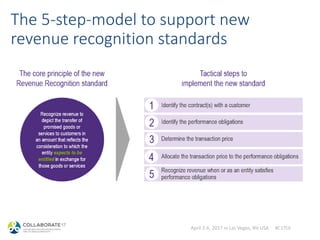
Brad Kwiatek, Grant Thornton LLP
April 2-6, 2017 in Las Vegas, NV USA #C17LV
Your presenter
Executive summary
Chris is a Principal in the Pacific Northwest Advisory Services practice. He has proven experience and background in
finance, technology, and process design. He brings expertise in finance transformation, cost and performance
management, finance operations, and shared service design. Prior to joining Grant Thornton, Chris was a co-founder
and partner at Arryve, a management consulting firm providing thought leadership, execution excellence and great
relationships to clients ranging from Fortune 10 clients to small business owners. In his earlier career years, Chris
also worked for a Big Four firm as an auditor. His specialties include: project management, change management,
marketing, product strategy, corporate recovery, financial & tax strategy, business valuation, due diligence, business
intelligence, strategic planning, M&A, post-merger integration, ERP financial systems.
Chris Stephenson
Principal, Grant Thornton
Bellevue, WA
April 2-6, 2017 in Las Vegas, NV USA #C17LV
Your presenter
Executive summary
Brad Kwiatek is a Director in Grant Thornton’s Business Advisory Services – Oracle Practice. Brad has over 12 years
of experience with leading and managing financial transformation projects as well as implementing Enterprise
Resource Planning, Enterprise Performance Management, Business Intelligence, and Data Management solutions.
Brad is a proven thought leader in the delivery of integrated financial processes and systems. Prior to Grant Thornton,
Brad worked for MarketSphere and Intel.
Brad Kwiatek
Director, Grant Thornton
Omaha, NE
Related presentations & publication:
Remove your Head from the Clouds! Is PBCS or On-Premise Planning the right one for your business?
Head in the clouds? How an EPM upgrade fits into your cloud strategy
Laclede leverages Oracle Hyperion and BI to drive growth and acquisition strategy
MIQ Logistics Drives Growth using Oracle Hyperion Planning
Integrating Oracle ERP, BI and EPM Systems
April 2-6, 2017 in Las Vegas, NV USA #C17LV
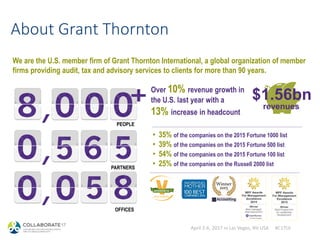
About Grant Thornton
PEOPLE
PARTNERS
OFFICES
Over 10% revenue growth in
the U.S. last year with a
13% increase in headcount
• 35% of the companies on the 2015 Fortune 1000 list
• 39% of the companies on the 2015 Fortune 500 list
• 54% of the companies on the 2015 Fortune 100 list
• 25% of the companies on the Russell 2000 list
revenues
We are the U.S. member firm of Grant Thornton International, a global organization of member
firms providing audit, tax and advisory services to clients for more than 90 years.
$1.56bn
April 2-6, 2017 in Las Vegas, NV USA #C17LV
Committed Oracle partner
Specialized Partner of the
Year, 2014 (EPM, NA)
JD Edwards Excellence
Award, 2015
Excellence Award, 2015 (Fusion Middleware
Innovation at Serta Simmons Bedding)
JD Edwards Excellence
Award, 2016
April 2-6, 2017 in Las Vegas, NV USA #C17LV
Agenda
• New revenue recognition standards
• The 5-step-model to support new revenue
recognition standards
• Transition and implementation considerations
• Managing your Revenue with RMCS
• Q&A
April 2-6, 2017 in Las Vegas, NV USA #C17LV
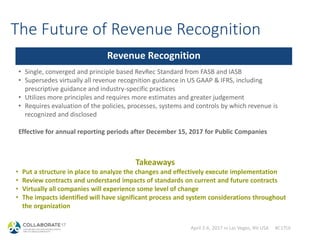
The Future of Revenue Recognition
Revenue Recognition
• Single, converged and principle based RevRec Standard from FASB and IASB
• Supersedes virtually all revenue recognition guidance in US GAAP & IFRS, including
prescriptive guidance and industry-specific practices
• Utilizes more principles and requires more estimates and greater judgement
• Requires evaluation of the policies, processes, systems and controls by which revenue is
recognized and disclosed
Effective for annual reporting periods after December 15, 2017 for Public Companies
Takeaways
• Put a structure in place to analyze the changes and effectively execute implementation
• Review contracts and understand impacts of standards on current and future contracts
• Virtually all companies will experience some level of change
• The impacts identified will have significant process and system considerations throughout
the organization
April 2-6, 2017 in Las Vegas, NV USA #C17LV
The 5-step-model to support new
revenue recognition standards
April 2-6, 2017 in Las Vegas, NV USA #C17LV
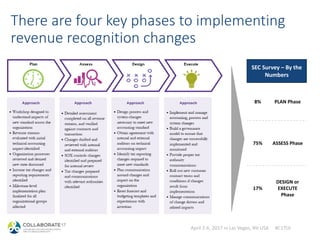
There are four key phases to implementing
revenue recognition changes
SEC Survey – By the
Numbers
8% PLAN Phase
75% ASSESS Phase
17%
DESIGN or
EXECUTE
Phase
April 2-6, 2017 in Las Vegas, NV USA #C17LV
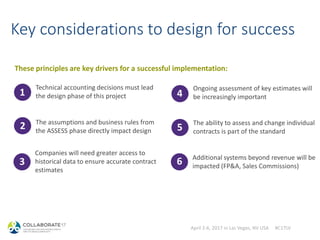
Key considerations to design for success
Technical accounting decisions must lead
the design phase of this project
The assumptions and business rules from
the ASSESS phase directly impact design
1
2
3
Companies will need greater access to
historical data to ensure accurate contract
estimates
Ongoing assessment of key estimates will
be increasingly important
The ability to assess and change individual
contracts is part of the standard
4
5
6 Additional systems beyond revenue will be
impacted (FP&A, Sales Commissions)
These principles are key drivers for a successful implementation:
April 2-6, 2017 in Las Vegas, NV USA #C17LV
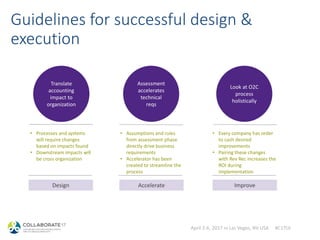
Guidelines for successful design &
execution
• Processes and systems
will require changes
based on impacts found
• Downstream impacts will
be cross organization
Translate
accounting
impact to
organization
Design
• Every company has order
to cash desired
improvements
• Pairing these changes
with Rev Rec increases the
ROI during
implementation
Look at O2C
process
holistically
Improve
• Assumptions and rules
from assessment phase
directly drive business
requirements
• Accelerator has been
created to streamline the
process
Assessment
accelerates
technical
reqs
Accelerate
Implementation considerations
using Oracle’s Revenue
Management Cloud Service
(RMCS)
April 2-6, 2017 in Las Vegas, NV USA #C17LV
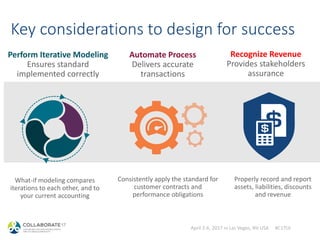
Key considerations to design for success
Consistently apply the standard for
customer contracts and
performance obligations
What-if modeling compares
iterations to each other, and to
your current accounting
Automate Process
Delivers accurate
transactions
Perform Iterative Modeling
Ensures standard
implemented correctly
Recognize Revenue
Provides stakeholders
assurance
Properly record and report
assets, liabilities, discounts
and revenue
April 2-6, 2017 in Las Vegas, NV USA #C17LV
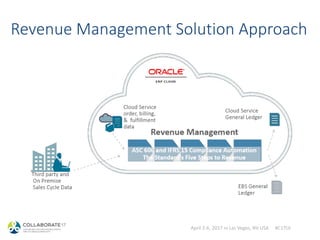
Revenue Management Solution Approach
April 2-6, 2017 in Las Vegas, NV USA #C17LV
Revenue Management Process
Standard 5 Steps
Pricing bands, Pricing
Dimensions (Stratifications)
Stand Alone Selling Price
Profiles
Establish SSP
Upload ESP using ADFdi
Contract & Performance
Obligation Identification
Rules
Satisfaction Rules
Review/Exempt/Approve
Contract/PO, Discard Contract,
Update Pricing Dimensions,
Review/Add Satisfaction Events
SLA Account/Journal Line
Rules
JERS / Accounting Method
Standalone Selling
Prices
Contracts,
Obligations, and
Satisfaction Events
Contract
Accounting Entries
Manage Stand
Alone Selling
Prices
Accounting
Register data sources
Review and fix data
import errors using ADFDi
Validated Source
Documents
Extract,
Transform &
Load
Calculate
Stand Alone Selling Price
(Basis for Revenue Allocation)
Identify Customer Contracts &
PO
Value Contracts
Value POs (Revenue Allocation)
Determine Liabilities & Assets
Recognize Revenue
Create Accounting
Data extract program
File upload to UCM
Process Revenue Basis
Lines
BIP/OTBI Reporting [OTBI in subsequent releases]
Configurations
Automated
Processes
Actions
Data
Outputs
InputsOutputs
April 2-6, 2017 in Las Vegas, NV USA #C17LV
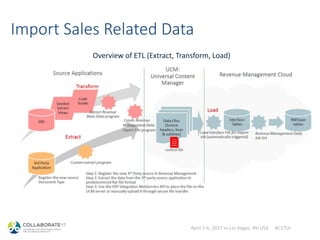
Import Sales Related Data
Overview of ETL (Extract, Transform, Load)
April 2-6, 2017 in Las Vegas, NV USA #C17LV
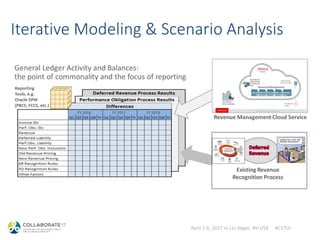
Iterative Modeling & Scenario Analysis
April 2-6, 2017 in Las Vegas, NV USA #C17LV
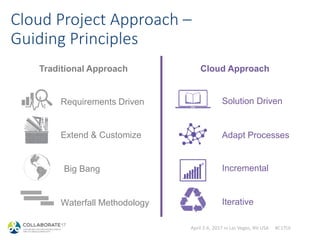
Cloud Project Approach –
Guiding Principles
Traditional Approach Cloud Approach
Big Bang
Extend & Customize
Waterfall Methodology
Requirements Driven Solution Driven
Adapt Processes
Incremental
Iterative
April 2-6, 2017 in Las Vegas, NV USA #C17LV
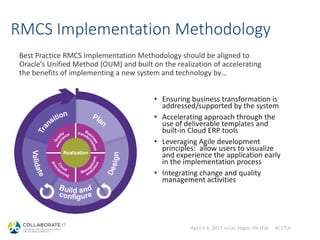
RMCS Implementation Methodology
Best Practice RMCS Implementation Methodology should be aligned to
Oracle's Unified Method (OUM) and built on the realization of accelerating
the benefits of implementing a new system and technology by…
• Ensuring business transformation is
addressed/supported by the system
• Accelerating approach through the
use of deliverable templates and
built-in Cloud ERP tools
• Leveraging Agile development
principles: allow users to visualize
and experience the application early
in the implementation process
• Integrating change and quality
management activities
Q&A
April 2-6, 2017 in Las Vegas, NV USA #C17LV
A 55,000+ member user community for JD Edwards,
PeopleSoft and Cloud Applications customers.
Visit Quest International Users Group at Booth #435
 Learn how Quest can help you receive 4x the return on
your ERP investment
 Walk through a customized Quest Activation Plan (QAP)
to help your ERP team
 Find out more about Quest’s product-specific events,
PeopleSoft RECONNECT and JD Edwards INFOCUS
April 2-6, 2017 in Las Vegas, NV USA #C17LV
Thank you for attending our session!
• If you have any follow-up questions please don’t hesitate
to contact us directly with our contact information
below:
Chris Stephenson
T: 425.214.9821
E: Chris.Stephenson@us.gt.com
Brad Kwiatek
T: 402.669.8276
E: Brad.Kwiatek@us.gt.com
Please Complete Your
Session Evaluation
Evaluate this session in your COLLABORATE app.
Pull up this session and tap "Session Evaluation"
to complete the survey.
Session ID: 10102
April 2-6, 2017 in Las Vegas, NV USA #C17LV
Upcoming events
• April 11-13: Modern Finance Experience and HCM World in Boston, MA
• April 18 webcast: Finishing strong in the ASC 606 marathon: An in-depth look at
designing for success
• April 19 webcast: Including Taleo in your Oracle ERP investment
• April 24-27: SuiteWorld in Las Vegas, NV
• May 17 webcast: Oracle Cloud HCM releases, patches and enhancements, oh my!
• June 6-9: OHUG global conference in Orlando, FL
• June 8 webcast: Project management for HCM Cloud implementations
• June 14 webcast: Getting to know all about you "Profile Management"
• June 18-21: HIUG Interact in Orlando, FL
• July 13 webcast: Oh the places you will go be a Maestro, with composer in the clouds
• Find your silver lining in the cloud: grantthornton.com/silverlining
Find Grant Thornton at these upcoming events:
Please look for those
wearing Education
Committee ribbons to share
feedback on this week’s
sessions!
Appendix: The 5-step-model
Additional details
April 2-6, 2017 in Las Vegas, NV USA #C17LV
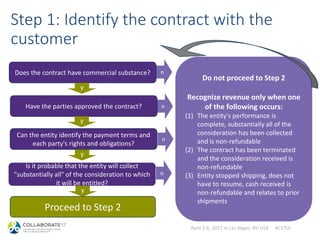
Step 1: Identify the contract with the
customer
Do not proceed to Step 2
Recognize revenue only when one
of the following occurs:
(1) The entity's performance is
complete, substantially all of the
consideration has been collected
and is non-refundable
(2) The contract has been terminated
and the consideration received is
non-refundable
(3) Entity stopped shipping, does not
have to resume, cash received is
non-refundable and relates to prior
shipments
n
n
n
n
Does the contract have commercial substance?
Have the parties approved the contract?
y
Can the entity identify the payment terms and
each party's rights and obligations?
y
Is it probable that the entity will collect
"substantially all" of the consideration to which
it will be entitled?
y
y
Proceed to Step 2
April 2-6, 2017 in Las Vegas, NV USA #C17LV
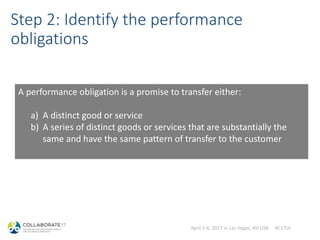
Step 2: Identify the performance
obligations
A performance obligation is a promise to transfer either:
a) A distinct good or service
b) A series of distinct goods or services that are substantially the
same and have the same pattern of transfer to the customer
April 2-6, 2017 in Las Vegas, NV USA #C17LV
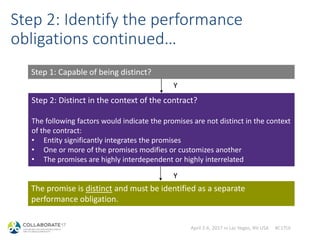
Step 2: Identify the performance
obligations continued…
Step 1: Capable of being distinct?
Step 2: Distinct in the context of the contract?
The following factors would indicate the promises are not distinct in the context
of the contract:
• Entity significantly integrates the promises
• One or more of the promises modifies or customizes another
• The promises are highly interdependent or highly interrelated
Y
Y
The promise is distinct and must be identified as a separate
performance obligation.
April 2-6, 2017 in Las Vegas, NV USA #C17LV
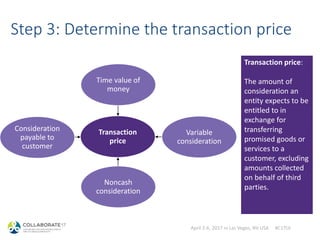
Step 3: Determine the transaction price
Transaction
price
Time value of
money
Variable
consideration
Noncash
consideration
Consideration
payable to
customer
Transaction price:
The amount of
consideration an
entity expects to be
entitled to in
exchange for
transferring
promised goods or
services to a
customer, excluding
amounts collected
on behalf of third
parties.
April 2-6, 2017 in Las Vegas, NV USA #C17LV
Step 3: Determine the transaction price
continued…
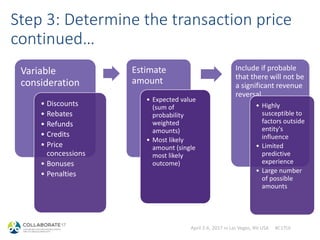
Variable
consideration
• Discounts
• Rebates
• Refunds
• Credits
• Price
concessions
• Bonuses
• Penalties
Estimate
amount
• Expected value
(sum of
probability
weighted
amounts)
• Most likely
amount (single
most likely
outcome)
Include if probable
that there will not be
a significant revenue
reversal
• Highly
susceptible to
factors outside
entity's
influence
• Limited
predictive
experience
• Large number
of possible
amounts
April 2-6, 2017 in Las Vegas, NV USA #C17LV
Step 4: Allocate the transaction price to
the performance obligations
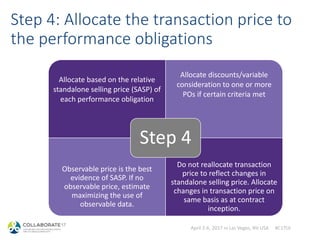
Allocate based on the relative
standalone selling price (SASP) of
each performance obligation
Allocate discounts/variable
consideration to one or more
POs if certain criteria met
Observable price is the best
evidence of SASP. If no
observable price, estimate
maximizing the use of
observable data.
Do not reallocate transaction
price to reflect changes in
standalone selling price. Allocate
changes in transaction price on
same basis as at contract
inception.
Step 4
April 2-6, 2017 in Las Vegas, NV USA #C17LV
Step 5: Recognize revenue over time or at
a point in time
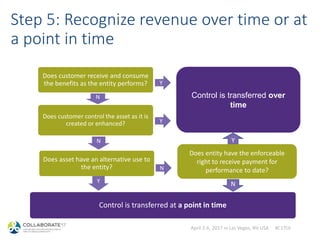
N
Does customer receive and consume
the benefits as the entity performs?
N
Does customer control the asset as it is
created or enhanced?
N
Does asset have an alternative use to
the entity?
Control is transferred at a point in time
Control is transferred over
time
Y
Y
Y
N
Does entity have the enforceable
right to receive payment for
performance to date?
April 2-6, 2017 in Las Vegas, NV USA #C17LV
The 5-step-model – challenges /
considerations by step
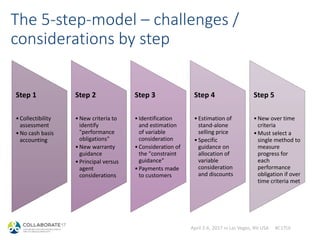
Step 1
•Collectibility
assessment
•No cash basis
accounting
Step 2
•New criteria to
identify
"performance
obligations"
•New warranty
guidance
•Principal versus
agent
considerations
Step 3
•Identification
and estimation
of variable
consideration
•Consideration of
the "constraint
guidance"
•Payments made
to customers
Step 4
•Estimation of
stand-alone
selling price
•Specific
guidance on
allocation of
variable
consideration
and discounts
Step 5
•New over time
criteria
•Must select a
single method to
measure
progress for
each
performance
obligation if over
time criteria met

Oracle Revenue Management Cloud Service

  • 1.
    Session ID: Prepared by: Oracle’sRMCS and all you want to know about the new revenue recognition standard: ASC 606/IFRS 15 10102 Chris Stephenson, Grant Thornton LLP Brad Kwiatek, Grant Thornton LLP
  • 2.
    April 2-6, 2017in Las Vegas, NV USA #C17LV Your presenter Executive summary Chris is a Principal in the Pacific Northwest Advisory Services practice. He has proven experience and background in finance, technology, and process design. He brings expertise in finance transformation, cost and performance management, finance operations, and shared service design. Prior to joining Grant Thornton, Chris was a co-founder and partner at Arryve, a management consulting firm providing thought leadership, execution excellence and great relationships to clients ranging from Fortune 10 clients to small business owners. In his earlier career years, Chris also worked for a Big Four firm as an auditor. His specialties include: project management, change management, marketing, product strategy, corporate recovery, financial & tax strategy, business valuation, due diligence, business intelligence, strategic planning, M&A, post-merger integration, ERP financial systems. Chris Stephenson Principal, Grant Thornton Bellevue, WA
  • 3.
    April 2-6, 2017in Las Vegas, NV USA #C17LV Your presenter Executive summary Brad Kwiatek is a Director in Grant Thornton’s Business Advisory Services – Oracle Practice. Brad has over 12 years of experience with leading and managing financial transformation projects as well as implementing Enterprise Resource Planning, Enterprise Performance Management, Business Intelligence, and Data Management solutions. Brad is a proven thought leader in the delivery of integrated financial processes and systems. Prior to Grant Thornton, Brad worked for MarketSphere and Intel. Brad Kwiatek Director, Grant Thornton Omaha, NE Related presentations & publication: Remove your Head from the Clouds! Is PBCS or On-Premise Planning the right one for your business? Head in the clouds? How an EPM upgrade fits into your cloud strategy Laclede leverages Oracle Hyperion and BI to drive growth and acquisition strategy MIQ Logistics Drives Growth using Oracle Hyperion Planning Integrating Oracle ERP, BI and EPM Systems
  • 4.
    April 2-6, 2017in Las Vegas, NV USA #C17LV About Grant Thornton PEOPLE PARTNERS OFFICES Over 10% revenue growth in the U.S. last year with a 13% increase in headcount • 35% of the companies on the 2015 Fortune 1000 list • 39% of the companies on the 2015 Fortune 500 list • 54% of the companies on the 2015 Fortune 100 list • 25% of the companies on the Russell 2000 list revenues We are the U.S. member firm of Grant Thornton International, a global organization of member firms providing audit, tax and advisory services to clients for more than 90 years. $1.56bn
  • 5.
    April 2-6, 2017in Las Vegas, NV USA #C17LV Committed Oracle partner Specialized Partner of the Year, 2014 (EPM, NA) JD Edwards Excellence Award, 2015 Excellence Award, 2015 (Fusion Middleware Innovation at Serta Simmons Bedding) JD Edwards Excellence Award, 2016
  • 6.
    April 2-6, 2017in Las Vegas, NV USA #C17LV Agenda • New revenue recognition standards • The 5-step-model to support new revenue recognition standards • Transition and implementation considerations • Managing your Revenue with RMCS • Q&A
  • 7.
    April 2-6, 2017in Las Vegas, NV USA #C17LV The Future of Revenue Recognition Revenue Recognition • Single, converged and principle based RevRec Standard from FASB and IASB • Supersedes virtually all revenue recognition guidance in US GAAP & IFRS, including prescriptive guidance and industry-specific practices • Utilizes more principles and requires more estimates and greater judgement • Requires evaluation of the policies, processes, systems and controls by which revenue is recognized and disclosed Effective for annual reporting periods after December 15, 2017 for Public Companies Takeaways • Put a structure in place to analyze the changes and effectively execute implementation • Review contracts and understand impacts of standards on current and future contracts • Virtually all companies will experience some level of change • The impacts identified will have significant process and system considerations throughout the organization
  • 8.
    April 2-6, 2017in Las Vegas, NV USA #C17LV The 5-step-model to support new revenue recognition standards
  • 9.
    April 2-6, 2017in Las Vegas, NV USA #C17LV There are four key phases to implementing revenue recognition changes SEC Survey – By the Numbers 8% PLAN Phase 75% ASSESS Phase 17% DESIGN or EXECUTE Phase
  • 10.
    April 2-6, 2017in Las Vegas, NV USA #C17LV Key considerations to design for success Technical accounting decisions must lead the design phase of this project The assumptions and business rules from the ASSESS phase directly impact design 1 2 3 Companies will need greater access to historical data to ensure accurate contract estimates Ongoing assessment of key estimates will be increasingly important The ability to assess and change individual contracts is part of the standard 4 5 6 Additional systems beyond revenue will be impacted (FP&A, Sales Commissions) These principles are key drivers for a successful implementation:
  • 11.
    April 2-6, 2017in Las Vegas, NV USA #C17LV Guidelines for successful design & execution • Processes and systems will require changes based on impacts found • Downstream impacts will be cross organization Translate accounting impact to organization Design • Every company has order to cash desired improvements • Pairing these changes with Rev Rec increases the ROI during implementation Look at O2C process holistically Improve • Assumptions and rules from assessment phase directly drive business requirements • Accelerator has been created to streamline the process Assessment accelerates technical reqs Accelerate
  • 12.
    Implementation considerations using Oracle’sRevenue Management Cloud Service (RMCS)
  • 13.
    April 2-6, 2017in Las Vegas, NV USA #C17LV Key considerations to design for success Consistently apply the standard for customer contracts and performance obligations What-if modeling compares iterations to each other, and to your current accounting Automate Process Delivers accurate transactions Perform Iterative Modeling Ensures standard implemented correctly Recognize Revenue Provides stakeholders assurance Properly record and report assets, liabilities, discounts and revenue
  • 14.
    April 2-6, 2017in Las Vegas, NV USA #C17LV Revenue Management Solution Approach
  • 15.
    April 2-6, 2017in Las Vegas, NV USA #C17LV Revenue Management Process Standard 5 Steps Pricing bands, Pricing Dimensions (Stratifications) Stand Alone Selling Price Profiles Establish SSP Upload ESP using ADFdi Contract & Performance Obligation Identification Rules Satisfaction Rules Review/Exempt/Approve Contract/PO, Discard Contract, Update Pricing Dimensions, Review/Add Satisfaction Events SLA Account/Journal Line Rules JERS / Accounting Method Standalone Selling Prices Contracts, Obligations, and Satisfaction Events Contract Accounting Entries Manage Stand Alone Selling Prices Accounting Register data sources Review and fix data import errors using ADFDi Validated Source Documents Extract, Transform & Load Calculate Stand Alone Selling Price (Basis for Revenue Allocation) Identify Customer Contracts & PO Value Contracts Value POs (Revenue Allocation) Determine Liabilities & Assets Recognize Revenue Create Accounting Data extract program File upload to UCM Process Revenue Basis Lines BIP/OTBI Reporting [OTBI in subsequent releases] Configurations Automated Processes Actions Data Outputs InputsOutputs
  • 16.
    April 2-6, 2017in Las Vegas, NV USA #C17LV Import Sales Related Data Overview of ETL (Extract, Transform, Load)
  • 17.
    April 2-6, 2017in Las Vegas, NV USA #C17LV Iterative Modeling & Scenario Analysis
  • 18.
    April 2-6, 2017in Las Vegas, NV USA #C17LV Cloud Project Approach – Guiding Principles Traditional Approach Cloud Approach Big Bang Extend & Customize Waterfall Methodology Requirements Driven Solution Driven Adapt Processes Incremental Iterative
  • 19.
    April 2-6, 2017in Las Vegas, NV USA #C17LV RMCS Implementation Methodology Best Practice RMCS Implementation Methodology should be aligned to Oracle's Unified Method (OUM) and built on the realization of accelerating the benefits of implementing a new system and technology by… • Ensuring business transformation is addressed/supported by the system • Accelerating approach through the use of deliverable templates and built-in Cloud ERP tools • Leveraging Agile development principles: allow users to visualize and experience the application early in the implementation process • Integrating change and quality management activities
  • 20.
  • 21.
    April 2-6, 2017in Las Vegas, NV USA #C17LV A 55,000+ member user community for JD Edwards, PeopleSoft and Cloud Applications customers. Visit Quest International Users Group at Booth #435  Learn how Quest can help you receive 4x the return on your ERP investment  Walk through a customized Quest Activation Plan (QAP) to help your ERP team  Find out more about Quest’s product-specific events, PeopleSoft RECONNECT and JD Edwards INFOCUS
  • 22.
    April 2-6, 2017in Las Vegas, NV USA #C17LV Thank you for attending our session! • If you have any follow-up questions please don’t hesitate to contact us directly with our contact information below: Chris Stephenson T: 425.214.9821 E: Chris.Stephenson@us.gt.com Brad Kwiatek T: 402.669.8276 E: Brad.Kwiatek@us.gt.com
  • 23.
    Please Complete Your SessionEvaluation Evaluate this session in your COLLABORATE app. Pull up this session and tap "Session Evaluation" to complete the survey. Session ID: 10102
  • 24.
    April 2-6, 2017in Las Vegas, NV USA #C17LV Upcoming events • April 11-13: Modern Finance Experience and HCM World in Boston, MA • April 18 webcast: Finishing strong in the ASC 606 marathon: An in-depth look at designing for success • April 19 webcast: Including Taleo in your Oracle ERP investment • April 24-27: SuiteWorld in Las Vegas, NV • May 17 webcast: Oracle Cloud HCM releases, patches and enhancements, oh my! • June 6-9: OHUG global conference in Orlando, FL • June 8 webcast: Project management for HCM Cloud implementations • June 14 webcast: Getting to know all about you "Profile Management" • June 18-21: HIUG Interact in Orlando, FL • July 13 webcast: Oh the places you will go be a Maestro, with composer in the clouds • Find your silver lining in the cloud: grantthornton.com/silverlining Find Grant Thornton at these upcoming events:
  • 25.
    Please look forthose wearing Education Committee ribbons to share feedback on this week’s sessions!
  • 26.
  • 27.
    April 2-6, 2017in Las Vegas, NV USA #C17LV Step 1: Identify the contract with the customer Do not proceed to Step 2 Recognize revenue only when one of the following occurs: (1) The entity's performance is complete, substantially all of the consideration has been collected and is non-refundable (2) The contract has been terminated and the consideration received is non-refundable (3) Entity stopped shipping, does not have to resume, cash received is non-refundable and relates to prior shipments n n n n Does the contract have commercial substance? Have the parties approved the contract? y Can the entity identify the payment terms and each party's rights and obligations? y Is it probable that the entity will collect "substantially all" of the consideration to which it will be entitled? y y Proceed to Step 2
  • 28.
    April 2-6, 2017in Las Vegas, NV USA #C17LV Step 2: Identify the performance obligations A performance obligation is a promise to transfer either: a) A distinct good or service b) A series of distinct goods or services that are substantially the same and have the same pattern of transfer to the customer
  • 29.
    April 2-6, 2017in Las Vegas, NV USA #C17LV Step 2: Identify the performance obligations continued… Step 1: Capable of being distinct? Step 2: Distinct in the context of the contract? The following factors would indicate the promises are not distinct in the context of the contract: • Entity significantly integrates the promises • One or more of the promises modifies or customizes another • The promises are highly interdependent or highly interrelated Y Y The promise is distinct and must be identified as a separate performance obligation.
  • 30.
    April 2-6, 2017in Las Vegas, NV USA #C17LV Step 3: Determine the transaction price Transaction price Time value of money Variable consideration Noncash consideration Consideration payable to customer Transaction price: The amount of consideration an entity expects to be entitled to in exchange for transferring promised goods or services to a customer, excluding amounts collected on behalf of third parties.
  • 31.
    April 2-6, 2017in Las Vegas, NV USA #C17LV Step 3: Determine the transaction price continued… Variable consideration • Discounts • Rebates • Refunds • Credits • Price concessions • Bonuses • Penalties Estimate amount • Expected value (sum of probability weighted amounts) • Most likely amount (single most likely outcome) Include if probable that there will not be a significant revenue reversal • Highly susceptible to factors outside entity's influence • Limited predictive experience • Large number of possible amounts
  • 32.
    April 2-6, 2017in Las Vegas, NV USA #C17LV Step 4: Allocate the transaction price to the performance obligations Allocate based on the relative standalone selling price (SASP) of each performance obligation Allocate discounts/variable consideration to one or more POs if certain criteria met Observable price is the best evidence of SASP. If no observable price, estimate maximizing the use of observable data. Do not reallocate transaction price to reflect changes in standalone selling price. Allocate changes in transaction price on same basis as at contract inception. Step 4
  • 33.
    April 2-6, 2017in Las Vegas, NV USA #C17LV Step 5: Recognize revenue over time or at a point in time N Does customer receive and consume the benefits as the entity performs? N Does customer control the asset as it is created or enhanced? N Does asset have an alternative use to the entity? Control is transferred at a point in time Control is transferred over time Y Y Y N Does entity have the enforceable right to receive payment for performance to date?
  • 34.
    April 2-6, 2017in Las Vegas, NV USA #C17LV The 5-step-model – challenges / considerations by step Step 1 •Collectibility assessment •No cash basis accounting Step 2 •New criteria to identify "performance obligations" •New warranty guidance •Principal versus agent considerations Step 3 •Identification and estimation of variable consideration •Consideration of the "constraint guidance" •Payments made to customers Step 4 •Estimation of stand-alone selling price •Specific guidance on allocation of variable consideration and discounts Step 5 •New over time criteria •Must select a single method to measure progress for each performance obligation if over time criteria met