
Integration of ORCID identifiers by
publishers
Véronique Kiermer, PhD
Executive Editor
Head of Researchers Services
Nature Publishing Group
ORCID Outreach Meeting
October 2013
Credits
• Howard Ratner, CHORUS
• Tara Packer, Head of Authors & Referees
Services, NPG
• Mark Henry, Vrushali Potdar, Ingrid
McNamara, Rebecca Barr, Alex Kotin
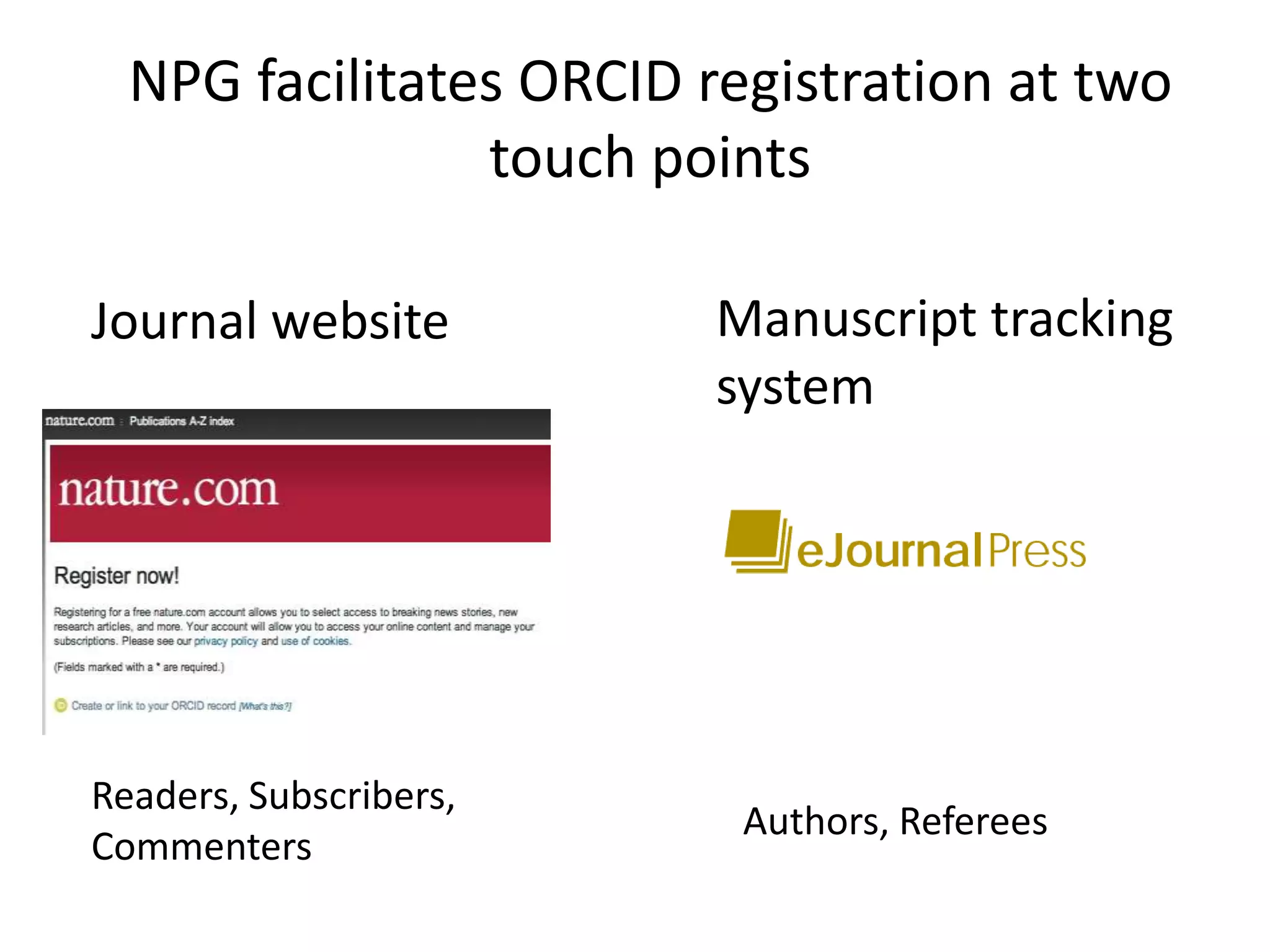
NPG facilitates ORCID registration at two
touch points
Journal website

Readers, Subscribers,
Commenters

Manuscript tracking
system

Authors, Referees
Benefits to publishers
•
•
•
•

disambiguation of user accounts
cross-talk between multiple internal systems
richer connections on the website
service to authors
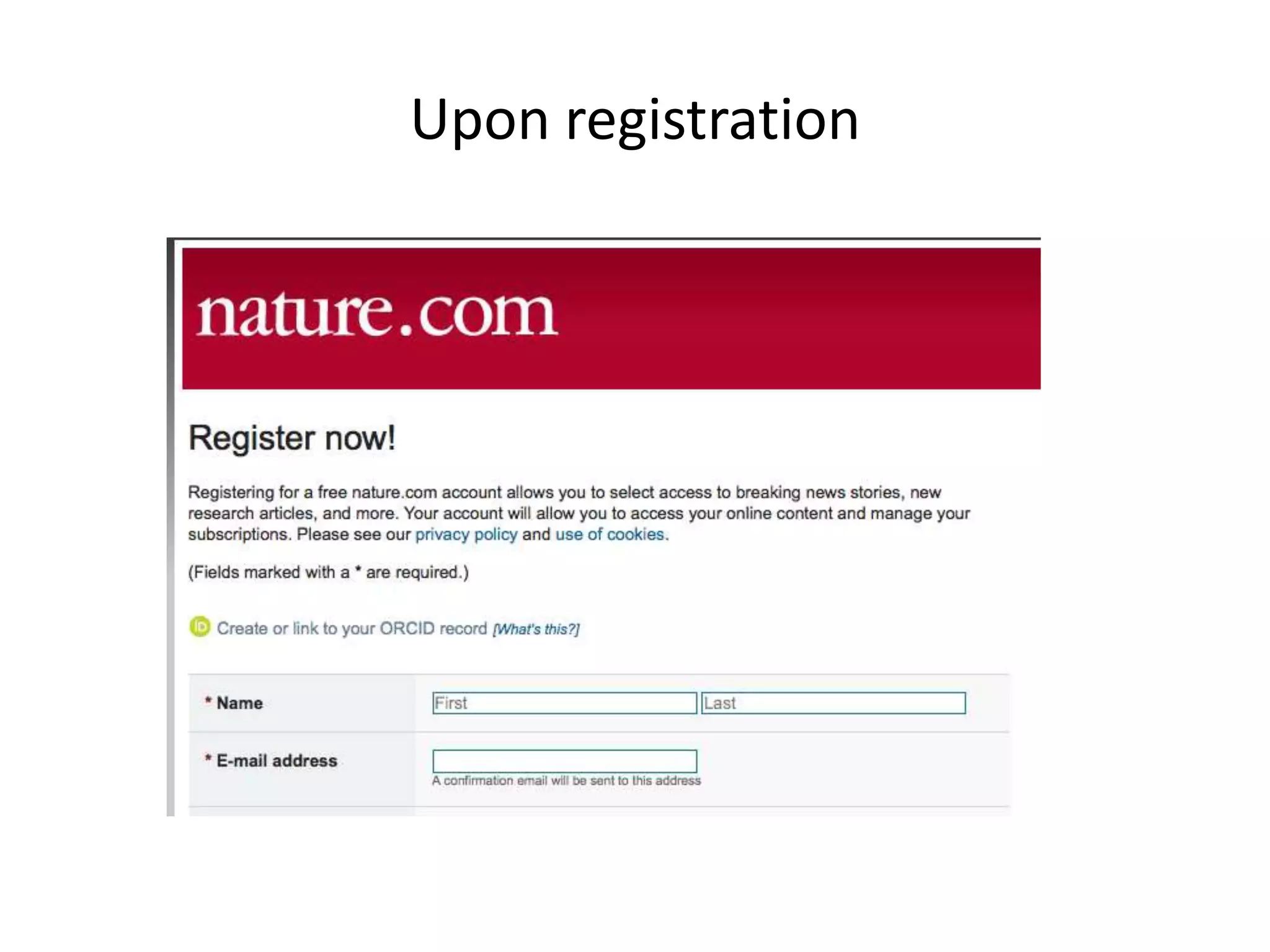
Upon registration
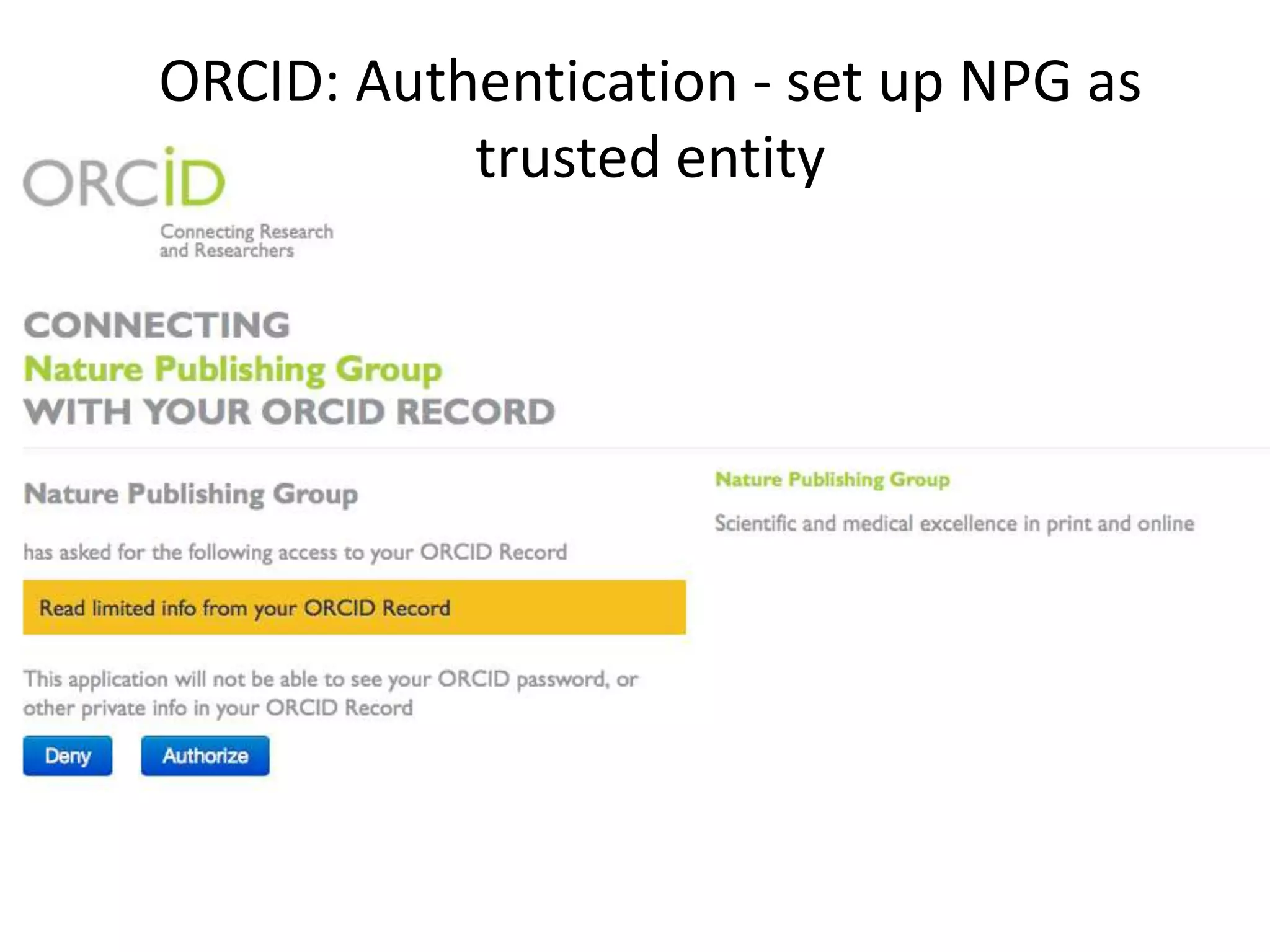
ORCID: Authentication - set up NPG as
trusted entity
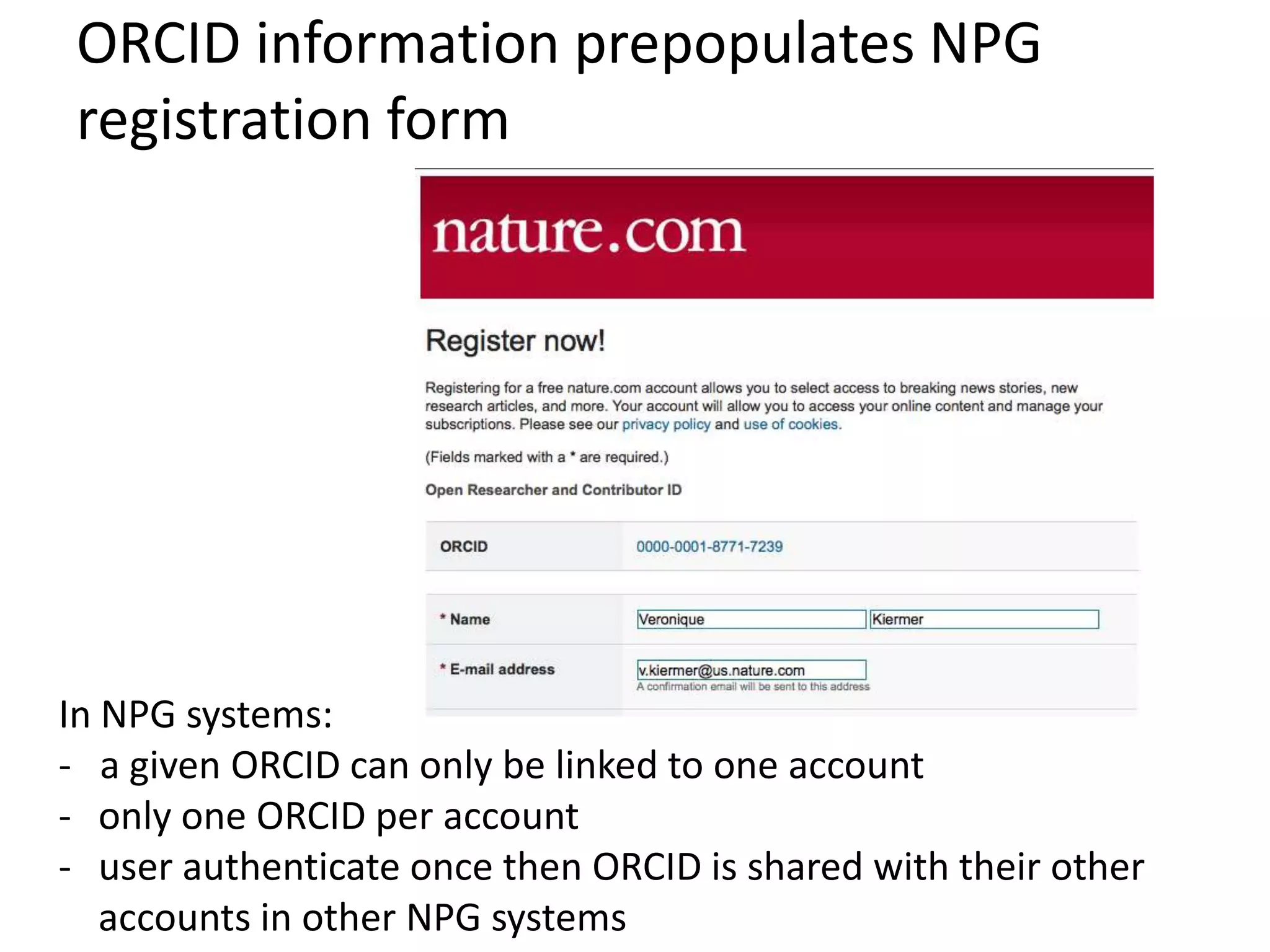
ORCID information prepopulates NPG
registration form

In NPG systems:
- a given ORCID can only be linked to one account
- only one ORCID per account
- user authenticate once then ORCID is shared with their other
accounts in other NPG systems
Upon manuscript submission
Authenticate to ORCID
to create an identifier
or link an existing
identifier
Set up NPG as trusted
entity
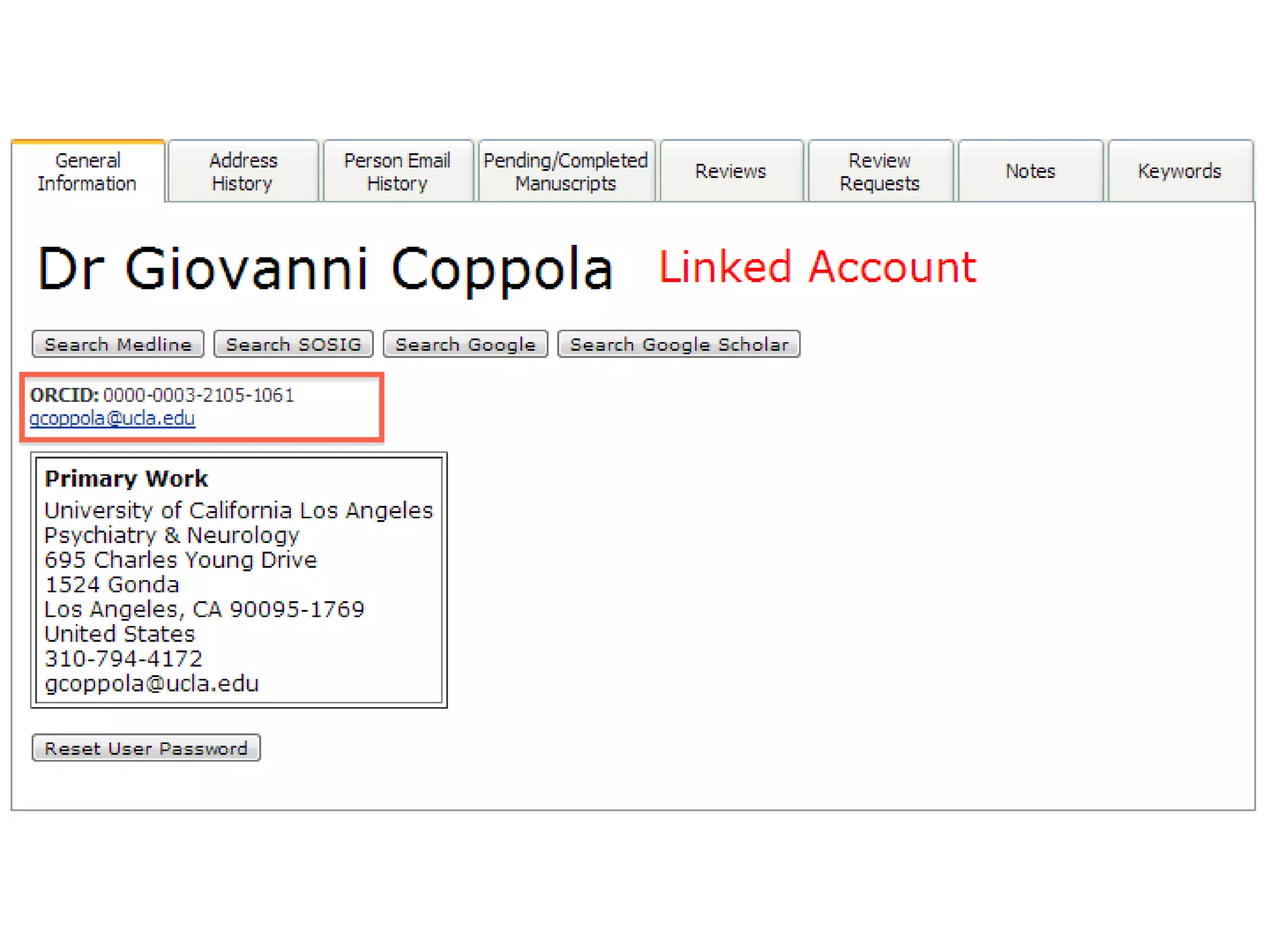
ORCID information
pre-populates author
information in
submission form
ORCID becomes
associated with eJP
account
Searching NPG database by ORCID
ORCID collection

Production

Article file

Publication

Third party
Export from eJP to production tracking system
Adding ORCID in XML
Upon publication
Link from article to ORCID record

• In future: update of ORCID record upon publication
• NPG already sends ORCID-doi association to CrossRef and
indexers
• In future, CrossRef will be able to push information to
ORCID
ORCID collection

Production

Article file

Publication

Third party
Publishers implementation challenges
• O Auth protocol implementation
• ensuring that ORCIDs remain unique
• dealing with multiple vendors during
production
• manual integration in XML
• proofing challenges
• correction policy
Stats
• Traffic referral to ORCID from NPG systems: 3,000
visitors/month (~2,500 unique visitors)
• ORCID creation: ~1,000 /month
• September: 1,735 authorizations; 25 access
denied
Since launch at NPG (1 year):
• 4500 user accounts in manuscript tracking system
with ORCIDs
• 4166 user accounts in nature.com with ORCIDs
An ORCID mandate for all authors?
• we currently do not mandate ORCIDs
• we may consider mandating ORCID for
corresponding authors/submitters but NOT for
co-authors
• we need strong incentives for authors to make
them link an ORCID to their paper
• requires the whole ecosystem to work in
coordinated fashion
Two options to encourage adoption
Contact co-authors

Submitter enters ORCIDs instead
of Authors details

• Publisher collects min
information about coauthors from submitter:
name, email
• Publisher contacts all coauthors during manuscript
consideration – asking them
to register for an ORCID
• Benefits to authors?

• Publisher queries ORCID
and returns prepopulated
field for submitter to
validate
• Need email and affiliation
from ORCID
Incentives for authors
• “Make my life easier when I submit a paper”
– remove the need to key in my up-to-date personal
information
– remove the need for me to enter my co-authors
information

• “Help me manage my online presence and reporting
needs”
– my ORCID profile is automatically updated upon
publication of a new article
– my other profiles read from ORCID
– my publisher knows my obligations to my funder (ms
deposition)
Potential future services
• facilitate manuscript submission
• automate deposition of manuscripts in
relevant repositories
• better recommendations to readers
• commenting notification
• micro-attribution, better credit for all
contributions
Thank you!

v.kiermer@us.nature.com

Kiermer outreach oct2013

  • 1.
    Integration of ORCIDidentifiers by publishers Véronique Kiermer, PhD Executive Editor Head of Researchers Services Nature Publishing Group ORCID Outreach Meeting October 2013
  • 2.
    Credits • Howard Ratner,CHORUS • Tara Packer, Head of Authors & Referees Services, NPG • Mark Henry, Vrushali Potdar, Ingrid McNamara, Rebecca Barr, Alex Kotin
  • 3.
    NPG facilitates ORCIDregistration at two touch points Journal website Readers, Subscribers, Commenters Manuscript tracking system Authors, Referees
  • 4.
    Benefits to publishers • • • • disambiguationof user accounts cross-talk between multiple internal systems richer connections on the website service to authors
  • 5.
  • 6.
    ORCID: Authentication -set up NPG as trusted entity
  • 7.
    ORCID information prepopulatesNPG registration form In NPG systems: - a given ORCID can only be linked to one account - only one ORCID per account - user authenticate once then ORCID is shared with their other accounts in other NPG systems
  • 8.
    Upon manuscript submission Authenticateto ORCID to create an identifier or link an existing identifier Set up NPG as trusted entity ORCID information pre-populates author information in submission form ORCID becomes associated with eJP account
  • 10.
  • 11.
  • 12.
    Export from eJPto production tracking system
  • 13.
  • 14.
  • 15.
    Link from articleto ORCID record • In future: update of ORCID record upon publication • NPG already sends ORCID-doi association to CrossRef and indexers • In future, CrossRef will be able to push information to ORCID
  • 16.
  • 17.
    Publishers implementation challenges •O Auth protocol implementation • ensuring that ORCIDs remain unique • dealing with multiple vendors during production • manual integration in XML • proofing challenges • correction policy
  • 18.
    Stats • Traffic referralto ORCID from NPG systems: 3,000 visitors/month (~2,500 unique visitors) • ORCID creation: ~1,000 /month • September: 1,735 authorizations; 25 access denied Since launch at NPG (1 year): • 4500 user accounts in manuscript tracking system with ORCIDs • 4166 user accounts in nature.com with ORCIDs
  • 19.
    An ORCID mandatefor all authors? • we currently do not mandate ORCIDs • we may consider mandating ORCID for corresponding authors/submitters but NOT for co-authors • we need strong incentives for authors to make them link an ORCID to their paper • requires the whole ecosystem to work in coordinated fashion
  • 20.
    Two options toencourage adoption Contact co-authors Submitter enters ORCIDs instead of Authors details • Publisher collects min information about coauthors from submitter: name, email • Publisher contacts all coauthors during manuscript consideration – asking them to register for an ORCID • Benefits to authors? • Publisher queries ORCID and returns prepopulated field for submitter to validate • Need email and affiliation from ORCID
  • 21.
    Incentives for authors •“Make my life easier when I submit a paper” – remove the need to key in my up-to-date personal information – remove the need for me to enter my co-authors information • “Help me manage my online presence and reporting needs” – my ORCID profile is automatically updated upon publication of a new article – my other profiles read from ORCID – my publisher knows my obligations to my funder (ms deposition)
  • 22.
    Potential future services •facilitate manuscript submission • automate deposition of manuscripts in relevant repositories • better recommendations to readers • commenting notification • micro-attribution, better credit for all contributions
  • 23.

Editor's Notes

  • #5 users have accounts in multiple journals, authors have moved and recreated accounts with new affiliation, etccross talk between website and MTS: (1) readers who are also authors/referees(2) in order to comment, you need to register – possibility to contact authorsconnections on the website: better recommendations to users if one can identify their preferences unambiguously, links between co-authors, notification of authors that comments on papers, etcservice to authors – (1) provide them with full and unambiguous credit for their contributions in our journals(2) develop services that rely on authors identity
  • #11 At the moment, we are not yet able to search ORCID at this point ORCID cannot be associated with account if not authenticatedAPI wiork not integrateduseful for staffwill be useful for batch upload
  • #12 Export into production: tracking system generates an XML file with ORCIDsTypesetters: XML files is sent to typesetters – who MANUALLY add the XML ORCID tags to the article XMLWeb production
  • #17 Export into production: tracking system generates an XML file with ORCIDsTypesetters: XML files is sent to typesetters – who MANUALLY add the XML ORCID tags to the article XMLWeb production
  • #18 Oauth implementation is that it is time consuming. There is a big learning curve, it is complex, there are multiple security issues to deal with to make sure you're safely authenticating across the open internet (by using appropriate protocols, encryption, firewalls, client authentication, etc).
  • #19 ORCID creation per month: averaging 500/month in eJP – steady growth but only <10% submissions