ORCID: AN OVERVIEW
CROSSREF LIVE, SEOUL
KOFST, JUNE 12, 2017
ALICE MEADOWS
Director – Community Engagement & Support, ORCID
orcid.org/0000-0003-2161-3781
Names	are	messy!
PIDS FOR PEOPLE, PLACES, & THINGS
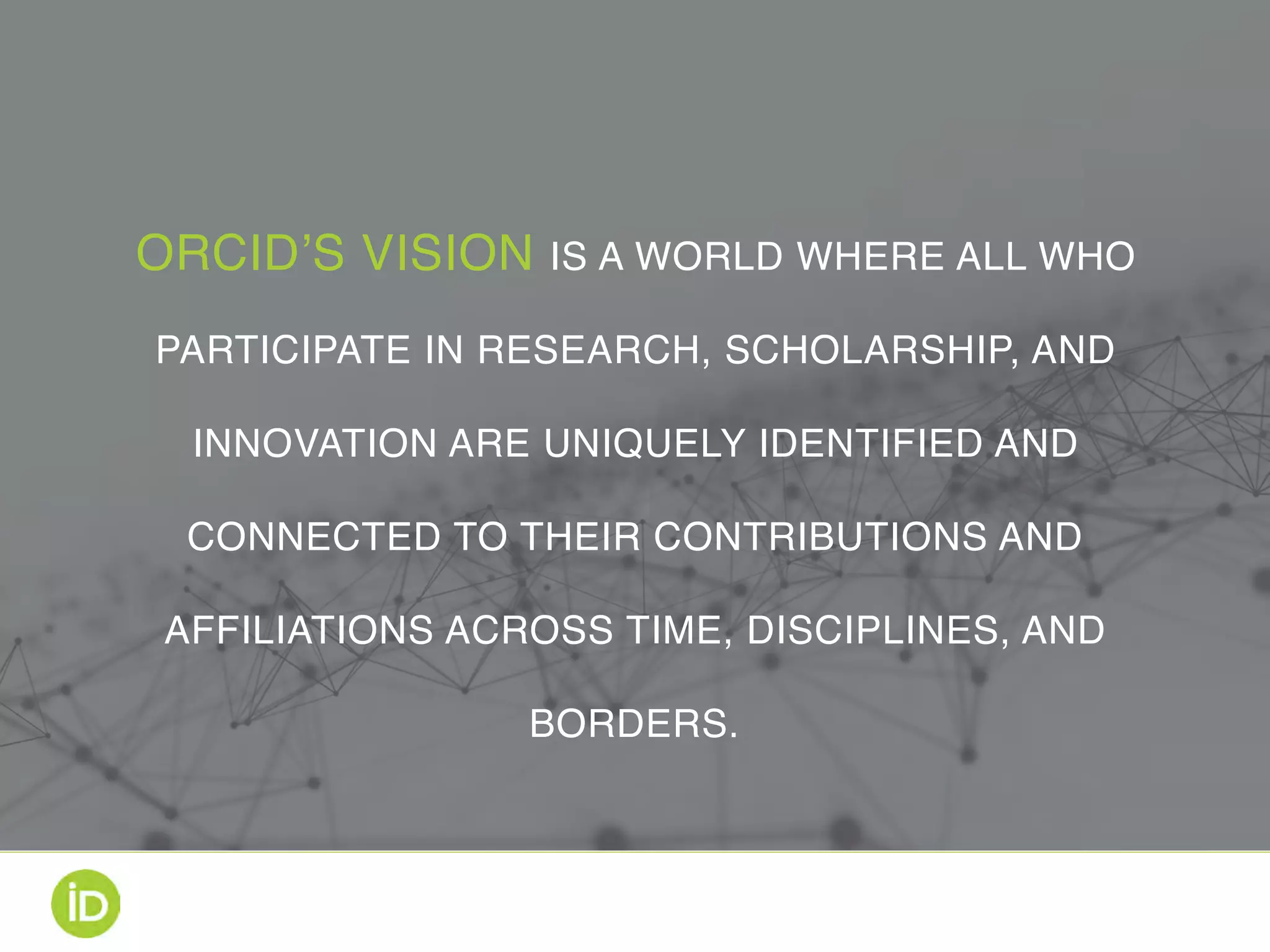
ORCID’S VISION IS A WORLD WHERE ALL WHO
PARTICIPATE IN RESEARCH, SCHOLARSHIP, AND
INNOVATION ARE UNIQUELY IDENTIFIED AND
CONNECTED TO THEIR CONTRIBUTIONS AND
AFFILIATIONS ACROSS TIME, DISCIPLINES, AND
BORDERS.
✓ ORCID is an open, not-for-profit organization that serves
the research community by collaborating and innovating
with organizations like yours
✓ We provide researchers with a unique identifier, an ORCID
iD, that reliably and clearly connects them with their
research contributions and affiliations
✓ Hundreds of systems have now integrated ORCID iDs –
from grant application and manuscript submission to CRIS
and other research information management systems, and
more!
WHAT IS ORCID?
THE ORCID COMMUNITY
• Over 3.5m researchers, 1m+ records with at least one
connection, 8m+ unique DOIs
• Close to 700 member organizations
• 40 countries
• National consortia in the UK, Denmark, Finland,
Netherlands, Belgium, Germany, Italy, Sweden,Taiwan,
Australia, New Zealand, Canada
• Regional consortia in the US
• Over 500 integrations across all sectors of the
research community
We want researchers to spend
more time making
contributions and less time
managing them
INTEROPERABILITY ENTER ONCE
REUSE OFTEN
• 57 publisher members
• Plus 27 associations
• Publishers Open Letter
• Auto-update of ORCID records
• Peer review
• ORCID in books workflows
http://ands.org.au/newsletters/share_issue18.pdf
ORCID IN PUBLISHING WORKFLOW
• Launched January 2016
• Eight original signatories
• Now 27 signatories and growing!
• Major publishers and associations including:
• American Chemical Society
• American Geophysical Union
• IEEE
• PLOS
• Royal Society of Chemistry
• Springer Nature
• Wiley
http://ands.org.au/newsletters/share_issue18.pdf
PUBLISHERS OPEN LETTER
• Require ORCID iDs for corresponding authors of
published papers
• ORCID iD collection should be enabled as an option for
all authors and should ideally take place at submission
• Collect authenticated ORCID iDs
• Authors are not asked to type in or search for their iD
• Crossref/DataCite DOI metadata includes ORCID
iDs for authors to enable Crossref
• Metadata indicates whether the iD was authenticated
• Author/co-author ORCID iDs are embedded into
article metadata for publication
• At least in online versions, and ideally in print versions of
the publication
http://ands.org.au/newsletters/share_issue18.pdf
PUBLISHERS OPEN LETTER: REQUIREMENTS
• Enables researchers to authorize
automatic updates to their ORCID
record
• Currently used by Crossref and
DataCite
• Crossref: during submission process
• 150,000 records, 300,000 works updated
• DataCite: independent of submission
process
• 25,000 records, 50,000 works updated
http://ands.org.au/newsletters/share_issue18.pdf
ORCID AUTO-UPDATE FUNCTIONALIT
• Collect authenticated ORCID iDs
from authors
• Include iDs in content registered
with Crossref and DataCite
• Provenance and source are essential
• Display iDs in published article
• Connect iDs to author’s ORCID
record when DOI is created
• Crossref/DataCite auto-update
• Synchronize data with your own
systems
http://ands.org.au/newsletters/share_issue18.pdf
HOW IT WORKS: ORGANIZATION
• Sign up for an ORCID iD
• Authenticate ORCID iD when
prompted during submission
(Crossref)
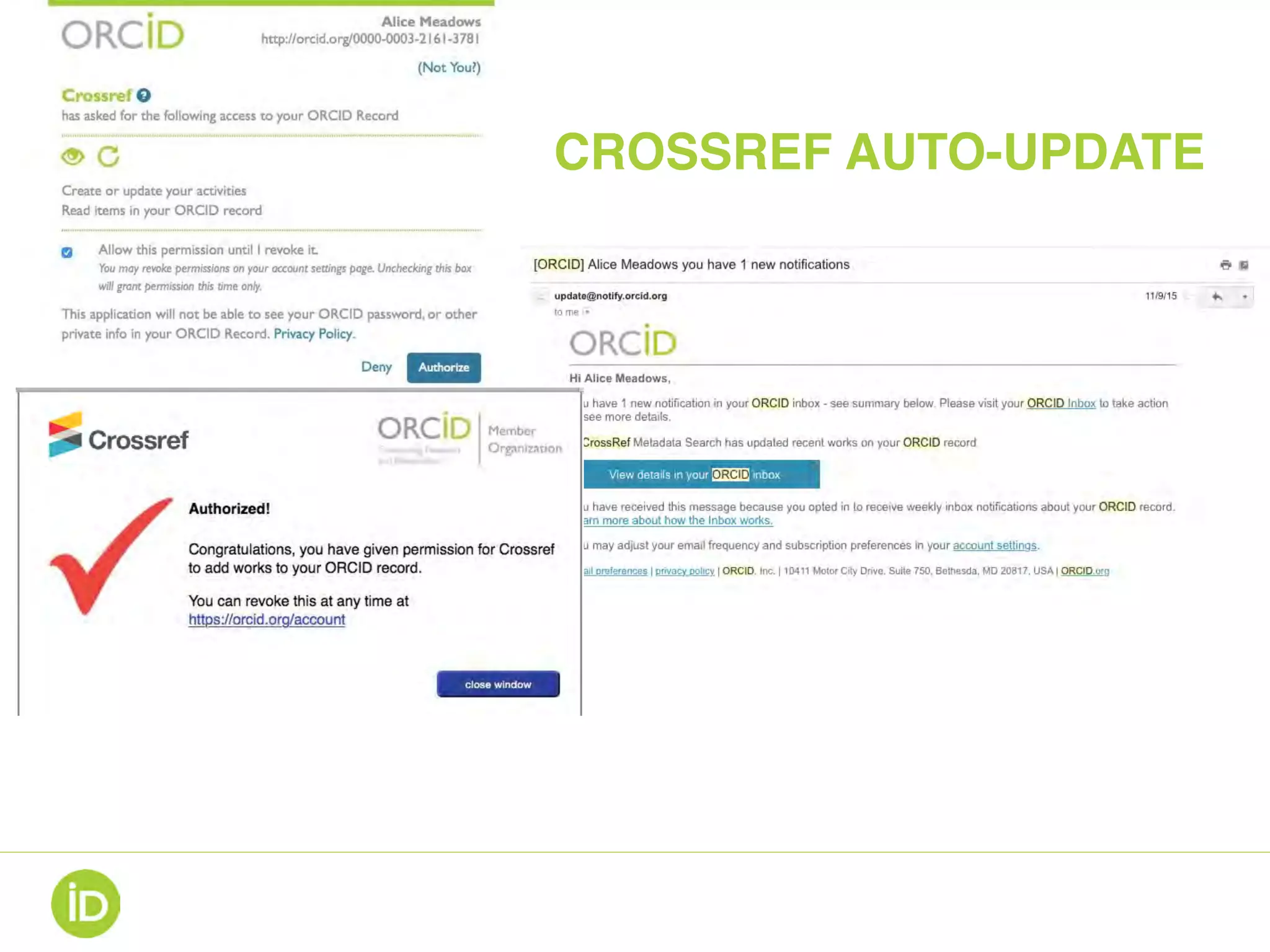
• Authorize Crossref/DataCite to
read/update record
• One time only authorization
• Select preferred visibility setting
for works
http://ands.org.au/newsletters/share_issue18.pdf
HOW IT WORKS:

RESEARCHERS
CROSSREF AUTO-UPDATE

• Based on CASRAI Peer Review
Services Dictionary
• Suitable for all types of peer review
• Review activities are added by third
party, not researcher
• Enables organizations to recognize peer
review activities
• Allows researchers to keep track of their
own reviews
135,000+ reviews added to ORCID
records to date
http://ands.org.au/newsletters/share_issue18.pdf
ORCID PEER REVIEW FUNCTIONALIT
• Collect reviewers’ iDs and
biographical information
• Display reviewers’ iDs
• Connect review activity data to
reviewers’ ORCID records
• Synchronize your system's data
with reviewers' records
Only available with API 2.0
https://members.orcid.org/api/
workflow/peer-review
http://ands.org.au/newsletters/share_issue18.pdf
HOW IT WORKS:

ORGANIZATIONS
• Sign up for an ORCID iD
• Authenticate ORCID iD when
prompted
• Authorize reviewing
organization to read/update
record
• Select preferred visibility setting
for review data
http://ands.org.au/newsletters/share_issue18.pdf
HOW IT WORKS:

RESEARCHERS
JOURNAL OF NEUROSCIENCE

(BLIND REVIEW)
F1000 EXAMPLE (OPEN REVIEW)
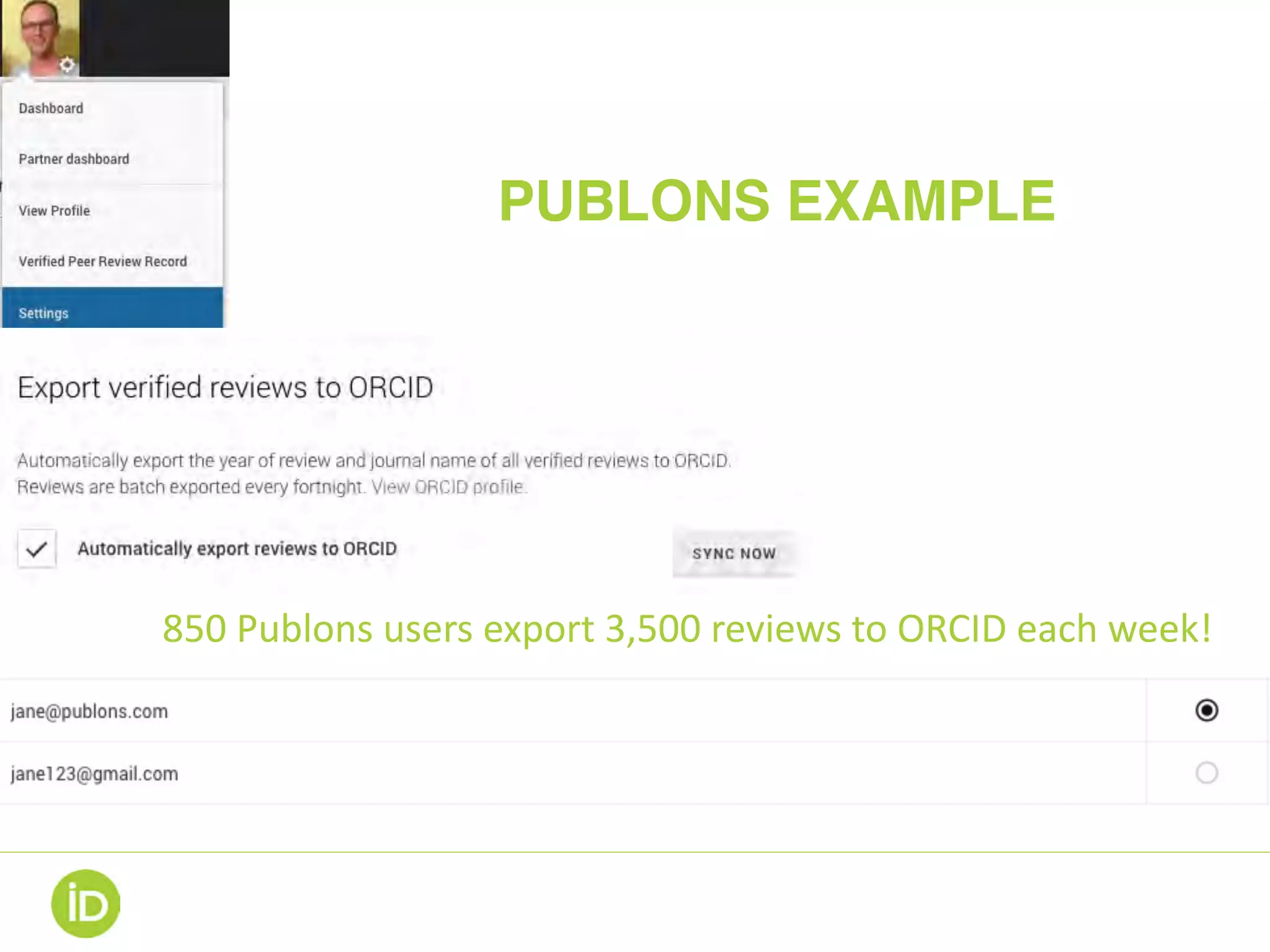
PUBLONS EXAMPLE

PUBLONS EXAMPLE

850	Publons	users	export	3,500	reviews	to	ORCID	each	week!
• Community Working Group
launched September 2016
• Consultant appointed January
2016
• Report and recommendations
available July 2017
• Community feedback and input
welcome!
http://ands.org.au/newsletters/share_issue18.pdf
ORCID IN BOOKS WORKFL
ORCID IN BOOKS WORKFLOW:
BENEFITS
• Matching authors across book and journal
systems
• Simplifying sign-on into systems
• Improved discovery, citation, and
marketing
• Benefits in peer review
• Empowering semantic systems
ORCID IN BOOKS WORKFLOW:
CHALLENGES
• Differences between book and journal
workflows
• And between different types of books workflows
• Lack of awareness of ORCID in key
disciplines
• Dealing with backlist titles
• Lack of ORCID integration in books systems
(but…)
ORCID IN BOOKS WORKFLOW:
RECOMMENDATIONS
• Focus on author touchpoints and title
management systems
• Prioritize publishers already using ORCID for
journals and/or that publish conference
proceedings, major reference works
• Collaborate with MLA Commons and others to
build awareness/trust
• Develop/expand partnerships with JSTOR,
OCLC, ISNI etc
• Share success stories!
Spend more time making
contributions and less time
managing them

ORCID: An Overview - Alice Meadows

  • 1.
    ORCID: AN OVERVIEW CROSSREFLIVE, SEOUL KOFST, JUNE 12, 2017 ALICE MEADOWS Director – Community Engagement & Support, ORCID orcid.org/0000-0003-2161-3781
  • 2.
  • 3.
    PIDS FOR PEOPLE,PLACES, & THINGS
  • 4.
    ORCID’S VISION ISA WORLD WHERE ALL WHO PARTICIPATE IN RESEARCH, SCHOLARSHIP, AND INNOVATION ARE UNIQUELY IDENTIFIED AND CONNECTED TO THEIR CONTRIBUTIONS AND AFFILIATIONS ACROSS TIME, DISCIPLINES, AND BORDERS.
  • 5.
    ✓ ORCID isan open, not-for-profit organization that serves the research community by collaborating and innovating with organizations like yours ✓ We provide researchers with a unique identifier, an ORCID iD, that reliably and clearly connects them with their research contributions and affiliations ✓ Hundreds of systems have now integrated ORCID iDs – from grant application and manuscript submission to CRIS and other research information management systems, and more! WHAT IS ORCID?
  • 6.
    THE ORCID COMMUNITY •Over 3.5m researchers, 1m+ records with at least one connection, 8m+ unique DOIs • Close to 700 member organizations • 40 countries • National consortia in the UK, Denmark, Finland, Netherlands, Belgium, Germany, Italy, Sweden,Taiwan, Australia, New Zealand, Canada • Regional consortia in the US • Over 500 integrations across all sectors of the research community
  • 7.
    We want researchersto spend more time making contributions and less time managing them
  • 8.
  • 9.
    • 57 publishermembers • Plus 27 associations • Publishers Open Letter • Auto-update of ORCID records • Peer review • ORCID in books workflows http://ands.org.au/newsletters/share_issue18.pdf ORCID IN PUBLISHING WORKFLOW
  • 10.
    • Launched January2016 • Eight original signatories • Now 27 signatories and growing! • Major publishers and associations including: • American Chemical Society • American Geophysical Union • IEEE • PLOS • Royal Society of Chemistry • Springer Nature • Wiley http://ands.org.au/newsletters/share_issue18.pdf PUBLISHERS OPEN LETTER
  • 11.
    • Require ORCIDiDs for corresponding authors of published papers • ORCID iD collection should be enabled as an option for all authors and should ideally take place at submission • Collect authenticated ORCID iDs • Authors are not asked to type in or search for their iD • Crossref/DataCite DOI metadata includes ORCID iDs for authors to enable Crossref • Metadata indicates whether the iD was authenticated • Author/co-author ORCID iDs are embedded into article metadata for publication • At least in online versions, and ideally in print versions of the publication http://ands.org.au/newsletters/share_issue18.pdf PUBLISHERS OPEN LETTER: REQUIREMENTS
  • 12.
    • Enables researchersto authorize automatic updates to their ORCID record • Currently used by Crossref and DataCite • Crossref: during submission process • 150,000 records, 300,000 works updated • DataCite: independent of submission process • 25,000 records, 50,000 works updated http://ands.org.au/newsletters/share_issue18.pdf ORCID AUTO-UPDATE FUNCTIONALIT
  • 13.
    • Collect authenticatedORCID iDs from authors • Include iDs in content registered with Crossref and DataCite • Provenance and source are essential • Display iDs in published article • Connect iDs to author’s ORCID record when DOI is created • Crossref/DataCite auto-update • Synchronize data with your own systems http://ands.org.au/newsletters/share_issue18.pdf HOW IT WORKS: ORGANIZATION
  • 14.
    • Sign upfor an ORCID iD • Authenticate ORCID iD when prompted during submission (Crossref) • Authorize Crossref/DataCite to read/update record • One time only authorization • Select preferred visibility setting for works http://ands.org.au/newsletters/share_issue18.pdf HOW IT WORKS:
 RESEARCHERS
  • 15.
  • 16.
    • Based onCASRAI Peer Review Services Dictionary • Suitable for all types of peer review • Review activities are added by third party, not researcher • Enables organizations to recognize peer review activities • Allows researchers to keep track of their own reviews 135,000+ reviews added to ORCID records to date http://ands.org.au/newsletters/share_issue18.pdf ORCID PEER REVIEW FUNCTIONALIT
  • 17.
    • Collect reviewers’iDs and biographical information • Display reviewers’ iDs • Connect review activity data to reviewers’ ORCID records • Synchronize your system's data with reviewers' records Only available with API 2.0 https://members.orcid.org/api/ workflow/peer-review http://ands.org.au/newsletters/share_issue18.pdf HOW IT WORKS:
 ORGANIZATIONS
  • 18.
    • Sign upfor an ORCID iD • Authenticate ORCID iD when prompted • Authorize reviewing organization to read/update record • Select preferred visibility setting for review data http://ands.org.au/newsletters/share_issue18.pdf HOW IT WORKS:
 RESEARCHERS
  • 19.
  • 20.
  • 21.
  • 22.
  • 23.
    • Community WorkingGroup launched September 2016 • Consultant appointed January 2016 • Report and recommendations available July 2017 • Community feedback and input welcome! http://ands.org.au/newsletters/share_issue18.pdf ORCID IN BOOKS WORKFL
  • 24.
    ORCID IN BOOKSWORKFLOW: BENEFITS • Matching authors across book and journal systems • Simplifying sign-on into systems • Improved discovery, citation, and marketing • Benefits in peer review • Empowering semantic systems
  • 25.
    ORCID IN BOOKSWORKFLOW: CHALLENGES • Differences between book and journal workflows • And between different types of books workflows • Lack of awareness of ORCID in key disciplines • Dealing with backlist titles • Lack of ORCID integration in books systems (but…)
  • 26.
    ORCID IN BOOKSWORKFLOW: RECOMMENDATIONS • Focus on author touchpoints and title management systems • Prioritize publishers already using ORCID for journals and/or that publish conference proceedings, major reference works • Collaborate with MLA Commons and others to build awareness/trust • Develop/expand partnerships with JSTOR, OCLC, ISNI etc • Share success stories!
  • 27.
    Spend more timemaking contributions and less time managing them