WELCOME BACK Families 
Back -to -School 2014 
• NEW Family FACES 
• PTA 
• SCHEDULE for Evening 
• ACHIEVEMENT DATA 
• Wilkeson Way 
• STAR Expectations 
6:00 – Overview and Introduction 
6:20 – Clean Up Chairs and Head 
to Classrooms 
*Non-School Age kids can be checked in at the 
Gym. 
6:30 – Session 1 in Classrooms 
7:00 – Session 2 in Classrooms
Welcome Back
WELCOME BACK Families 
Back -to -School 2014 
• NEW Family FACES 
• PTA 
• SCHEDULE for Evening 
• ACHIEVEMENT DATA 
• Wilkeson Way 
• STAR Expectations 
6:00 – Overview and Introduction 
6:20 – Clean Up Chairs and Head 
to Classrooms 
*Non-School Age kids can be checked in at the 
Gym. 
6:30 – Session 1 in Classrooms 
7:00 – Session 2 in Classrooms
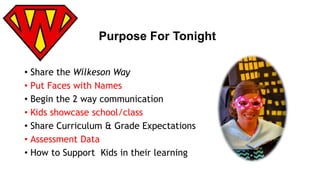
Purpose For Tonight 
• Share the Wilkeson Way 
• Put Faces with Names 
• Begin the 2 way communication 
• Kids showcase school/class 
• Share Curriculum & Grade Expectations 
• Assessment Data 
• How to Support Kids in their learning
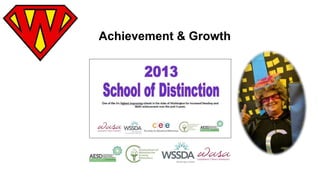
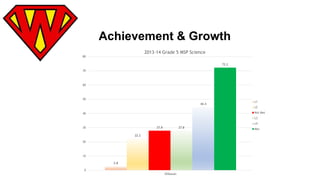
Achievement & Growth
Achievement & Growth 
2.8 
22.2 
2013-14 Grade 5 MSP Science 
27.8 27.8 
44.4 
72.2 
80 
70 
60 
50 
40 
30 
20 
10 
0 
Wilkeson 
L1 
L2 
Not Met 
L3 
L4 
Met
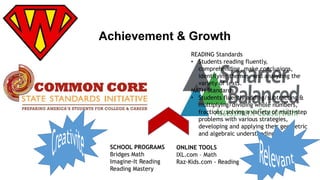
Achievement & Growth 
SCHOOL PROGRAMS 
Bridges Math 
Imagine-It Reading 
Reading Mastery 
READING Standards 
• Students reading fluently, 
comprehending, make conclusions, 
identifying themes, and analyzing the 
variety of texts. 
MATH Standards 
• Students fluently adding/subtracting & 
multiplying/dividing whole numbers, 
fractions, solving a variety of multi-step 
problems with various strategies, 
developing and applying their geometric 
and algebraic understanding 
ONLINE TOOLS 
IXL.com – Math 
Raz-Kids.com - Reading
Achievement & Growth
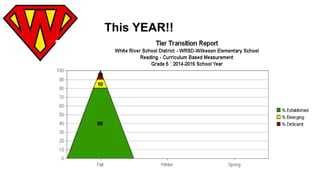
This YEAR!!
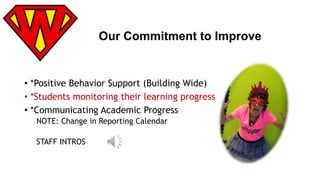
Our Commitment to Improve 
• *Positive Behavior Support (Building Wide) 
• *Students monitoring their learning progress 
• *Communicating Academic Progress 
NOTE: Change in Reporting Calendar 
STAFF INTROS
Communication 
Parents 
•Email or phone calls anytime 
• (Drop byes are difficult!) 
•School or home meetings by calling ahead 
•Sharing concerns: Teacher  Office!
Routines for Success 
1. Come to school on-time – every day 8:50 School 
Open 
2. Listen and follow directions – right away 
3. Complete your BEST work – all the time 
4. Read, come prepared, and participate in discussion 
5. Communicate regularly with Teachers
Volunteer at School 
1. Help in classroom 
2. Help the teacher (take a project home) 
3. Join WatchDOGS (Dads, Uncles, Grandpas, Adults) 
4. Help with PTA events 
5. Participate in field trips 
6. Come to STAR Assemblies 
7. Camp Read A Lot 
Note: Schedule time and complete volunteer form for 
background check.
Attendance Policy Changes 
ABSENCES 
• Absences from school shall be classified as either excused or 
unexcused absence. 
• Elementary School: More than 30 minutes late to school and 
leaving more than 30 minutes early from school will constitute 
a half-day absence.
Attendance Policy Changes 
EXCUSED ABSENCES 
♦ An excused absence is any absence that has the approval of both the parent/guardian and the school. 
To excuse an absence, the parent/guardian must call or send a note to the Main Office within 48 hours of the 
absence. Please give the following information: student’s full name, date of absence(s), reason for absence, 
and parent/guardian signature (if a note). 
If a parent/guardian does not phone or send a written note of clearance within 48 hours, the absence is 
considered unexcused. 
♦ An excused absence shall not be granted if the school deems the absence(s) may cause a serious adverse 
effect upon the student’s academic progress. 
♦ If the parent/guardian and the school are not in agreement or the school/district deems an absence to 
cause serious adverse effect upon the student’s educational progress, the absence shall be considered 
unexcused.
Attendance Policy Changes 
LATE ARRIVAL (TARDY) 
It is vital that student be on time to every class every day; when 
students are late to class, they disrupt the instruction in the 
classroom. 
Elementary Schools: Your teacher will take attendance every 
morning. 
Students who are not in class when the bell rings are tardy. 
Elementary- When a student has been tardy five times; it will be 
recorded in our system as an unexcused absence.
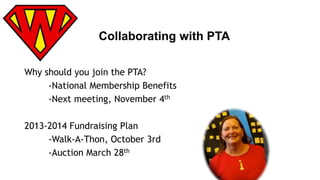
Collaborating with PTA 
Why should you join the PTA? 
-National Membership Benefits 
-Next meeting, November 4th 
2013-2014 Fundraising Plan 
-Walk-A-Thon, October 3rd 
-Auction March 28th
Collaborating with PTA 
Things we sponsor, offer, and do: 
-WatchD.O.G.S, Kick off is September 23rd 6:30pm 
-Family Fun Nights (Bingo January, Movie Nights, etc.) 
-Square 1 Art 
-Popcorn Fridays and Student Store 
-Enrichment days, assemblies, field trips 
-Technology Updates
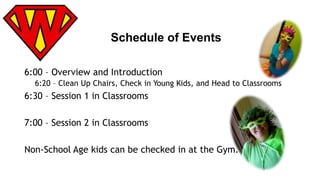
Schedule of Events 
6:00 – Overview and Introduction 
6:20 – Clean Up Chairs, Check in Young Kids, and Head to Classrooms 
6:30 – Session 1 in Classrooms 
7:00 – Session 2 in Classrooms 
Non-School Age kids can be checked in at the Gym.
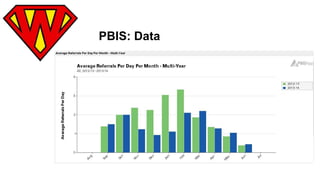
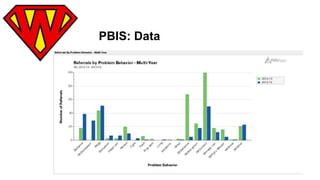
PBIS: Data
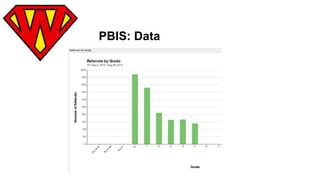
PBIS: Data
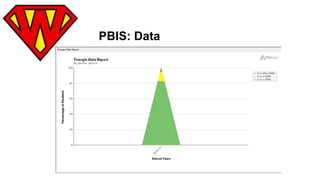
PBIS: Data
PBIS: Data
School-wide PBIS is: 
A framework for establishing the social culture and behavioral supports 
needed for a school to be an effective learning environment for all 
students.
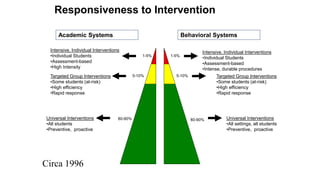
1-5% 1-5% 
5-10% 5-10% 
Intensive, Individual Interventions 
•Individual Students 
•Assessment-based 
•High Intensity 
Intensive, Individual Interventions 
•Individual Students 
•Assessment-based 
•Intense, durable procedures 
80-90% 80-90% 
Targeted Group Interventions 
•Some students (at-risk) 
•High efficiency 
•Rapid response 
Targeted Group Interventions 
•Some students (at-risk) 
•High efficiency 
•Rapid response 
Universal Interventions 
•All students 
•Preventive, proactive 
Universal Interventions 
•All settings, all students 
•Preventive, proactive 
Responsiveness to Intervention 
Academic Systems Behavioral Systems 
Circa 1996
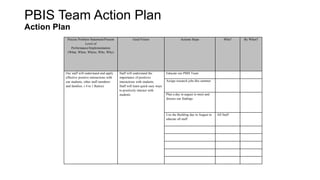
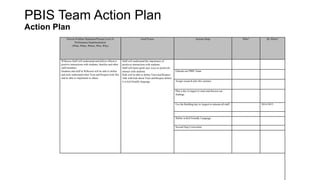
PBIS Team Action Plan 
Action Plan 
Precise Problem Statement/Present 
Level of 
Performance/Implementation 
(What, When, Where, Who, Why) 
Goal/Vision Actions Steps Who? By When? 
Our staff will understand and apply 
effective positive interactions with 
our students, other staff members 
and families. ( 4 to 1 Ratios) 
Staff will understand the 
importance of positives 
interactions with students. 
Staff will learn quick easy ways 
to positively interact with 
students. 
Educate our PBIS Team 
Assign research jobs this summer 
Plan a day in august to meet and 
discuss our findings 
Use the Building day in August to 
educate all staff 
All Staff
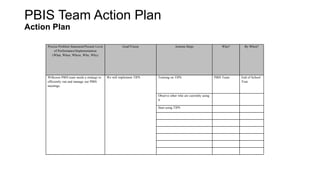
PBIS Team Action Plan 
Action Plan 
Precise Problem Statement/Present Level 
of Performance/Implementation 
(What, When, Where, Who, Why) 
Goal/Vision Actions Steps Who? By When? 
Wilkeson PBIS team needs a strategy to 
efficiently run and manage our PBIS 
meetings. 
We will implement TIPS Training on TIPS PBIS Team End of School 
Year 
Observe other who are currently using 
it 
Start using TIPS
PBIS Team Action Plan 
Action Plan 
Precise Problem Statement/Present Level of 
Performance/Implementation 
(What, When, Where, Who, Why) 
Goal/Vision Actions Steps Who? By When? 
Wilkeson Staff will understand and deliver effective 
positive interactions with students, families and other 
staff members. 
Students and staff at Wilkeson will be able to define 
and truly understand what Trust and Respect look like 
and be able to implement to others. 
Staff will understand the importance of 
positives interactions with students. 
Staff will learn quick easy ways to positively 
interact with students. 
Kids will be able to define Trust and Respect 
Talk with kids about Trust and Respect define 
it in kid friendly language 
Educate our PBIS Team 
Assign research jobs this summer 
Plan a day in august to meet and discuss our 
findings 
Use the Building day in August to educate all staff 2014-2015 
Define in Kid Friendly Language 
Second Step Curriculum
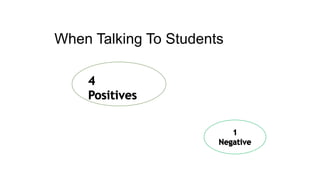
When Talking To Students 
4dsM
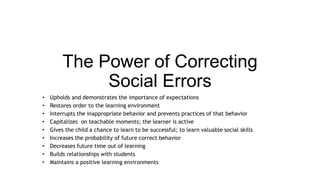
The Power of Correcting 
Social Errors 
• Upholds and demonstrates the importance of expectations 
• Restores order to the learning environment 
• Interrupts the inappropriate behavior and prevents practices of that behavior 
• Capitalizes on teachable moments; the learner is active 
• Gives the child a chance to learn to be successful; to learn valuable social skills 
• Increases the probability of future correct behavior 
• Decreases future time out of learning 
• Builds relationships with students 
• Maintains a positive learning environments
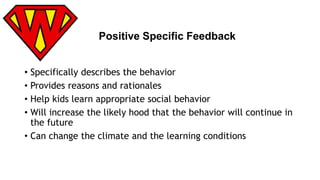
Positive Specific Feedback 
• Specifically describes the behavior 
• Provides reasons and rationales 
• Help kids learn appropriate social behavior 
• Will increase the likely hood that the behavior will continue in 
the future 
• Can change the climate and the learning conditions
Social Errors 
For many students they do not 
know how to perform the expected 
behavior appropriately or don’t know 
it well enough to routinely use it at 
the appropriate times this is because 
they understand what is expected 
but do not know the skill well 
enough to perform it easily or not 
understand why it is important.
Less Effective Feedback 
General praise or commonly used phrases such as 
good job, though important for a pleasant 
classroom, are inadequate for building and 
sustaining desired behavior.
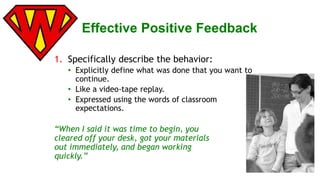
Effective Positive Feedback 
1. Specifically describe the behavior: 
• Explicitly define what was done that you want to 
continue. 
• Like a video-tape replay. 
• Expressed using the words of classroom 
expectations. 
“When I said it was time to begin, you 
cleared off your desk, got your materials 
out immediately, and began working 
quickly.”
Effective Positive Feedback 
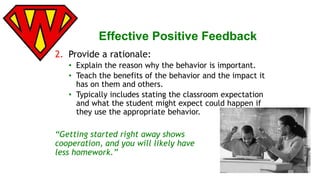
2. Provide a rationale: 
• Explain the reason why the behavior is important. 
• Teach the benefits of the behavior and the impact it 
has on them and others. 
• Typically includes stating the classroom expectation 
and what the student might expect could happen if 
they use the appropriate behavior. 
“Getting started right away shows 
cooperation, and you will likely have 
less homework.”
Effective Positive Feedback 
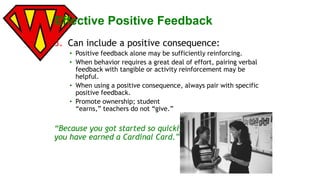
3. Can include a positive consequence: 
• Positive feedback alone may be sufficiently reinforcing. 
• When behavior requires a great deal of effort, pairing verbal 
feedback with tangible or activity reinforcement may be 
helpful. 
• When using a positive consequence, always pair with specific 
positive feedback. 
• Promote ownership; student 
“earns,” teachers do not “give.” 
“Because you got started so quickly, 
you have earned a Cardinal Card.”
It’s Nothing Personal 
We want kids to do 
the appropriate 
behavior because 
of the benefits to 
them rather than 
simply to please 
the teacher.
MO SW-PBS 
Sincere and Appropriate 
• Use a genuFineee, dwbaramc, ksincere response that is 
appropriate for the situation and the individual. 
• Use a variety of phrases, showing spontaneity and 
credibility. 
• Find own style to communicate sincere care and 
concern. 
“Super job walking quietly in your group! That shows respect 
to everyone. Thank you.” 
“Wow! What a great job of accepting correction. You looked 
right at me, said ‘okay,’ and didn’t argue or complain. 
When you do that you show respect and you can learn 
and avoid mistakes in the future. Why don’t you be the 
first to leave class today.” 
15 
5
Positive Feedback 
• Essential to change and sustain behavior. 
• Recognizes successes or efforts at tasks that are difficult for 
the child. 
• While general praise contributes to a pleasant classroom, it is 
insufficient to build and sustain desired behavior. 
• Students need clear specific feedback on classroom 
expectations and behaviors. 
MO SW-PBS 15 
4
More Examples 
• “Dolly, you stopped and took some time to think about your 
decision and then walked away from Sam. That wasn’t easy, 
but it can help to avoid an argument.” 
• “Hey Pedro, thanks for throwing your trash away. That shows 
cooperation and respect for our classroom. You earned a Bee 
ticket to add to our class hive. We are getting close to our 
goals!” 
• “Jasmine, thanks for being on time to class. That’s important 
at school and when you are on the job.”
Behaviors thatP imrpeacfte strurdeendt a Affedct,u clotm pBliaenche,aavndiolearrsning: 
• Proximity–communicate privately at 20” with individual 
students; communication across the room reserved for 
information intended for entire group only 
• Listening–pause, attend thoughtfully to the student 
• Eye Contact–communicate at eye level; look student in the 
eye when instructing or directing; hold eye contact briefly 
for compliance 
• Pleasant Voice–use calm pleasant voice when talking with, 
praising, and correcting students 
• Smiles–pleasant facial expression and frequent smiles 
• Touch–appropriate brief nurturing touch 
• Use of Student’s Name–begin interactions with student name 
and use frequently during interactions 
MO SW-PBS 
15 
3
Activity: Personal Reflection 
Example 
• Challenging Activity and Misbehavior: Beginning 
of class students walk around, talk out 
• Specific classroom expectation or procedure: Sit 
in seat, read warm-up activity on Smart Board, 
begin to work on warm-up activity with voices 
off. 
• Effective Positive Feedback you will say: “Thanks 
for getting to work right away with your voice 
off. That helps you focus and take 
responsibility for your learning.” 
• Write the specific day and time you are going to 
give the Effective Positive Feedback. Tomorrow, 
first hour! 
MO SW-PBS
PBIS: Action Plan 
1. Tier 1 and Tier 2 Curriculum Implementation 
2. Increase 4:1 Positives to Correctives 
3. Communicate and monitor Students’ Knowledge of STAR 
Expectations 
4. Implement a Team Protocol for (TIPS)
PBIS: Common Expectations 
Group Discussion 
- Common Area Expectations 
- STAR Common Expectations Rotation 
- B.I. Reports 
- Grade Level Matrix

Wilkeson Back-to-School2014

  • 2.
    WELCOME BACK Families Back -to -School 2014 • NEW Family FACES • PTA • SCHEDULE for Evening • ACHIEVEMENT DATA • Wilkeson Way • STAR Expectations 6:00 – Overview and Introduction 6:20 – Clean Up Chairs and Head to Classrooms *Non-School Age kids can be checked in at the Gym. 6:30 – Session 1 in Classrooms 7:00 – Session 2 in Classrooms
  • 3.
  • 4.
    WELCOME BACK Families Back -to -School 2014 • NEW Family FACES • PTA • SCHEDULE for Evening • ACHIEVEMENT DATA • Wilkeson Way • STAR Expectations 6:00 – Overview and Introduction 6:20 – Clean Up Chairs and Head to Classrooms *Non-School Age kids can be checked in at the Gym. 6:30 – Session 1 in Classrooms 7:00 – Session 2 in Classrooms
  • 5.
    Purpose For Tonight • Share the Wilkeson Way • Put Faces with Names • Begin the 2 way communication • Kids showcase school/class • Share Curriculum & Grade Expectations • Assessment Data • How to Support Kids in their learning
  • 6.
  • 7.
    Achievement & Growth 2.8 22.2 2013-14 Grade 5 MSP Science 27.8 27.8 44.4 72.2 80 70 60 50 40 30 20 10 0 Wilkeson L1 L2 Not Met L3 L4 Met
  • 8.
    Achievement & Growth SCHOOL PROGRAMS Bridges Math Imagine-It Reading Reading Mastery READING Standards • Students reading fluently, comprehending, make conclusions, identifying themes, and analyzing the variety of texts. MATH Standards • Students fluently adding/subtracting & multiplying/dividing whole numbers, fractions, solving a variety of multi-step problems with various strategies, developing and applying their geometric and algebraic understanding ONLINE TOOLS IXL.com – Math Raz-Kids.com - Reading
  • 9.
  • 10.
  • 11.
  • 12.
    Our Commitment toImprove • *Positive Behavior Support (Building Wide) • *Students monitoring their learning progress • *Communicating Academic Progress NOTE: Change in Reporting Calendar STAFF INTROS
  • 14.
    Communication Parents •Emailor phone calls anytime • (Drop byes are difficult!) •School or home meetings by calling ahead •Sharing concerns: Teacher  Office!
  • 15.
    Routines for Success 1. Come to school on-time – every day 8:50 School Open 2. Listen and follow directions – right away 3. Complete your BEST work – all the time 4. Read, come prepared, and participate in discussion 5. Communicate regularly with Teachers
  • 16.
    Volunteer at School 1. Help in classroom 2. Help the teacher (take a project home) 3. Join WatchDOGS (Dads, Uncles, Grandpas, Adults) 4. Help with PTA events 5. Participate in field trips 6. Come to STAR Assemblies 7. Camp Read A Lot Note: Schedule time and complete volunteer form for background check.
  • 17.
    Attendance Policy Changes ABSENCES • Absences from school shall be classified as either excused or unexcused absence. • Elementary School: More than 30 minutes late to school and leaving more than 30 minutes early from school will constitute a half-day absence.
  • 18.
    Attendance Policy Changes EXCUSED ABSENCES ♦ An excused absence is any absence that has the approval of both the parent/guardian and the school. To excuse an absence, the parent/guardian must call or send a note to the Main Office within 48 hours of the absence. Please give the following information: student’s full name, date of absence(s), reason for absence, and parent/guardian signature (if a note). If a parent/guardian does not phone or send a written note of clearance within 48 hours, the absence is considered unexcused. ♦ An excused absence shall not be granted if the school deems the absence(s) may cause a serious adverse effect upon the student’s academic progress. ♦ If the parent/guardian and the school are not in agreement or the school/district deems an absence to cause serious adverse effect upon the student’s educational progress, the absence shall be considered unexcused.
  • 19.
    Attendance Policy Changes LATE ARRIVAL (TARDY) It is vital that student be on time to every class every day; when students are late to class, they disrupt the instruction in the classroom. Elementary Schools: Your teacher will take attendance every morning. Students who are not in class when the bell rings are tardy. Elementary- When a student has been tardy five times; it will be recorded in our system as an unexcused absence.
  • 20.
    Collaborating with PTA Why should you join the PTA? -National Membership Benefits -Next meeting, November 4th 2013-2014 Fundraising Plan -Walk-A-Thon, October 3rd -Auction March 28th
  • 21.
    Collaborating with PTA Things we sponsor, offer, and do: -WatchD.O.G.S, Kick off is September 23rd 6:30pm -Family Fun Nights (Bingo January, Movie Nights, etc.) -Square 1 Art -Popcorn Fridays and Student Store -Enrichment days, assemblies, field trips -Technology Updates
  • 22.
    Schedule of Events 6:00 – Overview and Introduction 6:20 – Clean Up Chairs, Check in Young Kids, and Head to Classrooms 6:30 – Session 1 in Classrooms 7:00 – Session 2 in Classrooms Non-School Age kids can be checked in at the Gym.
  • 23.
  • 24.
  • 25.
  • 26.
  • 27.
    School-wide PBIS is: A framework for establishing the social culture and behavioral supports needed for a school to be an effective learning environment for all students.
  • 28.
    1-5% 1-5% 5-10%5-10% Intensive, Individual Interventions •Individual Students •Assessment-based •High Intensity Intensive, Individual Interventions •Individual Students •Assessment-based •Intense, durable procedures 80-90% 80-90% Targeted Group Interventions •Some students (at-risk) •High efficiency •Rapid response Targeted Group Interventions •Some students (at-risk) •High efficiency •Rapid response Universal Interventions •All students •Preventive, proactive Universal Interventions •All settings, all students •Preventive, proactive Responsiveness to Intervention Academic Systems Behavioral Systems Circa 1996
  • 30.
    PBIS Team ActionPlan Action Plan Precise Problem Statement/Present Level of Performance/Implementation (What, When, Where, Who, Why) Goal/Vision Actions Steps Who? By When? Our staff will understand and apply effective positive interactions with our students, other staff members and families. ( 4 to 1 Ratios) Staff will understand the importance of positives interactions with students. Staff will learn quick easy ways to positively interact with students. Educate our PBIS Team Assign research jobs this summer Plan a day in august to meet and discuss our findings Use the Building day in August to educate all staff All Staff
  • 31.
    PBIS Team ActionPlan Action Plan Precise Problem Statement/Present Level of Performance/Implementation (What, When, Where, Who, Why) Goal/Vision Actions Steps Who? By When? Wilkeson PBIS team needs a strategy to efficiently run and manage our PBIS meetings. We will implement TIPS Training on TIPS PBIS Team End of School Year Observe other who are currently using it Start using TIPS
  • 32.
    PBIS Team ActionPlan Action Plan Precise Problem Statement/Present Level of Performance/Implementation (What, When, Where, Who, Why) Goal/Vision Actions Steps Who? By When? Wilkeson Staff will understand and deliver effective positive interactions with students, families and other staff members. Students and staff at Wilkeson will be able to define and truly understand what Trust and Respect look like and be able to implement to others. Staff will understand the importance of positives interactions with students. Staff will learn quick easy ways to positively interact with students. Kids will be able to define Trust and Respect Talk with kids about Trust and Respect define it in kid friendly language Educate our PBIS Team Assign research jobs this summer Plan a day in august to meet and discuss our findings Use the Building day in August to educate all staff 2014-2015 Define in Kid Friendly Language Second Step Curriculum
  • 33.
    When Talking ToStudents 4dsM
  • 34.
    The Power ofCorrecting Social Errors • Upholds and demonstrates the importance of expectations • Restores order to the learning environment • Interrupts the inappropriate behavior and prevents practices of that behavior • Capitalizes on teachable moments; the learner is active • Gives the child a chance to learn to be successful; to learn valuable social skills • Increases the probability of future correct behavior • Decreases future time out of learning • Builds relationships with students • Maintains a positive learning environments
  • 35.
    Positive Specific Feedback • Specifically describes the behavior • Provides reasons and rationales • Help kids learn appropriate social behavior • Will increase the likely hood that the behavior will continue in the future • Can change the climate and the learning conditions
  • 36.
    Social Errors Formany students they do not know how to perform the expected behavior appropriately or don’t know it well enough to routinely use it at the appropriate times this is because they understand what is expected but do not know the skill well enough to perform it easily or not understand why it is important.
  • 37.
    Less Effective Feedback General praise or commonly used phrases such as good job, though important for a pleasant classroom, are inadequate for building and sustaining desired behavior.
  • 38.
    Effective Positive Feedback 1. Specifically describe the behavior: • Explicitly define what was done that you want to continue. • Like a video-tape replay. • Expressed using the words of classroom expectations. “When I said it was time to begin, you cleared off your desk, got your materials out immediately, and began working quickly.”
  • 39.
    Effective Positive Feedback 2. Provide a rationale: • Explain the reason why the behavior is important. • Teach the benefits of the behavior and the impact it has on them and others. • Typically includes stating the classroom expectation and what the student might expect could happen if they use the appropriate behavior. “Getting started right away shows cooperation, and you will likely have less homework.”
  • 40.
    Effective Positive Feedback 3. Can include a positive consequence: • Positive feedback alone may be sufficiently reinforcing. • When behavior requires a great deal of effort, pairing verbal feedback with tangible or activity reinforcement may be helpful. • When using a positive consequence, always pair with specific positive feedback. • Promote ownership; student “earns,” teachers do not “give.” “Because you got started so quickly, you have earned a Cardinal Card.”
  • 41.
    It’s Nothing Personal We want kids to do the appropriate behavior because of the benefits to them rather than simply to please the teacher.
  • 42.
    MO SW-PBS Sincereand Appropriate • Use a genuFineee, dwbaramc, ksincere response that is appropriate for the situation and the individual. • Use a variety of phrases, showing spontaneity and credibility. • Find own style to communicate sincere care and concern. “Super job walking quietly in your group! That shows respect to everyone. Thank you.” “Wow! What a great job of accepting correction. You looked right at me, said ‘okay,’ and didn’t argue or complain. When you do that you show respect and you can learn and avoid mistakes in the future. Why don’t you be the first to leave class today.” 15 5
  • 43.
    Positive Feedback •Essential to change and sustain behavior. • Recognizes successes or efforts at tasks that are difficult for the child. • While general praise contributes to a pleasant classroom, it is insufficient to build and sustain desired behavior. • Students need clear specific feedback on classroom expectations and behaviors. MO SW-PBS 15 4
  • 44.
    More Examples •“Dolly, you stopped and took some time to think about your decision and then walked away from Sam. That wasn’t easy, but it can help to avoid an argument.” • “Hey Pedro, thanks for throwing your trash away. That shows cooperation and respect for our classroom. You earned a Bee ticket to add to our class hive. We are getting close to our goals!” • “Jasmine, thanks for being on time to class. That’s important at school and when you are on the job.”
  • 45.
    Behaviors thatP imrpeacftestrurdeendt a Affedct,u clotm pBliaenche,aavndiolearrsning: • Proximity–communicate privately at 20” with individual students; communication across the room reserved for information intended for entire group only • Listening–pause, attend thoughtfully to the student • Eye Contact–communicate at eye level; look student in the eye when instructing or directing; hold eye contact briefly for compliance • Pleasant Voice–use calm pleasant voice when talking with, praising, and correcting students • Smiles–pleasant facial expression and frequent smiles • Touch–appropriate brief nurturing touch • Use of Student’s Name–begin interactions with student name and use frequently during interactions MO SW-PBS 15 3
  • 46.
    Activity: Personal Reflection Example • Challenging Activity and Misbehavior: Beginning of class students walk around, talk out • Specific classroom expectation or procedure: Sit in seat, read warm-up activity on Smart Board, begin to work on warm-up activity with voices off. • Effective Positive Feedback you will say: “Thanks for getting to work right away with your voice off. That helps you focus and take responsibility for your learning.” • Write the specific day and time you are going to give the Effective Positive Feedback. Tomorrow, first hour! MO SW-PBS
  • 47.
    PBIS: Action Plan 1. Tier 1 and Tier 2 Curriculum Implementation 2. Increase 4:1 Positives to Correctives 3. Communicate and monitor Students’ Knowledge of STAR Expectations 4. Implement a Team Protocol for (TIPS)
  • 48.
    PBIS: Common Expectations Group Discussion - Common Area Expectations - STAR Common Expectations Rotation - B.I. Reports - Grade Level Matrix