Visualization and manipulation of
Matched Molecular Series for
decision support
Noel O’Boyle and Roger Sayle
NextMove Software
250th ACS National Meeting, Boston
16th Aug 2015
Matched (Molecular) Pairs
[Cl, F]1.6
3.5
Coined by Kenny and Sadowski in 2005*
Easier to predict differences in the values of a property
than it is to predict the value itself
* Chemoinformatics in drug discovery, Wiley, 271–285.
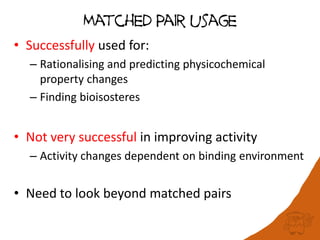
Matched Pair usage
• Successfully used for:
– Rationalising and predicting physicochemical
property changes
– Finding bioisosteres
• Not very successful in improving activity
– Activity changes dependent on binding environment
• Need to look beyond matched pairs
Matched Series of length 2
= Matched Pair
[Cl, F]
“Matching molecular series” introduced by Wawer and
Bajorath, J. Med. Chem. 2011, 54, 2944
Matched Series of length 3
[Cl, F, NH2]
Ordered Matched Series of length 3
3.5
2.1
1.6
pIC50
[Cl > F > NH2]
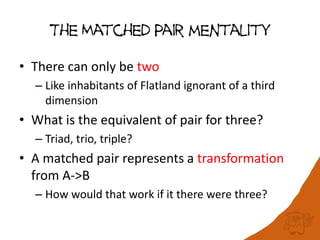
The Matched Pair mentality
• There can only be two
– Like inhabitants of Flatland ignorant of a third
dimension
• What is the equivalent of pair for three?
– Triad, trio, triple?
• A matched pair represents a transformation
from A->B
– How would that work if it there were three?
Matsy:
Prediction using
Matched Series
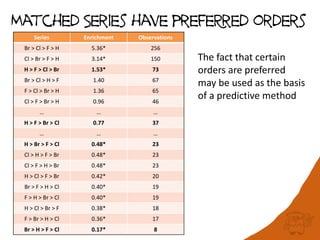
Matched Series have prefeRred orders
Series Enrichment Observations
Br > Cl > F > H 5.36* 256
Cl > Br > F > H 3.14* 150
H > F > Cl > Br 1.53* 73
Br > Cl > H > F 1.40 67
F > Cl > Br > H 1.36 65
Cl > F > Br > H 0.96 46
… … …
H > F > Br > Cl 0.77 37
… … …
H > Br > F > Cl 0.48* 23
Cl > H > F > Br 0.48* 23
Cl > F > H > Br 0.48* 23
H > Cl > F > Br 0.42* 20
Br > F > H > Cl 0.40* 19
F > H > Br > Cl 0.40* 19
H > Cl > Br > F 0.38* 18
F > Br > H > Cl 0.36* 17
Br > H > F > Cl 0.17* 8
The fact that certain
orders are preferred
may be used as the basis
of a predictive method
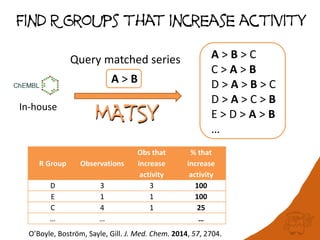
Find R Groups that increase activity
A > B
Query matched series A > B > C
C > A > B
D > A > B > C
D > A > C > B
E > D > A > B
…
R Group Observations
Obs that
increase
activity
% that
increase
activity
D 3 3 100
E 1 1 100
C 4 1 25
… … …
In-house
O’Boyle, Boström, Sayle, Gill. J. Med. Chem. 2014, 57, 2704.
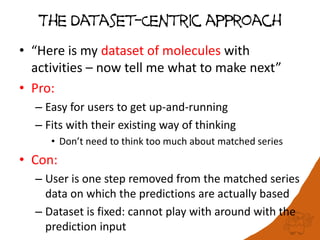
The Dataset-Centric approach
• “Here is my dataset of molecules with
activities – now tell me what to make next”
• Pro:
– Easy for users to get up-and-running
– Fits with their existing way of thinking
• Don’t need to think too much about matched series
• Con:
– User is one step removed from the matched series
data on which the predictions are actually based
– Dataset is fixed: cannot play with around with the
prediction input
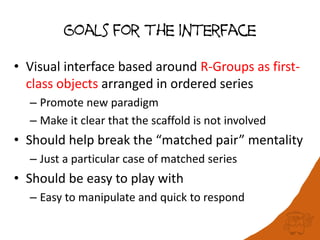
Goals for the interface
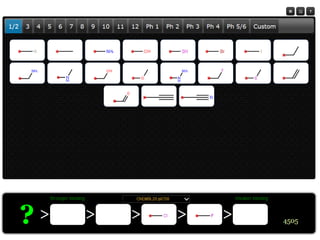
• Visual interface based around R-Groups as first-
class objects arranged in ordered series
– Promote new paradigm
– Make it clear that the scaffold is not involved
• Should help break the “matched pair” mentality
– Just a particular case of matched series
• Should be easy to play with
– Easy to manipulate and quick to respond
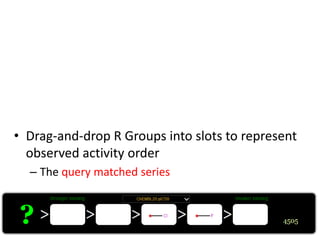
• Drag-and-drop R Groups into slots to represent
observed activity order
– The query matched series
Pros
• Easy to play around with
– Swap around order of R groups
– See what happens if you follow the predictions
• May suggest hypotheses
• Useful for searching (not just for predictions)
• Tablet-friendly
ConS
• The user needs to be able to provide an
ordered matched series as a query
– You can’t just provide a dataset of molecules
No Chemistry required
• Predictions are solely based on the order of R
groups in a matched series
– Not using any calculated properties
• Images of all R groups in ChEMBL can be
generated in advance (~65K)
• ⇒ A cheminformatics toolkit is not required for
the interface or even for making predictions
• In practice, we do use a toolkit to allow the user
to enter R groups as SMILES
Use Case #1
Are matched Series
Predictions symmetric?
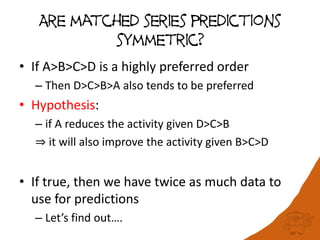
Are matched series predictions
symmetric?
• If A>B>C>D is a highly preferred order
– Then D>C>B>A also tends to be preferred
• Hypothesis:
– if A reduces the activity given D>C>B
⇒ it will also improve the activity given B>C>D
• If true, then we have twice as much data to
use for predictions
– Let’s find out….
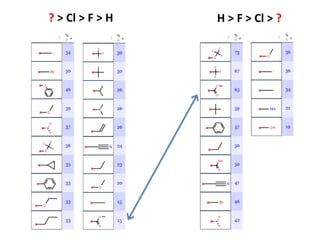
? > Cl > F > H H > F > Cl > ?
Use case #2
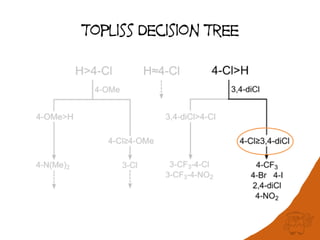
Topliss Decision Tree
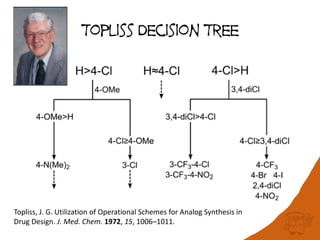
Topliss, J. G. Utilization of Operational Schemes for Analog Synthesis in
Drug Design. J. Med. Chem. 1972, 15, 1006–1011.
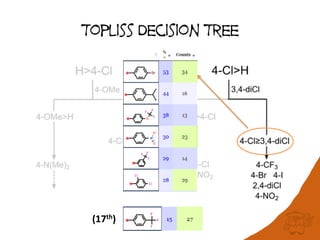
Topliss Decision Tree
(17th)
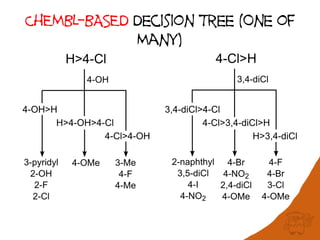
ChEMBL-BASED Decision Tree (One of
Many)
http://nextmovesoftware.com
noel@nextmovesoftware.com
@nmsoftware
Visualization and manipulation of
Matched Molecular Series for decision
support

CINF 29: Visualization and manipulation of Matched Molecular Series for decision support

  • 1.
    Visualization and manipulationof Matched Molecular Series for decision support Noel O’Boyle and Roger Sayle NextMove Software 250th ACS National Meeting, Boston 16th Aug 2015
  • 2.
    Matched (Molecular) Pairs [Cl,F]1.6 3.5 Coined by Kenny and Sadowski in 2005* Easier to predict differences in the values of a property than it is to predict the value itself * Chemoinformatics in drug discovery, Wiley, 271–285.
  • 3.
    Matched Pair usage •Successfully used for: – Rationalising and predicting physicochemical property changes – Finding bioisosteres • Not very successful in improving activity – Activity changes dependent on binding environment • Need to look beyond matched pairs
  • 4.
    Matched Series oflength 2 = Matched Pair [Cl, F] “Matching molecular series” introduced by Wawer and Bajorath, J. Med. Chem. 2011, 54, 2944
  • 5.
    Matched Series oflength 3 [Cl, F, NH2]
  • 6.
    Ordered Matched Seriesof length 3 3.5 2.1 1.6 pIC50 [Cl > F > NH2]
  • 7.
    The Matched Pairmentality • There can only be two – Like inhabitants of Flatland ignorant of a third dimension • What is the equivalent of pair for three? – Triad, trio, triple? • A matched pair represents a transformation from A->B – How would that work if it there were three?
  • 8.
  • 9.
    Matched Series haveprefeRred orders Series Enrichment Observations Br > Cl > F > H 5.36* 256 Cl > Br > F > H 3.14* 150 H > F > Cl > Br 1.53* 73 Br > Cl > H > F 1.40 67 F > Cl > Br > H 1.36 65 Cl > F > Br > H 0.96 46 … … … H > F > Br > Cl 0.77 37 … … … H > Br > F > Cl 0.48* 23 Cl > H > F > Br 0.48* 23 Cl > F > H > Br 0.48* 23 H > Cl > F > Br 0.42* 20 Br > F > H > Cl 0.40* 19 F > H > Br > Cl 0.40* 19 H > Cl > Br > F 0.38* 18 F > Br > H > Cl 0.36* 17 Br > H > F > Cl 0.17* 8 The fact that certain orders are preferred may be used as the basis of a predictive method
  • 10.
    Find R Groupsthat increase activity A > B Query matched series A > B > C C > A > B D > A > B > C D > A > C > B E > D > A > B … R Group Observations Obs that increase activity % that increase activity D 3 3 100 E 1 1 100 C 4 1 25 … … … In-house O’Boyle, Boström, Sayle, Gill. J. Med. Chem. 2014, 57, 2704.
  • 11.
    The Dataset-Centric approach •“Here is my dataset of molecules with activities – now tell me what to make next” • Pro: – Easy for users to get up-and-running – Fits with their existing way of thinking • Don’t need to think too much about matched series • Con: – User is one step removed from the matched series data on which the predictions are actually based – Dataset is fixed: cannot play with around with the prediction input
  • 12.
    Goals for theinterface • Visual interface based around R-Groups as first- class objects arranged in ordered series – Promote new paradigm – Make it clear that the scaffold is not involved • Should help break the “matched pair” mentality – Just a particular case of matched series • Should be easy to play with – Easy to manipulate and quick to respond
  • 13.
    • Drag-and-drop RGroups into slots to represent observed activity order – The query matched series
  • 15.
    Pros • Easy toplay around with – Swap around order of R groups – See what happens if you follow the predictions • May suggest hypotheses • Useful for searching (not just for predictions) • Tablet-friendly ConS • The user needs to be able to provide an ordered matched series as a query – You can’t just provide a dataset of molecules
  • 16.
    No Chemistry required •Predictions are solely based on the order of R groups in a matched series – Not using any calculated properties • Images of all R groups in ChEMBL can be generated in advance (~65K) • ⇒ A cheminformatics toolkit is not required for the interface or even for making predictions • In practice, we do use a toolkit to allow the user to enter R groups as SMILES
  • 17.
    Use Case #1 Arematched Series Predictions symmetric?
  • 18.
    Are matched seriespredictions symmetric? • If A>B>C>D is a highly preferred order – Then D>C>B>A also tends to be preferred • Hypothesis: – if A reduces the activity given D>C>B ⇒ it will also improve the activity given B>C>D • If true, then we have twice as much data to use for predictions – Let’s find out….
  • 19.
    ? > Cl> F > H H > F > Cl > ?
  • 20.
    Use case #2 ToplissDecision Tree
  • 21.
    Topliss Decision Tree Topliss,J. G. Utilization of Operational Schemes for Analog Synthesis in Drug Design. J. Med. Chem. 1972, 15, 1006–1011.
  • 22.
  • 23.
  • 24.
  • 25.