Blockchain Introduction
By: Vishal Sahu
Agenda
#. What is Blockchain
#. Definition & Properties
#. How it works
#. Node/Block/Hash
#. Mining and Proof-of-Work
#. Inside a Transaction.
#. What is a block
For Every Complex Problem, There Is an Answer That Is Clear, Simple, and
Wrong.
H.L. Mencken
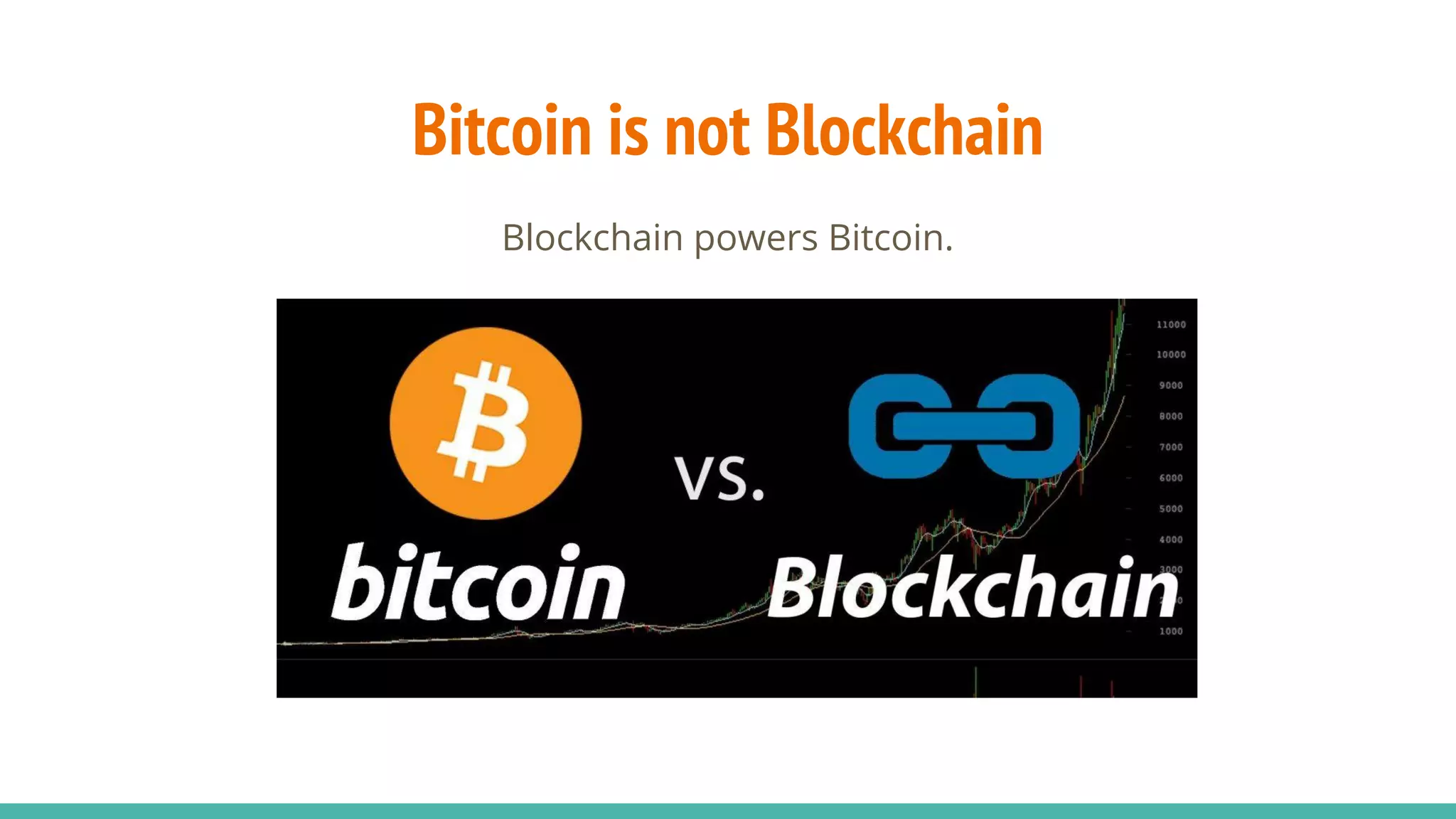
Bitcoin is not Blockchain
Blockchain powers Bitcoin.
Why we need blockchain?
#. Bring Trust : To establish trust between ourselves, we depend on individual
third parties such as banks, land registries, government etc.
#. Decentralization: Chances of error, mistakes and corruption can happen
in centralized control systems.
#. Remove Middle Man : They always comes with somewhat risk and cost.
History
Satoshi Nakamoto published a whitepaper on 31st October 2008 Bitcoin: A
Peer to Peer Electronic cash system.
The invention of the blockchain for bitcoin made it the first digital currency to
solve the double spending problem without the need of a trusted authority or
central server.
The satoshi is currently the smallest unit of the bitcoin currency recorded on
the blockchain. It is a one hundred millionth of a single bitcoin (0.00000001
BTC)
Properties of Blockchain
#. An open, immutable and distributed database/ledger.
#. Disintermediation - P2P
#. Consensus based - Hack proof
#. Trustless transfer of value - Transactions
#. No central authority.
#. Chained by Cryptography.
Definition : What it is?
A Distributed Ledger of Transactions, stored as Immutable Blocks that are
connected to one another hence forming a Chain, the Validity of which has
been agreed upon by Peers on a Decentralised network secured by
Cryptography.
Few Definitions
Node: It refers to client who owns the block.
Transaction: Transfer of something from A to B
Block: Bundle of transactions.
Miners: Burns energy to create blocks, get rewarded by Block Reward +
transaction fees.
Block Reward: New coins created with each block, goes to miner.
Transaction Fees: Small percentage of transaction value, which goes to the
miner.
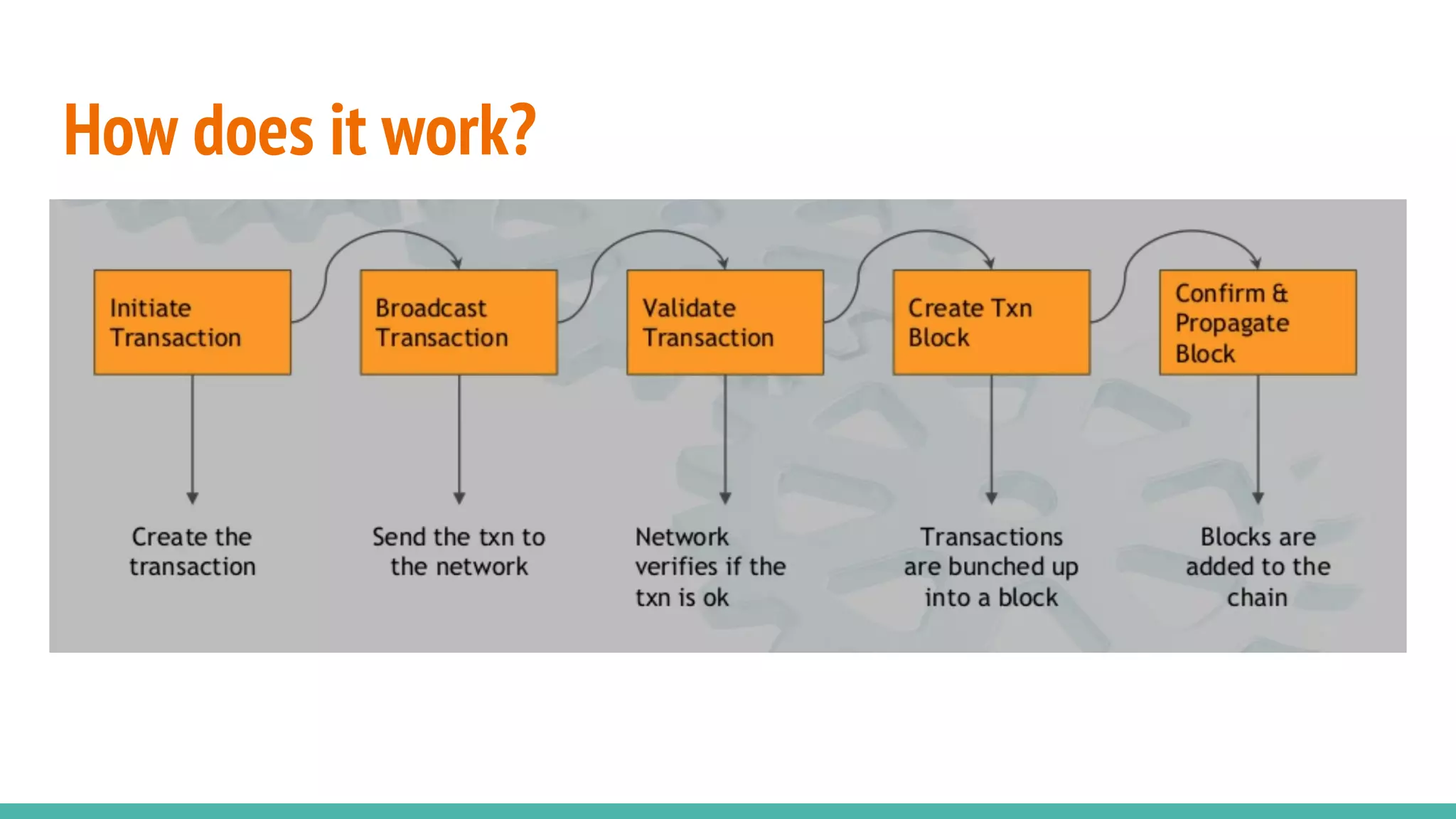
How does it work?
What is Node?
#. A node is a client, which owns the block.
#. A copy of the ledger operated by a participant of the blockchain network.
#. It contains one or more than one account.
#. Miner(Account) mines on the specific node to whom they belongs.
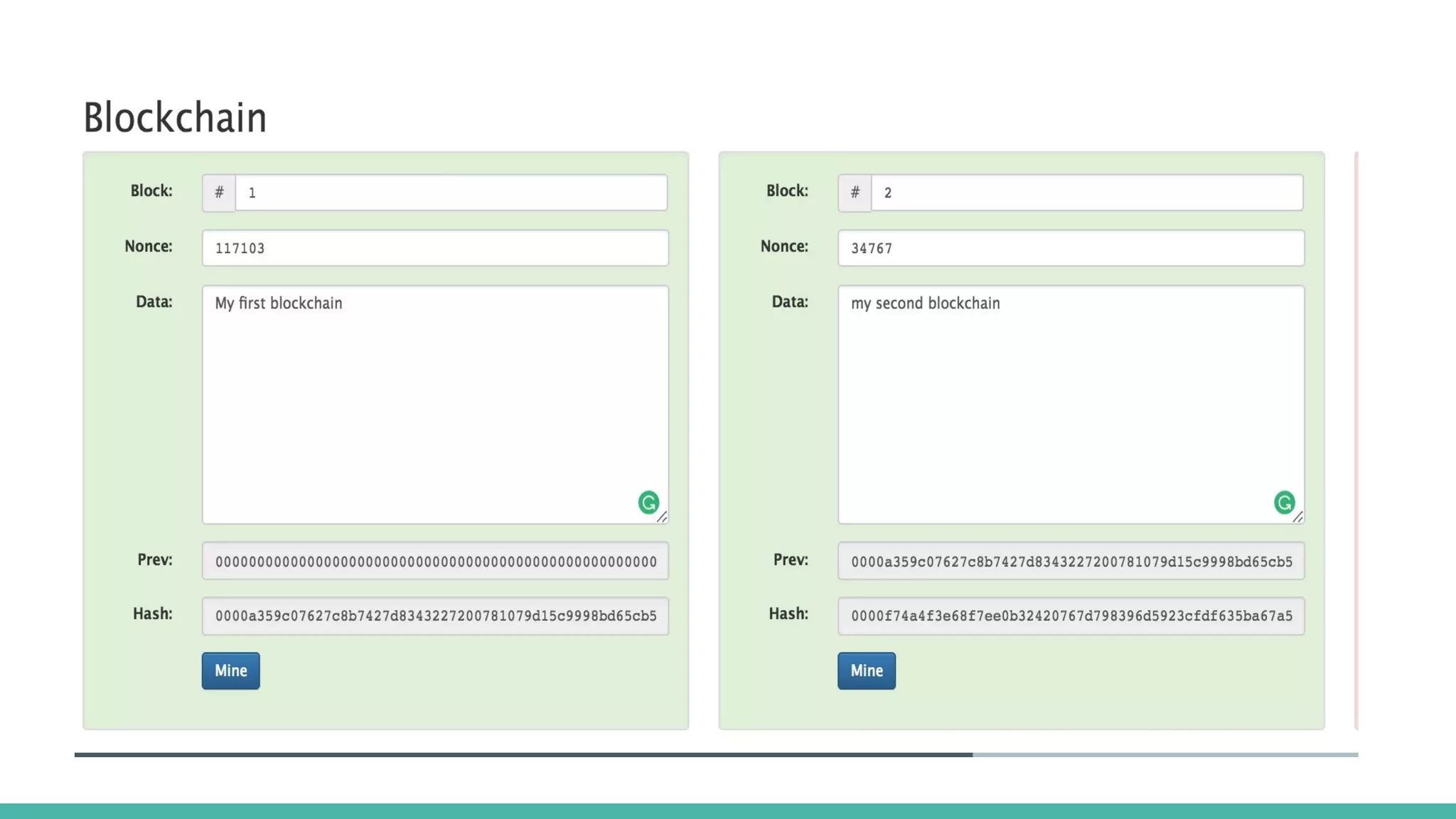
What is a block?
#. Bundle of Transactions.
#. Contains previous block hash.
#. All blocks are linked using their hash.
#. Data can’t be changed in one block without breaking the chain.
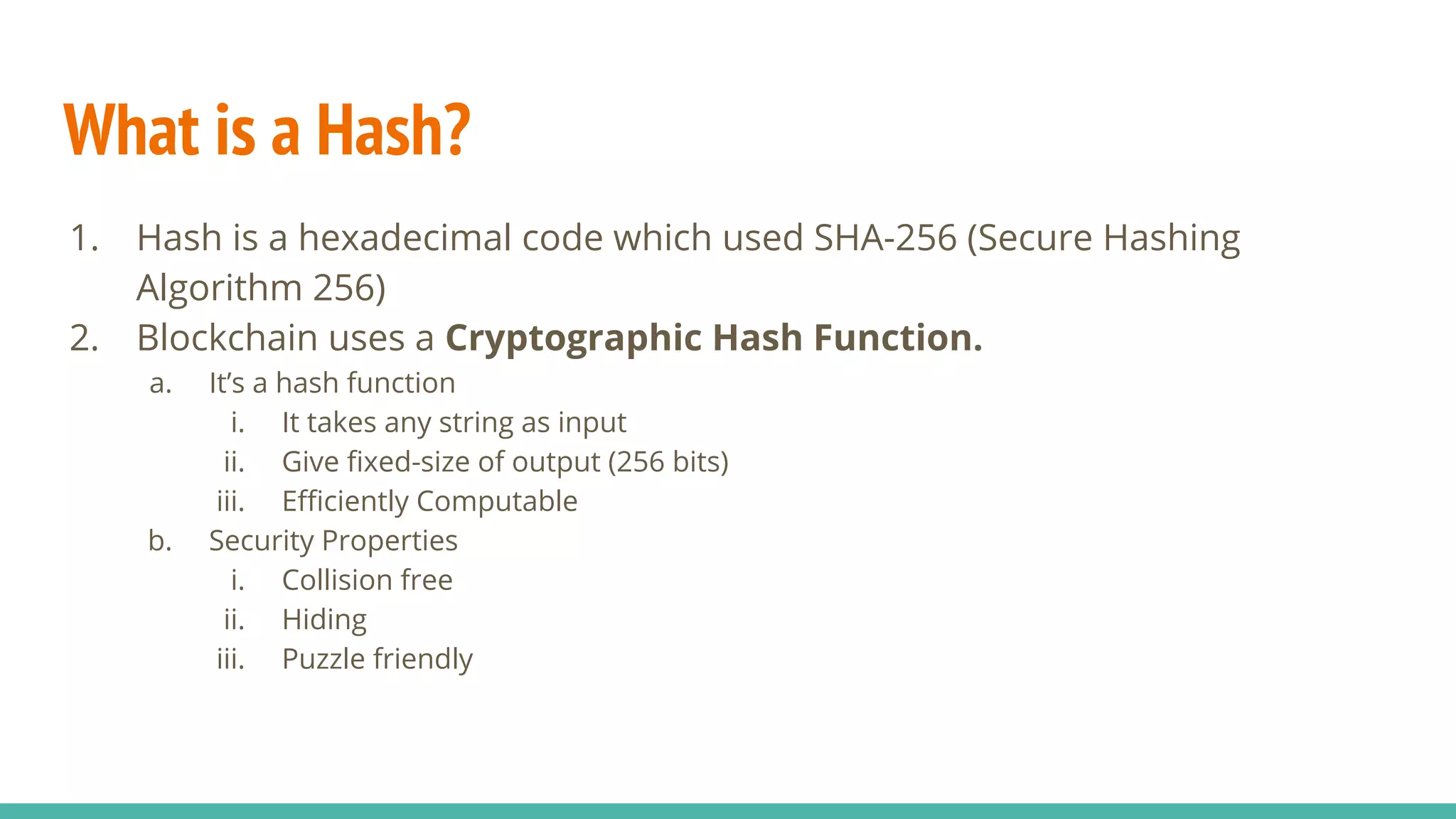
What is a Hash?
1. Hash is a hexadecimal code which used SHA-256 (Secure Hashing
Algorithm 256)
2. Blockchain uses a Cryptographic Hash Function.
a. It’s a hash function
i. It takes any string as input
ii. Give fixed-size of output (256 bits)
iii. Efficiently Computable
b. Security Properties
i. Collision free
ii. Hiding
iii. Puzzle friendly
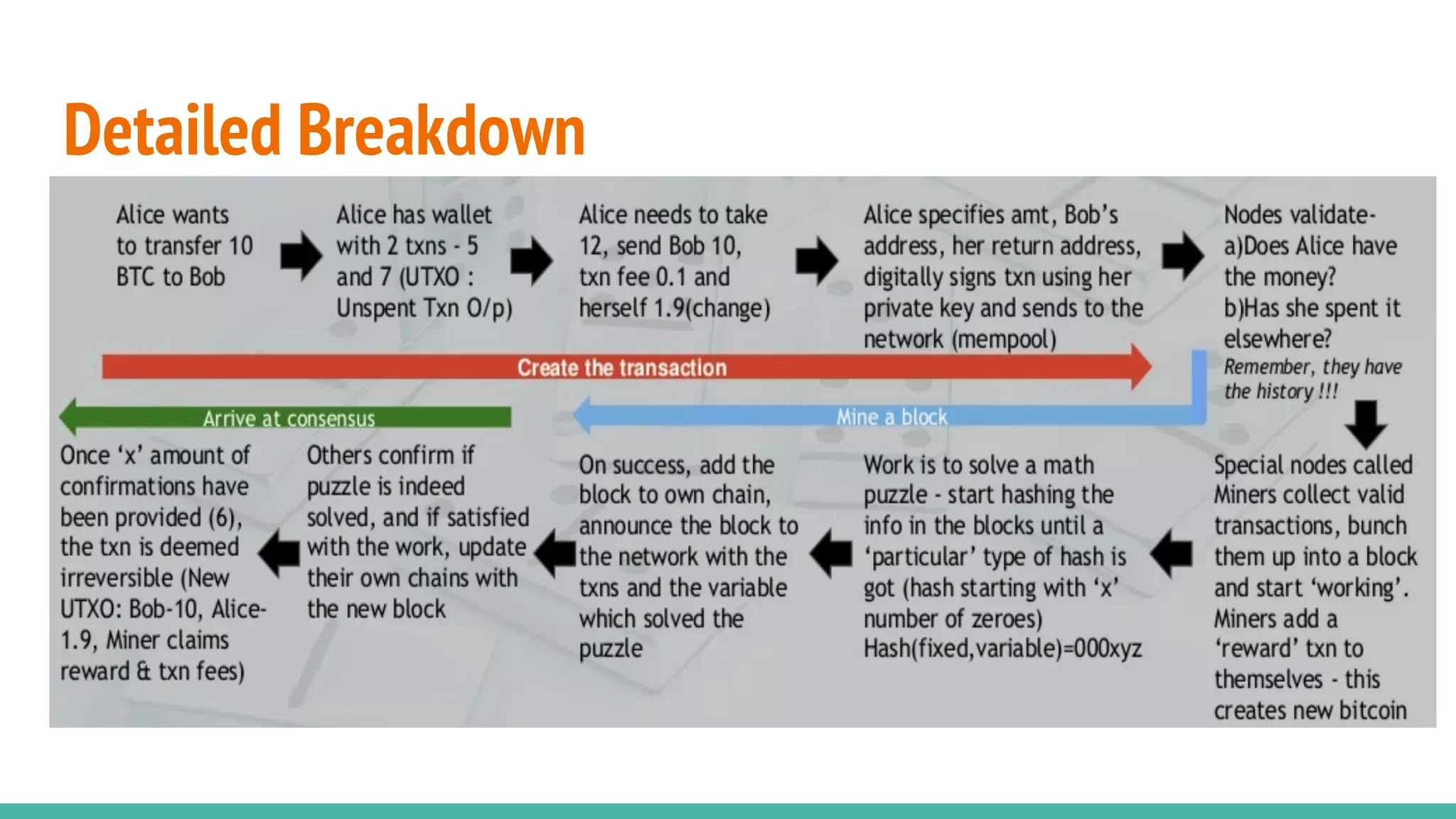
Detailed Breakdown
Mining is the process by which transactions are verified and added to a
blockchain.
Difficulty in Proof-of-Work mining, is how hard it is to verify blocks in a
blockchain network
Proof of Work is a system that ties mining capability to computational power.
When a block is successfully hashed, the hashing must have taken some time
and computational effort and hashed block is considered proof of work.
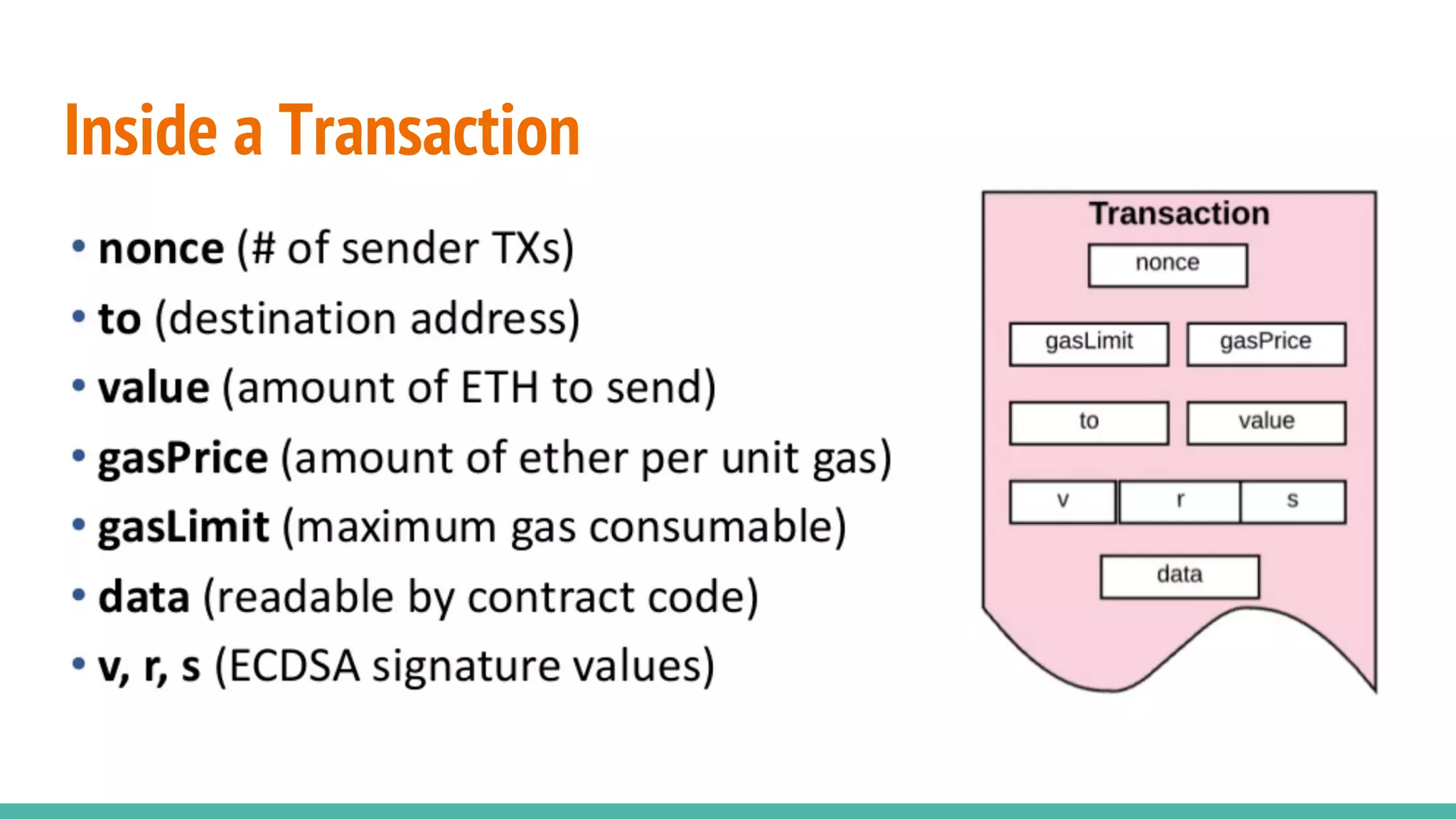
Inside a Transaction
Type of Blockchain Networks
#. Public + Permissionless Blockchains. Ex: Bitcoin, Ethereum, Litecoin
#. Private + Permissioned Blockchains. Ex: Multichain, Monax
#. Consortium Blockchains . Ex: R3, EWF, Corda
Blockchain Networks
#. Bitcoin Core
#. Ethereum
#. Ripple
#. Lisk
#. Corda
#. Hyperledger
Use Cases
#. Voting & Governance
#. Supply Chain management.
#. Subsidy distribution/ Crowdfunding.
#. Real time money transfer.
#. Audit Logs
#. Sharing Economy.
References
https://www.youtube.com/watch?v=_160oMzblY8
https://www.youtube.com/watch?v=93E_GzvpMA0
https://anders.com/blockchain
https://www.slideshare.net/feronera/blockchain-introduction-80908060
https://blockgeeks.com/guides/what-is-hashing/
https://www.quandl.com/data/BCHAIN/NTRBL-Bitcoin-Number-of-Transaction-per-Block
Thank You :)

An Introduction to Blockchain

  • 1.
  • 2.
    Agenda #. What isBlockchain #. Definition & Properties #. How it works #. Node/Block/Hash #. Mining and Proof-of-Work #. Inside a Transaction. #. What is a block
  • 3.
    For Every ComplexProblem, There Is an Answer That Is Clear, Simple, and Wrong. H.L. Mencken
  • 4.
    Bitcoin is notBlockchain Blockchain powers Bitcoin.
  • 5.
    Why we needblockchain? #. Bring Trust : To establish trust between ourselves, we depend on individual third parties such as banks, land registries, government etc. #. Decentralization: Chances of error, mistakes and corruption can happen in centralized control systems. #. Remove Middle Man : They always comes with somewhat risk and cost.
  • 6.
    History Satoshi Nakamoto publisheda whitepaper on 31st October 2008 Bitcoin: A Peer to Peer Electronic cash system. The invention of the blockchain for bitcoin made it the first digital currency to solve the double spending problem without the need of a trusted authority or central server. The satoshi is currently the smallest unit of the bitcoin currency recorded on the blockchain. It is a one hundred millionth of a single bitcoin (0.00000001 BTC)
  • 7.
    Properties of Blockchain #.An open, immutable and distributed database/ledger. #. Disintermediation - P2P #. Consensus based - Hack proof #. Trustless transfer of value - Transactions #. No central authority. #. Chained by Cryptography.
  • 8.
    Definition : Whatit is? A Distributed Ledger of Transactions, stored as Immutable Blocks that are connected to one another hence forming a Chain, the Validity of which has been agreed upon by Peers on a Decentralised network secured by Cryptography.
  • 9.
    Few Definitions Node: Itrefers to client who owns the block. Transaction: Transfer of something from A to B Block: Bundle of transactions. Miners: Burns energy to create blocks, get rewarded by Block Reward + transaction fees. Block Reward: New coins created with each block, goes to miner. Transaction Fees: Small percentage of transaction value, which goes to the miner.
  • 10.
  • 11.
    What is Node? #.A node is a client, which owns the block. #. A copy of the ledger operated by a participant of the blockchain network. #. It contains one or more than one account. #. Miner(Account) mines on the specific node to whom they belongs.
  • 12.
    What is ablock? #. Bundle of Transactions. #. Contains previous block hash. #. All blocks are linked using their hash. #. Data can’t be changed in one block without breaking the chain.
  • 13.
    What is aHash? 1. Hash is a hexadecimal code which used SHA-256 (Secure Hashing Algorithm 256) 2. Blockchain uses a Cryptographic Hash Function. a. It’s a hash function i. It takes any string as input ii. Give fixed-size of output (256 bits) iii. Efficiently Computable b. Security Properties i. Collision free ii. Hiding iii. Puzzle friendly
  • 15.
  • 16.
    Mining is theprocess by which transactions are verified and added to a blockchain. Difficulty in Proof-of-Work mining, is how hard it is to verify blocks in a blockchain network Proof of Work is a system that ties mining capability to computational power. When a block is successfully hashed, the hashing must have taken some time and computational effort and hashed block is considered proof of work.
  • 17.
  • 18.
    Type of BlockchainNetworks #. Public + Permissionless Blockchains. Ex: Bitcoin, Ethereum, Litecoin #. Private + Permissioned Blockchains. Ex: Multichain, Monax #. Consortium Blockchains . Ex: R3, EWF, Corda
  • 19.
    Blockchain Networks #. BitcoinCore #. Ethereum #. Ripple #. Lisk #. Corda #. Hyperledger
  • 20.
    Use Cases #. Voting& Governance #. Supply Chain management. #. Subsidy distribution/ Crowdfunding. #. Real time money transfer. #. Audit Logs #. Sharing Economy.
  • 21.
  • 22.