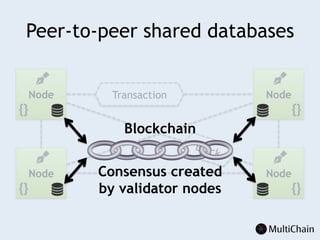
This document discusses private blockchains and how they differ from public blockchains. It explains that private blockchains are permissioned shared databases that use blockchain technology like cryptography and consensus algorithms to provide trust between entities that have limited trust. While they don't have the same properties as public blockchains like immutability and anonymity, private blockchains can enable use cases like financial settlement, provenance tracking, and interorganizational record keeping where a centralized database is not ideal due to lack of trust or need for disintermediation. The document addresses criticisms of private blockchains and blockchain technology in general. It also introduces the MultiChain platform for deploying private blockchains.
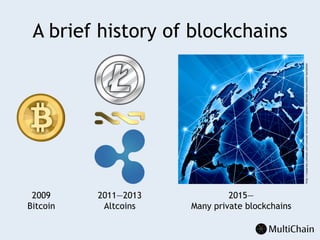
A brief historyof blockchains
2009
Bitcoin
2011—2013
Altcoins
2015—
Many private blockchains
http://corporate.comcast.com/comcast-voices/comcast-sponsors-internet-measurement-hackathon
3.
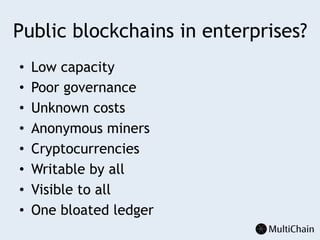
Public blockchains inenterprises?
• Low capacity
• Poor governance
• Unknown costs
• Anonymous miners
• Cryptocurrencies
• Writable by all
• Visible to all
• One bloated ledger
4.
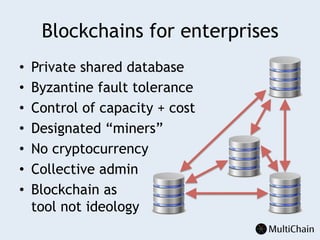
Blockchains for enterprises
• Private shared database
• Byzantine fault tolerance
• Control of capacity + cost
• Designated “miners”
• No cryptocurrency
• Collective admin
• Blockchain as
tool not ideology
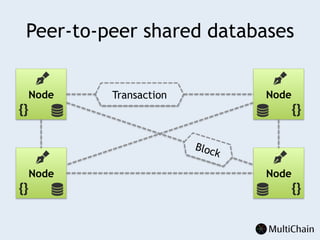
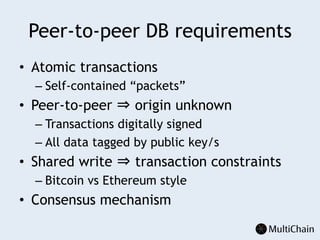
Peer-to-peer DB requirements
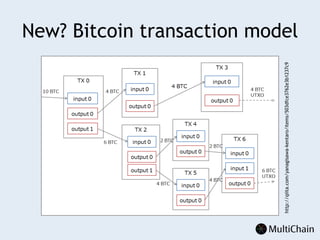
• Atomic transactions
– Self-contained “packets”
• Peer-to-peer ⇒ origin unknown
– Transactions digitally signed
– All data tagged by public key/s
• Shared write ⇒ transaction constraints
– Bitcoin vs Ethereum style
• Consensus mechanism
10.
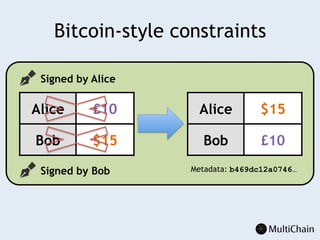
Signed by Bob
Signedby Alice
Alice £10
Bob $15
Alice $15
Bob £10
Bitcoin-style constraints
Metadata: b469dc12a0746…
11.
Ethereum-style constraints
from =msg.sender
fromvalue = contract.storage[from]
to = msg.data[0]
value = msg.data[1]
if fromvalue >= value:
contract.storage[from] -= value
contract.storage[to] += value
return(1)
else:
return(0)
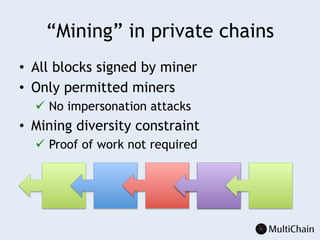
“Mining” in privatechains
• All blocks signed by miner
• Only permitted miners
ü No impersonation attacks
• Mining diversity constraint
ü Proof of work not required
15.
On immutability
• Publicblockchains
– Secured by hashing power
– Mutable by 51% of hashrate
– Threat: someone rich (e.g. a government)
• Private blockchains
– Secured by distributed consensus
– Mutable by ≥51% of validators
– Threat: validator collusion
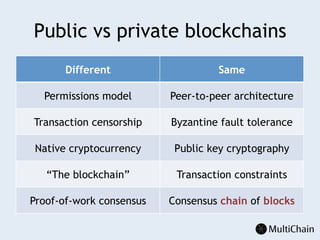
Public vs privateblockchains
Different Same
Permissions model Peer-to-peer architecture
Transaction censorship Byzantine fault tolerance
Native cryptocurrency Public key cryptography
“The blockchain” Transaction constraints
Proof-of-work consensus Consensus chain of blocks
18.
Public vs privateblockchains
Different Same
Permissions model Peer-to-peer architecture
Transaction censorship Byzantine fault tolerance
Native cryptocurrency Public key cryptography
“The blockchain” Transaction constraints
Proof-of-work consensus Consensus chain of blocks
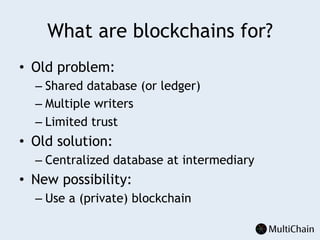
What are blockchainsfor?
• Old problem:
– Shared database (or ledger)
– Multiple writers
– Limited trust
• Old solution:
– Centralized database at intermediary
• New possibility:
– Use a (private) blockchain
22.
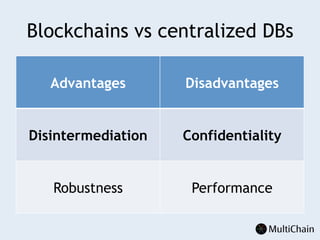
Blockchains vs centralizedDBs
Advantages Disadvantages
Disintermediation Confidentiality
Robustness Performance
23.
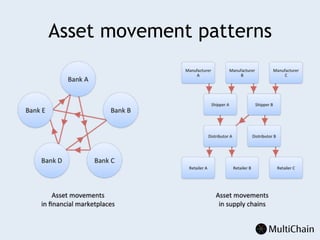
Post-trade settlement?
• Interbankblockchain
• Issue any asset on chain
• Rapid settlement
• Delivery versus payment
• No need for reconciliation
• Regulatory transparency
24.
Post-trade settlement?
• Interbankblockchain
• Issue any asset on chain
• Rapid settlement
• Delivery versus payment
• No need for reconciliation
• Regulatory transparency
Confidentiality
25.
Strong blockchain usecases
• Lightweight financial systems
• Provenance tracking
• Interorganizational record keeping
– Multiparty data aggregation
26.
Lightweight finance
• Anyasset can be tokenized on blockchain
– Tokens issued by trusted entity/s
– Token confers right of redemption
• Disintermediates centralized control
– More secure and cheaper
• Confidentiality limits applications
– Small financial trading circles
– Gift cards, loyalty points
27.
Provenance tracking
• Digitalcertificate of authenticity
– Physical transfer ⇒ token transfer
– Verifiable chain of custody
• Disintermediates risk of fraud
– Collusion cannot corrupt
• Confidentiality via multiple addresses
– Fewer transactions between competitors
– Regulation can still be a concern
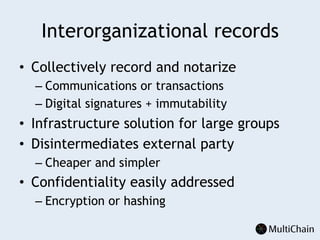
Interorganizational records
• Collectivelyrecord and notarize
– Communications or transactions
– Digital signatures + immutability
• Infrastructure solution for large groups
• Disintermediates external party
– Cheaper and simpler
• Confidentiality easily addressed
– Encryption or hashing
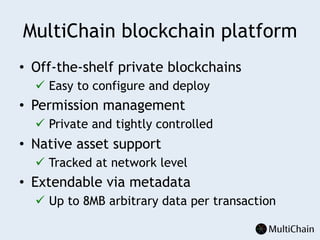
MultiChain blockchain platform
• Off-the-shelf private blockchains
ü Easy to configure and deploy
• Permission management
ü Private and tightly controlled
• Native asset support
ü Tracked at network level
• Extendable via metadata
ü Up to 8MB arbitrary data per transaction