what is blockchain?
1. Decentralization: Blockchain is a decentralized ledger technology that
enables peer-to-peer transactions without the need for intermediaries like
banks or governments. This decentralization ensures that no single entity has
control over the network, promoting transparency and trust among
participants.
2. Immutable and Transparent: Once data is recorded on a blockchain, it
cannot be altered or deleted. This immutability ensures the integrity of the
data, making blockchain a reliable solution for recording transactions and
maintaining a transparent record of events.
3. Cryptographic Security: Blockchain uses cryptographic techniques to secure
transactions and control access to the network. Each block in the chain is
linked using cryptographic hashes, and transactions are validated through
consensus mechanisms like Proof of Work (PoW) or Proof of Stake (PoS),
ensuring the authenticity and security of the network.
4. Smart Contracts: Smart contracts are self-executing contracts with the terms
of the agreement directly written into code. These contracts automatically
execute and enforce themselves when predefined conditions are met,
eliminating the need for intermediaries and reducing transaction costs.
5. Use Cases: Blockchain technology has a wide range of applications beyond
cryptocurrencies. It is being used in industries such as finance, supply chain
management, healthcare, voting systems, and more, to streamline processes,
enhance security, and increase efficiency.
How blockchain works?
1. Decentralized Network: A blockchain network consists of a decentralized
network of nodes (computers) connected to each other. Each node has a copy
of the entire blockchain ledger.
2. Transactions: When a user initiates a transaction, it is broadcasted to the
network. This transaction contains information such as sender, receiver, and
the amount of the transaction.
3. Validation: Nodes on the network verify the validity of the transaction using
consensus mechanisms like Proof of Work (PoW), Proof of Stake (PoS), or
other variants. The specific consensus mechanism depends on the blockchain
protocol being used.
4. Block Formation: Validated transactions are grouped together into a block.
Each block contains a cryptographic hash of the previous block, creating a
chain of blocks - hence the term "blockchain."
5. Consensus: Once a block is formed, it is added to the blockchain through a
consensus mechanism. This ensures that all nodes agree on the order and
validity of transactions, maintaining the integrity of the ledger.
6. Immutable Ledger: Once added to the blockchain, a block cannot be altered
or deleted. This immutability ensures the security and integrity of the ledger,
as any attempt to tamper with past transactions would require consensus
from the majority of the network, which is highly unlikely in a decentralized
system.
7. Distribution: The blockchain ledger is distributed across all nodes in the
network. This distribution ensures that no single entity has control over the
network, making it resistant to censorship and tampering.
How blckchain transaction takes place?
1. Initiation: A user initiates a transaction by creating a digital record containing
details such as the sender's address, recipient's address, and the amount of
the transaction.
2. Broadcasting: The transaction is broadcasted to all nodes (computers) in the
blockchain network.
3. Verification: Each node independently verifies the transaction's validity. This
verification process typically involves checking if the sender has sufficient
funds and ensuring that the transaction adheres to the network's rules and
protocols.
4. Validation: Valid transactions are grouped together into a block by miners (or
validators) who compete to solve a complex mathematical puzzle. This
process, known as mining, requires computational power and ensures the
security of the network.
5. Consensus: Once a miner successfully solves the puzzle and creates a new
block, they broadcast it to the network. Other nodes in the network then
validate the block and agree to add it to the blockchain through a consensus
mechanism, such as Proof of Work (PoW) or Proof of Stake (PoS).
6. Adding to the Blockchain: The validated block is added to the existing
blockchain, forming a chronological and immutable record of transactions.
Each block contains a reference to the previous block, creating a chain of
blocks that cannot be altered without consensus from the majority of the
network.
7. Confirmation: Once added to the blockchain, the transaction is considered
confirmed. The number of confirmations required may vary depending on the
blockchain protocol, but multiple confirmations increase the level of security
and trust in the transaction.
Through this process, blockchain technology enables secure, transparent, and
decentralized transactions without the need for intermediaries, such as ban
What are the key componets of blockchain?
1. Blocks: Blocks are the units of data that store transactions. Each block
typically contains a cryptographic hash of the previous block, transaction data,
and a timestamp.
2. Blockchain: The blockchain itself is a distributed ledger that consists of a
chain of blocks. It maintains a chronological and immutable record of all
transactions made on the network.
3. Decentralized Network: A blockchain operates on a decentralized network of
nodes (computers) that are interconnected. Each node maintains a copy of the
entire blockchain ledger and participates in the validation and consensus
process.
4. Consensus Mechanism: Consensus mechanisms are protocols that enable
nodes in the network to agree on the validity of transactions and the order in
which they are added to the blockchain. Common consensus mechanisms
include Proof of Work (PoW), Proof of Stake (PoS), and variations thereof.
5. Cryptographic Hashing: Cryptographic hashing is used to link blocks
together in a blockchain. Each block contains a hash of the previous block,
creating a chain of blocks that cannot be tampered with without altering
subsequent blocks.
6. Public/Private Key Cryptography: Public/private key cryptography is used to
secure transactions and provide ownership of digital assets on the blockchain.
Users have a pair of cryptographic keys: a public key for encryption and a
private key for decryption and digital signature.
7. Smart Contracts: Smart contracts are self-executing contracts with predefined
rules and conditions written in code. They automatically execute and enforce
agreements when specified conditions are met, without the need for
intermediaries.
8. Network Protocol: The network protocol governs how nodes communicate
with each other and how data is transmitted across the blockchain network. It
ensures the integrity and security of the network.
Importance and real life use cases of blochchain technology in stepwise manner
1. Security: Blockchain offers heightened security due to its decentralized and
immutable nature. Each block is linked to the previous one using
cryptographic hashes, making it extremely difficult for malicious actors to alter
past transactions.
2. Transparency: The transparent nature of blockchain enables all participants to
view transaction history in real-time. This transparency fosters trust among
users and reduces the risk of fraud or manipulation.
3. Decentralization: Blockchain eliminates the need for intermediaries by
enabling peer-to-peer transactions. This decentralization reduces dependency
on centralized authorities, resulting in more efficient and cost-effective
processes.
4. Smart Contracts: Blockchain platforms like Ethereum allow for the creation
and execution of smart contracts. These self-executing contracts automatically
enforce terms and conditions written in code, streamlining processes and
reducing the need for manual intervention.
5. Supply Chain Management: Blockchain is revolutionizing supply chain
management by providing transparency and traceability throughout the entire
supply chain. Companies can track the movement of goods from
manufacturer to end consumer, ensuring authenticity and reducing the risk of
counterfeit products.
Real life use cases
1. Financial Services: Blockchain technology is disrupting the financial services
industry by offering faster, cheaper, and more secure transactions.
Cryptocurrencies like Bitcoin and Ethereum enable borderless payments and
remittances, bypassing traditional banking systems.
2. Healthcare: Blockchain is being used in healthcare to securely store and
manage patient records. Patients have greater control over their data, while
healthcare providers can access accurate and up-to-date information, leading
to improved patient care and outcomes.
3. Voting Systems: Blockchain has the potential to transform voting systems by
providing a secure and transparent way to conduct elections. Blockchain-
based voting platforms ensure the integrity of the voting process, prevent
voter fraud, and increase voter turnout.
4. Intellectual Property Protection: Blockchain can be used to timestamp and
authenticate digital assets, such as intellectual property rights, patents, and
copyrights. This ensures the integrity and ownership of digital assets, reducing
the risk of piracy and infringement.
5. Tokenization of Assets: Blockchain enables the tokenization of real-world
assets, such as real estate, art, and commodities. Tokenization divides assets
into digital tokens, making them more accessible and liquid for investors.
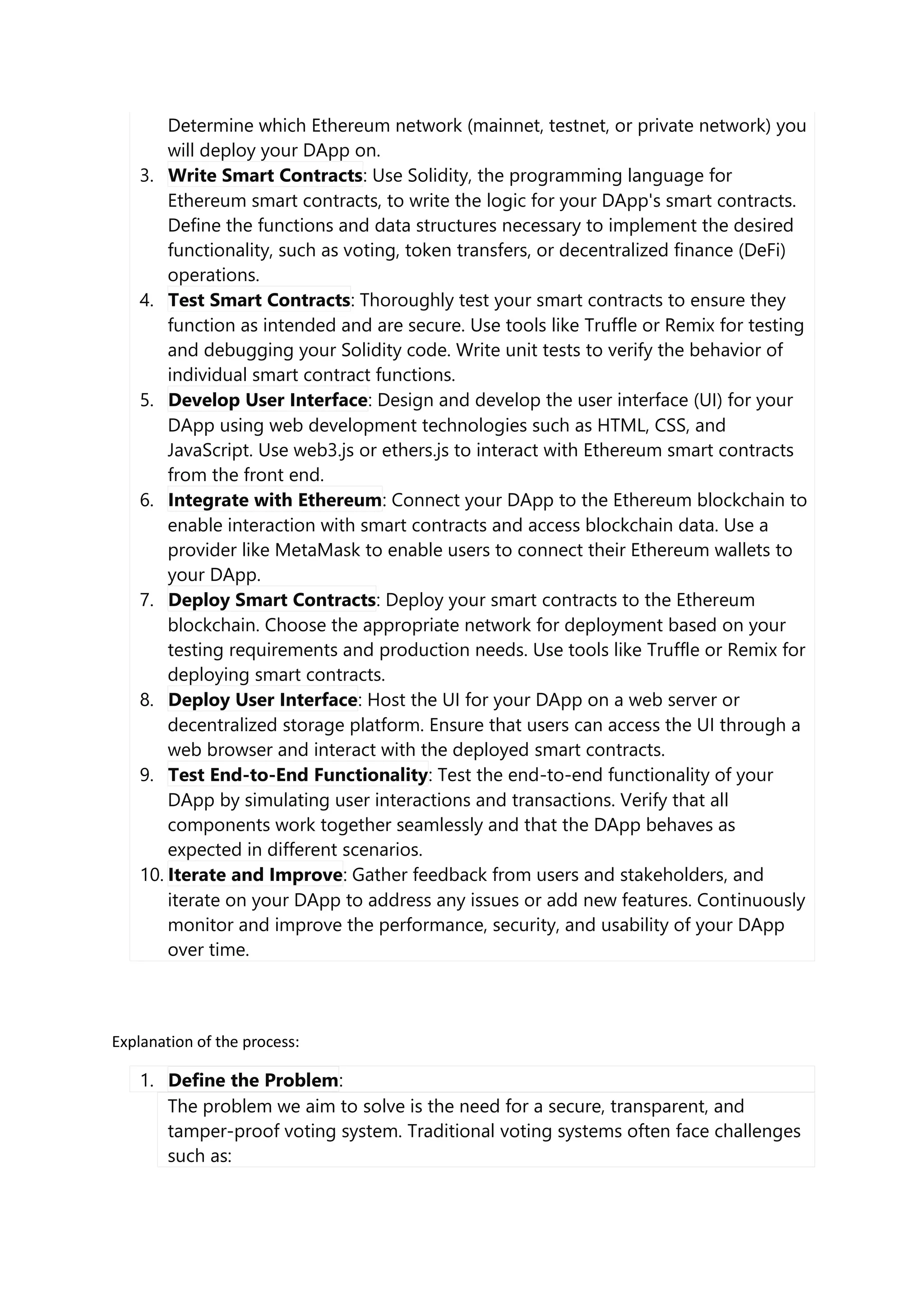
Building a decentralized application (DApp) using Solidity and Ethereum involves several key
steps. Here's a high-level overview of the process:
1. Define the Problem: Clearly define the problem your DApp aims to solve or
the functionality it will provide. Identify the specific use case and the target
audience for your application.
2. Design the Architecture: Plan the architecture of your DApp, including the
smart contracts, user interface, and interactions with the Ethereum blockchain.
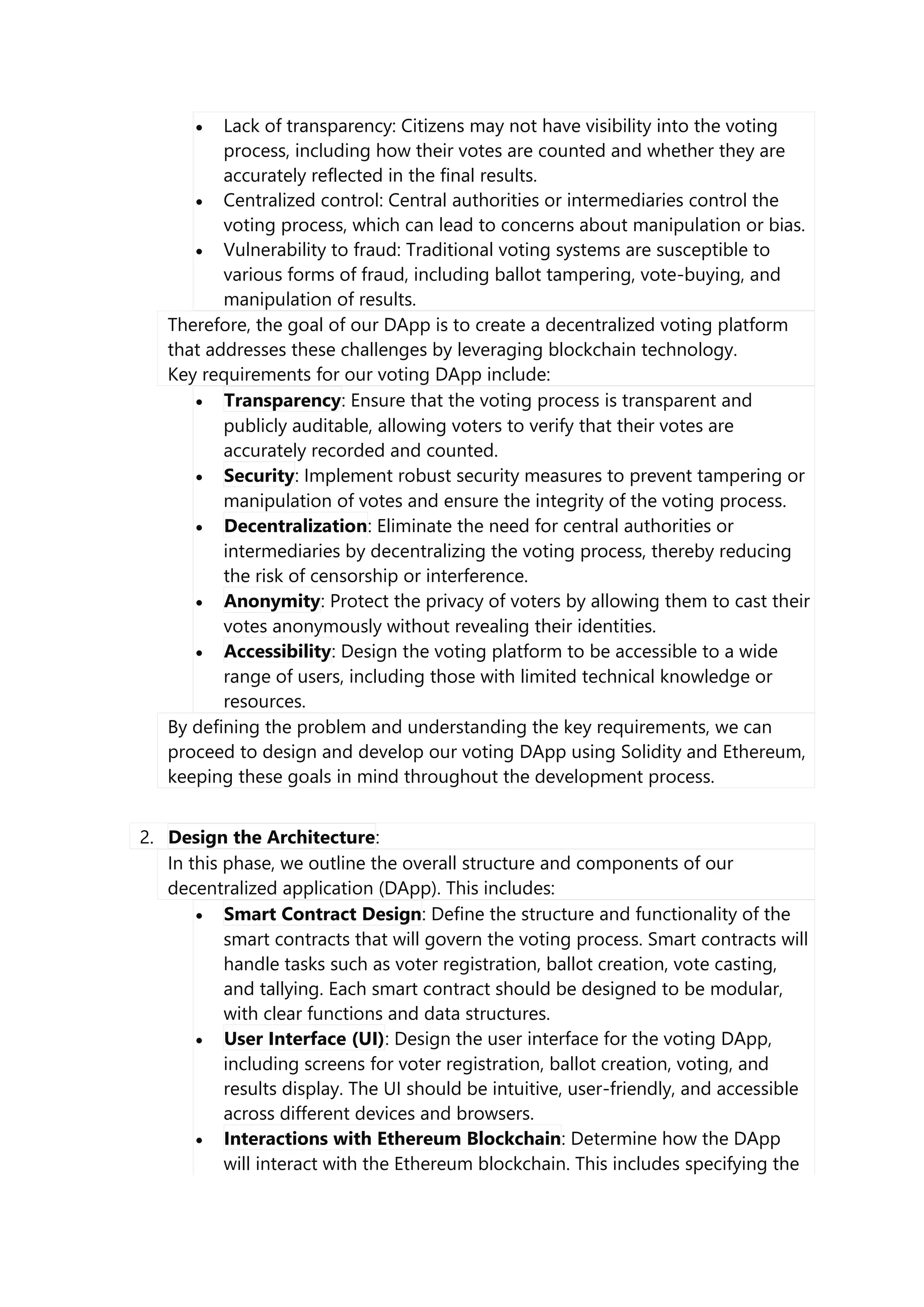
Determine which Ethereum network (mainnet, testnet, or private network) you
will deploy your DApp on.
3. Write Smart Contracts: Use Solidity, the programming language for
Ethereum smart contracts, to write the logic for your DApp's smart contracts.
Define the functions and data structures necessary to implement the desired
functionality, such as voting, token transfers, or decentralized finance (DeFi)
operations.
4. Test Smart Contracts: Thoroughly test your smart contracts to ensure they
function as intended and are secure. Use tools like Truffle or Remix for testing
and debugging your Solidity code. Write unit tests to verify the behavior of
individual smart contract functions.
5. Develop User Interface: Design and develop the user interface (UI) for your
DApp using web development technologies such as HTML, CSS, and
JavaScript. Use web3.js or ethers.js to interact with Ethereum smart contracts
from the front end.
6. Integrate with Ethereum: Connect your DApp to the Ethereum blockchain to
enable interaction with smart contracts and access blockchain data. Use a
provider like MetaMask to enable users to connect their Ethereum wallets to
your DApp.
7. Deploy Smart Contracts: Deploy your smart contracts to the Ethereum
blockchain. Choose the appropriate network for deployment based on your
testing requirements and production needs. Use tools like Truffle or Remix for
deploying smart contracts.
8. Deploy User Interface: Host the UI for your DApp on a web server or
decentralized storage platform. Ensure that users can access the UI through a
web browser and interact with the deployed smart contracts.
9. Test End-to-End Functionality: Test the end-to-end functionality of your
DApp by simulating user interactions and transactions. Verify that all
components work together seamlessly and that the DApp behaves as
expected in different scenarios.
10. Iterate and Improve: Gather feedback from users and stakeholders, and
iterate on your DApp to address any issues or add new features. Continuously
monitor and improve the performance, security, and usability of your DApp
over time.
Explanation of the process:
1. Define the Problem:
The problem we aim to solve is the need for a secure, transparent, and
tamper-proof voting system. Traditional voting systems often face challenges
such as:
 Lack of transparency: Citizens may not have visibility into the voting
process, including how their votes are counted and whether they are
accurately reflected in the final results.
 Centralized control: Central authorities or intermediaries control the
voting process, which can lead to concerns about manipulation or bias.
 Vulnerability to fraud: Traditional voting systems are susceptible to
various forms of fraud, including ballot tampering, vote-buying, and
manipulation of results.
Therefore, the goal of our DApp is to create a decentralized voting platform
that addresses these challenges by leveraging blockchain technology.
Key requirements for our voting DApp include:
 Transparency: Ensure that the voting process is transparent and
publicly auditable, allowing voters to verify that their votes are
accurately recorded and counted.
 Security: Implement robust security measures to prevent tampering or
manipulation of votes and ensure the integrity of the voting process.
 Decentralization: Eliminate the need for central authorities or
intermediaries by decentralizing the voting process, thereby reducing
the risk of censorship or interference.
 Anonymity: Protect the privacy of voters by allowing them to cast their
votes anonymously without revealing their identities.
 Accessibility: Design the voting platform to be accessible to a wide
range of users, including those with limited technical knowledge or
resources.
By defining the problem and understanding the key requirements, we can
proceed to design and develop our voting DApp using Solidity and Ethereum,
keeping these goals in mind throughout the development process.
2. Design the Architecture:
In this phase, we outline the overall structure and components of our
decentralized application (DApp). This includes:
 Smart Contract Design: Define the structure and functionality of the
smart contracts that will govern the voting process. Smart contracts will
handle tasks such as voter registration, ballot creation, vote casting,
and tallying. Each smart contract should be designed to be modular,
with clear functions and data structures.
 User Interface (UI): Design the user interface for the voting DApp,
including screens for voter registration, ballot creation, voting, and
results display. The UI should be intuitive, user-friendly, and accessible
across different devices and browsers.
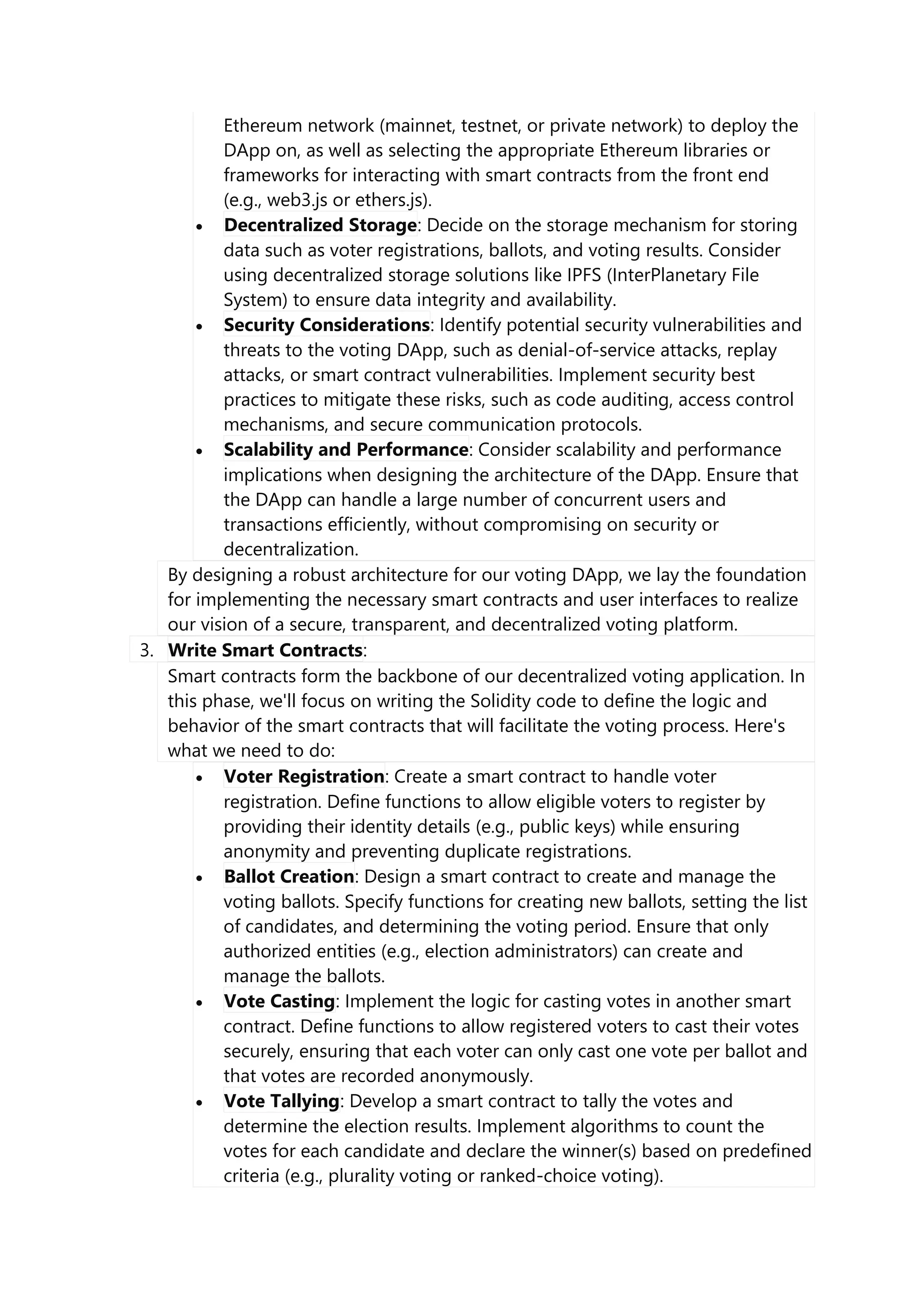
 Interactions with Ethereum Blockchain: Determine how the DApp
will interact with the Ethereum blockchain. This includes specifying the
Ethereum network (mainnet, testnet, or private network) to deploy the
DApp on, as well as selecting the appropriate Ethereum libraries or
frameworks for interacting with smart contracts from the front end
(e.g., web3.js or ethers.js).
 Decentralized Storage: Decide on the storage mechanism for storing
data such as voter registrations, ballots, and voting results. Consider
using decentralized storage solutions like IPFS (InterPlanetary File
System) to ensure data integrity and availability.
 Security Considerations: Identify potential security vulnerabilities and
threats to the voting DApp, such as denial-of-service attacks, replay
attacks, or smart contract vulnerabilities. Implement security best
practices to mitigate these risks, such as code auditing, access control
mechanisms, and secure communication protocols.
 Scalability and Performance: Consider scalability and performance
implications when designing the architecture of the DApp. Ensure that
the DApp can handle a large number of concurrent users and
transactions efficiently, without compromising on security or
decentralization.
By designing a robust architecture for our voting DApp, we lay the foundation
for implementing the necessary smart contracts and user interfaces to realize
our vision of a secure, transparent, and decentralized voting platform.
3. Write Smart Contracts:
Smart contracts form the backbone of our decentralized voting application. In
this phase, we'll focus on writing the Solidity code to define the logic and
behavior of the smart contracts that will facilitate the voting process. Here's
what we need to do:
 Voter Registration: Create a smart contract to handle voter
registration. Define functions to allow eligible voters to register by
providing their identity details (e.g., public keys) while ensuring
anonymity and preventing duplicate registrations.
 Ballot Creation: Design a smart contract to create and manage the
voting ballots. Specify functions for creating new ballots, setting the list
of candidates, and determining the voting period. Ensure that only
authorized entities (e.g., election administrators) can create and
manage the ballots.
 Vote Casting: Implement the logic for casting votes in another smart
contract. Define functions to allow registered voters to cast their votes
securely, ensuring that each voter can only cast one vote per ballot and
that votes are recorded anonymously.
 Vote Tallying: Develop a smart contract to tally the votes and
determine the election results. Implement algorithms to count the
votes for each candidate and declare the winner(s) based on predefined
criteria (e.g., plurality voting or ranked-choice voting).
 Security and Access Control: Incorporate security measures into the
smart contracts to prevent unauthorized access or manipulation of the
voting process. Use access control mechanisms (e.g., modifiers) to
restrict certain functions to authorized users and enforce data integrity
and confidentiality.
 Event Logging: Emit events in the smart contracts to log important
actions and state changes during the voting process. Events provide
transparency and allow external parties to monitor the progress of the
election in real-time.
By writing robust and secure smart contracts, we ensure that the voting
process is transparent, tamper-proof, and resistant to fraud or manipulation.
These smart contracts will serve as the foundation for our decentralized voting
application, enabling voters to participate in elections securely and with
confidence in the integrity of the results.
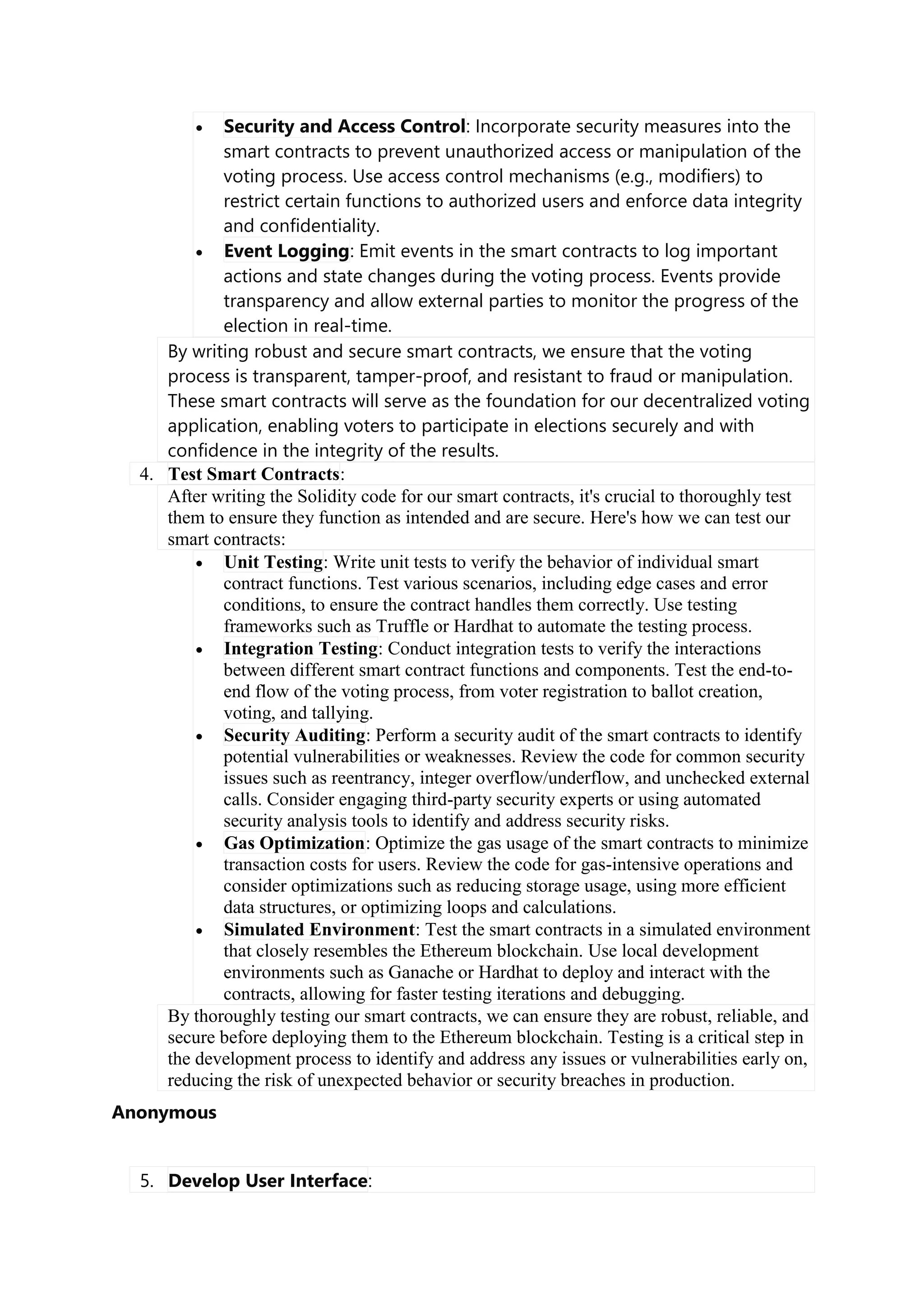
4. Test Smart Contracts:
After writing the Solidity code for our smart contracts, it's crucial to thoroughly test
them to ensure they function as intended and are secure. Here's how we can test our
smart contracts:
 Unit Testing: Write unit tests to verify the behavior of individual smart
contract functions. Test various scenarios, including edge cases and error
conditions, to ensure the contract handles them correctly. Use testing
frameworks such as Truffle or Hardhat to automate the testing process.
 Integration Testing: Conduct integration tests to verify the interactions
between different smart contract functions and components. Test the end-to-
end flow of the voting process, from voter registration to ballot creation,
voting, and tallying.
 Security Auditing: Perform a security audit of the smart contracts to identify
potential vulnerabilities or weaknesses. Review the code for common security
issues such as reentrancy, integer overflow/underflow, and unchecked external
calls. Consider engaging third-party security experts or using automated
security analysis tools to identify and address security risks.
 Gas Optimization: Optimize the gas usage of the smart contracts to minimize
transaction costs for users. Review the code for gas-intensive operations and
consider optimizations such as reducing storage usage, using more efficient
data structures, or optimizing loops and calculations.
 Simulated Environment: Test the smart contracts in a simulated environment
that closely resembles the Ethereum blockchain. Use local development
environments such as Ganache or Hardhat to deploy and interact with the
contracts, allowing for faster testing iterations and debugging.
By thoroughly testing our smart contracts, we can ensure they are robust, reliable, and
secure before deploying them to the Ethereum blockchain. Testing is a critical step in
the development process to identify and address any issues or vulnerabilities early on,
reducing the risk of unexpected behavior or security breaches in production.
Anonymous
5. Develop User Interface:
With the smart contracts tested and ready, the next step is to develop the user
interface (UI) for our decentralized voting application. The UI will allow users
to interact with the smart contracts and participate in the voting process.
Here's what we need to do:
 Design UI Screens: Design the screens and user flows for the voting
application's UI. This includes screens for voter registration, ballot
creation, voting, and viewing election results. Use wireframing or
prototyping tools to visualize the UI design and gather feedback from
stakeholders.
 Implement UI Components: Develop the UI components using web
development technologies such as HTML, CSS, and JavaScript. Use
libraries or frameworks like React.js or Vue.js to build interactive and
responsive user interfaces. Ensure that the UI is accessible and intuitive
for users with varying levels of technical expertise.
 Integrate with Smart Contracts: Connect the UI components to the
Ethereum blockchain and interact with the deployed smart contracts.
Use Ethereum libraries such as web3.js or ethers.js to send transactions
to the smart contracts, read data from the blockchain, and listen for
events emitted by the smart contracts.
 Handle User Authentication: Implement user authentication
mechanisms to verify the identity of voters and ensure the security of
the voting process. Consider using Ethereum wallet providers like
MetaMask for user authentication and transaction signing.
 Provide Feedback and Error Handling: Display informative feedback
messages to users throughout the voting process, including
confirmation messages after successful transactions and error
messages for failed transactions or invalid inputs. Handle errors
gracefully to guide users through the voting process and prevent
confusion or frustration.
 Optimize for Mobile and Desktop: Ensure that the UI is optimized for
both mobile and desktop devices, allowing users to access the voting
application from any device with an internet connection. Use
responsive design techniques to adapt the layout and styling based on
the user's device screen size and orientation.
By developing a user-friendly and intuitive UI for our decentralized voting
application, we can empower users to participate in elections securely and
conveniently, regardless of their technical background or device preferences.
The UI plays a crucial role in facilitating user engagement and adoption of the
voting application, so it's essential to prioritize usability and accessibility
throughout the development process.
The seventh point in building a basic voting app using Solidity and Ethereum would
be:
7. Deploy Smart Contracts:
After testing the smart contracts and developing the user interface, the next
step is to deploy the smart contracts to the Ethereum blockchain. Here's how
we can deploy the smart contracts:
 Select Deployment Network: Decide which Ethereum network to
deploy the smart contracts on. Options include the Ethereum mainnet
(for production use), testnets (such as Ropsten, Rinkeby, or Kovan for
testing), or a private Ethereum network (for development purposes).
 Set up Deployment Environment: Set up the necessary tools and
accounts for deploying the smart contracts. Install a Ethereum client
like Geth or use a service like Infura to interact with the Ethereum
network. Ensure that you have access to an Ethereum account with
sufficient funds to cover deployment costs (gas fees).
 Compile Smart Contracts: Compile the Solidity smart contracts into
bytecode and ABI (Application Binary Interface) artifacts. Use a Solidity
compiler like solc or the Truffle framework to compile the contracts.
Generate the necessary JSON files containing the bytecode and ABI for
each contract.
 Deploy Contracts: Deploy the compiled smart contracts to the chosen
Ethereum network. Use deployment scripts or deployment tools
provided by Ethereum development frameworks like Truffle or Hardhat
to initiate the deployment process. Specify deployment parameters
such as constructor arguments and gas limits.
 Verify Contracts: Optionally, verify the deployed smart contracts on
block explorers like Etherscan to provide transparency and allow users
to inspect the contract source code and bytecode. This step is
recommended for public-facing applications to build trust and
credibility with users.
 Test Deployment: Test the deployed smart contracts to ensure they
function correctly in the live environment. Perform end-to-end testing
of the voting application on the Ethereum blockchain, including user
interactions and smart contract transactions.
 Monitor and Maintain: Monitor the deployed smart contracts for any
issues or anomalies and perform necessary maintenance tasks as
needed. Regularly update the contracts and UI components to
incorporate new features, fix bugs, and address security vulnerabilities.
By deploying the smart contracts to the Ethereum blockchain, we make the
voting application accessible to users worldwide and ensure its integrity,
transparency, and decentralization. Deployment is a critical step in the
development lifecycle, marking the transition from development to
production and enabling real-world usage of the voting app.
8. Deploy User Interface:
After deploying the smart contracts, the next step is to deploy the user
interface (UI) for the voting application. Here's how you can deploy the UI:
 Choose Hosting Platform: Select a hosting platform to deploy your UI
files. Common options include centralized hosting platforms like
Netlify, Vercel, or GitHub Pages, as well as decentralized storage
platforms like IPFS (InterPlanetary File System) or Swarm.
 Prepare UI Files: Bundle your UI files (HTML, CSS, JavaScript, and any
assets) into a single package or directory ready for deployment. Ensure
that the UI files are optimized for performance and compatibility across
different browsers and devices.
 Deploy to Hosting Platform: Upload or deploy your UI files to the
chosen hosting platform. Follow the platform's documentation or
deployment instructions to upload your files securely and configure any
necessary settings (e.g., custom domain, SSL certificate).
 Set up Domain and DNS: If you're using a custom domain for your
voting application, configure the domain settings and DNS (Domain
Name System) records to point to the hosting platform. This typically
involves updating the DNS records with the platform's IP address or
nameservers.
 Test Deployment: Test the deployed UI to ensure that it loads
correctly and functions as expected. Verify that users can access the
application and interact with the deployed smart contracts on the
Ethereum blockchain.
 Monitor Performance and Security: Monitor the performance and
security of the deployed UI to ensure uptime, reliability, and protection
against security threats. Use monitoring tools and security scanners to
detect and mitigate any issues promptly.
 Update and Maintain: Regularly update and maintain the deployed UI
to incorporate new features, fix bugs, and address security
vulnerabilities. Keep the UI files up-to-date with changes in the smart
contracts or underlying infrastructure.
By deploying the user interface for your voting application, you make it
accessible to users over the internet and provide a convenient way for them to
participate in the voting process. The UI plays a crucial role in user
engagement and adoption, so it's essential to deploy and maintain it
effectively to ensure a smooth and seamless user experience.
9. Test Deployment and User Interaction:
After deploying both the smart contracts and the user interface (UI), it's
essential to thoroughly test the deployed application to ensure everything
works as expected and users can interact with the voting system seamlessly.
Here's how you can test the deployment and user interaction:
 Functional Testing: Test the end-to-end functionality of the deployed
application by simulating user interactions. Ensure that users can
register to vote, create ballots, cast votes, and view election results
without encountering any errors or unexpected behavior.
 User Acceptance Testing (UAT): Invite users to test the application
and provide feedback on its usability, performance, and overall user
experience. Gather feedback from a diverse group of users to identify
any usability issues or areas for improvement.
 Cross-Browser and Cross-Device Testing: Test the application across
different web browsers (e.g., Chrome, Firefox, Safari) and devices
(desktop, mobile, tablet) to ensure compatibility and responsiveness.
Verify that the UI renders correctly and functions properly on various
platforms.
 Transaction Testing: Test the interaction between the UI and the
deployed smart contracts by performing transactions (e.g., voter
registration, ballot creation, vote casting) on the Ethereum blockchain.
Verify that transactions are processed correctly and reflected accurately
in the UI.
 Edge Cases and Error Handling: Test edge cases and error scenarios
to ensure that the application handles them gracefully. Test scenarios
such as invalid inputs, network disruptions, and unexpected errors to
verify that the application provides informative error messages and
handles errors robustly.
 Load Testing: Conduct load testing to assess the application's
performance under heavy user traffic. Simulate a large number of
concurrent users interacting with the application to identify any
performance bottlenecks or scalability issues.
 Security Testing: Perform security testing to identify and mitigate
potential vulnerabilities in the application. Test for common security
threats such as cross-site scripting (XSS), injection attacks, and
unauthorized access to sensitive data.
 Accessibility Testing: Ensure that the application is accessible to users
with disabilities by testing for compliance with accessibility standards
(e.g., WCAG). Verify that the UI is navigable and usable for users with
assistive technologies such as screen readers.
By thoroughly testing the deployment and user interaction of the voting
application, you can ensure its reliability, usability, and security in a real-world
environment. Testing is crucial for identifying and addressing any issues or
shortcomings before the application is made available to users for voting.

Blockchain development from concept to reality.docx

  • 1.
    what is blockchain? 1.Decentralization: Blockchain is a decentralized ledger technology that enables peer-to-peer transactions without the need for intermediaries like banks or governments. This decentralization ensures that no single entity has control over the network, promoting transparency and trust among participants. 2. Immutable and Transparent: Once data is recorded on a blockchain, it cannot be altered or deleted. This immutability ensures the integrity of the data, making blockchain a reliable solution for recording transactions and maintaining a transparent record of events. 3. Cryptographic Security: Blockchain uses cryptographic techniques to secure transactions and control access to the network. Each block in the chain is linked using cryptographic hashes, and transactions are validated through consensus mechanisms like Proof of Work (PoW) or Proof of Stake (PoS), ensuring the authenticity and security of the network. 4. Smart Contracts: Smart contracts are self-executing contracts with the terms of the agreement directly written into code. These contracts automatically execute and enforce themselves when predefined conditions are met, eliminating the need for intermediaries and reducing transaction costs. 5. Use Cases: Blockchain technology has a wide range of applications beyond cryptocurrencies. It is being used in industries such as finance, supply chain management, healthcare, voting systems, and more, to streamline processes, enhance security, and increase efficiency. How blockchain works? 1. Decentralized Network: A blockchain network consists of a decentralized network of nodes (computers) connected to each other. Each node has a copy of the entire blockchain ledger. 2. Transactions: When a user initiates a transaction, it is broadcasted to the network. This transaction contains information such as sender, receiver, and the amount of the transaction. 3. Validation: Nodes on the network verify the validity of the transaction using consensus mechanisms like Proof of Work (PoW), Proof of Stake (PoS), or other variants. The specific consensus mechanism depends on the blockchain protocol being used. 4. Block Formation: Validated transactions are grouped together into a block. Each block contains a cryptographic hash of the previous block, creating a chain of blocks - hence the term "blockchain." 5. Consensus: Once a block is formed, it is added to the blockchain through a consensus mechanism. This ensures that all nodes agree on the order and validity of transactions, maintaining the integrity of the ledger.
  • 2.
    6. Immutable Ledger:Once added to the blockchain, a block cannot be altered or deleted. This immutability ensures the security and integrity of the ledger, as any attempt to tamper with past transactions would require consensus from the majority of the network, which is highly unlikely in a decentralized system. 7. Distribution: The blockchain ledger is distributed across all nodes in the network. This distribution ensures that no single entity has control over the network, making it resistant to censorship and tampering. How blckchain transaction takes place? 1. Initiation: A user initiates a transaction by creating a digital record containing details such as the sender's address, recipient's address, and the amount of the transaction. 2. Broadcasting: The transaction is broadcasted to all nodes (computers) in the blockchain network. 3. Verification: Each node independently verifies the transaction's validity. This verification process typically involves checking if the sender has sufficient funds and ensuring that the transaction adheres to the network's rules and protocols. 4. Validation: Valid transactions are grouped together into a block by miners (or validators) who compete to solve a complex mathematical puzzle. This process, known as mining, requires computational power and ensures the security of the network. 5. Consensus: Once a miner successfully solves the puzzle and creates a new block, they broadcast it to the network. Other nodes in the network then validate the block and agree to add it to the blockchain through a consensus mechanism, such as Proof of Work (PoW) or Proof of Stake (PoS). 6. Adding to the Blockchain: The validated block is added to the existing blockchain, forming a chronological and immutable record of transactions. Each block contains a reference to the previous block, creating a chain of blocks that cannot be altered without consensus from the majority of the network. 7. Confirmation: Once added to the blockchain, the transaction is considered confirmed. The number of confirmations required may vary depending on the blockchain protocol, but multiple confirmations increase the level of security and trust in the transaction. Through this process, blockchain technology enables secure, transparent, and decentralized transactions without the need for intermediaries, such as ban What are the key componets of blockchain?
  • 3.
    1. Blocks: Blocksare the units of data that store transactions. Each block typically contains a cryptographic hash of the previous block, transaction data, and a timestamp. 2. Blockchain: The blockchain itself is a distributed ledger that consists of a chain of blocks. It maintains a chronological and immutable record of all transactions made on the network. 3. Decentralized Network: A blockchain operates on a decentralized network of nodes (computers) that are interconnected. Each node maintains a copy of the entire blockchain ledger and participates in the validation and consensus process. 4. Consensus Mechanism: Consensus mechanisms are protocols that enable nodes in the network to agree on the validity of transactions and the order in which they are added to the blockchain. Common consensus mechanisms include Proof of Work (PoW), Proof of Stake (PoS), and variations thereof. 5. Cryptographic Hashing: Cryptographic hashing is used to link blocks together in a blockchain. Each block contains a hash of the previous block, creating a chain of blocks that cannot be tampered with without altering subsequent blocks. 6. Public/Private Key Cryptography: Public/private key cryptography is used to secure transactions and provide ownership of digital assets on the blockchain. Users have a pair of cryptographic keys: a public key for encryption and a private key for decryption and digital signature. 7. Smart Contracts: Smart contracts are self-executing contracts with predefined rules and conditions written in code. They automatically execute and enforce agreements when specified conditions are met, without the need for intermediaries. 8. Network Protocol: The network protocol governs how nodes communicate with each other and how data is transmitted across the blockchain network. It ensures the integrity and security of the network. Importance and real life use cases of blochchain technology in stepwise manner 1. Security: Blockchain offers heightened security due to its decentralized and immutable nature. Each block is linked to the previous one using cryptographic hashes, making it extremely difficult for malicious actors to alter past transactions. 2. Transparency: The transparent nature of blockchain enables all participants to view transaction history in real-time. This transparency fosters trust among users and reduces the risk of fraud or manipulation. 3. Decentralization: Blockchain eliminates the need for intermediaries by enabling peer-to-peer transactions. This decentralization reduces dependency on centralized authorities, resulting in more efficient and cost-effective processes.
  • 4.
    4. Smart Contracts:Blockchain platforms like Ethereum allow for the creation and execution of smart contracts. These self-executing contracts automatically enforce terms and conditions written in code, streamlining processes and reducing the need for manual intervention. 5. Supply Chain Management: Blockchain is revolutionizing supply chain management by providing transparency and traceability throughout the entire supply chain. Companies can track the movement of goods from manufacturer to end consumer, ensuring authenticity and reducing the risk of counterfeit products. Real life use cases 1. Financial Services: Blockchain technology is disrupting the financial services industry by offering faster, cheaper, and more secure transactions. Cryptocurrencies like Bitcoin and Ethereum enable borderless payments and remittances, bypassing traditional banking systems. 2. Healthcare: Blockchain is being used in healthcare to securely store and manage patient records. Patients have greater control over their data, while healthcare providers can access accurate and up-to-date information, leading to improved patient care and outcomes. 3. Voting Systems: Blockchain has the potential to transform voting systems by providing a secure and transparent way to conduct elections. Blockchain- based voting platforms ensure the integrity of the voting process, prevent voter fraud, and increase voter turnout. 4. Intellectual Property Protection: Blockchain can be used to timestamp and authenticate digital assets, such as intellectual property rights, patents, and copyrights. This ensures the integrity and ownership of digital assets, reducing the risk of piracy and infringement. 5. Tokenization of Assets: Blockchain enables the tokenization of real-world assets, such as real estate, art, and commodities. Tokenization divides assets into digital tokens, making them more accessible and liquid for investors. Building a decentralized application (DApp) using Solidity and Ethereum involves several key steps. Here's a high-level overview of the process: 1. Define the Problem: Clearly define the problem your DApp aims to solve or the functionality it will provide. Identify the specific use case and the target audience for your application. 2. Design the Architecture: Plan the architecture of your DApp, including the smart contracts, user interface, and interactions with the Ethereum blockchain.
  • 5.
    Determine which Ethereumnetwork (mainnet, testnet, or private network) you will deploy your DApp on. 3. Write Smart Contracts: Use Solidity, the programming language for Ethereum smart contracts, to write the logic for your DApp's smart contracts. Define the functions and data structures necessary to implement the desired functionality, such as voting, token transfers, or decentralized finance (DeFi) operations. 4. Test Smart Contracts: Thoroughly test your smart contracts to ensure they function as intended and are secure. Use tools like Truffle or Remix for testing and debugging your Solidity code. Write unit tests to verify the behavior of individual smart contract functions. 5. Develop User Interface: Design and develop the user interface (UI) for your DApp using web development technologies such as HTML, CSS, and JavaScript. Use web3.js or ethers.js to interact with Ethereum smart contracts from the front end. 6. Integrate with Ethereum: Connect your DApp to the Ethereum blockchain to enable interaction with smart contracts and access blockchain data. Use a provider like MetaMask to enable users to connect their Ethereum wallets to your DApp. 7. Deploy Smart Contracts: Deploy your smart contracts to the Ethereum blockchain. Choose the appropriate network for deployment based on your testing requirements and production needs. Use tools like Truffle or Remix for deploying smart contracts. 8. Deploy User Interface: Host the UI for your DApp on a web server or decentralized storage platform. Ensure that users can access the UI through a web browser and interact with the deployed smart contracts. 9. Test End-to-End Functionality: Test the end-to-end functionality of your DApp by simulating user interactions and transactions. Verify that all components work together seamlessly and that the DApp behaves as expected in different scenarios. 10. Iterate and Improve: Gather feedback from users and stakeholders, and iterate on your DApp to address any issues or add new features. Continuously monitor and improve the performance, security, and usability of your DApp over time. Explanation of the process: 1. Define the Problem: The problem we aim to solve is the need for a secure, transparent, and tamper-proof voting system. Traditional voting systems often face challenges such as:
  • 6.
     Lack oftransparency: Citizens may not have visibility into the voting process, including how their votes are counted and whether they are accurately reflected in the final results.  Centralized control: Central authorities or intermediaries control the voting process, which can lead to concerns about manipulation or bias.  Vulnerability to fraud: Traditional voting systems are susceptible to various forms of fraud, including ballot tampering, vote-buying, and manipulation of results. Therefore, the goal of our DApp is to create a decentralized voting platform that addresses these challenges by leveraging blockchain technology. Key requirements for our voting DApp include:  Transparency: Ensure that the voting process is transparent and publicly auditable, allowing voters to verify that their votes are accurately recorded and counted.  Security: Implement robust security measures to prevent tampering or manipulation of votes and ensure the integrity of the voting process.  Decentralization: Eliminate the need for central authorities or intermediaries by decentralizing the voting process, thereby reducing the risk of censorship or interference.  Anonymity: Protect the privacy of voters by allowing them to cast their votes anonymously without revealing their identities.  Accessibility: Design the voting platform to be accessible to a wide range of users, including those with limited technical knowledge or resources. By defining the problem and understanding the key requirements, we can proceed to design and develop our voting DApp using Solidity and Ethereum, keeping these goals in mind throughout the development process. 2. Design the Architecture: In this phase, we outline the overall structure and components of our decentralized application (DApp). This includes:  Smart Contract Design: Define the structure and functionality of the smart contracts that will govern the voting process. Smart contracts will handle tasks such as voter registration, ballot creation, vote casting, and tallying. Each smart contract should be designed to be modular, with clear functions and data structures.  User Interface (UI): Design the user interface for the voting DApp, including screens for voter registration, ballot creation, voting, and results display. The UI should be intuitive, user-friendly, and accessible across different devices and browsers.  Interactions with Ethereum Blockchain: Determine how the DApp will interact with the Ethereum blockchain. This includes specifying the
  • 7.
    Ethereum network (mainnet,testnet, or private network) to deploy the DApp on, as well as selecting the appropriate Ethereum libraries or frameworks for interacting with smart contracts from the front end (e.g., web3.js or ethers.js).  Decentralized Storage: Decide on the storage mechanism for storing data such as voter registrations, ballots, and voting results. Consider using decentralized storage solutions like IPFS (InterPlanetary File System) to ensure data integrity and availability.  Security Considerations: Identify potential security vulnerabilities and threats to the voting DApp, such as denial-of-service attacks, replay attacks, or smart contract vulnerabilities. Implement security best practices to mitigate these risks, such as code auditing, access control mechanisms, and secure communication protocols.  Scalability and Performance: Consider scalability and performance implications when designing the architecture of the DApp. Ensure that the DApp can handle a large number of concurrent users and transactions efficiently, without compromising on security or decentralization. By designing a robust architecture for our voting DApp, we lay the foundation for implementing the necessary smart contracts and user interfaces to realize our vision of a secure, transparent, and decentralized voting platform. 3. Write Smart Contracts: Smart contracts form the backbone of our decentralized voting application. In this phase, we'll focus on writing the Solidity code to define the logic and behavior of the smart contracts that will facilitate the voting process. Here's what we need to do:  Voter Registration: Create a smart contract to handle voter registration. Define functions to allow eligible voters to register by providing their identity details (e.g., public keys) while ensuring anonymity and preventing duplicate registrations.  Ballot Creation: Design a smart contract to create and manage the voting ballots. Specify functions for creating new ballots, setting the list of candidates, and determining the voting period. Ensure that only authorized entities (e.g., election administrators) can create and manage the ballots.  Vote Casting: Implement the logic for casting votes in another smart contract. Define functions to allow registered voters to cast their votes securely, ensuring that each voter can only cast one vote per ballot and that votes are recorded anonymously.  Vote Tallying: Develop a smart contract to tally the votes and determine the election results. Implement algorithms to count the votes for each candidate and declare the winner(s) based on predefined criteria (e.g., plurality voting or ranked-choice voting).
  • 8.
     Security andAccess Control: Incorporate security measures into the smart contracts to prevent unauthorized access or manipulation of the voting process. Use access control mechanisms (e.g., modifiers) to restrict certain functions to authorized users and enforce data integrity and confidentiality.  Event Logging: Emit events in the smart contracts to log important actions and state changes during the voting process. Events provide transparency and allow external parties to monitor the progress of the election in real-time. By writing robust and secure smart contracts, we ensure that the voting process is transparent, tamper-proof, and resistant to fraud or manipulation. These smart contracts will serve as the foundation for our decentralized voting application, enabling voters to participate in elections securely and with confidence in the integrity of the results. 4. Test Smart Contracts: After writing the Solidity code for our smart contracts, it's crucial to thoroughly test them to ensure they function as intended and are secure. Here's how we can test our smart contracts:  Unit Testing: Write unit tests to verify the behavior of individual smart contract functions. Test various scenarios, including edge cases and error conditions, to ensure the contract handles them correctly. Use testing frameworks such as Truffle or Hardhat to automate the testing process.  Integration Testing: Conduct integration tests to verify the interactions between different smart contract functions and components. Test the end-to- end flow of the voting process, from voter registration to ballot creation, voting, and tallying.  Security Auditing: Perform a security audit of the smart contracts to identify potential vulnerabilities or weaknesses. Review the code for common security issues such as reentrancy, integer overflow/underflow, and unchecked external calls. Consider engaging third-party security experts or using automated security analysis tools to identify and address security risks.  Gas Optimization: Optimize the gas usage of the smart contracts to minimize transaction costs for users. Review the code for gas-intensive operations and consider optimizations such as reducing storage usage, using more efficient data structures, or optimizing loops and calculations.  Simulated Environment: Test the smart contracts in a simulated environment that closely resembles the Ethereum blockchain. Use local development environments such as Ganache or Hardhat to deploy and interact with the contracts, allowing for faster testing iterations and debugging. By thoroughly testing our smart contracts, we can ensure they are robust, reliable, and secure before deploying them to the Ethereum blockchain. Testing is a critical step in the development process to identify and address any issues or vulnerabilities early on, reducing the risk of unexpected behavior or security breaches in production. Anonymous 5. Develop User Interface:
  • 9.
    With the smartcontracts tested and ready, the next step is to develop the user interface (UI) for our decentralized voting application. The UI will allow users to interact with the smart contracts and participate in the voting process. Here's what we need to do:  Design UI Screens: Design the screens and user flows for the voting application's UI. This includes screens for voter registration, ballot creation, voting, and viewing election results. Use wireframing or prototyping tools to visualize the UI design and gather feedback from stakeholders.  Implement UI Components: Develop the UI components using web development technologies such as HTML, CSS, and JavaScript. Use libraries or frameworks like React.js or Vue.js to build interactive and responsive user interfaces. Ensure that the UI is accessible and intuitive for users with varying levels of technical expertise.  Integrate with Smart Contracts: Connect the UI components to the Ethereum blockchain and interact with the deployed smart contracts. Use Ethereum libraries such as web3.js or ethers.js to send transactions to the smart contracts, read data from the blockchain, and listen for events emitted by the smart contracts.  Handle User Authentication: Implement user authentication mechanisms to verify the identity of voters and ensure the security of the voting process. Consider using Ethereum wallet providers like MetaMask for user authentication and transaction signing.  Provide Feedback and Error Handling: Display informative feedback messages to users throughout the voting process, including confirmation messages after successful transactions and error messages for failed transactions or invalid inputs. Handle errors gracefully to guide users through the voting process and prevent confusion or frustration.  Optimize for Mobile and Desktop: Ensure that the UI is optimized for both mobile and desktop devices, allowing users to access the voting application from any device with an internet connection. Use responsive design techniques to adapt the layout and styling based on the user's device screen size and orientation. By developing a user-friendly and intuitive UI for our decentralized voting application, we can empower users to participate in elections securely and conveniently, regardless of their technical background or device preferences. The UI plays a crucial role in facilitating user engagement and adoption of the voting application, so it's essential to prioritize usability and accessibility throughout the development process. The seventh point in building a basic voting app using Solidity and Ethereum would be:
  • 10.
    7. Deploy SmartContracts: After testing the smart contracts and developing the user interface, the next step is to deploy the smart contracts to the Ethereum blockchain. Here's how we can deploy the smart contracts:  Select Deployment Network: Decide which Ethereum network to deploy the smart contracts on. Options include the Ethereum mainnet (for production use), testnets (such as Ropsten, Rinkeby, or Kovan for testing), or a private Ethereum network (for development purposes).  Set up Deployment Environment: Set up the necessary tools and accounts for deploying the smart contracts. Install a Ethereum client like Geth or use a service like Infura to interact with the Ethereum network. Ensure that you have access to an Ethereum account with sufficient funds to cover deployment costs (gas fees).  Compile Smart Contracts: Compile the Solidity smart contracts into bytecode and ABI (Application Binary Interface) artifacts. Use a Solidity compiler like solc or the Truffle framework to compile the contracts. Generate the necessary JSON files containing the bytecode and ABI for each contract.  Deploy Contracts: Deploy the compiled smart contracts to the chosen Ethereum network. Use deployment scripts or deployment tools provided by Ethereum development frameworks like Truffle or Hardhat to initiate the deployment process. Specify deployment parameters such as constructor arguments and gas limits.  Verify Contracts: Optionally, verify the deployed smart contracts on block explorers like Etherscan to provide transparency and allow users to inspect the contract source code and bytecode. This step is recommended for public-facing applications to build trust and credibility with users.  Test Deployment: Test the deployed smart contracts to ensure they function correctly in the live environment. Perform end-to-end testing of the voting application on the Ethereum blockchain, including user interactions and smart contract transactions.  Monitor and Maintain: Monitor the deployed smart contracts for any issues or anomalies and perform necessary maintenance tasks as needed. Regularly update the contracts and UI components to incorporate new features, fix bugs, and address security vulnerabilities. By deploying the smart contracts to the Ethereum blockchain, we make the voting application accessible to users worldwide and ensure its integrity, transparency, and decentralization. Deployment is a critical step in the development lifecycle, marking the transition from development to production and enabling real-world usage of the voting app. 8. Deploy User Interface:
  • 11.
    After deploying thesmart contracts, the next step is to deploy the user interface (UI) for the voting application. Here's how you can deploy the UI:  Choose Hosting Platform: Select a hosting platform to deploy your UI files. Common options include centralized hosting platforms like Netlify, Vercel, or GitHub Pages, as well as decentralized storage platforms like IPFS (InterPlanetary File System) or Swarm.  Prepare UI Files: Bundle your UI files (HTML, CSS, JavaScript, and any assets) into a single package or directory ready for deployment. Ensure that the UI files are optimized for performance and compatibility across different browsers and devices.  Deploy to Hosting Platform: Upload or deploy your UI files to the chosen hosting platform. Follow the platform's documentation or deployment instructions to upload your files securely and configure any necessary settings (e.g., custom domain, SSL certificate).  Set up Domain and DNS: If you're using a custom domain for your voting application, configure the domain settings and DNS (Domain Name System) records to point to the hosting platform. This typically involves updating the DNS records with the platform's IP address or nameservers.  Test Deployment: Test the deployed UI to ensure that it loads correctly and functions as expected. Verify that users can access the application and interact with the deployed smart contracts on the Ethereum blockchain.  Monitor Performance and Security: Monitor the performance and security of the deployed UI to ensure uptime, reliability, and protection against security threats. Use monitoring tools and security scanners to detect and mitigate any issues promptly.  Update and Maintain: Regularly update and maintain the deployed UI to incorporate new features, fix bugs, and address security vulnerabilities. Keep the UI files up-to-date with changes in the smart contracts or underlying infrastructure. By deploying the user interface for your voting application, you make it accessible to users over the internet and provide a convenient way for them to participate in the voting process. The UI plays a crucial role in user engagement and adoption, so it's essential to deploy and maintain it effectively to ensure a smooth and seamless user experience. 9. Test Deployment and User Interaction: After deploying both the smart contracts and the user interface (UI), it's essential to thoroughly test the deployed application to ensure everything works as expected and users can interact with the voting system seamlessly. Here's how you can test the deployment and user interaction:  Functional Testing: Test the end-to-end functionality of the deployed application by simulating user interactions. Ensure that users can
  • 12.
    register to vote,create ballots, cast votes, and view election results without encountering any errors or unexpected behavior.  User Acceptance Testing (UAT): Invite users to test the application and provide feedback on its usability, performance, and overall user experience. Gather feedback from a diverse group of users to identify any usability issues or areas for improvement.  Cross-Browser and Cross-Device Testing: Test the application across different web browsers (e.g., Chrome, Firefox, Safari) and devices (desktop, mobile, tablet) to ensure compatibility and responsiveness. Verify that the UI renders correctly and functions properly on various platforms.  Transaction Testing: Test the interaction between the UI and the deployed smart contracts by performing transactions (e.g., voter registration, ballot creation, vote casting) on the Ethereum blockchain. Verify that transactions are processed correctly and reflected accurately in the UI.  Edge Cases and Error Handling: Test edge cases and error scenarios to ensure that the application handles them gracefully. Test scenarios such as invalid inputs, network disruptions, and unexpected errors to verify that the application provides informative error messages and handles errors robustly.  Load Testing: Conduct load testing to assess the application's performance under heavy user traffic. Simulate a large number of concurrent users interacting with the application to identify any performance bottlenecks or scalability issues.  Security Testing: Perform security testing to identify and mitigate potential vulnerabilities in the application. Test for common security threats such as cross-site scripting (XSS), injection attacks, and unauthorized access to sensitive data.  Accessibility Testing: Ensure that the application is accessible to users with disabilities by testing for compliance with accessibility standards (e.g., WCAG). Verify that the UI is navigable and usable for users with assistive technologies such as screen readers. By thoroughly testing the deployment and user interaction of the voting application, you can ensure its reliability, usability, and security in a real-world environment. Testing is crucial for identifying and addressing any issues or shortcomings before the application is made available to users for voting.