Blockchain
Presented By:
Amiya Debadarshi Mohapatra
Regd.No-1601289476
B.Tech.(CSE), 7th Semester,
Section –C, Group-2
Under the guidance of :
Mr. Pradipta kumar Mishra
Asst.Professor,Dept. of CSE
1
2
• Blockchain technology was first outlined in 1991 by Stuart Haber and W. Scott
Stornetta, two researchers who wanted to implement a system where
document timestamps could not be tampered with.
• But it wasn’t until almost two decades later, with the launch of Bitcoin in
January 2009, that blockchain had its first real-world application.
• The Bitcoin protocol is built on the blockchain. In a research paper introducing
the digital currency, Bitcoin’s pseudonymous creator Satoshi Nakamoto referred
to it as “a new electronic cash system that’s fully peer-to-peer, with no trusted
third party.
History of Blockchain
3
4
Ledger
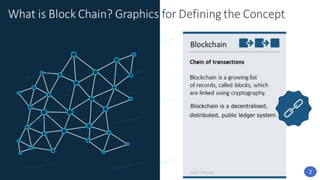
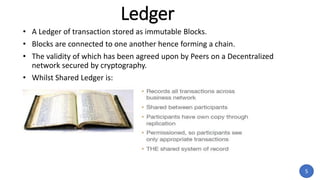
• A Ledger of transaction stored as immutable Blocks.
• Blocks are connected to one another hence forming a chain.
• The validity of which has been agreed upon by Peers on a Decentralized
network secured by cryptography.
• Whilst Shared Ledger is:
5
The Components
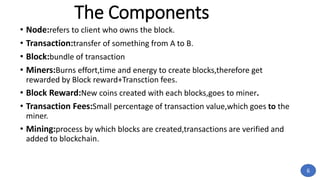
• Node:refers to client who owns the block.
• Transaction:transfer of something from A to B.
• Block:bundle of transaction
• Miners:Burns effort,time and energy to create blocks,therefore get
rewarded by Block reward+Transction fees.
• Block Reward:New coins created with each blocks,goes to miner.
• Transaction Fees:Small percentage of transaction value,which goes to the
miner.
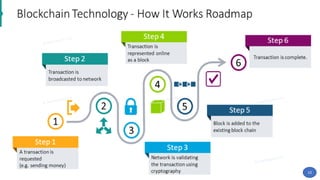
• Mining:process by which blocks are created,transactions are verified and
added to blockchain.
6
The Node
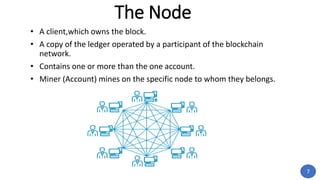
• A client,which owns the block.
• A copy of the ledger operated by a participant of the blockchain
network.
• Contains one or more than the one account.
• Miner (Account) mines on the specific node to whom they belongs.
7
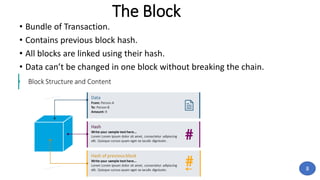
The Block
• Bundle of Transaction.
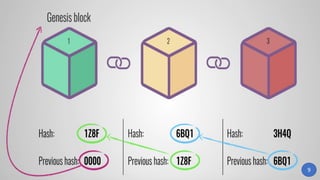
• Contains previous block hash.
• All blocks are linked using their hash.
• Data can’t be changed in one block without breaking the chain.
8
9
10
11
12
13
Conclusion
• In this short Presentation you were introduced to several concepts of
Blockchain.
• The Bitcoin is the first successful implementation of blockchain. Today,
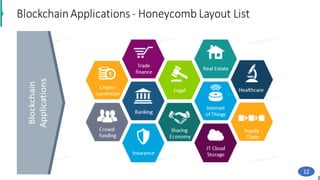
the world has found applications of blockchain technology in several
industries, where the trust without the involvement of a centralized
authority is desired.
• So welcome to the world of Blockchain.
14
References
• Ihttps://www.investopedia.com/terms/b/blockchain.asp
• https://www.slideshare.net
• https://www.infodiagram.com
• Blockchain: Blueprint for a New Economy Book by Melanie Swan
15
Thank you!
Any Queries?

Blockchain seminar

  • 1.
    Blockchain Presented By: Amiya DebadarshiMohapatra Regd.No-1601289476 B.Tech.(CSE), 7th Semester, Section –C, Group-2 Under the guidance of : Mr. Pradipta kumar Mishra Asst.Professor,Dept. of CSE
  • 2.
  • 3.
  • 4.
    • Blockchain technologywas first outlined in 1991 by Stuart Haber and W. Scott Stornetta, two researchers who wanted to implement a system where document timestamps could not be tampered with. • But it wasn’t until almost two decades later, with the launch of Bitcoin in January 2009, that blockchain had its first real-world application. • The Bitcoin protocol is built on the blockchain. In a research paper introducing the digital currency, Bitcoin’s pseudonymous creator Satoshi Nakamoto referred to it as “a new electronic cash system that’s fully peer-to-peer, with no trusted third party. History of Blockchain 3
  • 5.
  • 6.
    Ledger • A Ledgerof transaction stored as immutable Blocks. • Blocks are connected to one another hence forming a chain. • The validity of which has been agreed upon by Peers on a Decentralized network secured by cryptography. • Whilst Shared Ledger is: 5
  • 7.
    The Components • Node:refersto client who owns the block. • Transaction:transfer of something from A to B. • Block:bundle of transaction • Miners:Burns effort,time and energy to create blocks,therefore get rewarded by Block reward+Transction fees. • Block Reward:New coins created with each blocks,goes to miner. • Transaction Fees:Small percentage of transaction value,which goes to the miner. • Mining:process by which blocks are created,transactions are verified and added to blockchain. 6
  • 8.
    The Node • Aclient,which owns the block. • A copy of the ledger operated by a participant of the blockchain network. • Contains one or more than the one account. • Miner (Account) mines on the specific node to whom they belongs. 7
  • 9.
    The Block • Bundleof Transaction. • Contains previous block hash. • All blocks are linked using their hash. • Data can’t be changed in one block without breaking the chain. 8
  • 10.
  • 11.
  • 12.
  • 13.
  • 14.
  • 15.
    Conclusion • In thisshort Presentation you were introduced to several concepts of Blockchain. • The Bitcoin is the first successful implementation of blockchain. Today, the world has found applications of blockchain technology in several industries, where the trust without the involvement of a centralized authority is desired. • So welcome to the world of Blockchain. 14
  • 16.
    References • Ihttps://www.investopedia.com/terms/b/blockchain.asp • https://www.slideshare.net •https://www.infodiagram.com • Blockchain: Blueprint for a New Economy Book by Melanie Swan 15
  • 17.