SENSORY EVALUATION
FSN 501 (1+1) 1
SENSORY EVALUATION
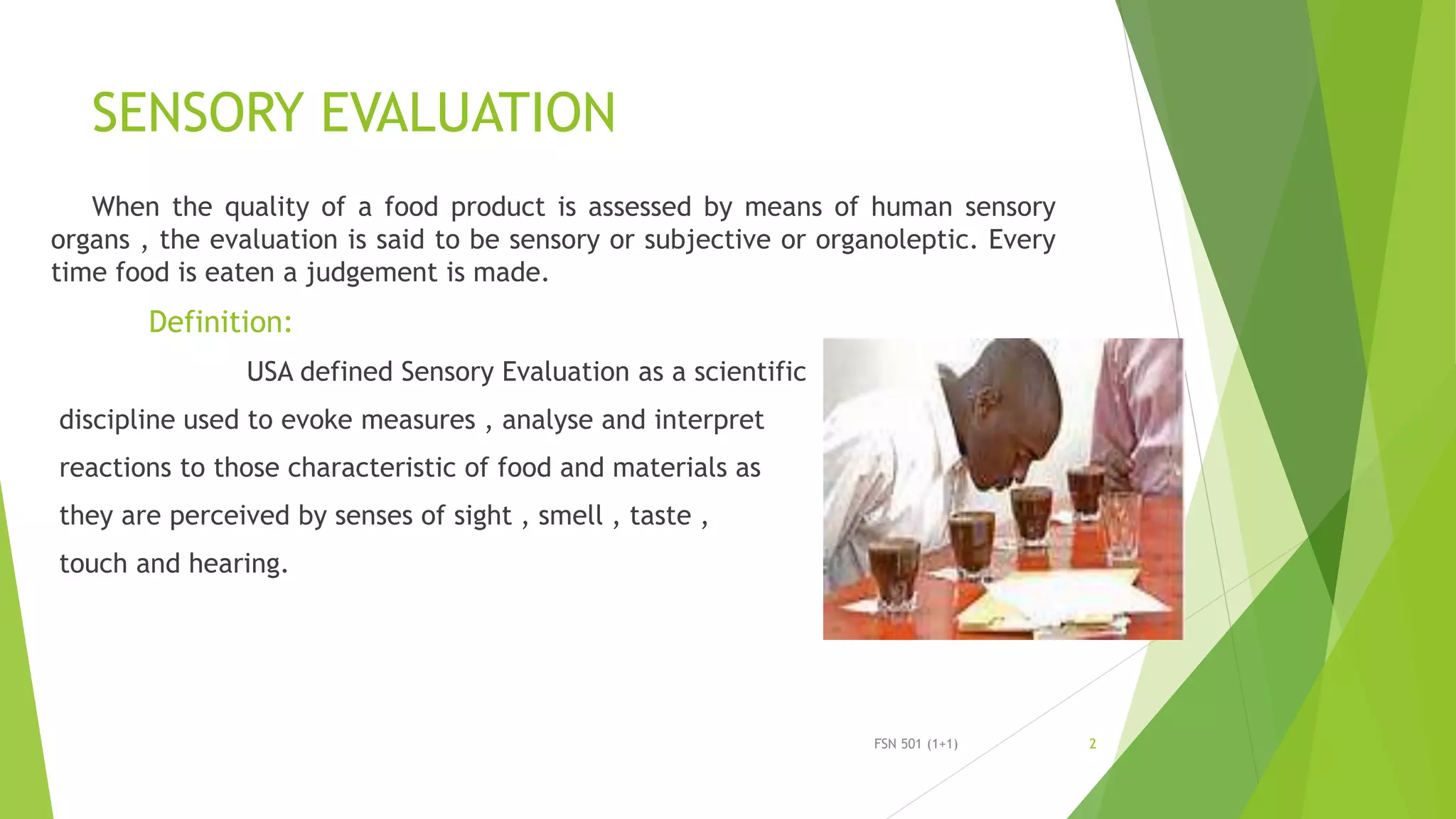
When the quality of a food product is assessed by means of human sensory
organs , the evaluation is said to be sensory or subjective or organoleptic. Every
time food is eaten a judgement is made.
Definition:
USA defined Sensory Evaluation as a scientific
discipline used to evoke measures , analyse and interpret
reactions to those characteristic of food and materials as
they are perceived by senses of sight , smell , taste ,
touch and hearing.
FSN 501 (1+1) 2
WHY SENSORY EVALUATION USED
 It reduces uncertainty and risks in decision making.
 It ensures a cost efficient delivery of new products with
high consumer acceptability.
 Human observes are good measuring instruments.
FSN 501 (1+1) 3
QUALITY EVALUATION
Quality is the ultimate criterion of the desirability of any food
products. Food quality can be evaluated by subjective and objective
methods.
subjective methods objective methods
 Appearance 1 Physical methods
Texturometer
 Taste Colorimeter
 Texture Tenderometer
 Colour Succulometer
Viscometer
Consistometer
Electric nose
2 Chemical method
FSN 501 (1+1) 4
SUBJECTIVE METHOD
These methods of quality evaluation are based on
the opinion of the investigators. These are the individual
experience and preference. They are subjective because the
individual is required to give his opinion. The sensory organs
are appearance , taste, texture flavour.
FSN 501 (1+1) 5
APPEARANCE
 Surface characteristic of food products contribute to the appearance.
 Interior appearance can also be evaluated. Lumps in a pudding or gravy
are not desirable can be judged by the eye.
FSN 501 (1+1) 6
TASTE
 Taste sensation which the taste buds register are
categorised as sweet, salt , sour or bitter.
 Taste buds near the tip of the tongue are more sensitive
to sweet and salt.
 Those on the sides sour and those near the back
to bitter.
FSN 501 (1+1) 7
TEXTURE
 Texture in ice cream depends upon the size of the
crystals.
 Coarse texture crystalline products are said to be grainy.
 The brittleness of food is another aspect of texture.
FSN 501 (1+1) 8
COLOUR
 Ripeness of fruits like banana, mango, guava, papaya and
plum can be assed by the colour.
 Colour is used as an index to the quality of a number of
foods.
 The strength of coffee and tea is judged in part by the
colour of the beverages.
FSN 501 (1+1) 9
OBJECTIVE METHODS
Methods of evaluating food quality that depends on some
measure other than the human senses are often called objective methods
of evaluation.
1. PHYSICAL METHODS OF MEASUREMENTS
This methods uses the different equipments for assessing
the physical attributes of the food products.
FSN 501 (1+1) 10
COLORIMETER
 Helps to measure the intensity of the color of the food
product.
 Used in juices to measure the clarity.
FSN 501 (1+1) 11
TEXTUROMETER
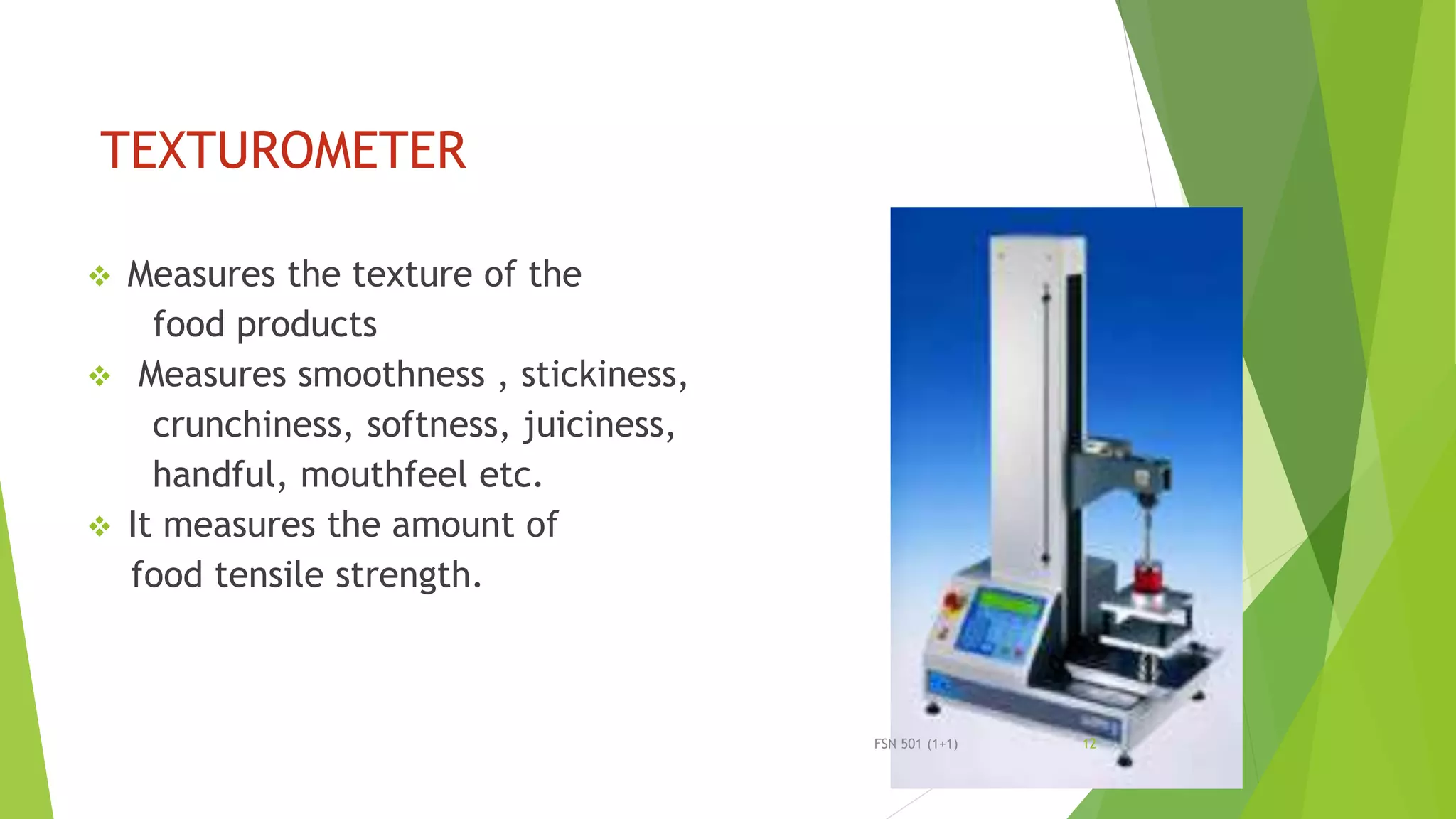
 Measures the texture of the
food products
 Measures smoothness , stickiness,
crunchiness, softness, juiciness,
handful, mouthfeel etc.
 It measures the amount of
food tensile strength.
FSN 501 (1+1) 12
TENDEROMETER
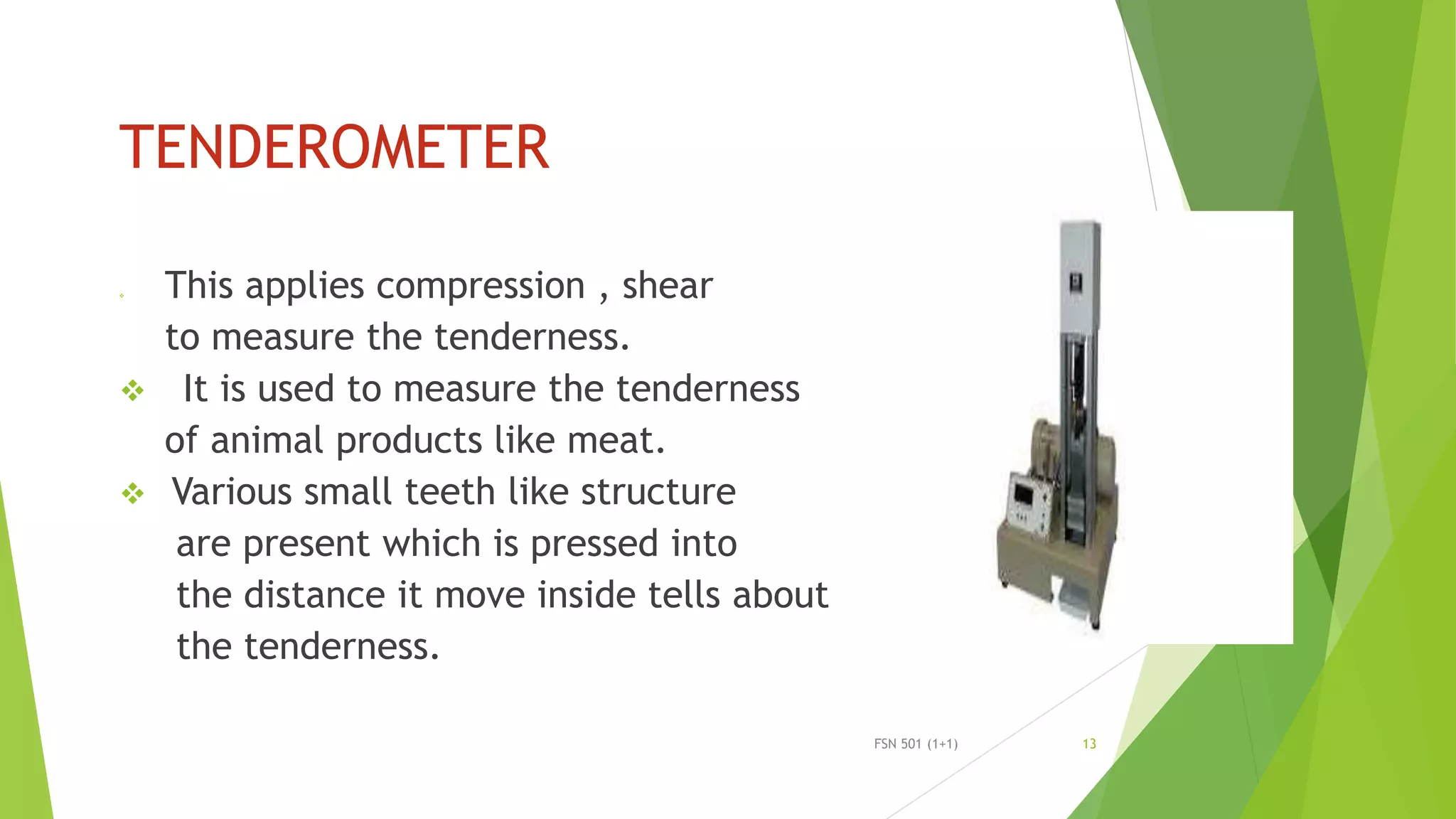
 This applies compression , shear
to measure the tenderness.
 It is used to measure the tenderness
of animal products like meat.
 Various small teeth like structure
are present which is pressed into
the distance it move inside tells about
the tenderness.
FSN 501 (1+1) 13
SUCCULOMETER
 Compression to squeeze
juice out of food as a
measure of succulence.
FSN 501 (1+1) 14
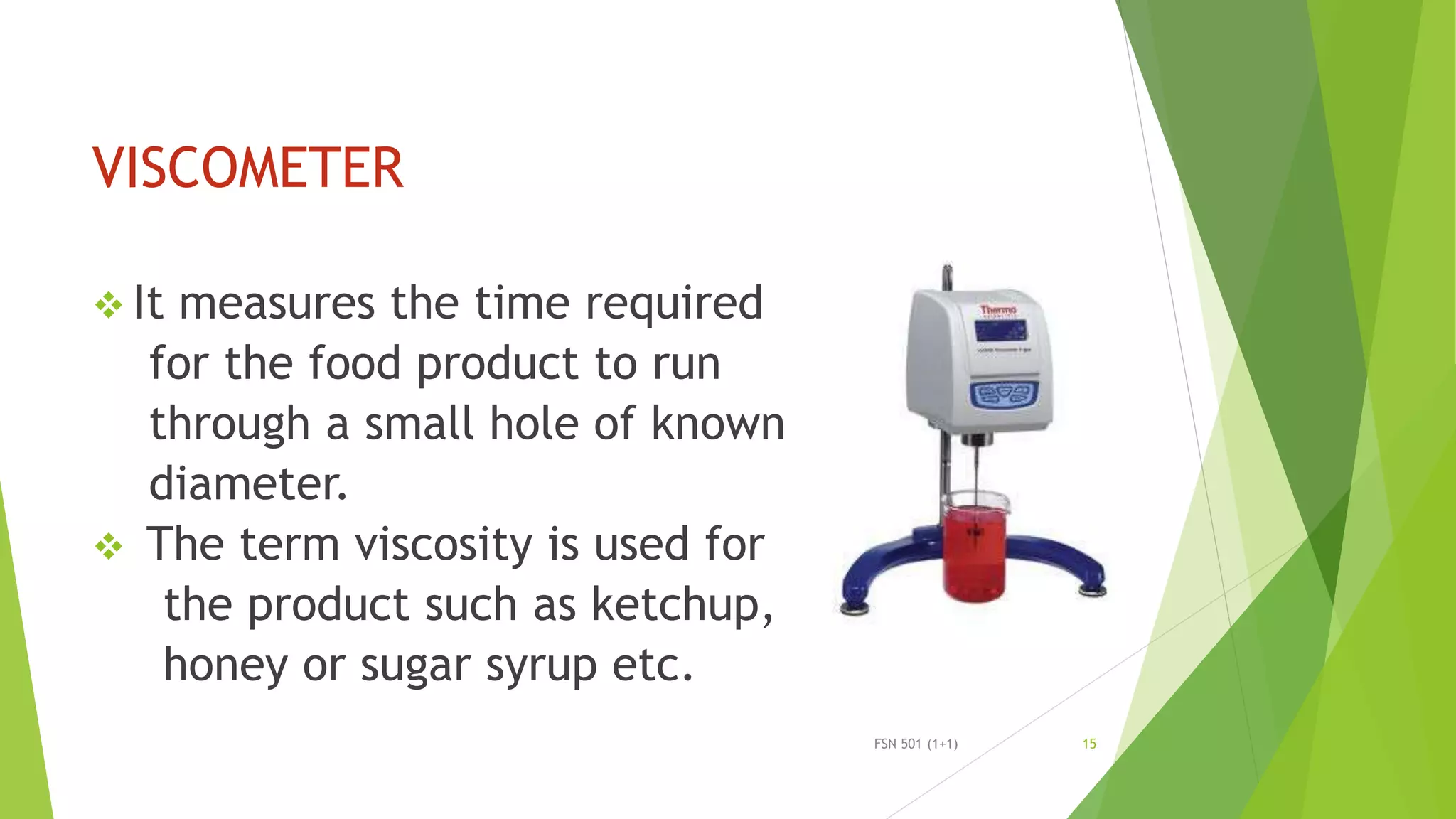
VISCOMETER
 It measures the time required
for the food product to run
through a small hole of known
diameter.
 The term viscosity is used for
the product such as ketchup,
honey or sugar syrup etc.
FSN 501 (1+1) 15
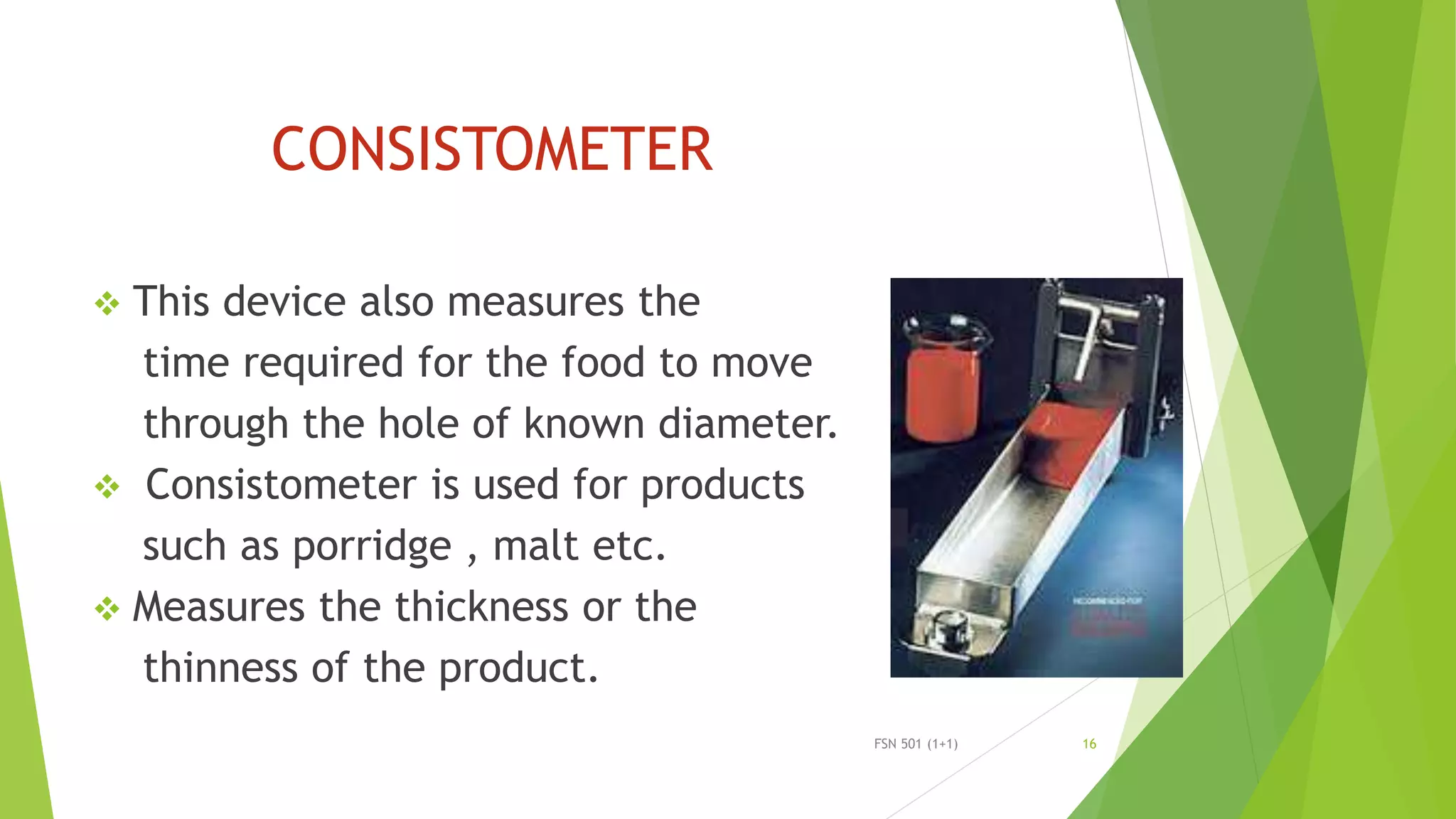
CONSISTOMETER
 This device also measures the
time required for the food to move
through the hole of known diameter.
 Consistometer is used for products
such as porridge , malt etc.
 Measures the thickness or the
thinness of the product.
FSN 501 (1+1) 16
ELECTRIC NOSE
 It used to assess the type of
aroma present in the food.
 Chances of errors is very
negligible as the human
subjects are not present.
FSN 501 (1+1) 17
2. CHEMICAL METHODS OF MEASUREMENTS
 Chemicals are estimated in food spoiling like peroxide in
fats.
 Adulteration in foods e . g,, presence of starch in milk ,
metanil yellow in turmeric powder and loss of nutrients
during cooking can be estimated.
FSN 501 (1+1) 18
SUBJECTIVE METHOD OBJECTIVE METHOD
Uses individual Uses equipment
Involves humans sensory organs Uses physical, chemical techniques
Results may be variable Results are repeatable
Determines human sensitivity Need to find technic applicable for food
Determines consumers acceptance Cannot determine consumer acceptance
Time consuming and expensive Essential for routine quality control
Essential for food development
FSN 501 (1+1) 19
EVALUATION CARD
 The questionnaire or score card should be prepared carefully for each
test.
 The card should be clearly typed or printed.
 It should be simple and use unambiguous terms and directions in the
desired sequence of action as a guide to the evaluation.
 A score card may be as simple as indicating which sample is different
as done when duo trio or triangle testing is the mode being used.
 No single score card fits all experiment. Instead , the score card
needs to be developed for the specific experiment.
 All score cards should contain the date and name of the judge.
FSN 501 (1+1) 20
DIFFERENT TYPES OF TESTS
Different sensory tests are employed for food
evaluation. The tests are grouped into four types.
1. Difference test
2. Rating test
3. Sensitivity test
4. Descriptive test
FSN 501 (1+1) 21
DIFFERENCE TEST
A 1. Paired comparison test
 The panel members receive several pairs of samples .
These may be different or the same samples in each pair.
Samples are always given in code number.
 Different samples are given in each pair which differ in
the intensity of one characteristic e,g.. sweetness,
bitterness or rancidity. In each pair, the sample with more
or less intense taste will have to be picked out.
FSN 501 (1+1) 22
 Sample card:
 Name:
 Date:
 Product
 You are given one or several pairs of sample. Evaluate the two samples in the
pair for--------
 Is there any difference between two samples in the pair?
 Code no. of pairs Yes No
--------- ---------- -----------
--------- ---------- -----------
--------- ---------- -----------
Signature
FSN 501 (1+1) 23
A2 . Duo trio test
 This test employs three samples , two identical and one different.
 The panel is first given one of the pair of identical samples as known
reference sample R and then the other two successively in random order
and asked to much one of these with the first.
 A positive answer is required even if it is a guess. The chance of the
samples of placing the samples in a certain order is one half.
FSN 501 (1+1) 24
 Sample card:
 Name:
 Date
 Product:
 The first sample ‘R’ given is the reference sample.
 Taste it carefully.
 From the pair of coded sample next given, judge which sample is the same as
‘R’.
 Set no. Code no. of pairs Same as R
 1 ---------- ----------
 2 ---------- ----------
 3 ---------- ----------
 4 ---------- ----------
 Signature
FSN 501 (1+1) 25
A3. Triangle test
 This test employs three samples , two identical and one different ,
presented simultaneously to the panel.
 The judge asked to determine which of the three is the odd sample.
 A positive answer required even if it is guess. Since all samples are
unknown , the chance probability of placing the sample in a certain
order in one third.
 Two samples A & B can be presented in two combinations AAB & BBA &
for replication in six different arrangements AAB , ABA, BAA, BAB, ABB &
BBA.
FSN 501 (1+1) 26
 Sample card:
 Name
 Date
 Product
 Two of the three samples are identical
.Determine the odd sample.
Set no. code no . of samples code no. odd of samples comment
1 ---------- ---------- ----------
2 ---------- ---------- ----------
Signature
FSN 501 (1+1) 27
B. RATING TEST
These test given more quantitative data than difference tests
and can be used for the analysis of more than two samples at the same
time.
B1. Ranking test
This test is used to determine how several samples differ on the
basis of a single characteristic. A control need not be identified.
Panellists are presented all samples simultaneously with code numbers
and are asked to rank all samples according to the intensity of the
specified characteristic . In consumer analysis , the panellist are asked to
rank the coded samples according to their preference.
FSN 501 (1+1) 28
 Sample card
 Name
 Date
 Product
 Please rank the samples in numerical order according to your preference or
intensity of aroma or taste characteristic of the product
 Intensity/Preference Sample code
 1 ----------
 2 ----------
 3 ----------
 4 ----------
 Comments(Type of off-flavour . etc. )
 Signature:
FSN 501 (1+1) 29
B 2 . Single sample test
 This test is useful for testing foods that have an after
taste or flavour carry over which precludes testing a
second sample at the same session.
 The panellist is asked to indicate the presence or absence
and /or intensity of a particular quality characteristic.
With trained panellist, the completed analyses of two or
more samples evaluated at different times can be
compared .
FSN 501 (1+1) 30
 Sample card
 Name
 Date
 Product
 Please taste and rank the sample carefully. Can you detect any off flavour in the
product?
 Circle one
 Yes No
 If you detect any off-flavour please describe it below.
 Intensity(Circle one) Comments
 Trace Off-Flavour is due to
 Moderate Off-odour
 Strong Off-taste
Residual taste
Other defects
Signature FSN 501 (1+1) 31
B3. Two sample difference test
 This test is a variation of the paired comparison test and measures the
amount of different.
 Each taster is served four pairs of samples . Each pair consists of an
identified reference and coded test samples . In two pairs , the test
sample is a duplicate of the reference sample. In the other two pairs ,
the test sample is the test variables.
 The panellist is asked to judge each pair independently as to the
degree of difference between the test sample and standard on a scale
of ‘0’ representing no difference to 3 representing extreme difference.
 Additional questions on directions on difference can also be asked . The
panellist is not to guess and he is panellist for guessing through the
coded duplicate standard in two pairs.
FSN 501 (1+1) 32
 Sample card
 Name
 Date
 Product
1. Compare the coded sample to the reference sample independently in each of the four
pairs given. Test sample may or may not be different from the reference sample.
2. Determine the degree and direction of difference on the following scale.
 Degree Direction
 No difference 0 Superior to standard S
 Very slight difference 1 Equal to standard E
 Moderate difference 2 Inferior to standard I
 Large difference 3
3. Comment on what the difference is based on odour taste or both .
 Sample code no. Degree of difference Direction Comment
---------- ----------- ---------- ------
Signature
FSN 501 (1+1) 33
B4. Multiple sample test
 In this test more than one test variable can be evaluated per
session but with reduced reliability.
 Each panellist is served 3 to6 samples depending upon the
number of test variables. One sample is a known standard .
The panellist compares each coded sample with the known
standard . One coded sample is a duplicate of the standard.
 Whatever score the panellist assign to the blind standard is
subtracted from the score he assign to the test variables. The
panellist is not to guess. Direction and degree of difference is
also to be judged.
FSN 501 (1+1) 34
 Sample card
 Name
 Date
 Product
 You are given a standard or reference sample marked ”R”. Taste it carefully for the quality
characters to be evaluated. You are next given a no. of samples which are to be compared to
the reference sample for odour and flavour. Rate in each sample degree pf difference and the
direction of quality according to the following scale.
 Degree of difference Direction of quality
 Rating Difference from standard
0 None E-Equal
1 slight I-inferior
2 Moderate S-Superior
3 large
Sample code no. Odour Flavour
Degree direction comments Degree direction comments
Signature
FSN 501 (1+1) 35
B5. Hedonic rating test
 Hedonic rating relates to pleasurable or unpleasurable
experiences.
 The hedonic rating test is used to measure the consumer
acceptability of food products.
 Ask each taster to taste each sample in turn and tick a
box from like extremely to dislike extremely.
 The results are analysed for preference with data from
large untrained panel.
FSN 501 (1+1) 36
 Sample card
 Name
 Date
 Product
 Taste these samples and check how much you like or dislike each one. Use the appropriate scale to show
your attitude by checking at the point that best describes your feelings about the sample. Please give a
reason for this attitude.
code code code
 Like extremely
 Like very much
 Like moderately
 Like slight
 Neither like nor dislike
 Dislike slightly
 Dislike moderately
 Dislike very much
 Dislike extremely
Reason
Signature
FSN 501 (1+1) 37
B6. Numerical scoring test
 One or more samples are presented to each
panellist in random order or according to a
statistical design.
 The panellist evaluate each sample on a specific
scale for a particular characteristic indicating the
rating of the sample.
 The panellist are trained to follow the sensory
characteristic corresponding to the agreed quality
description and scores.
FSN 501 (1+1) 38
 Sample card
 Name
 Date
 Product
 Please rate these samples according to the following descriptions
 Score Quality description
 90 Excellent
 80 Good
 70 Fair
 60 Poor
 Sample score Comment
 Signature
FSN 501 (1+1) 39
B7. Composite scoring test
 The rating scale is defined so that specific
characteristic of a product are rated separately.
 This method is helpful in grading products and
comparison of quality attributes by indicating
which characteristic is at fault in a poor product.
 It gives more information than the straight
numerical method.
FSN 501 (1+1) 40
 Sample card
 Name
 Date
 Product
 Quality Possible score Sample score
 Colour 20
 Consistency 20
 Flavour 4
 Absence of defects 20
 Total score 10
 Signature
FSN 501 (1+1) 41
C SENSITIVITY TEST
C1 . Sensitivity threshold test
Threshold test is defined as a statistically determined point on
the stimulus scale at which a transition in a series of sensation or
judgements occur.
There are mainly three types of threshold
a. Stimulus detection threshold is that magnitude of stimulus at which a
transition occurs from no sensation to sensation.
b. Recognition identification threshold is the minimum concentration at
which a stimulus is correctly identified.
c . Terminal saturation threshold is the magnitude of a stimulus above
which there is no increase in the perceived intensity of the stimulus.
FSN 501 (1+1) 42
C2 . Dilution test
 Dilution tests are designated to establish the smallest
amount of an unknown material , developed as a
substitute for a standard product.
 The quality of the test material is represented by the
dilution number.
 The bigger the dilution number the better is the quality of
the test material.
FSN 501 (1+1) 43
D. DESCRIPTIVE FLAVOUR PROFILE
METHOD
This is both qualitative and quantitative description for analysis in
products containing different tastes and odour .
For tomato ketchup the flavour profile analysis is given
Aroma Taste Mouth feel Texture
Garlic 1 Sour(Tea) 1 Chillies(1) Smoothness(
3)
Pepper 2 Sweet(S) 2
Onion 3 Salt 1
Cinnamon 2
Cloves 1
FSN 501 (1+1) 44
Limitations of sensory evaluation
1. The result may be highly variable.
2. People with colors or other health problems temporarily lose
their maximum effectiveness.
3. Emotional burdens may influence an individual’s ability.
FSN 501 (1+1) 45
REFERENCE
FOOD SCIENCE B. SRILAKSHMI
FSN 501 (1+1) 46

sensory evaluation 1.ppt

  • 1.
  • 2.
    SENSORY EVALUATION When thequality of a food product is assessed by means of human sensory organs , the evaluation is said to be sensory or subjective or organoleptic. Every time food is eaten a judgement is made. Definition: USA defined Sensory Evaluation as a scientific discipline used to evoke measures , analyse and interpret reactions to those characteristic of food and materials as they are perceived by senses of sight , smell , taste , touch and hearing. FSN 501 (1+1) 2
  • 3.
    WHY SENSORY EVALUATIONUSED  It reduces uncertainty and risks in decision making.  It ensures a cost efficient delivery of new products with high consumer acceptability.  Human observes are good measuring instruments. FSN 501 (1+1) 3
  • 4.
    QUALITY EVALUATION Quality isthe ultimate criterion of the desirability of any food products. Food quality can be evaluated by subjective and objective methods. subjective methods objective methods  Appearance 1 Physical methods Texturometer  Taste Colorimeter  Texture Tenderometer  Colour Succulometer Viscometer Consistometer Electric nose 2 Chemical method FSN 501 (1+1) 4
  • 5.
    SUBJECTIVE METHOD These methodsof quality evaluation are based on the opinion of the investigators. These are the individual experience and preference. They are subjective because the individual is required to give his opinion. The sensory organs are appearance , taste, texture flavour. FSN 501 (1+1) 5
  • 6.
    APPEARANCE  Surface characteristicof food products contribute to the appearance.  Interior appearance can also be evaluated. Lumps in a pudding or gravy are not desirable can be judged by the eye. FSN 501 (1+1) 6
  • 7.
    TASTE  Taste sensationwhich the taste buds register are categorised as sweet, salt , sour or bitter.  Taste buds near the tip of the tongue are more sensitive to sweet and salt.  Those on the sides sour and those near the back to bitter. FSN 501 (1+1) 7
  • 8.
    TEXTURE  Texture inice cream depends upon the size of the crystals.  Coarse texture crystalline products are said to be grainy.  The brittleness of food is another aspect of texture. FSN 501 (1+1) 8
  • 9.
    COLOUR  Ripeness offruits like banana, mango, guava, papaya and plum can be assed by the colour.  Colour is used as an index to the quality of a number of foods.  The strength of coffee and tea is judged in part by the colour of the beverages. FSN 501 (1+1) 9
  • 10.
    OBJECTIVE METHODS Methods ofevaluating food quality that depends on some measure other than the human senses are often called objective methods of evaluation. 1. PHYSICAL METHODS OF MEASUREMENTS This methods uses the different equipments for assessing the physical attributes of the food products. FSN 501 (1+1) 10
  • 11.
    COLORIMETER  Helps tomeasure the intensity of the color of the food product.  Used in juices to measure the clarity. FSN 501 (1+1) 11
  • 12.
    TEXTUROMETER  Measures thetexture of the food products  Measures smoothness , stickiness, crunchiness, softness, juiciness, handful, mouthfeel etc.  It measures the amount of food tensile strength. FSN 501 (1+1) 12
  • 13.
    TENDEROMETER  This appliescompression , shear to measure the tenderness.  It is used to measure the tenderness of animal products like meat.  Various small teeth like structure are present which is pressed into the distance it move inside tells about the tenderness. FSN 501 (1+1) 13
  • 14.
    SUCCULOMETER  Compression tosqueeze juice out of food as a measure of succulence. FSN 501 (1+1) 14
  • 15.
    VISCOMETER  It measuresthe time required for the food product to run through a small hole of known diameter.  The term viscosity is used for the product such as ketchup, honey or sugar syrup etc. FSN 501 (1+1) 15
  • 16.
    CONSISTOMETER  This devicealso measures the time required for the food to move through the hole of known diameter.  Consistometer is used for products such as porridge , malt etc.  Measures the thickness or the thinness of the product. FSN 501 (1+1) 16
  • 17.
    ELECTRIC NOSE  Itused to assess the type of aroma present in the food.  Chances of errors is very negligible as the human subjects are not present. FSN 501 (1+1) 17
  • 18.
    2. CHEMICAL METHODSOF MEASUREMENTS  Chemicals are estimated in food spoiling like peroxide in fats.  Adulteration in foods e . g,, presence of starch in milk , metanil yellow in turmeric powder and loss of nutrients during cooking can be estimated. FSN 501 (1+1) 18
  • 19.
    SUBJECTIVE METHOD OBJECTIVEMETHOD Uses individual Uses equipment Involves humans sensory organs Uses physical, chemical techniques Results may be variable Results are repeatable Determines human sensitivity Need to find technic applicable for food Determines consumers acceptance Cannot determine consumer acceptance Time consuming and expensive Essential for routine quality control Essential for food development FSN 501 (1+1) 19
  • 20.
    EVALUATION CARD  Thequestionnaire or score card should be prepared carefully for each test.  The card should be clearly typed or printed.  It should be simple and use unambiguous terms and directions in the desired sequence of action as a guide to the evaluation.  A score card may be as simple as indicating which sample is different as done when duo trio or triangle testing is the mode being used.  No single score card fits all experiment. Instead , the score card needs to be developed for the specific experiment.  All score cards should contain the date and name of the judge. FSN 501 (1+1) 20
  • 21.
    DIFFERENT TYPES OFTESTS Different sensory tests are employed for food evaluation. The tests are grouped into four types. 1. Difference test 2. Rating test 3. Sensitivity test 4. Descriptive test FSN 501 (1+1) 21
  • 22.
    DIFFERENCE TEST A 1.Paired comparison test  The panel members receive several pairs of samples . These may be different or the same samples in each pair. Samples are always given in code number.  Different samples are given in each pair which differ in the intensity of one characteristic e,g.. sweetness, bitterness or rancidity. In each pair, the sample with more or less intense taste will have to be picked out. FSN 501 (1+1) 22
  • 23.
     Sample card: Name:  Date:  Product  You are given one or several pairs of sample. Evaluate the two samples in the pair for--------  Is there any difference between two samples in the pair?  Code no. of pairs Yes No --------- ---------- ----------- --------- ---------- ----------- --------- ---------- ----------- Signature FSN 501 (1+1) 23
  • 24.
    A2 . Duotrio test  This test employs three samples , two identical and one different.  The panel is first given one of the pair of identical samples as known reference sample R and then the other two successively in random order and asked to much one of these with the first.  A positive answer is required even if it is a guess. The chance of the samples of placing the samples in a certain order is one half. FSN 501 (1+1) 24
  • 25.
     Sample card: Name:  Date  Product:  The first sample ‘R’ given is the reference sample.  Taste it carefully.  From the pair of coded sample next given, judge which sample is the same as ‘R’.  Set no. Code no. of pairs Same as R  1 ---------- ----------  2 ---------- ----------  3 ---------- ----------  4 ---------- ----------  Signature FSN 501 (1+1) 25
  • 26.
    A3. Triangle test This test employs three samples , two identical and one different , presented simultaneously to the panel.  The judge asked to determine which of the three is the odd sample.  A positive answer required even if it is guess. Since all samples are unknown , the chance probability of placing the sample in a certain order in one third.  Two samples A & B can be presented in two combinations AAB & BBA & for replication in six different arrangements AAB , ABA, BAA, BAB, ABB & BBA. FSN 501 (1+1) 26
  • 27.
     Sample card: Name  Date  Product  Two of the three samples are identical .Determine the odd sample. Set no. code no . of samples code no. odd of samples comment 1 ---------- ---------- ---------- 2 ---------- ---------- ---------- Signature FSN 501 (1+1) 27
  • 28.
    B. RATING TEST Thesetest given more quantitative data than difference tests and can be used for the analysis of more than two samples at the same time. B1. Ranking test This test is used to determine how several samples differ on the basis of a single characteristic. A control need not be identified. Panellists are presented all samples simultaneously with code numbers and are asked to rank all samples according to the intensity of the specified characteristic . In consumer analysis , the panellist are asked to rank the coded samples according to their preference. FSN 501 (1+1) 28
  • 29.
     Sample card Name  Date  Product  Please rank the samples in numerical order according to your preference or intensity of aroma or taste characteristic of the product  Intensity/Preference Sample code  1 ----------  2 ----------  3 ----------  4 ----------  Comments(Type of off-flavour . etc. )  Signature: FSN 501 (1+1) 29
  • 30.
    B 2 .Single sample test  This test is useful for testing foods that have an after taste or flavour carry over which precludes testing a second sample at the same session.  The panellist is asked to indicate the presence or absence and /or intensity of a particular quality characteristic. With trained panellist, the completed analyses of two or more samples evaluated at different times can be compared . FSN 501 (1+1) 30
  • 31.
     Sample card Name  Date  Product  Please taste and rank the sample carefully. Can you detect any off flavour in the product?  Circle one  Yes No  If you detect any off-flavour please describe it below.  Intensity(Circle one) Comments  Trace Off-Flavour is due to  Moderate Off-odour  Strong Off-taste Residual taste Other defects Signature FSN 501 (1+1) 31
  • 32.
    B3. Two sampledifference test  This test is a variation of the paired comparison test and measures the amount of different.  Each taster is served four pairs of samples . Each pair consists of an identified reference and coded test samples . In two pairs , the test sample is a duplicate of the reference sample. In the other two pairs , the test sample is the test variables.  The panellist is asked to judge each pair independently as to the degree of difference between the test sample and standard on a scale of ‘0’ representing no difference to 3 representing extreme difference.  Additional questions on directions on difference can also be asked . The panellist is not to guess and he is panellist for guessing through the coded duplicate standard in two pairs. FSN 501 (1+1) 32
  • 33.
     Sample card Name  Date  Product 1. Compare the coded sample to the reference sample independently in each of the four pairs given. Test sample may or may not be different from the reference sample. 2. Determine the degree and direction of difference on the following scale.  Degree Direction  No difference 0 Superior to standard S  Very slight difference 1 Equal to standard E  Moderate difference 2 Inferior to standard I  Large difference 3 3. Comment on what the difference is based on odour taste or both .  Sample code no. Degree of difference Direction Comment ---------- ----------- ---------- ------ Signature FSN 501 (1+1) 33
  • 34.
    B4. Multiple sampletest  In this test more than one test variable can be evaluated per session but with reduced reliability.  Each panellist is served 3 to6 samples depending upon the number of test variables. One sample is a known standard . The panellist compares each coded sample with the known standard . One coded sample is a duplicate of the standard.  Whatever score the panellist assign to the blind standard is subtracted from the score he assign to the test variables. The panellist is not to guess. Direction and degree of difference is also to be judged. FSN 501 (1+1) 34
  • 35.
     Sample card Name  Date  Product  You are given a standard or reference sample marked ”R”. Taste it carefully for the quality characters to be evaluated. You are next given a no. of samples which are to be compared to the reference sample for odour and flavour. Rate in each sample degree pf difference and the direction of quality according to the following scale.  Degree of difference Direction of quality  Rating Difference from standard 0 None E-Equal 1 slight I-inferior 2 Moderate S-Superior 3 large Sample code no. Odour Flavour Degree direction comments Degree direction comments Signature FSN 501 (1+1) 35
  • 36.
    B5. Hedonic ratingtest  Hedonic rating relates to pleasurable or unpleasurable experiences.  The hedonic rating test is used to measure the consumer acceptability of food products.  Ask each taster to taste each sample in turn and tick a box from like extremely to dislike extremely.  The results are analysed for preference with data from large untrained panel. FSN 501 (1+1) 36
  • 37.
     Sample card Name  Date  Product  Taste these samples and check how much you like or dislike each one. Use the appropriate scale to show your attitude by checking at the point that best describes your feelings about the sample. Please give a reason for this attitude. code code code  Like extremely  Like very much  Like moderately  Like slight  Neither like nor dislike  Dislike slightly  Dislike moderately  Dislike very much  Dislike extremely Reason Signature FSN 501 (1+1) 37
  • 38.
    B6. Numerical scoringtest  One or more samples are presented to each panellist in random order or according to a statistical design.  The panellist evaluate each sample on a specific scale for a particular characteristic indicating the rating of the sample.  The panellist are trained to follow the sensory characteristic corresponding to the agreed quality description and scores. FSN 501 (1+1) 38
  • 39.
     Sample card Name  Date  Product  Please rate these samples according to the following descriptions  Score Quality description  90 Excellent  80 Good  70 Fair  60 Poor  Sample score Comment  Signature FSN 501 (1+1) 39
  • 40.
    B7. Composite scoringtest  The rating scale is defined so that specific characteristic of a product are rated separately.  This method is helpful in grading products and comparison of quality attributes by indicating which characteristic is at fault in a poor product.  It gives more information than the straight numerical method. FSN 501 (1+1) 40
  • 41.
     Sample card Name  Date  Product  Quality Possible score Sample score  Colour 20  Consistency 20  Flavour 4  Absence of defects 20  Total score 10  Signature FSN 501 (1+1) 41
  • 42.
    C SENSITIVITY TEST C1. Sensitivity threshold test Threshold test is defined as a statistically determined point on the stimulus scale at which a transition in a series of sensation or judgements occur. There are mainly three types of threshold a. Stimulus detection threshold is that magnitude of stimulus at which a transition occurs from no sensation to sensation. b. Recognition identification threshold is the minimum concentration at which a stimulus is correctly identified. c . Terminal saturation threshold is the magnitude of a stimulus above which there is no increase in the perceived intensity of the stimulus. FSN 501 (1+1) 42
  • 43.
    C2 . Dilutiontest  Dilution tests are designated to establish the smallest amount of an unknown material , developed as a substitute for a standard product.  The quality of the test material is represented by the dilution number.  The bigger the dilution number the better is the quality of the test material. FSN 501 (1+1) 43
  • 44.
    D. DESCRIPTIVE FLAVOURPROFILE METHOD This is both qualitative and quantitative description for analysis in products containing different tastes and odour . For tomato ketchup the flavour profile analysis is given Aroma Taste Mouth feel Texture Garlic 1 Sour(Tea) 1 Chillies(1) Smoothness( 3) Pepper 2 Sweet(S) 2 Onion 3 Salt 1 Cinnamon 2 Cloves 1 FSN 501 (1+1) 44
  • 45.
    Limitations of sensoryevaluation 1. The result may be highly variable. 2. People with colors or other health problems temporarily lose their maximum effectiveness. 3. Emotional burdens may influence an individual’s ability. FSN 501 (1+1) 45
  • 46.
    REFERENCE FOOD SCIENCE B.SRILAKSHMI FSN 501 (1+1) 46