The VoiceMOS Challenge 2022
Wen-Chin Huang¹, Erica Cooper², Yu Tsao³, Hsin-Min Wang³, Tomoki Toda¹, Junichi Yamagishi²
¹Nagoya University, Japan
²National Institute of Informatics, Japan
³Academia Sinica, Taiwan
第141回音声言語情報処理
研究発表会 招待講演
Outline
I. Introduction
II. Challenge description
A. Tracks and datasets
B. Rules and timeline
C. Evaluation metrics
D. Baseline systems
III. Challenge results
A. Participants demographics
B. Results, analysis and discussion
1. Comparison of baseline systems
2. Analysis of top systems
3. Sources of difficulty
4. Analysis of metrics
IV. Conclusions
Introduction
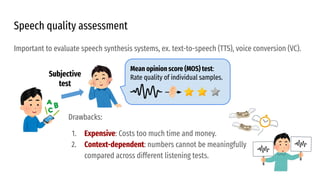
Important to evaluate speech synthesis systems, ex. text-to-speech (TTS), voice conversion (VC).
Mean opinion score (MOS) test:
Rate quality of individual samples.
Speech quality assessment
Subjective
test
Drawbacks:
1. Expensive: Costs too much time and money.
2. Context-dependent: numbers cannot be meaningfully
compared across different listening tests.
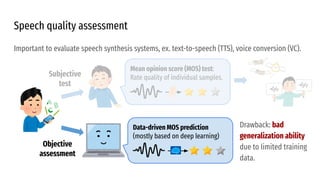
Important to evaluate speech synthesis systems, ex. text-to-speech (TTS), voice conversion (VC).
Mean opinion score (MOS) test:
Rate quality of individual samples.
Speech quality assessment
Subjective
test
Objective
assessment
Data-driven MOS prediction
(mostly based on deep learning)
Drawback: bad
generalization ability
due to limited training
data.
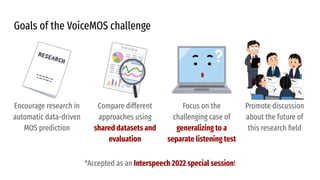
Goals of the VoiceMOS challenge
*Accepted as an Interspeech 2022 special session!
Encourage research in
automatic data-driven
MOS prediction
Compare different
approaches using
shared datasets and
evaluation
Focus on the
challenging case of
generalizing to a
separate listening test
Promote discussion
about the future of
this research field
Challenge
description
I. Tracks and datasets
II. Rules and timeline
III. Evaluation metrics
IV. Baseline systems
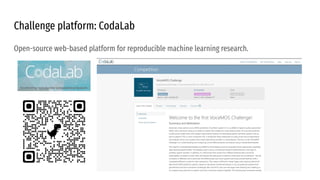
Challenge platform: CodaLab
Open-source web-based platform for reproducible machine learning research.
Tracks and dataset: Main track
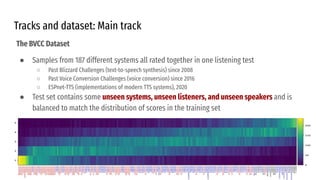
The BVCC Dataset
● Samples from 187 different systems all rated together in one listening test
○ Past Blizzard Challenges (text-to-speech synthesis) since 2008
○ Past Voice Conversion Challenges (voice conversion) since 2016
○ ESPnet-TTS (implementations of modern TTS systems), 2020
● Test set contains some unseen systems, unseen listeners, and unseen speakers and is
balanced to match the distribution of scores in the training set
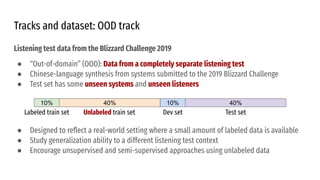
Listening test data from the Blizzard Challenge 2019
● “Out-of-domain” (OOD): Data from a completely separate listening test
● Chinese-language synthesis from systems submitted to the 2019 Blizzard Challenge
● Test set has some unseen systems and unseen listeners
● Designed to reflect a real-world setting where a small amount of labeled data is available
● Study generalization ability to a different listening test context
● Encourage unsupervised and semi-supervised approaches using unlabeled data
Tracks and dataset: OOD track
10% 40% 10% 40%
Labeled train set Unlabeled train set Dev set Test set
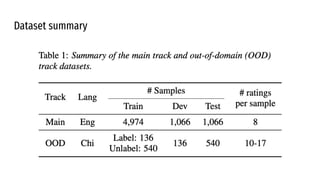
Dataset summary
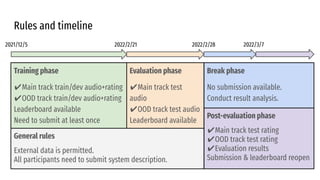
Rules and timeline
Training phase
✔Main track train/dev audio+rating
✔OOD track train/dev audio+rating
Leaderboard available
Need to submit at least once
2021/12/5 2022/2/21 2022/2/28 2022/3/7
Break phase
No submission available.
Conduct result analysis.
Evaluation phase
✔Main track test
audio
✔OOD track test audio
Leaderboard available
Max 3 submissions
Post-evaluation phase
✔Main track test rating
✔OOD track test rating
✔Evaluation results
Submission & leaderboard reopen
General rules
External data is permitted.
All participants need to submit system description.
Evaluation metrics
System-level and Utterance-level
● Mean Squared Error (MSE): difference between predicted and actual MOS
● Linear Correlation Coefficient (LCC): a basic correlation measure
● Spearman Rank Correlation Coefficient (SRCC): non-parametric; measures ranking order
● Kendall Tau Rank Correlation (KTAU): more robust to errors
import numpy as np
import scipy.stats
# `true_mean_scores` and `predict_mean_scores` are both 1-d numpy arrays.
MSE = np.mean((true_mean_scores - predict_mean_scores)**2)
LCC = np.corrcoef(true_mean_scores, predict_mean_scores)[0][1]
SRCC = scipy.stats.spearmanr(true_mean_scores, predict_mean_scores)[0]
KTAU = scipy.stats.kendalltau(true_mean_scores, predict_mean_scores)[0]
Following prior work, we
picked system-level SRCC as
the main evaluation metric.
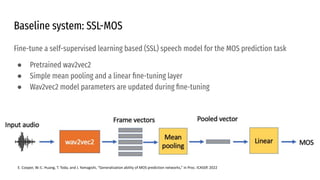
Baseline system: SSL-MOS
Fine-tune a self-supervised learning based (SSL) speech model for the MOS prediction task
● Pretrained wav2vec2
● Simple mean pooling and a linear fine-tuning layer
● Wav2vec2 model parameters are updated during fine-tuning
E. Cooper, W.-C. Huang, T. Toda, and J. Yamagishi, “Generalization ability of MOS prediction networks,” in Proc. ICASSP, 2022
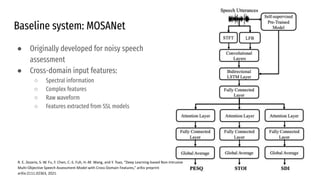
Baseline system: MOSANet
● Originally developed for noisy speech
assessment
● Cross-domain input features:
○ Spectral information
○ Complex features
○ Raw waveform
○ Features extracted from SSL models
R. E. Zezario, S.-W. Fu, F. Chen, C.-S. Fuh, H.-M. Wang, and Y. Tsao, “Deep Learning-based Non-Intrusive
Multi-Objective Speech Assessment Model with Cross-Domain Features,” arXiv preprint
arXiv:2111.02363, 2021.
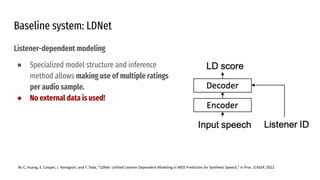
Baseline system: LDNet
Listener-dependent modeling
● Specialized model structure and inference
method allows making use of multiple ratings
per audio sample.
● No external data is used!
W.-C. Huang, E. Cooper, J. Yamagishi, and T. Toda, “LDNet: Unified Listener Dependent Modeling in MOS Prediction for Synthetic Speech,” in Proc. ICASSP, 2022
Challenge results
I. Participants demographics
II. Results, analysis and discussion
A. Comparison of baseline systems
B. Analysis of top systems
C. Sources of difficulty
D. Analysis of metrics
Participants demographics
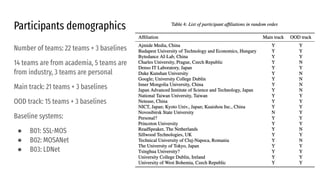
Number of teams: 22 teams + 3 baselines
14 teams are from academia, 5 teams are
from industry, 3 teams are personal
Main track: 21 teams + 3 baselines
OOD track: 15 teams + 3 baselines
Baseline systems:
● B01: SSL-MOS
● B02: MOSANet
● B03: LDNet
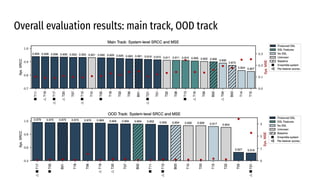
Overall evaluation results: main track, OOD track
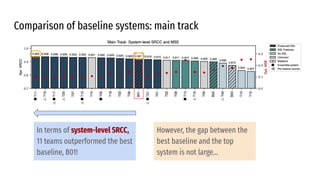
Comparison of baseline systems: main track
In terms of system-level SRCC,
11 teams outperformed the best
baseline, B01!
However, the gap between the
best baseline and the top
system is not large…
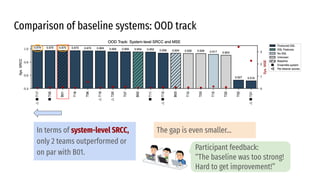
Comparison of baseline systems: OOD track
In terms of system-level SRCC,
only 2 teams outperformed or
on par with B01.
The gap is even smaller…
Participant feedback:
“The baseline was too strong!
Hard to get improvement!”
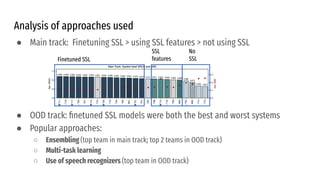
Analysis of approaches used
● Main track: Finetuning SSL > using SSL features > not using SSL
● OOD track: finetuned SSL models were both the best and worst systems
● Popular approaches:
○ Ensembling (top team in main track; top 2 teams in OOD track)
○ Multi-task learning
○ Use of speech recognizers (top team in OOD track)
Finetuned SSL
SSL
features
No
SSL
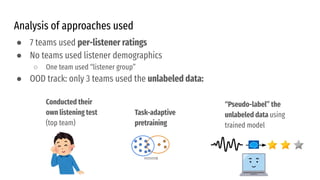
Analysis of approaches used
● 7 teams used per-listener ratings
● No teams used listener demographics
○ One team used “listener group”
● OOD track: only 3 teams used the unlabeled data:
Conducted their
own listening test
(top team)
Task-adaptive
pretraining
“Pseudo-label” the
unlabeled data using
trained model
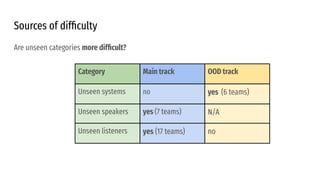
Sources of difficulty
Are unseen categories more difficult?
Unseen systems
Unseen speakers
Unseen listeners
Main track OOD track
no
yes (7 teams)
Category
yes (17 teams)
yes (6 teams)
N/A
no
Sources of difficulty
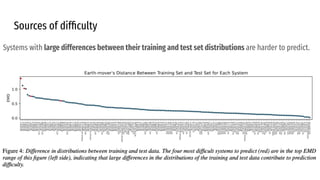
Systems with large differences between their training and test set distributions are harder to predict.
Sources of difficulty
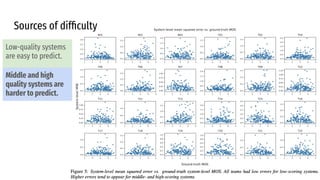
Low-quality systems
are easy to predict.
Middle and high
quality systems are
harder to predict.
Analysis of metrics
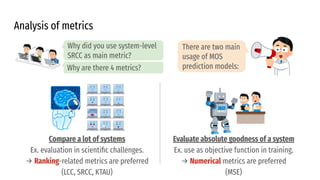
Why did you use system-level
SRCC as main metric?
Why are there 4 metrics?
There are two main
usage of MOS
prediction models:
Compare a lot of systems
Ex. evaluation in scientific challenges.
→ Ranking-related metrics are preferred
(LCC, SRCC, KTAU)
Evaluate absolute goodness of a system
Ex. use as objective function in training.
→ Numerical metrics are preferred
(MSE)
Analysis of metrics
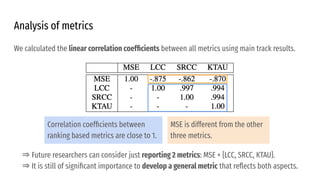
We calculated the linear correlation coefficients between all metrics using main track results.
Correlation coefficients between
ranking based metrics are close to 1.
MSE is different from the other
three metrics.
⇒ Future researchers can consider just reporting 2 metrics: MSE + {LCC, SRCC, KTAU}.
⇒ It is still of significant importance to develop a general metric that reflects both aspects.
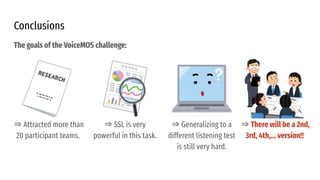
Conclusions
Conclusions
⇒ Attracted more than
20 participant teams.
⇒ SSL is very
powerful in this task.
⇒ Generalizing to a
different listening test
is still very hard.
⇒ There will be a 2nd,
3rd, 4th,... version!!
The goals of the VoiceMOS challenge:
Useful materials
The CodaLab challenge page is still open! Datasets are free to download. VoiceMOS Challenge
The baseline systems are open-sourced!
● https://github.com/nii-yamagishilab/mos-finetune-ssl
● https://github.com/dhimasryan/MOSA-Net-Cross-Domain
● https://github.com/unilight/LDNet
The arXiv paper is available!
● https://arxiv.org/abs/2203.11389

The VoiceMOS Challenge 2022

  • 1.
    The VoiceMOS Challenge2022 Wen-Chin Huang¹, Erica Cooper², Yu Tsao³, Hsin-Min Wang³, Tomoki Toda¹, Junichi Yamagishi² ¹Nagoya University, Japan ²National Institute of Informatics, Japan ³Academia Sinica, Taiwan 第141回音声言語情報処理 研究発表会 招待講演
  • 2.
    Outline I. Introduction II. Challengedescription A. Tracks and datasets B. Rules and timeline C. Evaluation metrics D. Baseline systems III. Challenge results A. Participants demographics B. Results, analysis and discussion 1. Comparison of baseline systems 2. Analysis of top systems 3. Sources of difficulty 4. Analysis of metrics IV. Conclusions
  • 3.
  • 4.
    Important to evaluatespeech synthesis systems, ex. text-to-speech (TTS), voice conversion (VC). Mean opinion score (MOS) test: Rate quality of individual samples. Speech quality assessment Subjective test Drawbacks: 1. Expensive: Costs too much time and money. 2. Context-dependent: numbers cannot be meaningfully compared across different listening tests.
  • 5.
    Important to evaluatespeech synthesis systems, ex. text-to-speech (TTS), voice conversion (VC). Mean opinion score (MOS) test: Rate quality of individual samples. Speech quality assessment Subjective test Objective assessment Data-driven MOS prediction (mostly based on deep learning) Drawback: bad generalization ability due to limited training data.
  • 6.
    Goals of theVoiceMOS challenge *Accepted as an Interspeech 2022 special session! Encourage research in automatic data-driven MOS prediction Compare different approaches using shared datasets and evaluation Focus on the challenging case of generalizing to a separate listening test Promote discussion about the future of this research field
  • 7.
    Challenge description I. Tracks anddatasets II. Rules and timeline III. Evaluation metrics IV. Baseline systems
  • 8.
    Challenge platform: CodaLab Open-sourceweb-based platform for reproducible machine learning research.
  • 9.
    Tracks and dataset:Main track The BVCC Dataset ● Samples from 187 different systems all rated together in one listening test ○ Past Blizzard Challenges (text-to-speech synthesis) since 2008 ○ Past Voice Conversion Challenges (voice conversion) since 2016 ○ ESPnet-TTS (implementations of modern TTS systems), 2020 ● Test set contains some unseen systems, unseen listeners, and unseen speakers and is balanced to match the distribution of scores in the training set
  • 10.
    Listening test datafrom the Blizzard Challenge 2019 ● “Out-of-domain” (OOD): Data from a completely separate listening test ● Chinese-language synthesis from systems submitted to the 2019 Blizzard Challenge ● Test set has some unseen systems and unseen listeners ● Designed to reflect a real-world setting where a small amount of labeled data is available ● Study generalization ability to a different listening test context ● Encourage unsupervised and semi-supervised approaches using unlabeled data Tracks and dataset: OOD track 10% 40% 10% 40% Labeled train set Unlabeled train set Dev set Test set
  • 11.
  • 12.
    Rules and timeline Trainingphase ✔Main track train/dev audio+rating ✔OOD track train/dev audio+rating Leaderboard available Need to submit at least once 2021/12/5 2022/2/21 2022/2/28 2022/3/7 Break phase No submission available. Conduct result analysis. Evaluation phase ✔Main track test audio ✔OOD track test audio Leaderboard available Max 3 submissions Post-evaluation phase ✔Main track test rating ✔OOD track test rating ✔Evaluation results Submission & leaderboard reopen General rules External data is permitted. All participants need to submit system description.
  • 13.
    Evaluation metrics System-level andUtterance-level ● Mean Squared Error (MSE): difference between predicted and actual MOS ● Linear Correlation Coefficient (LCC): a basic correlation measure ● Spearman Rank Correlation Coefficient (SRCC): non-parametric; measures ranking order ● Kendall Tau Rank Correlation (KTAU): more robust to errors import numpy as np import scipy.stats # `true_mean_scores` and `predict_mean_scores` are both 1-d numpy arrays. MSE = np.mean((true_mean_scores - predict_mean_scores)**2) LCC = np.corrcoef(true_mean_scores, predict_mean_scores)[0][1] SRCC = scipy.stats.spearmanr(true_mean_scores, predict_mean_scores)[0] KTAU = scipy.stats.kendalltau(true_mean_scores, predict_mean_scores)[0] Following prior work, we picked system-level SRCC as the main evaluation metric.
  • 14.
    Baseline system: SSL-MOS Fine-tunea self-supervised learning based (SSL) speech model for the MOS prediction task ● Pretrained wav2vec2 ● Simple mean pooling and a linear fine-tuning layer ● Wav2vec2 model parameters are updated during fine-tuning E. Cooper, W.-C. Huang, T. Toda, and J. Yamagishi, “Generalization ability of MOS prediction networks,” in Proc. ICASSP, 2022
  • 15.
    Baseline system: MOSANet ●Originally developed for noisy speech assessment ● Cross-domain input features: ○ Spectral information ○ Complex features ○ Raw waveform ○ Features extracted from SSL models R. E. Zezario, S.-W. Fu, F. Chen, C.-S. Fuh, H.-M. Wang, and Y. Tsao, “Deep Learning-based Non-Intrusive Multi-Objective Speech Assessment Model with Cross-Domain Features,” arXiv preprint arXiv:2111.02363, 2021.
  • 16.
    Baseline system: LDNet Listener-dependentmodeling ● Specialized model structure and inference method allows making use of multiple ratings per audio sample. ● No external data is used! W.-C. Huang, E. Cooper, J. Yamagishi, and T. Toda, “LDNet: Unified Listener Dependent Modeling in MOS Prediction for Synthetic Speech,” in Proc. ICASSP, 2022
  • 17.
    Challenge results I. Participantsdemographics II. Results, analysis and discussion A. Comparison of baseline systems B. Analysis of top systems C. Sources of difficulty D. Analysis of metrics
  • 18.
    Participants demographics Number ofteams: 22 teams + 3 baselines 14 teams are from academia, 5 teams are from industry, 3 teams are personal Main track: 21 teams + 3 baselines OOD track: 15 teams + 3 baselines Baseline systems: ● B01: SSL-MOS ● B02: MOSANet ● B03: LDNet
  • 19.
    Overall evaluation results:main track, OOD track
  • 20.
    Comparison of baselinesystems: main track In terms of system-level SRCC, 11 teams outperformed the best baseline, B01! However, the gap between the best baseline and the top system is not large…
  • 21.
    Comparison of baselinesystems: OOD track In terms of system-level SRCC, only 2 teams outperformed or on par with B01. The gap is even smaller… Participant feedback: “The baseline was too strong! Hard to get improvement!”
  • 22.
    Analysis of approachesused ● Main track: Finetuning SSL > using SSL features > not using SSL ● OOD track: finetuned SSL models were both the best and worst systems ● Popular approaches: ○ Ensembling (top team in main track; top 2 teams in OOD track) ○ Multi-task learning ○ Use of speech recognizers (top team in OOD track) Finetuned SSL SSL features No SSL
  • 23.
    Analysis of approachesused ● 7 teams used per-listener ratings ● No teams used listener demographics ○ One team used “listener group” ● OOD track: only 3 teams used the unlabeled data: Conducted their own listening test (top team) Task-adaptive pretraining “Pseudo-label” the unlabeled data using trained model
  • 24.
    Sources of difficulty Areunseen categories more difficult? Unseen systems Unseen speakers Unseen listeners Main track OOD track no yes (7 teams) Category yes (17 teams) yes (6 teams) N/A no
  • 25.
    Sources of difficulty Systemswith large differences between their training and test set distributions are harder to predict.
  • 26.
    Sources of difficulty Low-qualitysystems are easy to predict. Middle and high quality systems are harder to predict.
  • 27.
    Analysis of metrics Whydid you use system-level SRCC as main metric? Why are there 4 metrics? There are two main usage of MOS prediction models: Compare a lot of systems Ex. evaluation in scientific challenges. → Ranking-related metrics are preferred (LCC, SRCC, KTAU) Evaluate absolute goodness of a system Ex. use as objective function in training. → Numerical metrics are preferred (MSE)
  • 28.
    Analysis of metrics Wecalculated the linear correlation coefficients between all metrics using main track results. Correlation coefficients between ranking based metrics are close to 1. MSE is different from the other three metrics. ⇒ Future researchers can consider just reporting 2 metrics: MSE + {LCC, SRCC, KTAU}. ⇒ It is still of significant importance to develop a general metric that reflects both aspects.
  • 29.
  • 30.
    Conclusions ⇒ Attracted morethan 20 participant teams. ⇒ SSL is very powerful in this task. ⇒ Generalizing to a different listening test is still very hard. ⇒ There will be a 2nd, 3rd, 4th,... version!! The goals of the VoiceMOS challenge:
  • 31.
    Useful materials The CodaLabchallenge page is still open! Datasets are free to download. VoiceMOS Challenge The baseline systems are open-sourced! ● https://github.com/nii-yamagishilab/mos-finetune-ssl ● https://github.com/dhimasryan/MOSA-Net-Cross-Domain ● https://github.com/unilight/LDNet The arXiv paper is available! ● https://arxiv.org/abs/2203.11389