Sentence DiagrammingKey skills
5 key skillsIdentify central parts of the sentenceEstablish relationships between those partsShow those relationships with correct lines in the diagramAssign modifiers to each sentence partDraw in modifiers for each part on the diagram
Identify partsThere are four central parts of a sentenceSubjectPredicateDirect objectIndirect objectPractice finding each part in the following sentences
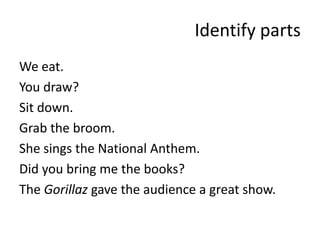
Identify partsWe eat.You draw?Sit down.Grab the broom.She sings the National Anthem.Did you bring me the books?The Gorillaz gave the audience a great show.
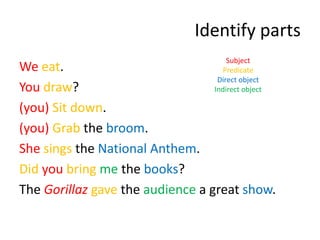
Identify partsWeeat.Youdraw?(you) Sit down.(you) Grab the broom.Shesings the National Anthem.Didyoubringme the books?The Gorillazgave the audience a great show.SubjectPredicateDirect objectIndirect object
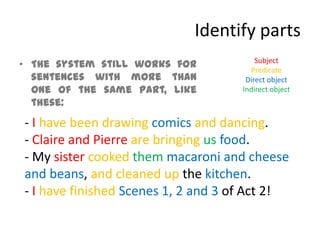
Identify partsSubjectPredicateDirect objectIndirect objectThe system still works for sentences with more than one of the same part, like these:- Ihave been drawing comics and dancing.- Claire and Pierre are bringing usfood.- My sistercooked themmacaroni and cheese and beans, and cleaned up the kitchen.- Ihave finished Scenes 1, 2 and 3 of Act 2!
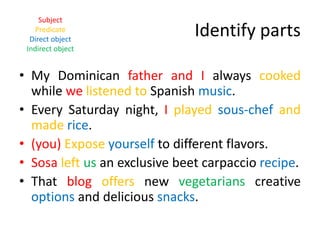
Identify partsSubjectPredicateDirect objectIndirect objectMy Dominican father and I always cooked while we listened to Spanish music.Every Saturday night, I played sous-chef and made rice.Expose yourself to different flavors.Sosa left us an exclusive beet carpaccio recipe.That blog offers vegetarians creative options and delicious snacks.
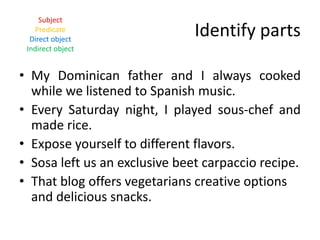
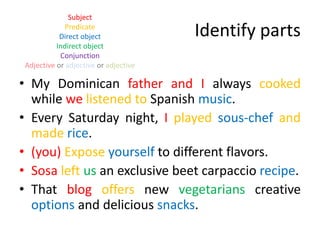
Identify partsSubjectPredicateDirect objectIndirect objectMy Dominican father and I always cooked while welistened to Spanish music.Every Saturday night, Iplayedsous-chefandmaderice.(you) Exposeyourself to different flavors.Sosaleftus an exclusive beet carpacciorecipe.That blogoffers new vegetarians creative options and delicious snacks.
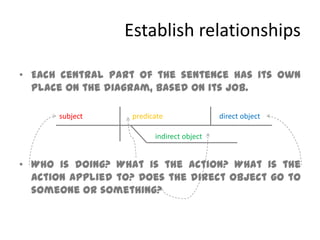
Establish relationshipsEach central part of the sentence has its own place on the diagram, based on its job. Who is doing? What is the action? What is the action applied to? Does the direct object go to someone or something?subjectpredicatedirect objectindirect object
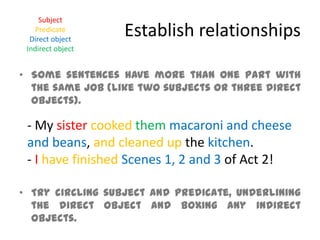
Establish relationshipsSubjectPredicateDirect objectIndirect objectSome sentences have more than one part with the same job (like two subjects or three direct objects).Try circling subject and predicate, underlining the direct object and boxing any indirect objects. - My sistercooked themmacaroni and cheese and beans, and cleaned up the kitchen.- Ihave finished Scenes 1, 2 and 3 of Act 2!
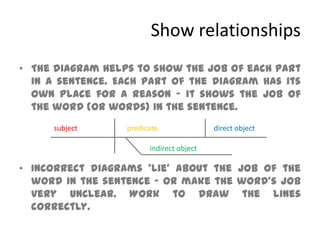
Show relationshipsThe diagram helps to show the job of each part in a sentence. Each part of the diagram has its own place for a reason – it shows the job of the word (or words) in the sentence.Incorrect diagrams ‘lie’ about the job of the word in the sentence – or make the word’s job very unclear. Work to draw the lines correctly.subjectpredicatedirect objectindirect object
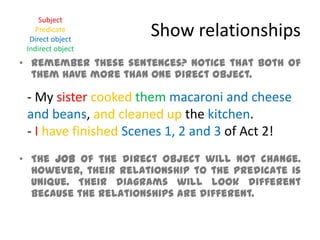
Show relationshipsRemember these sentences? Notice that both of them have more than one direct object. The job of the direct object will not change. However, their relationship to the predicate is unique. Their diagrams will look different because the relationships are different.SubjectPredicateDirect objectIndirect object- My sistercooked themmacaroni and cheese and beans, and cleaned up the kitchen.- Ihave finished Scenes 1, 2 and 3 of Act 2!
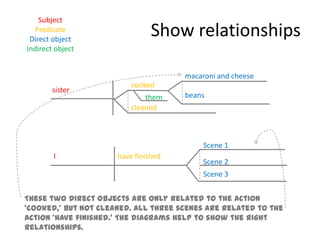
cookedcleanedShow relationshipsSubjectPredicateDirect objectIndirect objectmacaroni and cheesebeansScene 1Scene 2Scene 3sisterIhave finishedthemThese two direct objects are only related to the action ‘cooked,’ but not cleaned. All three scenes are related to the action ‘have finished.’ The diagrams help to show the right relationships.
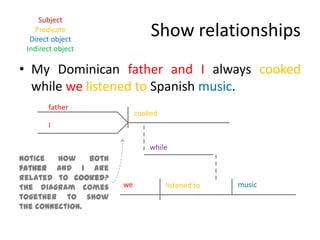
Show relationshipsSubjectPredicateDirect objectIndirect objectMy Dominican father and I always cooked while welistened to Spanish music.fatherIcookedwhileNotice how both father and I are related to cooked? The diagram comes together to show the connection.listened towemusic
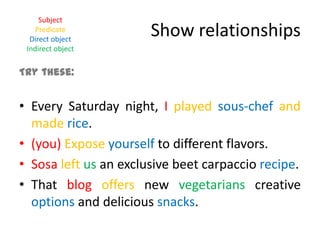
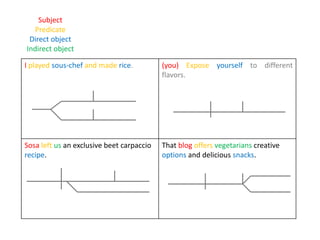
Show relationshipsSubjectPredicateDirect objectIndirect objectTry these:Every Saturday night, Iplayedsous-chefandmaderice.(you) Exposeyourself to different flavors.Sosaleftus an exclusive beet carpacciorecipe.That blogoffers new vegetarians creative options and delicious snacks.
SubjectPredicateDirect objectIndirect object
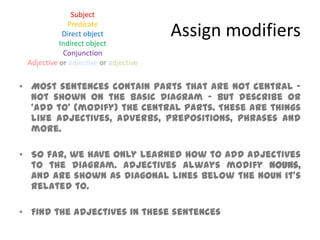
Assign modifiersSubjectPredicateDirect objectIndirect objectConjunctionAdjective oradjective or adjectiveMost sentences contain parts that are not central – not shown on the basic diagram – but describe or ‘add to’ (modify) the central parts. These are things like adjectives, adverbs, prepositions, phrases and more. So far, we have only learned how to add adjectives to the diagram. Adjectives always modify nouns, and are shown as diagonal lines below the noun it’s related to.Find the adjectives in these sentences
Identify partsSubjectPredicateDirect objectIndirect objectConjunctionAdjective oradjective or adjectiveMy Dominican father and I always cooked while welistened to Spanish music.Every Saturday night, Iplayedsous-chefandmaderice.(you) Exposeyourself to different flavors.Sosaleftus an exclusive beet carpacciorecipe.That blogoffers new vegetarians creative options and delicious snacks.
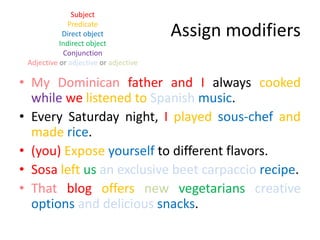
Assign modifiersSubjectPredicateDirect objectIndirect objectConjunctionAdjective oradjective or adjectiveMy Dominican father and I always cookedwhilewelistened to Spanishmusic.Every Saturday night, Iplayedsous-chefandmaderice.(you) Exposeyourself to different flavors.Sosaleftusan exclusive beet carpacciorecipe.Thatblogoffersnewvegetarianscreativeoptionsand delicious snacks.
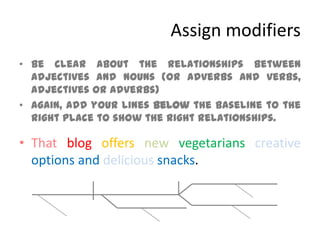
Assign modifiersBe clear about the relationships between adjectives and nouns (or adverbs and verbs, adjectives or adverbs)Again, add your lines below the baseline to the right place to show the right relationships.Thatblogoffersnewvegetarianscreativeoptionsand delicious snacks.
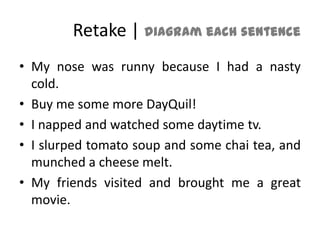
Retake | diagram each sentenceMy nose was runny because I had a nasty cold.Buy me some more DayQuil!I napped and watched some daytime tv.I slurped tomato soup and some chai tea, and munched a cheese melt.My friends visited and brought me a great movie.

Sentence diagramming

  • 1.
  • 2.
    5 key skillsIdentifycentral parts of the sentenceEstablish relationships between those partsShow those relationships with correct lines in the diagramAssign modifiers to each sentence partDraw in modifiers for each part on the diagram
  • 3.
    Identify partsThere arefour central parts of a sentenceSubjectPredicateDirect objectIndirect objectPractice finding each part in the following sentences
  • 4.
    Identify partsWe eat.Youdraw?Sit down.Grab the broom.She sings the National Anthem.Did you bring me the books?The Gorillaz gave the audience a great show.
  • 5.
    Identify partsWeeat.Youdraw?(you) Sitdown.(you) Grab the broom.Shesings the National Anthem.Didyoubringme the books?The Gorillazgave the audience a great show.SubjectPredicateDirect objectIndirect object
  • 6.
    Identify partsSubjectPredicateDirect objectIndirectobjectThe system still works for sentences with more than one of the same part, like these:- Ihave been drawing comics and dancing.- Claire and Pierre are bringing usfood.- My sistercooked themmacaroni and cheese and beans, and cleaned up the kitchen.- Ihave finished Scenes 1, 2 and 3 of Act 2!
  • 7.
    Identify partsSubjectPredicateDirect objectIndirectobjectMy Dominican father and I always cooked while we listened to Spanish music.Every Saturday night, I played sous-chef and made rice.Expose yourself to different flavors.Sosa left us an exclusive beet carpaccio recipe.That blog offers vegetarians creative options and delicious snacks.
  • 8.
    Identify partsSubjectPredicateDirect objectIndirectobjectMy Dominican father and I always cooked while welistened to Spanish music.Every Saturday night, Iplayedsous-chefandmaderice.(you) Exposeyourself to different flavors.Sosaleftus an exclusive beet carpacciorecipe.That blogoffers new vegetarians creative options and delicious snacks.
  • 9.
    Establish relationshipsEach centralpart of the sentence has its own place on the diagram, based on its job. Who is doing? What is the action? What is the action applied to? Does the direct object go to someone or something?subjectpredicatedirect objectindirect object
  • 10.
    Establish relationshipsSubjectPredicateDirect objectIndirectobjectSome sentences have more than one part with the same job (like two subjects or three direct objects).Try circling subject and predicate, underlining the direct object and boxing any indirect objects. - My sistercooked themmacaroni and cheese and beans, and cleaned up the kitchen.- Ihave finished Scenes 1, 2 and 3 of Act 2!
  • 11.
    Show relationshipsThe diagramhelps to show the job of each part in a sentence. Each part of the diagram has its own place for a reason – it shows the job of the word (or words) in the sentence.Incorrect diagrams ‘lie’ about the job of the word in the sentence – or make the word’s job very unclear. Work to draw the lines correctly.subjectpredicatedirect objectindirect object
  • 12.
    Show relationshipsRemember thesesentences? Notice that both of them have more than one direct object. The job of the direct object will not change. However, their relationship to the predicate is unique. Their diagrams will look different because the relationships are different.SubjectPredicateDirect objectIndirect object- My sistercooked themmacaroni and cheese and beans, and cleaned up the kitchen.- Ihave finished Scenes 1, 2 and 3 of Act 2!
  • 13.
    cookedcleanedShow relationshipsSubjectPredicateDirect objectIndirectobjectmacaroni and cheesebeansScene 1Scene 2Scene 3sisterIhave finishedthemThese two direct objects are only related to the action ‘cooked,’ but not cleaned. All three scenes are related to the action ‘have finished.’ The diagrams help to show the right relationships.
  • 14.
    Show relationshipsSubjectPredicateDirect objectIndirectobjectMy Dominican father and I always cooked while welistened to Spanish music.fatherIcookedwhileNotice how both father and I are related to cooked? The diagram comes together to show the connection.listened towemusic
  • 15.
    Show relationshipsSubjectPredicateDirect objectIndirectobjectTry these:Every Saturday night, Iplayedsous-chefandmaderice.(you) Exposeyourself to different flavors.Sosaleftus an exclusive beet carpacciorecipe.That blogoffers new vegetarians creative options and delicious snacks.
  • 16.
  • 17.
    Assign modifiersSubjectPredicateDirect objectIndirectobjectConjunctionAdjective oradjective or adjectiveMost sentences contain parts that are not central – not shown on the basic diagram – but describe or ‘add to’ (modify) the central parts. These are things like adjectives, adverbs, prepositions, phrases and more. So far, we have only learned how to add adjectives to the diagram. Adjectives always modify nouns, and are shown as diagonal lines below the noun it’s related to.Find the adjectives in these sentences
  • 18.
    Identify partsSubjectPredicateDirect objectIndirectobjectConjunctionAdjective oradjective or adjectiveMy Dominican father and I always cooked while welistened to Spanish music.Every Saturday night, Iplayedsous-chefandmaderice.(you) Exposeyourself to different flavors.Sosaleftus an exclusive beet carpacciorecipe.That blogoffers new vegetarians creative options and delicious snacks.
  • 19.
    Assign modifiersSubjectPredicateDirect objectIndirectobjectConjunctionAdjective oradjective or adjectiveMy Dominican father and I always cookedwhilewelistened to Spanishmusic.Every Saturday night, Iplayedsous-chefandmaderice.(you) Exposeyourself to different flavors.Sosaleftusan exclusive beet carpacciorecipe.Thatblogoffersnewvegetarianscreativeoptionsand delicious snacks.
  • 20.
    Assign modifiersBe clearabout the relationships between adjectives and nouns (or adverbs and verbs, adjectives or adverbs)Again, add your lines below the baseline to the right place to show the right relationships.Thatblogoffersnewvegetarianscreativeoptionsand delicious snacks.
  • 21.
    Retake | diagrameach sentenceMy nose was runny because I had a nasty cold.Buy me some more DayQuil!I napped and watched some daytime tv.I slurped tomato soup and some chai tea, and munched a cheese melt.My friends visited and brought me a great movie.