MS. SYNDEY G. MARAMOT
SENTENCE
DIAGRAMMING
DIAGRAMMING SENTENCES
❑ is a way to visualize how the different parts of a
sentence fit together.
❑ The subject of a clause goes in one slot, the verb in
another, and so on.
❑ Words that modify another word are attached to the
word they modify. The method we use to attach
them indicates what the relationship is between
them.
DIAGRAMMING SENTENCES:
SUBJECT AND VERBS
SUBJECTS tell us whom or what a sentence about.
VERBS tell us what the subject is or does.
In diagramming sentences, put the subject on the left
side of the vertical line and the verb on the right side
of the vertical line.
Helping verbs are part of the verb, so helping verbs
and main verbs are written together n the right side of
the vertical line.
1. 1. Cats meow.
SUBJECT VERB
Cats meow
1. 2. Birds were chirping.
Birds were chirping
1. 4. Sydney has been playing.
Cailey must have been sleeping
1. 3. Cailey must have been sleeping.
Sydney has been playing
DIAGRAMMING QUESTIONS:
Did you notice that all of the sentences you
diagrammed above began with the subjects?
Well QUESTIONS (interrogative sentences) are
typically written in a different order. If you have a
hard time finding the subject question, reorder
the question into a statement.
Example: Have you been cooking? Becomes
You have been cooking.
Be sure to maintain the original capitalization of
the sentence when you diagram it.
1. 2. Did Josh eat?
I May run
1. 1. May I run?
Josh Did eat
1. 4. Has Lucy been reading?
we Should have been swimming
1. 3. Should we have been swimming?
Lucy Has been reading
DIAGRAMMING MODIFIERS:
MODIFIERS describe other words.

Adjectives and adverbs are modifiers, and you’ll
learn more about them and how to diagram
them with these exercises.
SUBJECT VERB
DIAGRAMMING ADJECTIVES
ADJECTIVES are words that describe nouns and
pronouns. They answer the adjective questions.
(Which one? what kind? How many? Whose?)
Sentence diagrams show us that adjectives
describe nouns and pronouns.
Adjectives and adverbs are modifiers, and you’ll
learn more about them and how to diagram them
with these exercises.
1. 1. Two fat birds chirped.
birds chirped
1. 2. That cute baby has been laughing.
baby has been laughing
1. 3. Will my mother sing?
mother Will sing
box fell
1. 4. The green box fell.
1. 5. The lovely, scented candle burned.
candle burned
DIAGRAMMING ADVERBS
ADVERBS are words that describe verbs, adjectives
and other adverbs. They answer the adverb
questions. (How? When? Where? Why? To what
extent? Sentence diagrams show us that adverbs
describe verbs, adjectives and adverbs.
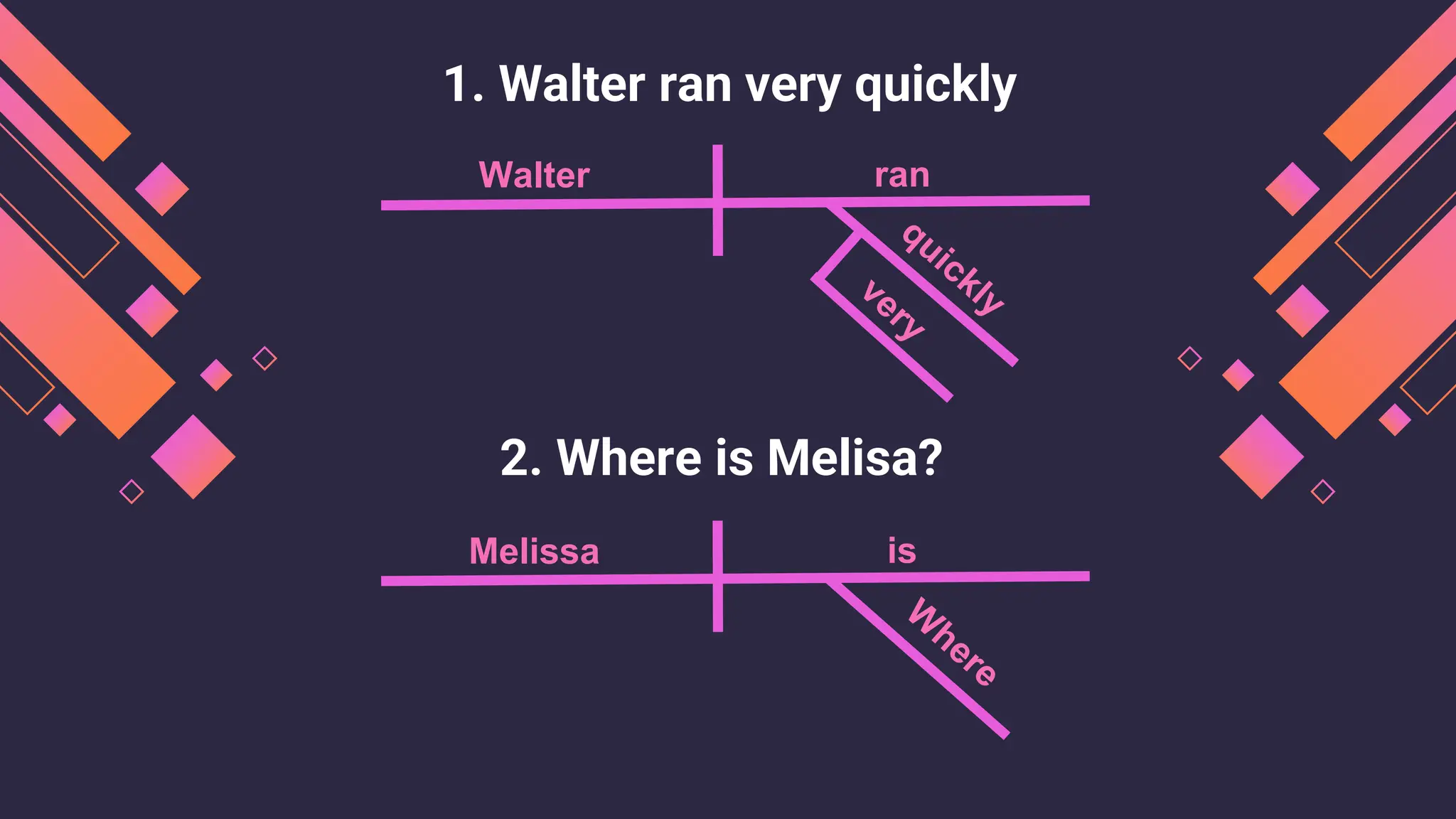
1. 1. Walter ran very quickly
Walter ran
1. 2. Where is Melisa?
Melissa is
1. 3. May Rover stay here?
Rover May stay
1. 4. Thomas Edison worked diligently.
Thomas Edison worked
1. 5. Very politely, Henry bowed.
Henry bowed
DIAGRAMMING
MODIFIERS:
ADJECTIVES &
ADVERBS
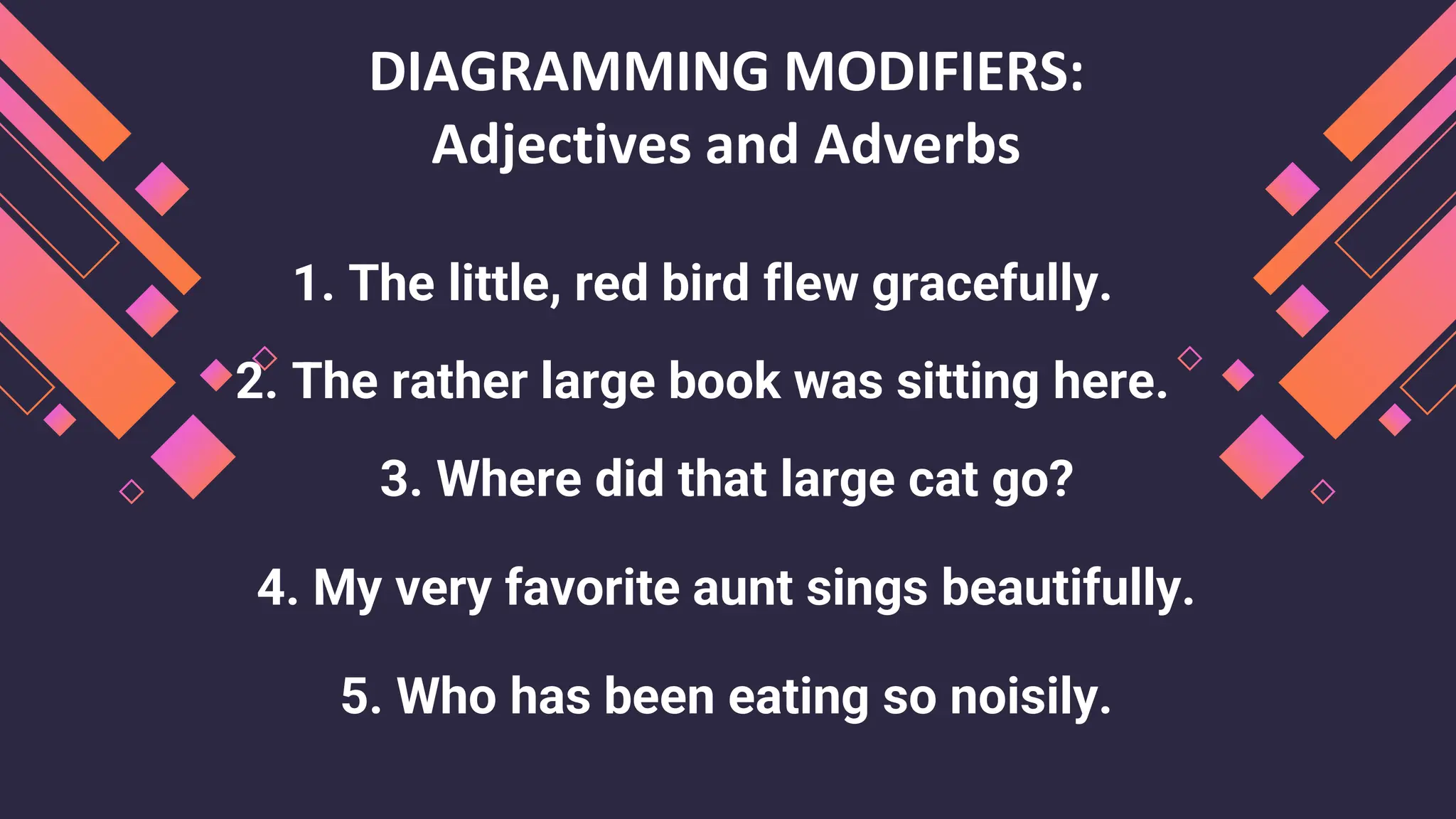
DIAGRAMMING MODIFIERS:
Adjectives and Adverbs
1. The little, red bird flew gracefully.
2. The rather large book was sitting here.
3. Where did that large cat go?
4. My very favorite aunt sings beautifully.
5. Who has been eating so noisily.
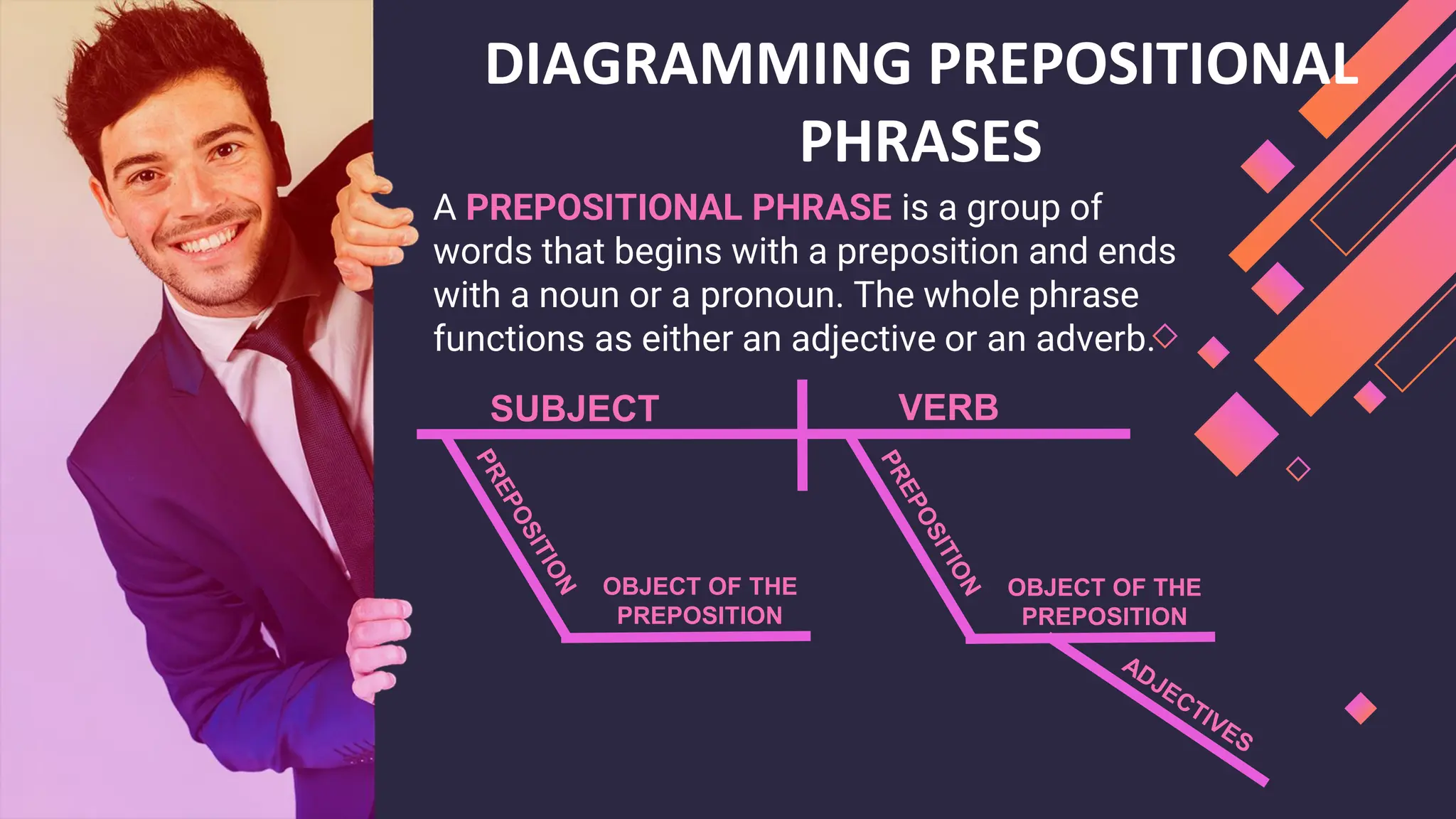
DIAGRAMMING PREPOSITIONAL
PHRASES
A PREPOSITIONAL PHRASE is a group of
words that begins with a preposition and ends
with a noun or a pronoun. The whole phrase
functions as either an adjective or an adverb.
SUBJECT VERB
OBJECT OF THE
PREPOSITION
OBJECT OF THE
PREPOSITION
DIAGRAMMING PREPOSITIONAL
PHRASES (Adjectives)
When these function as adjectives, they modify
nouns or pronouns. Do you remember the
adjective questions? Knowing them will help you.
Put the preposition on a slanted line under the
noun that it modifies (in this case, the subject).
Put the object of the preposition on a horizontal
line after it. All of these prepositional phrases
modify the subject of the sentence.
1. The blue birds in the trees were chirping.
birds were chirping
trees
DIAGRAMMING
PREPOSITIONAL
PHRASES:
Adjectives
DIAGRAMMING PREPOSITIONAL
PHRASES: Adjectives
1. The children in the park are playing.
2. The rock on the cliff fell.
3. That dog across the street has been barking
again
4. Did the green box with the blue lid fall?
5. The lovely, scented candle on the table burned
continually.
DIAGRAMMING PREPOSITIONAL
PHRASES (Adverbs)
When these function as adverbs, they modify
verbs, adjectives, and adverbs. Do you remember
the adverb questions? Knowing them will help
you.
Put the preposition on a slanted line under the
word that it modifies. These all modify the verbs.
Put the object of the preposition on a horizontal
line after it.
1. The rabbit hopped through the pretty garden.
rabbit hopped
garden
DIAGRAMMING
PREPOSITIONAL
PHRASES:
Adverbs
DIAGRAMMING PREPOSITIONAL
PHRASES: Adverbs
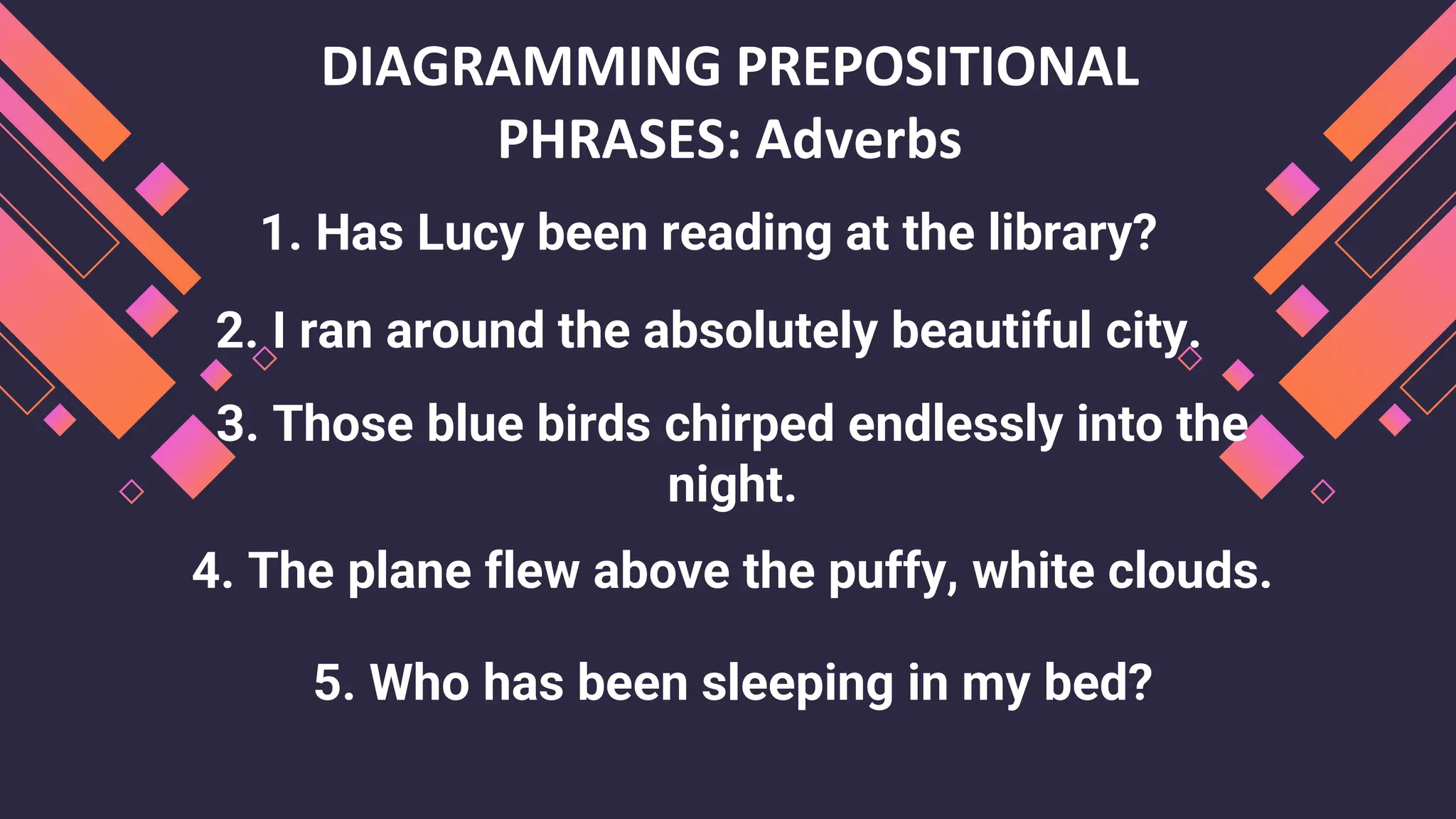
1. Has Lucy been reading at the library?
2. I ran around the absolutely beautiful city.
3. Those blue birds chirped endlessly into the
night.
4. The plane flew above the puffy, white clouds.
5. Who has been sleeping in my bed?
DIAGRAMMING
COORDINATING
CONJUNCTIONS
DIAGRAMMING COORDINATING
CONJUNCTIONS
Conjunctions connect words, phrases, and
independent clauses. The connected elements are
said to be compound. There are only seven
coordinating conjunctions.
and, but, for, nor, or, so, yet
Mark and Jake walked around the block.
This sentence has two subjects joined with the
coordinating conjunction and. That means that this
sentence has a compound phrase.
DIAGRAMMING
COMPOUND
WORDS
DIAGRAMMING COMPOUND WORDS
We structure each compound element
differently in our sentence diagrams.
Here are examples of how to diagram
compound subjects, verbs, adjectives,
adverbs, and objects of the preposition.
COMPOUND SUBJECTS
VERB
SUBJECT
conjunction
SUBJECT
1. Alex and David laughed.
laughed
Alex
and
David
COMPOUND VERBS
subject
verb
verb
conjunction
1. Cathy smiled and laughed.
Cathy
smiled
laughed
and
COMPOUND ADJECTIVES
SUBJECT VERB
CONJUNCTION
1. Red and blue birds chirp.
birds chirp
and
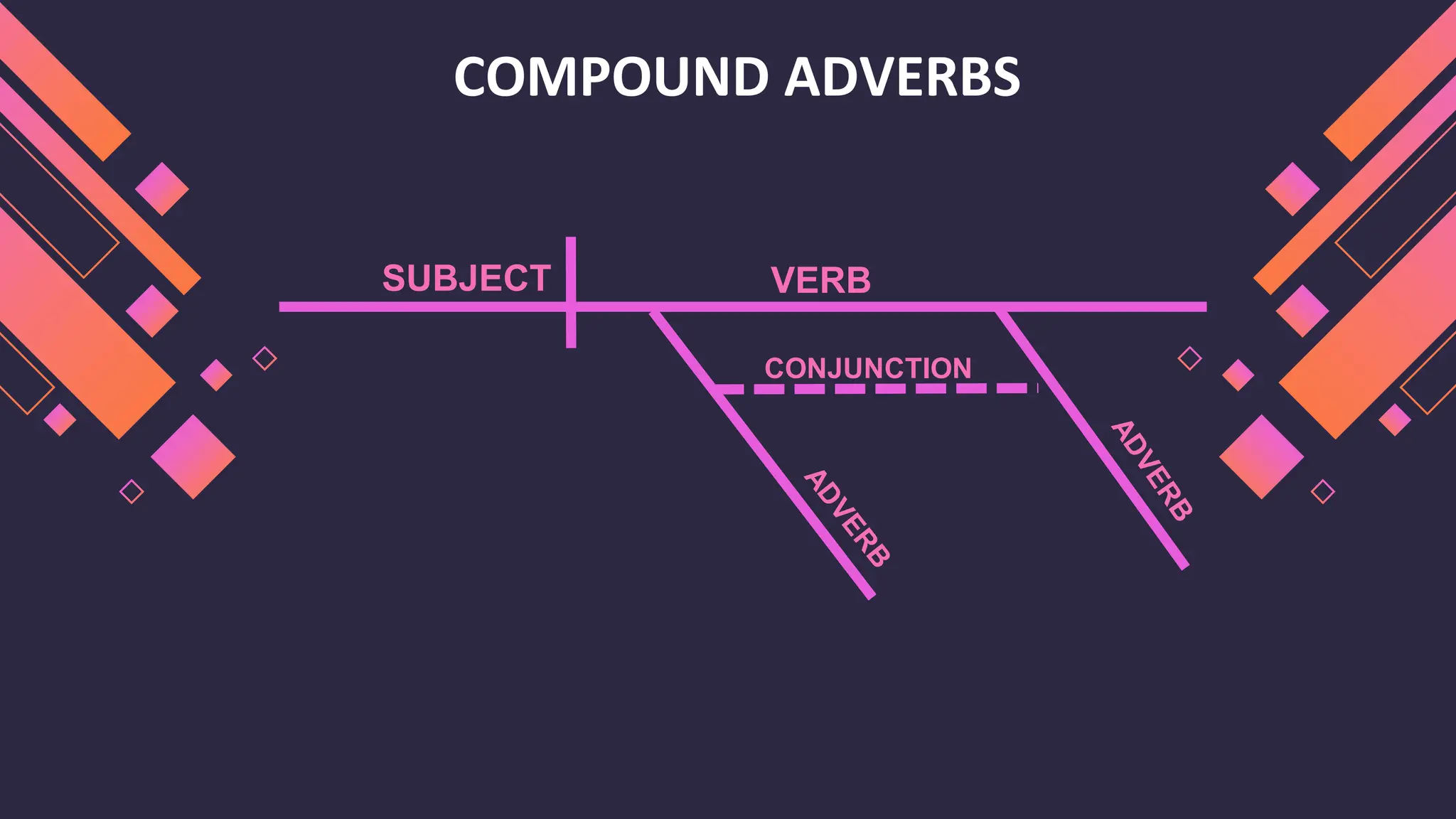
COMPOUND ADVERBS
SUBJECT VERB
CONJUNCTION
1. Beth walked confidently and swiftly.
Beth walked
and
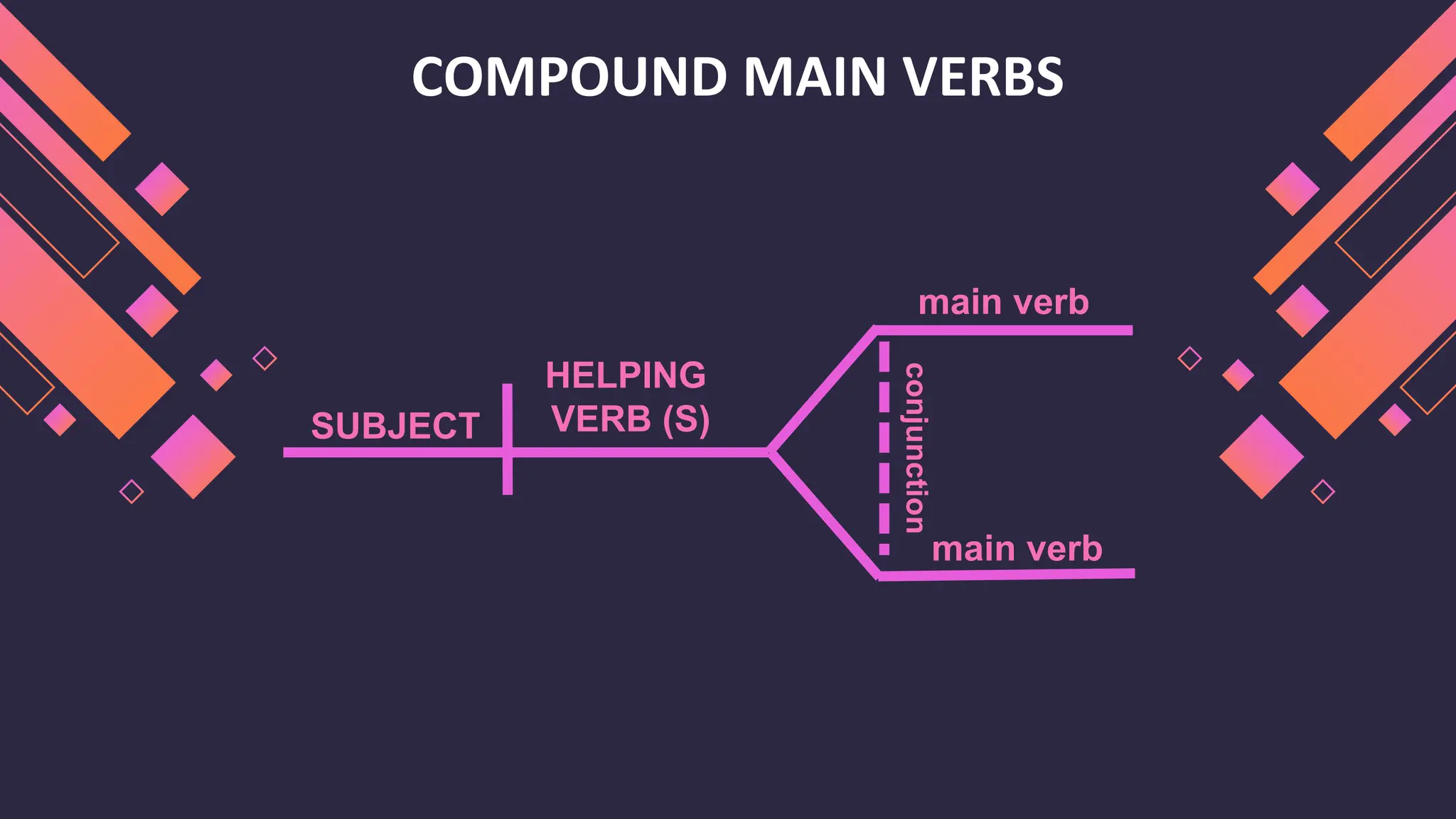
COMPOUND MAIN VERBS
SUBJECT
HELPING
VERB (S)
main verb
conjunction
main verb
1. Dad will cook and clean.
Dad will
cook
and
clean
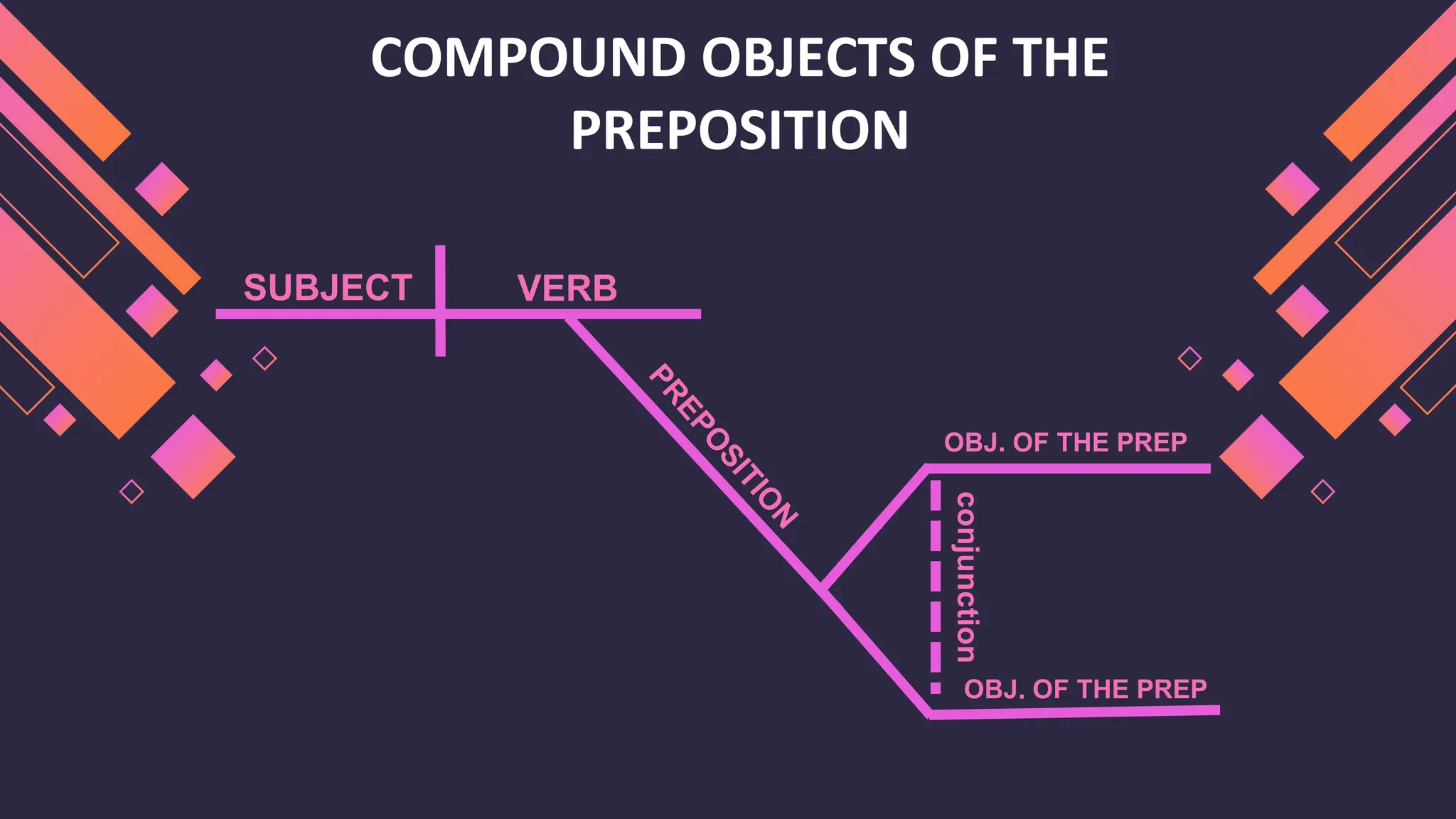
COMPOUND OBJECTS OF THE
PREPOSITION
SUBJECT
OBJ. OF THE PREP
conjunction
VERB
OBJ. OF THE PREP
1. Rover ran across fields and streams.
Rover
fields
and
ran
streams
DIAGRAMMING
VERB AND
PREPOSITIONAL
PHRASES
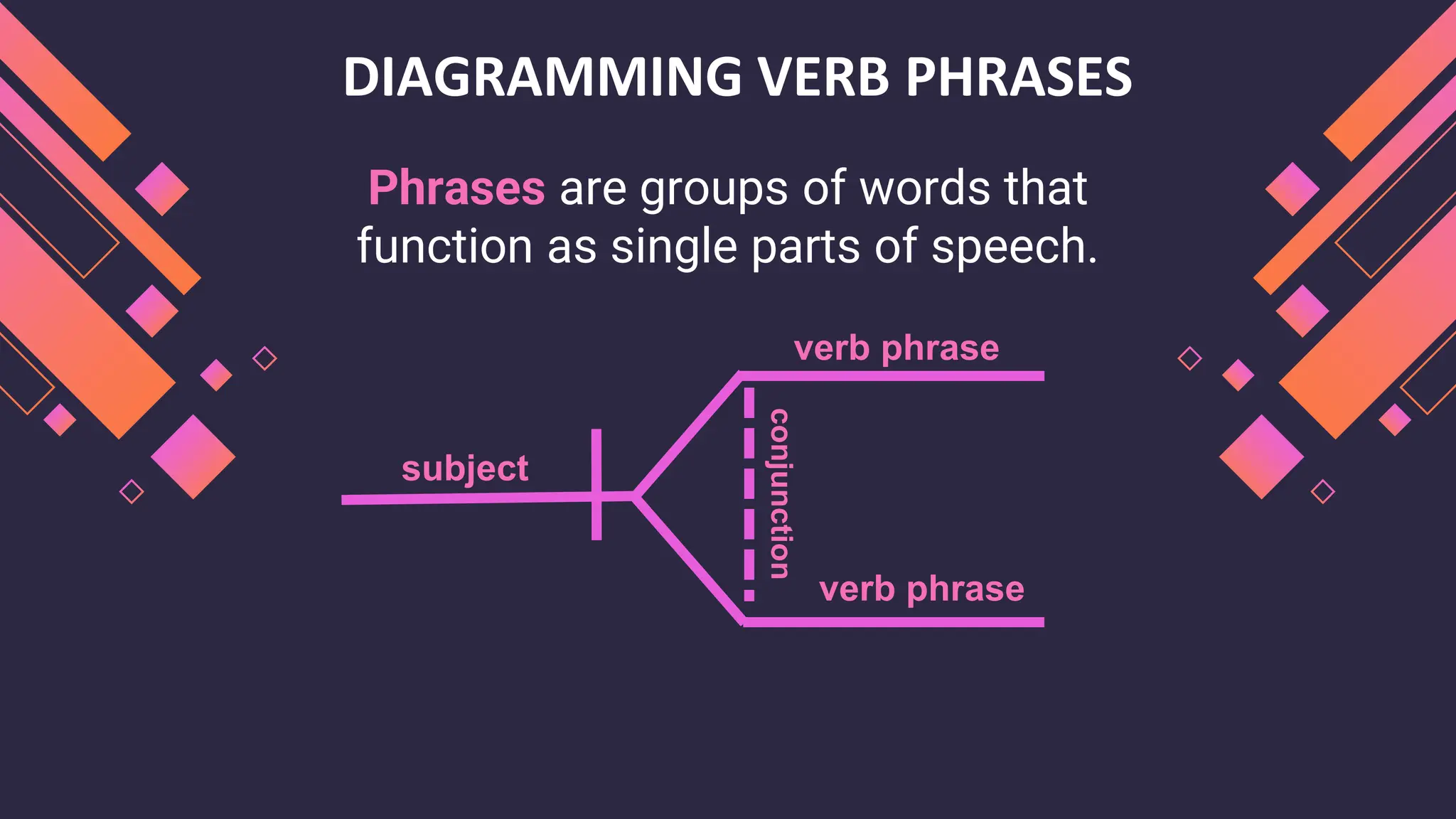
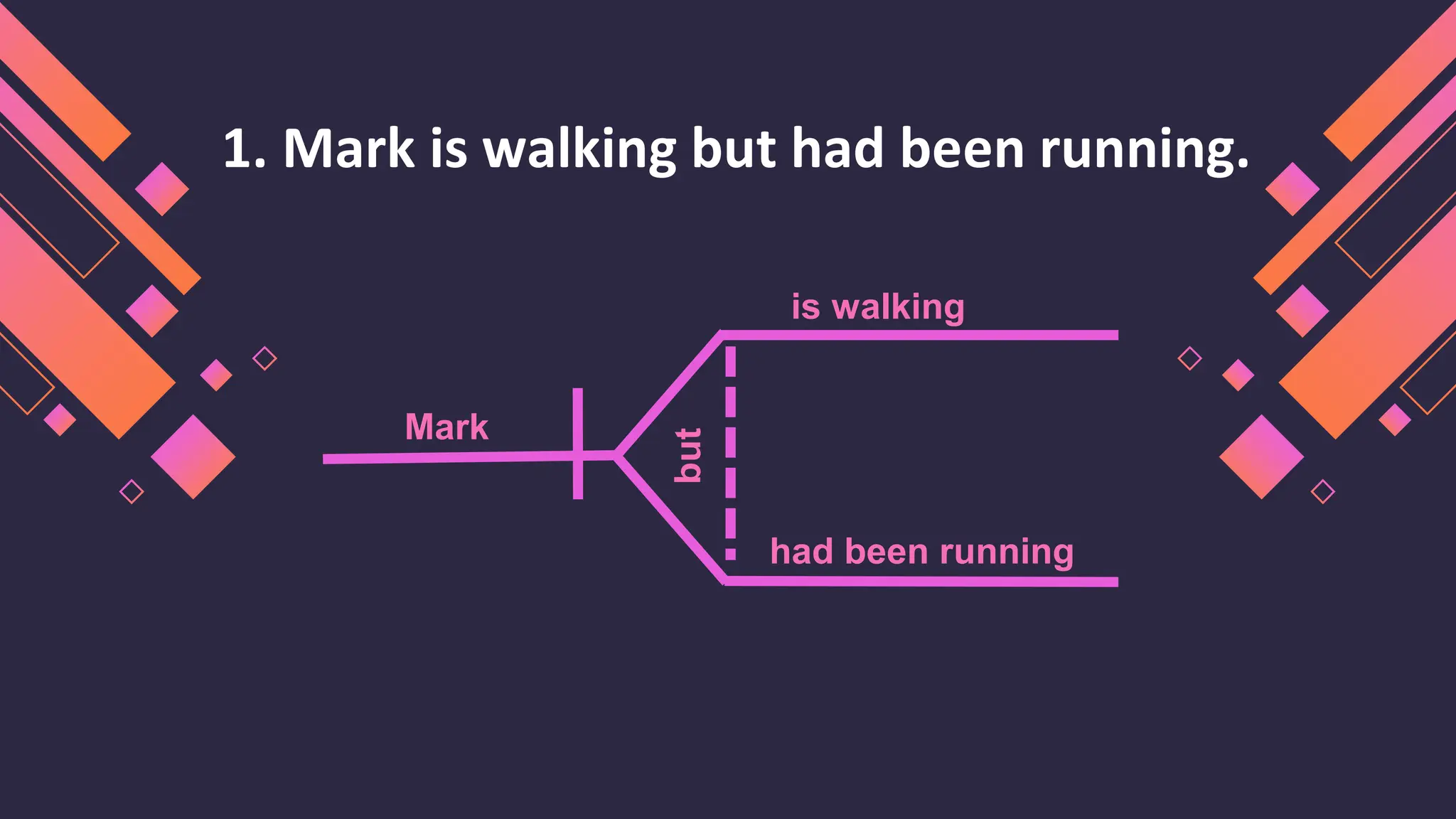
DIAGRAMMING VERB PHRASES
Phrases are groups of words that
function as single parts of speech.
subject
verb phrase
verb phrase
conjunction
1. Mark is walking but had been running.
Mark
is walking
had been running
but
COMPOUND PREPOSITIONAL PHRASES
SUBJECT VERB
CONJUNCTION
OBJ. OF PREP OBJ. OF PREP
1. Sunny walked over the hill and into
the park.
Sunny walked
and
hill park
DIAGRAMMING
SENTENCES
DIAGRAMMING SENTENCES
Sentences are groups of words that
expresses a complete thought. We
can make sentences compound by
putting two or more independent
clauses together with a coordinating
conjunction.
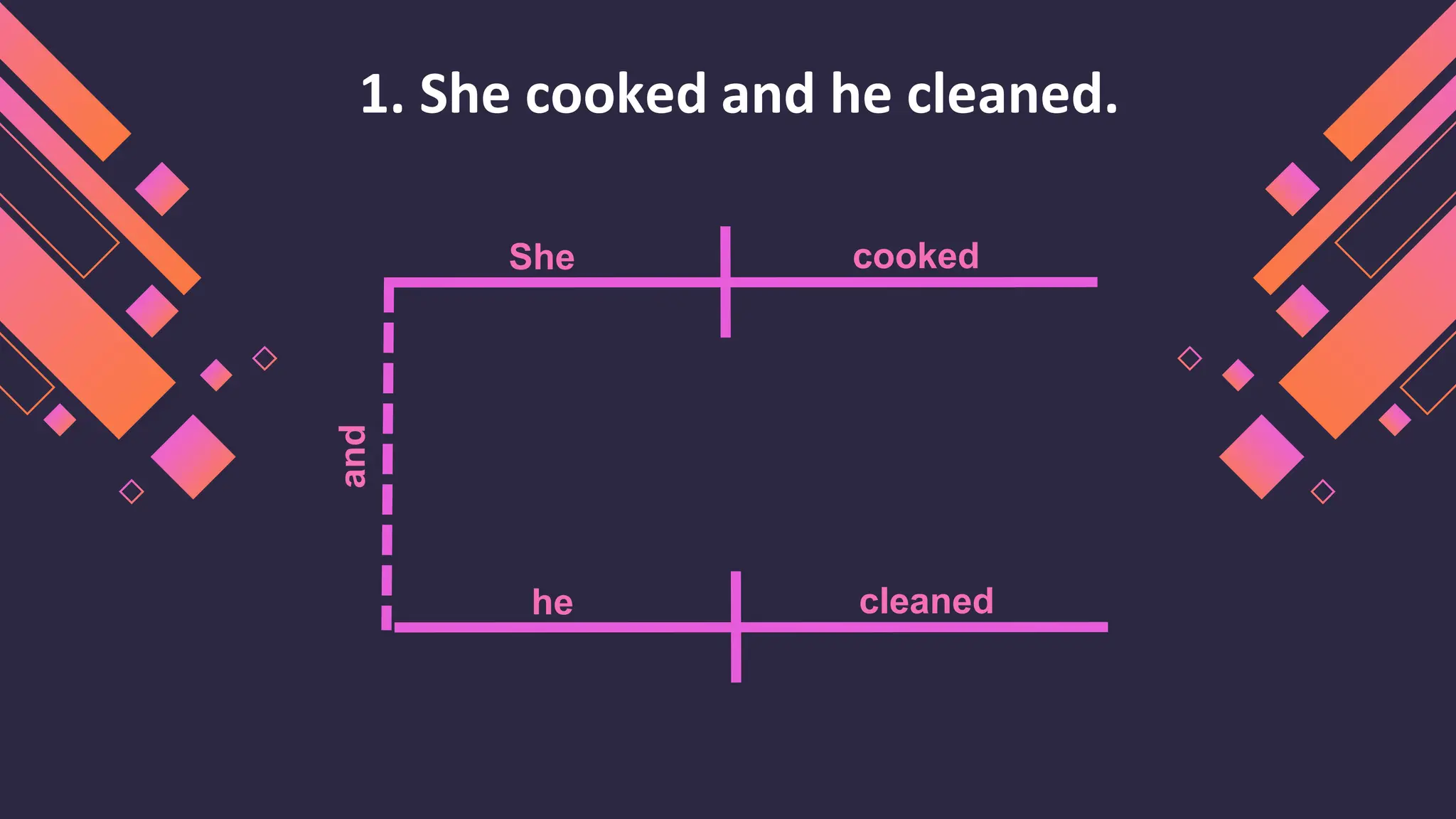
COMPOUND SENTENCES
SUBJECT VERB
SUBJECT VERB
COORDINATING
CONJUNCTION
1. She cooked and he cleaned.
She cooked
he cleaned
and
DIAGRAMMING
INTERJECTIONS
& NOUNS OF
DIRECT
ADDRESS
DIAGRAMMING SENTENCES
Interjections are words that show excitement
or emotion. They have something in
common with nouns of direct address.
Nouns of direct address name the person or
people being spoken to.
Both of them are grammatically
disconnected from the rest of the sentence.
This means that they don’t describe, modify,
or affect anything else in the sentence.
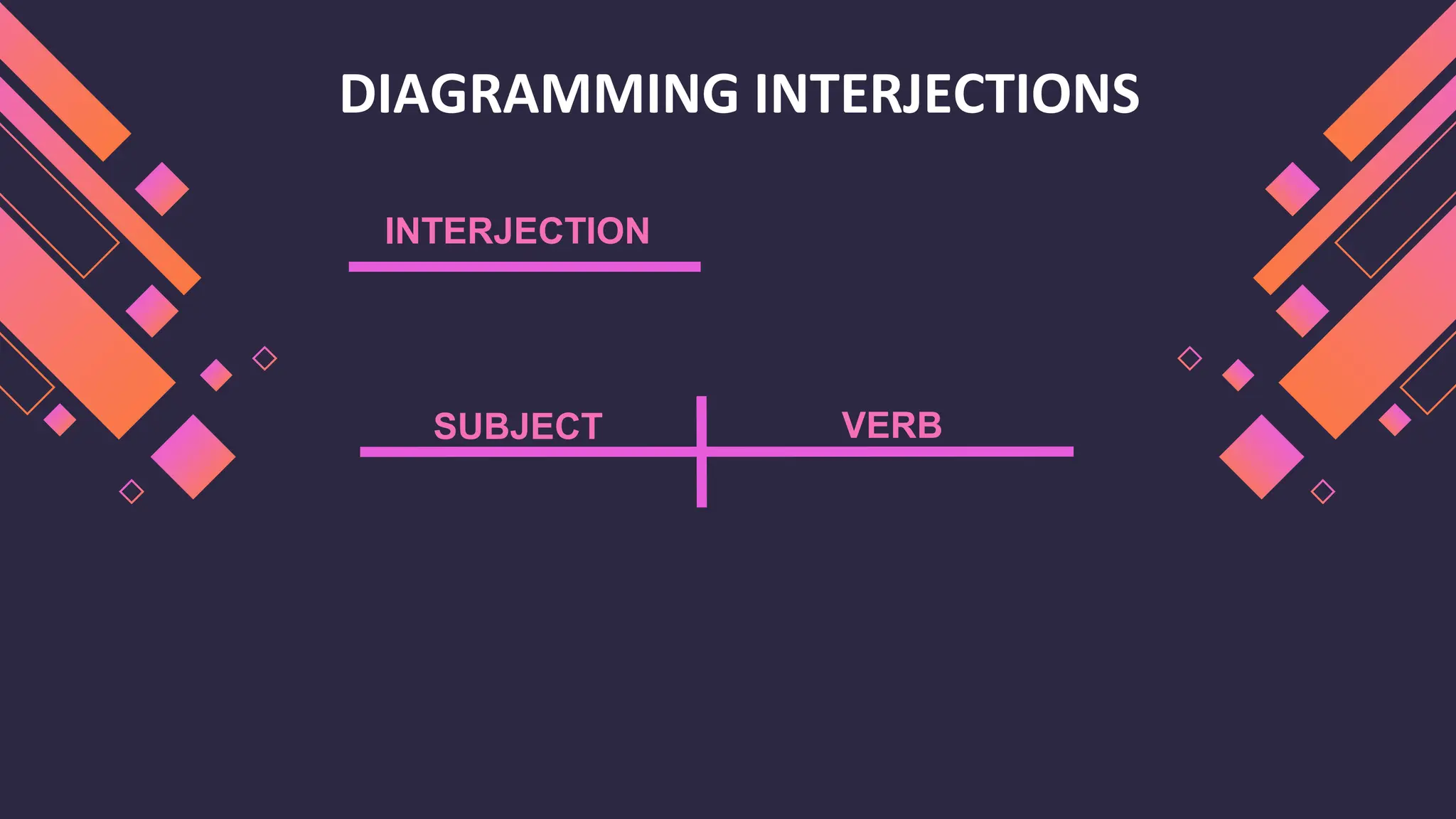
DIAGRAMMING INTERJECTIONS
SUBJECT VERB
INTERJECTION
1. Holy cow! This cake is delicious!
is
Holy cow
delicious
cake
DIAGRAMMING NOUNS OF DIRECT
ADDRESS
SUBJECT VERB
NOUNS OF DIRECT ADDRESS
1. Caroline, we won the game.
Caroline
won
We game
diagramming structure of english english

diagramming structure of english english