Density!!!!!!
Let the fun begin!
What is Density?
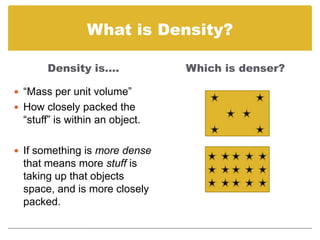
Density is….
 “Mass per unit volume”
 How closely packed the
“stuff” is within an object.
 If something is more dense
that means more stuff is
taking up that objects
space, and is more closely
packed.
Which is denser?
Density Examples and other
important information
 An elevator with 15 people in it would be more
dense than the same elevator with only 3 people in
it.
 Density does depend on size as well as how
compact the molecules are inside:
 If I have the same amount (say 10g) of an object that is
extremely dense and an object that has a much lower
density (say gold versus Styrofoam) I will need much
more of lower density substance to get 10 grams worth
than the denser substance.
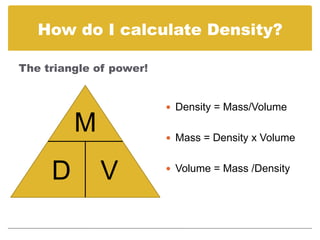
How do I calculate Density?
The triangle of power!
 Density = Mass/Volume
 Mass = Density x Volume
 Volume = Mass /Density
M
D V
Density of water
(important to know)
 Water has a density of 1g/mL
 1 gram for every 1mililiter.
 If I have 20 grams of water, I have 20 ml of water.
 If I have 50ml of water, I will have 50 grams of
water.
Floating and Sinking with
Density
 If something has a greater
density than 1g/mL then it
will SINK
 ex: 3g/mL> 1g/mL
 If something has a smaller
density than 1g/mL then it
will FLOAT!!!
 ex: .5g/mL < 1g/mL
More floating and Sinking
 That same “rule” applies for any fluid. As long as
the object/liquid you are putting into the fluid has a
lower density (smaller number) it will ALWAYS
float.
 As long as the object/fluid has a greater density
(larger number), it will ALWAYS sink!
A test to see if you were paying
attention:
 5 g/mL  Sink!
 2 g/cm3  Sink!
 .8g/mL  Float!
 1.5 g/mL  Sink!
 .99 g/cm3  Float!
 1.01g/cm3  Sink!
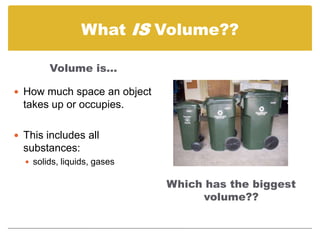
What IS Volume??
Volume is…
 How much space an object
takes up or occupies.
 This includes all
substances:
 solids, liquids, gases
Which has the biggest
volume??
Mass vs. Weight
Mass is…
 The amount of matter in an
object.
 How much “stuff” is inside
of it.
Weight is…
 A reflection of gravity’s pull
on an object.
 Hence…. People weigh
less on the moon because
there is a smaller force
pulling them down. (but
their mass stays the
same!)
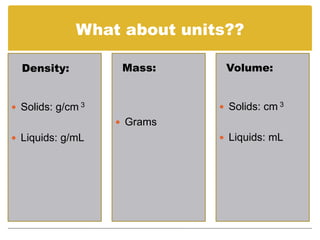
What about units??
Density:
 Solids: g/cm 3
 Liquids: g/mL
Mass:
 Grams
Volume:
 Solids: cm 3
 Liquids: mL
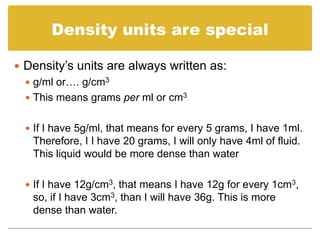
Density units are special
 Density’s units are always written as:
 g/ml or…. g/cm3
 This means grams per ml or cm3
 If I have 5g/ml, that means for every 5 grams, I have 1ml.
Therefore, I I have 20 grams, I will only have 4ml of fluid.
This liquid would be more dense than water
 If I have 12g/cm3, that means I have 12g for every 1cm3,
so, if I have 3cm3, than I will have 36g. This is more
dense than water.
Let’s try a couple of problems!
If I fill a cup with 250 mL of gasoline, and the mass is 200 grams, what is it’s
density?
I’m solving for density…. So what do I do with the triangle
of power???
M
D V
Cover “D” and find out that I divide mass by volume!
D = ??
M = 200 g
V = 250 mL
D = m/v
D = 200g / 250 mL
D = .8 g/mL
Let’s try a couple of problems!
Chloroform has a density of 1.73 g/ml, if I have 25 mL of it,
what is the mass?
I’m solving for mass…. So what do I do with the triangle
of power???
M
D V
Cover “M” and find out that I multiply density by volume!
D = 1.73 g/mL
M = ??
V = 25 mL
M = DxV
M= 1.73g/mL x 25 mL
M = 43.25g
Let’s try a couple of problems!
Glycerin has a density of 1.26 g/ml, if I have 25 grams of
it how much do I have in mL?
I’m solving for volume…. So what do I do with the triangle
of power???
M
D V
Cover “V” and find out that I divide mass by density!
D = 1.26 g/mL
M = 25 g
V = ????
V = M/D
V= 25 g / 1.26g/mL
V = 19.84mL

Density!!!!!!

  • 1.
  • 2.
    What is Density? Densityis….  “Mass per unit volume”  How closely packed the “stuff” is within an object.  If something is more dense that means more stuff is taking up that objects space, and is more closely packed. Which is denser?
  • 3.
    Density Examples andother important information  An elevator with 15 people in it would be more dense than the same elevator with only 3 people in it.  Density does depend on size as well as how compact the molecules are inside:  If I have the same amount (say 10g) of an object that is extremely dense and an object that has a much lower density (say gold versus Styrofoam) I will need much more of lower density substance to get 10 grams worth than the denser substance.
  • 4.
    How do Icalculate Density? The triangle of power!  Density = Mass/Volume  Mass = Density x Volume  Volume = Mass /Density M D V
  • 5.
    Density of water (importantto know)  Water has a density of 1g/mL  1 gram for every 1mililiter.  If I have 20 grams of water, I have 20 ml of water.  If I have 50ml of water, I will have 50 grams of water.
  • 6.
    Floating and Sinkingwith Density  If something has a greater density than 1g/mL then it will SINK  ex: 3g/mL> 1g/mL  If something has a smaller density than 1g/mL then it will FLOAT!!!  ex: .5g/mL < 1g/mL
  • 7.
    More floating andSinking  That same “rule” applies for any fluid. As long as the object/liquid you are putting into the fluid has a lower density (smaller number) it will ALWAYS float.  As long as the object/fluid has a greater density (larger number), it will ALWAYS sink!
  • 8.
    A test tosee if you were paying attention:  5 g/mL  Sink!  2 g/cm3  Sink!  .8g/mL  Float!  1.5 g/mL  Sink!  .99 g/cm3  Float!  1.01g/cm3  Sink!
  • 9.
    What IS Volume?? Volumeis…  How much space an object takes up or occupies.  This includes all substances:  solids, liquids, gases Which has the biggest volume??
  • 10.
    Mass vs. Weight Massis…  The amount of matter in an object.  How much “stuff” is inside of it. Weight is…  A reflection of gravity’s pull on an object.  Hence…. People weigh less on the moon because there is a smaller force pulling them down. (but their mass stays the same!)
  • 11.
    What about units?? Density: Solids: g/cm 3  Liquids: g/mL Mass:  Grams Volume:  Solids: cm 3  Liquids: mL
  • 12.
    Density units arespecial  Density’s units are always written as:  g/ml or…. g/cm3  This means grams per ml or cm3  If I have 5g/ml, that means for every 5 grams, I have 1ml. Therefore, I I have 20 grams, I will only have 4ml of fluid. This liquid would be more dense than water  If I have 12g/cm3, that means I have 12g for every 1cm3, so, if I have 3cm3, than I will have 36g. This is more dense than water.
  • 13.
    Let’s try acouple of problems! If I fill a cup with 250 mL of gasoline, and the mass is 200 grams, what is it’s density? I’m solving for density…. So what do I do with the triangle of power??? M D V Cover “D” and find out that I divide mass by volume! D = ?? M = 200 g V = 250 mL D = m/v D = 200g / 250 mL D = .8 g/mL
  • 14.
    Let’s try acouple of problems! Chloroform has a density of 1.73 g/ml, if I have 25 mL of it, what is the mass? I’m solving for mass…. So what do I do with the triangle of power??? M D V Cover “M” and find out that I multiply density by volume! D = 1.73 g/mL M = ?? V = 25 mL M = DxV M= 1.73g/mL x 25 mL M = 43.25g
  • 15.
    Let’s try acouple of problems! Glycerin has a density of 1.26 g/ml, if I have 25 grams of it how much do I have in mL? I’m solving for volume…. So what do I do with the triangle of power??? M D V Cover “V” and find out that I divide mass by density! D = 1.26 g/mL M = 25 g V = ???? V = M/D V= 25 g / 1.26g/mL V = 19.84mL