DENSITY
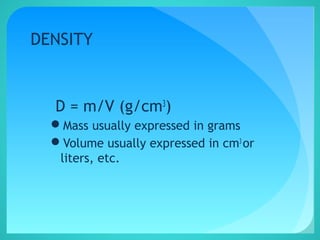
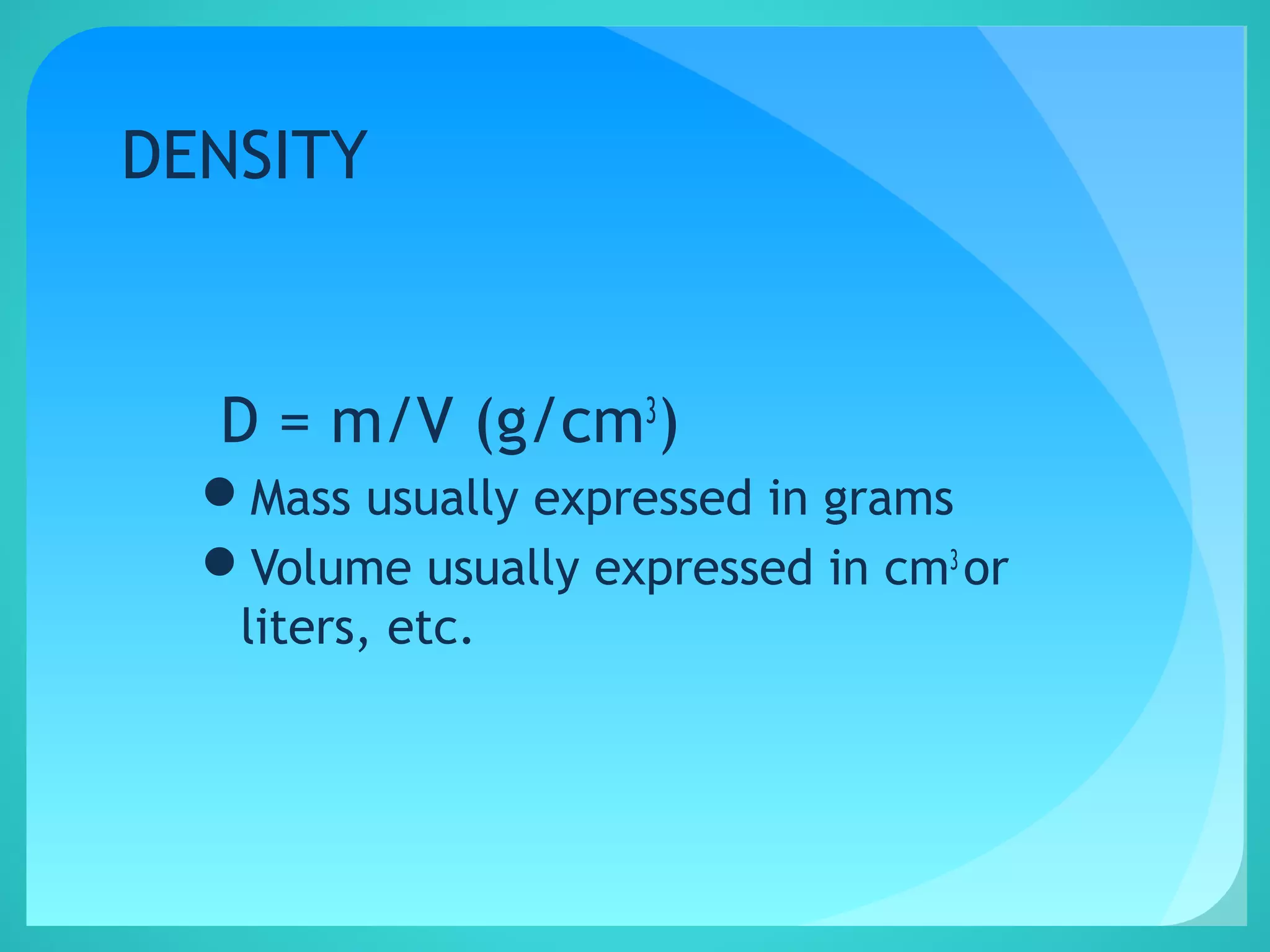
D = m/V (g/cm3
)
Mass usually expressed in grams
Volume usually expressed in cm3
or
liters, etc.
Density
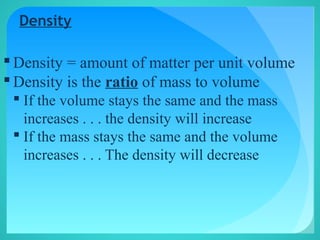
 Density = amount of matter per unit volume
 Density is the ratio of mass to volume
 If the volume stays the same and the mass
increases . . . the density will increase
 If the mass stays the same and the volume
increases . . . The density will decrease
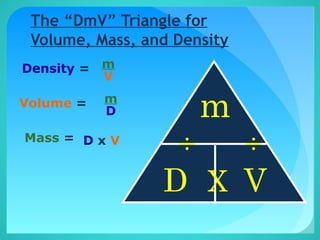
The “DmV” Triangle for
Volume, Mass, and Density
m
÷ ÷
D X V
Density = m
V
Volume = m
D
Mass = D x V
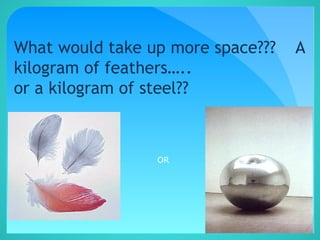
What would take up more space??? A
kilogram of feathers…..
or a kilogram of steel??
OR
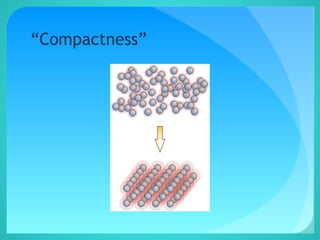
How close the atoms or molecules are to
eachother
More than “heaviness” - density includes
how much space an object takes up!!
All substances have density including
liquids, solids, and gases
Density is the measure of the
“compactness” of a material
“Compactness”
Gases
How much kinetic energy do the
molecules have??
The greater the kinetic energy
 ……the greater the volume
 …… and the less dense that
gas is!!
Therefore, cold air is more dense
than warm air

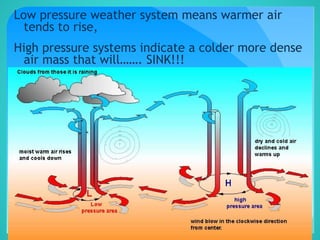
Low pressure weather system means warmer air
tends to rise,
High pressure systems indicate a colder more dense
air mass that will……. SINK!!!
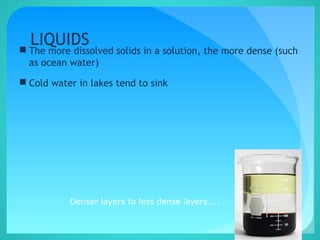
LIQUIDS The more dissolved solids in a solution, the more dense (such
as ocean water)
 Cold water in lakes tend to sink
Denser layers to less dense layers…..
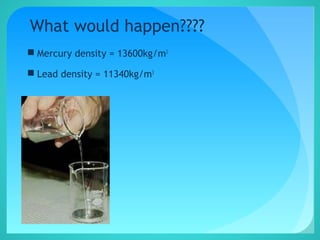
What would happen????
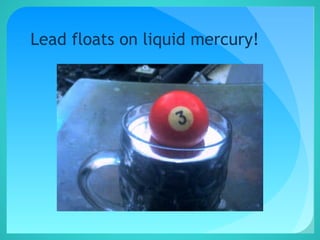
 Mercury density = 13600kg/m3
 Lead density = 11340kg/m3
Lead floats on liquid mercury!
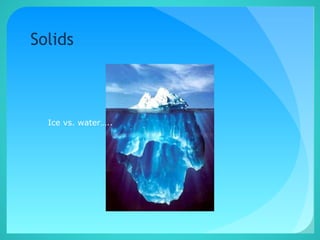
Solids
Ice vs. water…..
SOLIDS
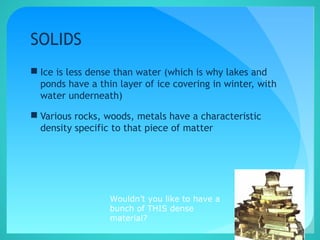
 Ice is less dense than water (which is why lakes and
ponds have a thin layer of ice covering in winter, with
water underneath)
 Various rocks, woods, metals have a characteristic
density specific to that piece of matter
Wouldn’t you like to have a
bunch of THIS dense
material?
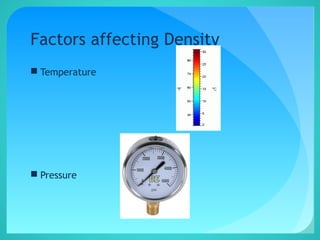
Factors affecting Density
 Temperature
 Pressure
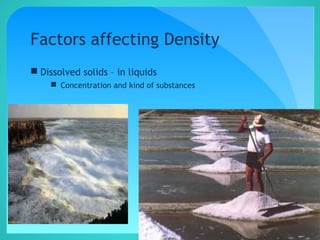
Factors affecting Density
 Dissolved solids – in liquids
 Concentration and kind of substances
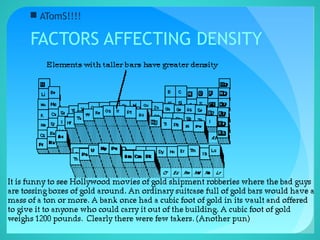
FACTORS AFFECTING DENSITY
 ATomS!!!!
Relative Density
 The density of a material or substance, relative to
another substance
 Expressed in a ratio: water = 1g/cc
 Water is the substance to which we generally compare
other substances
 ALSO known as SPECIFIC GRAVITY
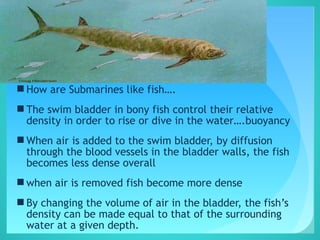
 How are Submarines like fish….
 The swim bladder in bony fish control their relative
density in order to rise or dive in the water….buoyancy
 When air is added to the swim bladder, by diffusion
through the blood vessels in the bladder walls, the fish
becomes less dense overall
 when air is removed fish become more dense
 By changing the volume of air in the bladder, the fish’s
density can be made equal to that of the surrounding
water at a given depth.
Absolute DENSITY
 The density of a material in its closest “packed form”
 For water: Absolute Density = 1000kg/m3
at 40
C and 1 atm(pressure)
in other words, the greatest density of water is at 40
C
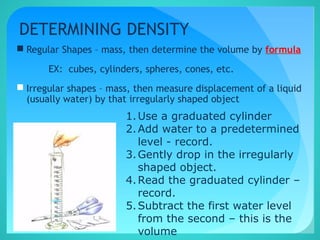
DETERMINING DENSITY
 Regular Shapes – mass, then determine the volume by formula
EX: cubes, cylinders, spheres, cones, etc.
 Irregular shapes – mass, then measure displacement of a liquid
(usually water) by that irregularly shaped object
1.Use a graduated cylinder
2.Add water to a predetermined
level - record.
3.Gently drop in the irregularly
shaped object.
4.Read the graduated cylinder –
record.
5.Subtract the first water level
from the second – this is the
volume
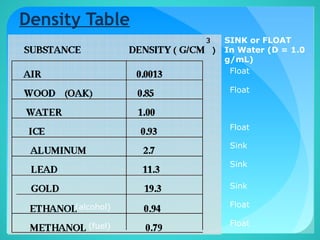
Density Table
SINK or FLOAT
In Water (D = 1.0
g/mL)
Float
Float
Float
Sink
Sink
Sink
Float
Float
(alcohol)
(fuel)

Density

  • 1.
    DENSITY D = m/V(g/cm3 ) Mass usually expressed in grams Volume usually expressed in cm3 or liters, etc.
  • 2.
    Density  Density =amount of matter per unit volume  Density is the ratio of mass to volume  If the volume stays the same and the mass increases . . . the density will increase  If the mass stays the same and the volume increases . . . The density will decrease
  • 3.
    The “DmV” Trianglefor Volume, Mass, and Density m ÷ ÷ D X V Density = m V Volume = m D Mass = D x V
  • 4.
    What would takeup more space??? A kilogram of feathers….. or a kilogram of steel?? OR
  • 5.
    How close theatoms or molecules are to eachother More than “heaviness” - density includes how much space an object takes up!! All substances have density including liquids, solids, and gases Density is the measure of the “compactness” of a material
  • 6.
  • 7.
    Gases How much kineticenergy do the molecules have?? The greater the kinetic energy  ……the greater the volume  …… and the less dense that gas is!! Therefore, cold air is more dense than warm air 
  • 8.
    Low pressure weathersystem means warmer air tends to rise, High pressure systems indicate a colder more dense air mass that will……. SINK!!!
  • 9.
    LIQUIDS The moredissolved solids in a solution, the more dense (such as ocean water)  Cold water in lakes tend to sink Denser layers to less dense layers…..
  • 10.
    What would happen???? Mercury density = 13600kg/m3  Lead density = 11340kg/m3
  • 11.
    Lead floats onliquid mercury!
  • 12.
  • 13.
    SOLIDS  Ice isless dense than water (which is why lakes and ponds have a thin layer of ice covering in winter, with water underneath)  Various rocks, woods, metals have a characteristic density specific to that piece of matter Wouldn’t you like to have a bunch of THIS dense material?
  • 14.
    Factors affecting Density Temperature  Pressure
  • 15.
    Factors affecting Density Dissolved solids – in liquids  Concentration and kind of substances
  • 16.
  • 17.
    Relative Density  Thedensity of a material or substance, relative to another substance  Expressed in a ratio: water = 1g/cc  Water is the substance to which we generally compare other substances  ALSO known as SPECIFIC GRAVITY
  • 18.
     How areSubmarines like fish….  The swim bladder in bony fish control their relative density in order to rise or dive in the water….buoyancy  When air is added to the swim bladder, by diffusion through the blood vessels in the bladder walls, the fish becomes less dense overall  when air is removed fish become more dense  By changing the volume of air in the bladder, the fish’s density can be made equal to that of the surrounding water at a given depth.
  • 19.
    Absolute DENSITY  Thedensity of a material in its closest “packed form”  For water: Absolute Density = 1000kg/m3 at 40 C and 1 atm(pressure) in other words, the greatest density of water is at 40 C
  • 20.
    DETERMINING DENSITY  RegularShapes – mass, then determine the volume by formula EX: cubes, cylinders, spheres, cones, etc.  Irregular shapes – mass, then measure displacement of a liquid (usually water) by that irregularly shaped object 1.Use a graduated cylinder 2.Add water to a predetermined level - record. 3.Gently drop in the irregularly shaped object. 4.Read the graduated cylinder – record. 5.Subtract the first water level from the second – this is the volume
  • 21.
    Density Table SINK orFLOAT In Water (D = 1.0 g/mL) Float Float Float Sink Sink Sink Float Float (alcohol) (fuel)

Editor's Notes

  • #5 ROCKS - pass around
  • #6 Bread slice and compacted bread in large flask of water
  • #7 Hot air balloon - Describe how a hot air balloon works. Defend your argument.
  • #10 Straw solute
  • #11 Sinking vial - make it float
  • #14 Beans/ping pong ball; Big jug of water in a pool
  • #15 Add several drops of red food color to each of two 250-mL Erlenmeyer flasks; fill them with warm tap water. (If tap water is not warm, heat some tap water on a hot plate to 40-45 °C.) Add several drops of blue food coloring to each of the other two 250-mL Erlenmeyer flasks; fill them with cool tap water. Predict the outcome when one flask is inverted over the other. Place a paper card on top of the vessel filled with warm water. Invert the flask making sure to hold the card in place. Stack it on top of one of the cool water flasks. Remove the card. Remain prepared to catch the flasks.   ** Visual here. Place a paper card on top of the flask filled with cool water. Invert the flask making sure to hold the card in place. Stack it on top of the other warm water flask. Remove the card.   ** Visual here. Wide mouth containers may also be used.
  • #18 Relative Liquid densities: Oil, colored water, and corn syrup in a graduated cylinder. An H2O ice cube floats in liquid H2O but floats in rubbing alcohol. A can of diet coke floats in water while a can of regular coke sinks (can determine density of sugar versus NutraSweet using balance).
  • #19 Air bladder when pulled up to quickly