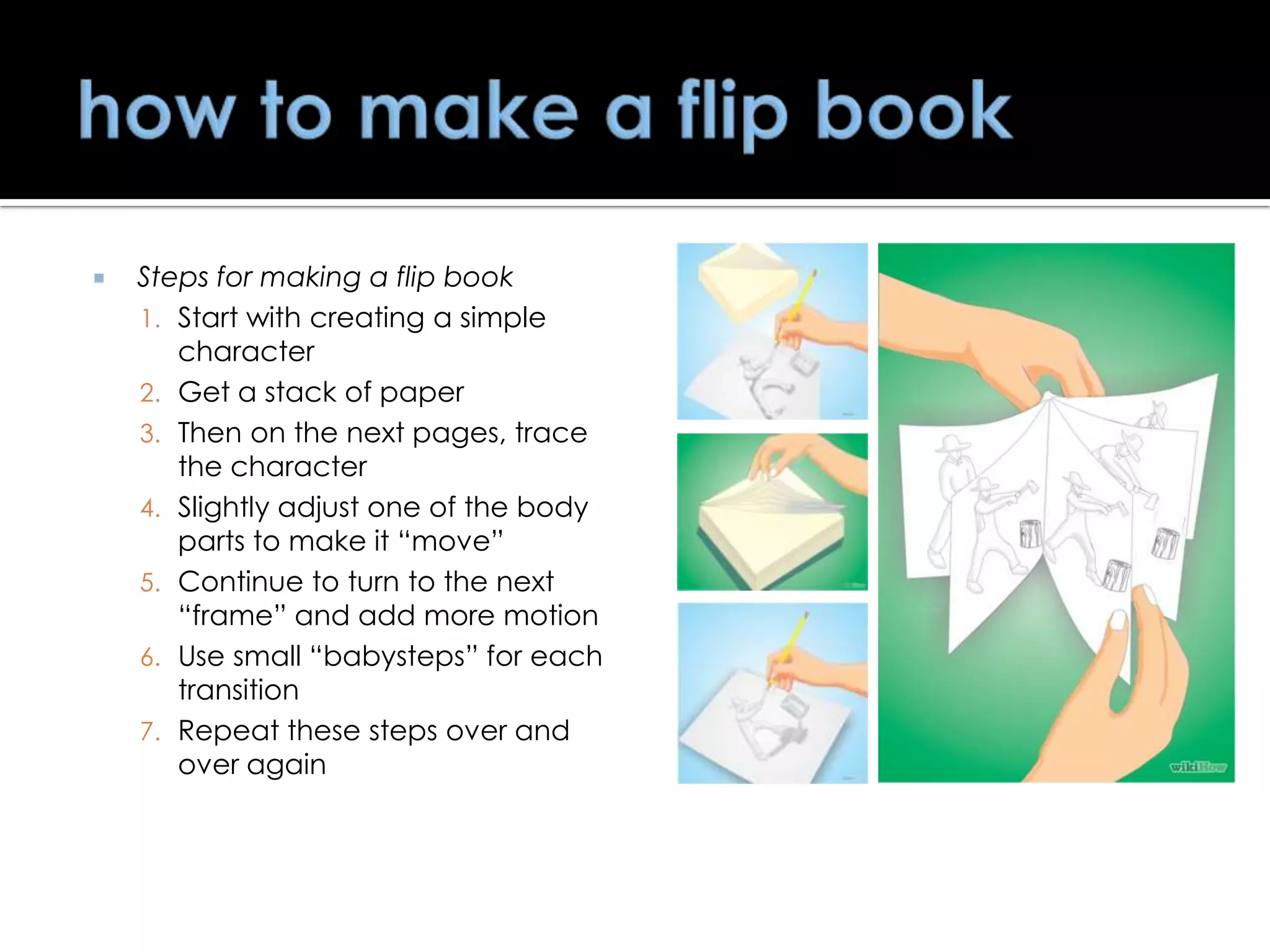
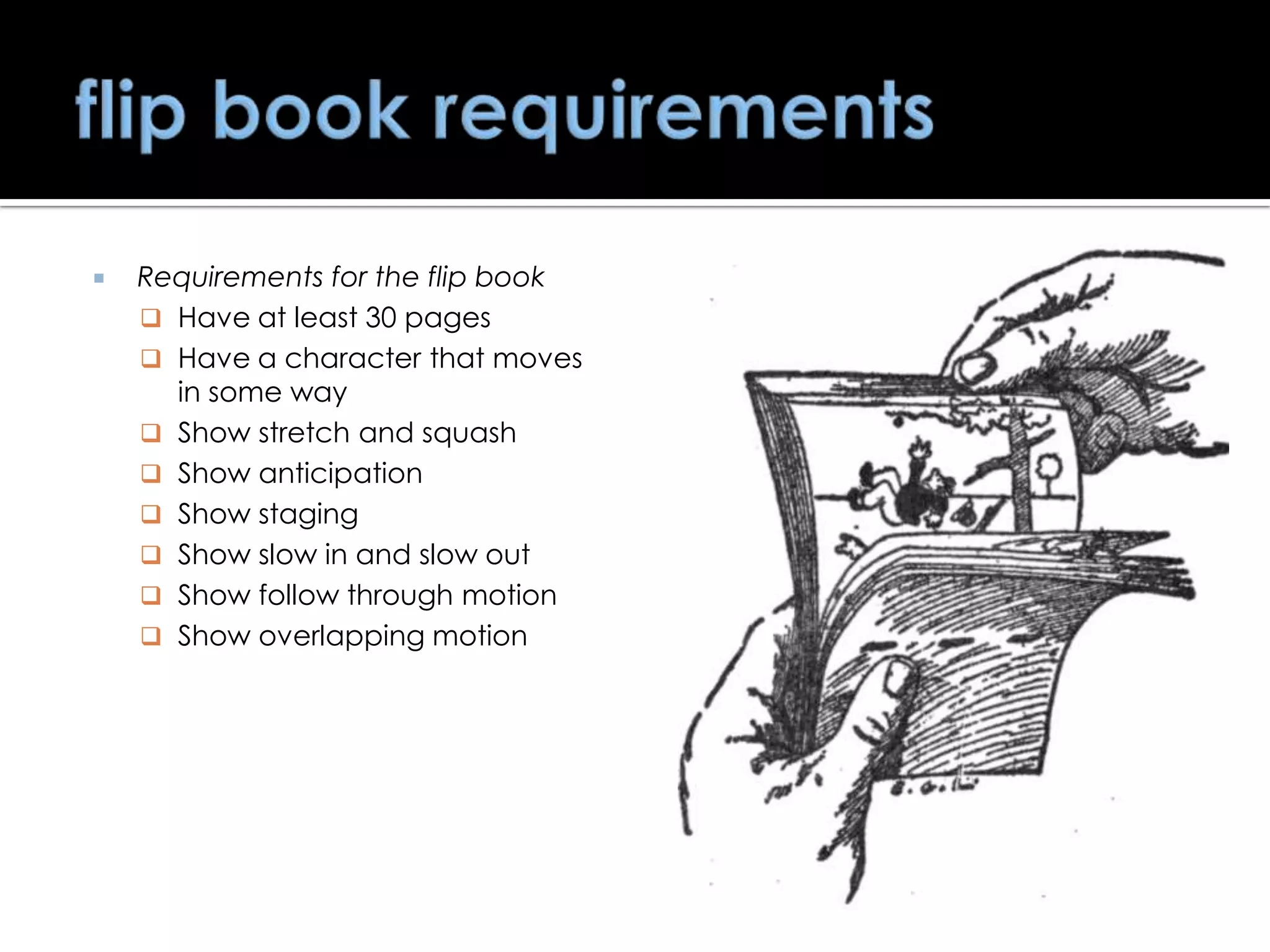
Animation is the illusion of motion created by displaying a sequence of images that differ slightly over time. The basic principles of animation that create realistic motion include squash and stretch, anticipation, staging, slow in and slow out, follow through and overlapping action. These principles aim to mimic the natural laws of physics and motion in the human body. A flip book is a simple animation created by drawing a character in slightly different poses on sequential pages and rapidly flipping through to illustrate motion.
![
What is animation?
Animation is the process of creating a
continuous motion and shape
change[Note 1] illusion by means of
the rapid display of a sequence of
static images that minimally differ from
each other. The illusion—as in motion
pictures in general—is thought to rely
on the phi phenomenon.
The bouncing ball animation (to the
right) consists of these six frames. This
animation moves at 10 frames per
second.
Animations can be stored or recorded
on either analogue media, such as Flip
book, motion picture film, video
tape, on digital media, including
formats such as animated GIF, Flash
animation or digital video. To display
it, a digital camera, a computer, or a
projector are used.](https://image.slidesharecdn.com/commartunit5-140108085504-phpapp02/75/COMM-ART-UNIT-5-Notes-and-Project-Outline-2-2048.jpg)
![
history of animation
Early examples of attempts to capture the
phenomenon of motion into a still drawing can be
found in paleolithic cave paintings, where animals are
often depicted with multiple legs in superimposed
positions, clearly attempting to convey the perception
of motion.
A Chinese zoetrope-type device had been invented in
180 AD.[1]
The Voynich manuscript that dates back to between
1404 and 1438 contains several series of illustrations of
the same subject-matter and even few circles that –
when spun around the center – would create an illusion
of motion.[2]
These devices produced the appearance of movement
from sequential drawings using technological
means, but animation did not really develop much
further until the advent of cinematography. The
cinématographe was a projector, printer, and camera
in one machine that allowed moving pictures to be
shown successfully on a screen which was invented by
history's earliest film makers, Auguste and Louis
Lumière, in 1894.[3]
The phenakistoscope (1832), zoetrope (1834) and
praxinoscope (1877), as well as the common flip
book, were early animation devices to produce
movement from sequential drawings using
technological means, but animation did not develop
further until the advent of motion picture film.](https://image.slidesharecdn.com/commartunit5-140108085504-phpapp02/75/COMM-ART-UNIT-5-Notes-and-Project-Outline-3-2048.jpg)
![
Stretch and squash
Illustration of the "squash and stretch"-principle:
Example A shows a ball bouncing with a rigid, nondynamic movement. In example B the ball is "squashed"
at impact, and "stretched" during fall and rebound. The
movement also accelerates during the fall, and slows
down towards the apex (see "slow in and slow out").
Animated sequence of a race horse galloping. Photos
taken by Eadweard Muybridge. The horse's body
demonstrates squash and stretch in natural
musculature.
The most important principle is "squash and stretch",[4]
the purpose of which is to give a sense of weight and
flexibility to drawn objects. It can be applied to simple
objects, like a bouncing ball, or more complex
constructions, like the musculature of a human
face.[5][6] Taken to an extreme point, a figure stretched
or squashed to an exaggerated degree can have a
comical effect.[7] In realistic animation, however, the
most important aspect of this principle is the fact that an
object's volume does not change when squashed or
stretched. If the length of a ball is stretched vertically, its
width (in three dimensions, also its depth) needs to
contract correspondingly horizontally](https://image.slidesharecdn.com/commartunit5-140108085504-phpapp02/75/COMM-ART-UNIT-5-Notes-and-Project-Outline-4-2048.jpg)
![
Anticipation
Anticipation is used to prepare the audience for an
action, and to make the action appear more
realistic.[9] A dancer jumping off the floor has to bend
his knees first; a golfer making a swing has to swing the
club back first. The technique can also be used for less
physical actions, such as a character looking off-screen
to anticipate someone's arrival, or attention focusing on
an object that a character is about to pick up.[10]
Anticipation: A baseball player making a pitch
prepares for the action by moving his arm back.
For special effect, anticipation can also be omitted in
cases where it is expected. The resulting sense of
anticlimax will produce a feeling of surprise in the
viewer, and can often add comedy to a scene.[11] This
is often referred to as a 'surprise gag'.[12]](https://image.slidesharecdn.com/commartunit5-140108085504-phpapp02/75/COMM-ART-UNIT-5-Notes-and-Project-Outline-5-2048.jpg)
![
Staging
This principle is akin to staging as it is known in theatre
and film.[13] Its purpose is to direct the audience's
attention, and make it clear what is of greatest
importance in a scene;[14] Johnston and Thomas
defined it as "the presentation of any idea so that it is
completely and unmistakably clear", whether that idea
is an action, a personality, an expression or a mood.[13]
This can be done by various means, such as the
placement of a character in the frame, the use of light
and shadow, and the angle and position of the
camera.[15] The essence of this principle is keeping
focus on what is relevant, and avoiding unnecessary
detail.
Slow in and slow out
The movement of the human body, and most other
objects, needs time to accelerate and slow down. For
this reason, animation looks more realistic if it has more
drawings near the beginning and end of an
action, emphasizing the extreme poses, and fewer in
the middle.[14] This principle goes for characters moving
between two extreme poses, such as sitting down and
standing up, but also for inanimate, moving objects, like
the bouncing ball in the above illustration](https://image.slidesharecdn.com/commartunit5-140108085504-phpapp02/75/COMM-ART-UNIT-5-Notes-and-Project-Outline-6-2048.jpg)
![
Follow through and overlapping
Follow through and overlapping action is a general
heading for two closely related techniques which help
to render movement more realistically, and help to give
the impression that characters follow the laws of physics.
"Follow through" means that separate parts of a body
will continue moving after the character has stopped.
"Overlapping action" is the tendency for parts of the
body to move at different rates (an arm will move on
different timing of the head and so on). A third related
technique is "drag", where a character starts to move
and parts of him take a few frames to catch up.[14]
These parts can be inanimate objects like clothing or
the antenna on a car, or parts of the body, such as
arms or hair. On the human body, the torso is the
core, with arms, legs, head and hair appendices that
normally follow the torso's movement. Body parts with
much tissue, such as large stomachs and breasts, or the
loose skin on a dog, are more prone to independent
movement than bonier body parts.[21]
Again, exaggerated use of the technique can produce
a comical effect, while more realistic animation must
time the actions exactly, to produce a convincing
result.](https://image.slidesharecdn.com/commartunit5-140108085504-phpapp02/75/COMM-ART-UNIT-5-Notes-and-Project-Outline-7-2048.jpg)