Asthma: Current Concepts in  Diagnosis and Management Christie F. Michael, MD Assistant Professor University of Tennessee, Memphis
Goals of Talk Scope of asthma Definition/diagnosis NHLBI guidelines 2007 Asthma in pregnancy Omalizumab
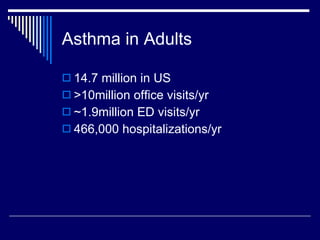
Asthma in Adults 14.7 million in US >10million office visits/yr ~1.9million ED visits/yr 466,000 hospitalizations/yr
Asthma Mortality Asthma deaths: >5000 each year (1998,USA) Asthma death in children 36% severe persistent 31% moderate persistent 33% mild persistent
The Good News Mortality on decline despite increasing incidence Most asthmatics can lead normal, active life with proper treatment
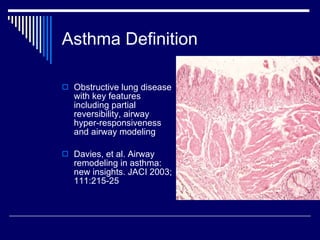
Asthma Definition Obstructive lung disease with key features including partial reversibility, airway hyper-responsiveness and airway modeling  Davies, et al. Airway remodeling in asthma: new insights. JACI 2003; 111:215-25
Asthma: Expanding Definition “ A chronic inflammatory disorder of the airways in which many cells and cellular elements play a role…” 1.“Reversibility incomplete in some patients..” 2. Anti-inflammatory tx fails to prevent dz progression.
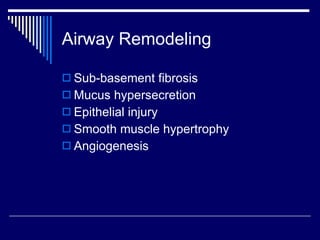
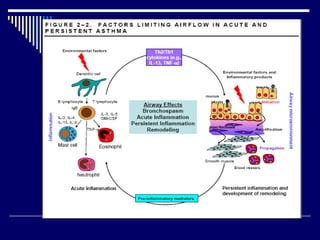
Airway Remodeling Sub-basement fibrosis Mucus hypersecretion Epithelial injury Smooth muscle hypertrophy Angiogenesis
 
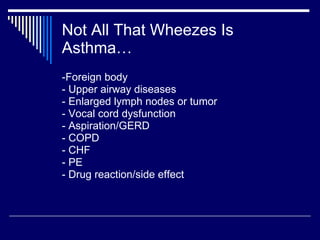
Not All That Wheezes Is Asthma… -Foreign body - Upper airway diseases  - Enlarged lymph nodes or tumor - Vocal cord dysfunction  - Aspiration/GERD  - COPD - CHF - PE - Drug reaction/side effect
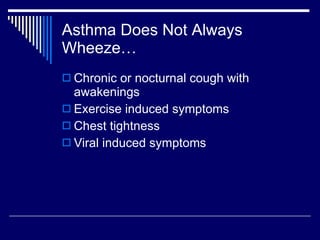
Asthma Does Not Always Wheeze… Chronic or nocturnal cough with awakenings Exercise induced symptoms Chest tightness Viral induced symptoms
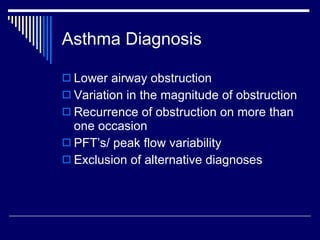
Asthma Diagnosis Lower airway obstruction Variation in the magnitude of obstruction Recurrence of obstruction on more than one occasion PFT’s/ peak flow variability Exclusion of alternative diagnoses
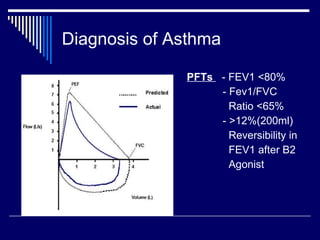
Diagnosis of Asthma PFTs  - FEV1 <80% - Fev1/FVC  Ratio <65% - >12%(200ml) Reversibility in FEV1 after B2 Agonist
Diagnosis of Asthma Methacholine challenge:  Peak expiratory flow rate (PEFR):  Ht (cm) X 5.25-425
 
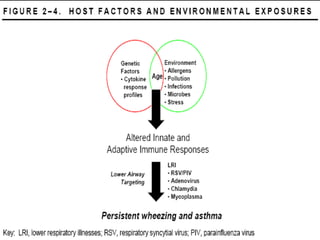
Gene by Environment RSV in pediatrics Smoking/ smoke exposure Atopy Many others…
Link Between Asthma/Atopy: “One Airway, One Disease” ~80% asthmatics with allergic rhinitis 40% AR pts with asthma Of asymptomatic AR pts- up to 40% with AHR Nasal allergen challenge increases AHR tx AR lowers asthma sx’s and related costs
Guidelines for Asthma Diagnosis and Management ASSESSMENT and MONITORING CONTRIBUTING FACTORS PATIENT EDUCATION PHARMACOTHERAPY
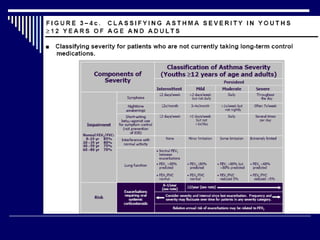
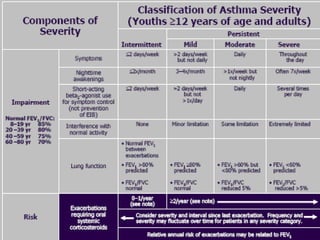
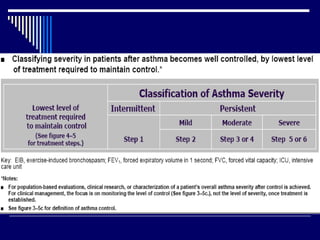
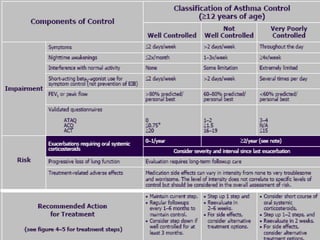
Asthma Severity Classification Intrinsic intensity of dz process Used as the basis for selection of therapy Incorporates subjective and objective parameters Must apply with clinical judgement
Impairment AND Risk Domains of both assessment and control Current symptoms  Future risk  Objective and subjective measures
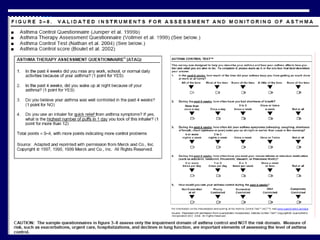
Impairment Quality of life Missed school or work Surveys (ACT, ACQ..) Lung functions
Risk Hospital stays/ICU ED visits Oral steroid bursts Lung function (FEV1, FEV1/FVC) Other biomarkers not proven (FeNO, serum IgE, bld/sputum eos)


Assess Control Once long-term control therapy initiated Responsiveness- the ease with which control achieved Continue to assess impairment and risk


Guidelines for Asthma Diagnosis and Management ASSESSMENT and MONITORING CONTRIBUTING FACTORS PATIENT EDUCATION PHARMACOTHERAPY
Precipitating Factors Viral URIs Inhalant allergens- grasses, trees, molds, pets, dust/dust mite, feather, cockroach Food allergens- soy, wheat, milk, nuts, eggs Irritant triggers- strong odors, smoke, cold air Weather changes
Comorbid Conditions Sinusitis Rhinitis Gastroesophageal reflux ABPA Vocal cord dysfunction OSA
Recognizing High-risk Asthmatics Beta2-agonist over-use Disregard of symptoms Psychosocial factors Previous respiratory arrest or ICU admit
Asthma in Pregnancy 1/3 patients better 1/3 stay the same 1/3 worsen
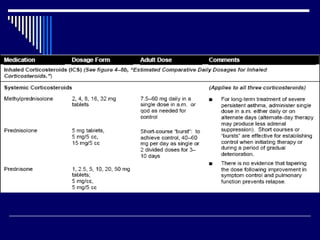
Acute Treatment of Asthma  2 Agonists- PO, IV (albuterol, terbutaline) Anticholinergics- Ipatropium (Atrovent) Steroids- PO, IV (solumedrol, prednisone) Methylxanthines- PO, IV (Aminophylline, Theophylline) Heliox (60/40) Magnesium Sulfate Intubation
 
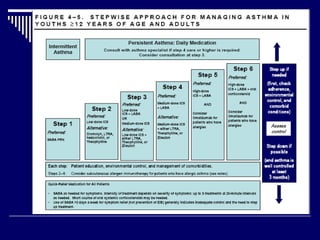
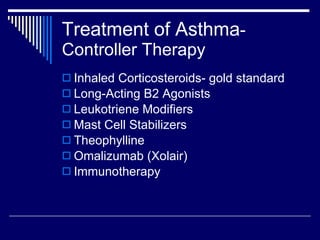
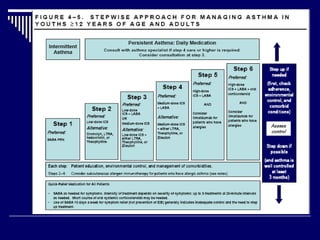
Treatment of Asthma -Controller Therapy Inhaled Corticosteroids- gold standard Long-Acting B2 Agonists Leukotriene Modifiers Mast Cell Stabilizers Theophylline Omalizumab (Xolair) Immunotherapy
 
 
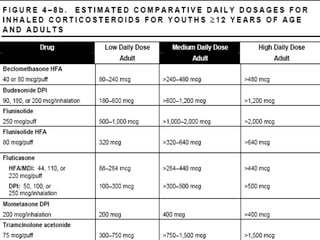
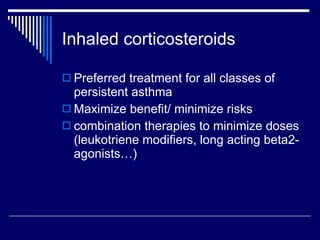
Inhaled corticosteroids Preferred treatment for all classes of persistent asthma Maximize benefit/ minimize risks combination therapies to minimize doses (leukotriene modifiers, long acting beta2- agonists…)
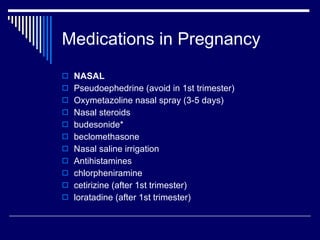
Medications in Pregnancy NASAL Pseudoephedrine (avoid in 1st trimester) Oxymetazoline nasal spray (3-5 days) Nasal steroids budesonide* beclomethasone Nasal saline irrigation Antihistamines chlorpheniramine cetirizine (after 1st trimester) loratadine (after 1st trimester)
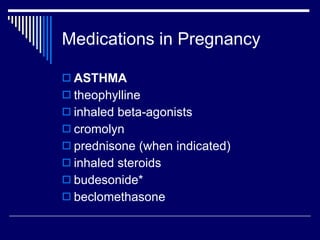
Medications in Pregnancy ASTHMA theophylline inhaled beta-agonists cromolyn prednisone (when indicated) inhaled steroids budesonide* beclomethasone
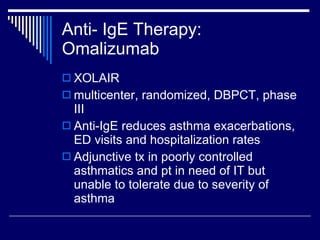
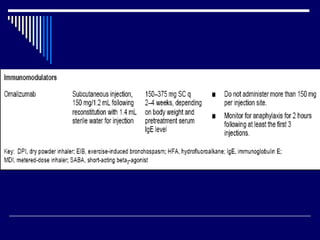
Anti- IgE Therapy: Omalizumab XOLAIR multicenter, randomized, DBPCT, phase III Anti-IgE reduces asthma exacerbations, ED visits and hospitalization rates Adjunctive tx in poorly controlled asthmatics and pt in need of IT but unable to tolerate due to severity of asthma
 
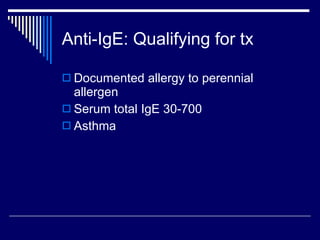
Anti-IgE: Qualifying for tx Documented allergy to perennial allergen Serum total IgE 30-700 Asthma
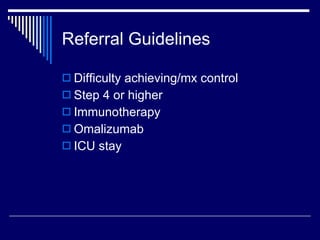
Referral Guidelines Difficulty achieving/mx control Step 4 or higher  Immunotherapy Omalizumab ICU stay

Asthma Talk For Obgyn

  • 1.
    Asthma: Current Conceptsin Diagnosis and Management Christie F. Michael, MD Assistant Professor University of Tennessee, Memphis
  • 2.
    Goals of TalkScope of asthma Definition/diagnosis NHLBI guidelines 2007 Asthma in pregnancy Omalizumab
  • 3.
    Asthma in Adults14.7 million in US >10million office visits/yr ~1.9million ED visits/yr 466,000 hospitalizations/yr
  • 4.
    Asthma Mortality Asthmadeaths: >5000 each year (1998,USA) Asthma death in children 36% severe persistent 31% moderate persistent 33% mild persistent
  • 5.
    The Good NewsMortality on decline despite increasing incidence Most asthmatics can lead normal, active life with proper treatment
  • 6.
    Asthma Definition Obstructivelung disease with key features including partial reversibility, airway hyper-responsiveness and airway modeling Davies, et al. Airway remodeling in asthma: new insights. JACI 2003; 111:215-25
  • 7.
    Asthma: Expanding Definition“ A chronic inflammatory disorder of the airways in which many cells and cellular elements play a role…” 1.“Reversibility incomplete in some patients..” 2. Anti-inflammatory tx fails to prevent dz progression.
  • 8.
    Airway Remodeling Sub-basementfibrosis Mucus hypersecretion Epithelial injury Smooth muscle hypertrophy Angiogenesis
  • 9.
  • 10.
    Not All ThatWheezes Is Asthma… -Foreign body - Upper airway diseases - Enlarged lymph nodes or tumor - Vocal cord dysfunction - Aspiration/GERD - COPD - CHF - PE - Drug reaction/side effect
  • 11.
    Asthma Does NotAlways Wheeze… Chronic or nocturnal cough with awakenings Exercise induced symptoms Chest tightness Viral induced symptoms
  • 12.
    Asthma Diagnosis Lowerairway obstruction Variation in the magnitude of obstruction Recurrence of obstruction on more than one occasion PFT’s/ peak flow variability Exclusion of alternative diagnoses
  • 13.
    Diagnosis of AsthmaPFTs - FEV1 <80% - Fev1/FVC Ratio <65% - >12%(200ml) Reversibility in FEV1 after B2 Agonist
  • 14.
    Diagnosis of AsthmaMethacholine challenge: Peak expiratory flow rate (PEFR): Ht (cm) X 5.25-425
  • 15.
  • 16.
    Gene by EnvironmentRSV in pediatrics Smoking/ smoke exposure Atopy Many others…
  • 17.
    Link Between Asthma/Atopy:“One Airway, One Disease” ~80% asthmatics with allergic rhinitis 40% AR pts with asthma Of asymptomatic AR pts- up to 40% with AHR Nasal allergen challenge increases AHR tx AR lowers asthma sx’s and related costs
  • 18.
    Guidelines for AsthmaDiagnosis and Management ASSESSMENT and MONITORING CONTRIBUTING FACTORS PATIENT EDUCATION PHARMACOTHERAPY
  • 19.
    Asthma Severity ClassificationIntrinsic intensity of dz process Used as the basis for selection of therapy Incorporates subjective and objective parameters Must apply with clinical judgement
  • 20.
    Impairment AND RiskDomains of both assessment and control Current symptoms Future risk Objective and subjective measures
  • 21.
    Impairment Quality oflife Missed school or work Surveys (ACT, ACQ..) Lung functions
  • 22.
    Risk Hospital stays/ICUED visits Oral steroid bursts Lung function (FEV1, FEV1/FVC) Other biomarkers not proven (FeNO, serum IgE, bld/sputum eos)
  • 23.
  • 24.
  • 25.
  • 26.
    Assess Control Oncelong-term control therapy initiated Responsiveness- the ease with which control achieved Continue to assess impairment and risk
  • 27.
  • 28.
  • 29.
  • 30.
    Guidelines for AsthmaDiagnosis and Management ASSESSMENT and MONITORING CONTRIBUTING FACTORS PATIENT EDUCATION PHARMACOTHERAPY
  • 31.
    Precipitating Factors ViralURIs Inhalant allergens- grasses, trees, molds, pets, dust/dust mite, feather, cockroach Food allergens- soy, wheat, milk, nuts, eggs Irritant triggers- strong odors, smoke, cold air Weather changes
  • 32.
    Comorbid Conditions SinusitisRhinitis Gastroesophageal reflux ABPA Vocal cord dysfunction OSA
  • 33.
    Recognizing High-risk AsthmaticsBeta2-agonist over-use Disregard of symptoms Psychosocial factors Previous respiratory arrest or ICU admit
  • 34.
    Asthma in Pregnancy1/3 patients better 1/3 stay the same 1/3 worsen
  • 35.
    Acute Treatment ofAsthma  2 Agonists- PO, IV (albuterol, terbutaline) Anticholinergics- Ipatropium (Atrovent) Steroids- PO, IV (solumedrol, prednisone) Methylxanthines- PO, IV (Aminophylline, Theophylline) Heliox (60/40) Magnesium Sulfate Intubation
  • 36.
  • 37.
    Treatment of Asthma-Controller Therapy Inhaled Corticosteroids- gold standard Long-Acting B2 Agonists Leukotriene Modifiers Mast Cell Stabilizers Theophylline Omalizumab (Xolair) Immunotherapy
  • 38.
  • 39.
  • 40.
    Inhaled corticosteroids Preferredtreatment for all classes of persistent asthma Maximize benefit/ minimize risks combination therapies to minimize doses (leukotriene modifiers, long acting beta2- agonists…)
  • 41.
    Medications in PregnancyNASAL Pseudoephedrine (avoid in 1st trimester) Oxymetazoline nasal spray (3-5 days) Nasal steroids budesonide* beclomethasone Nasal saline irrigation Antihistamines chlorpheniramine cetirizine (after 1st trimester) loratadine (after 1st trimester)
  • 42.
    Medications in PregnancyASTHMA theophylline inhaled beta-agonists cromolyn prednisone (when indicated) inhaled steroids budesonide* beclomethasone
  • 43.
    Anti- IgE Therapy:Omalizumab XOLAIR multicenter, randomized, DBPCT, phase III Anti-IgE reduces asthma exacerbations, ED visits and hospitalization rates Adjunctive tx in poorly controlled asthmatics and pt in need of IT but unable to tolerate due to severity of asthma
  • 44.
  • 45.
    Anti-IgE: Qualifying fortx Documented allergy to perennial allergen Serum total IgE 30-700 Asthma
  • 46.
    Referral Guidelines Difficultyachieving/mx control Step 4 or higher Immunotherapy Omalizumab ICU stay

Editor's Notes

  • #7 SYMPTOMS/OBSTRUCTION/INFLAMMATION/HYPERRESPONSIVENESS
  • #8 Current asthma tx with anti-inflammatory medications does not appear to prevent disease progression
  • #11 Lung volumes, DLCO, ECHO
  • #15 Mch not done if FEV1 &lt; 65% predicted
  • #21 No hgb A1C
  • #23 Other biomarkers tend to reflect method of tx employed (LTRA, ICS…)
  • #42 Joint panel of ACAAI and Am Col of Obs and Gyn