071-332-5000 (SL3) Prepare an Operation OverlaySTP 21-24 SMCT
Given Complete copy of the operation order (OPORD) that your unit is to executeCommander's or a battalion operations officer's (S3) guidance (to include time available for preparation)Conditions
Given (cont.)Overlay material (paper/acetate)TapeMap of the operational area, Colored pencils/markers (red, black, blue, green, and yellow)No. 2 pencil Coordinate scaleFM 101-5-1Conditions (cont.)
Within the specified time: Identified the overlay by map reference data, effective date, and purposeThe overlay contained classification markings and downgrading instructions, if applicable and distribution instructions and authentication, if distributed separatelyStandards
Within the specified time: (cont.)Prepared overlay in accordance with overlay techniques outlined in FM 101-5-1, with:Boundaries and unit locations plotted to within 50 metersTactics and fire support measures to within 25 metersStandards (cont.)
Create a condensed representation of:PlansOrdersInformation concerning a military operationHeavy use of military symbolsPurpose
Performance Steps
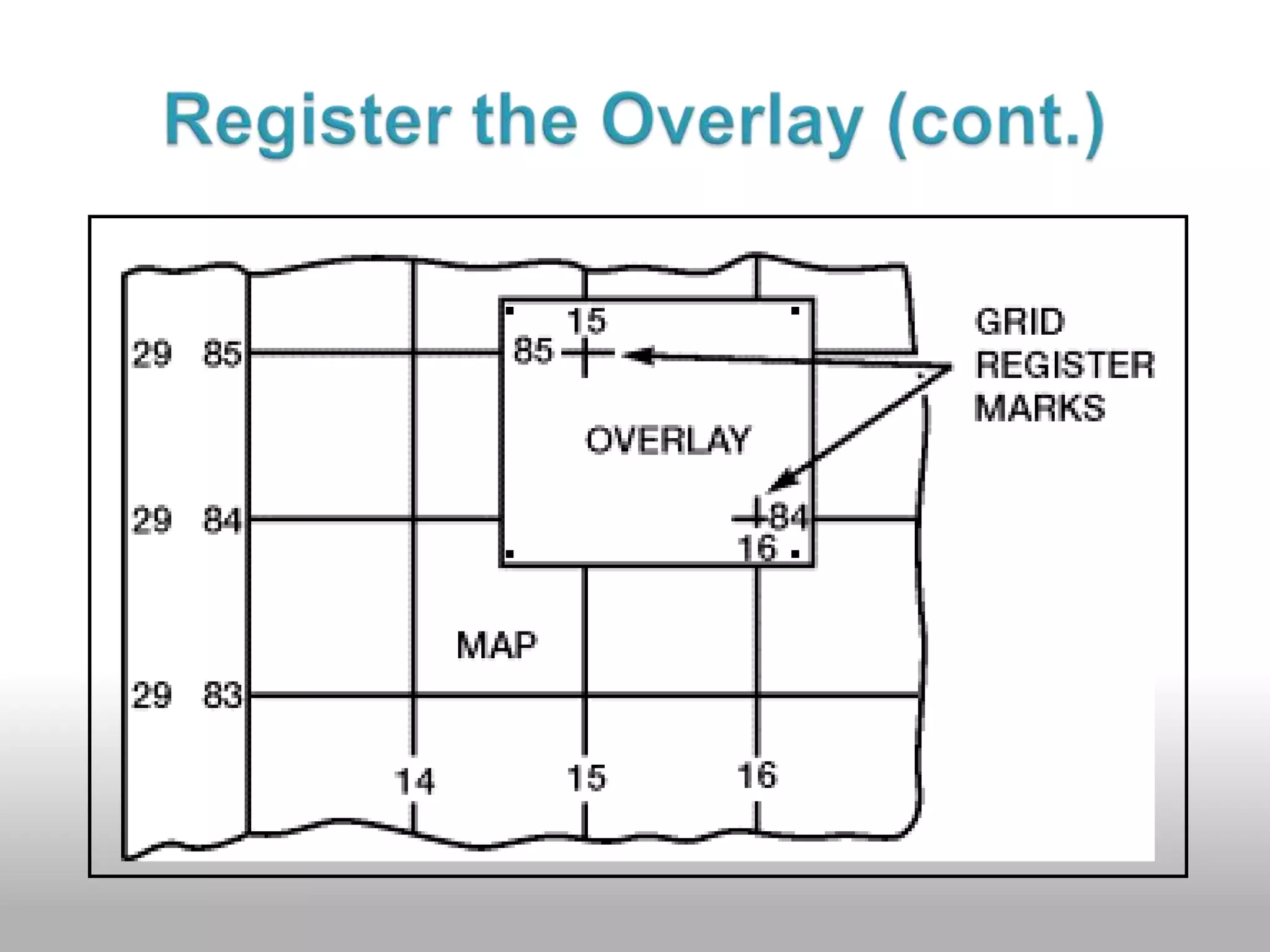
Orient the overlay material over the map area to the annotated portionTemporarily attach it to the map with the tape or tacksTrace the grid intersections nearest the opposite corners of the overlay Label each with the proper grid coordinatesRegister the Overlay
Register the Overlay (cont.)....
Use colored pencils or markers in standard colors, when available, to plot any detail (FM 101-5-1) Otherwise, plot the activity you wish to show with a pen or pencil that makes a lasting mark without cutting the overlayPlot New Detail
Use standard military symbols where possibleWhen the author invents nonstandard symbols, they must be identified on the edge of the overlayShow only that detail with which the document is directly concernedPlot New Detail (cont.)
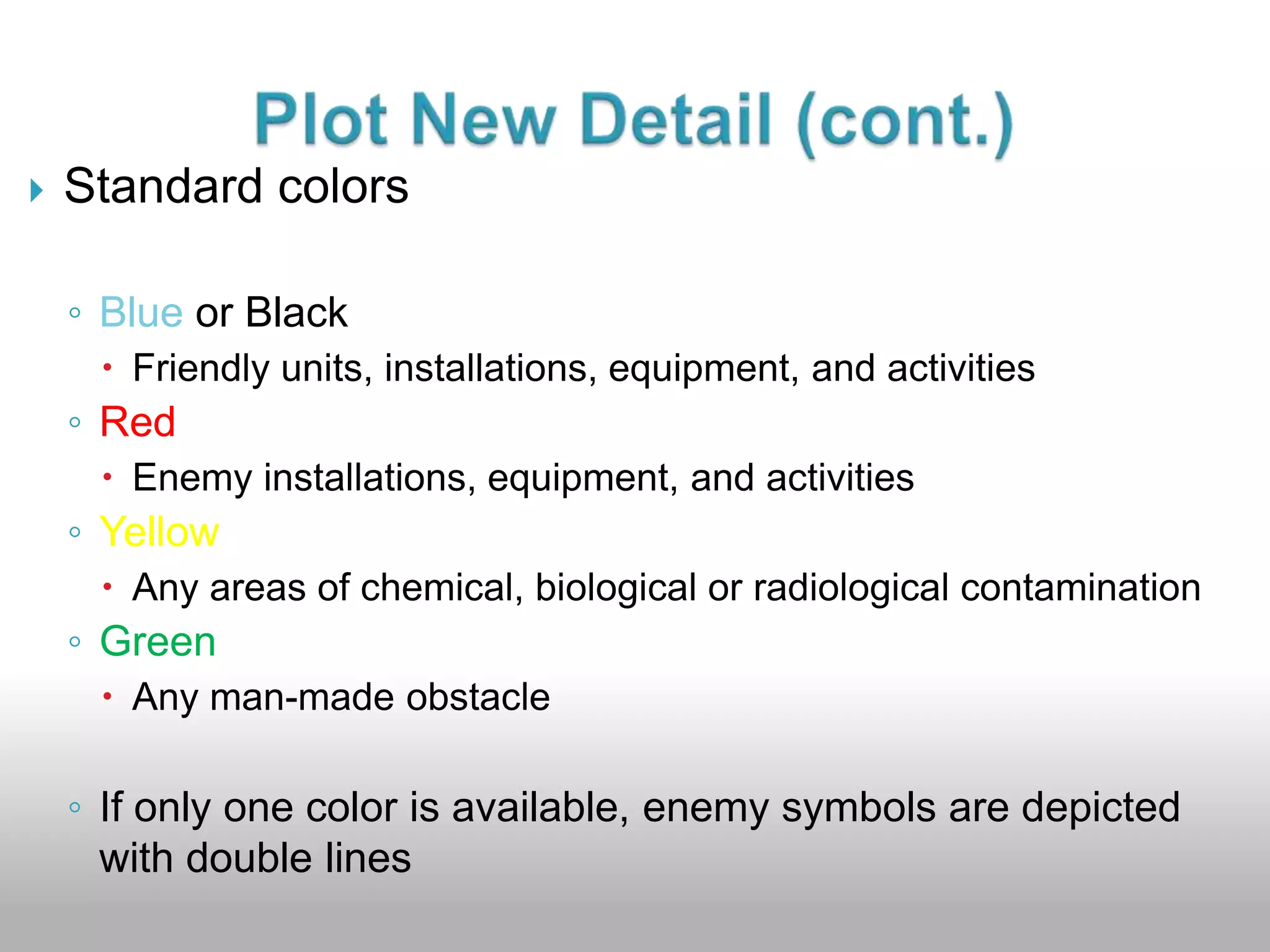
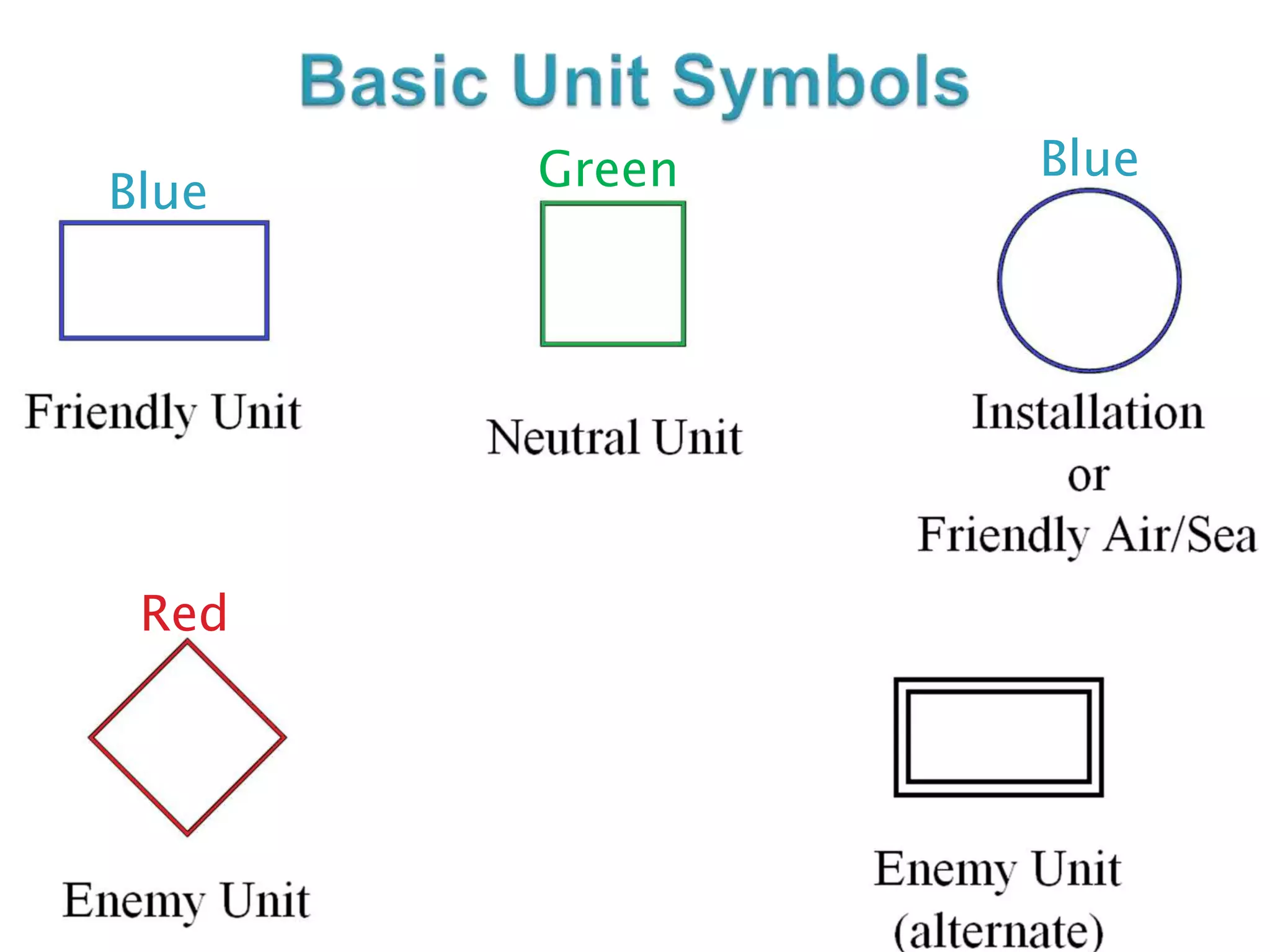
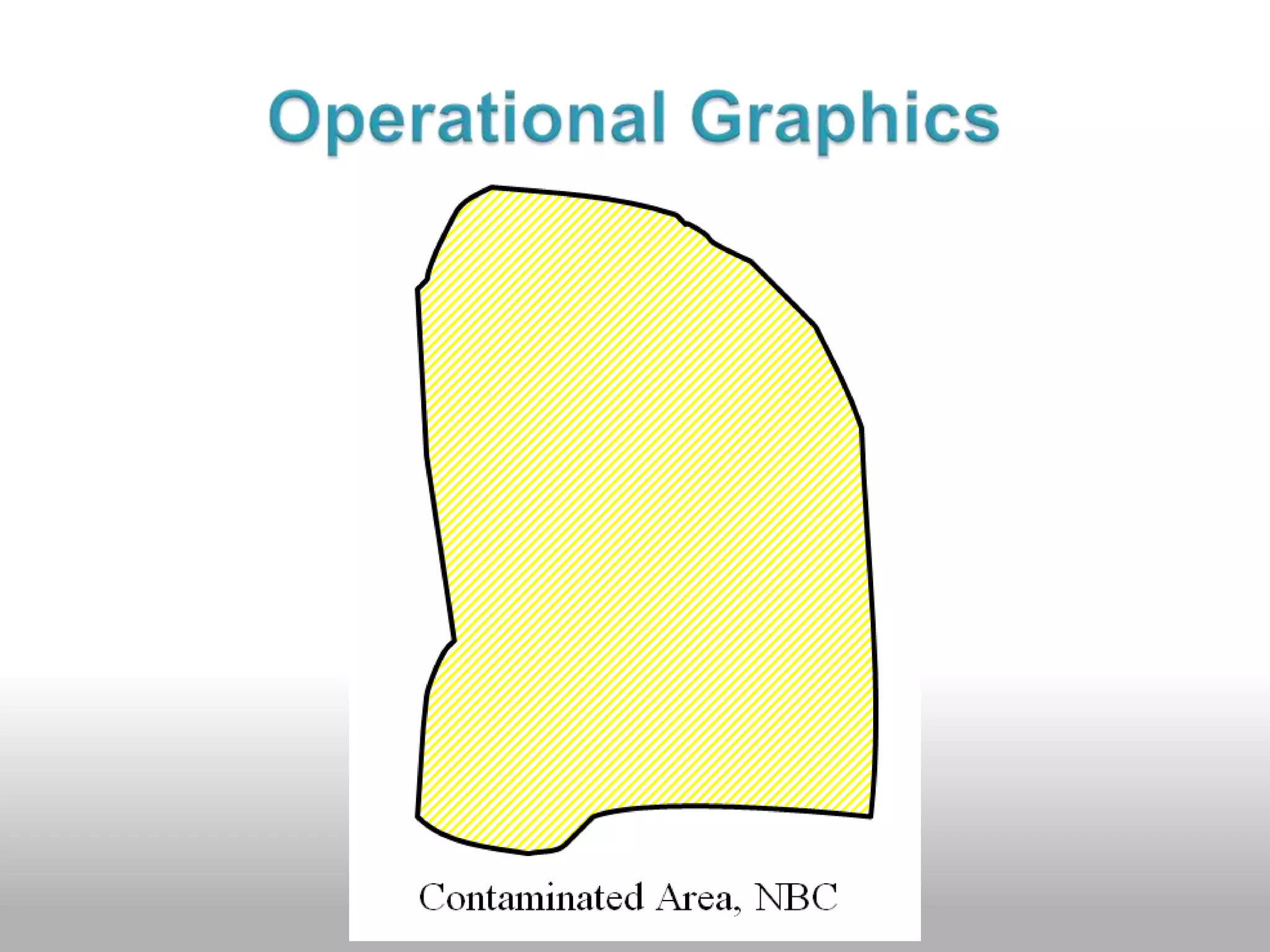
Standard colorsBlue or BlackFriendly units, installations, equipment, and activitiesRedEnemy installations, equipment, and activitiesYellowAny areas of chemical, biological or radiological contaminationGreen  Any man-made obstacleIf only one color is available, enemy symbols are depicted with double linesPlot New Detail (cont.)
The classification of the overlay is dependent upon classification of the order used to prepare the overlayTop SecretSecretConfidentialUnclassifiedU//FOUO—"Unclassified—For Official Use Only"Mark the top and bottom of the overlay with the classificationMark the Overlay Classification
Basic Military Symbols and Graphics
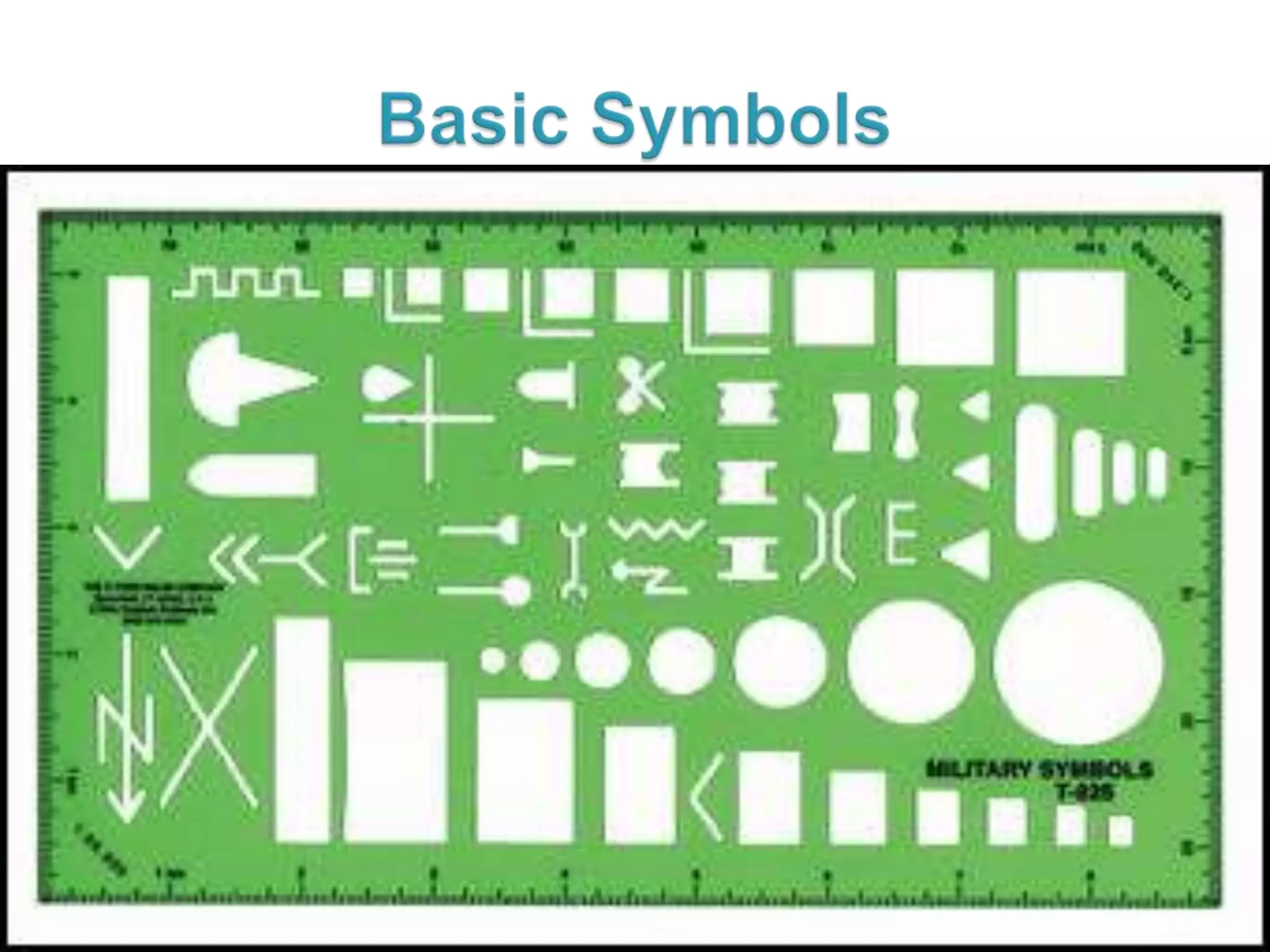
Basic Symbols
Basic Unit SymbolsBlueGreenBlueRed
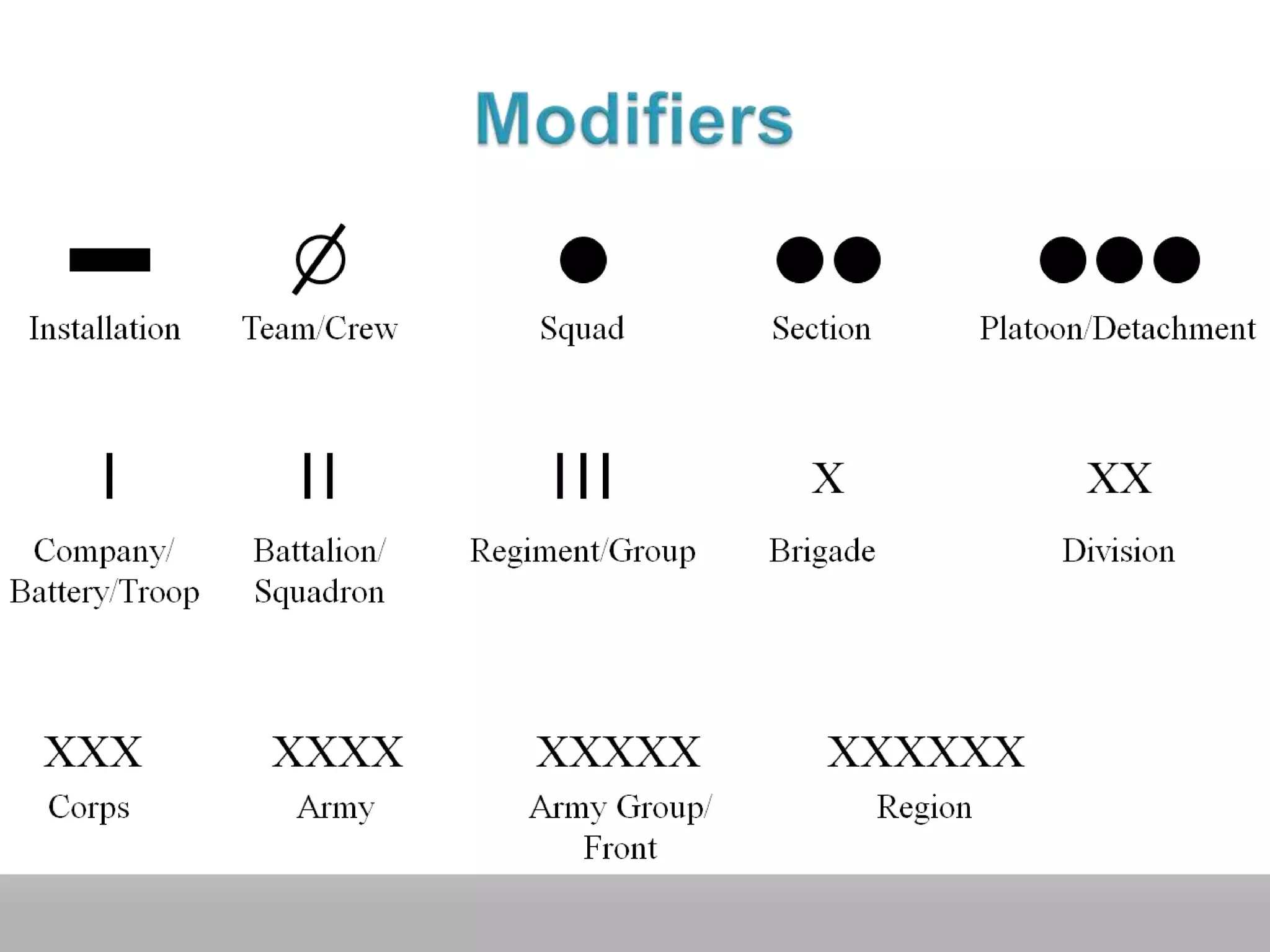
Modifiers
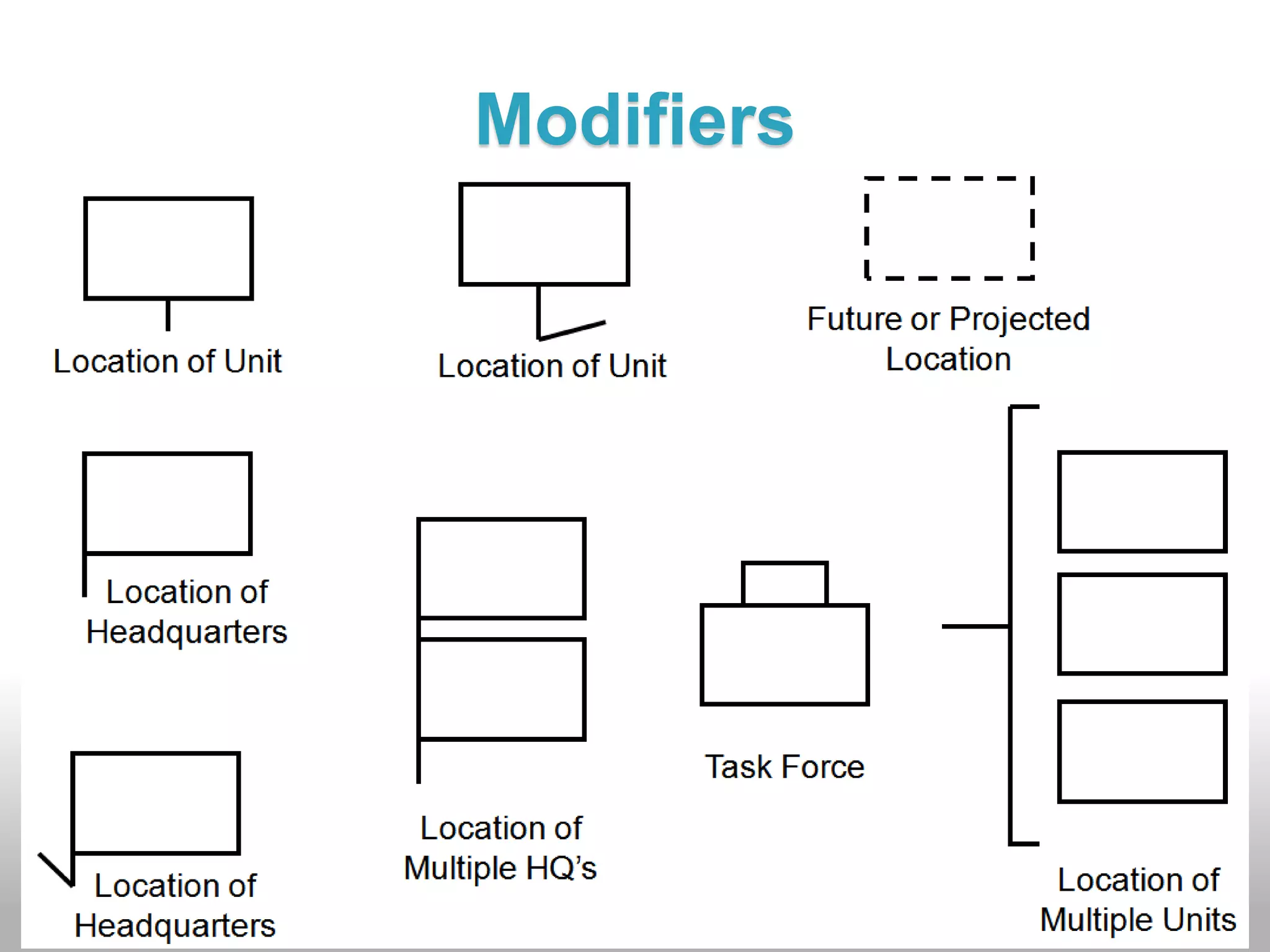
Modifiers
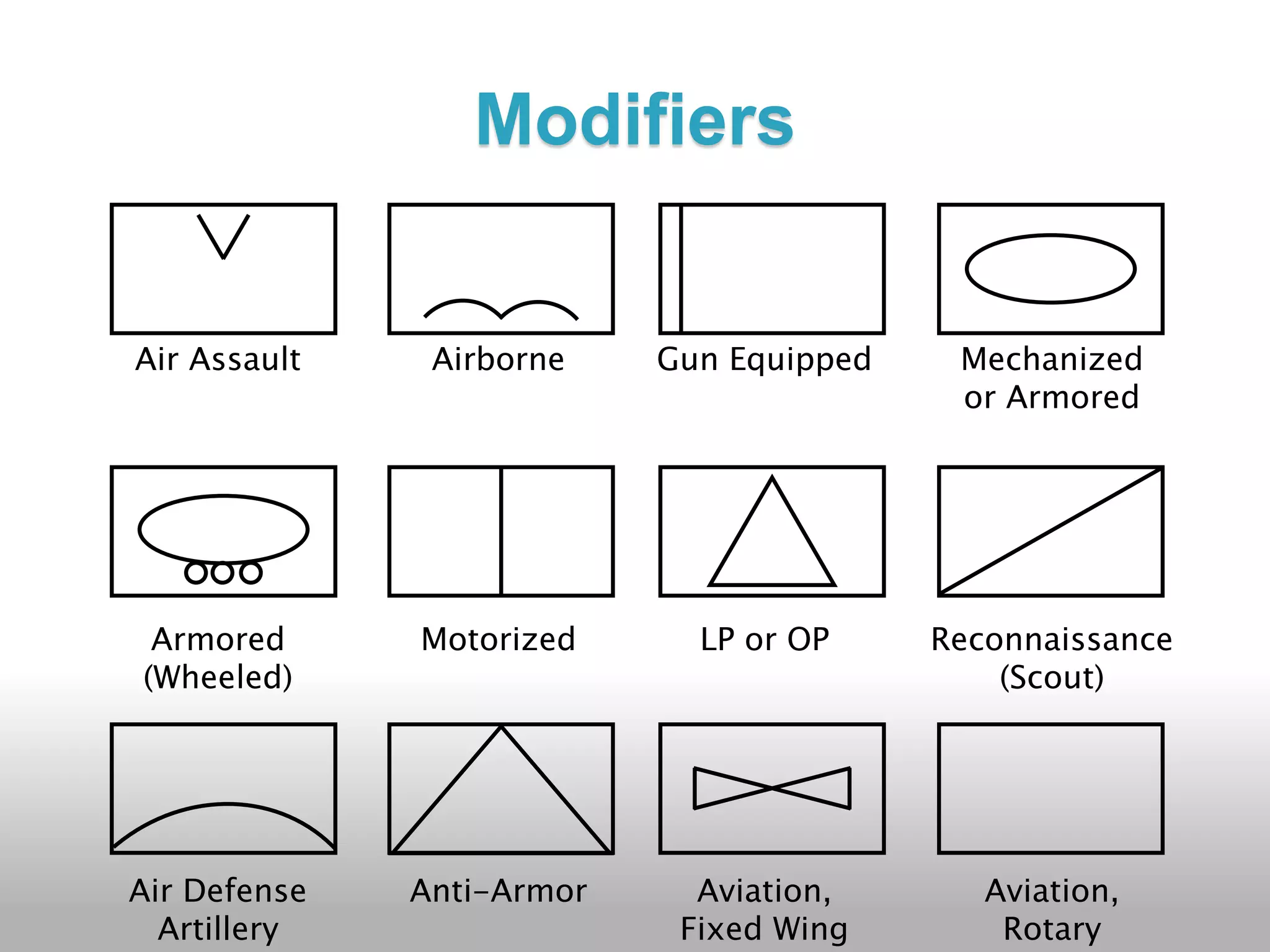
ModifiersAir AssaultAirborneGun EquippedMechanizedor ArmoredArmored(Wheeled)MotorizedLP or OPReconnaissance(Scout)Air DefenseArtilleryAnti-ArmorAviation,Fixed WingAviation,Rotary
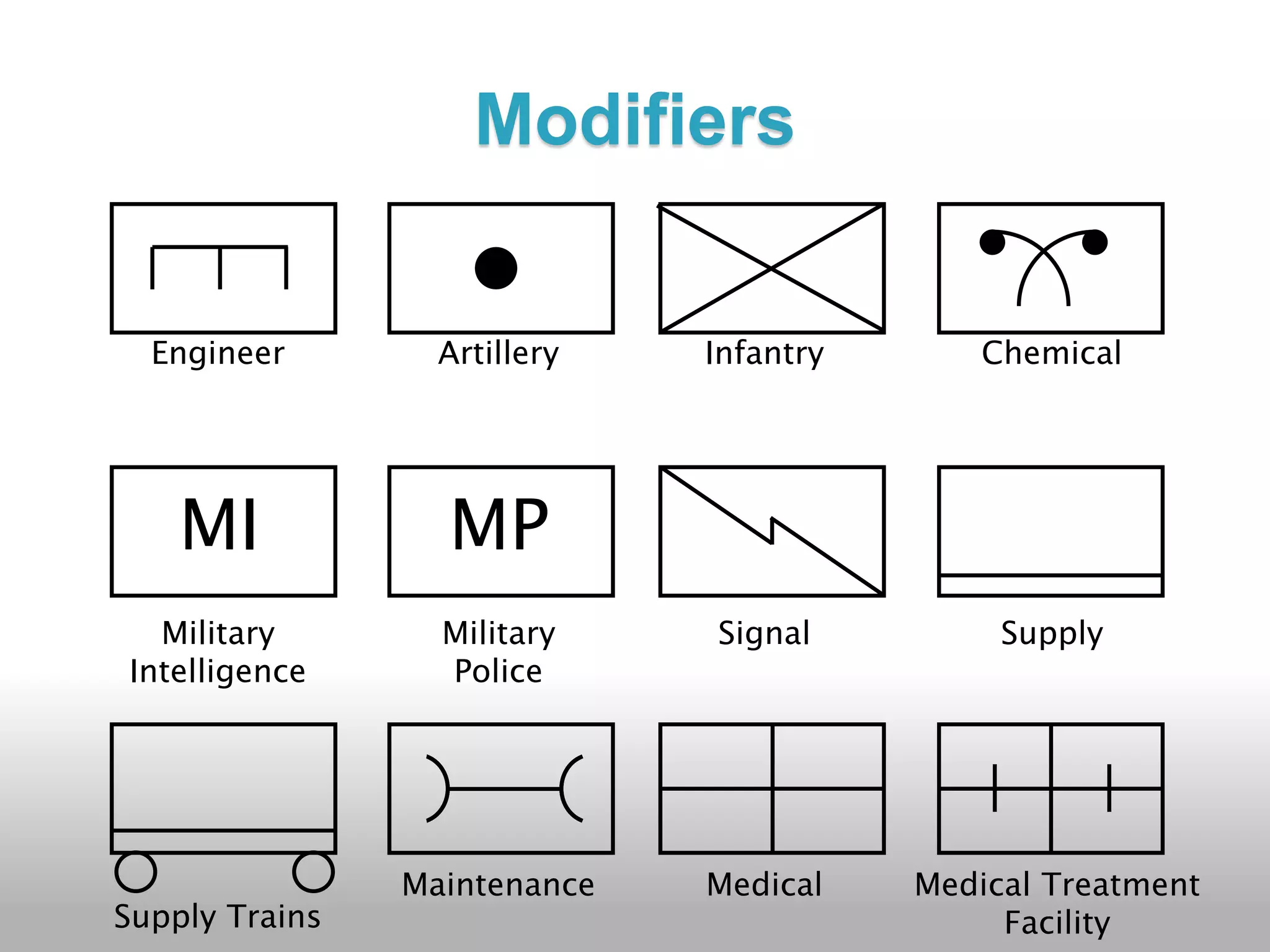
ModifiersEngineerArtilleryInfantryChemicalMIMPMilitaryIntelligenceMilitaryPoliceSignalSupplyMaintenanceMedicalMedical TreatmentFacilitySupply Trains
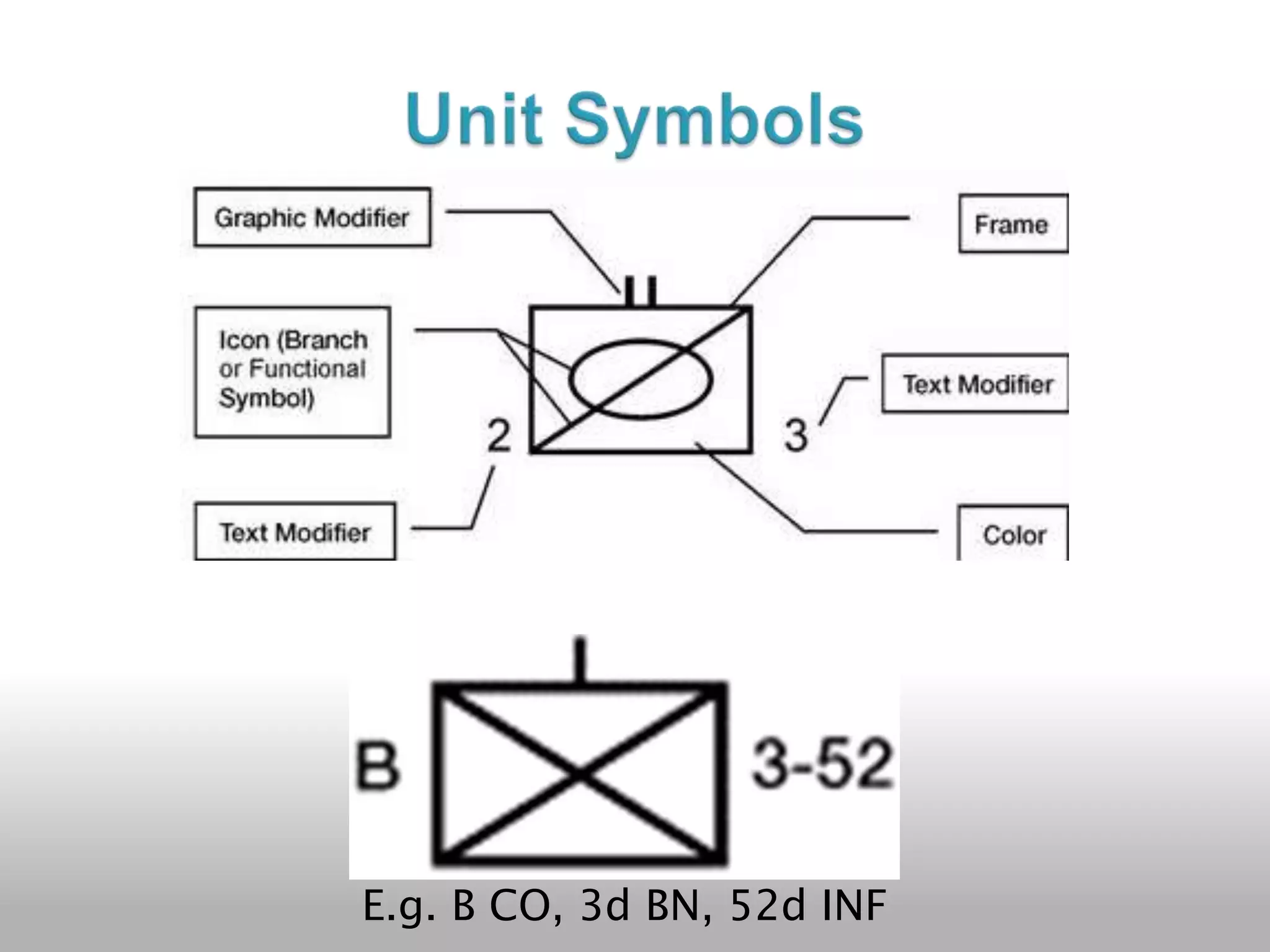
Unit SymbolsE.g. B CO, 3d BN, 52d INF
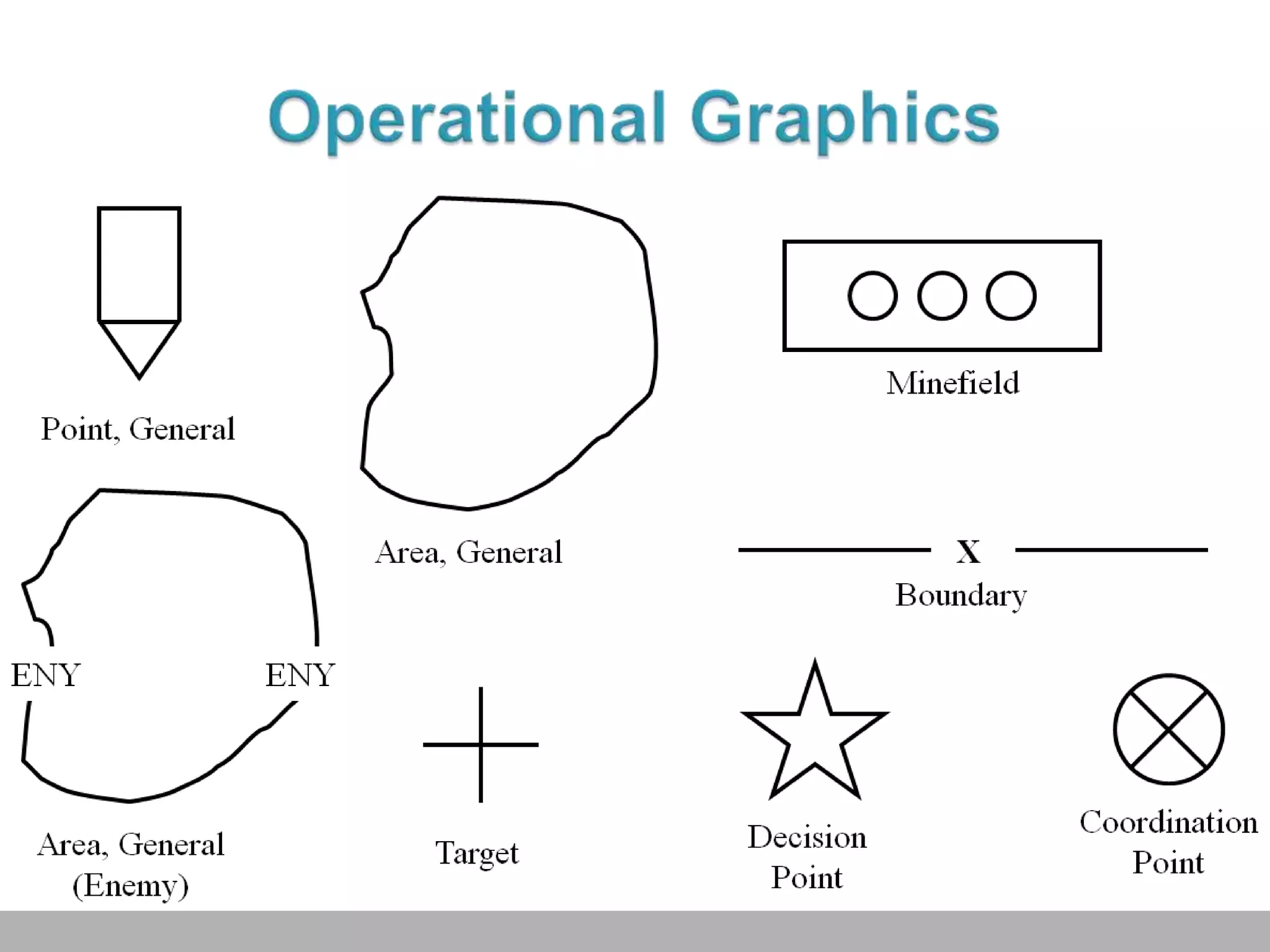
Operational Graphics
Recognize Overlay Techniques
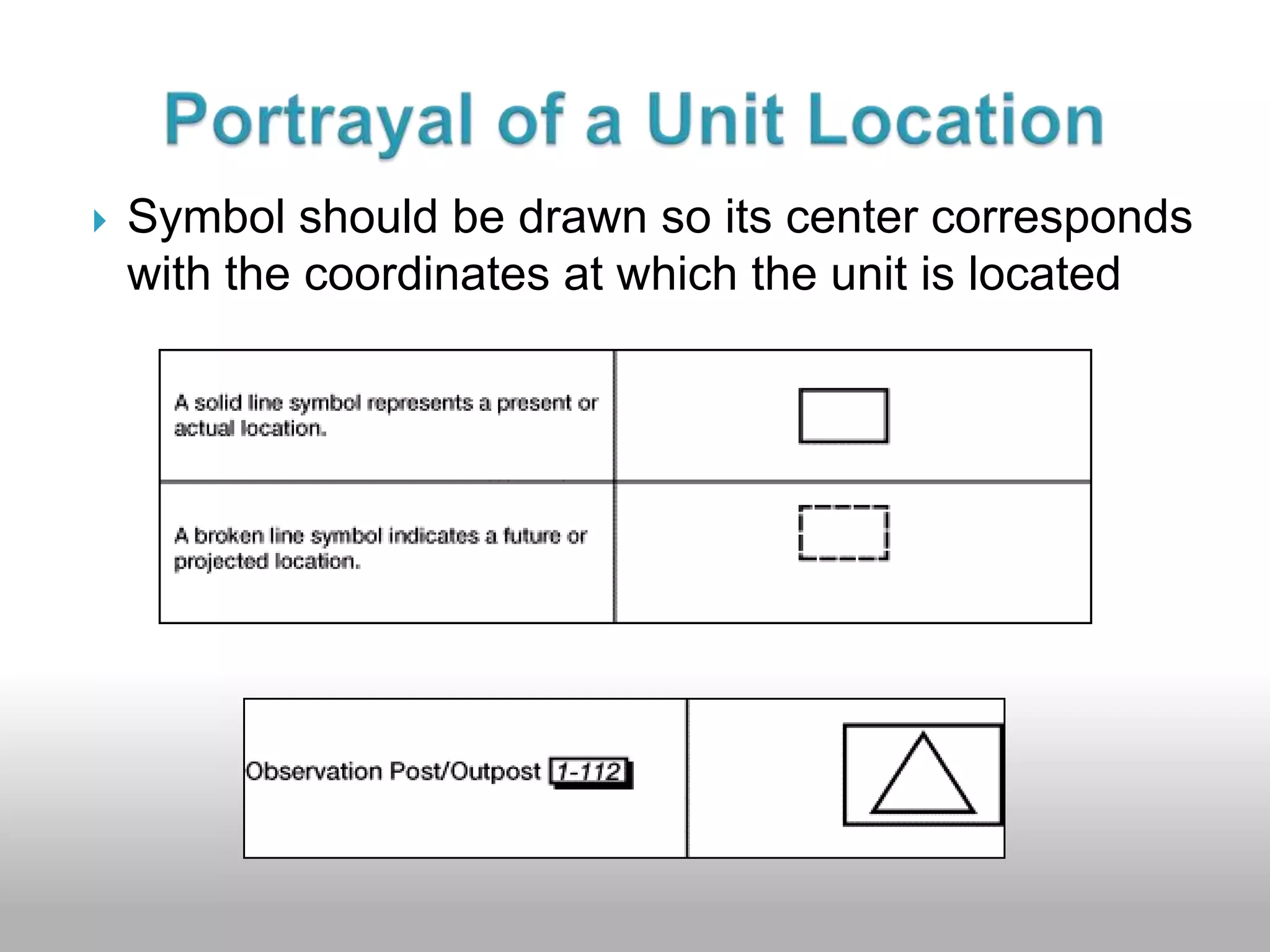
Solid lines indicateThe location of a unit or installation or coordinating detail (for example, line of departure or boundary) is in effect and will continue, or is made effective by the order preparedBroken lines indicateProposed or future locationCoordinating detail to become effective laterSolid and Broken Lines
Areas of tactical responsibilityIn the offense - referred to as zones of actionIn the defense and retrograde - referred to as sectors of responsibilityDesirably drawn along terrain features easily recognizable on the groundBoundaries
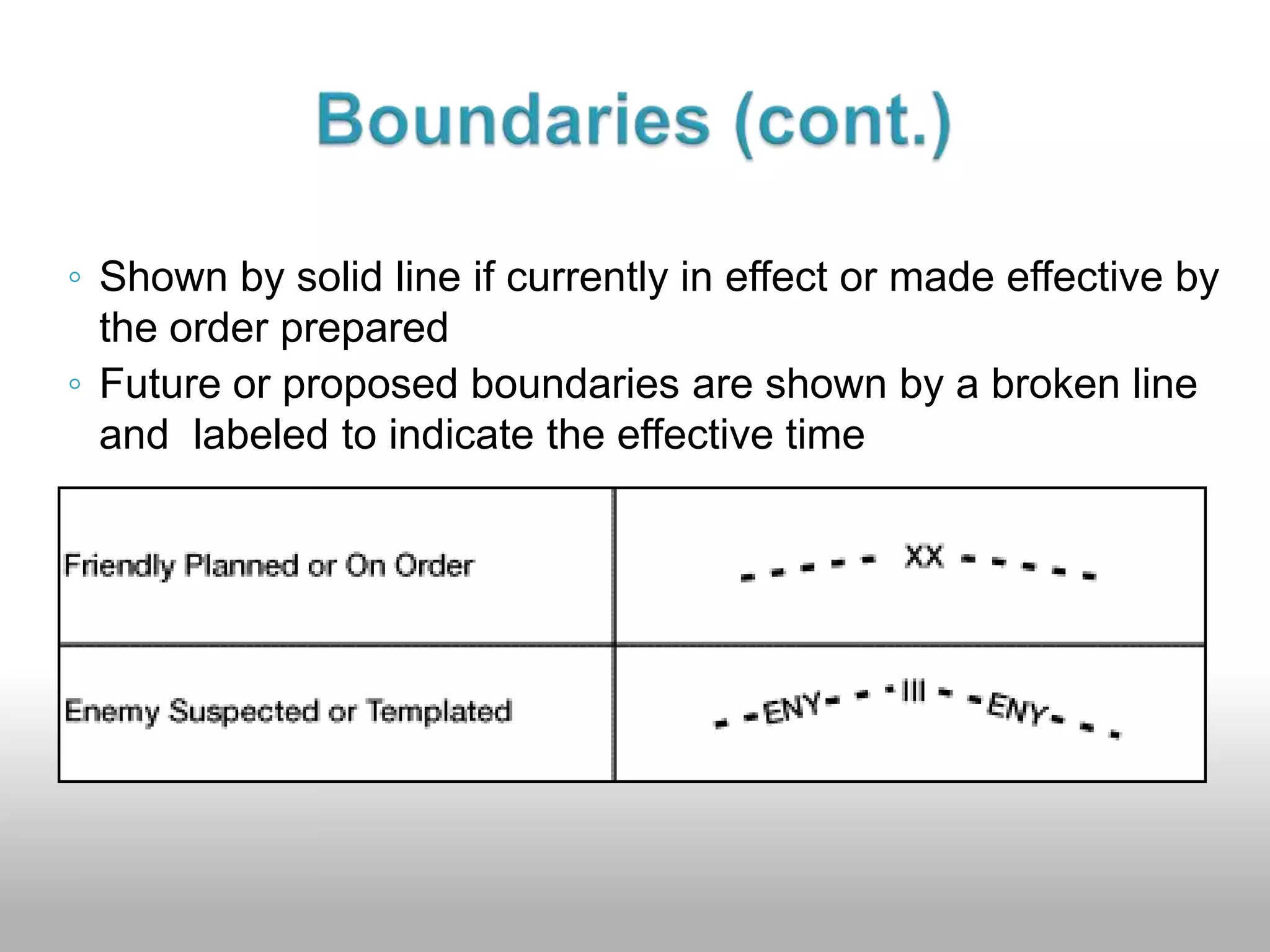
Shown by solid line if currently in effect or made effective by the order preparedFuture or proposed boundaries are shown by a broken line and  labeled to indicate the effective timeBoundaries (cont.)
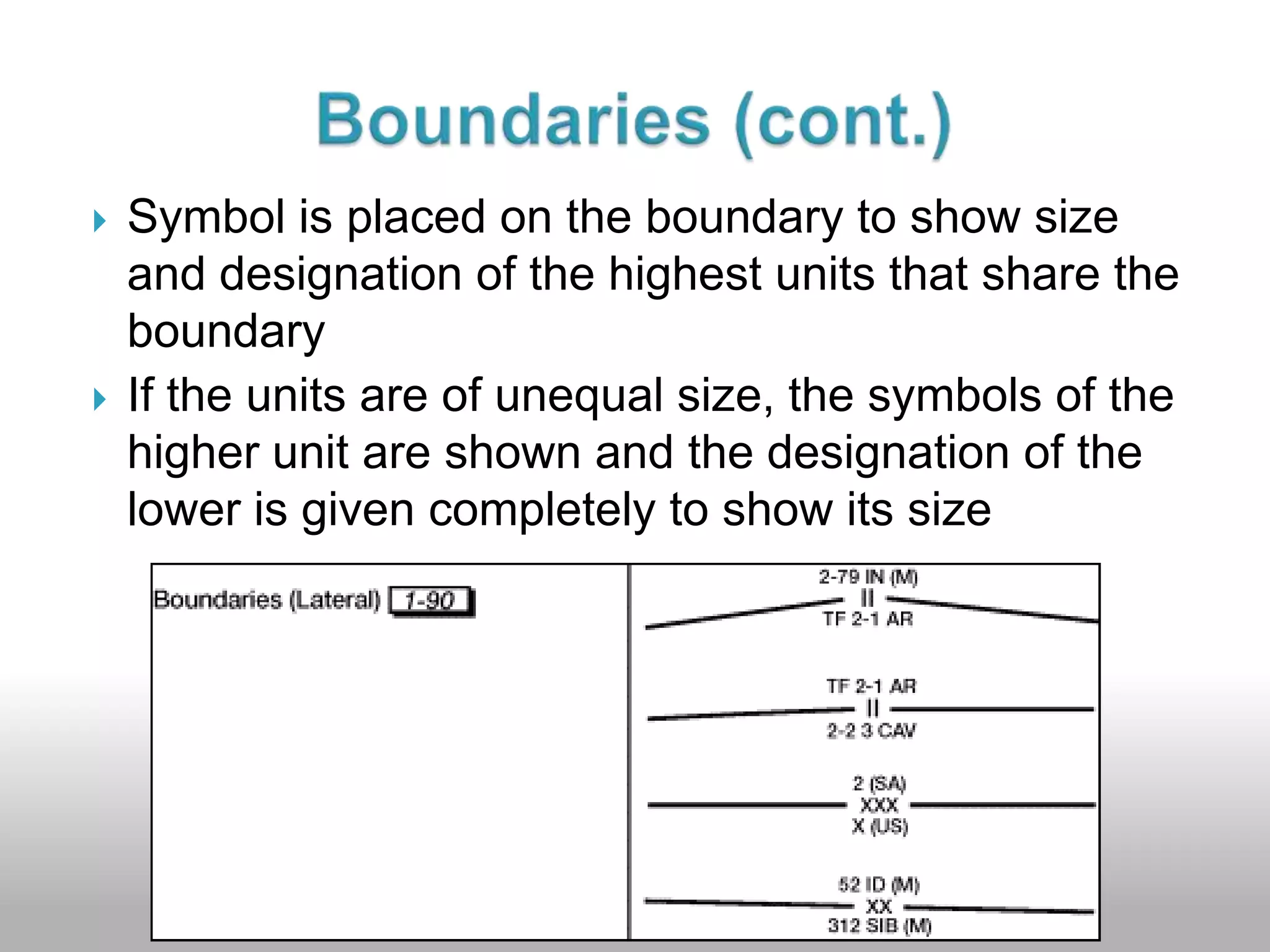
Symbol is placed on the boundary to show size and designation of the highest units that share the boundaryIf the units are of unequal size, the symbols of the higher unit are shown and the designation of the lower is given completely to show its sizeBoundaries (cont.)
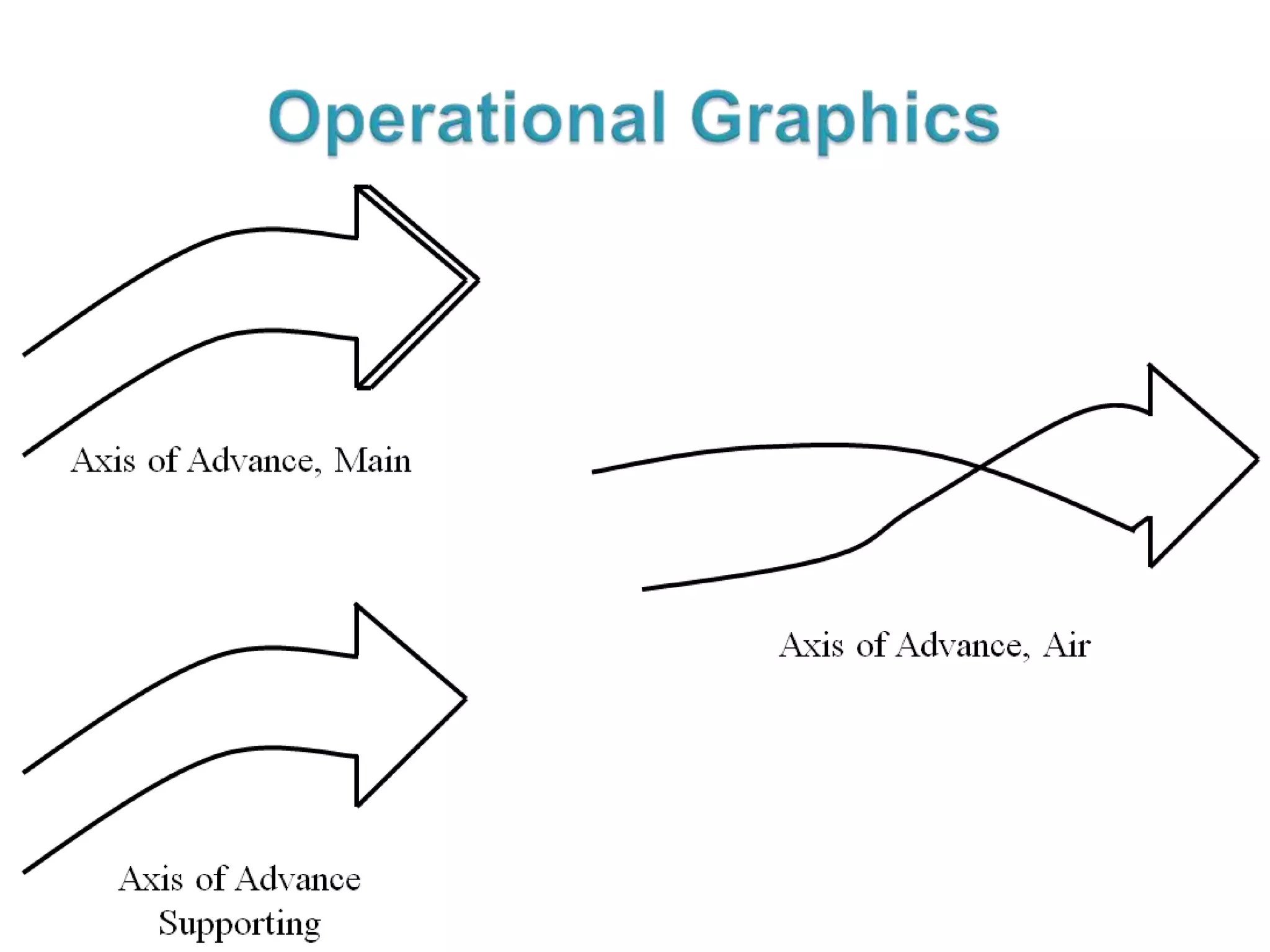
Shown from the line of departure (LD) to the objective following an avenue of approachAxis of Advance
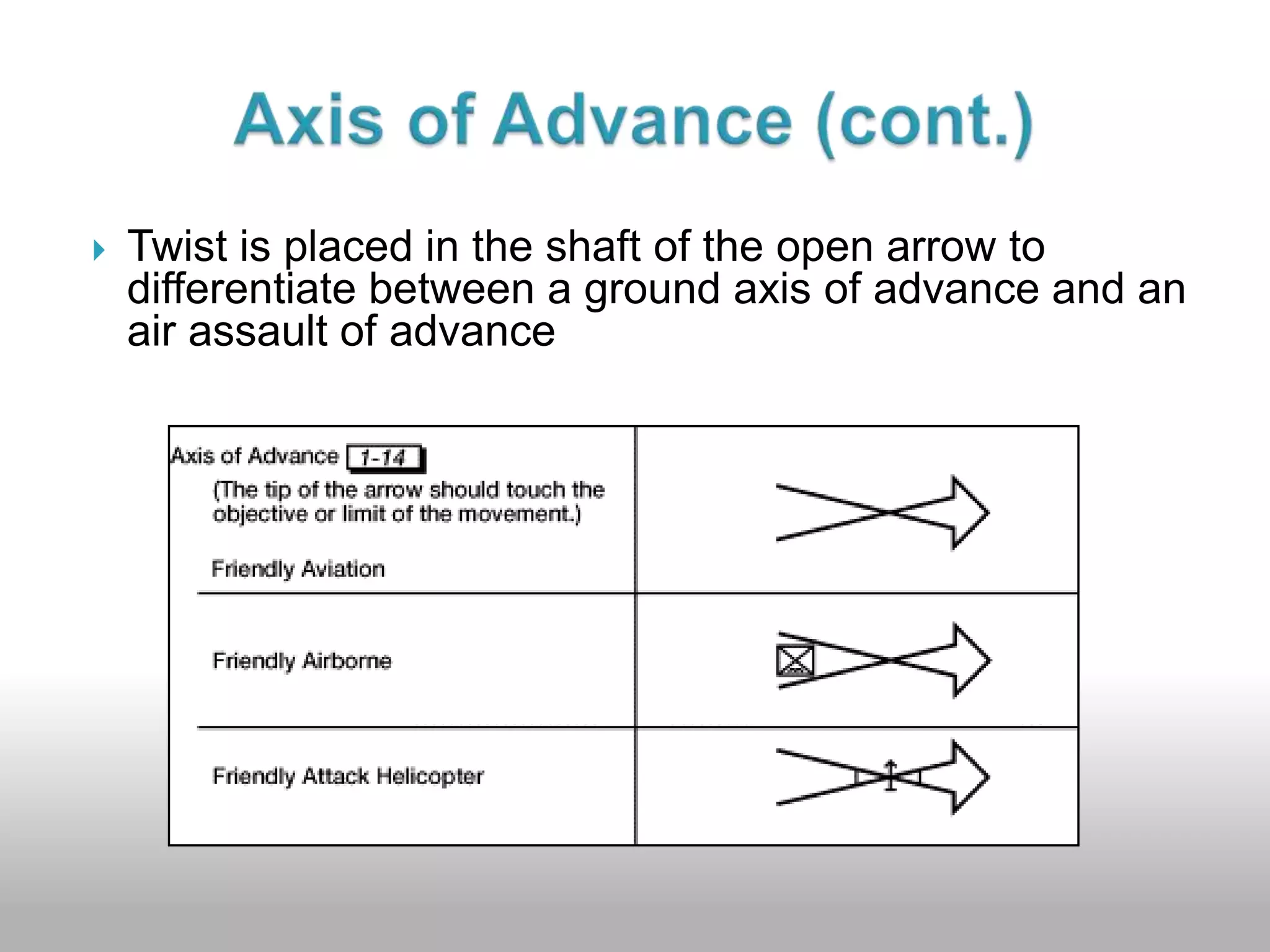
Twist is placed in the shaft of the open arrow to differentiate between a ground axis of advance and an air assault of advanceAxis of Advance (cont.)
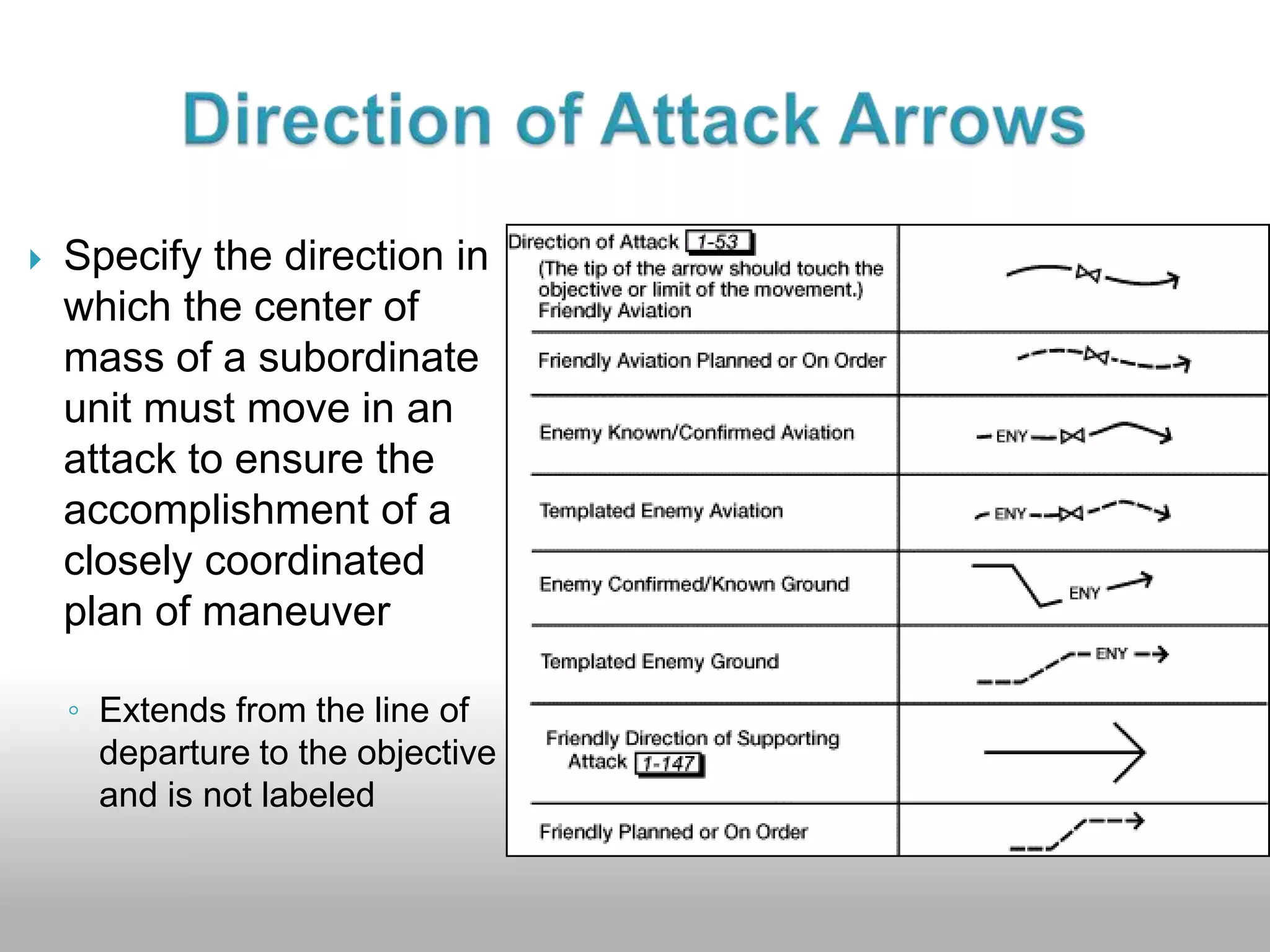
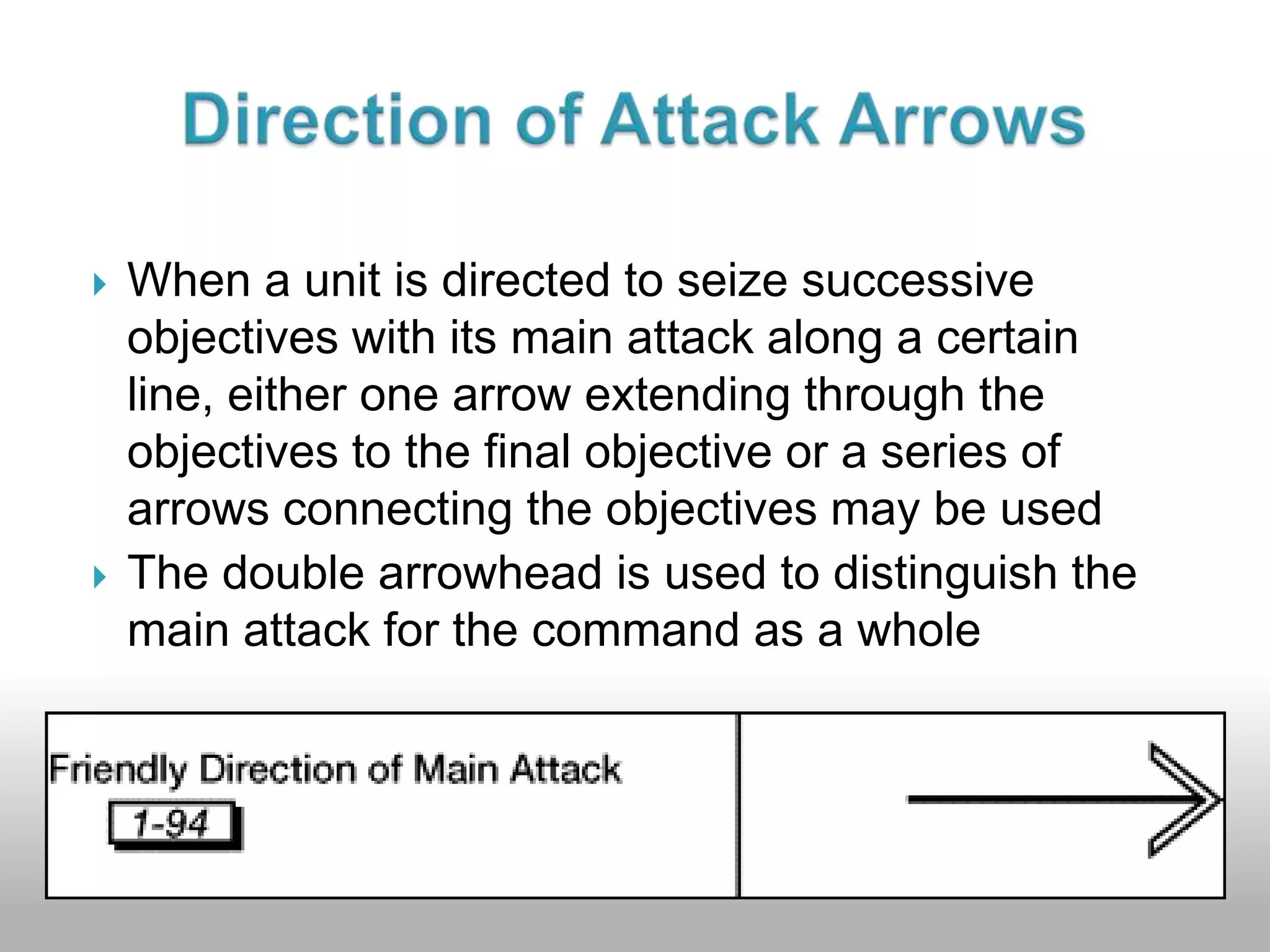
Specify the direction in which the center of mass of a subordinate unit must move in an attack to ensure the accomplishment of a closely coordinated plan of maneuverExtends from the line of departure to the objective and is not labeledDirection of Attack Arrows
When a unit is directed to seize successive objectives with its main attack along a certain line, either one arrow extending through the objectives to the final objective or a series of arrows connecting the objectives may be usedThe double arrowhead is used to distinguish the main attack for the command as a wholeDirection of Attack Arrows
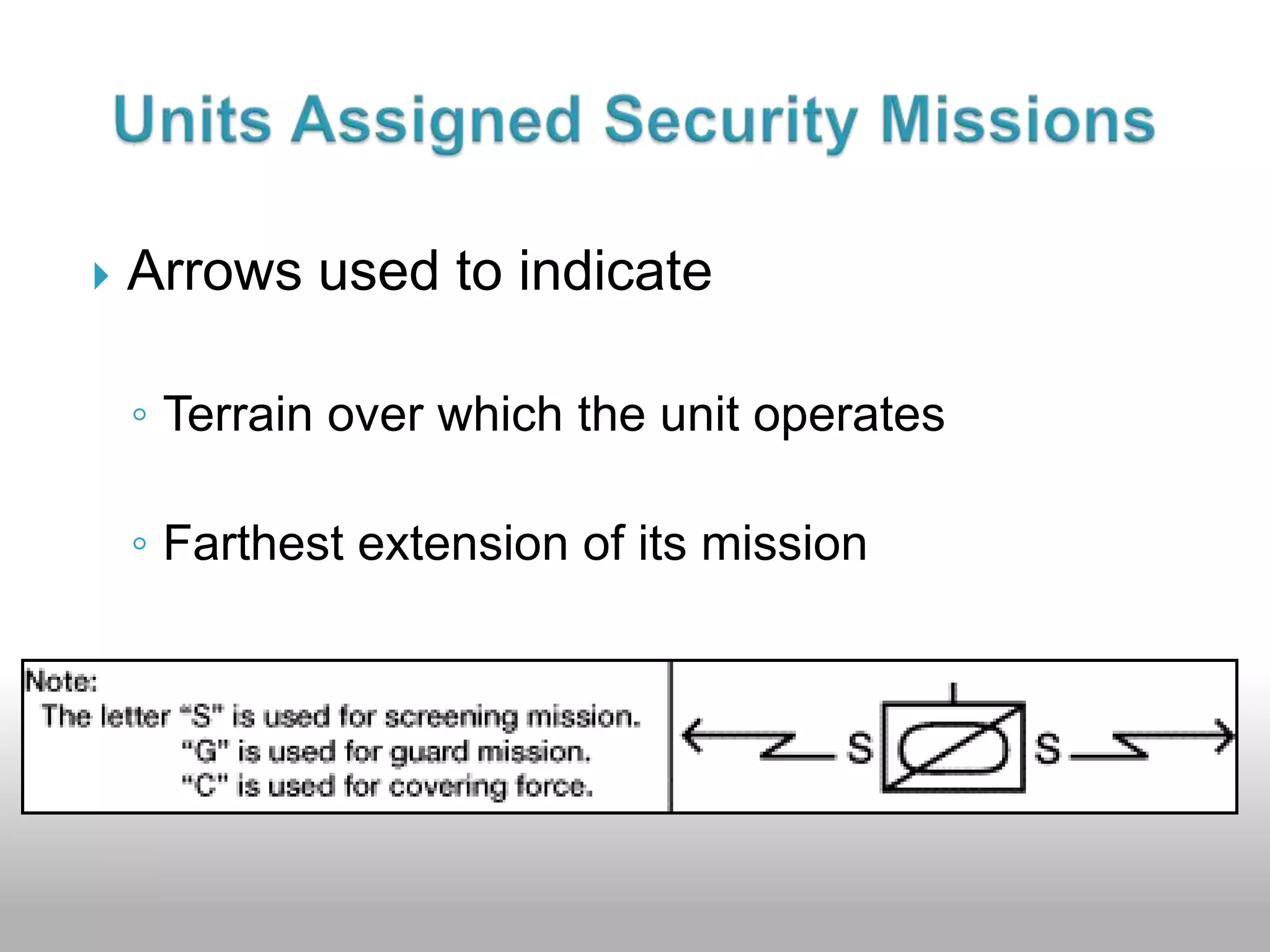
Arrows used to indicateTerrain over which the unit operates Farthest extension of its missionUnits Assigned Security Missions
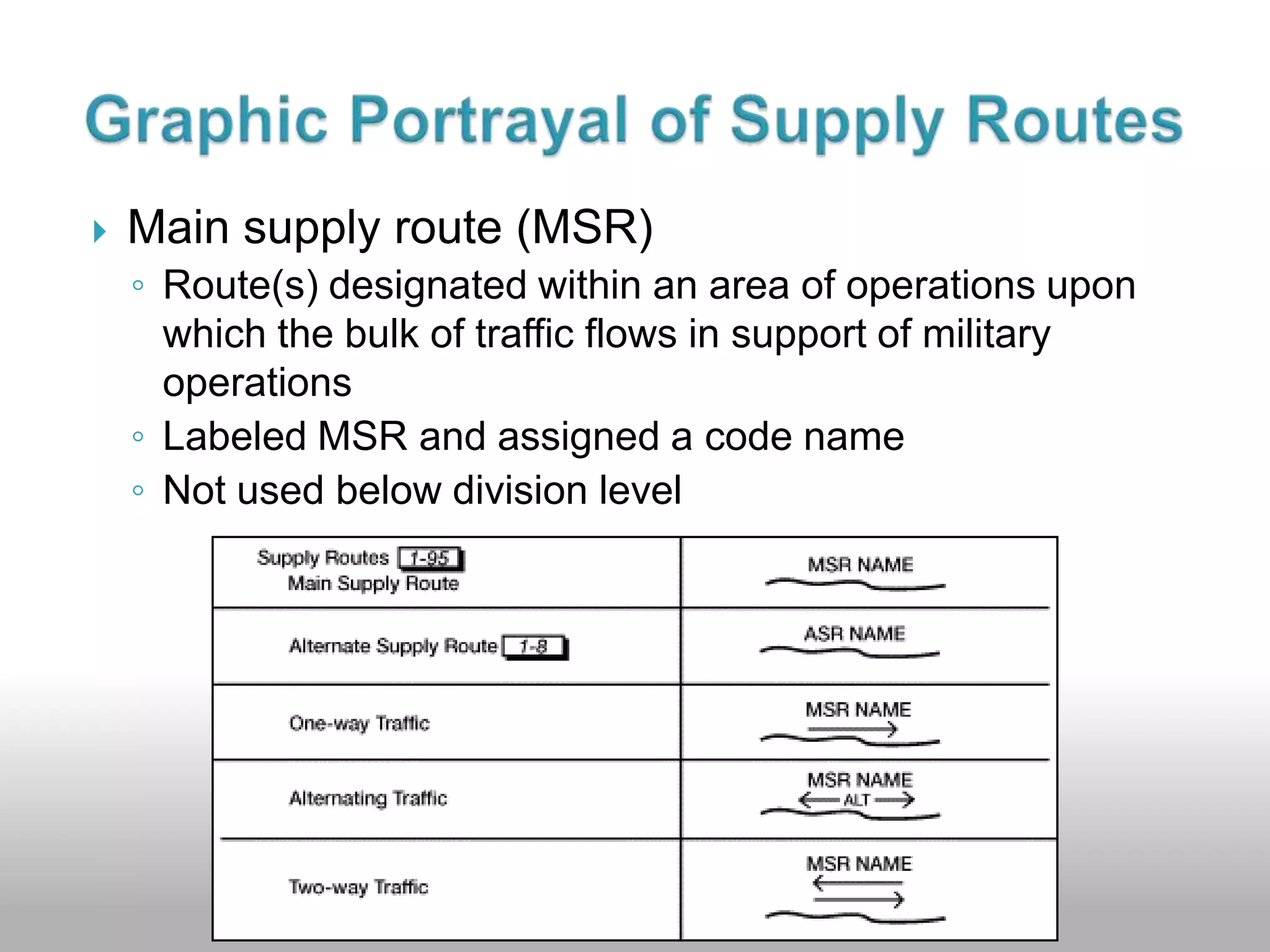
Main supply route (MSR) Route(s) designated within an area of operations upon which the bulk of traffic flows in support of military operationsLabeled MSR and assigned a code nameNot used below division levelGraphic Portrayal of Supply Routes
Symbol should be drawn so its center corresponds with the coordinates at which the unit is locatedPortrayal of a Unit Location
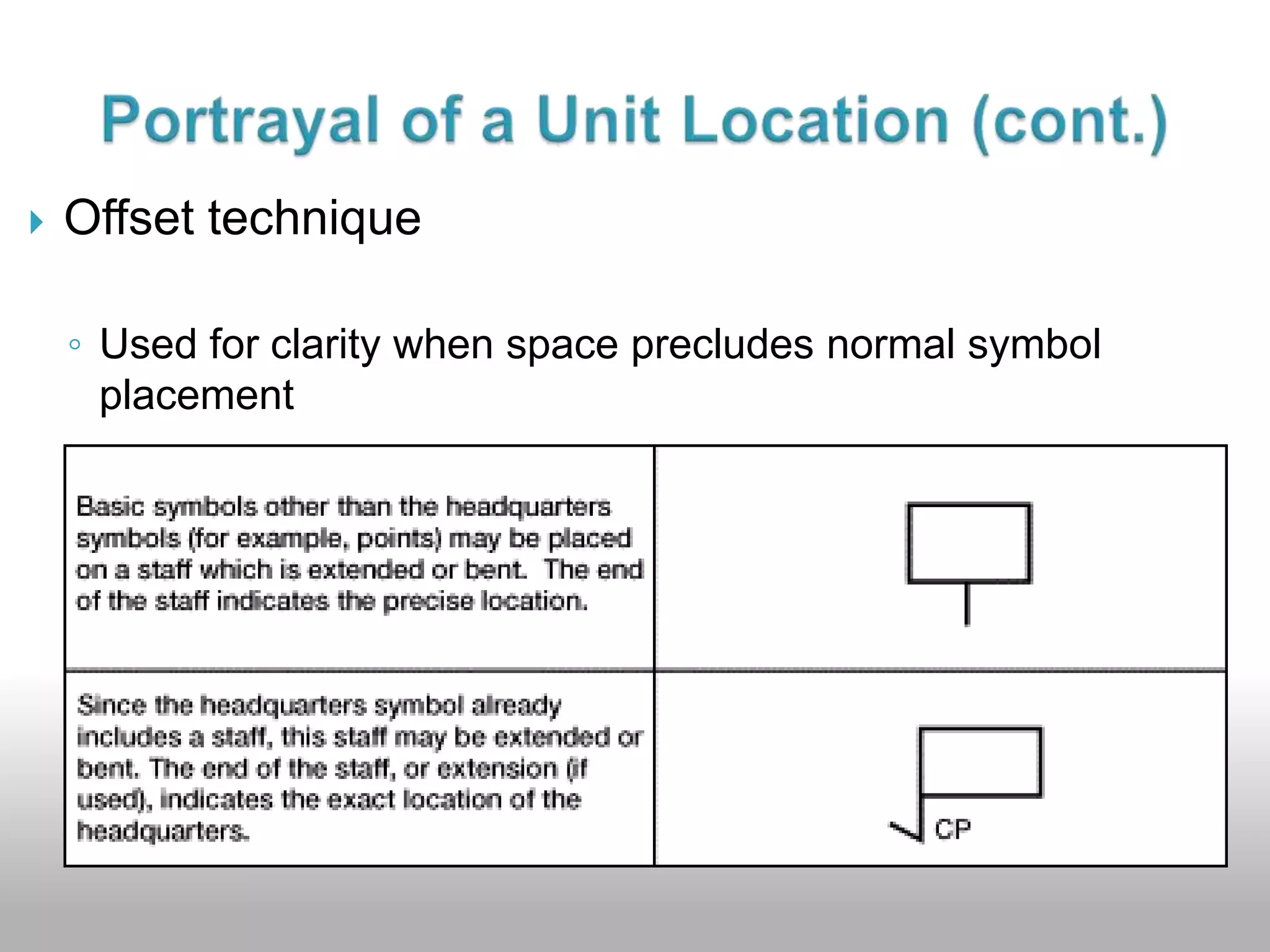
Offset technique Used for clarity when space precludes normal symbol placementPortrayal of a Unit Location (cont.)
Offset staffsMay be "bent" as required.  Dashed for future or proposed locations  Extend vertically from the bottom center of the symbol (except for command posts [CP])End of the offset staff indicates Exact locations of CPs and aid stations Center of mass for other units or installations  The staff for a CP symbol is always on the left edgePortrayal of a Unit Location (cont.)
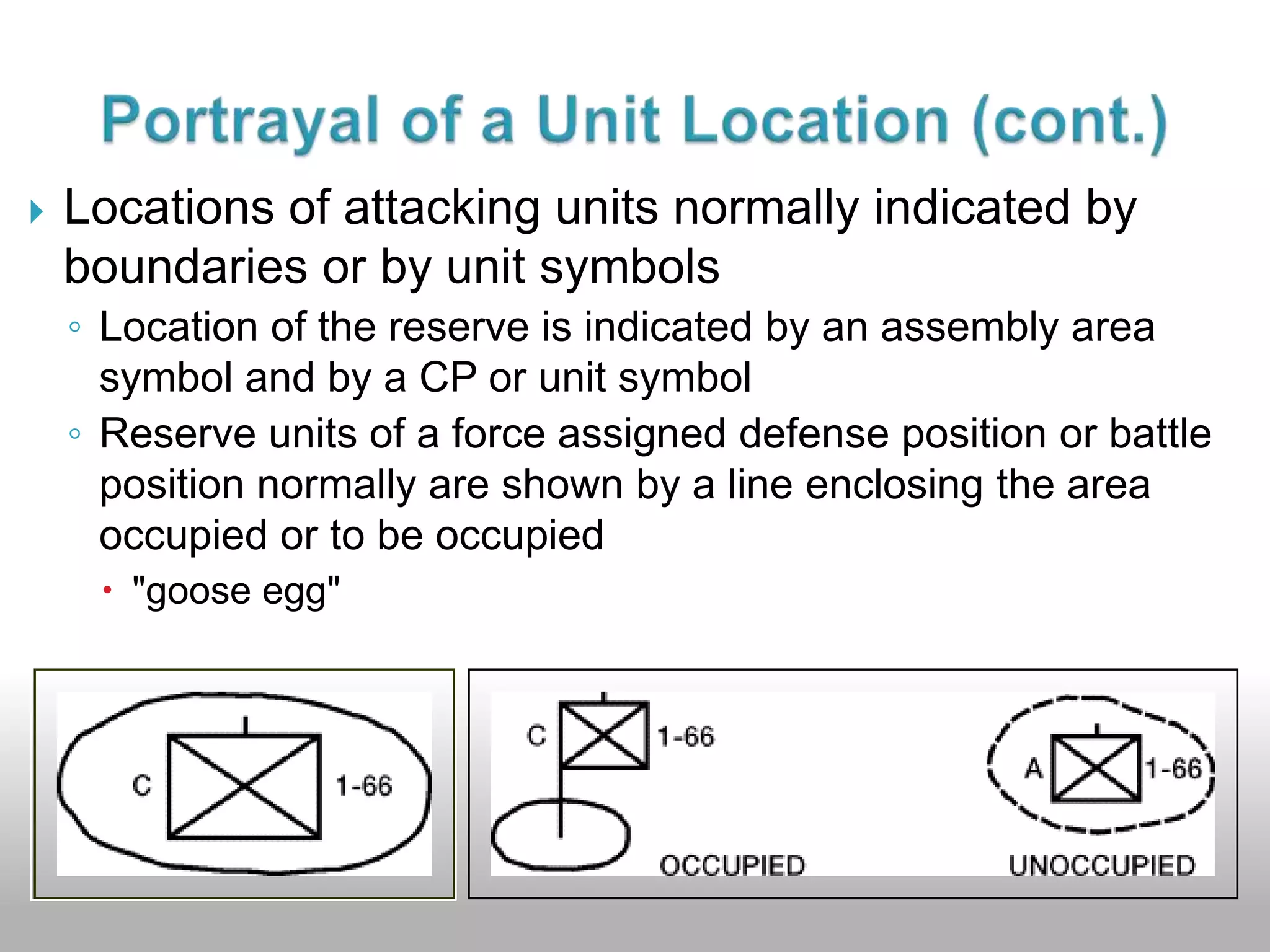
Locations of attacking units normally indicated by boundaries or by unit symbolsLocationof the reserve is indicated by an assembly area symbol and by a CP or unit symbolReserve units of a force assigned defense position or battle position normally are shown by a line enclosing the area occupied or to be occupied"goose egg"Portrayal of a Unit Location (cont.)
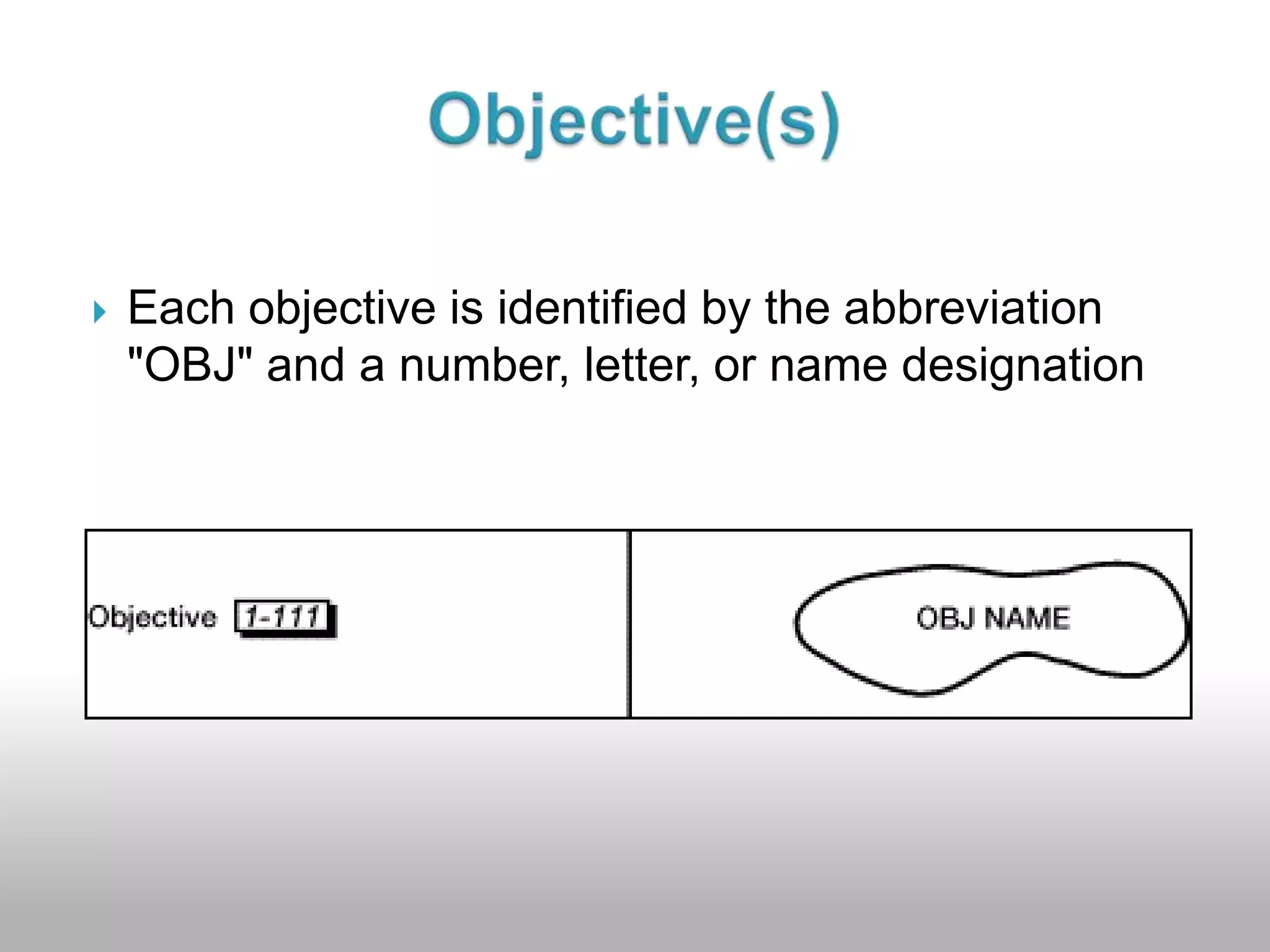
Each objective is identified by the abbreviation "OBJ" and a number, letter, or name designationObjective(s)
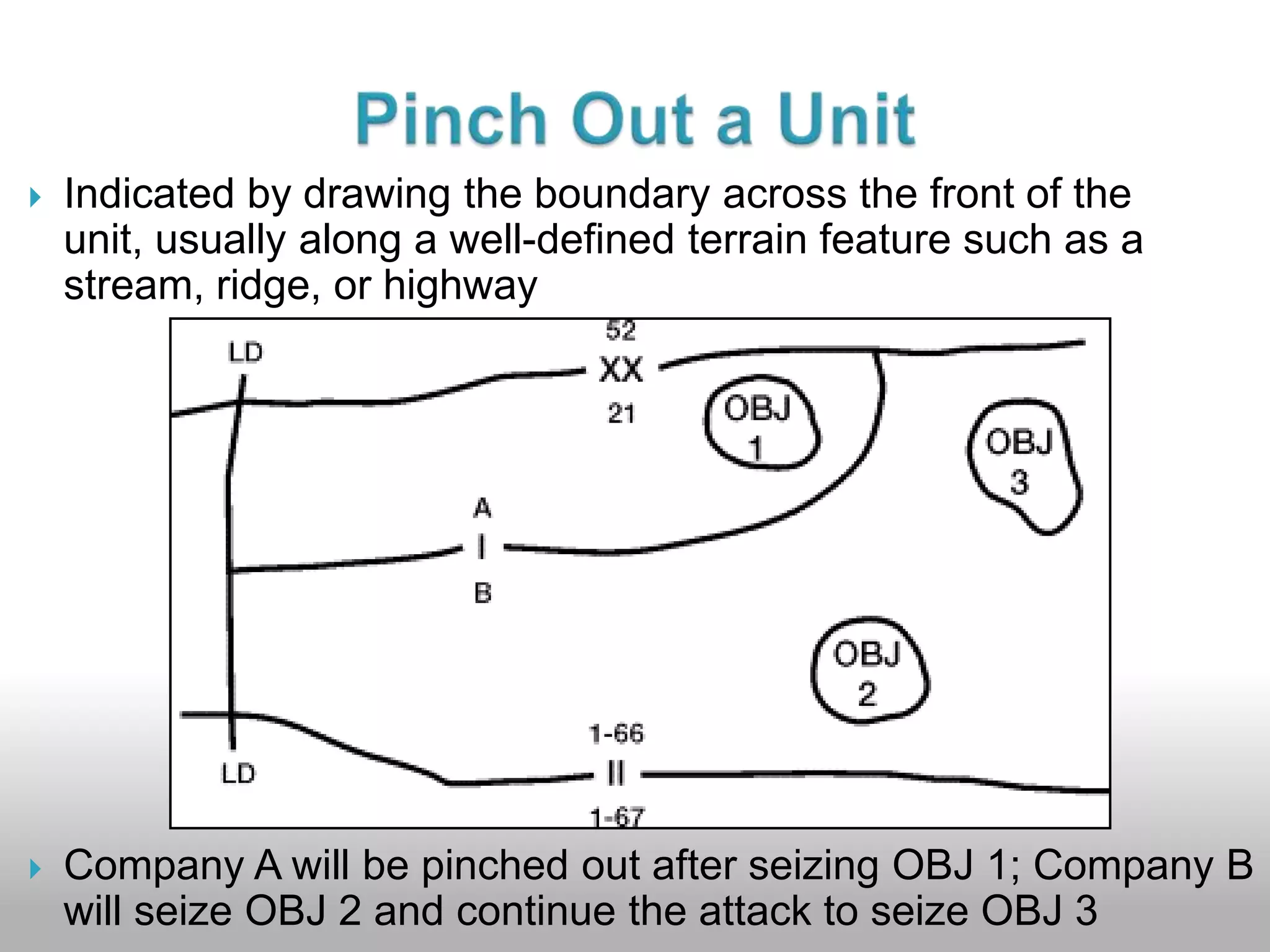
Indicated by drawing the boundary across the front of the unit, usually along a well-defined terrain feature such as a stream, ridge, or highwayCompany A will be pinched out after seizing OBJ 1; Company B will seize OBJ 2 and continue the attack to seize OBJ 3Pinch Out a Unit
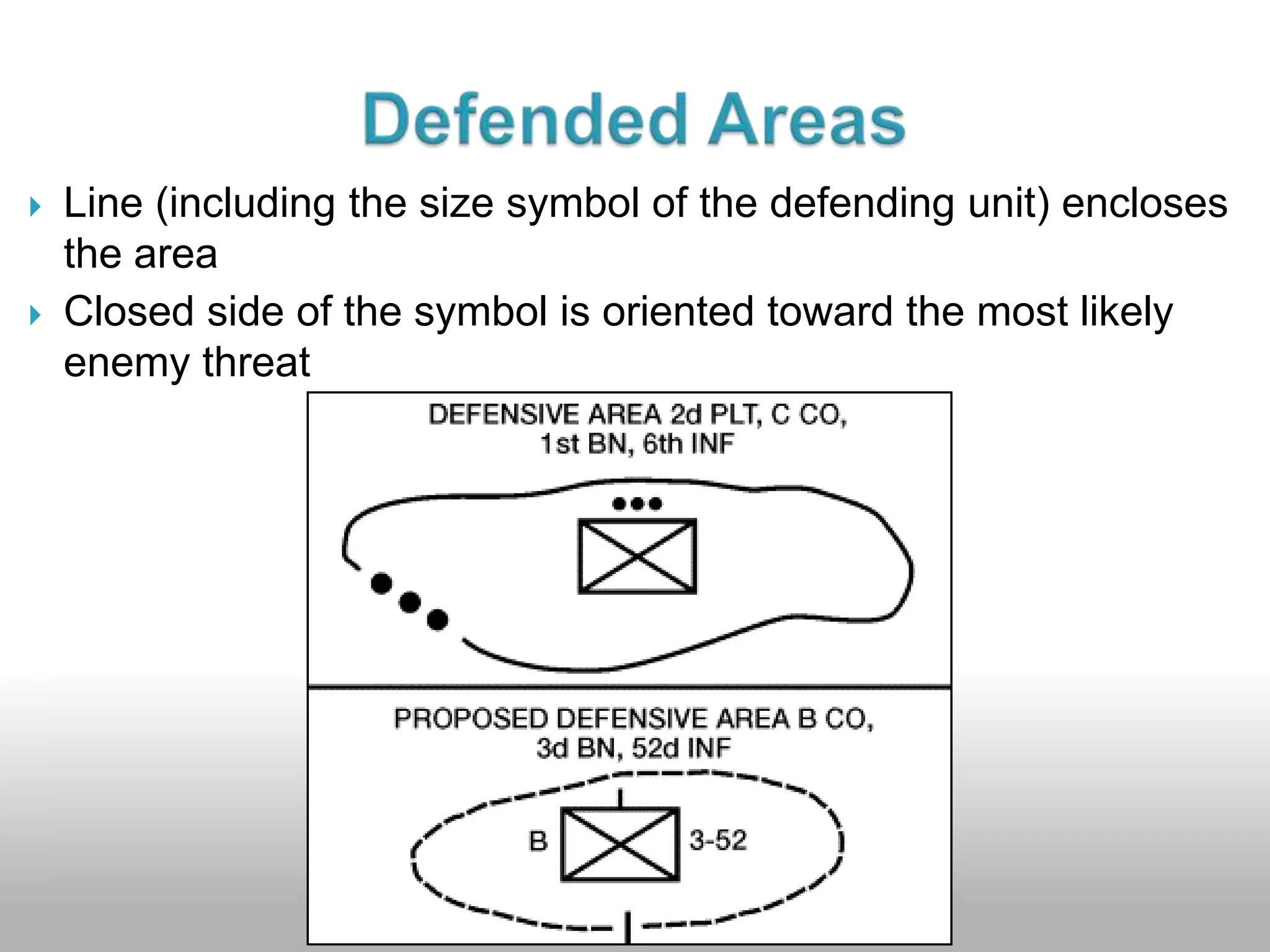
Line (including the size symbol of the defending unit) encloses the areaClosed side of the symbol is oriented toward the most likely enemy threatDefended Areas
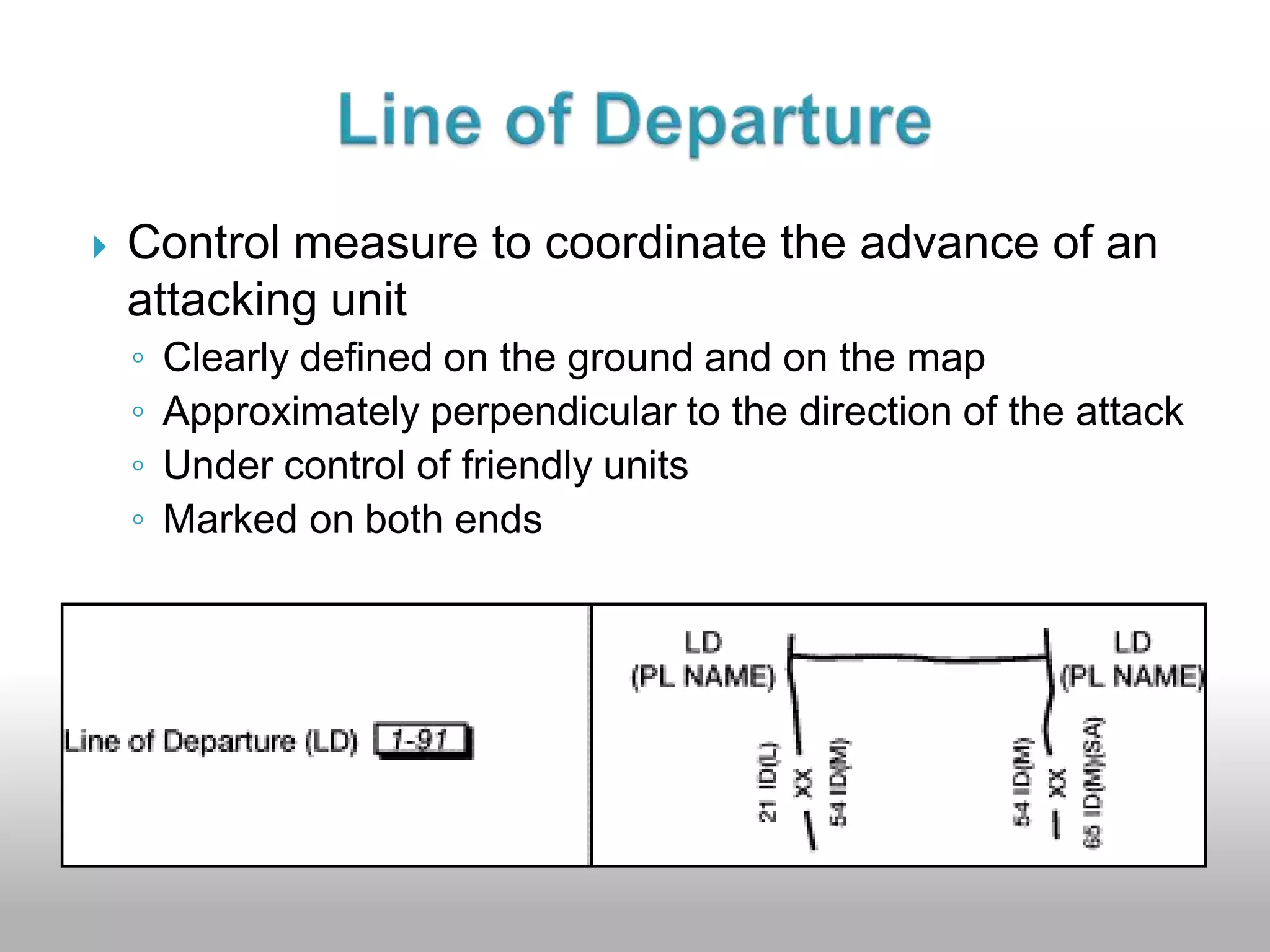
Control measure to coordinate the advance of an attacking unitClearly defined on the ground and on the mapApproximately perpendicular to the direction of the attackUnder control of friendly unitsMarked on both endsLine of Departure
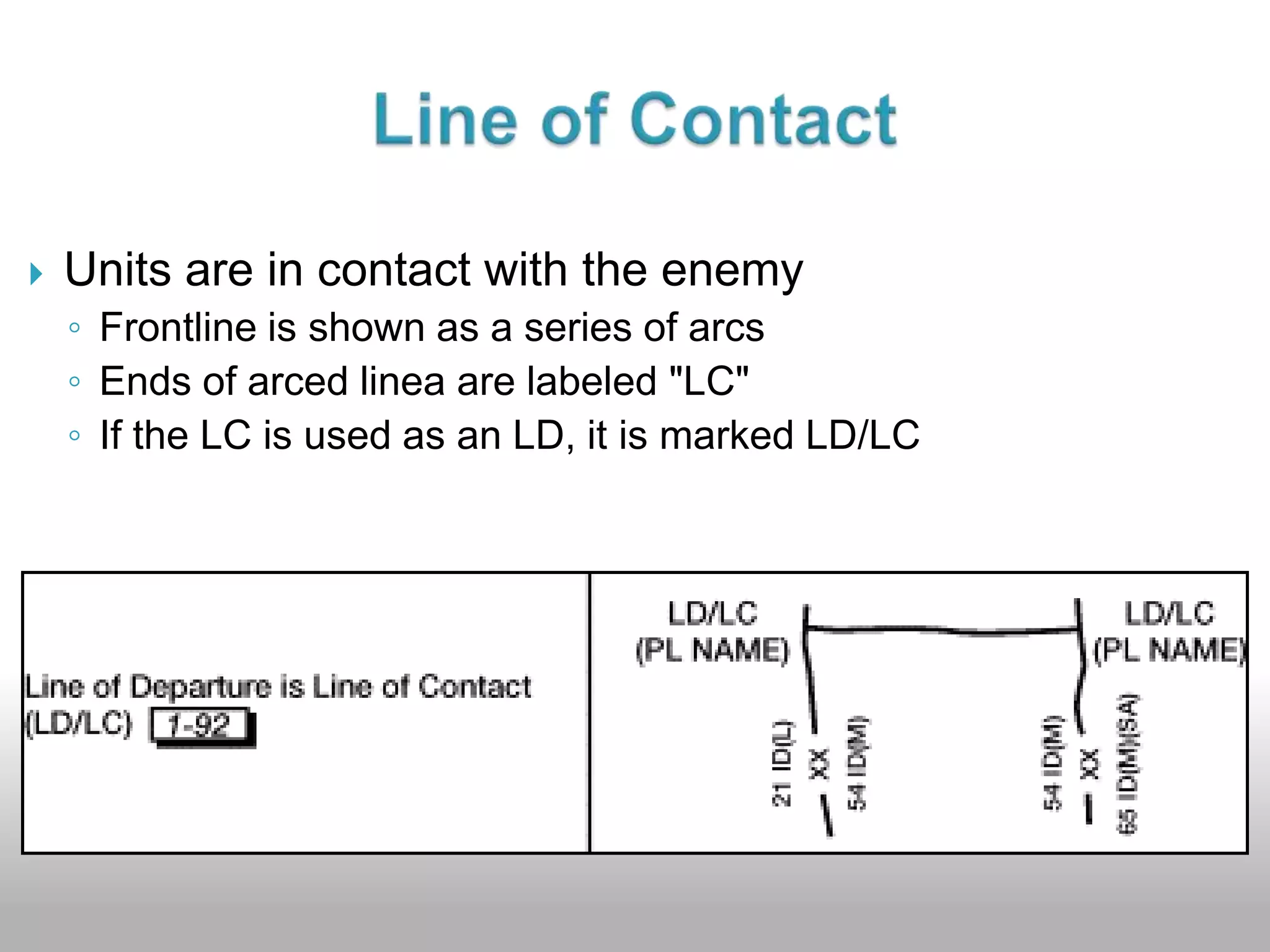
Units are in contact with the enemyFrontline is shown as a series of arcsEnds of arced linea are labeled "LC"If the LC is used as an LD, it is marked LD/LCLine of Contact
Units report their arrival at, or clearance of, a PL, but they do not halt unless ordered to do soControl the progress of unitsAlso used to control fires and unit movement and even to limit the advance of attacking elementsShould be easily recognized terrain features, normally perpendicular to the direction of advanceDrawn as a solid line with the letters PL at each end of the line identified further by a number, a letter, or code namePhase Line
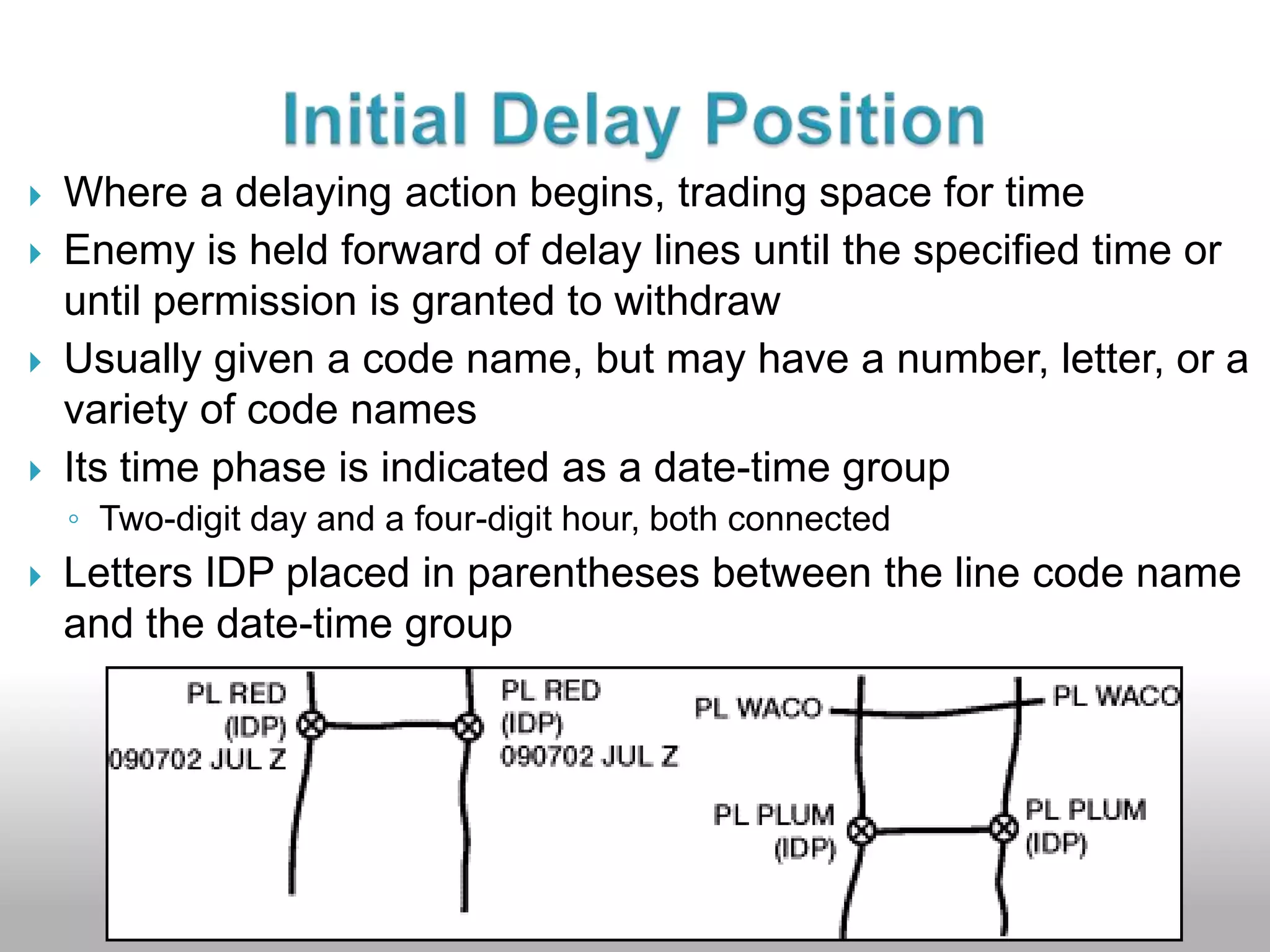
Where a delaying action begins, trading space for timeEnemy is held forward of delay lines until the specified time or until permission is granted to withdrawUsually given a code name, but may have a number, letter, or a variety of code namesIts time phase is indicated as a date-time group Two-digit day and a four-digit hour, both connectedLetters IDP placed in parentheses between the line code name and the date-time group Initial Delay Position
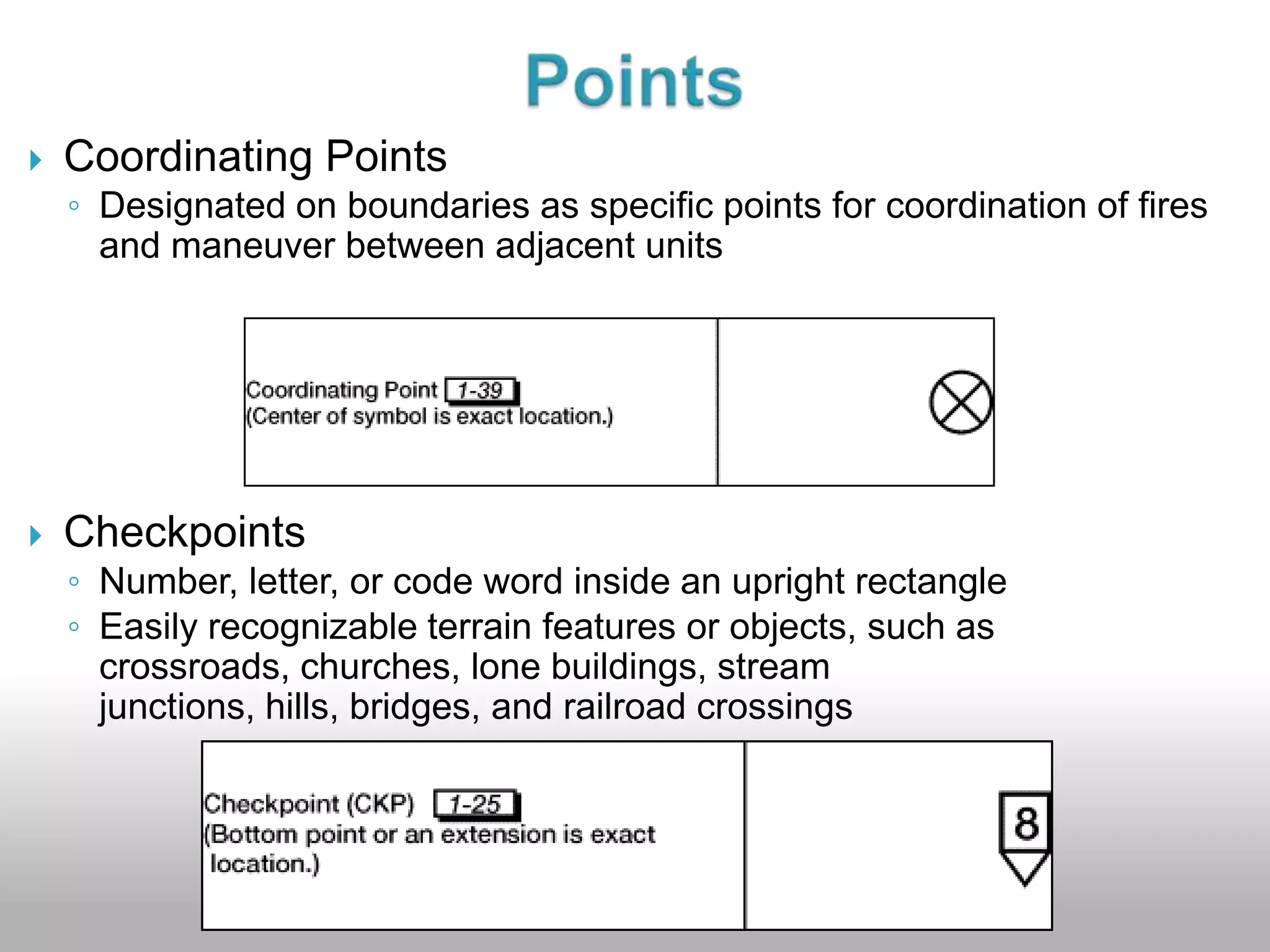
PointsCoordinating PointsDesignated on boundaries as specific points for coordination of fires and maneuver between adjacent unitsCheckpointsNumber, letter, or code word inside an upright rectangleEasily recognizable terrain features or objects, such as crossroads, churches, lone buildings, stream junctions, hills, bridges, and railroad crossings
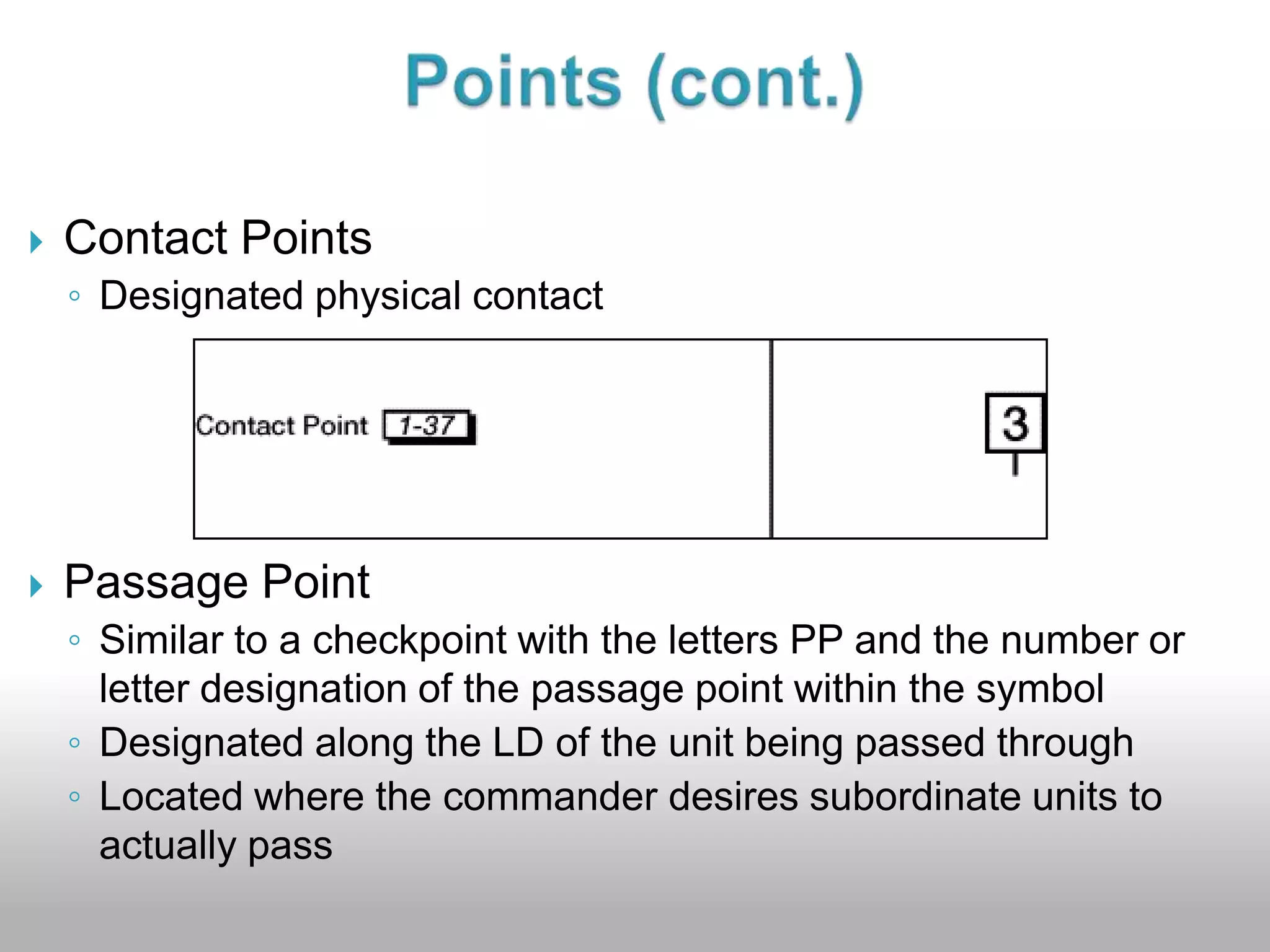
Points (cont.)Contact PointsDesignated physical contactPassage PointSimilar to a checkpoint with the letters PP and the number or letter designation of the passage point within the symbolDesignated along the LD of the unit being passed throughLocated where the commander desires subordinate units to actually pass
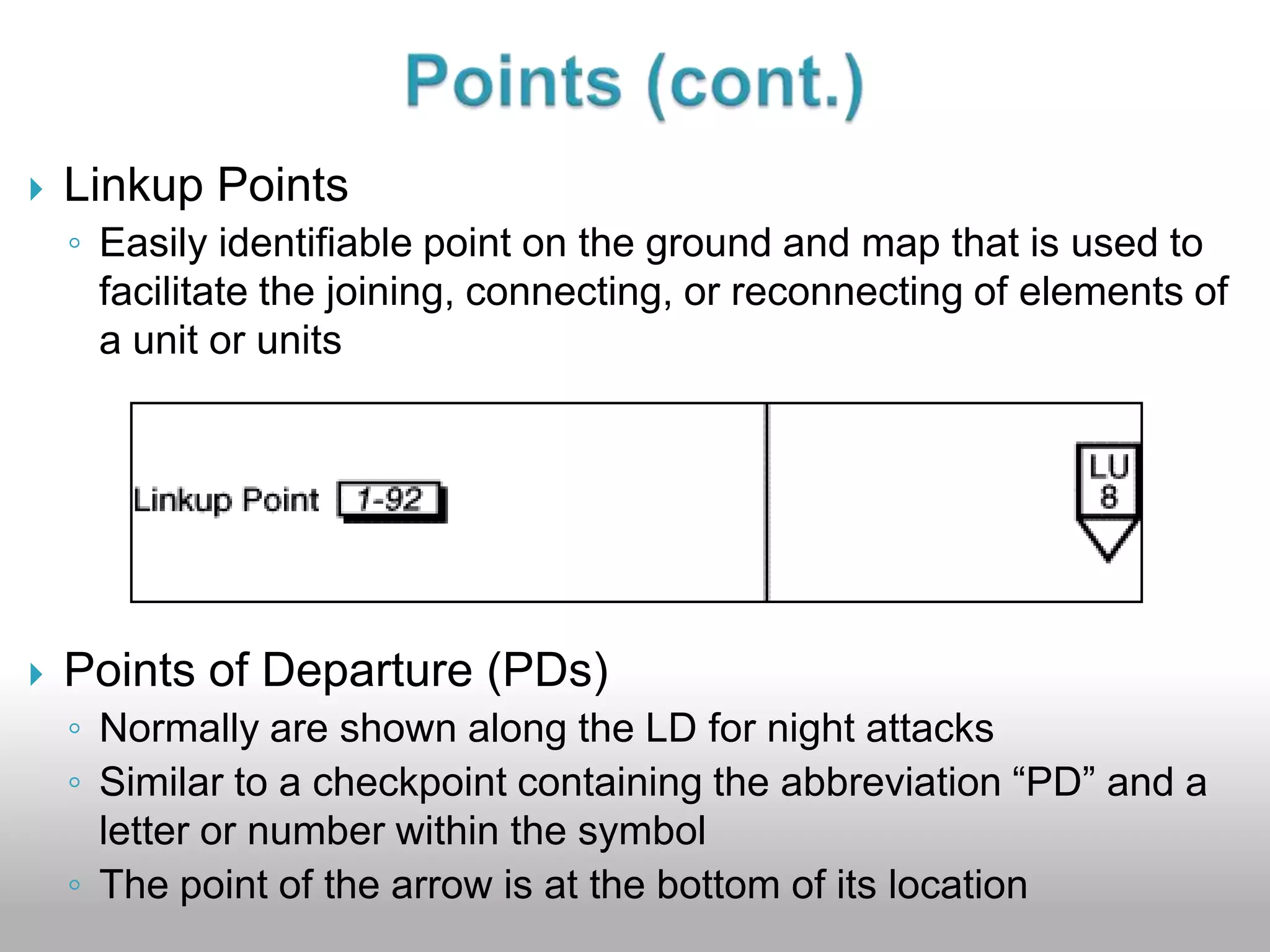
Points (cont.)Linkup Points  Easily identifiable point on the ground and map that is used to facilitate the joining, connecting, or reconnecting of elements of a unit or unitsPoints of Departure (PDs)Normally are shown along the LD for night attacksSimilar to a checkpoint containing the abbreviation “PD” and a letter or number within the symbol The point of the arrow is at the bottom of its location
TestFriendly Mechanized Infantry UnitLocation: XJ 90 84Friendly Wheeled Armored Infantry UnitLocation: XJ 89 89Friendly Wheeled Armored Infantry Unit with Gun SystemsLocation: XJ 85 82Friendly Wheeled Armored Infantry Battalion with Gun SystemsLocation: XJ 87 85710th Area Support Medical CO, 108th Multifunctional Medical BN, 108th Sustainment BDELocation: XJ 85 85
QUESTIONS

071-332-5000 Prepare an Operation Overlay

  • 1.
    071-332-5000 (SL3) Preparean Operation OverlaySTP 21-24 SMCT
  • 2.
    Given Complete copyof the operation order (OPORD) that your unit is to executeCommander's or a battalion operations officer's (S3) guidance (to include time available for preparation)Conditions
  • 3.
    Given (cont.)Overlay material(paper/acetate)TapeMap of the operational area, Colored pencils/markers (red, black, blue, green, and yellow)No. 2 pencil Coordinate scaleFM 101-5-1Conditions (cont.)
  • 4.
    Within the specifiedtime: Identified the overlay by map reference data, effective date, and purposeThe overlay contained classification markings and downgrading instructions, if applicable and distribution instructions and authentication, if distributed separatelyStandards
  • 5.
    Within the specifiedtime: (cont.)Prepared overlay in accordance with overlay techniques outlined in FM 101-5-1, with:Boundaries and unit locations plotted to within 50 metersTactics and fire support measures to within 25 metersStandards (cont.)
  • 6.
    Create a condensedrepresentation of:PlansOrdersInformation concerning a military operationHeavy use of military symbolsPurpose
  • 7.
  • 8.
    Orient the overlaymaterial over the map area to the annotated portionTemporarily attach it to the map with the tape or tacksTrace the grid intersections nearest the opposite corners of the overlay Label each with the proper grid coordinatesRegister the Overlay
  • 9.
  • 10.
    Use colored pencilsor markers in standard colors, when available, to plot any detail (FM 101-5-1) Otherwise, plot the activity you wish to show with a pen or pencil that makes a lasting mark without cutting the overlayPlot New Detail
  • 11.
    Use standard militarysymbols where possibleWhen the author invents nonstandard symbols, they must be identified on the edge of the overlayShow only that detail with which the document is directly concernedPlot New Detail (cont.)
  • 12.
    Standard colorsBlue orBlackFriendly units, installations, equipment, and activitiesRedEnemy installations, equipment, and activitiesYellowAny areas of chemical, biological or radiological contaminationGreen  Any man-made obstacleIf only one color is available, enemy symbols are depicted with double linesPlot New Detail (cont.)
  • 13.
    The classification ofthe overlay is dependent upon classification of the order used to prepare the overlayTop SecretSecretConfidentialUnclassifiedU//FOUO—"Unclassified—For Official Use Only"Mark the top and bottom of the overlay with the classificationMark the Overlay Classification
  • 14.
  • 15.
  • 16.
  • 17.
  • 18.
  • 19.
    ModifiersAir AssaultAirborneGun EquippedMechanizedorArmoredArmored(Wheeled)MotorizedLP or OPReconnaissance(Scout)Air DefenseArtilleryAnti-ArmorAviation,Fixed WingAviation,Rotary
  • 20.
  • 21.
    Unit SymbolsE.g. BCO, 3d BN, 52d INF
  • 22.
  • 23.
  • 24.
  • 25.
  • 26.
    Solid lines indicateThelocation of a unit or installation or coordinating detail (for example, line of departure or boundary) is in effect and will continue, or is made effective by the order preparedBroken lines indicateProposed or future locationCoordinating detail to become effective laterSolid and Broken Lines
  • 27.
    Areas of tacticalresponsibilityIn the offense - referred to as zones of actionIn the defense and retrograde - referred to as sectors of responsibilityDesirably drawn along terrain features easily recognizable on the groundBoundaries
  • 28.
    Shown by solidline if currently in effect or made effective by the order preparedFuture or proposed boundaries are shown by a broken line and  labeled to indicate the effective timeBoundaries (cont.)
  • 29.
    Symbol is placedon the boundary to show size and designation of the highest units that share the boundaryIf the units are of unequal size, the symbols of the higher unit are shown and the designation of the lower is given completely to show its sizeBoundaries (cont.)
  • 30.
    Shown from theline of departure (LD) to the objective following an avenue of approachAxis of Advance
  • 31.
    Twist is placedin the shaft of the open arrow to differentiate between a ground axis of advance and an air assault of advanceAxis of Advance (cont.)
  • 32.
    Specify the directionin which the center of mass of a subordinate unit must move in an attack to ensure the accomplishment of a closely coordinated plan of maneuverExtends from the line of departure to the objective and is not labeledDirection of Attack Arrows
  • 33.
    When a unitis directed to seize successive objectives with its main attack along a certain line, either one arrow extending through the objectives to the final objective or a series of arrows connecting the objectives may be usedThe double arrowhead is used to distinguish the main attack for the command as a wholeDirection of Attack Arrows
  • 34.
    Arrows used toindicateTerrain over which the unit operates Farthest extension of its missionUnits Assigned Security Missions
  • 35.
    Main supply route(MSR) Route(s) designated within an area of operations upon which the bulk of traffic flows in support of military operationsLabeled MSR and assigned a code nameNot used below division levelGraphic Portrayal of Supply Routes
  • 36.
    Symbol should bedrawn so its center corresponds with the coordinates at which the unit is locatedPortrayal of a Unit Location
  • 37.
    Offset technique Usedfor clarity when space precludes normal symbol placementPortrayal of a Unit Location (cont.)
  • 38.
    Offset staffsMay be"bent" as required.  Dashed for future or proposed locations  Extend vertically from the bottom center of the symbol (except for command posts [CP])End of the offset staff indicates Exact locations of CPs and aid stations Center of mass for other units or installations  The staff for a CP symbol is always on the left edgePortrayal of a Unit Location (cont.)
  • 39.
    Locations of attackingunits normally indicated by boundaries or by unit symbolsLocationof the reserve is indicated by an assembly area symbol and by a CP or unit symbolReserve units of a force assigned defense position or battle position normally are shown by a line enclosing the area occupied or to be occupied"goose egg"Portrayal of a Unit Location (cont.)
  • 40.
    Each objective isidentified by the abbreviation "OBJ" and a number, letter, or name designationObjective(s)
  • 41.
    Indicated by drawingthe boundary across the front of the unit, usually along a well-defined terrain feature such as a stream, ridge, or highwayCompany A will be pinched out after seizing OBJ 1; Company B will seize OBJ 2 and continue the attack to seize OBJ 3Pinch Out a Unit
  • 42.
    Line (including thesize symbol of the defending unit) encloses the areaClosed side of the symbol is oriented toward the most likely enemy threatDefended Areas
  • 43.
    Control measure tocoordinate the advance of an attacking unitClearly defined on the ground and on the mapApproximately perpendicular to the direction of the attackUnder control of friendly unitsMarked on both endsLine of Departure
  • 44.
    Units are incontact with the enemyFrontline is shown as a series of arcsEnds of arced linea are labeled "LC"If the LC is used as an LD, it is marked LD/LCLine of Contact
  • 45.
    Units report theirarrival at, or clearance of, a PL, but they do not halt unless ordered to do soControl the progress of unitsAlso used to control fires and unit movement and even to limit the advance of attacking elementsShould be easily recognized terrain features, normally perpendicular to the direction of advanceDrawn as a solid line with the letters PL at each end of the line identified further by a number, a letter, or code namePhase Line
  • 46.
    Where a delayingaction begins, trading space for timeEnemy is held forward of delay lines until the specified time or until permission is granted to withdrawUsually given a code name, but may have a number, letter, or a variety of code namesIts time phase is indicated as a date-time group Two-digit day and a four-digit hour, both connectedLetters IDP placed in parentheses between the line code name and the date-time group Initial Delay Position
  • 47.
    PointsCoordinating PointsDesignated onboundaries as specific points for coordination of fires and maneuver between adjacent unitsCheckpointsNumber, letter, or code word inside an upright rectangleEasily recognizable terrain features or objects, such as crossroads, churches, lone buildings, stream junctions, hills, bridges, and railroad crossings
  • 48.
    Points (cont.)Contact PointsDesignatedphysical contactPassage PointSimilar to a checkpoint with the letters PP and the number or letter designation of the passage point within the symbolDesignated along the LD of the unit being passed throughLocated where the commander desires subordinate units to actually pass
  • 49.
    Points (cont.)Linkup Points  Easilyidentifiable point on the ground and map that is used to facilitate the joining, connecting, or reconnecting of elements of a unit or unitsPoints of Departure (PDs)Normally are shown along the LD for night attacksSimilar to a checkpoint containing the abbreviation “PD” and a letter or number within the symbol The point of the arrow is at the bottom of its location
  • 50.
    TestFriendly Mechanized InfantryUnitLocation: XJ 90 84Friendly Wheeled Armored Infantry UnitLocation: XJ 89 89Friendly Wheeled Armored Infantry Unit with Gun SystemsLocation: XJ 85 82Friendly Wheeled Armored Infantry Battalion with Gun SystemsLocation: XJ 87 85710th Area Support Medical CO, 108th Multifunctional Medical BN, 108th Sustainment BDELocation: XJ 85 85
  • 51.